
Cuban Outfielder Yadiel Hernandez Declared Free Agent
Cuban outfielder Yadiel Hernandez, who defected from the island late last June, has been declared a free agent by Major League Baseball today, reports Baseball America’s Ben Badler. The 28-year-old corner fielder had a showcase back in February that reportedly drew scouts from 25 teams.
Because Hernandez is older than 23 and has more than five years of professional experience in Cuba, he’s exempt from international signing bonuses and free to sign a Major League contract for any amount. A career .324/.449/.487 batter in Cuba, Hernandez has enough pop in his bat to hit 10 to 15 homers in a season, Badler writes, but the left-handed hitter’s on-base skills are a likelier source of value to big league teams. Indeed, Hernandez walked at an exceptional 17.5 percent clip throughout his career in Cuba, and his 380 walks drawn in those six seasons dwarf his 285 strikeouts.
Unlike many international free agents, Hernandez could conceivably help a big league club in short order, but it’s also important to note that he hasn’t played regularly in a game setting since the 2014-15 season in Cuba’s Serie Nacional. As such, it seems likely that he’d require some time in the minor leagues if for no other reason than to get up to speed and get some reps at the plate and in the field.
Badler adds that since his open showcase in late February, Hernandez has been hosting private workouts for interested clubs. He’s a client of Rep 1 Baseball.
Pirates Release Michael Morse
APRIL 21: Morse has been unconditionally released by the Pirates, tweets MLB.com’s Adam Berry. He’s now a free agent and can sign with any club.
APRIL 13: The Pirates announced today that they have selected the contract of right-hander A.J. Schugel and designated first baseman/outfielder Michael Morse for assignment in order to clear a spot on the 25- and 40-man rosters.
The Pirates acquired Morse and cash considerations from the Dodgers last season in exchange for outfielder Jose Tabata and the remaining money on his contract, meaning they didn’t actually take on any additional salary in picking up Morse, who is owed $8MM in 2016 — the second season of a two-year, $16MM contract originally signed with the Marlins. The 34-year-old Morse has had one of the more interesting career arcs you’ll come across, going from third-round pick of the White Sox to failed prospect in Chicago/Seattle to breakout slugger at the age of 28 with the Nationals. Morse slugged 64 homers in 346 games for the 2010-12 Nats, posting an OPS+ of 131 before being sent back to Seattle in a trade. The 2013 season was another dreadful year for Morse, but he again revitalized his career with a huge season at the plate for the 2014 World Champion Giants. Upon signing his two-year deal with the Marlins, though, Morse’s offense again deteriorated, and he found himself involved in two salary dump trades last season.
Morse has batted a combined .247/.356/.351 in 90 plate appearances with the Pirates across the past two seasons. However, the offseason additions of Jason Rogers and David Freese left the club without a clear need for Morse, who had previously been penciled in as a right-handed platoon mate for first baseman John Jaso. It’s unlikely that any club will pick Morse up on release waivers due to his salary, so Morse is likely to clear and hit the open market, where he’ll be free to sign with any club. In that scenario, a new team would only be required to pay him the pro-rated league minimum (assuming they’re willing to give a 40-man roster spot).
As for Schugel, the 26-year-old was an offseason waiver claim for the Pirates, who subsequently outrighted him off the 40-man roster. Schugel struggled in nine innings with the D-backs last year — his first taste of Major League action — and has had some alarming troubles at the Triple-A level as well. Schugel has dominated Double-A but owns a 7.92 ERA in 128 1/3 Triple-A innings.
Minor MLB Transactions: 4/21/16
Here are the day’s minor moves:
- Right-hander Keyvius Sampson, who was designated for assignment by the Reds earlier this week, has cleared waivers and been sent outright to Triple-A Louisville, reports C. Trent Rosecrancs of the Cincinnati Enquirer (Twitter link). The former Padres top prospect has logged 55 1/3 innings with the Reds across the past two seasons, struggling to a 6.83 ERA with a 45-to-30 K/BB ratio in that time. He’ll report to Louisville on Friday, per Rosecrans.
Earlier Moves
- The Nationals have released first baseman Nate Freiman, Triple-A Syracuse broadcaster Kevin Brown tweets. Freiman, 29, had struggled in limited action since coming over in exchange for Tyler Moore late in the spring. The towering first bagger owns a .256/.309/.408 bating line in 301 plate appearances at the major league level, all compiled with the Athletics in 2013-14 campaigns. He struggled at the Triple-A level last year for Oakland, putting up a .220/.279/.321 slash.
- Former big leaguer Micah Owings has signed on with the Atlantic League’s York Revolution, Jason Bristol of CBS 21 reports on Twitter. A rare two-way player at times, Owings will dedicate himself to making it back on the mound. After parts of six seasons as a big league pitcher, Owings moved to the outfield before 2013 and slashed .265/.305/.480 with eight home runs over 213 plate appearances at the Triple-A level with the Nationals organization. He had returned to the hill since, but hasn’t thrown much in affiliated ball. The 33-year-old hasn’t seen MLB action since 2012.
MLBTR Live Chat: 4/21/16
Click here to read a transcript of today’s live chat with host Jeff Todd.
Cuban Prospect Jose Adolis Garcia To Play In Japan
Cuban outfielder Jose Adolis Garcia has reached agreement on a contract with Japan’s Yomiuri Giants, Ben Badler of Baseball America reports. The 24-year-old is the younger brother of Braves third baseman Adonis Garcia.
Garcia will be playing on a one-year arrangement with the authorization of the Cuban government. he is expected to return to his home island after the deal expires — as has been the case with several other top Cuban players in recent years.
Per Badler, Garcia is one of the better prospects who has yet to leave Cuba. He has the speed and arm strength to play center or right field. And he’s demonstrated good bat speed with some pop, though Badler notes that it’ll be interesting to see how he adapts to the higher-quality NPB pitching that he’ll face.
It seems unlikely that Garcia will end up with a major league organization in the near-term, of course, but that doesn’t necessarily mean he won’t make it here eventually. After all, he’ll have a chance to improve against better competition and will certainly give MLB organizations a long look in Tokyo. And given the massive change currently taking place in U.S.-Cuban relations, it’s eminently possible that there will be a reasonable mechanism for player movement in place when Garcia’s NPB stint is up.
Kyle Lewis (Mercer University) Interview: Draft Prospect Q&A
MLBTR continues its Draft Prospect Q&A series in order to give our readers a look at some of the top names on the board in this year’s draft. MLBTR will be chatting with some of the draft’s most well-regarded prospects as they prepare for the 2016 draft on June 9-11; we’ve already spoken with Oklahoma’s Alec Hansen and Louisville’s Corey Ray.
Centerfielder Kyle Lewis is doing everything he can to put himself and Mercer University on the baseball map. The 6’4”, 210-pound junior has scouts flocking to Macon, GA, to watch the Southern Conference star play – and was named to the Golden Spikes Midseason Watch List this week.
Undrafted out of high school, the Snellville, GA, product burst onto the scene during the summer of 2014 by earning Great Lakes League Player of the Year honors. Last year, he nearly won the Southern Conference Triple Crown (batting .367 with 17 homers and 56 RBI) before putting together a stellar summer in the Cape Cod League.
Lewis entered the 2016 season ranking as the No. 8 overall prospect for the draft according to both MLB.com and Baseball America. Last week, ESPN.com’s Keith Law listed him as the seventh-best prospect for the draft, calling him “an athletic centerfielder with real power in his wrists. That’s a rarity in the draft for a position player who projects to stay up the middle.”
Lewis began this week ranking in the national Top 5 in homers, total bases, RBI, slugging percentage, walks, on-base percentage, runs scored and batting average. He took some time out of his busy schedule to talk with MLBTR:
Chuck Wasserstrom: Let’s start out by talking about Mercer – which isn’t exactly a baseball hotbed. You have the chance to become the first 1st-round pick in school history. Is that important to you?
Kyle Lewis: “Yes it is. It would be something exciting to say that I came from a small school and accomplish that type of thing. I take a lot of pride in being able to represent my school and be one of the faces for the school. So that would be something definitely exciting for me.”
Can you tell me a little bit about your baseball background? You went undrafted out of high school. Is it safe to say you played other sports growing up?
“I played baseball, but I played a lot more basketball. That was kind of my big thing – playing basketball coming up. I played baseball as well during the season, but I never played any summer baseball or anything like that until going into my senior year of high school. That year, I played my first year of full travel baseball – and I was able to have some success in that. So going into my senior year, I started picking up training and things like that in order to start working on my skills and be able to pursue a college scholarship and potentially get drafted.”
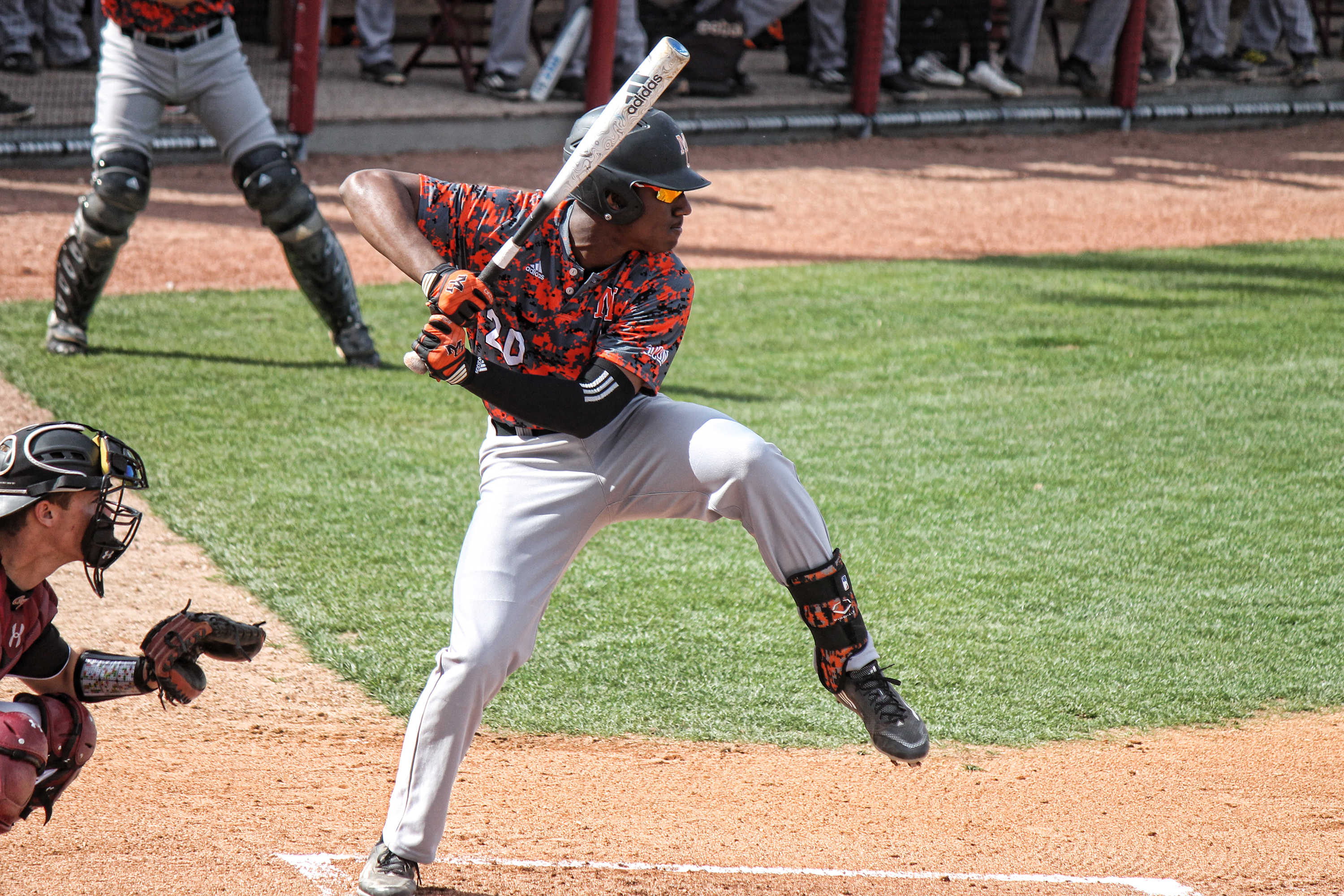
What types of things were you doing during the summer instead of playing travel baseball?
“I played basketball in the summer time. So I had to make a choice which one I wanted to play in college. After talking to some people around the baseball world, they told me if I was to practice more year-round and hone in on my skills, that I’d be able to be a pretty good player. That’s when I decided to commit to it.”
You had decisions to make in high school between pursuing paths in either basketball or baseball. How serious were you about going the basketball route in college?
“We had received interest calls in basketball. The Naval Academy was one of the bigger ones who wanted me to play for them. I did some workouts for mid-major schools. But after the season I went ahead and told my basketball coach to cancel those. At that point, I wanted to concentrate on baseball.”
So now you’ve decided you were going to play baseball in college. What other schools were showing you interest?
“Furman … Georgia State … Kennesaw State … Savannah State … and the University of Miami came on kind of late.”
It sounds like mostly schools closer to home.
“It was just a lot of local schools. By the time I got on the scene, most schools were already working on their next class and were done with my class. So it was tough to get interest from the major schools unless I would pursue a walk-on spot. But I wanted the scholarship, so I settled for the mid-major.”
Nothing wrong with that. You had your opportunity and ran with it.
“I tried to go where I’d be able to play and be able to get on the field and be a priority guy. That’s the biggest thing as far as picking a college. Where are you going to be able to learn and be able to pick up on stuff? Where are you going to be able to play? And I felt like Mercer presented a good opportunity for that as well as being able to potentially make regionals and play on a national stage.”
Your freshman year, you went through the typical first-year growing pains. Then things kind of exploded for you last year – and you never looked back. What happened?
“Going into my freshman year, I had to learn to sit on the bench and watch. I never had to do that before. A lot of that stuff was a mental challenge for me. I had to figure out how to learn and how to observe games from the sideline. I had to figure out what to do when my number was called. I got a lot of pinch-hit opportunities and a lot of pinch-running opportunities. Towards the end of the year, I started to figure it out – and I was able to start the last ten games. Going into that summer, I had a lot of momentum – and I was able to carry that momentum into the summer. I played in the Great Lakes League after my freshman year, and I was able to do really well up there. And I got called up to the Cape Cod League to play in the playoffs. That just gave me the confidence that I needed going into my sophomore year – when you saw the explosion.”
I’d have to think that sitting and watching as a freshman helped you learn the game, although I’m guessing you hated it at the time.
“(Laughing) Yeah, yeah, yeah. I definitely hated it. But from talking to people and talking to my family, they just said I should just see what guys ahead of you are doing that you’re not doing. Or what are they doing as far as preparation and extra work and things like that. And I was fortunate to watch a lineup full of seniors, so I was able to look up to guys who were 23 years old and had been through it. And they had made it to regionals. I was able to pick up on their tendencies and see what they do, and I was able to apply it to my own game.”
Growing up in Georgia, were you a big Braves fan?
“Yes I was – back when they had Andruw Jones and Chipper Jones.”
Those were your guys?
“Those were definitely my guys.”
Anybody growing up that you tried to model yourself after?
“The biggest person in high school that I watched was Adam Jones. I started watching him my junior year … just sit there watching YouTube videos of him. Then I’d try to embody myself after that as much as I could. I like the way he plays. I like the way he carries himself.”
Is he someone you want to be compared to?
“I think it’s kind of comparable as far as an athletic centerfielder with a smooth swing. I wouldn’t say that I try to be exactly like him, because I want to be my own person. But I can say that would be a nice comparison to have.”
I’ve also seen you called a right-handed version of Jason Heyward.
“I can see that. I like to take pride in my defense as well, and I think it’s overlooked sometimes. But I definitely take pride in my defense.”
[Continue reading after the break for more.]
Photo courtesy of Mercer University.
Marlins Designate Chris Narveson, Outright Dustin McGowan
The Marlins have announced that lefty Chris Narveson has been designated for assignment. His roster spot will go to recalled righty Jose Urena. Meanwhile, the club has outrighted right-hander Dustin McGowan, who was previously in DFA limbo.
Narveson, 34, was off to a rough start in his first 8 1/3 innings on the season. He’d allowed eight earned runs and three long balls already. While it’s early, the numbers reflect the fact that Narveson has been unable to generate many swings and misses (6.2% swinging strike rate) while also failing to get batters to chase the ball out of the zone.
Meanwhile, McGowan will have a chance to decide whether to elect free agency or instead remain in the Miami organization. He was reportedly earning a $1MM major league salary, but agreed to an advance consent clause that means he won’t be guaranteed that amount. Still, his deal likely includes a relatively appealing minor league rate of pay.
Brewers Select Contract Of Alex Presley
The Brewers have officially selected the contract of outfielder Alex Presley, as Tom Haudricourt of the Milwaukee Journal-Sentinel first reported on Twitter. Righty Tyler Cravy was sent down on options to create an active roster spot, while righty Zack Jones has been placed on the 60-day DL to create 40-man space.
The 30-year-old Presley did not break camp with Milwaukee, of course, despite strong spring numbers. Neither did he draw interest from other teams in a major league capacity at the start of the year — when his contract allowed him an opt-out opportunity if a club had been willing to put him on an Opening Day roster.
Though it’s been a while since he’s been able to produce at an above-average clip at the major league level, Presley has been been off to a hot start at Triple-A, slashing .344/.400/.563 in 35 plate appearances in a continuation of his good showing in camp. It seems that he will factor into the still-crowded center field mix, as the club appears largely set in the corners but hasn’t received much up the middle from players like Kirk Nieuwenhuis, Ramon Flores, and the already-optioned Keon Broxton.
Quick Hits: Opt-Outs, Hoover, Gutierrez, Arozarena, Braves
In a piece for the Hardball Times, Matt Swartz gives an in-depth explanation into the methodology he used when projecting the value of this offseason’s opt-out clauses here at MLBTR (links to Swartz’s valuations). As Swartz explains, the key to placing a dollar value on such a complex clause is in forecasting the extent to which the projections of a player’s value will change over time. As Swartz points out, whatever amount we currently project a player to be worth for the post-opt-out-date duration of his contract will assuredly change by the time that opt-out decision surfaces (especially in cases like David Price, where the opt-out is in three years). Setting a standard deviation of that expected value is crucial. Those that have a strong interest in the financial/economical side of the game and the math that goes into the financial decision-making of clubs will want to check out Swartz’s column in its entirety. Additionally, you can check out Swartz’s offseason appearance on the MLBTR Podcast (although the focus of that discussion was on his arbitration projections).
A few more notes from around the game…
- Right-hander J.J. Hoover will no longer serve as the Reds‘ closer, manager Bryan Price told reporters, including C. Trent Rosecrans of the Cincinnati Enquirer. The Reds will mix and match, perhaps turning to options such as Tony Cingrani, Blake Wood and Caleb Cotham, though Price said that none of the three is ready to take over the closer’s role on a full-time basis. The Cincinnati bullpen has struggled across the board this season, with Jumbo Diaz already having been optioned to the minors and Keyvius Sampson finding himself designated for assignment earlier today. Hoover posted a strong 2.94 ERA in a setup role last season, though his modest strikeout rate, elevated walk rate and excellent fortune on balls in play all served as warning signs that he could struggle to repeat that success. Hoover won an arbitration hearing this winter, resulting in a $1.4MM salary.
- Ben Badler of Baseball America provides some updates on a pair of intriguing Cuban free agents: 20-year-old right-hander Vladimir Gutierrez and 21-year-old outfielder/infielder Randy Arozarena. Gutierrez’s most recent showcase increased interest around the league, and he’ll host another open showcase for clubs on May 29. Last month’s showing for scouts saw Gutierrez sit 92-94 mph with his fastball to complement a “hammer” curve that he was throwing around 80 mph. Gutierrez’s projectable frame has long led scouts to believe that he would grow into more velocity, Badler writes, and that appears to be the case now. Badler also recaps Arozarena’s recent performance in Mexico and notes that he’s likely to wait until July 2 to sign.
- The Braves have optioned right-hander Williams Perez to Triple-A Gwinnett, and his rotation spot could be filled by either Mike Foltynewicz or Aaron Blair, writes MLB.com’s Mark Bowman. Both right-handers have come over to the Braves in high-profile trades over the past 15 months, with Foltynewicz arriving by way of the Evan Gattis trade and Blair coming over from Arizona alongside Dansby Swanson and Ender Inciarte in the Shelby Miller blockbuster. Blair’s stock is currently higher after Foltynewicz struggled in his Braves debut last season, but Bowman notes that Atlanta could also elect to keep Blair in Triple-A to gain more experience and delay the start of service time/arbitration clock.
NL West Notes: Lincecum, Van Slyke, Story, Heston
Free-agent right-hander Tim Lincecum has built up his endurance to the point where he’s throwing 70 pitches on the time frame of a five-man rotation, reports MLB Network’s Jon Heyman (links to Twitter). Lincecum recently threw at the Giants‘ Spring Training complex in Arizona, Heyman notes, adding that Lincecum has also pitched “a few other places.” That bit of into shouldn’t necessarily be construed as a workout for the Giants, as Henry Schulman of the San Francisco Chronicle writes that Lincecum has been granted use of the Giants’ facility more as a courtesy than anything else. Heyman notes that a Lincecum showcase is “expected soon,” though it should be noted that that’s been the steady refrain out of the Lincecum camp for the better part of three months. Lincecum is one of the more intriguing unsigned names in baseball, but there’s no way of truly classifying a front-runner to sign him and no way of knowing when he’s likely to get back onto a big league mound until he auditions for teams. For now, Schulman notes, Lincecum’s representatives are going out of their way to keep scouts away from his throwing sessions until he’s ready for that showcase.
More from the NL West…
- Dodgers outfielder Scott Van Slyke won’t be cleared for baseball activities until next week, tweets Andy McCullough of the L.A. Times, and he could miss as much as another month with the back problem that has kept him from game action since April 10. Van Slyke hit the DL a bit more than a week ago after making just 10 plate appearances this season. He’s the latest in a slew of Dodgers outfielders to be shelved, as both Andre Ethier and Carl Crawford are on the DL as well. (Crawford, though, was sent on a minor league rehab assignment today.)
- In light of Trevor Story‘s outstanding start to the season, Dave Cameron of Fangraphs explores the legitimacy of his power using exit velocity and launch angle. Cameron and Baseball Prospectus’ Russell Carleton have pointed out that while bottom-line results in this type of a sample size are often mirages, batted ball trends such as these take less time to stabilize. Story leads the league in balls hit at 105+ mph with a launch angle of greater than 20 degrees, and while he’s not likely to continue to hit them at such a prolific rate, Cameron writes that it’s unlikely that Story has lucked his way into this type of company on the leaderboards. Acknowledging Story’s enormous strikeout rate and likely dip in overall production, Cameron concludes that while this overall type of production won’t continue, there’s a case to be made that Story’s power is realer than some skeptics believe.
- The Giants optioned right-hander Chris Heston to Triple-A yesterday, and Andrew Baggarly of the San Jose Mercury News spoke to manager Bruce Bochy about the difficulty of the move for Heston, who of course tossed a no-hitter for the Giants last season. Heston went from the 2015 rotation to a long relief role with San Francisco this season, and the Giants will hope that stint in the Triple-A rotation can help get his mechanics back on track. “It’s never easy, making a move like this,” said Bochy. “The best thing is for Chris to get his groove back.” Baggarly notes that part of the reason for stretching Heston out is also to shield the Giants in case of a sudden need in the rotation. It’s worth noting that Matt Cain and Jake Peavy have each struggled tremendously in their first three starts of the season.