
Reds Discussing Long-Term Deal With Homer Bailey
Discussing the team's inability to reach agreement with pitcher Homer Bailey before today's deadline to submit arbitration figures, Reds GM Walt Jocketty indicated that the sides were discussing a long-term extension, reports MLB.com's Mark Sheldon. He further indicated that the club was not concerned with the situations of either of its two prominent remaining arbitration cases, Bailey and closer Aroldis Chapman.
The sides have reportedly had previous discussions on a significant extension. They came close to getting something done today, according to John Fay of the Cincinnati Enquirer, 'We talked a one-year and a multiyear deal," said Jocketty. "We'll keep talking."
In his discussions with Sheldon, Jocketty raised expectations that something would get worked out, saying that he is "optimistic" about reaching a long-term deal. As the GM explained:
"In Bailey's case, we were working on a multi-year [deal]. The agent [Casey Close] has [Clayton] Kersaw and he has [Masahiro] Tanaka also, so he's been tied up with that. We just didn't anticipate getting it done, but we exchanged numbers in the event and we will continue to negotiate and hopefully get something done before the hearing date."
Discussing the terms of the contract, he said:
"I just think it depends on where they feel the market settles in on free-agent pitchers. Hopefully, we're not too far with our estimate and with their estimate about the market going forward. What it will be based on is what market for a guy like Bailey will be in the future."
The recent Clayton Kershaw extension would not be a comparable deal, but would nevertheless play a role, Jocketty explained. "I don't think it affects this one directly with Bailey, but it affects the market as a whole," Jocketty said. "Any time you sign a free agent to a contract, it drags it up a little bit. Kershaw is a special case."
Bailey has been projected by MLBTR contributor Matt Swartz to earn $9.3MM through arbitration in his final run through the process before reaching free agency. He filed at $11.6MM, with the club countering at $8.7MM.
Regarding Chapman, Jocketty said that he had not had much discussion with his representatives at Hendricks Sports. "Actually, this week was the first one we've had," Jocketty said. "I'm not that concerned about it." Swartz projects a $4.6MM tab for the fireballing lefty. That is the exact figure that the team submitted, while Chapman filed at $5.4MM, leaving a modest gap to bridge.
Jocketty's comments indicate that the Reds do not intend to take a "file and trial" approach, at least with these two players. An agent had told FOX Sports' Ken Rosenthal (Twitter link) that Cincinnati was adopting such a policy. It turns out that the team has only taken that position with respect to players whose deals were valued under the $2MM level, tweets Jeff Passan of Yahoo Sports.
Braves Will Go To Arbitration Hearings With Kimbrel, Freeman, Heyward
Braves GM Frank Wren says that his club will take its arbitration case to a hearing with the club's three remaining arbitration-filing players, reports David O'Brien of the Atlanta Journal-Constitution (via Twitter). Wren says that the club will not have any further negotiations with closer Craig Kimbrel, first baseman Freddie Freeman, and outfielder Jason Heyward.
The Braves are a noted "file and trial" club, and Wren's statements indicate that the club intends to stand by its position. "We have an organization philosophy of the filing date is our last date to negotiate prior to a hearing," said Wren. "We're done." None of the other "file and trial" clubs — the Blue Jays, Marlins, Pirates, Rays, Reds, and White Sox — has any players yet to reach agreement. (The Pirates and Reds are new additions to the list, per tweets from MLBTR's Tim Dierkes and FOX Sports' Ken Rosenthal.) For the first time ever, no players went to an arbitration hearing last year, but that apparently will not be the case for 2014.
As O'Brien explains, the Braves have not had a hearing since John Rocker back in 2001. The club avoided arbitration in 2009 with Jeff Francoeur just before a hearing, but has adopted its strict negotiating policy since that time.
Needless to say, those three players represent both a critical component of the team's young core and a substantial portion of its current and future payroll. Kimbrel, in particular, represents a fascinating arbitration case given his historic early-career performance from the back end of the pen. MLBTR contributor Matt Swartz projects him to earn a $7.25MM salary in his first trip through arbitration, with Freeman and Heyward projected to take home $4.9MM and $4.5MM, respectively.
Wren discussed the club's negotiations as well, as Mark Bowman of MLB.com reports on Twitter. "At the end of the day," Wren said, "we went well above the recommended salary arbitration numbers for all of our players."
The filing splits between player and team show that the Braves' filing numbers were in the ballpark of Swartz's projections. (The club may, of course, have been willing to go somewhat higher to avoid a hearing.) Kimbrel asked for $9MM, with the team countering at $6.55MM, while Freeman ($5.75MM vs. $4.5MM) and Heyward ($5.5MM vs. $5.2MM) also landed right around the projected dollar amounts.
Arbitration Roundup: 40 Players To Exchange Figures
Now that the dust has settled from the morning's rash of arbitration-avoiding deals, it is time to look out for reports on the arbitration numbers filed by players and teams that have yet to reach agreement. As MLBTR's Arbitration Tracker shows, at least 39 players will be exchanging figures with their clubs after failing to agree upon terms before noon central. (It is not yet known whether Pedro Strop avoided arbitration before exchanging figures with the Cubs.)
Remember, deals avoiding arbitration can still be reached even after the exchange of numbers. Hearings will be scheduled between February 1st and 21st, so there is plenty of time for the sides to come together before making their cases. Last year, for the first time ever, no arbitration hearings took place, but it appears that at least three hearings are going forward this time around.
That being said, some teams are known for their "file and trial" approach to arb-eligible players, meaning that they refuse to negotiate after the exchange deadline and go to a hearing if agreement has not been reached. Among those clubs, only the Braves (Freddie Freeman, Jason Heyward, Craig Kimbrel) failed to reach terms with all of their arb-eligibles.
Meanwhile, some other clubs have historically employed the "file and trial" approach on a modified or case-by-case basis. Two of those — the Nationals (Tyler Clippard, Doug Fister) and Indians (Michael Brantley, Justin Masterson, Vinnie Pestano, Josh Tomlin) — have open cases remaining.
Other prominent players who have yet to agree upon a 2014 salary include Homer Bailey and Aroldis Chapman of the Reds, Brandon Belt of the Giants, David Freese of the Angels, Greg Holland of the Royals, Kenley Jansen of the Dodgers, Jeff Samardzija of the Cubs, Mark Trumbo of the Diamondbacks, and Matt Wieters of the Orioles. Be sure to keep a close eye on MLBTR's pages for information on those and other situations, and in the meantime click here to review MLBTR contributor Matt Swartz's projections for all arbitration-eligible players.
Dodgers Extend Clayton Kershaw
The Dodgers have officially announced the extension of ace Clayton Kershaw, who receives a groundbreaking seven-year, $215MM contract one year before he would have qualified for free agency. Notably, the deal includes an out clause that the southpaw can exercise after five seasons, at which time he will still be just 30 years old.
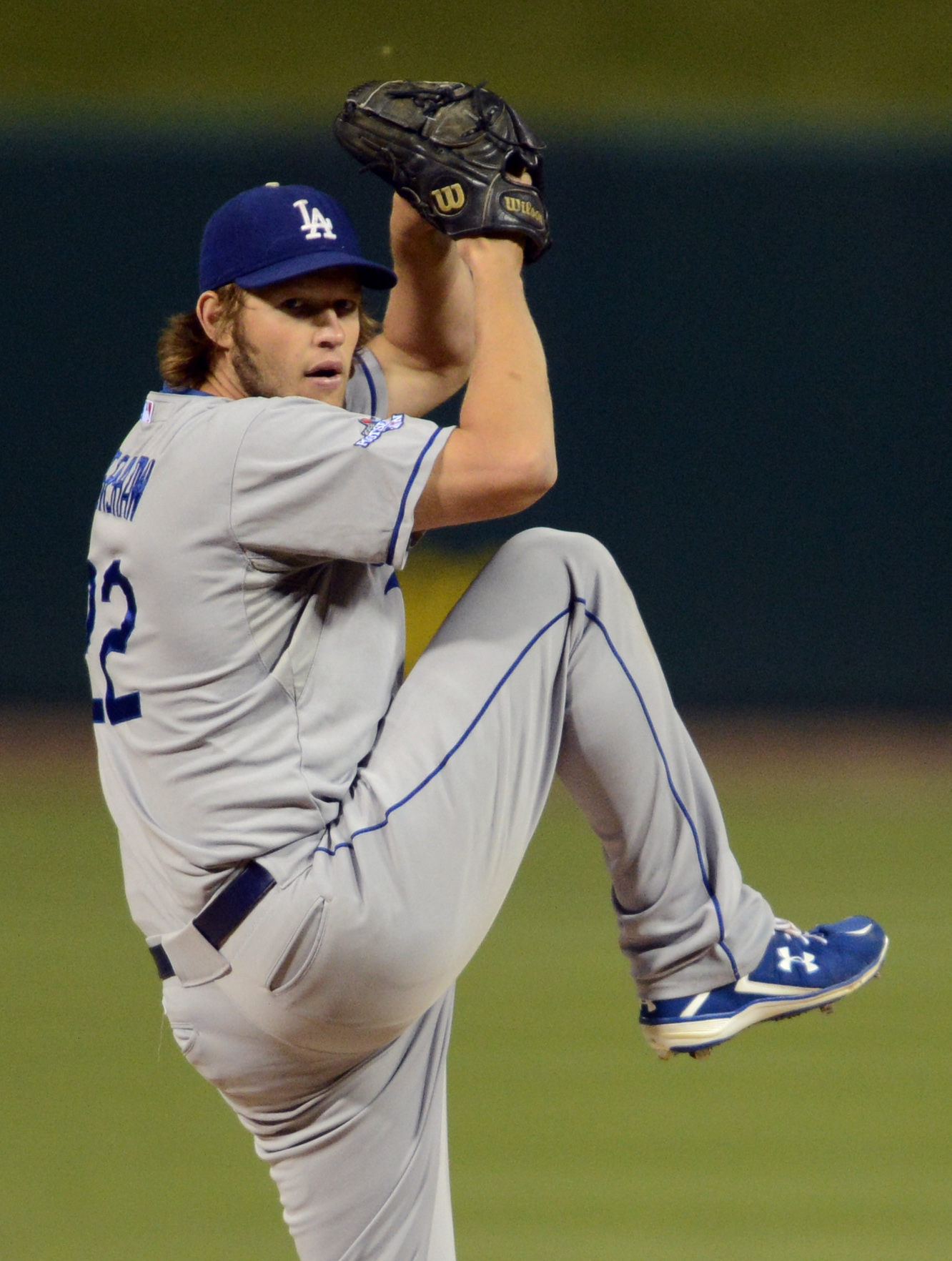
Kershaw's representatives at Excel Sports Management have secured their client the highest-ever annual salary for a baseball player. His $30.7MM AAV bests those achieved in the one-year, $28MM deal for Roger Clemens back in 2007 and Alex Rodriguez's ten-year, $275MM deal.
Kershaw's extension also gives him more new money than any pitcher contract in baseball history. Indeed, the deal exceeds the next biggest commitment — the seven-year, $161MM C.C. Sabathia deal — by a whopping $54MM. Likewise, it dwarfs other, more recent guarantees, including Zack Greinke's $147MM free agent pact and the extensions of Cole Hamels ($144M in new money), Justin Verlander ($140MM), and Felix Hernandez ($135.5MM).
Though it does not have a no-trade clause, Kershaw's contract contains language that would significantly impact his rights in a trade scenario. First and foremost, Kershaw would obtain the right to void the deal if traded. If he is sent to another club mid-season, he could void the rest of the deal before the start of the following season. If, instead, Kershaw is dealt during the offseason, he gets the right to void the remainder of the contract after the end of the ensuing campaign. He would also pick up a one-time, $3MM bonus if he is traded during the offseason.
Obviously, these clauses present a significant barrier to any trade, at least until the point at which Kershaw's opt-out clause would otherwise be available to him. In particular, they convey immense leverage to Kershaw to demand a massive, new extension from any team that wishes to acquire him.
Kershaw's salary will be somewhat backloaded. The big lefty will earn $22MM in 2014, $18MM of which is a signing bonus and only $4MM of which is in salary. His salary then tracks as follows: $30MM (2015), $32MM (2016), $33MM (2017), $33MM (2018), $32MM (2019), and $33MM (2020). The deal also contains incentives: Kershaw stands to earn $1MM for a Cy Young campaign and $500K for landing second or third in the voting.
This means that the opt-out decision facing Kershaw after the 2018 season will effectively be a two-year, $65MM proposition. If he leaves that money on the table, the deal would end up paying him $150MM over five years, good for a straight $30MM AAV.
Kershaw's nearly unprecedented level of early-career performance had lined him up for a projected $18.15MM arbitration payday this year, in the analysis of MLBTR contributor Matt Swartz. As MLBTR's Tim Dierkes notes on Twitter, that would imply an approximately $32.8MM AAV ($197MM over six years) for Kershaw's free agent years.
Indeed, Kershaw's historic contract was earned by a legitimately historic run in his career's early going. The soon-to-be 26-year-old became only the third pitcher in MLB history — following Greg Maddux and Lefty Grove — to lead the big leagues in ERA for three straight seasons, which he accomplished after posting the low mark again last year. He has registered a close second to Verlander in terms of fWAR (18.5 against 19.1) among starters over that same time period.
Last year was Kershaw's best season yet, as he posted a 1.83 ERA in 236 innings, leading the league in strikeouts (232) and WHIP (0.915) to go along with his ERA title. The net of his MLB career to date is a 2.60 ERA in 1,180 innings, buttressed by 9.2 K/9 against 3.0 BB/9. He has made at least 30 starts in every year since 2009 and has thrown over 200 innings for each of the last four seasons. Needless to say, Kershaw has been both outstanding and durable.
For the Dodgers, Kershaw adds a massive, but seemingly manageable, new obligation to the books. As I explained back in November, Los Angeles was running away from the rest of the league in terms of post-2014 salary obligations. Though major signings by clubs like the Yankees and Rangers have evened things out somewhat in the interim, L.A. will continue to set the pace on future spending. But that spending level is backed up by an unmatched $340MM local TV revenue stream.
As I further explored, the Dodgers stand to gain the most out of any team in baseball from an inflationary salary environment, as their massive obligations stand to see the largest decrease in real value as salaries rise. The money owed Kershaw, too, could reduce substantially in relative terms if salary trends continue upward. Moreover, as also illustrated in that piece, Los Angeles has a huge ramp-down in its future commitments beginning after the 2018 season, which creates some additional breathing room. But with the opt out landing at that same point, that salary space could ultimately end up going towards yet another extension.
As Dierkes notes on Twitter, Kershaw's contract is the ninth MLB deal to include an opt-out clause. Of the other eight deals, only those agreed to by Vernon Wells and Elvis Andrus came by way of extension rather than free agency.
Looking at the broader market impact, the Kershaw extension will undoubtedly be pointed to in negotiations regarding other top starters. Major arms that are set for free agency next year include Max Scherzer, James Shields, and Jon Lester, with David Price headlining the 2016 crop. Though Kershaw may be in a league of his own given his age and track record, his new deal certainly stretches the scale of reasoanbly attainable salaries upwards.
ESPN.com's Ramona Shelburne first reported the signing and its terms (via Twitter). Jon Heyman of CBSSports.com first reported the annual payment structure on Twitter. Joel Sherman of the New York Post first reported the deal's trade provisions (all links to Twitter).
Photo courtesy of USA Today Sports Images.
Nationals, Ian Desmond Agree To Two-Year Deal
3:50pm: Desmond would also earn an additional $500K for winning NL MVP honors in either season, tweets Adam Kilgore of the Washington Post.
11:56am: The Nationals have agreed to sign shortstop Ian Desmond to a two-year, $17.5MM extension that will buy out his final two years of arbitration, according to MLB.com's Bill Ladson (Twitter link). Desmond is a client of Sports One Athlete Management. Desmond will earn $6.5MM in 2014 and $11MM in 2015, tweets Joel Sherman of the New York Post.
Desmond's contract is the second two-year deal inked by the Nationals today, as they also locked up Jordan Zimmermann for two years and $24MM. Barring a long-term extension, Desmond's salaries are now locked in until he eligible for free agency following the 2015 campaign. He'd been projected to earn $6.9MM in 2014 by MLBTR's Matt Swartz.
Desmond has broken out as one of the game's best all-around shortstops, slashing .286/.333/.480 with solid defense at shortstop and a pair of 20-homer, 20-steal campaigns in 2012-13. The Nationals are reportedly interested in locking him up to a long-term extension, as is also the case with Zimmermann.
Mets, Daniel Murphy Avoid Arbitration
The Mets have avoided arbitration with second baseman Daniel Murphy by coming to terms on a one-year, $5.7MM contract, according to ESPNNewYork.com's Adam Rubin (on Twitter). Murphy can earn an additional $50K for reaching 500 plate appearances — a feat he's accomplished with ease in each of the past two seasons. Murphy is represented by ACES.
Murphy is in his second year of arbitration eligibility and is controllable through the 2015 season for the Mets. His $5.7MM salary comes in just $100K shy of MLBTR contributor Matt Swartz's $5.8MM projection, although he'd slice that difference in half upon reaching 500 PAs. The Mets still have yet to come to an agreement with Dillon Gee or Lucas Duda, as shown in MLBTR's Arb Tracker.
Tigers Avoid Arbitration With Max Scherzer
The Tigers and 2013 American League Cy Young Winner Max Scherzer have avoided arbitration by agreeing to a one-year deal worth $15.525MM, according to Jon Heyman of CBS Sports (on Twitter). Scherzer is represented by agent Scott Boras.
Scherzer and Boras were able to parlay his 2013 success into a massive $8.8MM raise — a whopping 130 percent raise on last year's salary and nearly $2MM more than the $13.6MM projected by MLBTR contributor Matt Swartz. As Swartz noted in his Arbitration Breakdown piece on Scherzer, the previous record raise for a pitcher with five-plus years of service time was Carlos Zambrano's $5.9MM raise back in 2007. Scherzer's $8.8MM pay increase shatters that mark and isn't likely to be touched at any point in the near future. With David Price having settled at $14MM and Clayton Kershaw having inked a historic extension, Scherzer seems to be a lock to take home the biggest one-year payday among arb-eligible players this offseason.
This is Scherzer's final season before heading into free agency, and one would think that another elite campaign would put him and Boras in position to try to top CC Sabathia's record-setting $161MM free agent contract that still stands as the largest open-market contract ever signed by a pitcher.
Scherzer is fresh off a dominant season in which he pitched to a 2.90 ERA with 10.1 K/9, 2.4 BB/9 and a 36.3 percent ground-ball rate in a career-high 214 1/3 innings. Some will argue that his Cy Young award was due to his gaudy 21-3 record, but Scherzer's 6.4 fWAR trailed only Clayton Kershaw, and his 6.7 rWAR was right in line with Hisashi Iwakuma (7.0) and Chris Sale (6.9) among American League starting pitchers.
Heyman reports that in spite of settling on a one-year agreement, the Tigers still have hopes of extending Scherzer and teammate Miguel Cabrera (Twitter link).
Marlins Avoid Arb With Stanton, Cishek
The Marlins have agreed to a one-year deal with Giancarlo Stanton, thereby avoiding arbitration, according to Juan C. Rodriguez of the Miami Sun Sentinel (on Twitter). Rodriguez tweets that Stanton will earn $6.5MM in 2014, while Ken Rosenthal of FOX Sports tweets that he'll earn an additional $100K if he reaches 600 PAs.
The slugging 24-year-old was projected to earn $4.8MM by MLBTR contributor Matt Swartz, though Swartz further explained that a substantially higher number would not be surprising. Given the reportedly rocky relationship between Stanton and the Fish, the two sides' ability to reach agreement on a challenging arbitration case would seem to bode well for harmony going forward.
All recent reports have indicated that Stanton is not likely to be dealt over the current off-season, and it will be worth watching to see whether any momentum could build toward an extension. Stanton would reach the open market before the 2017 season if a new deal is not reached in the meantime.
Clark Spencer of the Miami Herald reports that the Fish have also avoided arbitration with closer Steve Cishek (Twitter link). The side-arming righty will earn $3.8MM in 2014.
The 27-year-old had projected to land at $3.2MM for his Super Two arbitration year. Cishek has established himself as a strong big leaguer, with a career 2.48 ERA in 192 1/3 innings. That mark has not strayed above 2.69 in any one season, and last year it checked in at a sturdy 2.33 earned per nine. Cishek maintained a stellar strikeout rate (9.6 K/9) in 2013 while improving his command (career-low 2.8 BB/9). He still carries three more years of team control.
Braves Avoid Arb With Kris Medlen, Chris Johnson
The Braves and Kris Medlen have successfully avoided arbitration, tweets David O'Brien of the Atlanta Journal-Constitution. Medlen gets $5.8MM, according to O'Brien (on Twitter). O'Brien also reports that the Braves have avoided arb with third baseman Chris Johnson by agreeing to a $4.75MM contract (Twitter link).
The 28-year-old Medlen had a breakout year in 2011 and a solid, 3.11 ERA campaign last year in his first full season as a starter. He was projected by MLBTR contributor Matt Swartz to earn $5.9MM, and came quite close to matching that mark. Medlen will go through arbitration one more time before qualifying for free agency.
Johnson, 29, was one of the biggest surprises in baseball last year after coming to Atlanta in the Justin Upton trade. He posted a .321/.358/.457 mark in 547 plate appearances, earning a projection of a $4.2MM payday from Swartz. Johnson qualified as a Super Two last year, boosting his numbers this year. He will not be eligible for free agency until 2017.
Pirates, Neil Walker Avoid Arbitration
The Pirates have ducked an arbitration hearing with Neil Walker by agreeing to a one-year deal worth $5.75MM, according to Rob Biertempfel of the Pittsburgh Tribune (Twitter link).
Walker, a client of Excel Sports Management, receives a raise from the $3.3MM salary he received last season as a first-time arb-eligible Super Two player. He had been projected to earn $4.8MM by MLBTR's Matt Swartz, so his agents did well to approach the $6MM mark. Walker will be eligible for arbitration two more times before hitting free agency following the 2016 season.