
GM: Giants Have Been Informed They’re Out Of Running For Roki Sasaki
The Giants are currently introducing future Hall of Famer Justin Verlander at a press conference, but there’s some other headline news coming out of that media session as well. Giants general manager Zack Minasian revealed during his comments that while his team met with Roki Sasaki‘s camp, they’ve now been informed that Sasaki will not be signing there (link via Alex Pavlovic of NBC Sports Bay Area).
There are no further details on the matter than that. It’s not fully clear whether Sasaki visited Oracle Park in San Francisco or whether the meeting being referenced was conducted in Los Angeles, at the headquarters for Sasaki’s agency, Wasserman. That’s moot at this juncture anyhow, though, as the Giants’ elimination from the process is the latest step in narrowing the field.
Agent Joel Wolfe detailed at last month’s Winter Meetings that the plan for Sasaki’s free agency was for teams to submit initial presentations and pitches prior to the holidays. Sasaki and Wasserman hosted interested teams for meetings at a central location — Wasserman’s L.A. headquarters — and the plan was for the 23-year-old righty to then visit some finalists in their home locales after the holidays.
A full list of teams with which he’s visited isn’t publicly known, though Sasaki did travel to Toronto to meet with the Blue Jays recently. Presumably, with Wasserman being based in Los Angeles, Sasaki has met with the Dodgers and nearby Padres — the two long-presumed favorites in the bidding. Other clubs that have been prominently linked to Sasaki include the Rangers, Yankees, Mets, Cubs and Mariners.
With Sasaki not coming to San Francisco and Verlander’s deal now official, the Giants’ rotation appears all but set. Verlander will join Logan Webb, Robbie Ray, Kyle Harrison and Jordan Hicks in rounding out a quintet that’s quite talented but has a handful of question marks (Verlander’s age, Ray’s health, Hicks’ workload). In-house depth options with at least some big league experience include Tristan Beck, Hayden Birdsong, Mason Black and Landen Roupp.
Giants Sign Justin Verlander
January 13: The Giants made the deal official over the weekend and introduced Verlander to the media today. Per Jon Heyman of The New York Post, in addition to the $15MM salary, Verlander’s deal also contains awards bonuses and a full no-trade clause.
January 7: The Giants are in agreement with Justin Verlander on a one-year deal, pending a physical. Verlander, a client of ISE Baseball, is reportedly guaranteed $15MM.
The future Hall of Famer will play his age-42 season in San Francisco. Verlander has previously suggested he hopes to pitch until he’s 45. There was never any doubt that he’d be back on a one-year contract somewhere. It always seemed unlikely to continue in Houston. Verlander had an illustrious run with the Astros around his first half stay with the Mets in 2023. He’s coming off a challenging season, though, leading Houston to let him walk.
Verlander took the ball 17 times and turned in a 5.48 earned run average through 90 1/3 innings. He had a pair of injured list stints — first in April for shoulder inflammation, then a two-month stretch between June and August related to a neck issue. Opponents tagged him for an ERA north of 8.00 over his seven starts after he returned from the latter injury. Verlander conceded after the season that he had come back too soon as he tried to contribute to Houston’s playoff push.
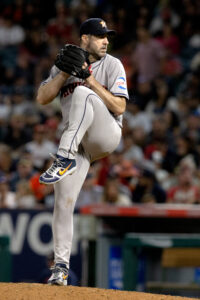
San Francisco believes there’s more in the tank with a healthy offseason. Verlander is only one year removed from an excellent season. He combined for a 3.22 ERA across 162 1/3 innings with New York and Houston in 2023. That came with a 21.5% strikeout rate that was well below Verlander’s prior level. That pointed to regression from his Cy Young form, but he still found plenty of success with diminished swing-and-miss stuff that year.
Verlander averaged 93.5 MPH on his four-seam fastball last season. That’s down slightly from the 94-95 MPH range in which he sat between 2022-23 but hasn’t completely fallen off the table. Pitching at less than full strength could account for that dip. If Verlander is fully healthy in 2025, it’s not outlandish to expect his velocity to rebound.
Health is an obvious caveat for a 42-year-old pitcher. Verlander has already defied expectations once, coming back from Tommy John surgery to win his third Cy Young at age 39 in 2022. Even if he’s not likely to repeat that kind of performance, he could be an asset as a mid-rotation arm and veteran presence in a staff that lost Blake Snell.
Logan Webb will be back to take the mantle as the team’s #1 starter. Verlander and Robbie Ray slot in the middle of the rotation as high-upside veterans who are trying to rebound from injuries. Former top prospect Kyle Harrison should be the fourth starter. President of baseball operations Buster Posey said last month that the Giants intend to give hard-throwing sinkerballer Jordan Hicks another chance at a rotation spot. Younger arms Landen Roupp, Mason Black and Hayden Birdsong could push Hicks for the fifth starter role.
This is the second free agent move of Posey’s first winter atop baseball operations. His big splash was a seven-year deal to install Willy Adames at shortstop. Posey has publicly suggested that continuing to strengthen the offense was a bigger priority than the rotation, but they evidently liked the value of a one-year roll of the dice on Verlander.
San Francisco had roughly $208MM in luxury tax obligations coming into today, as calculated by RosterResource. This will push them to around $223MM, a little less than $20MM shy of the $241MM base threshold. Verlander’s deal matches the $15MM salaries which veteran starters Alex Cobb and Charlie Morton also landed earlier this winter.
ESPN’s Jeff Passan first reported that the Giants and Verlander had agreed to a one-year deal. Jesse Rogers of ESPN reported the $15MM salary. Image courtesy of Imagn.
What Could Pete Alonso’s Market Look Like On A Short-Term Deal?
As the offseason wears on, talk about a potential short-term deal for Pete Alonso only intensifies. The slugger is one of the sport's most prolific home run hitters, second only to Aaron Judge dating back to Alonso's 2019 MLB debut. He's a consistent 30- or 40-homer presence who's anchored the middle of the Mets' lineup from the moment he set foot in the majors. The "Polar Bear" is a former Home Run Derby winner who's leaned into the spectacle of that summer showcase, participating in the event for five straight years and taking home the trophy on two different occasions.
Alonso is a marketable, star-caliber player who'd improve any lineup -- even on the heels of a downturn in performance (relative to his lofty standards). After slashing .261/.349/.535 through his first four MLB campaigns, Alonso has dipped to "only" .229/.324/.480 over the past two seasons. He's still corked 80 homers in that time and been 21% better than average at the plate by measure of wRC+, but it's a notable departure from Alonso's first four seasons, when wRC+ pegged him 37% better than the average hitter.
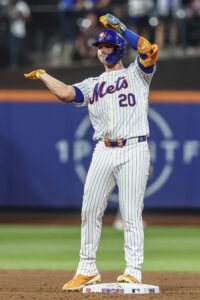
For a player who just turned 30 and doesn't bring much to the table with the glove or on the bases, any dip in production is worrying. Alonso's strikeout rate has also crept back up. After falling from 26.4% to 25.5% to 19.9% and 18.7% from 2019-22, he's punched out at a 22.9% rate in 2023 and a 24.7% rate in 2024. It's not necessarily an alarming trend yet for a player with Alonso's prodigious power -- especially since he's also boosted his walk rate in consecutive seasons, reaching 10.1% in '24 -- but there's still some reason to be concerned.
Alonso thrived at making contact on pitches off the plate in 2021-22 when his strikeout rate was at its lowest, doing so at a 59.4% clip that was well north of the 56.5% league average across those two seasons. Over the past two seasons, Alonso's contact rate outside the strike zone has dipped to 54.6%. He's offset that by cutting down on the rate at which he chases -- hence the improved walk rate -- but when he does chase, he's swinging through the pitch more often.
Those red flags (of varying severity), Alonso's age and the fact that he rejected a qualifying offer all surely combine to tamp down some interest in him. He never seemed that likely to reach the heights that Freddie Freeman did in free agency (six years, $162MM), but there was some thought that a five-year deal (or six at a lower rate) could be there.
That said, the short-term developments were also foreseeable. We've kicked ourselves for moving off the prediction of a three-year, $90MM deal with multiple opt-outs for Alonso, which for awhile was our unofficial prediction for MLBTR's annual Top 50 free agent list. The market hasn't rewarded this skill set in recent years, and it felt very possible that Alonso would go out looking for Freeman money -- if not more -- and find himself in a situation similar to that of last offseason's quartet of fellow Boras clients who lingered on the market into spring training. We ultimately opted to bet that the market -- or at least just the Mets -- would show out for Alonso and predicted five years and $125MM. Maybe he'll still get there, but the likelihood seems much lower now.
ESPN's Jeff Passan, The Athletic's Will Sammon, Bob Nightengale of USA Today, Jim Duquette of MLB Network Radio and a host of others have all reported on the possibility of Alonso taking a short-term deal in recent weeks. It's hard to imagine such an arrangement would happen anywhere other than Queens. But, if the Mets simply don't want to bring Alonso back on a premium annual salary -- they're nearly into the third luxury penalty tier; Alonso would catapult them to the fourth and highest tier -- others could certainly enter the mix.
Let's run through some potential landing spots under the assumption that Alonso has indeed softened his stance on a short-term arrangement...

Unlock Subscriber-Exclusive Articles Like This One With a Trade Rumors Front Office Subscription
- Access weekly subscriber-only articles by Tim Dierkes, Steve Adams, and Anthony Franco.
- Join exclusive weekly live chats with Anthony.
- Remove ads and support our writers.
- Access GM-caliber tools like our MLB Contract Tracker
Pirates Sign Burch Smith, Bryce Johnson To Minor League Deals
The Pirates announced a slate of 13 non-roster invitees to spring training Monday, revealing within that they’ve signed right-hander Burch Smith and outfielder Bryce Johnson to minor league contracts.
Smith, 35 in April, split the 2024 season between the Marlins and Orioles, pitching to a combined 4.95 ERA with a below-average 19.1% strikeout rate but a superlative 5% walk rate. The Truth Sports client averaged 94.9 mph on his heater and kept the ball on the ground at a 43.9% clip that’s nearly two percentage points north of the league average of 42.2%.
Originally a 14th-round pick by the Padres back in 2011, Smith has pitched for seven big league teams across parts of six major league seasons. He’s pitched all over the globe, including a brief appearance with the Hanwha Eagles of the Korea Baseball Organization in 2023, a solid run with the Seibu Lions in Japan’s Nippon Professional Baseball in 2022, and some work with los Gigantes de Cibao in the Dominican Winter League as well.
In 247 1/3 big league innings, Smith has a 5.79 ERA, although it’s worth pointing out that the 2024 version of Smith looks far different from the version we saw in the majors between 2013-21. He’s throwing harder than he ever did early in his career, when he averaged 93.1 mph on his fastball from 2013-21. He’s also scrapped his changeup and sinker — both offerings he once leaned upon heavily — in favor of a four-pitch mix including a four-seamer, cutter, curveball and sweeper (used in that order of frequency). Smith’s ground-ball rate climbed by more than eight percentage points with that new-look arsenal, while his 5% walk rate was less than half the 10.1% rate he showed over his first five MLB campaigns.
Smith will give the Bucs some veteran bullpen depth and compete for one of the final spots in Pittsburgh’s relief corps this spring. At least five spots feel locked into place with now with David Bednar, Colin Holderman, Dennis Santana, Carmen Mlodzinski and free-agent signee Caleb Ferguson all staking their claim.
Righty Kyle Nicolas was solid for 54 1/3 innings last year (3.95 ERA) but walked too many hitters (12.8%) and has minor league options remaining. DFA pickups Joey Wentz (claimed last September) and Peter Strzelecki (acquired for cash this offseason) are both out of minor league options and will need to make the Opening Day club or else be removed from the 40-man roster themselves. Others in the running could include Elvis Alvarado (on the 40-man roster) and non-roster invitees Yohan Ramirez, Tanner Rainey, Yerry Rodriguez, Isaac Mattson and Eddy Yean.
Turning to the 29-year-old Johnson, he’ll give Pittsburgh some depth at a corner outfield spot where they’ve been seeking help throughout the offseason. He’s played in each of the past three big league seasons, spending time with both the Giants and Padres, but carries a tepid .177/.248/.226 slash over a small sample of 140 major league plate appearances.
Those numbers clearly don’t impress, but Johnson also had his best Triple-A season in 2024, hitting .288/.407/.431 with the Padres’ El Paso affiliate. He’s played in parts of four Triple-A campaigns and touts a sharp .286/.381/.429 slash. Johnson is lacking in power — he hasn’t reached a double-digit homer total since hitting ten round-trippers across three minor league levels in 2019 — but he’s been a fleet-footed on-base machine in the minors. The former sixth-rounder (Giants, 2017) has walked in 10.9% of his minor league plate appearances, including an 11.6% clip in his four Triple-A seasons. He’s 181-for-226 in minor league stolen base attempts (80%) and has a trio of 30-steal seasons under his belt. Last year, he went 20-for-23 in just 74 games at the Triple-A level.
As things stand, the Pittsburgh outfield will have Bryan Reynolds and Oneil Cruz locked into two of the three spots (with Cruz set in center field, in particular). Joshua Palacios, Jack Suwinski, Ji Hwan Bae and Billy Cook are all on the 40-man roster and hoping for outfield at-bats. The Pirates have also been looking outside the organization, though, with recent reports indicating interest in Alex Verdugo and Randal Grichuk.
Free Agent Faceoff: Kenley Jansen vs. David Robertson
The free agent market for relief pitching has begun to heat up in recent days, with right-handers Chris Martin, Andrew Kittredge, and Jeff Hoffman all coming off the board. While top free agent relievers like Tanner Scott, Carlos Estévez, and Kirby Yates have gotten the majority of attention in the rumor mill of late, there’s a pair of veteran relief options available who between the two of them have more than 30 years of late inning experience on their resumes: right-handers Kenley Jansen and David Robertson. Both have plenty of closing experience and are on the wrong side of 35 but have remained effective even as they’ve aged into the latter stages of their careers, making them particular interesting options for clubs in need of bullpen help but with a preference for short-term deals.
Of the two, Jansen has the more storied career as a potential future Hall of Famer. The four-time All-Star and longtime Dodgers closer has taken a step back from his peak years in L.A., but his 447 career saves rank fourth all-time and he remains among the league’s better relief options. He departed the Dodgers following the 2021 season and has pitched for the Braves and Red Sox in the three years since then, posting a solid 3.42 ERA (126 ERA+) with a 3.26 FIP, a 29.9% strikeout rate, and an 8.9% walk rate while converting 97 of his 112 and save opportunities. He also boasts a dominant postseason resume, with a career 2.20 ERA, a 37.6% strikeout rate, and 20 saves across ten playoff runs.
The 37-year-old Jansen’s 3.44 ERA and 3.30 FIP during his two years in Boston were both solid, but his strikeout rate (28.1%) trended downward while his walk rate (9.2%) has begun to tick up. Most concerning, Jansen has begun allowing far more damaging contact. After posting a barrel rate of just 5.8% and a 25.7% hard-hit rate from the beginning of Statcast data in 2015 to the end of the 2022 season, those same figures have ballooned to 9.1% and 36.5% since he arrived in Boston. That’s left him with a 4.30 xFIP that’s more in line with middle relief options like Phil Maton and Héctor Neris than what’s expected of an elite closer, though other metrics like SIERA (3.62) are more favorable.
Robertson, meanwhile, has split his time between setup work (196 career holds) and closing (177 saves) over his 16-year career. He saved just two games for the Rangers last year and last saved more than 20 games in a season back in 2016. He’s the older of the pair and will turn 40 in April. That’s not to say Robertson is without his advantages, however. After a trio of lost seasons due to injury from 2019 to 2021, Robertson has reclaimed his place among the game’s top relievers with numbers that largely outshine Jansen over the past three years.
While bouncing between the Cubs, Phillies, Mets, Marlins, and Rangers over the past three years, Robertson has posted a 2.82 ERA and 3.24 FIP while striking out 31.1% of opponents in 201 innings of work. His 10.5% walk rate during that time leaves something to be desired and is more than a full percentage point higher than Jansen’s, but Robertson delivered a much more robust platform season with a 3.00 ERA and a 2.65 FIP in 72 innings for the Rangers as compared to Jansen’s 3.29 ERA and 3.00 FIP in 54 2/3 innings for Boston. Robertson’s also been more flexible in terms of his role over the years; he’s shown comfort both closing and acting as a setup man, while more than 80% of Jansen’s career innings have come in the ninth inning or later.
If you were running a team in need of late-inning relief help this winter, which veteran righty would you rather have for 2025? Would you prefer the younger Jansen with his elite postseason performance and lengthy track record of success in the ninth inning? Or would you opt for Robertson’s stronger peripheral numbers, flexibility to work outside of the ninth inning, and excellent platform season? Have your say in the poll below:
Which Would You Rather Have For 2025?
-
David Robertson 65% (2,137)
-
Kenley Jansen 35% (1,163)
Total votes: 3,300
Roki Sasaki Met With Blue Jays In Toronto
Within the next ten days, we’ll know where right-hander Roki Sasaki will be playing for the foreseeable future. The Japanese right-hander is one of the most talked-about international free agents in recent memory, due to a combination of age (23), pedigree (2.10 ERA in four NPB seasons) and his decision to potentially leave hundreds of millions on the table by pursuing an MLB move right now rather than in two years, when he’d be exempt from MLB’s bonus pool system for international “amateurs.” There’s been plenty of talk about the Dodgers and Padres as favorites, but Ken Rosenthal and Andy McCullough of The Athletic report that Sasaki recently traveled to Toronto to meet with the Blue Jays in person.
Back at last month’s Winter Meetings, agent Joel Wolfe of Wasserman laid out a timeline in which Sasaki would receive presentations from all interested teams and host interested parties at a central location prior to the holidays. The right-hander then planned to narrow the field and, post-holidays, meet with a smaller group of clubs in their home cities. That the Jays hosted Sasaki in Toronto ostensibly indicates that they’re still in the running in what’s effectively the second round of consideration.
That shouldn’t be construed with Toronto being considered any sort of favorite, however. Pinning down any kind of favorite at this stage remains difficult because so much hinges on the preferences of Sasaki himself. Baseball America’s Ben Badler just this morning ranked the Dodgers, Padres, Yankees and Rangers — in that order — as the likeliest to sign Sasaki.
The Dodgers and Padres have been the most heavily speculated landing spots — so much so in the case of the former that Wolfe felt obligated to publicly quash rumors of a pre-meditated deal between the two parties. Los Angeles and San Diego are both still believed to be in the running for Sasaki, who’s also been linked to the Mets, Rangers, Cubs, Mariners and Giants in recent weeks. It’s not yet clear which of those teams have hosted Sasaki for an in-person meeting at their own sites just yet.
Ultimately, the decision will boil down to where Sasaki feels most comfortable and which team he feels gives him the best long-term opportunity to develop as a pitcher. Wolfe has stated that market size isn’t a consideration. He said at last month’s Winter Meetings that he’d advise Sasaki against simply signing for the largest bonus right now, as the difference between theoretical bonus offers would be “negligible” compared to the “long-term arc of [Sasaki’s] career,” which is where he’ll truly earn his money.
Teams will still very likely to try to swing some deals to add space to their international bonus pools as they try to do everything they can to make themselves most enticing, but at least based on Wolfe’s prior comments — and based on how much Sasaki is leaving on the table to come to North American ball right now — it’s fair to presume that Sasaki won’t simply be going to the highest possible bidder.
Trade activity regarding bonus pool space is just one manner in which the international amateur market — which opens on Wednesday — is being thrown into chaos. Will Sammon, Dennis Lin and McCullough report at The Athletic that the Padres have told some international prospects with whom they’d previously reached handshake deals that they’re free to again talk to other clubs. Both the Padres and the Dodgers have also asked some within their expected group of signees if they’d wait to sign until next year’s period, per the report. The Dodgers already lost one high-profile prospect from their class to the Pirates.
It should be noted that while Sasaki cannot formally sign a contract prior to Jan. 15 and must sign by Jan. 23 (the final date in his 45-day posting window), he can agree to terms on a deal prior to either of those dates. It’s not clear of the right-hander is still traveling to meet with prospective clubs in their home locales, but in theory he could make his decision at any point now and simply sign on the dotted line when the international period opens. In that sense, it’s similar to any other free agent; it’s commonplace for an agreement to be reached, leak out to the public and only be formally announced by the team a few days later after the physical has been completed.
As a reminder of how this will all work, Major League Baseball’s international amateur bonus system allows clubs to sign players from Latin America, Asia, Europe, etc. beginning at age 16. Clubs scout players — particularly those in Latin America — for years ahead of time, often agreeing to handshake deals more than a year (sometimes two or three years) in advance. The league hard-caps each team’s bonus pool. Clubs are permitted to trade for up to 60% of the value of their initial bonus pools.
This year’s bonus pools range from $5.146MM (Dodgers, Giants) to $7.555MM (Reds, Tigers, Marlins, Twins, Brewers, A’s, Mariners, Rays). In theory, one of those eight clubs with the maximum pool size could trade to balloon their pool to $12.088MM. There’s no indication any of those clubs will do so, however.
International “amateur” players can only sign a minor league deal for a bonus that fits within a team’s allotted pool space (plus any additional space acquired via trade). Because of the stringent criteria to be classified a “professional” rather than an “amateur,” Sasaki will fall into the amateur bucket. MLB stipulates that a player must be at least 25 years of age and have six or more seasons of experience in a prominent foreign professional league (e.g. Nippon Professional Baseball, Korea Baseball Organization, Mexican League, Chinese Professional Baseball League, Cuban National Series, etc.). Had Sasaki waited two years, he might’ve been in line for the type of contract received by Yoshinobu Yamamoto (13 years, $325MM). Instead, he’ll sign a minor league deal with a bonus valued south (likely well south) of that $12.088MM maximum.
Cubs Designate Michael Arias For Assignment
The Cubs announced Monday that they’ve designated right-hander Michael Arias for assignment. His spot on the 40-man roster will go to fellow right-hander Colin Rea, whose previously reported one-year deal is now official.
Arias, 23, was selected to Chicago’s 40-man roster in the 2023-24 offseason in order to protect him from the Rule 5 draft. The infielder-turned-reliever spent the 2024 season in the upper minors, pitching to a combined 4.77 ERA in 60 innings between Double-A and Triple-A. Arias was more effective at the former than the latter, logging a 3.75 ERA in Double-A but a 5.35 mark in Triple-A.
Command was an issue for Arias at both levels, as has been the case since he moved to the mound. The hard-throwing righty sits mid-90s with his sinker but has walked a dismal 16.5% of opponents in his professional career — including 19.6% of his opponents in 36 1/3 Triple-A frames this past season.
Even with that notable flaw, Arias still landed 11th on FanGraphs’ recent ranking of the Cubs’ farm system. Eric Longenhagen and Travis Ice profiled the righty, touting a potential plus-plus changeup, a bat-missing slider and the ability to work multiple innings in relief. Arias’ location struggles — FanGraphs’ report notes that Arias “hasn’t even progressed to 40-grade control” yet — are prominent enough that the Cubs are comfortable trading him or exposing him to waivers.
While the Cubs may feel they don’t have room for him on their 40-man, Arias is a 23-year-old with a sinker up to 98 mph, a pair of average or better secondaries, and two minor league option years remaining. He seems like he’ll draw interest from another club, be it via a small trade or simply via waivers. The Cubs have five days to trade Arias. After that, he’ll need to be placed on waivers (a 48-hour process).
Cubs Sign Colin Rea
Jan. 13: The Cubs have announced Rea’s signing.
Jan. 10: The Cubs are in agreement with Colin Rea on a one-year, $5MM guarantee. Rea receives a $4.25MM salary for the upcoming season and is guaranteed a $750K buyout on a $6MM club option for 2026. The right-hander is represented by Joe Speed. The Cubs have a full 40-man roster and will need to open a spot in order for this deal to become official.
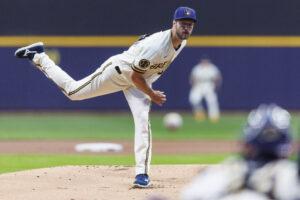
Rea, 34, is coming off a solid two-year run with the Brewers. Over the 2023 and 2024 seasons, he tossed 292 1/3 innings for Milwaukee, making 49 starts and nine relief appearances. He allowed 4.40 earned runs per nine. His 19.9% strikeout rate was a bit below league average, but he showed strong control with a 6.6% walk rate.
The Brewers could have retained Rea for 2025 via a modest $5.5MM club option, but they somewhat surprisingly put him on waivers to see if any other club wanted him at that price point. No team ended up claiming him, so the Brewers simply went for the $1MM buyout instead. By getting $5MM from the Cubs on top of that $1MM buyout, Rea will come out marginally better financially than if the Brewers had simply picked up the option.
By joining the Cubs, Rea will be reunited with manager Craig Counsell, who was the skipper in Milwaukee before coming to Chicago a year ago. Rea was also with the Brewers in 2021, though he only got to pitch six innings in the majors that year. He then headed to Japan for the 2022 season, parlaying his decent performance over there into a return to the Brewers two years ago.
Rea doesn’t overpower hitters, averaging around 93 miles per hour on his fastball over the past two years, but he can keep them off balance with a diverse mix of six pitches. Per Statcast, he also threw a sinker, cutter, sweeper, splitter and curveball. He also didn’t lean on any one pitch too often, topping out with his sinker in each of the past two seasons, around 30% of the time in each year. That’s helped him have fairly neutral splits, with lefties hitting .257/.308/.465 against him last year and righties at .258/.315/.429.
For the Cubs, Rea is likely to slot into a similar swing role to the one he served with the Brewers. Chicago signed Matthew Boyd earlier this winter, adding him to a rotation mix that already had Justin Steele, Shota Imanaga and Jameson Taillon. Rea and Javier Assad have somewhat similar numbers over the past two years and could perhaps compete for the fifth spot in the rotation if everyone is healthy, with the other perhaps getting a long relief role in the bullpen.
Of course, rotations shift over the course of a season. Injuries are inevitable and some players will perform better or worse than expectations. The Cubs have guys like Jordan Wicks, Caleb Kilian, Ben Brown and Cody Poteet also on the 40-man roster, though they all still have options and are fairly lacking in experience. Prospect Cade Horton is not yet on the roster but could force his way into the mix during the upcoming season.
It’s also possible that the Cubs will make further moves to change the rotation plan. Since acquiring Boyd and trading Wesneski, they have been connected to free agent Jack Flaherty and trade candidates like Luis Castillo and Jesús Luzardo. The latter was already traded from the Marlins to the Phillies but another rotation acquisition of some kind is not off the table.
Rea’s role figures to be determined by those moves as well as the health and performance of everyone on the roster, including his own. He improves the depth of the pitching staff at a fairly low cost, relatively speaking. The starting pitching market has been aggressive this winter, as guys like Justin Verlander and Alex Cobb got $15MM guarantees despite being relatively older veterans coming off injury-marred seasons. Rea doesn’t have the same track record or ceiling as those guys but has been healthy and performing well lately, with just one third the salary commitment.
RosterResource now has the Cubs at a payroll of $181MM and a competitive balance tax number of $198MM. Last year, they eventually got to a $228MM payroll and went narrowly over the tax line. It’s unclear if they want to get to the same levels in 2025, but even if they want to avoid the tax, they can still add about $40MM to their CBT number while doing so. This year’s base CBT threshold is $241MM.
MLBTR’s Steve Adams first reported that the Cubs and Rea had agreed to a one-year, $5MM deal. ESPN’s Jesse Rogers reported the presence of a ’26 club option. MLBTR reported the option terms.
Submit Your Questions For This Week’s Episode Of The MLBTR Podcast
On the MLB Trade Rumors podcast, we regularly answer questions from our readers and listeners. With the next episode set for Wednesday, we’re looking for MLBTR’s audience to submit their questions and we’ll pick a few to answer.
Pitchers and catchers will be reporting to spring training in about a month, but there’s still plenty of offseason business to attend to. If you have a question about a past transaction, a look ahead to the rest of the winter or anything else baseball-related, we’d love to hear from you! You can email your questions to mlbtrpod@gmail.com.
Also, if you want to hear your voice on the podcast, send us your question in audio form and we might play it. iPhone users can find instructions on how to do so here.
In the meantime, don’t forget to subscribe to the podcast on Spotify and Apple Podcasts.
The Opener: Kittredge, Padres, Rangers
With less a month until pitchers and catchers begin reporting for Spring Training, here are three things we’ll be keeping an eye on around the baseball world today:
1. Kittredge to undergo physical:
Last week, the Orioles agreed to a one-year deal with right-hander Andrew Kittredge that guarantees the righty $10MM. According to Matt Weyrich of the Baltimore Sun, Kittredge is set to undergo a physical today. It’s the final box to check before the deal can be made official. Physical exams rarely hold up deals from coming together, though it certainly happens. The Orioles, dating back to prior ownership and front office regimes, have a reputation for altering deals or backing out of them entirely due to concerns regarding a player’s physical. A new front office and owner hasn’t necessarily changed that, as the O’s reportedly backed out of an agreement with right-hander Jeff Hoffman last week due to an issue with his physical, leading Hoffman to sign with the Blue Jays instead. If Kittredge’s physical goes over without issue, the Orioles will need to clear a 40-man roster spot to accommodate his signing.
2. How will the Padres clear salary?
While Padres president of baseball operations A.J. Preller is typically among the most active executives in the game, things have been extremely quiet for San Diego this winter. They’ve signed zero free agents to major league deals and have remained equally quiet on the trade market. That lack of activity has been caused by a payroll crunch, as reporting has suggested the club hopes to not only duck under the luxury tax in 2025 but also end the offseason with a payroll lower than the $208MM RosterResource currently projects. That’s led to plenty of discussion of both Dylan Cease and Luis Arráez in the rumor mill this winter. Dennis Lin of The Athletic reported over the weekend that the club prefers to hold onto Arraez and has at least entertained interest in closer Robert Suarez. With just a month to go until Spring Training begins and holes to be filled in the club’s outfield and starting rotation, the Padres are likely to put together some creative deals to address those holes and the current payroll predicament.
3. Rangers Winter Caravan begins:
After delays due to inclement weather, the Rangers are set to begin their Winter Caravan later today. The series of 13 fan events run from today until January 29 and are all free to attend. Today’s event is scheduled to run from 6:30pm to 8pm local time at the Audacy Showroom in Dallas and will feature appearances from left-hander Cody Bradford and All-Star second baseman Marcus Semien. The first 225 people in line for the event will be able to get autographs from both players. More information, including a full schedule of the events set to take place throughout the month, can be found here via MLB.com.