
Latest On MLB’s 2020 Schedule Proposal
TODAY: The league’s proposal will include use of a designated hitter for both NL and AL lineups, according to Joel Sherman of the New York Post. Earlier this week, The Athletic’s Jim Bowden wrote that the universal DH concept was “at least being discussed and considered” by league officials.
SATURDAY: Ken Rosenthal of The Athletic has the details on MLB’s newest proposal for a 2020 season. Rosenthal notes that nothing he describes is set in stone and could very well change upon scrutinization from the Players’ Union or medical professionals. Read his full write-up for all the details.
That said, the bones of the proposal are as follows: MLB would look to play a 78- or 82-game season beginning in early July, where teams would compete only with opponents in their geographic region (i.e., AL West teams would play only division rivals and NL West teams). Ideally, those games would take place in clubs’ normal home parks, but teams in cities where that isn’t feasible could temporarily relocate to their spring training cites or other MLB parks.
A 14-team postseason structure continues to be floated as part of this newest proposal. As previously described, each league would send 7 teams into the playoffs instead of the current 5. The best record in each league would hold a premium place in the postseason as the only team to get a bye for the first round. Of course, until we hear differently, any and all news of a playing schedule should be taken with a grain of salt.
Player pay continues to be a key question with any proposal (beyond health concerns and logistics, of course). There is no timetable for when fans would be allowed to return to stadiums, making it likely that players would be asked to accept a further reduction in pay. As Rosenthal lays out, however, they would potentially be compensated through a single-season revenue-sharing agreement.
The ramifications of this schedule proposal spread far and wide, though the priority remains on figuring out the safest and best way to return to baseball. Still, a season half the length of normal could result in suped-up playoff races.
Beyond the ramifications on the 2020 season, a wonky schedule could add another wrinkle to upcoming drafts. A short season means less margin for error and more room for potential cinderella runs or surprising collapses. Limiting the draft to just 5 rounds, meanwhile, means that a great number of potentially very good major league players will go unselected. It also likely means a stronger draft class in 2021 and beyond, as players with remaining eligibility will be inclined to return to school for another go-round. Factoring in a short season that could send some very competitive clubs to the top of the draft order, and MLB is facing a very particular couple of (draft) seasons in the short term. From a financial standpoint, clubs will have the opportunity to sign some very high-potential undrafted players for a mere $20K signing bonus. The competition and eventual distribution of those players will be an interesting case study to track over the next 10+ years.
Of course, the first step remains the approval of the proposed structure. If the owners approve of the deal on their scheduled call with the league office, Rosenthal suggests that the proposal could be sent to the Players’ Union for approval as early as Tuesday.
Prospect Notes: High Schoolers, Perez, Astros
The NCAA has voted to allow high school players to use an agent when negotiating with major league teams, writes Teddy Cahill of Baseball America. Previously, the use of an agent could qualify a player as a professional and invalidate his NCAA eligibility or result in a suspension. For now, the rule applies to five major conferences. Other D-I conferences have the option to opt in. As you may expect, high school players must end their relationship with the agent if they opt to attend college. A few more conditions apply.
The previous rule that banned player-agent relationships was most recently in the news in early 2014 when the Phillies accused fifth-round pick Ben Wetzler of using an agent. Wetzler did not sign with the Phillies and was subsequently banned for 20 percent of his senior season. While the new rule will help high school players in a similar situation, it would not have saved Wetzler. Drafted college juniors are still disallowed from using an agent.
- Shortstop Delvin Perez is the best prospect in Puerto Rico and a legitimate option as the top player in the draft, writes Keith Law of ESPN. The 17-year-old headlines a group of several top Puerto Rican prospect. Law cites 70 grade speed on the 20-80 scouting scale to go with a plus arm, hands, and raw power. He should eventually hit for average too, although he currently has trouble with offspeed stuff. Astros shortstop Carlos Correa is the most recent 17-year-old top prospect out of Puerto Rico. Perez is a faster player with better defensive ability, but he lacks Correa’s polish. Instead, Law compares him to Byron Buxton and Justin Upton, both of whom were considered raw, elite talents when drafted. For those keeping track at home, the Phillies hold the first overall pick.
- Law also has notes on other notable Puerto Ricans. Of those he profiled, he seems most enamored with Jose Miranda, citing great bat speed, some power, and a need for more polish. He’s currently a shortstop with a chance to stick at the position, but Law sees him as a better fit for second or third base.
- Since 2012, the Astros have the best minor league winning percentage, writes J.J. Cooper of Baseball America. Incidentally, that window corresponds with GM Jeff Luhnow’s tenure. The club does well to reward its minor league affiliates, including rings and big team dinners when they win a championship. First base prospect Tyler White offers an interesting anecdote – he’s won a championship in High-A, Double-A, and Triple-A over the last three seasons. The winning culture not only means the club has a talented bunch of minor leaguers, it’s also good for player development.
White Sox Sign Carson Fulmer
The White Sox announced today that they have signed first-round pick Carson Fulmer to a minor league contract with a $3,470,600 signing bonus. The announced bonus matches the full slot value of Fulmer’s No. 8 overall selection (slot value via Baseball America). A right-handed pitcher out of Vanderbilt, Fulmer was advised by and is now a client of Icon Sports Management.
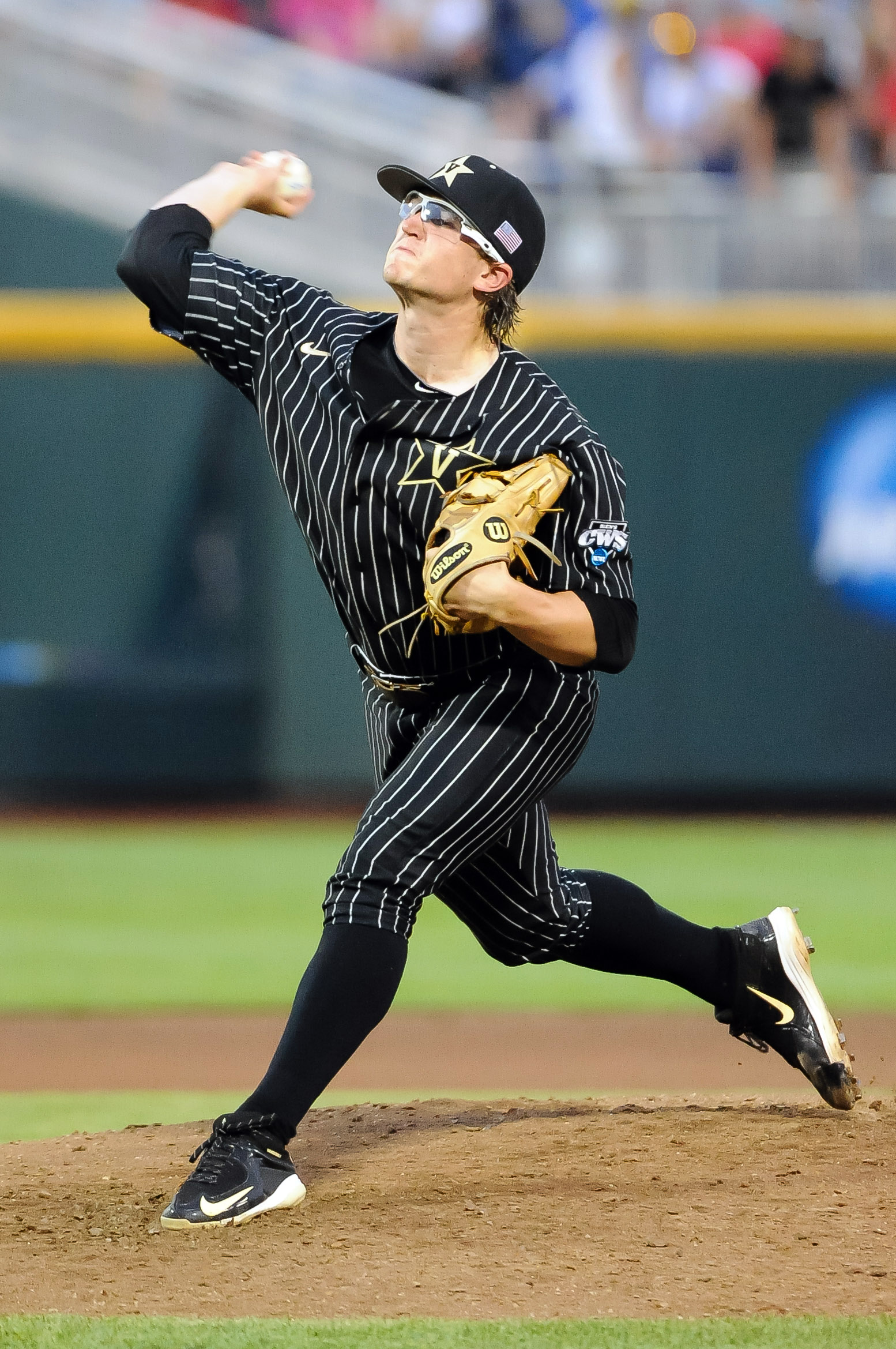
Fulmer was one of the most interesting available players heading into the draft, with big-time stuff and a track record of excellence in major college ball, but also questions about whether he’ll be a big league starter in the long run. Having dominated the SEC with a 1.83 ERA and 13.1 K/9 against 3.9 BB/9, and featuring a sustainable, mid-90s heater with a very good curve and promising change, Fulmer is about as MLB-ready as drafted players come.
So what’s the downside? To an extent, it comes down to how you value near-term contributions versus long-term expectations, as Kiley McDaniel of Fangraphs explained before the draft. Those prospect observers that attributed significant value to his near-big league readiness rated Fulmer as a top-ten prospect (McDaniel had him fifth, MLB.com ranked him 3rd, and Baseball America placed him sixth on its list).
But others, concerned with Fulmer’s high-effort delivery, relatively small stature, and lack of a consistent third pitch, put more weight on the idea that he has too great a chance of being relegated tot he pen in the long run. Keith Law of ESPN.com fell in the latter camp, placing Fulmer way down in the 43rd spot on his board.
Chicago, obviously, decided that Fulmer’s risky (but still high-ceiling) future outlook was worth taking on in order to add such an immediately impactful arm. With Fulmer now set to join an increasingly impressive stable of controllable starters — led by Chris Sale but also including Jose Quintana and last year’s third overall pick, Carlos Rodon — the White Sox rotation has quite a bit o potential. The team has now signed all of its choices from the first ten rounds.
Photo courtesy of USA Today Sports Images.
Astros Links: Lee, Wandy, Vasquez, Santana, Law
The Astros inked southpaw Trever Miller on this date in 2006, bringing him back for a second stint with the team. Here's the latest from Houston…
- The Astros have heard from a few teams with interest in Carlos Lee, reports Jon Paul Morosi of FOX Sports (on Twitter). Nothing is close however, and Morosi speculates that the Indians could be a fit.
- Interest in Wandy Rodriguez "seems almost nonexistent," reports Jon Heyman of CBSSports.com (on Twitter). Last month we heard that the Astros seemed willing to absorb some of the $25.5MM left on the left-hander's contract to facilitate a trade.
- MLB.com's Brian McTaggart reports that the Astros have signed 16-year-old right-hander Carlos Vasquez and 17-year-old outfielder Edward Santana. An agreement with 17-year-old righty Tomas Lopez is not yet official. All three players are from the Dominican Republic and will report to the team's academy there.
- Keith Law announced (on Twitter) that he will remain with ESPN after interviewing for some front office positions with the Astros last month.
- The Astros have received permission to interview Cardinals regional cross-checker Mike Elias for a special assistant role in scouting, reports Law (on Twitter).
Law On Hosmer, Alvarez Bonus Demands
ESPN’s Keith Law has a new blog post discussing possible bonus demands for a couple of projected first-round picks.
- Law says high school first baseman Eric Hosmer has a "reported demand" of $7MM. Hosmer is advised by Scott Boras. Law says Hosmer would go in the #5-8 range if not for his price tag. Could he fall to the Nationals, Rangers, or A’s if one of those teams is willing to pony up?
- Corner infielder Pedro Alvarez might be looking for something in $8.6MM range. Some folks think the Rays will pass but the Pirates will make a splash and take Alvarez.
Ryan Howard and Arbitration Comparables
ESPN’s Keith Law has some good info up on his personal blog. I have always wondered about this stuff. In the post, Law discusses how little sense it makes for the Phillies to pay Ryan Howard more than his service time calls for. But also in the comments Law explains which players Howard’s agent can compare him to for an arbitration hearing.
Law says:
For comparison purposes, a player may be compared to players in the same “service class” in the current year or in prior years, and third- and fourth-time eligibles may be compared to free agents who have signed in the current year or in prior years. Single-year salaries are more powerful comparisons than multi-year deals, since the individual salaries within a multi-year deal may be skewed due to bonuses, backloading, or other factors.
Law notes that Howard’s comp could be Miguel Cabrera, who made $7.4MM last year. Howard logically deserves more than that based on a stat comparison, making the Phillies’ $7MM submission seem low.