
Big Hype Prospects: Gilbert, Eder, Clifford, Watson, Made
Last week, we broke down the early trade deadline deals. Let’s finish things up. For the smart alecks in the audience, we are relaxing our definition of “big hype” to accommodate timely analysis.
Five Big Hype Prospects
Drew Gilbert, 22, OF, NYM (AA)
(A+/AA) 321 PA, 12 HR, 10 SB, .277/.367/.461
Acquired in the Justin Verlander trade, Gilbert looks the part of a future core-performing outfielder. The Astros took him with the 28th pick of the 2022 draft, and he’s already within spitting distance of the Majors. The overall profile doesn’t read as particularly impactful, instead filling a high-floor, modest-ceiling bucket. While that isn’t an exciting review of Gilbert’s skills, he’s still viewed as a Top 100 prospect with some support for a Top 50 ranking. High-probability 2-WAR athletes are widely coveted around the league. Defensive reviews vary. Some evaluators prefer him in a corner, but he seemingly has the skills to stick in center if a better defender isn’t already on hand.
Jake Eder, 24, SP, CWS (AA)
(A/AA) 41.1 IP, 10.9 K/9, 5.4 BB/9, 4.35 ERA
The return for Jake Burger, Eder was on the fast track in 2021 before requiring UCL replacement. He was well on his way to a Top 25 prospect ranking. Alas, his stuff has backed up since returning, and his command shed a grade as well. At his best, the southpaw had a carrying fastball, a lethal slider, and a show-me changeup. Reports indicate he’s lost his arm slot which affected his stuff. He’s also lost velocity, further diminishing his stuff. More distance from surgery could be the cure.
If he’s in search of development, my contacts recommend he follow Lucas Giolito’s lead and seek help from a third party. His new org is not well-regarded by outside evaluators. There’s now considerable relief risk – and not necessarily sexy high-leverage kind. Still, he was among the best pitchers on the planet only a few years ago. He could yet recover.
Ryan Clifford, 19, 1B/OF, NYM (A+)
(A/A+) 320 PA, 19 HR, 4 SB, .284/.394/.513
The other piece of the Verlander trade, Clifford might turn out to be the best hitter dealt at the deadline – assuming he connects enough to catch on at higher levels. He’s a slow runner, and he struggles against fastballs at the top of the zone. Considering even most sinkerballers have a high fastball in their repertoire these days, it’s not a great time to bring that Pat Burrell swing back to the Majors. That said, he punishes anything low in the zone, including breaking balls. Power is Clifford’s carrying trait. If he ever maintains a permanent Major League role, it will be on the back of 30-homer power.
The Astros had him working on his passivity at High-A, and it seemed to be going well. We’ll see how the Mets approach his development.
Kahlil Watson, 20, SS, CLE (A+)
255 PA, 7 HR, 14 SB, .203/.333/.364
One of the top prep shortstop prospects in the 2021 draft, Watson’s development has stagnated in the Marlins system. Inconsistent strike zone judgment and a 12.5 percent swinging strike rate are to blame. The Guardians are known for their love of disciplined, contact-oriented athletes. Ostensibly, they know how to train these traits. There are fully substantiated reports regarding his makeup – you can google them if you want – which the Guardians will need to address. It’s fair to remember not every 20-year-old athlete is an old soul with a zen attitude. Some guys are fiery and later learn to channel it. In any event, Watson’s athleticism remains on display. He should be considered extremely raw.
Kevin Made, 20, SS, WSH (A+)
300 PA, 3 HR, 3 SB, .240/.328/.355
In recent years, we’ve gotten used to watching meteoric rises within every farm system. The business of prospecting is booming. Still, some guys take a longer path to the bigs. Made looks like one of these. He’s an able defensive shortstop who should remain at the position. Tool grades on his bat generally come in around the 45- to 55-grade range. He has plus discipline without the usual case of passivitis. There’s a high probability utility man floor here with potential for a starting role – likely of the second-division variety. For now, he needs to mature into more physicality without losing a step.
Three More
Nick Nastrini, CWS (23): Sent to the White Sox in the Lynn/Kelly trade, Nastrini features two above average breaking balls and a quality heater. He’s a fly ball pitcher with below average command. I view him as a future reliever, but plenty of better evaluators give him a shot at sticking in the rotation.
Hao-Yu Lee, DET (20): Lee has hit at every stop. His defensive limitations – he’s a second-baseman only – and modest pop lead to an awkward fit in the current meta. At the top end of the spectrum, comparable defenders like Luis Arraez and Edouard Julien hit enough to force their way into the lineup. By the time Lee is ready, Detroit will have some practice with this defensive profile courtesy of Colt Keith.
Sem Robberse, STL (21): Robberse doesn’t turn heads, but he has all the traits teams look for in under-the-radar innings eaters. He features a plus changeup and a deep repertoire of otherwise slightly below average offerings. His command has potential to be plus and will help decide how far he travels along a Zach Eflin-like path.
Did I miss a detail or nuance? DM me on Twitter @BaseballATeam to suggest corrections.
Cubs Acquire Jeimer Candelario
Jeimer Candelario is headed back to Chicago. The Cubs announced they acquired the switch-hitting third baseman from the Nationals for prospects DJ Herz and Kevin Made. The Cubs had an open 40-man roster spot after outrighting Edwin Ríos yesterday.
Candelario was one of the best rental hitters on the market after a strong four months in Washington. It was exactly what the Nats had envisioned when signing him to a one-year, $5MM free agent contract last winter.
Originally signed by the Cubs as an amateur more than a decade ago, Candelario made his big league debut with Chicago. His first stint on the North Side was short-lived. He played in five games in 2016 and 11 more the following season before being dealt to the Tigers in the Justin Wilson trade, as the Cubs pushed in young talent for veterans while trying to defend their World Series title.
Candelario got his first extended run down the stretch in Detroit and was an everyday player by the following season. He was a below-average regular for the first two years but took a significant step forward in 2020. Candelario carried that over a full schedule the following season, when he led the majors in doubles. Between those two seasons, he hit .278/.356/.458 in more than 800 trips to the plate.
As was the case for essentially everyone in the Detroit lineup, things fell apart in 2022. Candelario slumped to a .217/.272/.361 line over 124 games. The Tigers non-tendered him in lieu of paying around $7MM for his final season of arbitration eligibility. While it’s a move Detroit probably wishes they had back in hindsight, the subsequent $5MM free agent deal indicates the market didn’t value Candelario as a $7MM player just a few months ago.
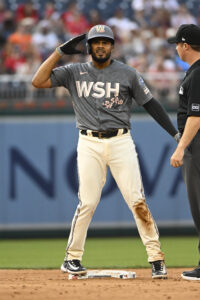
The 29-year-old has certainly elevated his stock since that point. He has more or less regained his 2020-21 form. Candelario hit .258/.342/.481 through 419 plate appearances with Washington. He connected on 16 homers and 30 doubles, ranking fifth in the majors in the latter category. He’s walking at a roughly average 8.6% clip against a decent 21% strikeout rate.
Candelario has been better from the left side of the plate this season, a departure from his early-career work. He’d typically fared better against southpaws but now has similar platoon splits overall. Since the start of 2020, he’s a .253/.334/.438 hitter against right-handed pitching and owns a .256/.330/.437 line versus lefties. That well-rounded offensive production adds to a Chicago lineup built mostly on strong depth as opposed to impact talent aside from Cody Bellinger.
While his profile has mostly been built on offense, Candelario has also gotten solid reviews from public metrics for his third base defense this year. Defensive Runs Saved has pegged him two runs above par in 834 1/3 innings of hot corner work, while Statcast has estimated him as four runs above average. Candelario had gotten mixed to below-average marks throughout his time in Detroit but should at least be a solid gloveman in Chicago.
He has some experience at first base as well but hasn’t played anywhere aside from third since 2020. The Cubs could plug him in at either spot but will presumably use him more often at the hot corner. Nick Madrigal, Patrick Wisdom, Christopher Morel and Miles Mastrobuoni have been part of a revolving door at the position. Morel has raked but isn’t a good defender. Wisdom hits for power but doesn’t consistently put the ball in play; Madrigal has the opposite profile. Candelario is the most balanced of the group.
It’s a modest financial addition for Chicago. Candelario is due around $1.67MM in salary through year’s end. He’d tack on another $200K in incentives if he reaches 600 plate appearances, though that’s also fairly modest. As calculated by Roster Resource, the Cubs have a luxury tax number a bit north of $228MM.
That’s a little less than $5MM shy of the $233MM base threshold. It had seemed the Cubs were trending towards staying below that mark and selling away veteran pieces, but a recent eight-game win streak completely changed the calculus. The addition of one of the top rental hitters available affirms their status as buyers, which had already become clear when they took Bellinger off the trade market yesterday. They also added some middle relief depth tonight in acquiring José Cuas from Kansas City and figure to look for more impactful bullpen upgrades in the next 24 hours.
Candelario’s time in Washington proved fruitful for both parties. He revitalized his stock and now looks positioned for a much more lucrative free agent trip. He’ll be one of the top hitters available in a below-average class for bats. The Nats never seemed likely to issue him a qualifying offer, but the trade officially takes that off the table. Players dealt midseason are ineligible for the QO, so Candelario will hit the market unencumbered by draft compensation.
The club adds a pair of players to a continually improving farm system. Made, 20, is a right-handed hitting shortstop from the Dominican Republic. He didn’t appear on Chicago’s midseason top 30 prospects at Baseball America but ranked 19th on the organizational list at FanGraphs. The outlet credited the 5’9″ infielder with roughly average tools and suggested he has an outside shot to be an everyday shortstop. He’s hitting .240/.328/.355 over 300 plate appearances with High-A South Bend. He hit just three homers there but walked at a solid 10% clip against a lower than average 18% strikeout rate.
Herz, 22, has gotten 14 starts with Double-A Tennessee. The former eighth-round pick owns a 3.97 ERA across 59 innings, striking out an excellent 30.4% of opponents but walking 14% of batters faced. He was 19th among Cubs’ prospects at Baseball America and 22nd at FanGraphs. He sits in the low 90s with his fastball and has an excellent changeup, but the obvious control woes lead most evaluators to point to a bullpen future. There’s little harm for the Nats in letting him continue to start in the minors. Herz and Made will have to go on the 40-man roster this offseason to stay out of the Rule 5 draft.
It’s the first of likely multiple deadline deals for the rebuilding Nats. Candelario was their most obvious trade chip. Middle reliever Kyle Finnegan could be on the move as well. Washinton’s top realistic trade piece would be outfielder Lane Thomas, though it remains to be seen how eager they are to deal him.
Michael Cerami and David Kaplan of Bleacher Nation reported the Cubs and Nationals were in discussions about Candelario. Ken Rosenthal of the Athletic first reported Candelario was being traded to Chicago. Cerami was first with Herz and Made going back to Washington.
Image courtesy of USA Today Sports.