
Mariners Acquire Luis Castillo
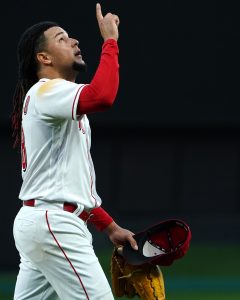
The first major starting pitching trade has been made, as the Mariners and Reds announced a deal sending two-time All-Star Luis Castillo to Seattle. In exchange, the Reds bring back four prospects — highly-regarded infielders Noelvi Marte and Edwin Arroyo and right-handers Levi Stoudt and Andrew Moore. Cincinnati has selected the contract of reliever Ryan Hendrix to take Castillo’s roster spot.
Castillo had been perhaps the prize of this year’s rotation market. After missing a few weeks due to shoulder soreness to open the year, Castillo made his season debut in early May and has looked like a bona fide top-of-the-rotation arm. He’s made 14 starts and worked 85 innings, pitching to a 2.86 ERA despite playing his home games in one of the league’s more hitter-friendly parks. Castillo has punched out a quality 25.8% of opposing hitters against a solid 8% walk rate. This season’s 47.1% grounder percentage is down a bit relative to his 2019-21 levels, but it remains a few points better than the league average.
That kind of high-end production is about what we’ve come to expect from Castillo, who has cemented himself as one of the sport’s top arms over the past few seasons. He’s posted an ERA under 4.00 in each of the last four years, carrying a cumulative 3.49 mark in 91 starts since the beginning of the 2019 campaign. That’s 24th among 98 qualified starters over that stretch. His 26.8% strikeout rate ranks 23rd among that group, and he’s 12th with a 14.2% swinging strike percentage (whiffs per pitch). He’s complemented the strikeout stuff with a massive 54.8% ground-ball percentage that ranks among the top ten.
Few pitchers can match Castillo’s combination of whiffs and grounders, and the 29-year-old backs it up with an impressive arsenal. He’s one of the harder throwing starters, averaging just shy of 97 MPH on both his four-seam and sinker. Castillo’s bread-and-butter secondary pitch, his changeup, is among the game’s top offspeed offerings, and he’s gotten strong results on his slider as well.
Castillo will move to the front of a rotation that suddenly looks to be one of the more fearsome in the sport. The M’s signed reigning AL Cy Young winner Robbie Ray to a five-year deal over the winter, and second-year hurler Logan Gilbert has a 2.78 ERA through 21 starts. Rookie George Kirby, who was generally considered among the top handful of pitching prospects entering the season, has a 3.50 ERA through his first 13 big league outings. Chris Flexen and Marco Gonzales aren’t high-strikeout arms, but they’re more than capable back-of-the-rotation types.
Seattle will want to keep an eye on the innings totals for Gilbert and Kirby, so there’d have been sense in even adding a stable back-end arm. Instead, president of baseball operations Jerry Dipoto and his staff swung bigger to bolster the 54-46 club they expect to snap the franchise’s two-decade playoff drought. Should they make the postseason, the front office and fanbase alike would no doubt feel strongly about their ability to match opponents’ top three arms with Castillo, Ray and Gilbert.
The deal is about more than just the 2022 season, as Castillo will be arbitration-eligible for a final time this winter. He’s making $7.35MM this year, around $2.75MM of which has yet to be paid out. He’ll earn a decent raise in arbitration but still have a plenty affordable salary — likely around the $12MM range. That’s an obvious bargain for a pitcher of his caliber, making a year and a half of his services incredibly valuable.
That’s reflected in the return, which looks very strong. Marte and Arroyo were the top two prospects in the Seattle system on Baseball America’s most recent top 100, respectively checking in 47th and 48th in the league. Marte, the most well-known of the group, entered the season ranked among the game’s top 15 farmhands in the estimation of each of Keith Law of the Athletic, FanGraphs and Kiley McDaniel of ESPN.
A 6’3″ infielder out of the Dominican Republic, Marte is universally projected as a possible plus power hitter capable of racking up 25 or more home runs annually at his peak. He has played exclusively shortstop in the minors, and while evaluators suggest he might eventually grow off that position, he’s expected to stick on the infield as a possible above-average third baseman. He’s spent the year in High-A as a 20-year-old, putting up an impressive .270/.360/.460 line with 15 homers, a strong 10.8% walk rate and a manageable 21.1% strikeout percentage through 389 plate appearances.
Arroyo, 18, was Seattle’s second-round pick in last year’s draft. The Puerto Rico native has already notably elevated his stock in his first full professional season, raking at a .316/.385/.514 clip in Low-A. He’s collected 13 homers and 19 doubles and stolen 21 bases. That kind of offensive performance was unexpected, as the switch-hitter entered the season more well-regarded for his potential plus defense at shortstop than his bat.
Stoudt recently checked in as the M’s #10 prospect, per Baseball America. The 24-year-old righty has struggled at Double-A this year, pitching to a 5.28 ERA across 87 innings. He has a slightly below-average 22% strikeout rate and a tiny 5.9% walk percentage that look more palatable, however. BA writes that he works in the 94-98 MPH range with his fastball and has a solid array of secondary offerings, led by his changeup. The 2019 3rd-round pick will have to be added to the 40-man roster this offseason to keep him from being selected in the Rule 5 draft. He’s regarded as a possible back-of-the-rotation starter.
Moore, not to be confused with the former Seattle starter of the same name, was a 14th-round pick out of junior college last year. The 22-year-old righty has worked exclusively out of the bullpen in Low-A, posting a 1.95 ERA through 32 1/3 innings with a ridiculous 43.6% strikeout rate. He’s generally facing younger competition and has walked almost 13% of opponents, but BA recently wrote that he features a 95-97 MPH fastball and a swing-and-miss breaking pitch. He’ll add an interesting lower level bullpen arm to the Cincinnati system.
The trade — which marks the second time in four months these two teams have lined up on a blockbuster — will have plenty of repercussions. Seattle’s decision to push in arguably their top two prospects for one of the sport’s best starters reinforces that the M’s view themselves as a legitimate contender in the American League. It also seemingly signifies they’re out of the running for Juan Soto, although there’s still plenty of upper level talent for Dipoto and his group to further bolster the roster over the next three days. Second base looks like a possible target area, as does backup catcher. Castillo, though, figures to be the splash — the impact addition designed to put a team that’s generally strong around the diamond over the top.
As for the Reds, it’s the second (and likely most notable) trade they’ll make this week as they strip down the big league roster in search of future talent. Castillo’s former rotation mate Tyler Mahle could soon join him in being moved for a marquee return (although not likely one as strong as this). Rental hitters like Brandon Drury and Donovan Solano won’t recoup a franchise-altering package, but there’s little reason for them not to join Tyler Naquin and Castillo in changing clubs.
With Castillo off the market, Mahle and A’s hurler Frankie Montas become the top two rotation trade candidates, in addition to a handful of high-impact arms who might be available despite having control windows extending beyond 2023. Teams like the Yankees, Cardinals, Rangers and Twins are known to be in the market for rotation help. Mark Feinsand of MLB.com tweets that 12 teams were in contact with the Reds about Castillo and suggests the Yankees’ offer was close to the quality of Seattle’s. Ken Rosenthal of the Athletic indicates Texas made a strong push as well. In the end, the Mariners put the best offer on the table, leaving plenty of others to look elsewhere over the next 72 hours.
Jeff Passan of ESPN was first to report Seattle was nearing a deal for Castillo. Ryan Divish of the Seattle Times was first to report the prospects going back to Cincinnati.
Image courtesy of USA Today Sports.
Big Hype Prospects: Cruz, Abrams, Volpe, Veen, Wiemer
This week, we investigate a mix of prospects at a wide range of levels.
Five Big Hype Prospects
Oneil Cruz, 23, SS, Pirates (MLB)
(AAA numbers) 247 PA, 9 HR, 11 SB, .232/.336/.422
When Tim Dierkes suggested I run this column, Cruz was his first example of the type of player he wanted to see covered. I’d previously written a fantasy column about “Peripheral Prospects” in this same format covering lesser-known guys like Ken Waldichuk and Brett Kerry. It’s only fitting to touch upon Cruz one more time. While his Triple-A numbers don’t jump off the page, he eventually settled in to the level. Since early-May, he’s batted .280/.374/.520 with an 11.4 percent walk rate and 17.7 percent strikeout rate. Reportedly, he was disappointed by his initial demotion, and it contributed to his April-long slump.
Since rejoining the Majors, Cruz is 4-for-18 with a stolen base. In four games, he’s already hit four balls over 100-mph, including two lasers over 110-mph. This is consistent with his track record. Cruz is built like a young Aaron Judge, and he hits the ball nearly as hard. His typical angle of contact is geared towards ground ball and line drive contact which could limit his home run production. When he does lift the ball, you can expect to see it soar. Anytime he’s in the lineup, Cruz is one of the most fascinating players in the league.
C.J. Abrams, 21, SS, Padres (MLB)
(AAA numbers) 151 PA, 7 HR, 10 SB, .314/.364/.507
Like Cruz, Abrams had a previous brief taste of the Majors and recently returned for four games. He’s 2-for-15 with one strikeout. Unlike Cruz, his exit velocities have been outright poor – just 81.8-mph. Abrams’ selection to the Padres roster followed on the heels of a particularly torrid multi-week stretch. He hit .398/.442/.519 over his last 95 Triple-A plate appearances. Included in the fun were four home runs, a 5.3 percent walk rate, and an 11.6 percent strikeout rate.
Such production indicated immediate readiness, especially for a prospect of Abrams’ caliber who scouts adore. If there’s a shortcoming in his profile, it’s that he doesn’t walk. It’s not necessarily an issue of discipline. He expands the zone in part because his speed has allowed him to still reach base in the minors. It’s possible he’ll learn to lay off marginal pitches in the Majors to improve his outcomes. If he does, he’ll flower into a high-quality leadoff hitter. There are still questions about his eventual defensive home – and not only because he has to share a field with Fernando Tatis Jr.
The worst-case scenario for Abrams is as an over-aggressive, contact-oriented slasher who plays all over the field. Between injuries and his incredible talent, we haven’t seen Abrams make many adjustments as a professional.
Anthony Volpe, 21, SS, Yankees (AA)
270 PA, 9 HR, 25 SB, .233/.326/.427
Over the offseason, I was virtually cornered by several Yankees fans who not-so-calmly explained that Volpe was the best prospect since Mike Trout. To the glee of everybody who loves to hate the Yankees, he performed particularly poorly until mid-May. Through May 17, he slashed a meager .170/.297/.330. Optimists cited four reasons he would rebound. First, the talent remained evident. He was working counts (13.8 percent walk rate). His .195 BABIP indicated poor luck. Lastly, he wasn’t the first prospect to wilt in chilly early-season weather.
As the calendar has heated up, so too has Volpe. He’s slashing .292/.356/.517 since May 18, a span of 132 plate appearances. He’s also putting more balls in play (6.8 percent walk rate, 15.9 percent strikeout rate) with a normal .319 BABIP. Volpe is on the shortlist for top prospect remaining in the minors. He’s also making a strong case for promotion to Triple-A – possibly by the end of this month.
Zac Veen, 20, OF, Rockies (A+)
258 PA, 8 HR, 25 SB, .259/.368/.440
The Rockies don’t exactly have an illustrious reputation with prospects. It’s nice to see Veen continue to perform to his draft pedigree. Scouting reports uniformly express concern about his hit tool playing against elite competition. While he possesses considerable raw power, his swing has qualities that some might describe as grooved. Such hitters can still succeed in the Majors. Billy Wagner once ridiculed Pat Burrell’s one-path swing (after allowing a home run). Joc Pederson might be a more relevant groovy comparison as a left-handed hitter with a pretty, loopy swing.
In any event, Veen is on track to spend some time in Double-A this season and debut either late in 2023 or early 2024. He works counts (14.3 percent walk rate) though he is also whiff prone (23.6 percent strikeout rate, 14.3 percent swinging-strike rate). While he’s 25-for-26 on the basepaths this season, it’s not clear if Veen will continue to run as he moves up the organizational ladder.
Joey Wiemer, 23, OF, Brewers (AA)
267 PA, 15 HR, 20 SB, .272/.348/.531
A divisive prospect, Wiemer is gaining steam as one of those guys who might succeed – perhaps even thrive – despite glaring flaws. He changed his mechanics heading into 2021 and unlocked massive in-game power. He launched 27 home runs in 472 plate appearances last season before tearing through the Arizona Fall League – one home run and a .467/.568/.667 triple-slash in 30 plate appearances.
There’s question if the hit tool will play in the Majors, but the power is evident enough to easily support a low-average approach. A worst-case scenario might look something like Adolis Garcia with plate discipline. Or Adam Duvall with discipline and an eagerness to run. He sells out for pull-side, fly-ball contact. He’s posted high BABIPs at every level, but this is a hitting profile that usually yields low BABIPs due to a cacophony of pulled grounders and easy fly outs. We should see him tested in Triple-A before long. Milwaukee might even need his help in the Majors late in the season if they don’t add outfield depth at the trade deadline.
Having watched him play several games, the energy he gives off evokes Bryce Harper.
Five More
Gunnar Henderson, Orioles (21): Last week’s lead BHP (that’s Big Hype Prospect), I noted Henderson would soon jump from around the 50th prospect to somewhere in the Top 10 as listmakers prepare their midseason updates. Since then, Baseball Prospectus’ Jarrett Seidler indicated Henderson might be the top prospect left in the minors. A highly-placed source at another major industry outlet confirmed Henderson is on a shortlist of about five players for their top prospect. As I understand it, this excludes all prospect-eligible players currently in the Majors like Michael Harris, Oneil Cruz, and C.J. Abrams.
Eury Perez, Marlins (19): Currently shredding Double-A hitters, Perez is perhaps the most-precocious pitching prospect since Julio Urias. While Urias’ development was eventually delayed by injuries, Perez remains both healthy and effective. Most of what I would say about Perez was gleaned from the Marlins system update posted to FanGraphs earlier today. So, I’ll let you read what Eric Longenhagen has to say directly.
Jeter Downs, Red Sox (23): Downs made his debut recently, struck out three times in four plate appearances, and was promptly optioned back to Triple-A. Once a fairly well-regarded prospect, he’s fallen off the map since joining the Red Sox in the Mookie Betts trade. He still possesses tantalizing power and speed along with decent plate discipline. Unfortunately, there’s a ton of swing-and-miss in the profile; the kind that’s readily exploitable by seasoned pitchers. The best-case scenario these days is a sort of Dylan Moore-like outcome.
Brett Baty, Mets (22): Baty was, for me, the most visibly impressive prospect in the Arizona Fall League. Like Volpe, he had a chilly start to his Double-A campaign – his second visit to the level. He currently has a 14-game hitting over which he’s tamed his strikeout rate and pulled his season-long batting line up to an above-average .282/.372/.450 performance. Like the most of the other Double-A bats we’ve profiled today, he’s seemingly on the cusp of a promotion.
Noelvi Marte, Mariners (20): Two weeks ago, I noted some in the scouting biz had indicated Marte’s early-career dominance might be linked to physical traits that won’t necessarily scale as he advances to higher levels. In plain English, the boy got big young. Last week, I issued something of a retraction because I’d misplaced my source. Since then, I rediscovered the initial note, and it comes from a highly reputable source with access to dozens of scouts. All of this is to say that Marte doesn’t seem to be the second-coming if you buy into this early-development narrative. Not everybody does! This has been the most contentious take to appear in BHP. I look forward to fomenting more discussion about Marte. For what it’s worth, his June-long slump has continued. He hit .214/.241/.250 over the last week and is at .191/.257/.324 for the month.
Quick Hits: Mullins, Farm Rankings, Mariners, Universal DH
Cedric Mullins of the Baltimore Orioles, baseball’s top power-speed threat in 2021, opened up in a video (Twitter link) that dropped today about some previously private health struggles with Crohn’s disease. The 27-year-old details how teammate Trey Mancini‘s abrupt colon cancer diagnosis before the 2020 season helped him pay more attention to his own health woes.
This introspection ultimately led Mullins down a path that included intestinal surgery in November 2020, severe weight loss, and a Crohn’s disease diagnosis that very well could have been career-derailing. That Mullins broke out last season— earning an All-Star nod, Silver Slugger, and the distinction as baseball’s only 30-30 player— is made all the more remarkable by the presence of a condition that so often proves debilitating. We at MLBTR tip our collective caps to Mullins for sharing his story and raising awareness for a condition that is growing in prevalence.
Some more uplifting news from around the league…
- Baseball America unveiled their 2022 Organization Talent Rankings today, with the Seattle Mariners claiming the top spot on this offseason’s installment. With talented youngsters like Julio Rodriguez, George Kirby, and Noelvi Marte forcing their way up the minor leagues and the Mariners fresh off a 90-win season, the time may be right to buy stock in the Mariners franchise. BA’s Kyle Glaser notes that 16 of the last 17 teams to claim the top farm system have reached the playoffs within two years of earning that distinction. The one team who bucked that trend, the 2011 Royals, took three years, reaching the World Series in 2014 and winning it in 2015. This history may prove to be of huge import for Seattle fans, who are now 20 years removed from their last playoff appearance.
- Jon Heyman of MLB Network lent more credence to the idea that a universal DH will be included in the next CBA, stating (via Twitter) “Barring something totally unexpected, it can be assumed at this point that the universal DH will be in place in 2022”. Heyman adds that both the player’s union and league are in favor of implementing the rule, though there is some disagreement about which party will benefit more from having a DH in the National League. We polled readers back in December to gauge how a universal DH would be received, with 62% of readers expressing enthusiasm, 26% expressing disdain, and another 12% expressing indifference to the change.