
Let’s Not Forget About Franchy Cordero
With high-profile signings like Eric Hosmer and Manny Machado and a superlative farm system that has produced standout rookies like Chris Paddack and Fernando Tatis Jr., the Padres have begun to return to relevancy after a stretch of seasons spent in baseball’s doldrums. More eyes are trained on the team now than maybe any point in the last decade, and onlookers have begun to expect results.
As such, the majority of the attention goes to the likes of Machado and Tatis—rightfully so—leaving other players in their shadow. One forgotten Padre could be key in their 2020 campaign: after elbow and quad injuries have limited him to just 49 games over the last two seasons, it’s easy to discount Franchy Cordero among the Padres’ core of young players. We’ve seen glimpses of his potential since he debuted in 2017, but we’ve yet to get a real extended look at him in the Majors, leaving us uncertain about the player he will be at his peak.
In parts of three seasons at the MLB level, Cordero has appeared in just 79 games and made 273 scattered plate appearances. That’s still a decent amount of exposure for a 25-year-old, but when it comes in bits and pieces rather than extended stretches, it makes it especially difficult to draw conclusions about who Cordero really is and will be as a player.
That said, there’s no doubt that he boasts a rare combination of power and speed that makes him a tantalizing player. Per Statcast measurements, his sprint speed has ranked in the top 11% of MLBers in each of the last three years. That alone is pretty impressive for a player of Cordero’s stature (6’3″, 175 lbs.), but it’s even cooler when you consider that in 2018, Cordero’s average exit velocity was 92.6 mph, which equals the numbers put up by Matt Chapman and Jorge Soler last year (granted, Cordero did so with very few batted balls, so the usual sample size concerns apply).
Those tools are fun—that much is undeniable. The numbers above point to something special, and they’re indicative of the superlative talent that could make Cordero a premier player in his prime years. But there’s a big difference between being a premier player and merely possessing awesome talent; plenty of athletic outliers have failed to grow into productive Major Leaguers. If Cordero is to solidify himself as a reliable regular in the Majors, he’ll need to develop a more well-rounded game. For one thing, his approach at the plate still leaves something to be desired: his strikeout rate (38.8% for his career) remains too high, especially given his unspectacular walk rate (8.8% career).
That’s a ubiquitous challenge for young players, and it’s something that is often tempered with sustained exposure to MLB pitching. Plenty of players succeed with high strikeout rates—especially those with prodigious power like Cordero—so it won’t take a complete transformation of Cordero’s skillset to unlock his next level. I’d argue that it comes down mostly to opportunity, and a regular role could do wonders for his development.
The Padres’ outfield mix will be a little crowded as it is, with the additions of Tommy Pham and Trent Grisham likely representing two Opening Day starters. Cordero can certainly compete for the third spot, but he’ll have to overtake Wil Myers for the job. He probably fits best in right field, but has played plenty of center field in his career. Regardless, Cordero is firmly among the four best outfielders on the roster and should therefore have a path to more at-bats, assuming he’s healthy. Anyway, if the NL plays the 2020 season with a designated hitter, there should be ample opportunity to get Cordero’s bat in the lineup one way or another.
Whereas in previous years Cordero has been an intriguing, if still mysterious, piece on some fun Padres teams, he now has a chance to be a real contributor on a team that hopes to be taken more seriously. Without a doubt, he’s a player that deserves attention; we’ll eagerly watch this year to see whether a consistent role will allow Cordero to make adjustments that bring him a step closer to stardom. Don’t be surprised if Cordero’s name becomes more familiar to baseball fans.
What Would The Padres Do For A DH?
Mixing and matching in the designated hitter spot is a fairly common approach for American League clubs. That may be all the more common if, as expected, National League teams are suddenly given a DH slot to work with for 2020. The Padres have some clear candidates for steady work but could certainly end up operating with a rotation as the team’s needs evolve.
There are two fairly obvious options for regular hitter-only usage in San Diego. First and foremost is Wil Myers, who has moved all over the diamond in recent years but never really found a home. He’s got to fit somewhere, as he’s earning a $20MM annual salary from 2020 through 2022. Myers has already produced thirty dingers in a big-league season, though he slumped last year.
The other possibility is the younger and less-established Josh Naylor, a converted first baseman who’s still learning the outfield. He has options aplenty, so it’s easy enough to keep him off of the active roster, but the Friars are surely interested to see if he’s a keeper. Naylor held his own but didn’t excel in his first attempt at the majors in 2019. But the 22-year-old has shown all he really needs to against upper-minors pitching, including exceptional plate discipline. The question remains whether he can deliver steady pop in the bigs.
So, how about some kind of platoon? Well, Naylor really hasn’t been vulnerable to lefties in the minors. And Myers hasn’t shown significant splits historically. But that did change last year, when he marauded lefties (130 wRC+) while failing to show up against same-handed hurlers (87 wRC+).
Odds are, the Pads will want both of these guys to cycle through spots on the field as well, both to keep everyone fresh and to enhance the organization’s long-term flexibility with those players. Plus, there’s an opportunity here to expand the team’s options behind the dish — Francisco Mejia could get some plate appearances as the DH — and elsewhere. It’d be nice to find added rest for the high-priced Manny Machado, for instance, and keeping Franchy Cordero healthy is a priority after several injury-plagued campaigns. It would be easy enough to slot Tommy Pham, Eric Hosmer, and even Brian Dozier into the DH spot from time to time.
The Padres’ Under-The-Radar Star
There may not be many who realize it, but the Padres’ Tommy Pham has been one of the most productive outfielders in baseball over the past few years. Compared to most other major league standouts, Pham came from humble draft beginnings as a 16th-round pick in 2006, and it took him several years to put up notable production in the minors. From his draft year through 2009, Pham’s OPS sat below .700, but his numbers trended upward thereafter, and he finally earned his first MLB look in 2014 with the Cardinals, who drafted him.
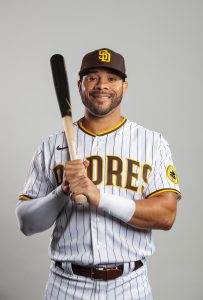
While Pham only played in six games and totaled a mere two plate appearances the year St. Louis promoted him, he represented a solid bench piece with the club from 2015-16, during which he slashed .247/.335/.458 (115 wRC+) in 356 PA. Any team would sign up for that type of offensive production from a reserve player, but Pham has demonstrated since then that he’s a bona fide starter – not a backup.
Pham’s breakout began in 2017, a season in which he batted .306/.411/.520 with 23 home runs and 25 stolen bases in 530 PA. Although Pham ended the year eighth in the majors in wRC+ (149) and 10th in fWAR (6.2), it proved to be his only full season as a starter in St. Louis.
Pham got off to an underwhelming start in 2018, when he owned a .730 OPS through July, and the Cardinals sent him and $500K in international bonus money to the Rays at the deadline in exchange for outfielder Justin Williams, left-hander Genesis Cabrera and right-hander Roel Ramirez. The Cardinals haven’t really profited from that swap at the MLB level, at least not yet, but it went swimmingly for the Rays. Pham was terrific in Tampa Bay from 2018-19, when he totaled 828 PA and led all their position players in fWAR (5.9), hitting .287/.385/.485 (136 wRC+) with 28 homers and 30 steals.
You’d think the Rays would have regarded Pham as a keeper after his first season-plus in their uniform, but considering he’s 32, on a $7.9MM salary this season and only controllable for one more year after that, the budget-conscious franchise flipped him over the winter. The Rays wound up sending Pham to the Padres in a December 2019 deal centering on him and the powerful Hunter Renfroe, a fellow outfielder. Pham is flat-out better than Renfroe, but the latter’s 28, on a $3.3MM salary this year and under wraps through 2023, so you can see his appeal from the Rays’ standpoint.
So what did the Padres get in Pham? A batter who has been far superior to most offensive players since he busted out in 2017. Going back to then, here’s where Pham ranks in a few important categories…
- fWAR: 18th (13.6; he’s tied with Freddie Freeman)
- wRC+: 26th (133; he’s between Joey Votto and Matt Olson)
- Walk percentage: 33rd (12.5; he’s a bit ahead of Cody Bellinger and Kris Bryant)
Not only can Pham hit, but he’s a respectable outfielder – someone who has lined up at all three spots in the grass during his career and accounted for nine Defensive Runs and a 6.5 Ultimate Zone Rating in almost 4,000 innings. By all indications, the Padres have a gem on their hands in Pham. The question now is how much they’ll benefit from his presence in 2020, when the coronavirus will lead to a shortened campaign or perhaps no season at all.
Photo courtesy of USA Today Sports Images.
The Pitcher To Receive The Most Extra Strikes In 2019 Was…
In a recent bout of strike zone curiosity, I started looking into umpire accuracy metrics to try to visualize the baseball world at our doorstep: a world in which balls and strikes are called by robot umpires. While referring to an electronic strike zone as “robot umpires” no doubt adds an unnecessary measure of Asimovian flourish, the reality of baseball’s future is bearing down on us. Electronic strike zones are coming to baseball.
Then again, COVID-19 threw a wrench into all pockets of predicting baseball’s future, and there’s no longer any certainty in, well, just about anything. So there will be no more crystal ball voyeurism from me today, no more speculation, only a cold, hard look at the past.
Of course, the issue of umpire accuracy is hardly reserved for the future. Until electronic strike zones are implemented, the human models making the calls behind the plate remain incapable of ridding themselves entirely of human error – try as they might. Sometimes a ball misses the plate, and they call it a strike. Sometimes it crosses the dish, and the arm stays at the umpire’s side. The question for today is this: which pitcher got the most extra strikes in 2019?
With my previous look into Statcast pitch data, I looked for clusters of pitchers that would illuminate certain things about how umpires called balls and strikes. Today is about passing along some of the trivia. Statcast data, after all, holds a ton of information, including whether or not each ball or strike was correctly called. Using machine learning, we can pretty cleanly find those pitchers who benefited the most from gifted strikes, as well as those who were hurt the most by stolen strikes.
And that brings us to Adam Warren of the San Diego Padres (frequently and presently a member of the New York Yankees). Of the pitchers who threw as many as 200 pitches in the majors in 2019, it wasn’t close: Warren benefited more than any other pitcher in 2019 from umpires gifting extra strikes.
To be perfectly clear, a gifted strike here is a pitch that lands outside the strike zone that the umpire calls a strike. This alone does not make Warren the luckiest pitcher in baseball. Nor does it make him the umpires’ favorite (though it probably gets him a look). In a vacuum, that Warren led the league in percentage of called strikes that were gifted means only this: no pitcher had a higher percentage of their called strikes come from pitches that missed the zone.
This was important for Warren because, even with the added help, only 31.4% of his pitches landed in the zone (league average was 39.4%). And while batters swung and missed at a relatively average rate when Warren was throwing strikes, batter O-Contract% – the percentage of times a batter makes contact when swinging at a ball outside the zone – was just 61.9%, much lower than the 67.3% average. So the more Warren got batters to chase, the more effective he became (surprise, surprise). Still, he only registered 7.85 K/9 versus 3.77 BB/9.
For context, MLB pitchers – on average – had ~16% of their called strikes come on pitches outside the zone. Warren, by contrast, received a gifted strike on almost 42% of his strike calls. This was an extreme outlier. The second-place finisher for highest percentage of gifted strikes was Michel Baez at ~30% – interestingly, also of the Padres (and the conspiracy is on!). Not for nothing, but Warren also fits the profile of the type of pitcher more prone to getting extra calls. He averaged just 86.4 mph this season (fastball clocking at 91.4 mph), he’s right-handed, and both his fastball and curve register in the bottom quartile for spin rate.
If he were a starter, he’d fit the mold exactly. Of course, sample size is likely a culprit here in Warren’s numbers being so far outside the norm. Warren wasn’t exactly a spotlight pitcher in 2019. He threw 555 pitches for the Padres across 25 games, 28 2/3 innings. He ended the year 4-1 with a 5.34 ERA/6.91 FIP making his season worth -0.2 bWAR/-0.8 fWAR. This is not to say he will be a total disaster if he suits up for the Yankees sometime this season, nor is it to say he’ll receive the same measure of umpire error if he does. Though Warren has been received favorably by umpires in the past, his overall average percentage of gifted strikes over the past 5 seasons is just under 28%. That still puts him two standard deviations above the mean, but nowhere near the outlier of his 2019.
When Padres Gave Up An Eventual 2-Time Cy Young Winner
Although right-hander Corey Kluber has been one of the most successful starters in recent memory, it’s not as if his he was a can’t-miss prospect who was expected to turn into the two-time American League Cy Young winner he became. Kluber entered the pros as a fourth-round pick of the Padres in 2007, but he wasn’t lights-out at preventing runs at the lower levels of the minors with them during his time with the franchise. The Padres eventually deemed Kluber expendable when they sent him to the Indians in a July 2010 three-team trade that also involved the Cardinals. The headliners then were outfielder Ryan Ludwick (he went from the Cardinals to the Padres) and righty Jake Westbrook (the Indians shipped him to the Redbirds). Little did anyone know Kluber would turn into the most valuable player in the deal.
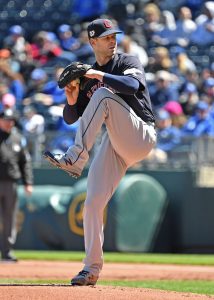
If we go back a decade, Ludwick was amid a rather impressive run with the Cardinals, largely because of a 5.3-fWAR campaign in 2008 in which he posted a jaw-dropping 151 wRC+. While he fell back to earth from there, the Padres – who were playoff contenders in 2010 – expected him to at least serve as a solid regular in their uniform. But the Padres, despite winning 90 games that year, didn’t end up making the playoffs, and they never got much value from Ludwick. He slashed a weak .228/.301/.358 (86 wRC+) over 664 plate appearances in a Padres uniform in 160 games before they sold him to the Pirates in July 2011.
Ludwick’s subpar production in San Diego makes it all the more unfortunate that the team said goodbye to Kluber, who later evolved into one of the top starters of the past several years. Kluber came into his own in 2013, his first full season in the majors, and proceeded to post a sterling 2.96 ERA/2.89 FIP with 9.91 K/9 and 1.86 BB/9 across 1,238 2/3 innings through 2018.
As mentioned, Kluber took home a pair of Cy Youngs during his halcyon stretch. He also earned three All-Star nods, ranked 10th among all qualified starters in ERA, and helped the Indians to four playoff berths and three AL Central championships. Not bad for someone who was unheralded when the Indians got him. Westbrook, whom the Indians gave up, was quite good in their uniform at times, and he did enjoy success in St. Louis, but that’s nonetheless a trade that Cleveland would make again in light of how much Kluber blossomed as a member of the club.
However, now 34 years old, Kluber is no longer part of the team with which he broke out. After a disappointing, injury-ruined 2019, the Indians sent Kluber and his waning team control (he has a guaranteed one year, $18.5MM left on the five-year, $38.5MM pact the Indians gave him in 2015) to the Rangers for reliever Emmanuel Clase and outfielder Delino DeShields. It has never come off as an overwhelming return for Cleveland, especially in light of Clase’s recent 80-game suspension for performance-enhancing drugs. Then again, Kluber didn’t look like a special pickup when he joined the Indians, and look how he panned out. Regardless of what happens with Clase and DeShields, you can’t argue with what the Indians got from Kluber when he was in their rotation. For the Padres, though, he’s a star who got away.
Photo courtesy of USA Today Sports Images.
Three Years Ago, The Padres Got An Elite Reliever For Nothing
We just passed the three-year anniversary of a transaction that looked inconsequential at the time but has since turned into one of the finest moves of Padres general manager A.J. Preller’s career.
On April 26, 2017, the Padres took a low-risk flier on reliever Kirby Yates via waivers. Yates had been with the Angels, but they and GM Billy Eppler designated him for assignment just a few days earlier. It was actually the second time that month that the Angels designated Yates, though no one took the bait the first time. That was understandable considering he never did much to stand out in the majors to that point, so you can’t really fault the Angels for cutting ties with him in light of that fact
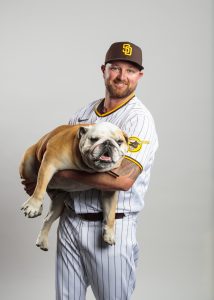
As MLBTR’s Jeff Todd wrote when the Padres claimed the right-hander: “Yates, 30, only made it into one contest for the Halos this year. Over his 98 2/3 total MLB frames since the start of the 2014 season, he owns only a 5.38 ERA.” However, Jeff went on to add, “[Yates] has also generated 10.4 K/9 to go with 3.7 BB/9 in that span and showed career-best fastball velocity (94 mph) in his sole MLB appearance this year.”
And Yates, a 26th-round pick of the Red Sox in 2005, did put up excellent production at the minors’ highest level. Also a former member of the Yankees and Rays in MLB, he caught on with the Padres as the owner of a 2.26 ERA with 12.9 K/9 and 3.5 BB/9 over 135 2/3 innings in Triple-A. Little did the Padres or anyone else know Yates would soon go on to post even better numbers in San Diego.
While Yates did not manage dominant run prevention figures during his first year as a Padre, he was quite serviceable, giving them 55 2/3 frames of 3.72 ERA/3.50 FIP pitching and fanning a jaw-dropping 14.07 batters per nine (compared to 3.07 BB/9). San Diego clearly had a useful hurler on its hands, and he took it up several notches from there.
Last year was especially incredible for Yates, who fired 60 2/3 innings of 1.19 ERA ball en route to his first All-Star nod and totaled 41 saves in 44 attempts. Yates did not win NL Reliever of the Year honors (that award went to the Brewers’ Josh Hader), but maybe he should have. After all, along with amassing the most saves in the game, he paced all relievers in ERA and FIP, and finished second in fWAR (3.4; only Athletics steal Liam Hendriks was better), third in K/BB ratio (7.77), and fifth in strikeouts per nine (14.98).
So how did Yates, now 33, become such a force? As he explained to AJ Cassavell of MLB.com in 2018, the introduction of a splitter to his repertoire was the turning point.
“The Angels didn’t want me to get away from the slider,” Yates told Cassavell. “I wasn’t necessarily going to get away from the slider, but I was trying to add a third pitch. When I got here, it was, ‘We like your split, we want you to throw it more.'”
Yates leaned on the pitch better than 36 percent of the time in ’18 and upward of 41 percent last year. Hitters could only muster a pitiful .182 weighted on-base average/.203 expected wOBA against it in 2019, per Statcast. According to FanGraphs, it has been the most effective pitch of its kind among all relievers since Yates began throwing it. It goes to show that any player, even a scrapheap pickup in his early 30s, might just be one adjustment from stardom.
For Preller, Yates was his second relief addition via waivers to evolve into an all-world bullpen piece. One April earlier, he grabbed Brad Hand from the Marlins (more on that here), and the Padres sold high on him when they sent him to the Indians in 2018. Perhaps Yates will meet a similar fate, or maybe he has already thrown his last pitch as a Padre. He’s scheduled to become a free agent next winter, though the two sides have discussed an extension. No matter where Yates pitches going forward, there’s no doubt he has provided worlds of value to the Padres and put himself in line to cash in on a multiyear contract. Who could have expected that to happen when they scooped him up three years ago?
Photo courtesy of USA Today Sports Images.
How Did The White Sox Trade Fernando Tatis Jr.?!
You have to give the White Sox credit for signing Fernando Tatis Jr. in the first place. They snagged the 16-year-old as an international signing out of the Dominican Republic back in 2015 for a bonus of $700K, years after Marco Paddy had restored credibility to the team’s efforts in Latin America following the David Wilder scandal.
At the time, MLB.com ranked Tatis Jr. 30th in his class, which also included Vladimir Guerrero Jr., Juan Soto, and Cristian Pache. The biggest available international player was Cuban star Yoan Moncada, at a time when a team could elect to exceed its bonus pool and pay a 100% tax, as the Red Sox did.
Tatis’ father had played 11 years in the Majors, cracking 113 home runs, so the bloodlines were strong. In their scouting report, MLB.com said, “Scouts like Tatis Jr.’s swing, his strong arm and his fluid actions on defense. He’s shown decent arm strength and raw power to his pull side. Tatis Jr.’s knack for barreling up balls and his repeatable swing have also impressed evaluators.” Jeff Buchanan of FutureSox wrote, “Tatis clearly doesn’t have the same upside as [White Sox top 2015 international signing] Franklin Reyes, but his well-rounded skillset, high baseball IQ and professional mentality mean he likely comes with less risk than Reyes and is a better bet to maximize his potential as a possible everyday player.”
Tatis Jr. was certainly an interesting July 2 international signing, but according to Dennis Lin’s excellent oral history in The Athletic, the Blue Jays, Indians, and Rays were the only other teams to attempt to sign him, which is why he didn’t land the multi-million bonuses others in his class did. If teams had an inkling of what Tatis Jr. would become, he would have signed for ten times as much money. Most of these players were six years away from the Majors, and projecting that far out is very difficult. Many of these guys could have been traded for a veteran starting pitcher the year after signing and we would have never spoken of it again.
11 months passed between the date of Tatis Jr. signing and the date of his fateful trade to the Padres. How much height the infielder gained in the interim could develop into a tall tale one day, but in Lin’s article, the player himself said he added two inches. Padres GM A.J. Preller, then a member of the Rangers’ front office, had seen Tatis Jr. multiple times before the player signed with Chicago. Members of the Padres’ front office observed him at least twice after he joined the White Sox organization: during the Arizona Instructional League in the fall of 2015, and again during extended spring training in 2016. So Tatis Jr. was on the Padres’ radar as the 2016 season progressed.
Padres executive chairman Ron Fowler told Lin that the team’s efforts to trade veteran starter James Shields “became accelerated” after the pitcher endured a May 31st, 2016 drubbing in Seattle in which he allowed ten earned runs while recording eight outs. In the outing, Shields’ ERA jumped from 3.06 to 4.28. The day after that start from Shields, Fowler went on the radio to term it an “an embarrassment to the team, an embarrassment to him.” After trading both Shields and outfielder Matt Kemp, Fowler would throw shade in saying, “We made a conscious decision to ship them out because we want people that are prepared to improve.”
So if the James Shields trade talks picked up around June 1st, 2016, where did the White Sox stand at that point? The club’s record stood at 29-25, two games behind the Royals in the AL Central and firmly in the Wild Card race as well. According to FanGraphs, the White Sox had a 33.8% chance of making the playoffs, which was actually better than teams that sat ahead of them like the Royals and Orioles. The White Sox hadn’t reached the playoffs since 2008, and GM Rick Hahn was justified in seeking reinforcements.
At the time, the White Sox starting rotation was fronted by Chris Sale, Jose Quintana, and Carlos Rodon. Free agent signing Mat Latos held down the fourth spot, but had a 6.54 ERA over his previous six starts. The club had recently released longtime rotation fixture John Danks, eating significant money in the process. Miguel Gonzalez was able to step on and temporarily hold the fifth starter job, with Hahn looking to make an acquisition.
As Hahn put it to Jon Greenberg of The Athletic, “That was a move, in going out to get James, that was due to the lack of depth in the organization. We did not have internal answers when (John) Danks wasn’t getting back to a form that was serviceable and (Mat) Latos was taking on water and regressing back to his more likely form for the rest of the season. So we had to do something stem the flow here. And that’s very fair to say that transaction is sort of emblematic of that past way of doing things and trying to fix it on the fly.” The team’s lack of rotation depth didn’t come out of nowhere, though, as depth seemed thin even prior to the season.
In just about every write-up of the Shields trade at the time, Tatis Jr. was listed after Erik Johnson, the other prospect the Padres acquired. Johnson, a 26-year-old righty, had been drafted by the White Sox in the second round out of UC Berkeley back in 2011. Coming through Chicago’s farm system, Johnson was seen as a potential No. 3 starter. His value peaked prior to the 2014 season, when Keith Law (then of ESPN) ranked him as the 59th-best prospect in baseball. But Johnson failed to stick in the White Sox rotation from 2014 up until the trade.
Could the White Sox have acquired Shields for different prospects? According to Preller in Lin’s article, “We talked about two of their top prospects. They weren’t going to move those guys. And we talked about Tatis as well. You got the sense that he might be the guy they would talk about in the initial conversations, just because he was further away and hadn’t played a game yet.” The top White Sox prospects prior to the 2016 were Tim Anderson and Carson Fulmer, as they had shipped off Frankie Montas in the offseason in the Todd Frazier deal. At the time of the Shields trade, Anderson was less than a week away from supplanting Jimmy Rollins to become the team’s starting shortstop. Fulmer had been drafted eighth overall by the White Sox the previous year, and it would be ridiculous revisionist history to suggest they should have had the foresight to trade him instead of Tatis Jr.
Was it reasonable for the White Sox to expect a midseason boost from Shields? MLBTR’s Charlie Wilmoth and Connor Byrne wrote at the time:
Shields, 34, isn’t the pitcher he was during his best years with the Rays and Royals, but he remains a competent innings eater who’s on pace to exceed the 200-inning plateau and surpass the 30-start barrier for the 11th straight season. That aside, Shields does come with red flags. After a dreadful final start with the Padres, Shields’ ERA (4.28) is at its highest since 2010. Further, his strikeout rate – which spiked to a personal-best 9.61 per nine innings last year – has regressed to 7.62 (closer to his 7.84 career average) and the control that he displayed in his earlier days has declined. Shields’ walk rate is at 3.61 per nine innings, which is in line with last year’s 3.6, and his velocity has dipped. To Shields’ credit, he has long been a capable ground-ball generator – at 48 percent this year, there’s no sign he’s slowing down in that area. That should help his cause as he shifts to the hitter-friendly confines of U.S. Cellular Field, but he does have the third-highest home run rate among qualified starters since last season (16.9 percent).
While Shields may have been an innings eater at that point in his career, no one expected him to post a 6.77 ERA for the remainder of the season. It wasn’t crazy to view him as a useful veteran addition. Plus, the Padres kicked in over $30MM, more than half of the money remaining on his contract. To the White Sox, Shields looked to be an affordable rotation piece for the remainder of 2016 as well as the ’17 and ’18 seasons.
The White Sox pounced on Shields early, basically kicking off the 2016 trading season. Later that summer, the Padres would also go on to trade their best starter, Drew Pomeranz, as well as Andrew Cashner. The Orioles picked up Wade Miley, the Dodgers acquired Rich Hill, the Pirates snagged Ivan Nova, the Angels and Twins swapped Ricky Nolasco and Hector Santiago, and the Blue Jays got Scott Feldman. There are many alternate universes where the White Sox acquire someone other than Shields, and who knows whether Tatis Jr. would have been involved. They also could have plugged in Miguel Gonzalez in June, held off on trades for a month like most teams, and realized they should be sellers rather than buyers.
Hahn has owned the Tatis Jr. trade, calling himself a “jackass” in front of fans and telling MLB.com’s Scott Merkin, “That was probably the last deal we made with having a short-term mindset in mind. Ultimately when this thing gets right, we are going to once again have a shorter time arising goal with our trades. It doesn’t mean you want to make a deal that haunts you for the long term, obviously.” Every GM has a trade he’d like to take back. Around that same time, the Marlins traded Luis Castillo, got him back due to a medical dispute, and then traded him again in the offseason. It was also the summer where the Dodgers traded Yordan Alvarez, as outlined here.
Though Hahn admitted to Greenberg in 2017, “I probably physically cringe whenever I see a Tatis highlight,” the club embarked on what seems to have been a successful rebuilding effort after the ’16 season. The White Sox brought in Yoan Moncada, Lucas Giolito, Eloy Jimenez, Dylan Cease, and Michael Kopech in subsequent trades and pounced on Luis Robert in the international market. Tatis Jr. may always be the one that got away, but an extended playoff run should take the sting off for the White Sox.
For more on the topic of the Tatis Jr. trade, be sure to check out Jeff Todd’s video on our YouTube channel.
When The Padres Fleeced The Marlins
Padres general manager A.J. Preller’s tenure atop the club’s baseball department certainly hasn’t been a smash success. The Padres hired him late in the 2014 season and haven’t even posted a .500 season since then. To Preller’s credit, though, the Padres have put together an enticing group of young talent with his help. And in one of Preller’s greatest moves to date, the Padres acquired a right-hander who has evolved into a potential ace in exchange for a fading reliever.
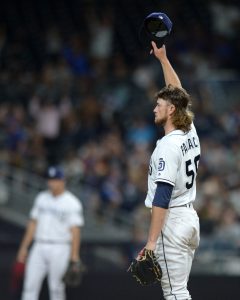
If we go back to June 30, 2016, shortly before the trade deadline, the Padres were well under .500 and on their way to a 68-win season. Meanwhile, the Marlins were 41-38. The long-suffering Fish were under the impression they were playoff contenders at that point. As a result, they traded young right-hander Chris Paddack to the Padres for grizzled reliever Fernando Rodney. Big mistake.
After signing for a guaranteed $2MM in the prior offseason, Fernando enjoyed an unbelievable few months in San Diego, where he recorded an almost perfect 0.31 ERA in 28 2/3 innings and converted 17 saves in as many chances. Unsurprisingly, those numbers proved to be impossible to sustain in Miami. As a member of the Marlins, Rodney logged a ghastly 5.89 ERA (thanks in part to 25 walks in just 36 2/3 innings) and blew three of 11 save opportunities. For their part, the Marlins floundered after the trade en route to a 79-82 finish and yet another non-playoff showing. They lost Rodney to the Diamondbacks via free agency in the ensuing offseason.
In hindsight, the Rodney gamble clearly wasn’t worth it for Miami. On the other side, selling high on him has already paid dividends for San Diego and looks as if it will go down as one of the franchise’s top trades in recent memory. In return for Rodney, the Padres received Paddack, then a low minors prospect who Keith Law of The Athletic (then with ESPN) noted when the swap occurred “hasn’t given up a hit in forever.” MLBTR’s Steve Adams observed that “it seems fair to say that his star is on the rise.”
Paddack’s production was indeed ridiculous that year, during which he managed a 0.85 ERA with 15.1 K/9 against 1.1 BB/9 in 42 1/3 innings between the Marlins’ and Padres’ Single-A teams. However, despite those numbers and the aforementioned praise, he wasn’t necessarily viewed as a can’t-miss prospect at the time of the trade. When the deal went down, MLB.com ranked Paddack 17th in a Marlins farm that was not particularly respected.
In August of the year that the trade occurred, Paddack underwent Tommy John surgery. The procedure wound up costing him all of 2017, but he returned the next season to dominate at the High-A and Double-A levels. That was enough to convince the Padres that Paddack was ready for major league action in 2019, and indeed he was. As a 23-year-old pitching in the bigs for the first time, the fiery Paddack tossed 140 2/3 innings of 3.33 ERA/3.96 FIP ball with 9.79 K/9 and 1.98 BB/9 to emerge as one of the brightest up-and-comers in baseball.
For Preller, another 2016 trade – one in which he gave up James Shields for Fernando Tatis Jr. – looks like his most successful move so far. But Paddack for Rodney comes off as a masterstroke in its own right. With Paddack atop their current rotation, and with excellent prospects MacKenzie Gore and Luis Patino closing in on the majors, the Padres’ long-term rotation picture appears to be in enviable shape.
Photo courtesy of USA Today Sports Images.
NL West Notes: Giants, Espinoza, Rockies
Much of the focus on the trade that sent right-hander Mark Melancon from the Giants to the Braves last July has centered on the surprising fact that the Braves were willing to take on all of the $14MM owed to Melancon in 2020. So much so, it seems, that the return the Giants received is often entirely overlooked. Alex Pavlovic of NBC Sports Bay Area writes, however, that the Giants are excited by the potential of righty Tristan Beck — a 23-year-old fourth rounder from the 2018 draft who saw his velocity trend upward during his run in the Arizona Fall League this year. Beck posted an ugly ERA (5.65) but encouraging FIP/xFIP numbers (3.04, 2.89) in eight starts with Atlanta’s Class-A Advanced affiliate. In the same number of innings with the Giants’ High-A club, Beck’s ERA dropped to 2.27 as he maintained sharp K/9 and BB/9 marks that carried into the fall league. Baseball America ranked Beck 14th among Giants prospects and called him a potential fourth starter, noting that his new organization’s decision to shift his four-seam focus to the top of the zone has improved his overall effectiveness.
A bit more from the division…
- Padres prospect Anderson Espinoza had been eyeing a summer return from last April’s Tommy John surgery, writes Dennis Lin of The Athletic in his latest reader mailbag. His timeline is now TBD, and the leaguewide stoppage has created the risk that he’ll miss an incredible fourth straight season of games. Still just 22 years of age, Espinoza was considered to be one of baseball’s premier minor league arms when the Red Sox shipped him to San Diego in return for a year and a half of Drew Pomeranz. But he’s twice undergone Tommy John surgery — most recently late last April — and now represents something of a wild card in a deep Padres farm system. His last appearance in a minor league game came back on Aug. 31, 2016.
- Although no one quite knows what the draft will look like, Rockies scouting director Bill Schmidt is confident that his club is prepared and ready whenever the date does roll around, per Kyle Newman of the Denver Post. Rox scout Jay Matthews expressed to Newman that the ability to connect with players will be all the more crucial this year, as nondrafted players will be capped at just $20K signing bonuses. “Since we’re all going to be under the same money figure for free agents, it’s going to come down to relationships that the area scouts have established with the prospects,” said Matthews, likening this year’s atypical signing process for undrafted players to the college recruiting process. Newman points out that the Rockies have trended toward college players in recent drafts, with a particular emphasis on pitching. Colorado will have three of the first 46 picks in the draft — whatever form it takes.
Offseason In Review: San Diego Padres
The Padres keep trying to find the perfect roster mix to supplement their rising young talent.
Major League Signings
- Drew Pomeranz, LHP: four years, $34MM
- Craig Stammen, RHP: two years, $9MM (includes $1MM buyout of $4MM club option for 2022)
- Pierce Johnson, RHP: two years, $5MM (includes $1MM buyout of $3MM club option for 2022)
- Total spend: $48MM
Trades and Claims
- Acquired OF Tommy Pham and INF Jake Cronenworth from Rays in exchange for OF Hunter Renfroe, INF Xavier Edwards and INF Esteban Quiroz (as PTBNL)
- Acquired RHP Emilio Pagan from Rays in exchange for OF Manuel Margot and C/OF Logan Driscoll
- Acquired OF Trent Grisham and RHP Zach Davies from Brewers in exchange for 2B/SS Luis Urias and LHP Eric Lauer
- Acquired 2B Jurickson Profar from Athletics in exchange for C Austin Allen and OF Buddy Reed (as PTBNL)
- Claimed INF Breyvic Valera off waivers from the Blue Jays
Notable Minor League Signings
- Abraham Almonte, Kyle Barraclough, Gordon Beckham (since released), Brian Dozier, Jerad Eickhoff, Seth Frankoff, Juan Lagares
Notable Losses
- Carl Edwards Jr., Robbie Erlin, Travis Jankowski, Ian Kinsler (retired), Aaron Loup, Kazuhisa Makita, Nick Margevicius, Bryan Mitchell, Chris Stewart, Robert Stock, Adam Warren, Eric Yardley
As usual, the Padres engaged in quite a lot of eyebrow-raising chatter this winter. There was talk at various points that the club was chasing trades involving Mookie Betts (see here), Kris Bryant (see here), Francisco Lindor (see here), Nick Senzel (same link), and Starling Marte (see here). In free agency, the Friars looked at veteran southpaws Madison Bumgarner and Dallas Keuchel … and also considered another in David Price as part of various trade scenarios.
There’s no new star in San Diego, but that probably wasn’t necessary for an organization that last year welcomed Manny Machado and oversaw the emergence of Fernando Tatis Jr. and Chris Paddack. It might have been nice to announce a new, long-term pact with Tatis. The San Diego organization built up some good will by promoting him to start the 2019 season — that’ll also ensure a full season of 2020 service even if the campaign isn’t played — but couldn’t make apparent headway in talks this winter.
While committing distant future money to a franchise star would’ve been possible, the Friars didn’t have much near-term payroll space to work with. The Padres tried but failed to deal Wil Myers to achieve greater flexibility, so for now they’re left saddled with the remaining three years and $61MM on his heavily back-loaded contract. After a bunch of non-tender decisions and some mostly modest salary additions, the team is sitting at about $144MM in cash payroll for 2020.
So, what did Padres GM A.J. Preller accomplish in his sixth offseason at the helm of baseball operations? Much of the work was in a set of four interesting swaps with three value-focused trade partners.
Most of all, Preller swung an outfield overhaul. Tommy Pham and Trent Grisham each came over as part of multi-player trades that defy characterization as “buy” or “sell”-side transactions for either the Padres or their respective trade partners in Tampa Bay and Milwaukee.
Pham is only controlled for two more seasons, but he could contribute a ton of excess value if he keeps hitting. He’ll replace Hunter Renfroe, one of the players for whom he was traded. Grisham brings a lot more long-term control and some real promise but isn’t nearly as established. He’ll slot into the mix at all three outfield spots, perhaps pairing with minor-league signee Juan Lagares to handle much of the work in center. Otherwise, the Friars will shrug and hope for the best from Myers and oft-injured youngster Francy Cordero. Another young left-handed slugger, Josh Naylor, could also factor into the mix. With a strong showing in the upper minors (if a season is played there), well-regarded prospect Taylor Trammell could force his way into the picture at some point.
As is the case for much of the rest of the San Diego roster, it’s possible to imagine the outfield unit playing at quite a high level … or being rather a marginal outfit. There’s decidedly more star power in the infield, though perhaps the outlook comes with the same sort of qualifications.
Barring injury, the left side of the infield will be occupied almost exclusively by aforementioned wunderkind Tatis and top-dollar star Machado. Greg Garcia is the primary reserve/fill-in option, with Ty France and newcomer Jake Cronenworth also on the 40-man. Francisco Mejia and Austin Hedges remain entrenched behind the dish, with hopes one or both will make strides in 2020. At first base, the Pads may ultimately have to decide whether to reduce the time of the disappointing Eric Hosmer. It’s arguable that the best alignment would involve a time share between Hosmer and Myers, however hard that would be to swallow given each former Royal’s weighty contract.
Ian Kinsler’s decision to elect retirement after a tough 2019 showing unexpectedly cleared some salary and seemed to pave a path to regular at-bats for top prospect Luis Urias — but the club obviously didn’t fully believe in him as a replacement. He ended up departing in the Grisham swap. The Padres gave up a bit of young talent to take over the final season of arbitration eligibility of Jurickson Profar, a formerly elite prospect (from back when he and Preller were with the Rangers organization) who was a mostly uninspiring performer in 2019. He’ll battle at second base with minor-league signee Brian Dozier. It wouldn’t be surprising to see that situation ultimately end up in a timeshare (with Garcia, France, and/or Cronenworth potentially involved).
Those aforementioned outfield moves spelled the end of the line for Manuel Margot in San Diego. He ended up being shipped out along with 2019 second-rounder Logan Driscoll in order to acquire reliever Emilio Pagan. The late-blooming Pagan brings highly appealing K/BB numbers and a big swinging-strike rate out west, but it seems rather curious that he will now be on his fourth MLB team in four seasons. Pagan carried an unsustainable strand rate (94.8%) to reach a 2.31 ERA last year and has been rather prone to the long ball (1.58 per nine for his career).
The Padres have visions of Pagan joining closer Kirby Yates to form a powerful combination of late-inning righties. Completing the high-leverage mix is southpaw Drew Pomeranz, who rode his second-half surge to a much bigger-than-expected contract and a surprising return to San Diego. The 31-year-old was flat-out dominant down the stretch, but it was still stunning to see the Friars go to a four-year guarantee to lure him. Further bullpen-building came in the form of more modest two-year pacts to bring back Craig Stammen and add interesting NPB returnee Pierce Johnson, who whiffed 91 hitters through 58 2/3 innings en route to a 1.38 ERA with the Hanshin Tigers in Japan last season.
The depth seems like it’ll be necessary. Young hurlers Andres Munoz and Reggie Lawson were each lost to Tommy John surgery in camp. The Padres can still turn to a host of other young arms, but most come with questions. Southpaw Matt Strahm (who has much better career numbers as a reliever) and converted infielder Javy Guerra seem likely to join the ‘pen once the season begins. Luis Perdomo, Adrian Morejon, Michel Baez, Ronald Bolanos, David Bednar, Jose Castillo, Trey Wingenter, and Gerardo Reyes and sixth starter Cal Quantrill are all 40-man options as well — some with real upside — but you’d have a hard time arguing any as sure things.
That leaves a rotation mix that mostly went untouched over the winter. The Friars did bring in Zach Davies while parting with Eric Lauer as the other half of the Grisham/Urias swap. It’s too much to expect a repeat of his 2019 showing (31 starts of 3.55 ERA ball), but Davies should be a solid part of the staff. The same holds true of Joey Lucchesi, who returns along with the upside-laden trio of Paddack, Garrett Richards, and Dinelson Lamet to form quite an interesting rotation mix. It would be even more exciting to see this group in a full season, when it could be supplemented by top prospects MacKenzie Gore and Luis Patino, but that’s all coming soon enough.
2020 Season Outlook
It’s awfully tough to look at this roster and see a threat to the powerhouse Dodgers. But all bets are off in a short-season format, which is likely all we’ll get if the 2020 season is played at all. And there’s reason for the Padres to hope they’ve done enough at least to compete for a Wild Card spot, though it’s a crowded NL field and it’ll be tough to make mid-season improvements given the (seeming) lack of payroll breathing room.
How would MLBTR fans grade the Padres’ offseason dealings? (Link to poll for Trade Rumors mobile app users)
Grade the Padres' offseason:
-
B 53% (1,338)
-
C 28% (704)
-
A 10% (261)
-
D 5% (132)
-
F 3% (71)
Total votes: 2,506