
Padres Agree To Terms With Cole Wilcox
The Padres and third-rounder Cole Wilcox are in agreement on a $3.3MM signing bonus, MLB.com’s Jim Callis reports (on Twitter). With the deal, Wilcox, a right-hander out of the University of Georgia, receives a record bonus for a third-round pick and absolutely shatters his slot value of $767,800.
Entering the draft, Wilcox was widely regarded as a potential first-round talent, but as a draft-eligible sophomore, he had some leverage working in his favor. Concerns over signability might’ve caused some clubs to pass, and the fact that Wilcox’s eventual bonus aligns closely with what would’ve been Top 20 slot money illustrates the difficulties other teams may have had in hammering out a deal. The Padres signed top pick Robert Hassell III nearly $900K under-slot, though, and they also “saved” $450K on third-rounder Owen Caissie and fourth-rounder Levi Weaver alike.
Wilcox, 20, ranked inside the draft’s 25 best prospects in the opinion of The Athletic’s Keith Law (No. 14), FanGraphs’ Eric Longenhagen (No. 18), ESPN’s Kiley McDaniel (No. 23) and the team at MLB.com (No. 23) and Baseball America (No. 24). Wilcox’s fastball reached 100 mph in a bullpen role and sat mid- to upper-90s as a starter, Law notes. He also has the makings of a pair of above-average offspeed pitches, with his slider ahead of his changeup by most counts (although Callis & Co. believe the opposite to be the case in their report).
As with any pitching prospect, there are some red flags — notably Wilcox’s at-times spotty command — but his 6’5″, 232-pound frame and arsenal of power offerings are enough for Padres fans to dream on as the organization adds yet another high-end talent to its minor league ranks.
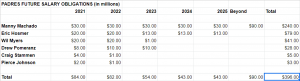
Manny & Hoz Account For Bulk Of Padres’ Long-Term Contract Commitments
2020 salary terms may finally be sorted out. But what about what’s owed to players beyond that point? The near-term economic picture remains questionable at best. That’ll make teams all the more cautious with guaranteed future salaries.
Every organization has some amount of future cash committed to players, all of it done before the coronavirus pandemic swept the globe. There are several different ways to look at salaries; for instance, for purposes of calculating the luxury tax, the average annual value is the touchstone, with up-front bonuses spread over the life of the deal. For this exercise, we’ll focus on actual cash outlays that still have yet to be paid.
We have now run through every team, with a big assist from the Cot’s Baseball Contracts database. Prior entries can be found here. The final team is the Padres:
*Manny Machado may opt out after 2023
*Eric Hosmer may opt out after 2022
*Includes buyouts on club options over Wil Myers, Craig Stammen, and Pierce Johnson
*Includes estimated distribution of signing bonus in Drew Pomeranz contract
(click to expand/view detail list)
Padres Announce Initial 60-Man Player Pool
Today marks the deadline for teams to submit their initial spring training player pools, which can comprise up to 60 players. Players are not eligible to participate in either a spring training or regular season game until they are included in the pool. Teams are free to change the makeup of the pools as they see fit. However, players removed from a team’s 60-man (for reasons unrelated to injury, suspension, etc.) must be exposed to other organizations via trade or waivers.
Not all players within a team’s pool are ticketed for MLB playing time, of course. Most teams will include well-regarded but still far-off prospects as a means of getting them training reps with no intention of running them onto a major league diamond this season. A comprehensive review of 2020’s unique set of rules can be found here.
The Padres’ initial 52-player pool consists of the following players…
Right-handed pitchers
- Michel Baez
- David Bednar
- Ronald Bolanos
- Zach Davies
- Jerad Eickhoff
- Javy Guerra
- Pierce Johnson
- Dinelson Lamet
- Chris Paddack
- Emilio Pagan
- Luis Patino
- Luis Perdomo
- Cal Quantrill
- Gerardo Reyes
- Garrett Richards
- Craig Stammen
- Trey Wingenter
- Kirby Yates
Left-handed pitchers
- Joey Cantillo
- Jose Castillo
- MacKenzie Gore
- Joey Lucchesi
- Adrian Morejon
- Drew Pomeranz
- Matt Strahm
- Ryan Weathers
Catchers
Infielders
- CJ Abrams
- Gabriel Arias
- Jake Cronenworth
- Ty France
- Greg Garcia
- Eric Hosmer
- Manny Machado
- Tucupita Marcano
- Owen Miller
- Jurickson Profar
- Fernando Tatis Jr.
- Breyvic Valera
Outfielders
Padres Sign 34th, 45th Overall Draft Picks
The Padres have signed supplemental first-round pick Justin Lange and second-rounder Owen Caissie, Jim Callis of MLB.com tweets (links: 1, 2). Lange will earn $2MM, while Caissie agreed to a bonus worth $1,200,004.
As the 34th overall pick, Lange’s selection came with a recommended value of $2,148,100. The Texas-based high school right-hander and Dallas Baptist recruit’s stock rose over the past year, thanks in part to a fastball that has skyrocketed to the 95 to 100 mph range. According to Baseball America, which ranked him as the 50th-best player in this year’s draft class, “Lange has all of the foundational pieces to be an impact pitcher at the next level.” That said, there are concerns about his command and his slider, per BA.
Caissie – the 45th choice – also signed for below slot, as his pick came with a recommended value of $1,650,200. The Canadian high school outfielder, who committed to Michigan before the draft, brings “super-projectable power,” above-average running and a big arm to the table, per Callis. BA only ranked Caissie as the 180th overall player before the draft, though MLB.com was much more bullish in placing him 75th.
With the Padres having secured Lange, Caissie and three other picks, they’re down to one unsigned selection – third-round righty Cole Wilcox. Money shouldn’t stand in the way a deal, though, as Wilcox’s pick (No. 80) carries a slot value of $767,800 and, as Jeff Sanders of the San Diego Union-Tribune points out, the Padres can still spend up to $3.3MM more.
Padres, First-Rounder Robert Hassell III Agree To Deal
On a day loaded with first-round signings, the Padres have become the latest team to reach a deal with their top pick. The Padres announced that they’ve come to terms with outfielder Robert Hassell III, the eighth overall selection in this year’s draft. Hassell will earn $4.3MM, down from the $5,176,900 slot value of his pick, Jeff Sanders of the San Diego Union-Tribune reports.
The 18-year-old Hassell committed to Vanderbilt before the draft, but the Padres managed to stop the Commodores from landing a highly promising prospect. MLB.com, FanGraphs, Baseball America, ESPN.com and The Athletic all ranked Hassell in the draft’s top 20 prospects entering the proceedings. Nobody was more bullish than ESPN’s Kiley McDaniel, who ranked Hassell sixth of those available, wrote that he may “have the best hit tool in the prep class” and noted that he has drawn comparisons to high-end Braves outfield prospect Drew Waters.
Amateur Draft Signings: 6/16/20
We’ll keep track of the latest amateur draft signings here…
- The Cardinals announced the signing of outfielder Alec Burleson, whom they drafted 70th overall. He’ll earn $700K, quite a bit less than the $906,800 value of his pick, according Jim Callis of MLB.com. The Cards landed the choice they used on Burleson as compensation for the departure of outfielder Marcell Ozuna in free agency. An East Carolina University product, Burleson topped out as FanGraphs’ 108th-ranked prospect before the draft. Burleson was a successful first baseman and left-handed pitcher in college, but he’s regarded as a much better hitting prospect, MLB.com notes.
- The Mets have signed third-round pick Anthony Walters for $20K, Jonathan Mayo of MLB.com tweets. It’s a stunningly low amount for a player whose pick, No. 91, was said to be worth $647,300. The total Walters received only matches the maximum sum an undrafted player can get this year. Walters, a former San Diego State shortstop, didn’t rank among Baseball America’s top 500 before the draft. However, Mayo observes that Walters brings “good hands” as a defender and “sneaky pop” at the plate.
- The Padres have inked fourth-rounder Levi Thomas for $80K, far below the $533K slot value of the 109th pick, Jim Callis of MLB.com reports. The right-hander from Troy “has an impressive history of throwing strikes and his fastball seems to have qualities that teams love,” Baseball America wrote in ranking Thomas as the 224th-best prospect in the 2020 class.
- The Nationals have reached a $20K agreement with fourth-round catcher Brady Lindsly, per Callis. The University of Oklahoma product, who was not one of BA’s top 500 prospects, did not expect to get drafted.
Each NL Team’s Top Recent Draft Class
With the MLB draft scheduled for next week, let’s take a look at each National League team’s most successful draft class in recent memory. Using Baseball Reference’s draft tracker, we can sum the combined career bWAR of each player selected by each team in a given year. It’s a simple shorthand, not a perfect measure, but it’ll give some insight into which teams have really hit on their picks in certain years.
First, a quick note on the methodology. For simplicity, we’re limiting this search to the 2006-2015 classes. A player’s value is only included if he signed with the club, although he needn’t have actually played for his drafting team in the majors. (So, the 2008 Yankees don’t get credit for drafting but failing to sign Gerrit Cole, while the 2007 Red Sox do get credit for drafting and signing Anthony Rizzo, even though he was traded before ever playing an MLB game for Boston). Of course, a player drafted in 2006 has had more time to rack up value than one drafted in 2015, so we’ll note in each team’s capsule if a more recent class is on the verge of taking over from an older class. On to the results…
- Braves: 2007 (76.6 bWAR) – Hitting on Jason Heyward and Freddie Freeman in the first two rounds goes a long way. Heyward has been a disappointment with the Cubs but had some electrifying seasons in his early days in Atlanta (and his year in St. Louis), while Freeman has emerged as a fixture in the Braves’ lineup as one of the best hitters in baseball over the past decade.
- Brewers: 2009 (30.7 bWAR) – This was period of some underwhelming draft returns for Milwaukee. The 2009 class tops the list thanks to Khris Davis, Mike Fiers and Scooter Gennett, all of whom are better known for their play (or whistleblowing, in Fiers’ case) elsewhere.
- Cardinals: 2006 (56.3 bWAR) – By virtue of putting up baseball’s best record in 2005, the Cardinals sat at the back of every round in 2006. No matter, as they managed to find a handful of highly productive big leaguers. First-rounder Adam Ottavino didn’t work out in St. Louis but went on to a strong career as a reliever in Colorado. Tommy Pham (16th round) and Jon Jay (2nd round) have each carved out strong careers, while Allen Craig (8th round) had a brief but productive peak.
- Cubs: 2007 (54.4 bWAR) – Unfortunately for the Cubs, this class is almost all about Josh Donaldson, who did none of his damage in a Chicago uniform. Perhaps Javier Báez (2012 draft) or Kris Bryant (2013 draft) will match or exceed Donaldson’s stellar career in time.
- Diamondbacks: 2009 (73.1 bWAR) – Paul Goldschmidt (8th round) went on to become the top position player in franchise history. First-rounder AJ Pollock had a couple star-level seasons of his own before injuries knocked him off track, while Chase Anderson (9th round) has emerged as a solid back-of-the-rotation starter.
- Dodgers: 2006 (70.6 bWAR) – The Dodgers only signed two big leaguers from the 2006 class. When one of them goes on to become arguably the best pitcher of his generation, you can more than get away with it. Clayton Kershaw’s Hall of Fame plaque will boast at least three Cy Young Awards and an NL MVP.
- Giants: 2008 (65.6 bWAR) – The late-2000’s draft classes set up the crux of the Giants’ three World Series titles the first half of the next decade. None was more impactful than 2008, when SF grabbed Buster Posey and Brandon Crawford in the first and fourth rounds, respectively.
- Marlins: 2010 (56.1 bWAR) – Christian Yelich and J.T. Realmuto have matured into two of the best players in baseball, so the Marlins’ 2010 class (which also boasted late-blooming A’s slugger Mark Canha) has a chance to be really special. Of course, none of those players are still in Miami.
- Mets: 2010 (50.5 bWAR) – Seventh overall pick Matt Harvey was briefly the ace the Mets hoped they were adding in 2010. As it turns out, Jacob deGrom (9th round) had a lot more staying power atop their rotation.
- Nationals: 2009 (44.9 bWAR) – First overall pick Stephen Strasburg has more than made good on that selection, culminating in a World Series MVP effort in 2019. The 2009 class also brought in a handful of role players, including Drew Storen and Michael Taylor.
- Padres: 2007 (38.9 bWAR) – Another team for whom the top player simply got away, the crown jewel of the Padres’ 2007 class was Corey Kluber (4th round). Obviously, even San Diego didn’t him expect him to go on to win a pair of Cy Young Awards.
- Phillies: 2014 (24.2 bWAR) – There were some tough results for the Phillies on draft day in recent seasons, but 2014 looks to be a notable exception. Aaron Nola went seventh overall and has emerged as a high-level starter, while Rhys Hoskins (fifth round) looks like the Phils’ long-term answer at first base.
- Pirates: 2011 (29.7 bWAR) – The Pirates’ 2011 class is almost exclusively about the contributions of first overall pick Gerrit Cole, but he obviously reached his peak after being traded to Houston. Josh Bell (2nd round) looked to have turned the corner at the plate in the first half of 2019.
- Reds: 2007 (43.1 bWAR) – The Reds found three future everyday players in the 2007 class. Todd Frazier (supplemental first-round), Zack Cozart (2nd round) and Devin Mesoraco (1st round) all went on to become productive players in Cincinnati.
- Rockies: 2009 (47.4 bWAR) – The Rockies graduated six players from the 2009 class to the big leagues, although only one proved a smashing success. Finding a player of Nolan Arenado’s caliber in the second round makes for a great draft even if the rest of the players taken underwhelm.
Latest On Furloughs, Pay Cuts Among MLB Clubs
6:09pm: The Rangers have committed to $400 a week for their minor leaguers through at least June, Levi Weaver of The Athletic was among those to report. The same goes for the Braves, per David O’Brien of The Athletic, as well as the Diamondbacks, Nick Piecoro of the Arizona Republic adds.
12:59pm: The Padres will also pay their minor leaguers the $400 weekly stipend through the end of August, Dennis Lin of The Athletic tweets.
12:34pm: Most of MLB’s 30 organizations agreed a ways back to pay their employees through the end of May. There were instances of lengthier commitments, but May 31 was broadly used as an initial endpoint, at which time fiscal matters would be reassessed. Minor league players have been receiving $400 weekly stipends during this time, but that arrangement is also only promised through the end of May. As you’d expect, clubs have begun to inform employees (both on the business and baseball operations side) and minor leaguers of their next steps. And, as you’d expect, in some instances it’s not pretty.
Yesterday was a particularly dark day in the Athletics organization, as ESPN’s Jeff Passan reports that the team informed minor league players they will no longer be paid their stipend as of June 1. Robert Murray of The Score shares the email that was sent to Oakland minor leaguers — one which was signed by GM David Forst rather than managing partner John J. Fisher. (Forst, of course, is being asked to play the messenger in this instance and is not the one making the decisions.)
Minor league players are generally undercompensated as a whole, and the $400 weekly stipend they’ve received over the past two months will now seemingly go down as the only baseball-related compensation they’ll receive in the calendar year. Their contracts, which are in a state of suspension but not terminated, bar them from “perform[ing] services for any other Club” and also render them ineligible for unemployment benefits, per The Athletic’s Emily Waldon (Twitter link).
As for the operations side of the equation, Athletics front office personnel will be either furloughed or see their pay reduced effective June 1 and running through the end of October, The Athletic’s Alex Coffey reports (Twitter thread). She adds that the maximum cut is 33 percent, and those determinations are based on seniority. Scouts aren’t considered front-office personnel, but they’ll be hit hard as well; USA Today’s Bob Nightengale tweets that A’s amateur and pro scouts alike will be furloughed from June 16 through Oct. 31. Fisher did write a letter to the club’s fanbase confirming the dramatic cuts (Twitter link via the San Francisco Chronicle’s Susan Slusser), emphasizing the pain that went into the decisions and his “deep commitment to the long-term future of the A’s.”
Those cutbacks are similar to the substantial cuts the Angels put in place earlier this month, but other L.A. club isn’t taking such rash measures. The Dodgers have informed all employees earning more than $75K that they’ll be subject to pay reductions beginning June 1, Ramona Shelburne of ESPN (Twitter thread). The extent of the reductions is dependent on overall salary — larger salaries get larger percentage cuts — and will be capped at 35 percent for the most part, although that they could be greater for the team’s very top executives. Those measures are being taken in an effort to avoid the type of large-scale furloughs being put in place in Oakland and Anaheim.
Across the country, the Nationals have implemented a series of partial furloughs both in baseball ops and business ops, Jesse Dougherty of the Washington Post reports (Twitter thread). The Nats are still covering full benefits and haven’t made any layoffs, but they’re implementing a sequence of 10 to 30 percent reductions in pay and total hours. The Brewers, meanwhile aren’t making any baseball ops furloughs but are furloughing some business operation employees, Todd Rosiak of the Milwaukee Journal-Sentinel tweets.
It’s not yet clear how every organization plans to handle the minor league pay dilemma, but Baseball America’s Kyle Glaser has heard from at least three clubs that plan to continue varying levels of compensation. The Phillies will keep paying their minor leaguers through at least June, but likely at less than the current $400 stipend. The White Sox are paying $400 per week through the end of June, and the Marlins have committed to paying their minor leaguers the full $400 per week through August — the would-be conclusion of the 2020 minor league season. The Marlins already informed players earlier this month that about 40 percent of the baseball ops department will be furloughed on June 1.
Which 15 Players Should The Padres Protect In An Expansion Draft?
In a few weeks, we’ll be running a two-team mock expansion draft here at MLBTR – just for the fun of it! Currently, we’re creating 15-player protected lists for each of the existing 30 teams. You can catch up on the rules for player eligibility here.
So far, we’ve covered the Giants, Rangers, Mariners, Athletics, Angels, Astros, Twins, Royals, Tigers, Indians, White Sox, Rays, Yankees, Red Sox, Blue Jays and Orioles. The Padres are up next.
We’ll start by removing free agents Garrett Richards, Kirby Yates, and Jurickson Profar from consideration.
Manny Machado and Eric Hosmer will make the list due to their no-trade protection. For this exercise, I’ve also decided to automatically protect any Baseball America Top 100 Prospect to whom they gave a 2020 ETA. That means Adrian Morejon is on the list. Otherwise, I’ve decided to make minor leaguers ineligible for our mock expansion draft. Here’s the full list of 12 Padres I’ll protect out of the gate:
Manny Machado
Eric Hosmer
Fernando Tatis Jr.
Chris Paddack
Adrian Morejon
Tommy Pham
Dinelson Lamet
Joey Lucchesi
Trent Grisham
Drew Pomeranz
Emilio Pagan
Francisco Mejia
That leaves three spots for the following 22 players:
Michel Baez
David Bednar
Ronald Bolanos
Jose Castillo
Franchy Cordero
Zach Davies
Ty France
Greg Garcia
Javy Guerra
Austin Hedges
Pierce Johnson
Andres Munoz
Wil Myers
Josh Naylor
Luis Perdomo
Cal Quantrill
Gerardo Reyes
Craig Stammen
Matt Strahm
Luis Torrens
Breyvic Valera
Trey Wingenter
With that, we turn it over to the MLBTR readership! In the poll below (direct link here), select exactly three players you think the Padres should protect in our upcoming mock expansion draft. Click here to view the results.
A Standout’s Unusual Path To D.C.
Since he made his major league debut in 2015, Trea Turner has established himself as one of the reigning World Series champion Nationals’ most valuable players. A second baseman and then a center fielder at the beginning of his career, Turner took over as the Nationals’ shortstop in 2017 and now has a stranglehold on the position.
Dating back to his first full season in 2018, Turner has accounted for 8.3 fWAR and hit .283/.348/.451 (110 wRC+) with 38 home runs and 78 stolen bases – the second-highest total in MLB – across 1,309 plate appearances. And the 26-year-old Turner figures to contribute similar or better production in Washington for at least the next couple seasons, as he’s only now about to enter his first of three arbitration-eligible campaigns.
With Turner having already given the Nationals quite a bit of surplus value, it’s worth revisiting how he joined the team in the first place. To say the least, it was unusual transaction that led him to D.C. Turner was a 20th-round pick of the Pirates in 2011, but he elected to pass on signing with the Bucs in order to play at North Carolina State. That proved to be a wise decision by Turner, who increased his stock so much as a college player that the Padres took him 13th overall in 2014. Little did Turner or the Padres know then that he’d never play a real game in their uniform, nor was either side aware their relationship would end in such unconventional fashion.
While Turner continued to succeed as a young pro with the Pads, ranking as Baseball America’s 65th-best prospect prior to 2015, the club parted with him that year. Actually, though, San Diego agreed to trade Turner in December 2014 in a three-team blockbuster that also involved the Rays and Nats and. The Padres received outfielder Wil Myers, pitchers Gerardo Reyes and Jose Castillo, and catcher Ryan Hanigan. The Rays acquired first baseman Jake Bauers, righty Burch Smith, outfielder Steven Souza Jr., catcher Rene Rivera and lefty Travis Ott. The Nationals picked up righty Joe Ross and a player to be named later. Ross showed flashes at the beginning of his Nats tenure, but injuries have helped knock him off course in recent years. On the other hand, the PTBNL, Turner, has been a gem.
Although the Padres and Rays had a handshake agreement in regards to Turner, they weren’t allowed to make it official for a while because of previous MLB rules. The league formerly had a system in place that barred teams from trading anyone who wasn’t a year removed from being drafted. So, because Turner didn’t meet that requirement, he had to spend several more months with the Padres, even though he knew he wasn’t really a member of the team. Turner’s agent, Jeff Berry, suggested he’d fight the setup. In the end, however, Turner didn’t officially change hands until June 2015 – one month after the league instituted new rules to stop something similar from taking place.
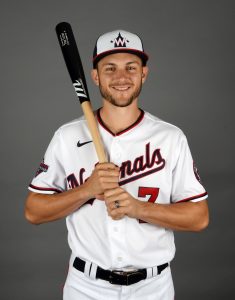
To the Padres’ credit, they treated Turner well during his waning months with the club. Turner had to go to Padres spring training and play in the minors as part of the franchise as he waited for the finalization of the trade, and he complimented the team on multiple occasions during that period.
Unfortunately for San Diego, it hasn’t gotten nearly enough out of this trade in hindsight. Turner, after all, has clearly become the top player in this massive swap. Myers had an All-Star season in 2016, which persuaded the Padres to hand him a six-year, $83MM extension, but he has fallen off since then and is now someone they’d like to remove from their books. Reyes had a rough go in his MLB debut last season (7.62 ERA), though he did amass 38 strikeouts in 26 innings. Castillo performed well as a rookie two years ago, but injuries wrecked his 2019. Unlike those three, Hanigan never even played for the Padres, who quickly flipped him to the Red Sox for third baseman Will Middlebrooks. Although Middlebrooks did pile up 270 PA as a Padre in 2015, he was just a .212/.241/.361 hitter then.
It’s fair to say this deal will not go down as a shining moment for Padres general manager A.J. Preller. Conversely, it’s one of the many feathers in the cap of GM Mike Rizzo and the Nationals, for whom a one-time player to be named later helped to a championship several months back.
Photo courtesy of USA Today Sports Images.