
AL West Notes: Otani, Angels, Rangers
As many as 16 teams had scouts and/or executives on hand to watch star right-hander Shohei Otani‘s most recent start, reports Dylan Hernandez of the L.A. Times (Twitter links). Of particular note, Hernandez adds that Mariners general manager Jerry Dipoto was among the execs on hand to scout Otani. The start was just Otani’s third of the season, as he’s been hampered by ankle and hamstring injuries throughout the calendar year that have prevented him from getting on the mound. It’s not yet certain if the two-way phenom will be posted for MLB clubs to bid on this offseason — the new CBA’s strict limits on international spending have radically limited his earning power in that scenario — but if he does, virtually every team that is not currently restricted for shattering previous bonus pools would have interest in the 23-year-old. Otani posted a 1.80 ERA with a 174-to-45 K/BB ratio in 140 innings on the mound and hit .322/.416/.588 with 22 homers in 382 plate appearances last season. He’s hitting .346/.416/.574 with seven homers through 185 PAs as a designated hitter this year.
More from the AL West…
- In addition to right-hander David Hernandez, the Angels would likely have traded righty Bud Norris leading up to the non-waiver deadline but didn’t receive much interest in him, the L.A. Times’ Pedro Moura writes in his latest Angels Inbox column. General manager Billy Eppler and his staff weren’t sure the team would have a reasonable enough shot at a Wild Card berth to pursue additions on July 31, though they obviously pivoted in August, acquiring Justin Upton and Brandon Phillips. As Moura notes, Hernandez hasn’t exactly dominated following his trade to Arizona, so that minor swap isn’t likely to be the ultimate difference in whether the Angels secure a Wild Card position or come up just shy. The Halos are one game back of the Twins for that spot at the moment. Moura also gives his thoughts on the team’s chances of retaining Upton and Phillips beyond 2017 and examines some of the Angels’ better low-cost pickups, so Halos fans will want to check it out.
- Jeff Fletcher of the Orange County Register writes that Angels lefty Andrew Heaney could miss his next start due to some shoulder troubles. While an MRI showed that Heaney did not have an “acute strain,” it also revealed symptoms “consistent with internal impingement.” Heaney has struggled in four of his five starts since returning from Tommy John anyhow, but the injury-ravaged Angels’ pitching staff hardly needs further injuries to tax the rotation or the bullpen with a Wild Card spot in arm’s reach.
- Promoting top prospect Willie Calhoun may not have been an easy call for the Rangers, writes Evan Grant of the Dallas Morning News, as the team didn’t have to add him to the 40-man to protect him from the Rule 5 Draft this winter. And, as Grant points out, the Rangers will already be effectively operating with only 39 spots on their 40-man roster, as they’ll need to carry Prince Fielder throughout the offseason in order to place him back on the 60-day disabled list next spring and collect the insurance on his contract. Nonetheless, injuries to Adrian Beltre, Carlos Gomez, Rougned Odor and Mike Napoli as well — Grant tweets that he could be down for a bit after missing yesterday’s game with “lower body stiffness” — created a need for Calhoun. He’ll likely play left field, with Delino DeShields manning center while Gomez is down.
Rangers To Promote Willie Calhoun
The Rangers have given notice to prospect Willie Calhoun that he will be called up, as his brother and girlfriend announced on Twitter and Evan Grant of the Dallas Morning News confirms in a tweet. Calhoun came to Texas as the headliner in the deadline blockbuster that sent ace Yu Darvish to the Dodgers.
Calhoun, 22, entered the season as a top-100 prospect leaguewide and has steadily raised his stock throughout the year. He’s carrying a .300/.355/.572 batting line with 31 home runs over 534 plate appearances at Triple-A in his first attempt at the highest level of the minors. While he doesn’t draw all that many walks, Calhoun has struck out only 61 times all season.
Predominantly a second baseman in the Los Angeles system, Calhoun has shifted to the outfield since arriving at Round Rock. It seems reasonably likely that he’ll line up there at the MLB level both now and into the future, though that’ll be determined by his play on the field.
It’s not immediately clear how Calhoun will be used over the next couple of weeks, but he could provide instant offense with his potent left-handed bat. As Grant explains, the Rangers have recently lots several key players to injury. While there’s plenty of depth around with rosters having expanded, none of the team’s fill-in options possess Calhoun’s potential as a hitter.
Despite selling at the deadline, the Rangers have held on in a messy race race for the second AL Wild Card that still features seven clubs (including Texas) within three and a half games of the berth. Beyond the need to create room on the 40-man roster, there’s little downside to calling upon Calhoun, who likely would’ve forced his way into the MLB picture in 2018 regardless.
At this stage of the season, of course, the youngster won’t have much opportunity to build up MLB service time (just 18 days, in fact). But he could well find himself in a position to force his way into the team’s plans for early next season — and might well be a strong possibility to appear on a postseason roster if the Rangers can sneak in.
Free Agents That Have Boosted Their Stock On One-Year Deals
With the offseason looming, it’s easy to focus on the top free agents this winter will have to offer. We at MLBTR reinforce that line of thinking with monthly Free Agent Power Rankings that profile the top names slated to hit the open market and ranking them in terms of earning power.
Settling for a one-year contract isn’t an ideal route for most free agents, but that doesn’t mean that those (relative) bargain pickups can’t bring significant on-field impact to the teams with which they sign. While none of the players on this list received all that much fanfare when signing, they’ve all provided some notable benefit to the teams that made these commitments:
- Kurt Suzuki, $1.5MM, Braves: Suzuki languished in free agency for several months as players like Jason Castro, Matt Wieters and Welington Castillo all generated more attention from teams and fans. However, it might be Suzuki that has provided the most bang for buck on last winter’s catching market. The 33-year-old has had a surprising career year in Atlanta, hitting .266/.344/.507 with 15 homers to date. Some have been quick to suggest that Atlanta’s new homer-happy stadium has benefited Suzuki, and while that may be true to an extent, he’s hit for more power on the road than at home. He’s put himself in position for a possible two-year deal this winter, but if he has to settle for one yet again, it should come at a higher rate.
- Adam Lind, $1.5MM, Nationals: An awful 2016 season and an overcrowded market for corner bats created some questions about whether Lind would have to settle for a minor league contract late last winter. He ultimately secured a guaranteed deal, but it came with just a $1MM base and a $500K buyout of a mutual option. For that meager commitment, he’s given the Nats 267 plate appearances with a .297/.352/.490 slash to go along with 11 homers. Like Suzuki, that might not land him a starting role, but it could land him multiple years as a complementary bench piece.
- Chris Iannetta, $1.5MM, Diamondbacks: Iannetta has not only rediscovered his power stroke in 2017 — he’s made it better than ever. The 34-year-old’s .249 ISO is a career best, and he’s slugged 14 homers. While that’s still four shy of his career-best with the 2008 Rockies, Iannetta’s 14 big flies this year have come in just 272 PAs, whereas he needed 407 to reach 18 back in ’08. He’s also bounced back from a down year in the framing department and been above average in that regard, per Baseball Prospectus.
- Jhoulys Chacin and Clayton Richard, $1.75MM each, Padres: The Friars signed four starters for $3MM or less last winter — Jered Weaver and Trevor Cahill being the others — and have received a combined 345 innings out of this pair. Chacin’s run-prevention (4.06 ERA) and strikeout rate (7.44 K/9) have been better, while Richard has 13 more innings (179 total), superior control (2.6 BB/9) and superior ground-ball tendencies (59.1 percent). Neither is going to be mistaken for much more than a back-of-the-rotation stabilizer, but both have done enough to garner larger commitments on the upcoming open market.
- Brian Duensing, $2MM, Cubs: I doubt I was alone in being surprised to see Duensing, 34, land a Major League deal last winter on the heels of a lackluster season in the Orioles organization. Duensing, though, has quietly been outstanding for the Cubs. In 54 2/3 innings, he’s logged a career-high 9.05 K/9 rate with 2.30 BB/9 and a 47 percent ground-ball rate en route to a 2.63 ERA. He’s held lefties in check reasonably well, but the first time in his career he’s also striking out right-handed batters at a lofty rate. In fact, the .211/.276/.317 that righties have posted against him is actually weaker than the .256/.300/.388 slash to which he’s limited left-handed bats.
- Matt Belisle, $2.05MM, Twins: Belisle’s inclusion is arguable; he’s posted a pedestrian 4.36 ERA with 8.55 K/9, 3.69 BB/9 and a 42.2 percent ground-ball rate. Those numbers are largely skewed by a putrid month of May, however. Since June 3, Belisle has a 2.25 ERA with nearly a strikeout per inning and improved control and ground-ball tendencies — all while stepping into higher and higher leverage roles. He’s now serving as the Twins’ closer and has a 1.54 ERA with a 29-to-5 K/BB ratio since July 1. He’ll be 38 next season, so the earning power here isn’t sky-high, but he’s probably earned a raise, barring a late collapse.
- Logan Morrison, $2.5MM, Rays: Few players have benefited more from one-year, “pillow” contracts in recent memory than Morrison, who has parlayed his $2.5MM deal into a .248/.355/.529 batting line and a 36-homer season campaign to date. Morrison only just turned 30 years old, so he’ll have age on his side this winter as well. A three- or four-year deal seems plausible for Morrison even with the diminished recent market for corner bats.
- Alex Avila, $2.5MM, Tigers: Avila hasn’t been as excellent with the Cubs as he was with the Tigers, but he’s still among the league leaders in hard contact and exit velocity — both of which have beautifully complemented his always-terrific walk rate (15.9 percent in 2016). With 14 homers under his belt and a batting line that grades out roughly 25 percent better than the league average, per context-neutral metrics like OPS+ (124) and wRC+ (127), Avila could vie for a multi-year deal and/or a starting job this offseason.
- Joe Smith, $3MM, Blue Jays: Smith’s K/9 has nearly doubled, from 6.92 in 2016 to 11.86 in 2017, and he’s posted a dramatically improved 1.82 BB/9 this year as well. Smith has also served up just three homers in 49 1/3 innings of work, and his 3.10 ERA, while solid, is actually representative of some poor fortune in the estimation of fielding-independent metrics (1.97 FIP, 2.35 xFIP, 2.34 SIERA). He’ll be 34 next year but should top that $3MM mark and could net the second multi-year free-agent deal of his career.
- Andrew Cashner, $10MM, Rangers: MLBTR’s Jeff Todd recently took a more in-depth look at Cashner, noting that his strong 3.19 ERA isn’t backed up by his K/BB numbers. Cashner’s complete lack of missed bats — he has the lowest swinging-strike rate and second-lowest K/9 rate of qualified MLB starters — is going to limit his earning power. But, he’s undeniably been better than he was in 2016, his velocity is comparable to last season and he’s limited hard contact quite well. A multi-year deal is certainly a possibility this offseason.
- Carlos Gomez, $11.5MM, Rangers: Gomez’s production hasn’t reached the star levels it did in 2013-14, but he’s been a better performer at the plate this season. A spike in his OBP (from .298 to .337) is due largely to a massive increase in the number of pitches by which he’s been hit, which is less encouraging than if he’d upped his walk rate considerably. However, Gomez has also shown quite a bit more power in 2017 than he had in recent seasons (.208 ISO in ’17 vs. .153 in ’15-16 combined), and Defensive Runs Saved feels he’s improved in center field as well. Gomez won’t see the massive payday he looked to be on pace for after 2014, but he’s still young enough to notch a multi-year deal this winter.
Notable exceptions: Neither Welington Castillo nor Greg Holland is included on this list, though both have provided good value to their new teams (Castillo in particular). While their contracts are often referred to as one-year deals with a player option, that type of contract is no more a one-year deal than Jason Heyward‘s eight-year, $184MM deal with a third-year opt-out is a three-year deal. Both players were guaranteed the possibility to be under contract for two years, and those agreements are considered two-year deals for the purposes of this list.
Jerry Blevins has also given the Mets terrific value on his one-year, $6.5MM deal, but the club option attached to that deal is a veritable lock to be exercised, so he’s unlikely to hit the free-agent market again following the season.
AL Injury Notes: Sanchez, Iwakuma, Dyson, Bush, Kela
The Blue Jays have announced that righty Aaron Sanchez will miss the rest of the season. Sanchez has dealt with blister issues throughout the year (with four separate DL stints) and hasn’t returned since being placed on the disabled list in late July. After breaking through in the Jays’ rotation in 2016, the 25-year-old will end his 2017 season with just 36 innings pitched, a 4.25 ERA, 6.0 K/9 and 5.0 BB/9. Here are more quick notes on AL injuries.
- Hisashi Iwakuma and Jarrod Dyson are running out of time to make it back to the Mariners‘ active roster before the end of the season, Bob Dutton of the Tacoma News Tribune writes. Iwakuma, who’s missed four months with shoulder issues, is still hopeful he’ll return this season, but manager Scott Servais says Iwakuma has “still got a little work to do” after throwing 30 pitches in a simulated game Saturday. Dutton adds that the Mariners are likely to pay a $1M buyout rather than exercise Iwakuma’s $10MM option next season. Dyson, who’s out with a strained groin, still felt pain upon participating in drills on Friday. He’s a free agent after the season.
- Matt Bush is back from the DL, but another Rangers reliever, Keone Kela, isn’t yet ready to return, MLB.com’s T.R. Sullivan writes. Bush, who posted a 3.04 ERA, 10.1 K/9, 3.4 BB/9 and 10 saves over 47 1/3 innings before suffering a concussion and a sprained knee in an on-field collision last month, is likely to pitch high-leverage innings, according to manager Jeff Banister. Alex Claudio will likely continue to close, however. Kela has been out with a shoulder injury since early August. He is set to throw a bullpen session Monday. Kela has posted a 2.36 ERA, 4.2 BB/9 and an outstanding 12.1 K/9 over 34 1/3 innings with the Rangers this season.
Blue Jays Notes: Prospects, Osuna, Anderson, Urena
The 2017-18 international market has only been open for a little over two months, but Baseball America’s Ben Badler already has a preview (available to BA subscribers) of 10 notable prospects who will be available in the 2018-19 int’l class, which opens next July 2. Dominican shortstop Orelvis Martinez projects to have the largest bonus of this group, as the 15-year-old is expected to receive over $3MM from a team, with the Blue Jays reportedly favorites. The Jays have been active on the international front in recent years, most notably landing star prospect Vladimir Guerrero Jr. Badler’s piece outlines which teams are connected to the other nine prospects, as well as details on the Rangers and Yankees potentially still lined up to sign well-regarded prospects in the current international class (or eyeing Shohei Otani this winter).
Here’s the latest from Toronto…
- Roberto Osuna has struggled in recent weeks, though as Sportsnet’s Shi Davidi notes, perhaps the only surprise is that Osuna went almost three full seasons into his career before hitting an extended slump. Osuna is still 22 and he has outstanding peripherals (11.6 K/9, 8.44 K/BB rate), plus his problems could stem from incorporating a sinker and cutter into his repertoire, as opposed to his old fastball/slider mix. The counter-argument is provided by Jonah Keri, writing for the Athletic (subscription required), who suggests that the Jays may want to consider trading Osuna while he still has value. Osuna’s velocity drop and 10 blown saves are both concerns, and Keri raises the point that hitters may simply be starting to figure Osuna out, as it’s rare for relievers to remain consistently dominant.
- Brett Anderson has a 3.06 ERA over his first three starts in a Jays uniform and he has yet to walk a batter over his 17 2/3 innings. As Sportsnet’s Arden Zwelling notes, Anderson is rebuilding his value for free agency this winter and even putting himself into the Blue Jays’ rotation plans. “I think everybody’s looking at him to see what’s available for next year,” manager John Gibbons said. “Hey, maybe if he’s really good they want to re-sign him. He’s experienced this place, maybe he likes it here, too.” Marcus Stroman, J.A. Happ and (health permitting) Aaron Sanchez are the only locks for the 2018 rotation, as Marco Estrada is headed for free agency and Joe Biagini‘s future may be in the bullpen.
- Richard Urena is off to a nice start in his Major League career, though the young shortstop seems likely to begin the 2018 season at Triple-A rather than on the Jays’ roster, Sportsnet’s Shi Davidi writes. Urena was something of a surprise call-up, going directly from Double-A to the bigs without a stop at Triple-A Buffalo since the Jays were in need of middle infield help. As such, his September playing time “is more a growth experience than audition for next year,” Davidi notes. Urena is still just 21 years old and, at Triple-A next year, he’ll give the Blue Jays some available depth at shortstop or second base, which is necessary given the checkered injury histories of Troy Tulowitzki and Devon Travis.
AL Injury Notes: Price, Mariners, Twins, Gomez, Angels
Red Sox southpaw David Price threw a two-inning sim game Saturday as he continues to work back from forearm problems, Scott Lauber of ESPN.com was among those to report (links here). While Price hasn’t taken the mound for the Red Sox since July 22 and only threw 32 pitches Saturday, they’re hopeful he’ll be able to come back this year as a starter, Lauber notes. The Sox will have a clearer idea about Price’s future after he throws another sim game midway through next week, but the likelihood is that he’ll finish 2017 as a reliever because he won’t have enough time to ramp back up as a starter, Tim Britton of the Providence Journal writes.
More injury news from around the American League:
- The Mariners will welcome James Paxton and Felix Hernandez back to their rotation during the upcoming week, Greg Johns of MLB.com relays (on Twitter). Both hurlers will hover around the 50- to 60-pitch marks during their first starts back. Paxton went on the disabled list with a strained left pectoral on Aug. 11, depriving the Mariners of a burgeoning ace for a key stretch. Hernandez, who preceded Paxton as the Mariners’ top starter, landed on the DL on Aug. 5 with shoulder bursitis. The 31-year-old previously missed all of May and most of June with the same injury.
- Twins manager Paul Molitor told reporters Friday that left-hander Hector Santiago is likely done for the season (via Rhett Bollinger of MLB.com). Santiago, who hasn’t taken a major league mound since July 2 because of a shoulder strain, threw just 84 mph to 87 mph in a Triple-A rehab start Sunday (down from his usual low-90s velocity) and is undergoing further testing in Minnesota, according to Bollinger. With his contract set to expire at season’s end, the 29-year-old Santiago may be done as a Twin. Formerly a capable starter with the White Sox and Angels, Santiago has posted unsightly numbers – including a 5.61 ERA and a 28.4 percent groundball rate – over 131 2/3 innings since the Twins acquired him from Los Angeles last summer.
- Rangers center fielder Carlos Gomez could miss a fair amount of time after suffering a high ankle sprain Saturday against the Yankees, per Gerry Fraley of the Dallas Morning News. Gomez, who departed the game in the second inning after injuring his right ankle, was on crutches and in a walking boot afterward. A lengthy Gomez absence would be the second notable loss in recent weeks for a Texas offense that saw superstar third baseman Adrian Beltre go down with a hamstring strain Sept. 1. While he’s not nearly as impactful as Beltre, Gomez has still had a decent contract year (.251/.337/.459, 2.0 fWAR in 407 plate appearances) for a team that’s three games out of a wild-card spot.
- Angels third baseman Yunel Escobar had another setback in his rehab from an oblique injury, Jeff Fletcher of the Orange County Register tweets. Nevertheless, manager Mike Scioscia still expects to see Escobar again this season. The impending free agent hasn’t played since Aug. 6 and was in the middle of a mediocre season at the time of his injury (.274/.333/.397 in 381 PAs).
Rosenthal’s Latest: Cashner, Rangers, Moore, Giants, Reds
The latest rumblings from FOX Sports’ Ken Rosenthal (video link)…
- Impending free agent right-hander Andrew Cashner told Rosenthal that he hasn’t discussed a new deal with the Rangers and expects to test free agency in the offseason. Cashner also expressed confidence that his production this season should lead to plenty of interest on the open market. The 30-year-old owns an excellent 3.19 ERA and a solid 48.1 percent groundball rate through 146 2/3 innings, though he ranks second last among starters in strikeouts per nine innings (4.79) and third from the bottom in swinging-strike percentage (5.7). While Cashner has been a mixed bag this year, he had a worse 2016 between San Diego and Miami but still landed a $10MM guarantee in the offseason.
- It’s a safe bet that the Giants will exercise left-hander Matt Moore‘s $9MM option for 2018 and retain his $10MM option for 2018 in the offseason, says Rosenthal. Although the 28-year-old Moore has recorded the NL’s highest ERA (5.31) through 162 2/3 innings this season, the Giants would rather bet on a bounce-back 2018 at a reasonable cost than subtract from their pitching depth. Buying Moore out would cost the Giants $1MM next year and $750K in 2019.
- Reds manager Bryan Price will return next season, but his future beyond then is in question, per Rosenthal, who adds that the club could cut the cord if it doesn’t make legitimate progress in 2018. The Reds have gone just 269-359 in three-plus years under Price and are currently one loss away from guaranteeing their fourth straight sub-.500 season during his reign. There hasn’t been much pressure on Price to this point, though, given Cincinnati’s rebuilding status and its lack of pitching.
AL Notes: Astros, Salazar, Profar, Travis
The Astros have reallocated resources away from traditional scouting roles to newer methods of assessing talent, most notably eliminating eight positions recently. It’s a move that could signal yet another stage of development in the now-ensconced analytical revolution, as Ken Rosenthal of The Athletic explores in detail through conversations with numerous key industry figures (subscription required and recommended). Houston is one of a few teams drawing back on the live-game player analysis of pro scouting. That said, per Rosenthal, other clubs have increased their staff sizes, making for a multitude of approaches around the game. The piece is essential reading for baseball fans.
Here are some more notes from the American League:
- Danny Salazar‘s first start upon returning from the disabled list lasted just two-third of an inning and put his spot in the Indians‘ postseason rotation in question, writes Paul Hoynes of the Cleveland Plain Dealer. Trevor Bauer, like staff aces Corey Kluber and Carlos Carrasco, is pitching well right now, Hoynes observes, and right-handers Mike Clevinger and Josh Tomlin have also been throwing better (should a fourth starter be needed). Hoynes wonders if the Indians could again use Salazar as a bullpen piece in the playoffs, noting that the righty did at least display strong velocity in his otherwise ugly outing.
- With the Rangers foregoing an opportunity to bring up Jurickson Profar this month, Evan Grant of the Dallas Morning News examines how the one-time uber prospect fell entirely out of the club’s plans. If Texas can’t even find a use for him with expanded rosters, it only stands to reason that the team will elect to move on over the winter — even if that means taking far less in return than once would have seemed reasonable. As Grant notes, that’s particularly true given that Profar will be out of options. Surely some other team will offer something to take a shot on a player who is still just 24 years of age and won’t command much of a raise on his $1.05MM arbitration salary. Notably, too, given his minimal MLB time this year — and the Rangers’ decision not to activate him in September — Profar will be controllable through arbitration for three more seasons.
- While Devon Travis has mostly been excellent for the Blue Jays when healthy, he has also appeared in only 213 games over the past three years while dealing with a variety of injuries. That has led to some suggestions that he might be best off moving off of second base to the outfield, though GM Ross Atkins (via MLB.com’s Gregor Chisholm, on Twitter) doesn’t sound wholly convinced of the idea. Atkins suggested some openness, but emphasized that it could be explored “more in the context of versatility” rather than that of improving durability. The GM made clear that he thinks Travis is most valuable as the team’s everyday second baseman and also stressed that there’s no real “research” showing that shifting onto the grass would really help keep Travis on the field.
Free Agent Stock Watch: Andrew Cashner
Andrew Cashner took a one-year, $10MM deal with the Rangers last winter — far shy of the kind of earning power that was anticipated a few years back, when Cashner seemed to be one of the better young pitchers in baseball. Still, that was a significant one-year payout and came with hopes for a bigger payday this winter.
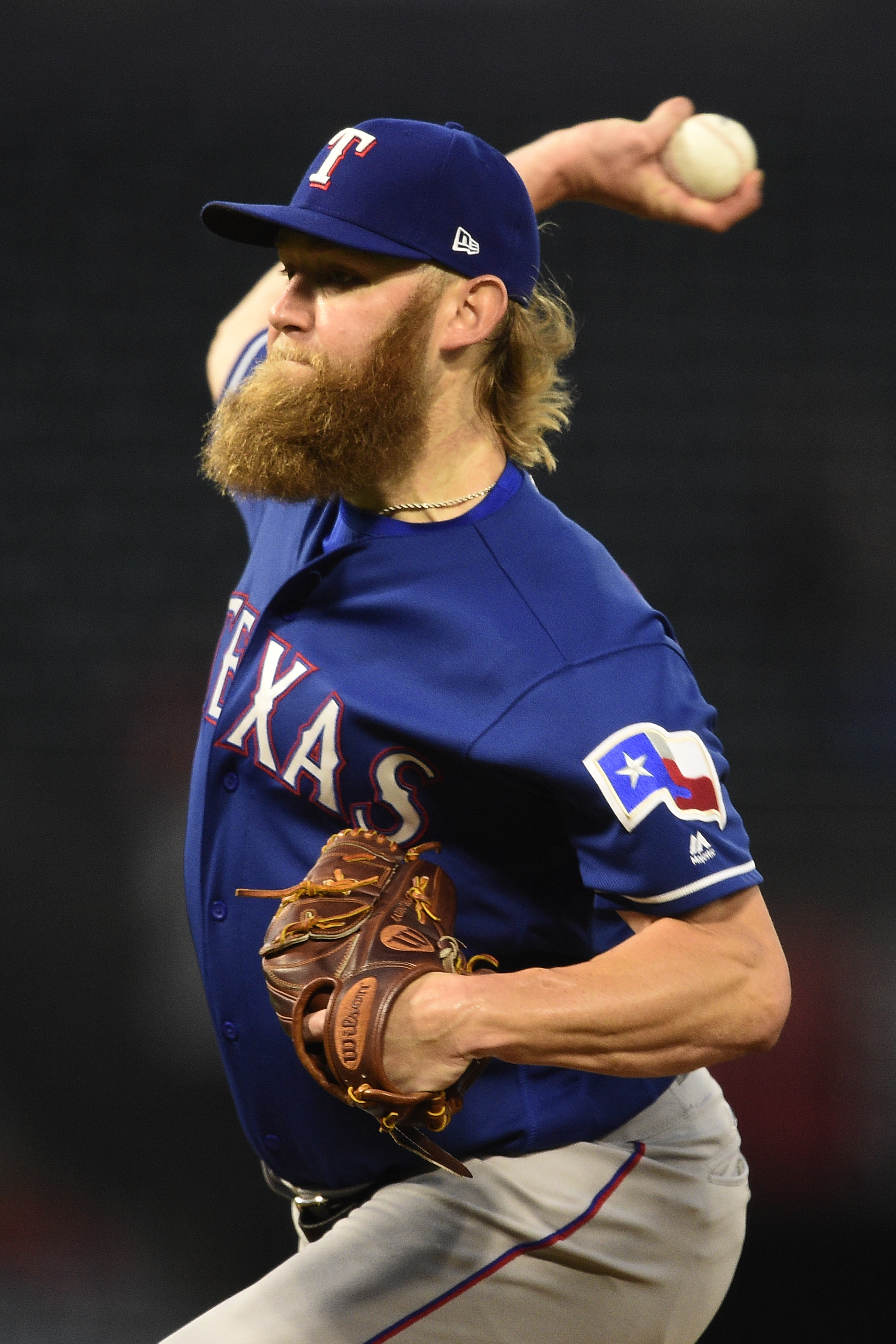 Cashner has certainly made good on the deal from the Rangers’ perspective, as he has turned in 139 2/3 innings of 3.29 ERA pitching over 23 starts. That’s a great return on the team’s investment, helping to balance out the miss on Cashner’s former Padres teammate, Tyson Ross, who also joined the Texas staff in hopes of a turnaround.
Those superficial results, however, don’t tell us all we need to know about Cashner’s interesting upcoming foray into free agency. While it’s tempting simply to assume that the notably talented right-hander has finally found health and figured things out, organizations — including the Rangers — will be looking at quite a bit more information in valuing the rights to his future production.
It’s hard not to raise an eyebrow at Cashner’s ugly K/BB numbers. He has recorded just 4.8 K/9 — second-lowest among all qualified starters — against 3.3 BB/9 on the year. He also sports a meager 5.7% swinging-strike rate that not only falls well below his career average but also ranks dead last among qualified starting pitchers.
The hurler has continued to maintain solid ground-ball numbers, with a 48.4% rate thus far in 2017. And perhaps there’s some indication of contact management in the .267 batting average on balls in play to which he has limited opposing hitters; while that’s surely a sign that there Cashner has benefited from some good fortune, the 28.2 percent hard-hit rate he’s allowed is the eighth-lowest in MLB. Cashner has tamped down on the homers that hurt him last year (8.3% HR/FB, 0.77 HR/9), though again it’s tough to see that as a fully sustainable skill.
Clearly, the underlying metrics paint quite a different picture than do the bottom-line results. Unsurprisingly, ERA estimators are not enthused with Cashner’s work this year. SIERA (5.41) and xFIP (5.16) have never before been this bearish on the right-hander, while FIP (4.42) only prefers his work this year to his more homer-prone 2016 (when he carried a 4.84 mark).
Beyond the matters of present and projected talent, long-term durability remains something of a question given that Cashner has missed some time with arm issues in the past. He’ll turn 31 in a few days, so he isn’t old, but he’s also not particularly young for a free-agent pitcher. Notably, too, Cashner’s velocity has trended downward. This year, he’s sitting at 94 mph with his four-seamer and 92.9 mph with his sinker — around one full tick below the prior year in both cases (and yet further behind his peak levels).
So, what might the market make of all this? It’s rather difficult to say, truthfully, since it’s hard to find pitchers with anything approaching this kind of profile. While bounceback hurlers such as Rich Hill and Scott Kazmir have scored three-year, $48MM contracts in recent years after returning from rough stretches, they did so after carrying good results and peripherals for one or more prior seasons.
Frankly, it’s hard to see Cashner commanding that sort of AAV. That’s particularly true given the relatively robust slate of mid- and back-of-the-rotation hurlers lined up on the market behind the biggest names. Cashner will be competing with pitchers such as Jeremy Hellickson, Marco Estrada, Lance Lynn, Alex Cobb, Jaime Garcia, Miguel Gonzalez, Tyler Chatwood, John Lackey, and a host of others.
Cashner’s inability to generate swings and misses makes a qualifying offer (reportedly set to be worth about $18.1MM) seem unlikely. Hellickson, after all, had a more impressive overall body of work in 2016 but still accepted a $17.2MM QO from the Phillies. Texas may not really want to chance that outcome in the hopes of securing the now-reduced draft compensation that could be available if he declines and signs elsewhere. Or, perhaps, if both team and player enjoy the current arrangement, the sides could pursue a multi-year arrangement during the exclusive negotiating window. (That’s how the Blue Jays got Estrada to stay for two years and $26MM two years ago.)
With or without compensation, Cashner seems more likely to receive offers in that $8MM to $12MM annual range, dependent upon the length of the term. We have seen quite a few solid but flawed arms land in that admittedly wide bucket — often scoring long-term commitments. Three-year pacts have gone to J.A. Happ ($36MM) and Ivan Nova ($26MM) — both of which have held up rather well thus far. Pitchers such as Ricky Nolasco and Brandon McCarthy have secured ~$12MM annually over four-year terms, though they had stronger free-agent cases based on their underlying metrics than Cashner. We’ve even seen some lower-AAV, longer-term deals, such as those landed by Phil Hughes (three years, $24MM) and Jason Vargas (four years, $32MM), which function as a reminder that the market can always create one-off contract scenarios.
Perhaps the most interesting analogy, all things considered, comes from Yovani Gallardo‘s recent trip into free agency. At the time, he was coming off of a year in which he put up 184 1/3 innings of 3.42 ERA pitching with a solid ground-ball rate but just 5.9 K/9 and 3.3 BB/9. He was younger than Cashner by about a year, with a lengthier track record of performance and durability, though he also had shown a more significant velocity decrease before entering the market. Gallardo was initially able to secure a $35MM guarantee over three years, but he ultimately had to settle for a promise of $22MM with a third-year option after a shoulder issue came up in his physical. Hopefully, Cashner can avoid any medical complications; he may also not come with draft compensation, which surely impacted Gallardo (who didn’t sign until late February).
While it’s hardly a perfect comp, the experience of Gallardo suggests there are some limits — but also that there’s real earning potential — for pitchers who have managed to post a solid ERA despite underwhelming peripheral indicators. Just how Cashner’s market will shape up is hard to guess at the moment, but he’ll be an interesting player to watch this winter.
Photo courtesy of USA Today Sports Images.
Minor MLB Transactions: 9/3/17
Sunday’s minor moves from around baseball:
- The Indians have signed 16-year-old Cuban right-hander Roberto Hernandez to a deal with a $320K bonus, Baseball America’s Ben Badler reports. Hernandez wasn’t included within MLB.com’s top 30 or BA’s top 50 rankings of 2017-18 international prospects, though Badler describes the righty as “one of the better” arms available in the July 2 class. Cleveland had an international spending pool of $5.75MM to work with in this signing period, and $3.825MM has already been accounted for by the team’s signings of youngsters George Valera, Aaron Bracho, Jose Tena and Wilfi Peralta.
Earlier moves
- The Phillies announced that they have outrighted first baseman Brock Stassi to Triple-A Lehigh Valley. Stassi lost his spot on the Phillies’ 40-man roster when they claimed reliever Juan Nicasio off waivers from the Pirates on Thursday. Prior to his designation for assignment, the 28-year-old Stassi batted just .167/.278/.295 in his first major league action (90 plate appearances). Stassi has been better – albeit not great – at Triple-A this year, having hit .256/.328/.354 in 186 PAs.
- The Rangers have outrighted right-hander Anthony Bass to Triple-A Round Rock, executive vice president of communications John Blake tweets. Texas designated Bass on Thursday when it acquired righty Miguel Gonzalez from the White Sox. Bass’ most recent extensive big league action came during a 64-inning campaign with the Rangers in 2015, when he pitched to a 4.50 ERA. He has made two appearances with the Rangers this season, but his work has otherwise come at Triple-A, where the 29-year-old has put up a 4.18 ERA with 10.39 K/9 and 3.35 BB/9 in 75 1/3 frames.