
Mets Sign Devin Williams To Three-Year Deal
December 3: The Mets have officially announced their signing of Williams.
December 1: Another free agent reliever has come off the board. The Mets are reportedly in agreement with Devin Williams on a three-year deal that guarantees the Klutch Sports client $51MM, though the net present value is knocked down by $15MM in deferrals.
Williams receives a $6MM signing bonus that’ll be paid in $2MM installments. He receives $15MM annual salaries, $5MM of which is deferred each season. (Signing bonuses are paid even in the event of a work stoppage, while players would not receive salaries for any games lost to a 2027 lockout.) There’s also reportedly a $1MM assignment bonus in the event of a trade.
A second-round pick by the Brewers in 2013, Williams took a while to climb through the minor leagues as a starting pitcher. He took off after being moved to the bullpen in 2019, climbing from Double-A to the big leagues by the end of that season. Williams emerged as one of the sport’s best late-game weapons by his first full big league season. He turned in a 0.33 ERA across 27 innings during the shortened 2020 schedule and claimed the National League Rookie and Reliever of the Year Awards.
The righty continued to dominate over the next few seasons, forming a lethal back-end duo with Josh Hader. Mets president of baseball operations David Stearns had a front row seat as Milwaukee’s front office leader for most of that tenure. Williams stepped into the ninth inning when Milwaukee sent Hader to San Diego at the ’22 deadline. He reeled off 36 saves in 40 tries with a 1.53 ERA to win his second career Reliever of the Year honors a year later.
Over his first four full seasons, Williams pitched to a 1.75 ERA while striking out 40.5% of opposing hitters. Heading into 2024, there was a decent argument for him as the best reliever in MLB. He hit his first real setback that Spring Training, as testing revealed two stress fractures in his back. He didn’t make his season debut until shortly before the trade deadline. Williams looked every bit as dominant during the regular season, reeling off 21 2/3 frames of three-run ball with 38 strikeouts to finish the year. His season ended in heartbreak fashion, as he surrendered a go-ahead homer to Pete Alonso in the final game of the Wild Card Series.
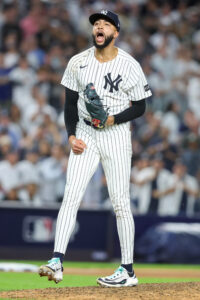
That wound up being Williams’ final action in a Milwaukee uniform. Before his last year of arbitration, the Brewers flipped him to the Yankees for starter Nestor Cortes and rookie infielder Caleb Durbin. The Yankees felt they were acquiring one of the ten best relievers in the sport. Williams’ results, at least, didn’t come close to those expectations.
The 31-year-old righty had an inconsistent lone season in the Bronx. He was terrible early on, giving up multiple runs in three of his first 10 appearances. Consecutive poor outings at the end of April led the Yankees to move him to a setup role and put Luke Weaver back into the ninth inning. Williams had one more rough appearance in early May before settling into a groove over the next few weeks. He returned to closing when Weaver landed on the injured list at the beginning of June.
Williams was lights out from that point through the All-Star Break. He gave up runs in seven of his first nine appearances of the second half, though, and the Yankees pushed him out of the closer role for good when they acquired David Bednar at the trade deadline. Williams posted a 5.06 ERA in the second half despite striking out nearly 40% of batters faced — the second-best rate among qualified relievers behind Mason Miller. He worked in a setup capacity late in the season and into the playoffs. Williams tossed four scoreless frames with four strikeouts in the postseason.
The end result was a career-worst 4.79 earned run average over 67 appearances. The Mets are placing a decent sized bet that the poor run prevention was a fluke. Opponents had a .339 batting average on balls in play when runners were on base. That’s easily the highest mark in Williams’ career (aside from his brief 2019 debut). He had a very difficult time stranding runners as a result. While relievers certainly need to be able to work out of tough situations, that had never previously been an issue.
Batted ball metrics can be volatile, especially for relievers who only throw 60-70 innings in a season. Williams’ stuff still grades out extremely well, and he remains capable of missing bats at a level that few other pitchers can match. He struck out 34.7% of opponents behind a 16.8% swinging strike rate. Those are down slightly from his usual marks but remain among the best in MLB. Among relievers with 50+ innings, Williams finished eighth in strikeout rate and 10th in whiffs.
Williams has two pitches which he has used at roughly equal rates over the past couple seasons. His fastball sits around 94 MPH and while it’s a good pitch, his standout offering is his unique “Airbender” screwball/changeup. The pitch still moves unlike any other changeup in the league, and opponents have hit below .200 against it in every full season of his career.
The underlying numbers made Williams a popular “buy-low” target among teams and fanbases. That is borne out in the contract to an extent. Williams might have been in the running for a $100MM deal had he posted another sub-2.00 ERA season. It didn’t force him to settle for a pillow contract, as he’s still being paid as a high-end reliever. Williams falls well short of the four years and $72MM which Tanner Scott commanded last winter, but he’s within the $46-58MM range in which closers Robert Suarez, Liam Hendriks and Raisel Iglesias have found themselves over the past few offseasons. He came up shy of the four years and $68MM which MLBTR had predicted in ranking him the second-best reliever in the class.
While an ugly walk year ERA still has some impact on a pitcher’s market, Williams is the third example this offseason of teams placing a decent amount of emphasis on stuff and whiffs in spite of that. Dylan Cease commanded a seven-year deal from the Blue Jays coming off a 4.55 ERA over 32 starts. Ryan Helsley pulled $14MM annually from the Orioles on a two-year contract with an opt-out despite a brutal finish to his 2025 season with the Mets. It’s easier for clubs to place that kind of bet on pitchers coming from a different team. The Mets were never likely to bring back Helsley, and while the Yankees reportedly kept in contact with Williams’ camp, they also opted not to issue him a $22.025MM qualifying offer that probably would have kept him around on a one-year deal.
The Mets obviously don’t feel that Williams is incapable of succeeding in New York. He’ll slot into a key late-inning role in Carlos Mendoza’s bullpen. He projects as the closer for now but could slide back into a setup capacity if the Mets bring back Edwin Díaz, which they’re reportedly still considering. If the Mets allow their longtime closer to walk, they’ll need to bring in multiple right-handed setup arms to bridge the gap to Williams in the ninth.
RosterResource projects the Mets’ 2026 payroll and luxury tax commitments in the $277-280MM range. They’re likely to end up beyond the $304MM final surcharge threshold by the time they address the rotation, bullpen, and/or first base and the corner outfield. The estimate from FanGraphs currently has them in the second tier of penalization — just below the $284MM cutoff for Tier 3. They’re taxed at a 62% rate for spending between $264MM and $284MM, so the Williams signing comes with an approximate $8-10MM tax hit depending on the calculation of the net present value. They’ll pay a 95% tax on spending between $284MM and $304MM and a 110% bill on any money beyond $304MM.
Will Sammon of The Athletic reported that the Mets and Williams had agreed to a three-year deal. ESPN’s Jeff Passan noted that the guarantee was above $50MM, while Jon Heyman of The New York Post had the salary/bonus/deferral breakdown. The Athletic’s Ken Rosenthal was first on the assignment bonus.
Image courtesy of Wendell Cruz, Imagn Images.
Braves Sign Austin Pope To Minor League Deal
The Braves have signed right-hander Austin Pope to a minor league deal, according to his transactions tracker at MLB.com. The Beverly Hills Sports Council client has been assigned to Triple-A Gwinnett for now but will presumably receive an invite to big league spring training.
Pope, 27, joins a new organization for the first time in his career. The pontiff was drafted by the Diamondbacks back in 2019. He climbed the minor league ladder and got to make brief major league debut in 2025. He was added to the roster in the final week of the regular season and got to make one appearance. On September 25th, with the Snakes down 8-0 to the Dodgers, Pope tossed two scoreless innings of mop-up duty. He allowed two hits and a walk while striking out one.
The righty was outrighted off the roster at the end of the season and was able to elect free agency, which has allowed Atlanta to scoop him up. They are presumably placing stock in Pope’s minor league results. Over the past three years, he has thrown 160 1/3 innings in the minor leagues, mostly with the Triple-A Reno Aces. His 4.55 earned run average in that time isn’t especially impressive but the Aces play in the hitter-friendly Pacific Coast League. His 9.4% walk rate in that time was pretty close to average while his 27.6% strikeout rate was quite strong.
Pope still has a full slate of option and just a handful of service days. If he gets added to Atlanta’s roster at any point, he can give the club a depth arm with roster flexibility and years of cheap control. For now, he can provide them papal depth without taking up a spot on the 40-man.
Photo courtesy of Rob Schumacher, Imagn Images
Guardians, Connor Brogdon Agree To Major League Deal
The Guardians and right-hander Connor Brogdon have agreed to a major league deal, reports Ken Rosenthal of The Athletic. Brogdon will make a salary of $900K next year, per Zack Meisel of The Athletic. The Guardians have 40-man vacancies and don’t need to make a corresponding move.
It’s a bit surprising to see Brogdon, 31 in January, secure himself a big league deal. He settled for a minor league deal with the Angels last winter. He was added to the roster a couple of times during the season, but was later passed through waivers in both instances. He tossed 47 innings for the Halos around those transactions, allowing 5.55 earned runs per nine.
Those were obviously not great results but the Guardians are presumably seeing something attractive under the hood. Brogdon’s 24.6% strikeout rate and 9% walk rate were both close to league average. His ERA was inflated because he allowed 11 home runs, almost doubling his previous career high of six. There are some ERA estimators which consider home run spikes to be fluky. Brogdon’s SIERA, for instance, was just 3.86 this year.
It’s also perhaps worth pointing out that Brogdon’s velocity came back. He averaged 95.5 miles per hour on his fastball in 2025. In 2024, he had battled plantar fasciitis and only tossed three big league innings. In that small sample of work, his fastball was down to 92.8 mph.
The Guardians presumably feel there’s a path to get Brogdon back to his previous results. From 2020 to 2022, then with the Phillies, Brogdon tossed 113 innings with a 3.42 ERA, 25.1% strikeout rate and 7.3% walk rate. He earned three saves and 16 holds. He also tossed 8 2/3 postseason innings with a 2.08 ERA in 2022, as the Phils made it all the way to the World Series. His fastball velo was in the 95-96 mph range for those seasons.
In 2023, his results backed up. He posted a 4.03 ERA with a 20.5% strikeout rate and 10.2% walk rate. His average fastball velo fell to 94.7 mph. The following year, he bounced to the Dodgers and battled the aforementioned plantar fasciitis situation. With the Angels in 2025, his results weren’t fully back but the velo and strikeouts were close to his best years in Philadelphia.
The Guards generally have pretty good bullpens and that was the case in 2025. Even though they lost Emmanuel Clase to a gambling investigation in July, the club’s relief corps still finished the season with a collective 3.44 ERA, third in the majors behind the Padres and Red Sox. Brogdon will jump into that mix as the Guards try to coax better results out of him than the Angels did in 2025.
Brogdon is out of options, meaning he can’t be sent to the minors without being exposed to waivers. If the Guards pass him through waivers at some point, he would have the right to elect free agency as a player with at least three years of service time. However, since he has less than five years of service, he would have to forfeit his remaining salary commitments in order to exercise that right.
The $900K salary isn’t that high, considering the MLB minimum will be $780K next year. However, it is perhaps enough to dissuade other teams from claiming Brogdon. It’s also very unlikely Brogdon choose to leave that money on the table. Perhaps the Guardians are planning on having Brogdon in Triple-A as non-roster depth at some point in the future. If he is holding a roster spot at the end of the 2026 season, he can be retained via arbitration for 2027.
Photo courtesy of Ed Szczepanski, Imagn Images
Blue Jays Sign Dylan Cease To Seven-Year Deal
December 3rd: The full breakdown is provided by Jon Heyman of The New York Post. Cease gets a $23MM signing bonus and then a $22MM salary in 2026. His salary then jumps to $30MM in 2027 and falls by $1MM in each subsequent season. $10MM of his 2026 salary is deferred followed by $9MM in each season after that. The deal also contains awards bonuses and a limited no-trade clause.
December 2nd: The Jays made it official today, announcing they have signed Cease to a seven-year deal. Ken Rosenthal of The Athletic reports that the MLBPA values the contract at roughly $184.6MM after adjusting for the deferred money.
November 26th: The Blue Jays are making a major splash at the top of the rotation. Toronto is in agreement with Dylan Cease on a seven-year contract, pending a physical. It’s reportedly a $210MM guarantee for the Boras Corporation client, though it includes deferred money that’ll drop the average annual value for luxury tax purposes to roughly $26MM. That puts the net present value closer to $182MM.
Even after adjusting for deferrals, it’s the largest free agent signing in franchise history. Though the Jays gave Vladimir Guerrero Jr. a $500MM extension earlier this year, they’d never gone beyond George Springer‘s six-year, $150MM deal on the open market.
Cease, 30 next month, entered free agency as a test case of how much modern front offices care about earned run average. In two of the past three seasons, his ERA has jumped to the mid-4.00s, including a 4.55 mark in 2025. However, in just about every other respect, he has been great. He has been incredibly durable. His control isn’t amazing but he has racked up strikeouts. He has kept his fastball velocity in the upper 90s, while also featuring a slider, knuckle curve and changeup.
Though Cease debuted back in 2019, he has actually never been on the major league injured list, apart from a very brief stint on the COVID list in 2021. He made 12 starts in the shortened 2020 season and has taken the ball at least 32 times in each full season since. In total, he’s made 174 starts since the start of 2020, which leads all major league pitchers. He generally doesn’t pitch deep into games, however, so he’s ninth in that span in terms of innings.
On top of the quantity, the quality has been strong. For that same 2020-25 span, he posted a 3.88 ERA. His 9.9% walk rate was a bit on the high side but he punched out 28.9% of batters faced with a 14.4% swinging strike rate.
As mentioned, his ERA has wobbled in recent years, but it has done so while other elements of his game have stayed more consistent. He actually saw his ERA drop to 2.20 in 2022. With the White Sox at that time, he finished second in American League Cy Young voting to Justin Verlander. His ERA then shot up to 4.58 in 2023, dropped to 3.47 in 2024 and then climbed back up to 4.55 this year.
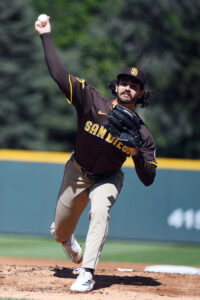
But during those ups and downs, his strikeout and walk rates have been less volatile. His strikeout rate did drop from 30.4% in 2022 to 27.3%, but then it climbed to 29.4% and 29.8% in the two most recent campaigns. His 10.4% walk rate in 2022 decreased to 10.1% and 8.5% in the next two years, followed by a slight uptick to 9.8% in 2025.
His batting average on balls in play, which tends to be a bit more luck based, has synched up more with his ERA shifts. A standard BABIP is usually around .290 but Cease was down at .260 in that 2022 season. It then swung the other way to .330 in 2023 as Cease’s ERA climbed, then went to .263 and .320 in the two most recent seasons as his ERA dipped and climbed again.
As such, ERA estimators have considered Cease to be far more steady than his actual ERA. His FIP has been between 3.10 and 3.72 for the past four years. His SIERA was at 3.48 in 2022, jumped a bit to 4.10 in 2023, and then has been at 3.46 and 3.58 in 2024 and 2025.
As we were deliberating our Top 50 Free Agents post at MLBTR, we had many debates about whether the inconsistent ERA would hurt his earning power, perhaps leading him to accept a short-term deal with opt-outs, or if teams would overlook the ERA and sign him based on his consistency in other areas. In the end, we opted for latter, predicting a seven-year, $189MM deal. Cease has surpassed that in terms of sticker price, though the deferrals will seemingly put the net present value closer just below that projection.
The Blue Jays are coming off their best season in years, as they charged all the way to Game Seven of the World Series, ultimately falling to the Dodgers in extra innings. However, the season ended with plenty of rotation uncertainty. Chris Bassitt and Max Scherzer became free agents. Shane Bieber had a $16MM player option he seemed likely to decline. In the long term, Kevin Gausman is a free agent after 2026. José Berríos has an opt-out in his deal after the upcoming campaign.
In the past few weeks and months, the long-term outlook has improved considerably. Trey Yesavage came up late in the year and was immediately able to get hitters out, quickly establishing himself as a rotation building block. Bieber surprisingly decided to trigger his player option and stick with the Jays for one more year. Now Cease is in the fold for the long run.
That gives the Jays a rotation of Gausman, Cease, Yesavage, Bieber and Berríos going into 2026, with guys like Eric Lauer, Ricky Tiedemann and Bowden Francis also in the mix. Though Bieber and Gausman are slated to depart after the upcoming campaign, with Berríos potentially joining them, Cease can serve as a bridge to another era. By then, it’s possible Jake Bloss has recovered from his Tommy John surgery and is back in the mix. Prospects like Gage Stanifer and Johnny King might have climbed into the picture by then as well.
Toronto is paying a significant cost to lock Cease in as a long-term anchor. RosterResource projected their 2026 payroll around $232MM, while their luxury tax number was right around the $244MM base threshold. It won’t be clear how much either number goes up until the payment and deferral structure is reported. The CBT number is based on the contract’s average annual value, so the salary breakdown doesn’t matter for tax purposes, but the deferrals reduce the contract’s actual value by around $4MM annually.
In any case, the Jays are clearly going to pay the tax in 2026, and this will push them beyond the $264MM first surcharge tier. They’re into CBT territory for a second consecutive season, meaning they’re taxed at a 30% rate for their first $20MM in overages. They’ll pay a 42% tax on spending between $264MM and $284MM, 75% for spending between $284MM and $304MM, and a 90% rate on any further spending. The Cease deal itself comes with roughly $8.5MM in taxes, but the penalties will get higher with any more significant additions.
The Jays almost certainly aren’t done. They’ve been loosely linked to Kyle Tucker and have interest in re-signing Bo Bichette. It seems fair to assume they won’t sign all three of this offseason’s top free agents, but a Bichette reunion could still be in play. They’ve also been linked to late-inning bullpen help, ideally a proven closer who’d push Jeff Hoffman into a leverage role in the seventh and eighth innings.
Cease rejected a qualifying offer from the Padres. The Jays are hit with the highest penalty to sign a qualified free agent because they paid the competitive balance tax this year. They’ll surrender their second- and fifth-highest selections in the 2026 draft plus $1MM from their international bonus pool in 2027. San Diego also paid the luxury tax this year, so they’re entitled to the lowest form of compensation: a selection after the fourth round next summer. They’ll get another of those if/when Michael King signs elsewhere.
Jon Heyman of The New York Post first reported the Blue Jays and Cease were in agreement on a seven-year, $210MM deal. Ken Rosenthal of The Athletic was first on the presence of deferrals, while Mitch Bannon of The Athletic reported the approximate $26MM AAV.
Image courtesy of Christopher Hanewinckel, Imagn Images.
Giants Sign Sam Hentges
December 3rd: The Giants officially announced the Hentges signing today.
November 27th: The Giants and left-hander Sam Hentges have agreed to a one-year deal worth $1.4MM, reports Robert Murray of FanSided. The Giants have an open 40-man spot and won’t need to make a corresponding move when the deal becomes official. The southpaw is represented by Warner Sports Management.
It’s a buy-low wild card move for the Giants. Hentges was a solid bullpen piece for the Guardians a few years ago but he hasn’t been healthy for a while. Over the 2022 and 2023 campaigns, Hentges tossed 114 1/3 innings for Cleveland, allowing 2.91 earned runs per nine. His 7.9% walk rate was just barely better than average while his 27.4% strikeout rate and 60.1% ground ball rate were both very strong. He gradually moved up to high leverage work, earning 23 holds over that span.
In 2024, he kept things going for a while, posting a 3.04 ERA over another 23 2/3 innings. However, he hit the injured list in July due to some inflammation in his throwing shoulder. He required surgery in September, a procedure which came with a recovery timeline of 12 to 14 months.
Though he was likely to going miss most or all of 2025, the Guards still kept him around. He was still under club control through 2027, so there was still a potential long-term payoff. He had qualified for arbitration ahead of 2024 as a Super Two player and made $1.1625MM in his first of four arb seasons. The Guards gave him a slight bump to $1.337MM in 2025. Even if he couldn’t manage a late-season return to health, he would still have two further seasons of control.
In 2025, not only did he not make it back to the majors, but he didn’t even begin a rehab assignment. In September, he underwent arthroscopic surgery on his right knee. That procedure comes with a recovery timeline of three to four months. That means he should be healthy by the spring but the Guards decided to move on. They non-tendered Hentges last week, sending him to free agency.
The Giants have swooped in and will sign Hentges, giving him a slight raise over last year, even though he missed the whole season. San Francisco non-tendered Joey Lucchesi last week but currently has Erik Miller, Matt Gage and Reiver Sanmartin as lefties in their bullpen. Hentges is obviously a big unknown, having missed a season and a half at this point. But if he can get back to health, he could be the best southpaw in the bunch.
If he does get back on track, he would be a bargain at a salary barely above the league minimum, which will be $780K next year. He is out of options but could be retained via arbitration for the 2027 season if things go especially well next year.
Photo courtesy of Jim Rassol, Imagn Images
Angels Sign Alek Manoah To Major League Deal
The Angels announced they have signed right-hander Alek Manoah to a major league deal. Jeff Passan of ESPN previously reported the agreement and that Manoah will make $1.95MM next year. The Halos had multiple 40-man vacancies and didn’t need to make a corresponding move for the Covenant Sports Group client.
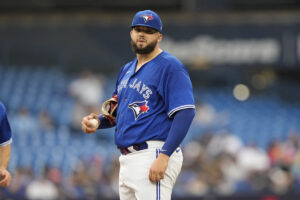
It’s a clear buy-low move for the Angels. Manoah was once a first round pick and top prospect, then became a Cy Young candidate as of a few years ago. But more recently, injuries and underperformance bumped his stock to the point that he was non-tendered by Atlanta last month.
The Blue Jays selected Manoah 11th overall in 2019. By 2021, he was making big league starts. He took the ball 20 times that year and threw 111 2/3 innings, allowing 3.22 earned runs per nine. His 8.7% walk rate was around average while his 27.7% strikeout rate was quite strong. 2022 was his first full season. He made 31 starts and logged 196 2/3 innings with a 2.24 ERA. His strikeout rate dropped to 22.9% but he also improved his walk rate to a 6.5% clip. He finished third in American League Cy Young voting behind Justin Verlander and Dylan Cease.
It’s basically been downhill since then. He struggled badly enough in 2023 to get optioned to the minors multiple times. He finished the year with a 5.87 ERA over 19 starts. His strikeouts dipped to a subpar 19% rate while his walk rate climbed to an ugly 14.2% pace.
Going into 2024, the Jays reportedly had some openness to trading Manoah, with the Angels checking in on him at that time. However, the Jays didn’t pull the trigger on a deal and he opened the 2024 season with Toronto. He was slowed by some shoulder soreness during the spring and began the season on the injured list. He was reinstated in May and then made five decent starts, with a 3.70 ERA, 25.2% strikeout rate and 7.8% walk rate. However, he then went back on the IL, this time due to an elbow sprain. He required Tommy John surgery in June of that year.
Manoah then spent the rest of that season on the IL. The Jays held him on the roster through the winter and tendered him a contract. They avoided arbitration by agreeing to a $2.2MM salary for 2025. They then put him back on the 60-day IL in March. He began a rehab assignment in July. Rehab assignments normally are capped at 30 days for pitchers but guys recovering from Tommy John can push that to 60.
By the middle of September, Manoah’s clock was up but the Jays had a rotation featuring Kevin Gausman, Shane Bieber, Chris Bassitt, José Berríos and Max Scherzer, with Trey Yesavage lurking in Triple-A. Manoah also hadn’t done much to force the issue, as he had a 19.6% strikeout rate and 12.8% walk rate during his rehab outings. He was reinstated from the IL but optioned to Triple-A Buffalo.
Later that month, the Jays needed a 40-man spot to reinstate Anthony Santander from the 60-day IL. Manoah was designated for assignment as the corresponding move. With the trade deadline having passed, the Jays had to put him on waivers, with Atlanta claiming him. They held him on their roster for a while but then non-tendered him. It might seem a bit odd to claim a player off waivers and then cut him shortly thereafter. Speculatively speaking, it’s possible Atlanta tried to sign him for 2026 but then non-tendered him when they couldn’t agree on the price point.
For the Halos, it’s a low-cost bet on a bounceback. The salary isn’t much beyond the league minimum, which will be $780K next year. Manoah also still has options, so it’s possible he could be pitching in Triple-A as depth.
Pitching has been a weakness for the club for quite a while and 2025 was no exception. The staff as a whole had a 4.89 ERA this year, putting them ahead of just the Rockies and Nationals. That includes a 4.91 ERA from the rotation, again ahead of just Washington and Colorado. Tyler Anderson became a free agent at season’s end, thinning out the group even more.
Going into 2026, there is very little certainty in the rotation group. Yusei Kikuchi and José Soriano have two spots spoken for. Reid Detmers seems like he’ll get a chance to return to the rotation but he’s a big question mark after struggling in 2024 and then pitching out of the bullpen in 2025. There are a few other guys in the mix, such as Jack Kochanowicz, Caden Dana and Sam Aldegheri, though those guys have fairly mixed track records.
Since the offseason has begun, this is the second time the Angels have bought low on a former big name. A couple of weeks ago, they traded Taylor Ward to the Orioles in order to nab Grayson Rodriguez. It’s a somewhat similar situation to Manoah, as Rodriguez was the 11th overall pick in 2018 but has seen his career thrown off course by injuries. Perhaps the Angels will make more of a surefire rotation addition later in the winter but they have stuck with the less certain guys so far.
It’s hard to know what to expect from Manoah now. It’s been a few years since he was both healthy and effective. He was averaging just 91 miles per hour on his fastball in Triple-A this year. That’s almost three ticks below his 2022 season, when he averaged 93.9 mph. Perhaps being further removed from his surgery will allow him to find a new gear. If not, the Angels won’t have lost much. If it works out, Manoah will finish the 2026 season with less than six years of service, so he could be retained via arbitration for the 2027 season.
Photos courtesy of Kamil Krzaczynski, John E. Sokolowski, Imagn Images
Cubs Sign Scott Kingery To Minor League Deal
The Cubs signed utility player Scott Kingery to a minor league contract, the team informed reporters (including Maddie Lee of The Chicago Sun-Times). He’ll be in MLB camp as a non-roster invitee.
Kingery returned to the majors this past season, getting into 19 games with the Angels. It marked his first MLB action in three years. His 29 MLB plate appearances were the most he logged in a season dating back to 2020. The former top Phillies prospect recored four hits with two walks and 11 strikeouts. He has a lifetime .227/.278/.382 batting line in nearly 1200 career plate appearances, almost all of which came in Philadelphia from 2018-19.
Now 31, Kingery spent most of this year at Triple-A Salt Lake. He batted .228/.284/.402 while striking out in a quarter of his trips to the plate. It was a step back from his more impressive ’24 season with the Phillies’ top affiliate, when Kingery had a 25-25 season in the minors.
The Cubs won’t expect much offensively from the right-handed hitter. Kingery provides defensive versatility and plays anywhere on the diamond aside from first base and catcher. He’s an above-average runner who’ll compete for a spot on Craig Counsell’s bench during Spring Training.
Braves Sign Danny Young
The Braves announced Tuesday morning that they’ve signed left-handed reliever Danny Young to a one-year, major league contract. It’s a split deal, paying the 31-year-old at different rates for time spent in the majors versus time in the minors. Young, a client of Dynamic Sports Group, goes onto Atlanta’s 40-man roster. He’ll be paid at a $925K rate in the majors, MLBTR has learned.

This will be Young’s second stint in Atlanta. He spent the 2023 season with the Braves organization as well, pitching 8 1/3 terrific innings in the majors and struggling in 15 2/3 minor league frames. Injuries limited his time on the field that year, and that’ll be the case in 2026 as well. Young has spent the past two seasons pitching well out of the Mets’ bullpen but underwent Tommy John surgery last May. By signing in Atlanta, he’ll reunite with Jeremy Hefner — his pitching coach with the Mets who has left and taken the same title with the Braves.
Young will open the ’26 season on the injured list as he finishes off the rehab from that Tommy John procedure. A source tells MLBTR that he began throwing last month and is targeting a return to game action before the All-Star break.
Young has pitched in parts of four major league seasons. He’s totaled 60 2/3 innings in that time and logged a 4.01 earned run average with far more intriguing rate stats: 29% strikeout rate, 9.3% walk rate, 53.3% ground-ball rate. Metrics like SIERA (3.02) and FIP (3.23) feel he’s been far better than his ERA would indicate, which isn’t a surprise considering his solid rate stats but bloated .344 average on balls in play.
Once spring training opens, Young will very likely be transferred to the 60-day IL to open a spot on the 40-man roster. If Atlanta needs that spot sooner, they could run him through waivers in the offseason. The salary terms might allow Young to go unclaimed, and while he’d have the right to reject an outright assignment in favor of free agency, doing so would require forfeiting the guaranteed money on his split major league and minor league rates of pay.
If Young stays on the 40-man roster/60-day injured list until the time of his activation, he’ll give Atlanta another southpaw option in a bullpen that already includes Dylan Lee and Aaron Bummer. Out-of-options lefties Dylan Dodd and Joey Wentz are also penciled into bullpen spots at the moment.
Should Young bounce back to form, he’s a potential long-term piece in the Atlanta ‘pen. He enters the 2026 season with only 1.160 years of major league service time, meaning he can be controlled for five more seasons — all the way through 2030. Obviously, there’s a long way to go before that long-term control comes into play, but the fact that the Braves put him directly onto the 40-man roster suggests an openness to plugging Young into the mix beyond the current season if he performs well; notably, Bummer is a free agent following the 2026 campaign.
Orioles Sign Ryan Helsley
The Orioles have signed right-hander Ryan Helsley to a two-year contract that allows him to opt out after the 2026 season. It’s reportedly a $28MM guarantee for the Wasserman client, who’d also receive a $500K assignment bonus if he’s traded. The salary is evenly distributed, so Helsley will decide on a $14MM player option next winter.
Felix Bautista underwent shoulder surgery last August that will keep the closer on the injured list until at least August 2026, and that timeline means one setback could sideline Bautista for the entirety of the 2026 campaign. As a result, the Orioles headed into the offseason looking for multiple bullpen additions, including a pitcher with past experience as a closer.
Helsley fits that description, as he racked up 105 saves as the Cardinals’ primary ninth-inning choice from 2022-25. This stretch saw Helsley named to two NL All-Star teams, he was the NL’s Reliever Of The Year in 2024, and he even received some down-ballot Cy Young Award consideration in both 2022 and 2024. Overall, Helsley posted a 2.67 ERA, 29.12% strikeout rate, and 9.93% walk rate over 299 2/3 innings in a St. Louis uniform, from his debut with the team in 2019 until he was traded to the Mets at last July’s trade deadline.
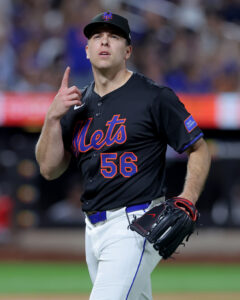 Given the Cardinals’ struggles over the last few seasons and Helsley’s looming free agency, it was seen as a surprise that it took so long for the reliever to be traded. (In fact, the Orioles were first rumored to be interested in Helsley back in May 2024.) Even trading Helsley last winter in the wake of his excellent 2024 would’ve brought a greater return back to the Cardinals, though they still landed three prospects in the midseason deal with New York. And, considering how things went south for Helsley with the Mets, it’s hard to say the Cards didn’t come out on top in the deal.
Over 20 innings and 22 appearances with the Mets, Helsley was torched for a 7.20 ERA, with his home run rate, strikeout rate, and walk rate all going in the wrong direction. Helsley felt he was tipping his pitches during his time in New York, but whatever the cause, the move back into a setup role behind Edwin Diaz ended up as a wash. Helsley’s struggles were one of the many reasons behind a disastrous second half for the Mets that saw the team slowly fade out of the playoff race and ultimately fall short of the postseason.
Despite this rough stretch, close to half the league reportedly had interest in Helsley on the open market. The Blue Jays, Cubs, and Tigers were among the many teams who saw Helsley as a bounce-back candidate and, intriguingly, Detroit and some other clubs viewed Helsley as a potential starting pitcher. Given how Helsley has never started a game at the MLB level, it would’ve been a surprising development to see him land somewhere as a rotation candidate, but he’ll now settle into his familiar closing role in Baltimore.
MLB Trade Rumors still ranked Helsley 36th on our list of the winter’s top 50 free agents. He topped our projection of a two-year, $24MM deal, and he might end up handily topping $24MM over a two-year timeframe depending on what happens with his opt-out clause. If he rediscovers his 2024 form, Helsley will surely choose to re-enter free agency in search of a more lucrative longer-term contract. The Orioles might not mind that scenario if Bautista is back healthy by that point, and Helsley could then be tagged with a qualifying offer heading into free agency next winter.
Helsley brings elite velocity and spin with his 99.3mph fastball, though batters teed off on Helsley’s fastball in 2025, and his slider has been the more effective of his pitches over the last few years. The righty has long struggled to avoid walks or hard contact, though the home run ball was never a huge issue until his brief stint with the Mets. It obviously wasn’t the ideal platform for Helsley as he entered free agency, yet it is understandable why the Orioles still felt comfortable in making a two-year investment in his services.
Even a two-year pact counts as a big step for an O’s front office that has been pretty conservative about investing heavily in free agents. Much of Mike Elias’ seven-year stint in charge of the baseball operations department was spent rebuilding, of course, but Tyler O’Neill‘s three-year, $49.5MM deal from last winter is the only other multi-year contract Elias has even given to a free agent. The Orioles’ disappointing 75-win performance in 2025 may have raised the urgency level, as Baltimore has been linked to a number of top-shelf names in this year’s free agent market.
Between signing Helsley and re-acquiring old friend Andrew Kittredge, the back end of the Orioles’ bullpen looks much sturdier than it did at season’s end. More relievers could still be on the way, but Baltimore’s primary pitching need is now rotation help.
ESPN’s Jeff Passan first reported that Helsley was in agreement with Baltimore on a two-year deal with an opt-out. Katie Woo of The Athletic had the $28MM guarantee, while The Athletic’s Ken Rosenthal first reported the $500K assignment bonus. The Associated Press reported the salary breakdown.
Inset photo courtesy of Brad Penner — Imagn Images
Rockies Sign Nicky Lopez, John Brebbia To Minor League Deals
The Rockies have signed infielder Nicky Lopez and right-hander John Brebbia to minor league deals, reports Kevin Henry of the Denver Gazette. Both players will receive invites to big league spring training. Lopez is represented by CAA and Brebbia by Icon Sports Management.
Lopez, 31 in March, has largely been a glove-first infielder in his career. He did have a nice .300/.365/.378 showing in 2021 but that seems to have been fuelled by a .347 batting average on balls in play, far higher than any other season he has played. In his career, he has stepped to the plate 2,374 times with just seven home runs. His 14.3% strikeout rate is quite low but his 7.6% walk rate is subpar. Put it all together and he has a .245/.310/.311 line and 73 wRC+, indicating he’s been 27% below league average at the plate.
Despite the lack of punch with the bat, Lopez has been able to carve out big league playing time on the strength of his defense. He has experience at all four infield spots and in left field. Reviews on his shortstop defense are mixed. He’s been credited with -11 Defensive Runs Saved at that spot, although a lot of that comes from a -9 in just 344 2/3 innings with the White Sox in 2024. Outs Above Average, meanwhile, has ranked him as 33 runs better than par at short. Both metrics give him positive reviews at the other positions he’s played.
Lopez got pushed to a fringe roster player in 2025. He got close to everyday playing time from 2019 to 2024 but he only got into 19 games and received 28 plate appearances this year. He had brief stints with the Angels and Cubs early in the year, then was stuck in the minors for the final few months of the season, bouncing to the Diamondbacks, Yankees and Cubs again.
The Rockies have plenty of uncertainty on their roster. They just lost 119 games and are retooling the organization. On the infield, Ezequiel Tovar is locked in at short but the other positions are up for grabs. Tyler Freeman, Kyle Karros, Troy Johnston, Adael Amador, Warming Bernabel, Ryan Ritter and Blaine Crim are all on the roster but Freeman is the only guy in that group with more than 60 games in the big leagues. Freeman can also play the outfield and might end up there, depending on what other moves the Rockies make.
In short, there’s lots of room for a veteran infielder. The Rockies had guys like Orlando Arcia, Thairo Estrada and Kyle Farmer on the roster in 2025 as veteran utility types but they’re all free agents now. If Lopez eventually cracks the roster, he can’t be optioned to the minors without his consent as a guy with at least five years of big league service time.
As for Brebbia, he’s a buy-low move for the Rockies. He had a strong run from 2017 to 2023, tossing 299 2/3 innings for the Cardinals and Giants, allowing 3.42 earned runs per nine. His 25.5% strikeout rate and 7.2% walk rate over that span were both better than league average. He got enough leverage work to earn two saves and 47 holds in those seasons.
The past two years haven’t been as smooth, however. He signed a one-year, $5.5MM deal with the White Sox going into 2024. Between Chicago and a brief appearance with Atlanta late in the year, he had a 5.86 ERA. However, his 27.7% strikeout rate and 7.9% walk rate were still strong. His ERA spike seemed to be connected to a career-high 11 home runs allowed.
The Tigers signed him to a one-year, $2.75MM deal going into 2025, hoping for a bounceback. They didn’t get it. He struggled and was designated for assignment in June. Like the year before, he was briefly scooped up by Atlanta. He finished the year with a 7.71 ERA over 22 appearances. His 22.6% strikeout rate was around average but his 10.4% walk rate was subpar. His home run woes continued, as he allowed five in less than half as many innings pitched as in the year prior.
The Rockies had a collective 5.99 ERA in 2025, the worst such mark in the majors. They have very few experienced pitchers on the roster. Kyle Freeland and Antonio Senzatela are the only two with more than five years of service time. Neither has been especially effective in recent years. If they get back on track in 2026, they will likely be traded since both are only signed through 2026, with contract options for 2027.
Brebbia is turning 36 in May and spent part of 2025 on the injured list due to a triceps strain. Maybe the odds of a bounceback aren’t great, particularly if he ends up pitching in Coors, but the Rockies need pitching more than any other club and will likely take a number of fliers on pitchers like this. They recently signed Parker Mushinski to a minor league deal and will certainly ink a few more deals of this type.
Photo courtesy of Benny Sieu, Imagn Images