
Orioles Place Ryan Helsley On IL With Elbow Inflammation
The Orioles announced that right-hander Ryan Helsley has been placed on the 15-day injured list, retroactive to April 29th, with right elbow inflammation. Fellow righty Albert Suárez has been selected to take Helsley’s place on the active roster. The 40-man roster had a couple of vacancies and the addition of Suárez brings the O’s up to 39 players on there.
It’s an out-of-nowhere IL stint for Helsley, as there wasn’t any previous indication that anything was wrong. He last pitched on Tuesday, recording a clean inning and earning a save as the O’s beat the Astros 5-3. His fastball averaged 99.3 miles per hour, right around his season average and a slight increase over his previous two outings. He didn’t pitch in the past two days but Baltimore didn’t have save chances in the interim. The game on Wednesday was postponed. The two games in yesterday’s doubleheader were not close, one being decided by six runs and the other by seven.
The club will presumably have more information later but it’s always a bit ominous when a pitcher’s throwing elbow is involved in an injury. For the O’s, they will have to figure out how to proceed with yet another hit to their bullpen. Their previous closer, Félix Bautista, underwent shoulder surgery in August of last year. That procedure came with a timeline of about a year. He could perhaps be back late in 2026 but it’s also possible he misses the entire season, which is why Helsley was signed to fill the closer’s role.
The O’s also have Dietrich Enns and Yaramil Hiraldo on the IL, meaning Helsey is now the fourth reliever on the shelf. Guys like Andrew Kittredge, Rico Garcia, Anthony Nunez or Grant Wolfram could step up to absorb some higher-leverage roles.
For Helsley personally, it could be a rough development as well. Not so long ago, he was one of the top relievers in the game and was trending towards cashing in as a free agent. Unfortunately, he had an ill-timed dip in performance in 2025, his walk year. His earned run average shot up to 4.50 after being around 2.00 in the previous three seasons.
He signed a two-year, $28MM deal with the Orioles, a pact which contained an opt-out halfway through. That would give Baltimore a replacement for Bautista in the closer’s role. For Helsley, ideally, he would return to form and then go back to free agency in search of a longer deal and a bigger guarantee.
The results have been mostly good so far, through 10 2/3 innings. His 15.2% walk rate is way too high but his 32.6% strikeout rate is a nice bounceback after it dropped to 25% last year. Obviously, a major elbow injury would kill that plan, so this will hopefully be just a minor issue and eventual footnote in his season.
Suárez, 36, began the season with the O’s on a minor league deal. His contract was selected a few days into the season. He spent close to a month in the bullpen as a long reliever, tossing 13 innings over five appearances with a 3.46 ERA.
Despite those pretty solid results, he was squeezed off the roster a few days ago. He cleared waivers and then elected free agency on Wednesday. It was reported at that time that he and the O’s would likely work out a new minor league deal. According to Roch Kubatko of MASNsports.com, his new minor league deal was approved just a few hours ago. He was initially going to join the Norfolk Tides in Nashville before being rerouted to be added to the big league roster as a replacement for Helsley.
Photo courtesy of Mitch Stringer, Imagn Images
Orioles Designate Albert Suarez For Assignment
The Orioles have designated right-hander Albert Suarez for assignment, the team announced. Closer Ryan Helsley has been reinstated from the bereavement list to take Suarez’s roster spot.
Suarez tossed a season-high 59 pitches in mop-up duty behind an ineffective Trevor Rogers on Saturday. He permitted four runs, but all of them were unearned thanks to errors by Adley Rutschman and Jeremiah Jackson. Suarez has provided reliable swingman work for the club over the past three seasons. Baltimore is likely hoping to sneak him through waivers and retain him as Triple-A depth. The club’s 40-man roster is down to 38 players following the move.
Baltimore brought Suarez back on a minor league deal in the winter. With Shane Baz and Chris Bassitt added to the rotation, plus a healthy Tyler Wells penciled in for long relief work, Suarez didn’t have a clear path to the big-league roster. A 7.59 ERA in MLB Spring Training didn’t help matters. An injury to Zach Eflin shortly into the regular season gave Suarez an opportunity before he could even make a minor league appearance.
The 36-year-old righty picked up a three-inning save in his return to the big leagues. Suarez has delivered a 3.46 ERA across 13 innings this year. He has nearly as many walks (5) as strikeouts (6), but has been able to skirt damage thanks to a .179 batting average on balls in play. Suarez doesn’t possess elite stuff, and his underlying metrics have typically lagged behind his actual production, but he’s posted a 3.58 ERA over 158 1/3 innings in Baltimore since debuting with the team in 2024.
The Orioles now have five days to trade Suarez or place him on outright waivers. If he makes it through waivers, he could head back to Triple-A Norfolk. Suarez has been outrighted in the past, so he could choose to forego the minor league assignment and test free agency.
Photo courtesy of Kim Klement Neitzel, Imagn Images
2026-27 Player Option/Opt-Out Preview: April Edition
At the end of each season, certain players will have to decide whether to stick with their current contracts or become free agents. These contract provisions are sometimes referred to as opt-outs and sometimes as player options. Despite the different terminology, they are effectively the same, with the player being the one making the call.
Naturally, the player’s health and performance leading up to the decision will impact which way the player leans. Which players have that decision looming after the 2026 campaign? MLBTR takes a look, in alphabetical order. Player ages in parentheses are for the 2027 season.
- José Berríos (33): can opt out of remaining two years, $48MM
The Blue Jays and Berríos agreed to a seven-year, $131MM extension back in November of 2021. The Jays had just acquired Berríos from the Twins a few months earlier, when he had a year and a half of club control remaining. A few months later, with that control window down to one year, they locked him up to keep him around. He could opt out of the final two seasons of the deal, giving him a chance to hit the open market after his age-31 season, when another long-term deal would still be theoretically possible.
Back then, Berríos was a front-of-rotation workhorse who could be banked on for 3-5 WAR per year. He hasn’t been getting as many strikeouts lately, making him feel more like a veteran innings-eater type. From 2022 to 2025, he posted a 4.14 ERA with a 20.7% strikeout rate, 6.9% walk rate and 41.7% ground ball rate.
Even that has been undercut by some injury concerns in recent months. He finished 2025 on the injured list due to elbow inflammation and has started this year on the IL as well, again due to elbow inflammation. The issue doesn’t appear to be major and he could be back with the Jays in the near future. He would have to come back healthy and pitch really well in the next few months for this opt-out to even be a consideration.
- Bo Bichette (29): can opt out of remaining two years, $84MM, taking a $5MM buyout
Bichette’s recent trip to the open market was an interesting case. He wasn’t the first notable free agent to settle for a short-term deal, but we do know that he could have taken a more traditional long-term pact. The Phillies reportedly offered him a seven-year deal worth around $200MM. That was pretty close to the eight-year, $208MM deal that MLBTR predicted at the beginning of the offseason.
Instead, Bichette went another way. The Mets offered a much higher average annual value on a short-term deal with opt-outs after each season. Bichette can collect $42MM from the Mets for his age-28 season. If he decides to return to free agency, he can take a $5MM buyout on his way out the door, going into his age-29 season.
He would be walking away from a big salary but another $200MM deal might be out there for him if he has another typical Bichette season. Perhaps he would look to lock that in but we have already seen him opt for the bigger salary once. Maybe he would do so again. On the other hand, it’s theoretically possible he can garner better long-term offers this coming offseason. Last time, he had question marks due to his knee injury and uncertain future position. This time, it’s possible he’ll be healthy and have some proof of concept as a third baseman.
Bichette will need to turn things around to even make this a discussion, as he’s off to a .228/.262/.263 start as a Met, but that’s in a small sample size of 61 plate appearances. He has lots of time to heat up.
- Corbin Burnes (32): can opt out of remaining four years and $140MM ($44MM deferred)
Burnes was a free agent after the 2024 season and few expected him to land in Arizona, but the Diamondbacks signed him to a six-year, $210MM deal, with $64MM deferred. The deal gave Burnes the chance to opt out after two seasons, which would be his age-30 and age-31 seasons.
The deal has not worked out as hoped so far. Burnes did give the club 11 good starts last year, posting a 2.66 ERA, but then required Tommy John surgery in June. He will be on the shelf for at least half of the 2026 season, if not more.
It is theoretically possible for Burnes to beat the remaining money on his deal. Blake Snell was going into his age-32 season in 2025 when the Dodgers gave him a five-year deal worth $182MM. A couple of years prior, Jacob deGrom did better at an even older age. He was going into his age-35 season when he got a five-year, $185MM deal from the Rangers.
For Burnes to make this a conversation, he’ll probably need to come back and shove for at least a few weeks. One or two starts in September won’t do it. It’s also worth considering that Burnes seemingly turned down larger offers from other clubs because he and his family live in Scottsdale. Even if he thinks there’s a chance of slightly more money out there, he might be happy where he is.
- Kyle Freeland (34) – $17MM player option for 2027 if 170 innings pitched in 2026
Freeland and the Rockies signed a five-year, $64.5MM extension back in April of 2022. The deal runs through 2026 but Freeland can unlock a $17MM player option by getting to 170 innings pitched this year. He hasn’t done that in a while, with 2022 being the last time he hit that mark. Even a minor injury that puts Freeland on the IL for a few weeks would quickly take this off the table.
Presumably, the Rockies don’t want him to trigger this. The deal was signed under the previous front office regime. Even at the time, it was a bit of a head-scratcher. Since it has been signed Freeland’s ERA has mostly been hovering around 5.00. That’s not so bad for a pitcher who plays his home games at Coors Field but the Rockies are now rebuilding and don’t seem likely to be in contention next year.
On the other hand, even without a real eye on contention, they have considered it worthwhile to invest in making the rotation more respectable. After losing 119 games last year, the new front office invested almost $20MM to sign Michael Lorenzen, Jose Quintana and Tomoyuki Sugano. Each of those guys got $8MM or less. Deals like that are probably preferable to spending twice as much on Freeland but it’s not as though that would be back breaking. Freeland is making $16MM this year, so it would be a modest raise.
- Ryan Helsley (32) – $14MM player option
Helsley became a free agent after last year and a pillow deal seemed likely. He had been so dominant at his best but was coming off a poor platform. From 2022 to 2024, he posted a 1.83 ERA with a 34.6% strikeout rate. But in 2025, his ERA jumped up to 4.50. It was an even worse 7.20 for the Mets, who had acquired him from the Cardinals at the deadline. He only struck out 23.2% of batters faced after the deal. There was some talk that he may have been tipping his pitches, as his stuff seemed the same.
The Orioles gave him a two-year, $28MM deal, with even $14MM salaries in each season. Ideally, Helsley would return to form. That would give the O’s a lock-down closer without a lengthy commitment, while Helsley could return to free agency and get a bigger payday.
The early results are mixed. Helsley has thrown 4 1/3 innings for the O’s. His 30.4% strikeout rate is a nice uptick but he has also walked 17.4% of batters faced in that small sample. He still has lots of time but the sooner he locks in, the more it will help him in the coming offseason.
- Clay Holmes (34) – $12MM player option
Holmes spent most of his career as a reliever until he hit free agency, when he drew interest as a starter. The Mets gave him a three-year, $38MM deal and stretched him out. That deal contained an opt-out after two years. That would give Holmes a chance to return to free agency with some proof of concept as a starter, while the Mets would hope to at least get a couple of decent seasons from him.
So far, so good. Holmes is striking out fewer batters as a starter but is still getting plenty of ground balls, leading to good results on the whole. He has thrown 178 1/3 innings as a Met with a 3.38 ERA. His 18.2% strikeout rate is well below his work as a reliever, when he was usually above 25%, but Holmes has induced grounders at a 56.4% clip. He has had a bit of luck from a .273 batting average on balls in play and 75% strand rate, but his 4.09 FIP and 4.39 SIERA suggest he would be a competent back-end starter even with more neutral luck.
A decent starting pitcher can beat $12MM these days, even one in his mid-30s. In the most recent offseason, Nick Martinez got $13MM from the Rays for his age-35 season. Chris Bassitt got $18.5MM from the Orioles for his age-37 season. Merrill Kelly got two years and $40MM from the Diamondbacks starting at age-37. Adrian Houser got two years and $22MM from the Giants beginning with his age-33 campaign, even though he had to settle for a minor league deal a year prior.
Holmes hasn’t been getting as many strikeouts as Kelly or Bassitt but he was comparable to Martinez and Houser last year, with far more grounders than anyone in that group. He’s not an ace but there could be a path to something better than what will be left on his deal.
- Tatsuya Imai (29) – can opt out of remaining two years, $36MM
Imai is just making his major league debut. Coming from Japan at the end of last season, there seemed to be big divisions in how he was viewed by major league teams. Some saw him as a viable mid-rotation guy but others felt his future would be as a leverage reliever.
Some, including us, thought that a team would bet on the upside. MLBTR predicted Imai to land a six-year deal worth $150MM. It seems no club was willing to go to that length, at least not yet. Imai signed a three-year, $54MM deal with the Astros. Opt-outs after each season give him a chance to return to free agency, ideally with a track record of success as a major league starter. He is still relatively young, turning 28 in May, so he should still be able to secure a long-term deal in the future if the results are there.
It has only been two starts but the numbers have been mixed. Imai has a huge 35.1% strikeout rate but a massive 18.9% walk rate. That lack of control is one of the worries with Imai. He got his walk rate down to 7% in his final NPB season but was above 11% from 2019 to 2023. Beating two years and $36MM would be easy if he’s a 29-year-old mid-rotation starter but he will probably stay if he doesn’t quite cement himself or gets pushed to the bullpen.
- Michael King (32) – can opt out of remaining two years, $58MM for a $5MM buyout
Not too long ago, King looked to be on his way to a nine-figure deal. He got a rotation chance with the Yankees late in 2023 and made the most of it. The Padres acquired him and put him into their starting group. King responded with an excellent 2024. He kept that going into 2025 until some injury issues popped up. From August 24th of 2023 until May 18th of 2025, King tossed 267 2/3 innings with a 2.72 ERA, 28.4% strikeout rate and 8.1% walk rate. FanGraphs credits him with 6.7 WAR for that span. The only six pitchers ahead of him on that leaderboard are Tarik Skubal, Chris Sale, Zack Wheeler, Logan Webb, Cole Ragans and Dylan Cease.
But King wasn’t able to carry that all the way into free agency. A pinched nerve in his shoulder sent him to the IL for a while. He returned but then quickly went back on the IL with left knee inflammation. He made a few starts in September but wasn’t as dominant as before.
Due to that unimpressive finish, he seemed likely to get a short-term deal with opt-outs, and that indeed came to pass. The Friars brought him back with a three-year deal worth $75MM. It’s a bit backloaded, a team preference since the Padres have been working with some payroll restrictions. King gets a $12MM signing bonus, $4MM annually, but he’ll get all of that even if he opts out. It’s a $5MM salary in the first season and then a $5MM buyout if he walks. Then there’s a $28MM salary in 2027 and $30MM for the final season.
He can easily beat that if he’s back in top form. As mentioned, he was pitching like an ace a year ago and was on a path to something well over $100MM. Even with the injuries, he almost got to nine figures. Through three starts, he has a 3.24 ERA. His 22.1% strikeout rate and 11.8% walk rate aren’t amazing but it’s a very small sample size.
- Yuki Matsui (31) – can opt out of remaining two years, $13.5MM
After years working as a closer in Japan, Matsui came over to North America ahead of the 2024 season. The Padres signed him to a five-year, $28MM deal. That pact allowed him to opt out after three years, as long as he didn’t have a major injury in the first two.
Matsui stayed healthy and has generally given the Padres solid relief work. He made more than 60 appearances and logged more than 60 innings in both 2024 and 2025. On the whole, he has a 3.86 ERA in 126 innings thus far. However, his 11.3% walk rate is high and his 24.6% strikeout rate is only about two ticks above average for a reliever. He hasn’t really been in a leverage role, with just one save and 12 holds. He began the 2026 season on the IL with a groin strain.
Two years and $13.5MM isn’t a massive amount of money in baseball terms but Matsui won’t beat that if he’s a low-leverage reliever. Those types of guys usually get one-year deals worth a few million. He would have another chance to opt out after 2027.
- Emilio Pagán (36) – $10MM player option
Pagán’s profile is well known at this point. He gets a lot of strikeouts but also allows lots of home runs. That leads to big swings in his ERA, depending on how many fly balls are leaving the yard. He had a 4.43 ERA with the Twins in 2022, then dropped that to 2.99 in 2023. The Reds signed him to a two-year deal with an opt-out. His ERA spiked to 4.50 in the first season and he decided to stay. He then had a 2.88 ERA in 2025.
He returned to free agency and the Reds re-signed him to basically the same deal as before. The first was $16MM over two years. The second deal gave him a slight bump to $20MM. Pagán has already allowed two home runs through 7 1/3 innings this year, leading to a 6.14 ERA. This one literally depends on which way the winds will be blowing this summer.
- Wandy Peralta (35) – $4.45MM player option
Peralta got a four-year, $16.5MM deal from the Padres going into 2024, with the final three seasons all being player options. That was a surprise at the time but the Friars like deals like this, seemingly because of their financial situation. The extra years lower the average annual value and therefore the hit to the competitive balance tax. If the player has a good season and opts out, that’s a loss to the roster but the Padres get him off the books.
With Peralta, he has mostly been a ground ball specialist in his career, getting opponents to pound the ball into the dirt at a 53.8% clip. His 19.1% strikeout rate is below average but he’s still been able to have some good seasons. His first two campaigns in San Diego were fine but weren’t enough for him to trigger either of his first two opt-out chances. He had a 3.99 ERA in 2024 and a 3.14 ERA last year. He has a 3.60 ERA in the early going in 2026.
$4.45MM isn’t a ton of money but veteran relievers can sometimes get squeezed. Andrew Chafin keeps having to settle for minor league deals, for instance. Peralta should probably just stick with San Diego for 2027 unless he has a surprisingly dominant season.
- Nick Pivetta (34) – can opt out of remaining two years and $32MM
The Padres signed Pivetta to a four-year, $55MM deal ahead of the 2025 season. Due to San Diego’s aforementioned payroll crunch, they backloaded the money. Pivetta got a $3MM signing bonus and $1MM salary in 2025. He is making $19MM this year, followed by two player options worth $14MM and $18MM. The 2027 option becomes a club option if Pivetta misses 130 days for a major injury.
The first season of the deal was the best of Pivetta’s career. He took the ball 31 times and posted a 2.87 ERA, though that may have been a bit fluky. His strikeout and walk rates held fairly steady compared to prior seasons. He went into 2025 with a 15.5% home run to fly ball rate but only 9.7% of his fly balls went over the fence last year. If his home run rates revert back to previous levels, his ERA would likely jump back to his usual range of the low 4.00s.
Two years and $32MM is beatable as a decent 34-year-old. Sonny Gray and Nathan Eovaldi both got three-year deals worth $75MM in recent years. Eovaldi was actually one year older, going into his age-35 campaign. Bassitt got three years and $63MM from the Blue Jays a few years back. Yusei Kikuchi got the same deal from the Angels. As previously mentioned, Kelly got $40MM over two years going into his age-37 season.
- Luis Severino (33) – $22MM player option
Severino signed a three-year, $67MM deal with the Athletics ahead of 2025. The A’s were desperate for pitching. Luring big leaguers there was going to be tough since they were going to be playing in a minor league park from 2025 to 2027. They also needed to spend a bit more to avoid putting their status as a revenue sharing recipient at risk. The Severino deal surpassed expectations and the industry consensus is that the A’s realized they had to overpay someone.
Though Severino accepted that job and has 67 million reasons to feel good about it, he also has a few reasons to feel annoyed and went public with those. It’s possible he’s eager to move on and maybe the opt-out was put into the contract so that he would have the ability to do so.
Last year’s results weren’t amazing, as he posted a 4.54 ERA. The minor league park played as hitter-friendly and may have hurt him, as he had a 6.01 ERA there compared to a 3.02 ERA on the road. However, that road ERA was helped by a tiny .249 BABIP. He only struck out 17% of batters faced in away games, so it’s not as though he was dominating. His 4.34 home FIP and 3.87 road FIP were much closer than the ERA splits.
Unless he really dominates in 2026, sticking with the A’s may be best financial decision. In the most recent offseason, decent starters got less than the $22MM Severino would be turning down. Zac Gallen got $22.025MM but with deferrals that knocked the net present value below $19MM. As mentioned, Houser got $22MM on a two-year deal. Steven Matz got $15MM over two. Bassitt got $18.5MM, Martinez got $13MM and Dustin May got $12.5MM via one-year deals. His 2026 results will play a role but his desire to get out of that minor league park may also be a factor.
Photo courtesy of D. Ross Cameron, Imagn Images
MLBTR Podcast: An Agent’s Perspective with B.B. Abbott – Also, Cease, Williams, Helsley, And Gray
The latest episode of the MLB Trade Rumors Podcast is now live on Spotify, Apple Podcasts, and wherever you get your podcasts! Make sure you subscribe as well! You can also use the player at this link to listen, if you don’t use Spotify or Apple for podcasts.
This week, host Darragh McDonald is joined by B.B. Abbott of Wasserman Baseball to discuss…
- Abbott’s approach to free agency (3:30)
- The impact of the media on free agency (10:00)
- The different levels of player involvement in free agency (17:00)
- The decision to sign an extension instead of going to free agency (20:15)
- Chris Sale and his extensions with the White Sox, Red Sox and Braves (23:00)
- Byron Buxton and his extension with the Twins (28:50)
- Representing young players going into the draft (32:10)
- The general state of baseball (35:50)
Plus, Anthony Franco of MLB Trade Rumors joins the show to discuss…
- The Blue Jays signing Dylan Cease to a seven-year deal, recorded prior to the Cody Ponce agreement (40:30)
- The Mets agreeing to a three-year deal with Devin Williams (50:50)
- The Orioles signing Ryan Helsley to a two-year deal (55:40)
- The Cardinals trading Sonny Gray to the Red Sox for Richard Fitts and Brandon Clarke (1:06:30)
Check out our past episodes!
- Some “Classic Baseball Trades,” Nimmo For Semien, And Ward For Rodriguez – listen here
- Offseason Preview Megapod: Top 50 Free Agents – listen here
- Surprising Option Decisions, Qualifying Offers, And Paul DePodesta – listen here
The podcast intro and outro song “So Long” is provided courtesy of the band Showoff. Check out their Facebook page here!
Photo courtesy of Jerome Miron, Imagn Images
Orioles Sign Ryan Helsley
The Orioles have signed right-hander Ryan Helsley to a two-year contract that allows him to opt out after the 2026 season. It’s reportedly a $28MM guarantee for the Wasserman client, who’d also receive a $500K assignment bonus if he’s traded. The salary is evenly distributed, so Helsley will decide on a $14MM player option next winter.
Felix Bautista underwent shoulder surgery last August that will keep the closer on the injured list until at least August 2026, and that timeline means one setback could sideline Bautista for the entirety of the 2026 campaign. As a result, the Orioles headed into the offseason looking for multiple bullpen additions, including a pitcher with past experience as a closer.
Helsley fits that description, as he racked up 105 saves as the Cardinals’ primary ninth-inning choice from 2022-25. This stretch saw Helsley named to two NL All-Star teams, he was the NL’s Reliever Of The Year in 2024, and he even received some down-ballot Cy Young Award consideration in both 2022 and 2024. Overall, Helsley posted a 2.67 ERA, 29.12% strikeout rate, and 9.93% walk rate over 299 2/3 innings in a St. Louis uniform, from his debut with the team in 2019 until he was traded to the Mets at last July’s trade deadline.
 Given the Cardinals’ struggles over the last few seasons and Helsley’s looming free agency, it was seen as a surprise that it took so long for the reliever to be traded. (In fact, the Orioles were first rumored to be interested in Helsley back in May 2024.) Even trading Helsley last winter in the wake of his excellent 2024 would’ve brought a greater return back to the Cardinals, though they still landed three prospects in the midseason deal with New York. And, considering how things went south for Helsley with the Mets, it’s hard to say the Cards didn’t come out on top in the deal.
Over 20 innings and 22 appearances with the Mets, Helsley was torched for a 7.20 ERA, with his home run rate, strikeout rate, and walk rate all going in the wrong direction. Helsley felt he was tipping his pitches during his time in New York, but whatever the cause, the move back into a setup role behind Edwin Diaz ended up as a wash. Helsley’s struggles were one of the many reasons behind a disastrous second half for the Mets that saw the team slowly fade out of the playoff race and ultimately fall short of the postseason.
Despite this rough stretch, close to half the league reportedly had interest in Helsley on the open market. The Blue Jays, Cubs, and Tigers were among the many teams who saw Helsley as a bounce-back candidate and, intriguingly, Detroit and some other clubs viewed Helsley as a potential starting pitcher. Given how Helsley has never started a game at the MLB level, it would’ve been a surprising development to see him land somewhere as a rotation candidate, but he’ll now settle into his familiar closing role in Baltimore.
MLB Trade Rumors still ranked Helsley 36th on our list of the winter’s top 50 free agents. He topped our projection of a two-year, $24MM deal, and he might end up handily topping $24MM over a two-year timeframe depending on what happens with his opt-out clause. If he rediscovers his 2024 form, Helsley will surely choose to re-enter free agency in search of a more lucrative longer-term contract. The Orioles might not mind that scenario if Bautista is back healthy by that point, and Helsley could then be tagged with a qualifying offer heading into free agency next winter.
Helsley brings elite velocity and spin with his 99.3mph fastball, though batters teed off on Helsley’s fastball in 2025, and his slider has been the more effective of his pitches over the last few years. The righty has long struggled to avoid walks or hard contact, though the home run ball was never a huge issue until his brief stint with the Mets. It obviously wasn’t the ideal platform for Helsley as he entered free agency, yet it is understandable why the Orioles still felt comfortable in making a two-year investment in his services.
Even a two-year pact counts as a big step for an O’s front office that has been pretty conservative about investing heavily in free agents. Much of Mike Elias’ seven-year stint in charge of the baseball operations department was spent rebuilding, of course, but Tyler O’Neill‘s three-year, $49.5MM deal from last winter is the only other multi-year contract Elias has even given to a free agent. The Orioles’ disappointing 75-win performance in 2025 may have raised the urgency level, as Baltimore has been linked to a number of top-shelf names in this year’s free agent market.
Between signing Helsley and re-acquiring old friend Andrew Kittredge, the back end of the Orioles’ bullpen looks much sturdier than it did at season’s end. More relievers could still be on the way, but Baltimore’s primary pitching need is now rotation help.
ESPN’s Jeff Passan first reported that Helsley was in agreement with Baltimore on a two-year deal with an opt-out. Katie Woo of The Athletic had the $28MM guarantee, while The Athletic’s Ken Rosenthal first reported the $500K assignment bonus. The Associated Press reported the salary breakdown.
Inset photo courtesy of Brad Penner — Imagn Images
Blue Jays Notes: Helsley, Berrios, Management Extensions
The Blue Jays had “at least preliminary interest” in Ryan Helsley before the right-hander signed with the Orioles, The Athletic’s Mitch Bannon reports. Toronto has shown past interest (both last offseason and at the trade deadline) in trading for Helsley when he was still a member of the Cardinals, so it tracks that the Jays would’ve again considered Helsley in free agency. As it turned out, the Blue Jays will now have to deal with Helsley pitching for a division rival while Toronto’s own search for bullpen help continues.
Such pitchers as Helsley, Raisel Iglesias, Phil Maton, Edwin Diaz, and Pete Fairbanks have been linked to the Jays thus far, and the first three of those names have already come off the board. Given how Ross Atkins’ front office is known for casting a wide berth in its free agent explorations, it’s probably safe to guess that the Jays have called about most or all of the top relievers on the market, ranging from set-up men to proven closers like Diaz. Atkins said after the season that the team was open to the possibility of moving Jeff Hoffman into a set-up role, thus opening the door for Toronto to seek out another top saves candidate.
Of course, the Jays’ biggest winter moves to date have come in the rotation, not the bullpen. Shane Bieber made the first move himself when he decided against opting out of the final year of his contract, and then the Jays made the priciest free agent signing in franchise history by inking Dylan Cease to a seven-year, $210MM contract. Within less than a month after the end of the World Series, the Blue Jays rotation suddenly went from a question mark to all but settled.
The projected starting five looks like Cease, Bieber, Kevin Gausman, Trey Yesavage, and Jose Berrios, with Eric Lauer on hand as a swingman. Adam Macko, Ricky Tiedemann and Bowden Francis are further depth options. It’s a deeper group with a higher ceiling than the starting pitching mix that got the Jays to the World Series, though it’s possible another starter could still be added.
To make room in the rotation for a higher-caliber arm, the Jays could consider trading Berrios. Bannon (in a piece for the Athletic) and the Toronto Star’s Gregor Chisholm each floated the concept, as Berrios ended up being the odd man out of the starting mix even before a bout of elbow inflammation kept him sidelined for the Blue Jays’ entire playoff run. The Jays planned to transition Berrios to bullpen work prior to the postseason, and Berrios made all of one relief appearance before hitting the injured list.
Trading Berrios would be tricky for a few reasons — his eight-team no-trade clause, the three years and $66MM remaining on his contract, and the opt-out clause Berrios holds after the 2026 season. There’s also the fact that Berrios was pretty unspectacular in 2025, posting a 4.17 ERA and a set of below-average Statcast numbers across 166 innings. Any Berrios suitor would be counting on a bounce-back, naturally, but primarily might be interested in the veteran righty as a durable source of innings.
Berrios’ ability to eat innings makes him valuable to the Jays as well, considering how their pitchers added more mileage during an extended postseason run. Moving Berrios would open up some payroll space for Toronto as well, though in limited fashion. It’s pretty unlikely that the Jays would find a team willing to take the entirety of Berrios’ $66MM salary, plus spending capacity might not really be a concern for a Blue Jays club that already shown it is willing to stretch its payroll even further in search of a championship.
Turning to other topics from Chisholm’s mailbag piece, he believes the Blue Jays might’ve already finalized extensions for Atkins, team president Mark Shapiro, and manager John Schneider if the club hadn’t still been playing on November 1. Regardless, it just seems like a matter of time before the trio are all officially retained. Shapiro’s contract is already technically up, and Atkins and Schneider’s deals are up after the 2026 season (the Jays already exercised their club option on Schneider for 2026).
Cubs Among Various Teams With Interest In Ryan Helsley
The Cubs are among the teams with interest in Ryan Helsley, reports Patrick Mooney of The Athletic. Chicago joins the Tigers as known suitors, but it seems Helsley has heard from half the league. The Athletic’s Katie Woo writes that around 15 clubs have been in contact with the righty’s camp to express interest.
Detroit has pursued Helsley as a starting pitcher. That’s a surprise even in a league that has become more willing to gamble on reliever to starter conversions over the past couple years. Helsley has never started a game in the majors and has not been a full-time starting pitcher since the 2018 season divided between Double-A and Triple-A. It doesn’t seem that Helsley is demanding a rotation role. The 31-year-old told Woo that while he’s open to starting, he’s quite comfortable pitching at the end of games.
“I missed starting probably the first half of my career, but once I really started closing, I didn’t think about it as much,” Helsley said. “Learning a new pitch would be something I could pick up, obviously, but it’d be a learning curve throughout this first year to figure out how to be a major league starting pitcher.” Helsley said he “(knows what he’s) capable of as a reliever,” even as he expressed confidence that he could be a starter.
As he pointed out, he’d certainly need to expand his repertoire to start. Helsley has been almost exclusively fastball-slider against hitters of either handedness. He sporadically mixes in a curveball but has never thrown a changeup or cutter with regularity. He’d probably need to add one of those offerings to keep left-handed hitters off balance. Helsley has done a good job against lefties over the course of his career, but that’d be a lot more challenging if needs to navigate a lineup multiple times with lesser stuff than he can throw when he’s only working one inning.
The quality of the stuff is a big selling point for Helsley, who hit free agency coming off one of the worst stretches of his career. Opposing hitters tattooed him for a 7.20 earned run average while batting .301/.379/.554 in 95 plate appearances after a deadline trade from St. Louis to the Mets. The raw stuff was as impressive as ever. Helsley’s fastball sat in the 99-100 MPH range and his upper-80s slider remained an excellent pitch. The heater played well below its velocity, though, as opponents turned it around for four home runs and five doubles in the final two months of the season.
Helsley said he has identified a pitch-tipping issue with his hand positioning that explains why hitters were so comfortable against him down the stretch. Based on the seemingly robust interest, it appears teams agree he can at least get back to being an All-Star caliber reliever (if not expanding his role). From the start of 2022 through the time of the trade, Helsley pitched to a 2.03 ERA while striking out 32.9% of batters faced in 203 2/3 innings. He’s seventh in MLB with 103 saves over the past four seasons — despite not collecting any saves for a Mets team that already had Edwin Díaz in the ninth inning.
Mooney doesn’t specify whether the Cubs’ interest in Helsley is as a starter or in relief. The Cubs need help in both areas, though they’ve already brought in his former St. Louis teammate Phil Maton on a two-year deal. It’d make more sense for Chicago to pursue Helsley as a reliever and aim for an established rotation upgrade. Shota Imanaga is back after accepting a qualifying offer. He slots behind Cade Horton and alongside Matthew Boyd, Jameson Taillon and eventually Justin Steele in the rotation. Colin Rea and Javier Assad are in the mix at the back of the rotation or long relief. The Cubs need another starter, but they should be after someone who can pitch alongside Horton in the upper half of the rotation.
MLBTR predicted Helsley to receive a two-year, $24MM contract. Woo writes that he has discussed multi-year arrangements with more than one team, so it seems he’s on track to at least command two years.
Tigers Among Teams Interested In Ryan Helsley As Starting Pitcher
Ryan Helsley is drawing interest from clubs as a starting pitcher, and the Tigers are among the teams who have spoken to him about a possible move to the rotation according to a report from Ken Rosenthal, Cody Stavenhagen, and Katie Woo of The Athletic.
It’s become a trend for relievers with starting experience to garner interest for rotation jobs around the league. For players like Reynaldo Lopez, Seth Lugo, and Michael King, the move has gone incredibly well and ended in them garnering attention in Cy Young conversations. For others, like Helsley’s former teammate Jordan Hicks, the move doesn’t go quite so swimmingly. Since signing with the Giants as a starter during the 2023-24 offseason, Hicks has a 5.19 ERA across 177 innings and ultimately had his contract dumped in a trade with the Red Sox, where he served as a salary offset in the Rafael Devers deal.
The risk of an outcome like Hicks had comes with substantial reward for both player and team. For teams, signing a reliever and giving them the opportunity to start affords them a chance at a top-shelf arm at a steep bargain compared to the nine-figure contracts routinely commanded by the league’s established front-end arms. For the player, meanwhile, the chance to return to starting could mean that a team is willing to invest in a more substantial contract than they would be for a less-than-elite reliever and could mean an even more substantial contract if they find success and return to free agency with an established track record of starting at a high level.
Common as the trend has been in recent years, Helsley is an unusual candidate for a move to the rotation. Most players that move to the rotation have starting experience in the majors, a pitch mix that lends itself towards starting, and lack a track record as an established closer in the majors. While there are some pitchers in this free agent class that all applies to (and Brad Keller is notably already garnering interest for a potential move back to the rotation himself), none of it is true of Helsley. Rosenthal notes that more than 90% of his pitches thrown last year were either his four-seamer or his slider, though he does also have a cutter and a curveball in his repertoire. Helsley also has zero starts at the big league level with 105 saves picked up across his time as a closer for the Cardinals.
Since he took over that role in 2022, the two-time All-Star has a 2.49 ERA with a 2.80 FIP and a 31.9% strikeout rate across 210 appearances. He’s overwhelmingly been used as a one-inning arm as well, with just three outings that lasted longer than three outs over the past two seasons. Taken together, it all makes him an odd fit for a move to the rotation. Rosenthal suggests that the idea could have something to do with the state of the market this winter.
After a host of rotation arms expected to be available this winter (Jack Flaherty, Shane Bieber, Shota Imanaga, and Brandon Woodruff) either exercised player options with their current clubs or accepted a qualifying offer, there’s fewer quality starters available than once seemed likely. That relative shortage in conjunction with the fact that this winter’s market lacks a slam-dunk ace on the level of Yoshinobu Yamamoto or Corbin Burnes could leave teams a bit more willing than usual to get creative with their pitching additions this winter. From Helsley’s perspective, meanwhile, he’s coming off the worst season he’s had since becoming a closer as he posted an ERA of 4.50 with a 4.14 FIP across 56 innings with the Cardinals and Mets.
That could put a damper on his market in a winter with plenty of closing options available. Edwin Diaz, Devin Williams, Robert Suarez, Luke Weaver, Emilio Pagan, Pete Fairbanks, Kyle Finnegan and Kenley Jansen are all quality relievers with ninth-inning experience coming off stronger seasons than Helsley, not to mention other arms like Keller who lack that closing experience but still figure to command significant dollars this winter. With such a deep group of late-inning relievers, perhaps Helsley can separate himself from the crowd by leaving the door to starting a game for the first time since he made his major league debut on the table.
Turning to the Tigers’ interest in Helsley more specifically, it’s not hard to see why Detroit might want more help for its rotation. Even as a trade of ace Tarik Skubal seems unlikely and Flaherty unexpectedly decided to stick around for another year, there’s not much certainty in the Tigers rotation outside of that duo and Casey Mize. Reese Olson is sure to be in rotation when healthy but made just 13 starts this year due to injuries. Troy Melton impressed in his rookie season but made just four starts for the Tigers in the majors this year. Even Mize and Flaherty will both join Skubal in free agency next winter, meaning that Detroit faces a major exodus of talent that could make signing a long-term starter with possible front-of-the-rotation upside this winter quite attractive.
Of course, it must be noted that Detroit surely isn’t the only team with interest in Helsley, even as a starter, and that the Tigers themselves could ultimately prefer a more established arm to serve as the bridge between their current rotation and the one they’ll need to build for 2027 and beyond. While the possibility of Helsley becoming the next King or Lopez is certainly enticing, if the Tigers are willing to go out and sign a more proven arm like Ranger Suarez or Dylan Cease that would offer a lot more certainty.
Blue Jays Targeting High-Leverage Relievers
The Blue Jays are targeting high-leverage relievers, reports Mitch Bannon of The Athletic. Free agent Edwin Díaz appears to be one possibility, according to Ken Rosenthal of The Athletic. Rosenthal frames the Jays as the main threat to poach Díaz from the Mets. Rosenthal reports that the Jays recently met with Díaz’s representatives from Wasserman, though he also notes that may not mean anything since everyone meets with everyone at this time of year. Jeff Jones of The Belleville News-Democrat reports that the Jays were interested in Ryan Helsley ahead of the deadline. He is now a free agent and could be a target as well. The Jays were also connected to Pete Fairbanks earlier this week.
The Jays have seemingly been casting a wide net early in the offseason, having been connected to all kinds of different pursuits. The bullpen is one thing on their list and it’s a sensible one. The Jays had a middling relief group in 2025. Toronto relievers had a collective 3.98 earned run average, which was 16th out of the 30 big league clubs. Closer Jeff Hoffman had a 4.37 ERA for the year. He dominated through most of the playoffs but then surrendered the big Miguel Rojas home run when the Jays were two outs away from a title.
Last week, general manager Ross Atkins said that Hoffman would be open to moving to a different role if the Jays found another closer. It seems the Jays are indeed considering that. Díaz is one of the best closers in the game today. He already has 253 saves under his belt. He just wrapped up a season in which he had 1.63 ERA, 38% strikeout rate, 8% walk rate and 48.4% ground ball rate.
He has been with the Mets since 2019 and it might be assumed by some that he will end up back in Queens. He was approaching free agency three years ago but signed a five-year, $102MM deal to stay with the Mets just days before he was set to hit the open market. That deal contained an opt-out after three years, which Díaz triggered. He is now a free agent for the first time.
The Mets could certainly re-sign him but it doesn’t seem to be a fait accompli. Díaz himself said this week he has been talking with the Mets but put the odds of a return at 50/50, per Laura Albanese of Newsday. “If they came with the best deal for me, I’d enjoy to stay with them,” Díaz said, “but at the end of the day, I don’t know what they’re thinking.”
Díaz is still quite a good reliever but he is three years older than when he signed his previous deal. MLBTR predicted him to secure a four-year, $82MM pact this time around, a similar average annual value but on a shorter commitment since he’ll turn 32 years old in a few months. Díaz appears to be setting his sights a bit higher than that. Earlier this week, reporting from Rosenthal and Will Sammon of The Athletic indicated he is looking for roughly the same kind of deal he got last time. Bob Nightengale of USA Today echoed that this week, reporting that Díaz is looking for at least $100MM over five years.
That would be a notable expenditure for any club. As shown in MLBTR’s Contract Tracker, the $102MM guarantee from the previous Díaz deal is still the record for a reliever. The $20.4MM AAV is also top of the list, apart from swingman Nick Martinez accepting a $21.1MM qualifying offer from the Reds a year ago.
Whether the Jays would be willing to do that remains to be seen. They’ve never given a reliever more than the three years and $33MM they gave to Hoffman a year ago. They might have to triple that to land Díaz. Perhaps getting so close to a World Series will push them there, both because the bullpen let the last game slip away and because they presumably raked in a bunch of extra money from the deep playoff run.
RosterResource projects the Jays for a $235MM payroll next year, more than $20MM shy of their year-end figure in 2025. It’s unknown how high they are willing to go in the wake of their 2025 run. Presumably, there is a limit somewhere and they will have to balance their desire for Díaz against pursuits of Bo Bichette, Kyle Tucker, starting pitching and so on. Díaz also rejected a qualifying offer. Since the Jays paid the competitive balance tax in 2025, signing a player tied to a QO means they would have to forfeit two draft picks and international bonus pool space.
The Mets have been operating with very few payroll limits in recent years but David Stearns has shown a measured approach to building his pitching staff since taking the president of baseball operations job. Despite having Steve Cohen’s seemingly boundless resources, he hasn’t given a pitcher a deal longer than three years yet. The bullpen has mostly been built with one-year deals. A.J. Minter got two years with an opt-out in the middle, though his lack of health in 2025 means he will be coming back for that second year.
Some may speculate that Cohen would just override Stearns and bring back Díaz as a fan favorite. Rosenthal downplays this notion is his column, linked above, referring back to the 50/50 comments from Díaz.
Turning back to the Jays, they could also shop in a different aisle. As mentioned, they have been connected to Fairbanks, who will be far cheaper than Díaz. That’s also true of Helsley, who has a strong track record but is coming off a poor platform season.
From 2022 to 2024, Helsley tossed 167 2/3 innings with a 1.83 ERA, 34.6% strikeout rate and 9.2% walk rate. In 2025, his ERA jumped to 4.50 as his strikeout rate fell to 25%. He was especially bad after getting traded from the Cardinals to the Mets at the deadline, with a 7.20 ERA after that swap.
That obviously puts a big dent in his earning power but he should still get interest as a bounceback candidate. Plenty of clubs would be happy to try him on a one-year deal with the hope that 2025 was a blip. He might also have enough juice for two years with an opt-out. MLBTR went the latter route, predicting him for a two-year, $24MM guarantee.
There’s no denying the trend lines aren’t good. Helsley’s strikeout rate has gone from 39.3% in 2022 to 35.6%, 29.7% and 25% in the most recent seasons. But he still averaged 99.3 miles per hour on his fastball this year, a tiny drop from his peak of 99.7 mph in in 2023. He may have been tipping his pitches and he also surrendered a fairly high .342 batting average on balls in play. His 14.5% home run to fly ball ratio was far worse than previous seasons. Part of that was him getting hit harder than before but some teams may feel he could be back to his old self with a tweak or two.
If the Jays circle back to Helsley, that would be a far different addition than Díaz. Díaz is about as rock-solid as a closer gets these days and would immediately supplant Hoffman as the top guy in the bullpen. Helsley would be a lower-cost flier and would surely start lower in the pecking order before having to earn his way up. How the Jays play it will presumably depend on the other market factors and how things play out with the other things on their to-do list.
Photo courtesy of Brad Penner, Imagn Images
Mets Acquire Ryan Helsley
The Mets continue to load up in the late innings. New York announced the acquisition of Ryan Helsley from the Cardinals for infield prospect Jesus Baez and minor league pitchers Nate Dohm and Frank Elissalt. It’s the third relief pickup of the week for the Mets, who had already acquired hard-throwing lefty Gregory Soto from Baltimore and paid a hefty price to get submariner Tyler Rogers from the Giants. They had an opening on the 40-man roster, so there was no corresponding move.
Helsley adds another power arm to the late innings. His fastball sits above 99 MPH on average. Opponents have nevertheless had a field day against the heater this season, batting .406 and slugging .522. They’ve had no success against Helsley’s upper 80s slider, which he turns to as often as he goes to the fastball. The end result is an even 3.00 earned run average across 36 innings. The righty has fanned an above-average 26.1% of batters faced behind a massive 16.1% swinging strike rate.
This is Helsley’s fourth consecutive season of strong production. He first assumed the Cardinals’ closing role in 2022 and has successfully nailed down 103 saves out of 121 tries over the past three-plus years. Helsley posted a 2.45 ERA or better in each season from 2021-23. He began this season a little slowly, allowing 3.60 earned runs per nine with eight walks and 10 strikeouts through the end of April. He has reeled off a 2.77 ERA with plus strikeout (27.4%) and walk (5.3%) percentages going back to May 1.
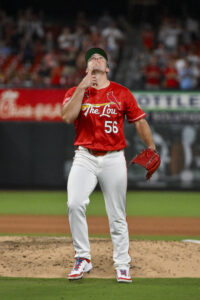
After a few seasons in the ninth inning, Helsley will move to a setup role in Queens. He’ll likely be Carlos Mendoza’s top leverage arm in the bridge to Edwin Díaz. Rogers may not be far behind him in the pecking order. Helsley and Rogers are each excellent relievers but couldn’t be more different stylistically. Mendoza will have a few different looks in what now seems to be one of the deepest bullpens in the game. Reed Garrett, Ryne Stanek and Soto all bring plus velocity in the middle relief group.
The 31-year-old Helsley is playing on an $8.2MM salary for his final season of arbitration. The Mets will pick up the remaining $2.65MM. They’re taxed at a 110% rate on all expenditures, so they’ll pay nearly $3MM in taxes on top of the money owed to Helsley. It’s an approximate $5.6MM investment. Helsley will be a free agent at season’s end. That’s also true of Stanek, Rogers, Soto and probably Díaz (who can opt out of the remaining two years and $37MM on his contract). New York holds a club option on southpaw Brooks Raley. There’ll be a lot of turnover next season, but it’s a high-octane group for the stretch run.
The Mets are loading up at the same time as the Phillies are dealing two highly-regarded prospects for Minnesota’s star closer, Jhoan Duran. Philadelphia is percentage points above New York in what should be a fantastic NL East race. The Mets have also been linked to center field upgrades — Luis Robert Jr., most prominently — and could turn their attention to the lineup over the final 22 hours before the deadline.
On the other end, the Cardinals are parting with a player who has spent a decade in the organization. Helsley was a fifth-round pick in 2015 and has spent parts of seven seasons with the big league club. The Cardinals curiously opted not to trade him last offseason despite cutting payroll and viewing 2025 primarily as an evaluation year for their young players. St. Louis hung around the playoff mix for a while, but an 8-15 record in July has sealed their fate as deadline sellers.
Helsley acknowledged last week that a trade was coming. While he’d spoken a few times about wanting to sign an extension with St. Louis, the team never seemed to reciprocate the interest. They weren’t especially likely to make him a qualifying offer that should land north of $22MM. (Teams cannot make a QO to players acquired midseason, so the trade ensures that Helsley will hit free agency unencumbered.) The Cards have dropped close to .500 and sit five games back in the Wild Card picture, making a trade inevitable.
In all likelihood, they’re getting a slightly lesser return than they would have received had they shopped Helsley over the winter. Baez, a 20-year-old infielder, is the headliner. He placed in the back half of the Mets’ top 10 prospects at both Baseball America and MLB Pipeline. Eric Longenhagen at FanGraphs slotted him 15th in his organizational writeup last June.
The righty-hitting Baez impresses evaluators with his bat speed and contact skills. That comes with a tendency to expand the strike zone that alarms some scouts, though, and Baez is not expected to have the requisite athleticism to stick at shortstop. He’s a potential regular at third base who remains at least a couple years from big league readiness. Baez is playing in a pitcher-friendly setting in High-A, batting .242/.332/.390 with 10 home runs and a lower than average 16.3% strikeout rate.
Dohm, a 6’4″ right-hander, was New York’s third-round pick last summer. The Mississippi State product has combined for a 2.87 ERA with a near-29% strikeout rate in 18 starts in the low minors. He ranked 14th in the system at MLB Pipeline but was further down at BA (25th) and FanGraphs (42nd). Dohm battled forearm injuries in college and faces some durability questions. He leans most heavily on a potential plus fastball while mixing in a slider and curveball. There’s a decent chance he’ll wind up in relief, but the Cards will presumably continue developing him as a starter.
Ellisalt was New York’s 19th-round pick last summer. FanGraphs ranked him 43rd in the system, writing that his fastball/slider combination gives him a shot to be a middle reliever if his command becomes passable. He’s a 23-year-old reliever with a 3.04 ERA and strong 29% strikeout rate against younger competition between two A-ball levels.
This’ll be the first of multiple subtractions from the St. Louis bullpen. Impending free agents Phil Maton and Steven Matz should both be moved. Lefty JoJo Romero has an additional season of arbitration control but could be dealt as well. None of those players will command as strong a return as Helsley did, but the Cards could add a few more mid-tier prospects to the farm system by tomorrow evening.
Jon Heyman of The New York Post first reported the Mets were closing in on a deal for Helsley. Anthony DiComo of MLB.com confirmed the deal was in place and was first with Baez as the headliner of a three-player package. Heyman was first on Ellisalt and Dohm. Image courtesy of Jeff Curry, Imagn Images.