
Angels Announce 11 Roster Moves
The Angels announced nearly a dozen roster moves as they prepare their Opening Day lineup. The team confirmed the signing of lefty reliever Joey Lucchesi to a one-year free agent deal. They also selected veteran infielders Adam Frazier and Jeimer Candelario onto the big league roster.
Vaughn Grissom lands on the 10-day injured list with a sprained left wrist. Pitchers Ben Joyce (shoulder inflammation), Alek Manoah (middle finger contusion), Kirby Yates (left knee inflammation), and Grayson Rodriguez (shoulder inflammation) all land on the 15-day injured list. Those five placements are retroactive to March 22.
The Angels needed to open three spots on the 40-man roster for Lucchesi, Frazier and Candelario. Two of those are procedural moves, as Anthony Rendon and Robert Stephenson have been placed on the 60-day injured list. The one roster casualty of the whole series of transactions is left-handed reliever Jayvien Sandridge, who was designated for assignment.
Most of these transactions had either been announced or strongly telegraphed by prior moves. Frazier and Candelario were each expected to break camp after offseason minor league contracts. The former is ticketed for the majority of the playing time at second base. Frazier’s left-handed bat and plus contact skills make him a rarity in a heavily right-handed lineup. He hit .281 with a .452 on-base percentage this spring but has been a below-average hitter in four consecutive seasons. Frazier ran a .267/.319/.365 slash in 459 plate appearances between the Pirates and Royals a year ago.
Candelario, 32, returns to the majors after finishing last season in Triple-A in the Yankees system. The switch-hitter turned in a meager .207/.265/.394 line while battling various injuries over a season and a half with the Reds. He popped four homers this spring but struck out 17 times in 56 plate appearances.
Primarily a corner infielder, Candelario has also gotten acclimated to second base in camp. He’ll work as a backup infielder alongside the out-of-options Oswald Peraza behind Frazier and third baseman Yoán Moncada. The Angels will only pay him the $780K league minimum while he’s on the roster. The Reds are still covering the rest of his $13MM salary after releasing him last June.
Of the injured list assignments, only the Yates move comes as a surprise. The 39-year-old righty signed a $5MM free agent deal over the winter. That was the biggest investment the Halos made in a quiet offseason. Yates was one of a handful of reclamation fliers who’ll slot into the bullpen. He had been expected to share closing work with Jordan Romano and Drew Pomeranz. That’ll be on hold for at least the first 12 days of the regular season. Yates pitched four times this spring, allowing one earned run over four innings.
Joyce is still building back from last May’s shoulder procedure. He’s throwing but didn’t get into any games this spring. He’s not ready for MLB game action but should be back relatively early in the year. It’s an encouraging sign for his health that the Angels opted to designate someone for assignment rather than place Joyce on the 60-day IL.
Grissom is out of minor league options. His injury buys the Halos a little bit of time to determine whether they want to keep him on the roster or designate him for assignment. Rodriguez and Manoah entered camp as the projected fourth and fifth starters. Their continued injury issues will draw Jack Kochanowicz and Ryan Johnson into the final two rotation spots instead.
Sandridge came over from the Yankees in a cash trade in January. The 27-year-old southpaw pitched twice before being optioned early in camp. He allowed five runs over two innings. Sandridge gave up two runs while recording two outs in his lone major league appearance, which came as a Yankee last July. In Triple-A, he posted a 4.55 ERA with huge strikeout stuff (33.1%) but too many walks (12%). The Angels have five days to trade him or try to run him through waivers.
Cubs Select Dylan Carlson
9:23pm: Chicago has selected Carlson’s contract and placed Austin on the 60-day injured list to open a 40-man roster spot, according to the MLB.com transaction log.
12:45pm: The Cubs are going to select outfielder Dylan Carlson to their roster before Opening Day, reports Jordan Bastian of MLB.com. Carlson will unlock the $2MM salary on his deal by getting the call. Bastian adds that infielder/outfielder Scott Kingery is travelling with the team and will likely get a spot as well, though the club is still monitoring external possibilities for the final spot on their bench. The Cubs also plan to select outfielder Michael Conforto, meaning they will need to open at least two 40-man spots and potentially a third. Outfielder Kevin Alcántara has been optioned and will start the season at Triple-A Iowa.
A few spring injuries have opened up some playing time for the Cubs. They began camp projected for three bench spots to go to Tyler Austin, Miguel Amaya and Matt Shaw, with an opening for an outfielder. Austin required knee surgery and is going to be on the injured list for months. Seiya Suzuki has a knee sprain and will also start the season on the IL. Those injuries have opened enough space for Conforto, Carlson and perhaps even Kingery to crack the roster.
Carlson, 27, was once one of the top prospects in the league for the Cardinals. A few years ago, he seemed to be cementing himself as a key piece of the St. Louis outfield but his results have tapered off in recent seasons. He has a combined .210/.294/.314 batting line since the start of 2023. His once-strong defensive grades have also slipped recently. He bounced to the Rays and Orioles, with Baltimore cutting him loose at the end of last year.
After those struggles, he had to settle for a minor league deal with the Cubs coming into 2026. He has had a good camp, putting up a .304/.429/.413 line. That got a lot of help from a .433 batting average on balls in play and he also posted a concerning 26.8% strikeout rate, but on the positive side, he drew a walk in 14.3% of his plate appearances.
Carlson is a switch hitter and may be used in a short-side platoon role. He has a .274/.347/.410 line against lefties in his career, compared to a .217/.298/.356 performance against righties. Conforto is a lefty bat with better career numbers against righties. Between the two, perhaps they can form a decent cover for Suzuki’s absence. When Suzuki is back, they both may lose playing time, but Carlson could still spell lefties like Michael Busch, Moisés Ballesteros and Pete Crow-Armstrong on occasion.
Kingery, 32 in April, was also in camp on a minor league deal. He has never hit much in the majors, with a career .227/.278/.382 line. He didn’t show much better during spring action, slashing .208/.345/.333. But he provides a lot of defensive versatility. He has experience at every position on the diamond except first base and catcher. He is also optionable and could be sent down the minors once Suzuki is healthy.
It should be known in about 24 hours if he gets a spot or not. Though only two teams are playing tomorrow, all teams have to submit their Opening Day rosters. There tends to be a lot of roster shuffling ahead of Opening Day as players opt out of contracts and others get squeezed off roster spots. Perhaps the Cubs will find someone they like better than Kingery to plug in. They don’t strictly need his versatility since Shaw is expected to play a multi-positional role off the bench, so perhaps they can find someone with a bit more offensive punch.
Alcántara is one of the club’s top prospects but there are concerns about his hit tool. He has been punched out in almost 30% of his plate appearances. Just now in camp, he struck out at a 32.6% pace. With the Suzuki injury, the Cubs could have given him some run in the big leagues but sending him for some more seasoning in Triple-A is also defensible.
Ideally, he’ll find some improvement in his bat to ball skills this year. He is slated to be out of options next year. The Cubs are slated to have Suzuki, Carlson, Conforto and Ian Happ all reach free agency after this season, leaving them with just Crow-Armstrong in their 2027 outfield. It would be great if Alcántara could step up and fill one of those openings but he’ll likely need to make more contact for that to be viable.
Photo courtesy of Rick Scuteri, Imagn Images
Orioles To Designate Bryan Ramos For Assignment
The Orioles are designating corner infielder Bryan Ramos for assignment, reports Francys Romero. He’s out of minor league options, so he needed to win an MLB job or be removed from the 40-man roster.
Ramos had an uphill path to a job. He had already been taken off the roster three times over the offseason. The O’s acquired him from the White Sox in January. Baltimore tried to get him through waivers a week later. The Cardinals placed a claim but designated him themselves less than two weeks after that. The Orioles brought him back on a waiver claim.
The 24-year-old Ramos put his best foot forward this spring. He hit .316 with a home run and three doubles in 42 trips to the plate. However, Ramos has slashed just .198/.244/.333 over 120 regular season plate appearances at the big league level. He’s coming off a rough season in Triple-A, batting .216/.309/.396 with 16 homers across 105 games with the White Sox’s top affiliate.
Baltimore will officially designate Ramos for assignment tomorrow morning when they announce their Opening Day roster. They’ll have five days after that to trade him or place him back on waivers. Blaze Alexander and Coby Mayo will draw into the starting lineup at second and third base, respectively, due to the Jackson Holliday and Jordan Westburg injuries. Ryan Mountcastle, Tyler O’Neill and Leody Taveras are locked into bench spots. Jeremiah Jackson or non-roster outfielder Weston Wilson are options for the final bench role.
Giants Likely To Designate Luis Matos For Assignment
The Giants are planning to designate outfielder Luis Matos for assignment, reports Susan Slusser of The San Francisco Chronicle. She adds that minor league signee Jared Oliva is expected to break camp in a bench role, so he’ll take Matos’ spot on the active and 40-man rosters.
Matos is out of minor league options. Formerly one of the organization’s top position player prospects, he was one of the most intriguing players fighting to hold his 40-man spot this spring. The Giants gave him a look long in camp, as he led the team with 23 games and 55 plate appearances.
After a quick start, Matos’ bat cooled in the middle of March. He finished the spring with a .260/.327/.440 line with two home runs. Matos only struck out three times but also took just one walk, as his on-base percentage was propped up by getting plunked by four pitches.
That aggressiveness has undercut Matos’ production in meaningful games. He’s a .231/.281/.369 hitter over parts of three MLB seasons. Matos has taken just under 600 plate appearances, the rough equivalent to one full season of playing time. He has hit 15 homers with strong contact rates but has worked walks at a modest 6.1% clip.
The Giants can wait until tomorrow morning to officially designate Matos for assignment. They’ll then have five days to try to trade him. If nothing comes together, they’d need to place him on waivers. There’s a decent chance he’ll be claimed, as he’s a 24-year-old former notable prospect who owns a .287/.345/.505 line over three Triple-A seasons. If another team acquires him via trade or waivers, they’d need to carry him on the big league roster.
Matos’ exclusion means the Giants will probably carry Jerar Encarnacion. He’s also an out-of-options outfielder who fits best in a corner or at designated hitter. He can get regular playing time at DH with Bryce Eldridge opening the season in the minors. San Francisco optioned depth outfielders Will Brennan and Drew Gilbert to Triple-A Sacramento this evening.
Rule 5 pick Daniel Susac is expected to win the backup catcher job. Casey Schmitt and Christian Koss seem ticketed for utility infield roles. That’ll very likely leave Oliva as a fifth outfielder and backup center fielder behind Harrison Bader. Assuming he’s officially selected onto the roster tomorrow, it’ll be his first MLB work in five years.
Oliva played in 26 big league games with the Pirates between 2020-21. He has bounced around the upper minors for the past few seasons without returning to the big league level. Oliva had a league average .252/.335/.413 batting line with 57 stolen bases in Triple-A with the Milwaukee organization last year. He signed a minor league deal with San Francisco over the winter and seized a job with his continued aggressiveness on the bases.
The righty-hitting outfielder stole 14 bags in 15 attempts. His .375 average over 20 games is unlikely to be a precursor to much of an impact at the plate, but the Giants are opting for more speed and defense in the final bench spot than Matos would have provided.
Angels To Sign Joey Lucchesi
The Angels are going to sign left-hander Joey Lucchesi, reports Jon Heyman of The New York Post. Heyman adds that the CAA Sports client is expected to be on the Opening Day roster, suggesting it’s a major league deal. That would mean the Halos would need a corresponding 40-man move. They have some candidates to move to the 60-day injured list, with Anthony Rendon being an obvious one, but they may also need spots for Adam Frazier and Jeimer Candelario if they plan to roster those guys.
Lucchesi, 33 in June, was in camp with the Giants on a minor league deal as of a few days ago. He was granted his release, which may or may not have involved him triggering an opt-out in that deal. Regardless, he was back on the open market and the Halos have scooped him up.
The southpaw has been a starter or swingman for most of his career. 2025 was his first big league season where he pitched exclusively as a reliever. He averaged just under 93 miles per hour with both his four-seamer and his sinker while also throwing a low-80s splitter and high-70s curveball. He gave the Giants 38 1/3 innings over 38 appearances, allowing 3.76 earned runs per nine frames. His 18.8% strikeout rate was subpar but his 7.3% walk rate was good and he induced grounders on 53% of balls in play.
The Giants could have retained Lucchesi for 2026 via arbitration, with MLBTR contributor Matt Swartz projecting him for a $2MM salary. Instead, they non-tendered him and then re-signed him to a minor league deal that would have paid him $1.5MM in the majors. As mentioned, they released him from that pact a few days ago.
The Angels signed Kirby Yates, Jordan Romano, Drew Pomeranz and Brent Suter to free agent deals this offseason. No one in that group can be optioned to the minors. Chase Silseth is out of options. Guys like Ryan Zeferjahn, Sam Bachman and Walbert Ureña seemed to be trending to Opening Day jobs but all three can be optioned. Perhaps one of them will get bumped to the minors to make room for Lucchesi, though knocking out Silseth could be a way for the club to open a 40-man spot.
Photo courtesy of Mark J. Rebilas, Imagn Images
Orioles Sign Elvis Peguero To Two-Year Minor League Deal
The Orioles announced that they have signed right-hander Elvis Peguero to a minor league deal covering the 2026 and 2027 seasons. He has been assigned to the Triple-A Norfolk Tides, though his current health status is unclear.
Two-year minor league deals are normally signed when a pitcher is facing a lengthy injury absence, often due to a notable procedure such as Tommy John surgery. These types of deals allow the pitcher to rehab using a team’s facilities while collecting a paycheck. For the team, they know they will get little or no return on that investment in the near term but the hope is that the deal pays off when the pitcher is healthy in the second year.
There hasn’t been any public reporting about Peguero undergoing surgery recently. The White Sox did put him on the 15-day injured list in August due to a right elbow strain. He stayed there through the end of the campaign. He was outrighted off the roster in October and became a free agent shortly thereafter. Perhaps the Orioles will reveal more information about Peguero’s status soon.
Over the past five seasons, Peguero has pitched for the Angels, Brewers and White Sox. He’s essentially been a two-pitch guy with an upper-90s sinker and a low-90s slider. He has allowed 4.26 earned runs per nine innings. His 19.5% strikeout rate and 10.8% walk rate are both a bit worse than average but he has induced grounders on 54.3% of balls in play.
He exhausted his final option season in 2025, meaning he will be out of options going forward. If he can eventually earn a roster spot and hold it, he can be retained for several years via arbitration. His service time count is currently at two years and 136 days.
Photo courtesy of Matt Marton, Imagn Images
Astros To Select Christian Vázquez
The Astros are going to open the season with Christian Vázquez as their backup to catcher Yainer Diaz, manager Joe Espada tells Matt Kawahara of The Houston Chronicle. He had been in camp on a minor league deal. César Salazar has been informed he won’t make the team. Since Salazar is out of options, he’ll need to be removed from the 40-man, which means he’ll be traded or placed on waivers in the coming days.
Vázquez, 35, has over a decade of big league experience under his belt. He’s probably not going to provide much offensively at this point in his career. He has had some good performances with the bat before but has a combined .215/.267/.311 line dating back to the start of the 2023 season. That’s why he had to settle for a minor league deal coming into 2026. He was playing for Puerto Rico in the World Baseball Classic at the time of that pact. He put up a flat .250/.250/.250 line in that tournament and then slashed .222/.364/.222 in 11 spring plate appearances with the Astros.
But he is considered one of the better defensive catchers in the game. He’s been credited with 64 Defensive Runs Saved since the start of 2014, his debut season. Only three other catchers are ahead of him in that category. One of them is Buster Posey, who retired long ago and is now running the Giants’ front office. Another is Roberto Pérez, who hasn’t played in the majors since 2023. The other is Austin Hedges. Vázquez generally ranks near the top of framing leaderboards as well.
The Astros are known as an organization that values catcher defense, as they have often rostered glove-first guys like Jason Castro and Martín Maldonado. They acquired Vázquez at the 2022 deadline and went on to win that year’s World Series, after which Vázquez signed a three-year, $30MM deal with the Twins. That deal didn’t really pan out the way the Twins hoped due to the aforementioned decline in his offense but Vázquez still has enough of a reputation to get back to the majors with Houston.
Rostering Vázquez means the Astros may be ending their relationship with Salazar. He has appeared in 36 games for the Astros over the past three years, putting up a .232/.318/.268 line in 67 plate appearances. He was considered a strong defender as a prospect but has only been able to log 143 2/3 innings behind the plate as a big leaguer.
As mentioned, he is out of options, meaning he can’t be sent to the minors unless he first clears waivers. It’s possible some other club could be interested. He does have the aforementioned strong defensive reputation. He hasn’t hit much in the majors yet but has a .238/.369/.389 line and 113 wRC+ at the Triple-A level dating back to the start of 2024. If any club were to pick him up, he could be controlled for another five seasons and is also two years away from qualifying for arbitration.
If he were to clear waivers, the Astros could keep him as non-roster depth. He doesn’t have three years of service time and doesn’t have a previous career outright, so he wouldn’t have the right to elect free agency. The Astros would probably be happy if that happened, as they don’t have any other catchers on their roster. Carlos Pérez is their only non-roster backstop with big league experience.
Photo courtesy of Troy Taormina, Imagn Images
Phillies Extend Cristopher Sanchez
For the second time in less than two years, the Phillies have announced a contract extension with Cristopher Sanchez. The left-hander’s previous extension in June 2024 gave the team control over Sanchez’s services through the 2030 season, but this new contract now locks Sanchez into the fold through at least the 2032 season for $88MM in new money. Sanchez is represented by Mato Sports Management.
The new deal keeps Sanchez’s $3MM salary in place for the 2026 season and adds a $6MM signing bonus. He’ll also earn the $6MM in 2027 and the $9MM in 2028 that was promised to him under the terms of his old extension. The Phillies previously held a $14MM club option on Sanchez for 2029 and a $15MM club option for 2030, but those option years have now been guaranteed under the new extension at those prices. Sanchez will then earn $27MM in each of the 2031 and 2032 seasons, though $10MM is deferred each year. Philadelphia holds a $32.5MM club option for the 2033 campaign. The value of that option can increase based on Cy Young voting from 2027 to 2032, with $2MM for a win, $1MM for second or third place, $750K for fourth or fifth and $500K for sixth through tenth. A buyout would also attach to the option by the same criteria. That becomes a $10MM club option if Sanchez spends 130 consecutive days on the injured list in 2031 or 2032. Sanchez can also earn up to $13MM extra via incentive bonuses over the course of the contract.
Sanchez’s four-year, $22.5MM extension from June 2024 had already proven to be a huge bargain for the Phillies, as the southpaw continued to produce throughout the 2024 campaign and then took a step forward by finishing second in NL Cy Young Award voting in 2025. It would’ve been easy for the Phillies to sit back and continue benefiting from the surplus value created by the extension, but president of baseball operations Dave Dombrowski took the long view towards Sanchez’s future in Philadelphia.
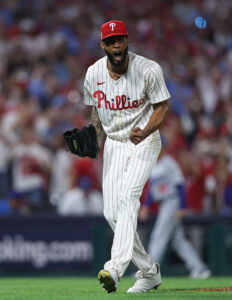 “We kind of assumed years four and five were a no-brainer as far as we were going to pick those up,” Dombrowski told The Athletic’s Matt Gelb and other reporters. “So we couldn’t even imagine a scenario in which we wouldn’t. Now we start talking beyond that. And we thought that somebody of Cristopher’s stature, we’d rather get this done now, while he’s still at the age that makes sense for us.”
It naturally isn’t uncommon for teams to sign their stars to multiple extensions over the course of their careers, as we’ve seen recently with the Guardians and Jose Ramirez back in January or the Diamondbacks with Ketel Marte last year. Those deals weren’t quite the same as the Sanchez extension, however. Both Ramirez and Marte had more than a decade of MLB experience under their belt and had already played out significant portions of their initial team-friendly extensions. In addition, those teams had the motive of restructuring their star’s previous deal to include deferred money.
That’s not to say Sanchez is undeserving of his new payday, of course. After earning a trip to the All-Star Game in 2024, Sanchez cemented his ace status with a superb 2025 season. The lefty spun a 2.50 ERA with a 2.55 FIP in 202 innings of work, striking out 212 batters across 32 starts. He paired his 26.3% strikeout rate with a 5.5% walk rate and a 58.3% ground ball rate, giving him a lower SIERA than every qualified starter in the NL and the third-lowest in baseball behind Tarik Skubal and Garrett Crochet.
By measure of fWAR, Sanchez’s 2025 season was a top-20 campaign by a qualified starter since 2015, tied with Cy Young-winning campaigns by future Hall of Famers like Chris Sale (2024), Max Scherzer (2017), and Justin Verlander (2019). Sanchez ultimately finished second behind Paul Skenes in Cy Young voting last year, but nonetheless established himself as among the upper-echelon of starters in today’s game with that performance.
Clearly, the Phillies are betting on Sanchez to age well like those other elite arms did by signing him to a big-money extension for his mid-thirties. Philadelphia has been unafraid of signing players well past their prime years previously, as shown by the fact that Zack Wheeler and Aaron Nola are under contract through their age-37 seasons, while Jesus Luzardo‘s new contract extension includes a club option for his age-34 campaign.
With this new contract, Sanchez joins Luzardo (2032 club option) and Trea Turner (contract guaranteed through 2033) as the only three players under team control beyond the expiration of Bryce Harper‘s contract in 2031. This restructured contract for Sanchez could be an interesting data point for Harper and agent Scott Boras, as the two-time MVP and future Hall of Famer has previously publicly expressed a desire to extend or restructure his contract with Philadelphia to keep him in town beyond the 2031 campaign. Of course, those previous attempts were before this past offseason’s comments from Dave Dombrowski critical of Harper that drew the superstar’s ire, prompting trade speculation that Dombrowski later firmly shut down.
Sanchez’s extension was first reported by FanSided’s Robert Murray. The Athletic’s Matt Gelb reported the total of money involved in the deal, while Francys Romero of Beisbol FR had the details about the performance incentives and Ronald Blum of The Associated Press provided all the financial details.
Inset photo courtesy of Bill Streicher — Imagn Images
Astros’ Peter Lambert Granted His Release
Astros righty Peter Lambert was granted his release after triggering an out clause in his minor league deal, manager Joe Espada tells reporters (link via Matt Kawahara of the Houston Chronicle). The team told Lambert over the weekend that he wouldn’t make the roster.
Lambert, 29 next month, had a solid spring showing and at one point looked to be in legitimate contention for a bullpen spot. He pitched 12 1/3 innings with the ‘Stros and held opponents to four runs on 16 hits and five walks with eight punchouts. That came on the heels of a decent season in Japan’s Nippon Professional Baseball last year, where he tossed 116 1/3 innings with a 4.26 ERA for the Yakult Swallows.
Lambert has pitched in parts of four MLB seasons, all coming with the Rockies, who originally selected him 44th overall in the 2015 draft. He’s been tagged for an unsightly 6.28 ERA in 243 2/3 MLB frames, battling myriad injuries and the inherent rigors of pitching at altitude in Denver.
This spring, Lambert’s average fastball clocked in at 95 mph — way up from the 93.3 mph he averaged with the Rox from 2019-24. That velocity bump, coupled with a solid (albeit small-sample) swinging-strike rate of 11.4% suggest Lambert could probably be counted on for a better mark than the ugly 14.8% strikeout rate he posted this spring.
It’s always feasible that veterans in these situations will re-sign with the same team on a new minor league deal — perhaps with better minor league pay and/or more additional opt-out dates that grant them some flexibility. The Astros seem to like Lambert’s arm, but he’s also out of minor league options, which makes him a tough fit for a Houston club that currently has four relievers (Bryan Abreu, Enyel De Los Santos, Steven Okert, Roddery Munoz) who can’t be optioned — plus another two (Josh Hader, Nate Pearson) rehabbing on the injured list.
Yankees Trade Zack Short To Nationals
The Yankees have traded infielder Zack Short to the Nationals in exchange for cash, per announcements from both clubs. Short, who’d been a non-roster invitee to Yankees camp, will head to Triple-A Rochester with his new organization for the time being.
Short, 30, signed a minor league deal with New York back in December and hit .278/.480/.333 in 25 spring plate appearances. He’s played in parts of four major league seasons between the Tigers, Mets, Red Sox, Braves and Astros, tallying a total of 594 plate appearances. In that time, he’s slashed .172/.271/.296 with 15 homers, 10 steals, a stout 11.8% walk rate and a bloated 29% strikeout rate.
The Nationals are relatively thin on infield depth, and Short has experience at second base, shortstop and third base in the majors — more than 300 innings at each position (including 784 at shortstop). He hasn’t posted especially strong defensive grades, but he’s a versatile right-handed bat with modest pop and solid on-base skills. His low batting averages persist even in Triple-A, where he’s batted just .216 in six seasons, but he also sports a .353 on-base percentage in that time.
Looking around the Nationals’ infield, CJ Abrams is the lone established player. Former first-round pick Brady House will get another look at third base, while Nasim Nunez and Luis Garcia Jr. look like options at second base and first base. Infielder Jorbit Vivas also came over from the Nats in a more notable trade and is out of minor league options, so he’ll mix in to some extent, as will righty-swinging first baseman Andres Chaparro.