
Braves Acquire Eli White From Rangers
The Braves announced they’ve acquired outfielder Eli White from the Rangers in exchange for cash. Infielder Hoy Park was designated for assignment to clear a 40-man roster spot. Texas had DFA White last week.
White, 28, has appeared at the MLB level in each of the last three seasons. A former Oakland draftee who landed with the Rangers in the Jurickson Profar swap before the 2019 campaign, he debuted with Texas the next year. White played a sporadic role for the next few seasons, suiting up in 130 games. He owns a .185/.260/.295 line over that stretch, hitting nine home runs but striking out at a massive 31.6% clip.
While While hasn’t hit much at the MLB level, he’s shown flashes in other areas. He’s stolen 17 bags in 22 career attempts, including a 12-for-13 success rate this year. The Clemson product has demonstrated that athleticism on defense, with Defensive Runs Saved pegging him 11 runs above average through 890 career innings of outfield work. He’s rated as nine runs better than par by Statcast’s Outs Above Average, with most of his time in left and center field.
White’s 2022 season was cut short in June when he fractured his right wrist in an outfield collision. The injury required surgery, but there’s no indication it’ll have any lingering effects on his 2023 preparation. Assuming he holds his 40-man roster spot all winter, he’ll compete for a bench job in Spring Training. Atlanta has Marcell Ozuna, Eddie Rosario, Jordan Luplow and Sam Hilliard all jockeying for left field playing time alongside Michael Harris II and Ronald Acuña Jr. No one in the left field mix — White included — can be optioned to the minor leagues, so Atlanta may wind up dropping one or two of those players from the 40-man roster before the regular season kicks off.
Park landed in Atlanta less than two weeks ago. The Braves acquired the left-handed hitting infielder from the Red Sox for cash or a player to be named later. He’d just been claimed off waivers by Boston from the Pirates, and he’ll head into DFA limbo for a third time this winter.
The 26-year-old has a .201/.291/.346 line in 210 MLB plate appearances with the Yankees and Bucs in the past two seasons. He’s shown solid plate discipline but hit for below-average power and struck out at a slightly elevated rate. The South Korea native is a .255/.384/.417 hitter in parts of two Triple-A campaigns. He’s played each of second, third base, shortstop and all three outfield spots in his limited MLB time. Park has two minor league option years remaining, so another team willing to devote him a 40-man roster spot could keep him in Triple-A for the next couple seasons. He’ll be traded or waived yet again in the next seven days.
Braves Acquire Lucas Luetge From Yankees
The Braves announced they’ve acquired reliever Lucas Luetge from the Yankees. Minor leaguers Caleb Durbin and Indigo Diaz are headed back in return. To clear a spot on their 40-man roster, Atlanta designated first baseman Lewin Díaz for assignment.
New York surprisingly designated Luetge for assignment last Wednesday. That opened a one-week window for them to trade him or place him on waivers, but the former outcome always seemed likelier. The veteran southpaw has been a productive piece of the New York bullpen over the past two years, so it’s no surprise to see a team part with some minor league talent to keep him off waivers.
Luetge, 35, pitched two seasons in the Bronx after signing a minor league deal during the 2020-21 offseason. Over his time in pinstripes, he put together a 2.71 ERA through 129 2/3 frames. That included a sub-3.00 mark in both years, with Luetge topping 55 innings in each season. His 2022 campaign saw him put together a 2.67 mark across 57 1/3 frames, striking out a solid 23.9% of opponents against a better than average 6.8% walk rate.
The veteran has held left-handed opponents to a .229/.281/.324 line in 185 plate appearances since joining the Yankees. Righties have a .268/.320/.395 slash that’s better but not overwhelming, meaning Luetge doesn’t have to be leveraged solely against same-handed hitters. He doesn’t throw hard but he’s been excellent at staying off barrels. Only 23.5% of batted balls against him this past season were hit hard, per Statcast; that’s the lowest rate of any qualified pitcher in the game.
Luetge has between four and five years of major league service. He’s arbitration-eligible for the next two seasons, with MLBTR contributor Matt Swartz projecting a $1.7MM salary in 2023. He’ll add a third southpaw to what should be a very strong Atlanta relief corps, with A.J. Minter and Dylan Lee on hand for higher-leverage work.
The acquisition bumps Lewin Díaz off the 40-man roster and back into DFA limbo. That’s familiar territory for the 26-year-old first baseman, who has changed organizations four times this winter. He’s gone from the Marlins to the Pirates to the Orioles via waivers, and Atlanta just purchased his contract from Baltimore last week.
The Braves will now have a week to deal Díaz or try to pass him through waivers, so it’s possible he changes teams again in the coming days. A left-handed hitter, he’s a .181/.227/.340 hitter through 112 MLB games. Díaz has a more impressive .250/.325/.504 mark in just under 700 Triple-A plate appearances, though. He’s also regarded as a plus defender at first base, with public defensive metrics very bullish on his early-career work at the position. That’s led to a decent amount of interest around the league, though Díaz hasn’t yet stuck on a 40-man roster very long this winter.
As for the Yankees, they’ll bring in some minor league talent. Indigo Diaz was a 27th-round pick in the 2019 draft. He entered the 2022 campaign as the #21 prospect in the Atlanta system, according to Baseball America. The 24-year-old spent the whole season at Double-A Mississippi, posting a 3.08 ERA through 49 2/3 innings of relief. The 6’5″ righty struck out nearly 30% of opposing hitters but walked batters at a huge 14.6% clip. Diaz went unselected in this offseason’s Rule 5 draft and adds some non-roster bullpen depth to the upper minors in New York.
Durbin went in the 14th round in the 2021 draft. He split this past season between two A-ball levels, hitting .241/.352/.372 across 450 plate appearances with matching 10.9% strikeout and walk rates. A right-handed hitter, Durbin split his time between second, third base and shortstop. He turns 23 in February and won’t be eligible for the Rule 5 draft until after the 2024 campaign.
Pirates Designate Bryse Wilson For Assignment
The Pirates announced they’ve designated Bryse Wilson for assignment. The move clears a spot on the 40-man roster for Jarlín García, who has officially signed his one-year deal with a 2024 club option.
A fourth-round draftee of the Braves out of a North Carolina high school in 2016, Wilson developed into one of the sport’s better pitching prospects a few seasons later. The right-hander ranked among Baseball America’s top 100 minor league talents in advance of the 2019 season after debuting with three MLB appearances late in the prior year.
Despite that lofty prospect pedigree, Wilson never got much run in the Atlanta starting staff. He’d start just six of 12 outings the next two years before picking up eight starts in the first half of the 2021 campaign. Wilson pitched fairly well at the Triple-A level but managed only a 5.90 ERA through 23 appearances in an Atlanta uniform. In advance of the ’21 trade deadline, the Braves dealt him and minor league pitcher Ricky DeVito to Pittsburgh for reliever Richard Rodríguez.
That trade didn’t pan out as either team had envisioned. Rodríguez struggled down the stretch and was non-tendered at the end of the season. Wilson has spent a season and a half in Pittsburgh but didn’t seize a permanent rotation spot. Since landing with the Bucs, he’s posted a 5.37 ERA across 156 innings in 33 appearances (28 starts). Wilson struck out a below-average 15% of opposing hitters while allowing a .279/.330/.484 line in just under 700 plate appearances.
Wilson did demonstrate the quality control for which he was credited as a prospect. He walked only 6.2% of opponents as a Pirate, including a 6.3% clip through 115 2/3 frames this past season. He induced grounders this year at a roughly average 43.3% rate, the highest of his career.
The Pirates squeezed Wilson out of the rotation in recent weeks with free agent additions of Vince Velasquez and Rich Hill. That duo figures to join Roansy Contreras, JT Brubaker and Mitch Keller in the season-opening starting five. They’ll now have a week to trade Wilson or attempt to run him through waivers.
While Wilson hasn’t yet found much MLB success, he could attract the interest of a pitching-needy club. He just turned 25 this month and had a strong prospect pedigree in the not too distant past. Wilson’s velocity has backed up in recent years, dropping from the 94-95 MPH range to roughly 91-92 MPH this year. He’s shown above-average control and mixes six pitches, however, so another team with some uncertainty at the back of their starting staff could look into a claim. Wilson is out of minor league option years, so an acquiring team would have to keep him on their active roster or again make him available to other clubs.
Red Sox To Sign Corey Kluber To One-Year Deal
3:55pm: The deal can max out at $27MM over the two years, reports Chris Cotillo of MassLive. In 2023, Kluber will get an extra $500K for starting 20 games, then $750K for getting to 25 and 30 starts. Those same figures will also be added to the value of the $11MM option, meaning it will escalate up to $11.5MM at 20 starts, $12.25MM at 25 and $13MM at 30. If the option is picked up, those same bonuses would be available to Kluber for 2024.
12:50pm: The Red Sox and right-hander Corey Kluber are in agreement on a one-year deal plus a club option for 2024. Kluber will be guaranteed $10MM on the deal, though there’s also $2MM in unknown incentives that could increase the eventual payday for the Wasserman client. The 2024 option is valued at $11MM, though with escalators and incentives for that season as well.
Kluber, 37 in April, was once one of the best pitchers alive, winning Cy Young awards in both 2014 and 2017. Those were part of a six-year run of excellence with Cleveland from 2013 to 2018, with Kluber posting a 2.96 ERA over that time along with a 27.7% strikeout rate, 5.2% walk rate and 44.9% ground ball rate.
Injuries limited him to just eight total starts over 2019 and 2020, with a forearm fracture and teres muscle tear the primary culprits. He’s since been ramping back up, but as more of a back-end hurler instead of the ace he was with Cleveland, signing one-year deals with the Yankees and Rays for the past two seasons. He made 16 starts in 2021 with a 3.83 ERA and 31 starts in 2022 with a 4.34 ERA. His 34.7% strikeout rate in 2017 was down to 24% last year and 20.2% in 2022. He did still avoid the free passes, something he’s long excelled at, with his 3% walk rate this year coming in a few ticks below his career 5.4% mark.
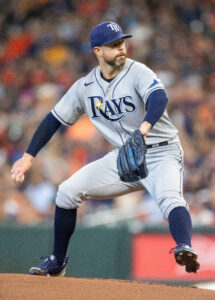
Statcast pegged Kluber’s average four-seam fastball velocity at 88.9 mph in 2022, a significant drop from prior to the injuries, when he was in the 93-95 range. Nonetheless, he still found ways to generally be effective, as his average exit velocity was in the 80th percentile, his hard hit rate in the 75th and his barrel rate 57th. Given his age and checkered health history, MLBTR predicted him for a one-year, $12MM deal, with Kluber coming in just under that, though the incentives could potentially make up the difference.
For the Sox, adding another starting pitcher makes a lot of sense given the uncertainty with their current options. Nick Pivetta is probably the only solid member of their group right now, as Chris Sale and James Paxton have hardly pitched in the past three years. Brayan Bello and Garrett Whitlock are penciled into two spots, though they are young and only have 20 MLB starts between them. Kluber is a bit of a question mark himself, but adding him into the picture still reduces the likelihood that the club will have to rely upon depth options like Connor Seabold or Josh Winckowski throughout the year.
Boston had also been connected to various other starters throughout the offseason, including Zach Eflin, Carlos Rodón, Kodai Senga, Andrew Heaney, Seth Lugo, Tyler Anderson, Rich Hill and Nathan Eovaldi. Those players have all since found new clubs, with Eovaldi signing a two-year deal with the Rangers yesterday. Chad Jennings of the Athletic reports that the Red Sox offered Eovaldi a three-year deal earlier this month, though the guarantee on that offer isn’t known. Regardless, it seems that Eovaldi spurned it in favor of the offer from Texas and Boston then pivoted to Kluber.
Kluber had previously been connected to the Angels and Cubs, though the latter’s interest was prior to signing Jameson Taillon and Drew Smyly. If the Angels are still looking for rotation upgrades, some of the remaining free agents include Michael Wacha, Johnny Cueto and Zack Greinke.
This deal brings the Red Sox payroll up to $186MM and their competitive balance tax figure to $212MM, per the calculations of Roster Resource. That should leave them room for further additions if they so choose, as they’ve run a payroll as high as $236MM in the past, per Cot’s Baseball Contracts, and they’re still more than $20MM shy of the $233MM luxury tax threshold.
Jeff Passan of ESPN first reported that Kluber and the Red Sox were in agreement on a one-year deal plus a club option. Alex Speier of the Boston Globe first reported the $10MM guarantee and later provided some details on the incentives. Jon Heyman of The New York Post first reported the $11MM figure for the option and that the deal contained incentives.
Image courtesy USA Today Sports.
Giants Designate Tommy La Stella For Assignment
The Giants have designated infielder Tommy La Stella for assignment, reports Alex Pavlovic of NBC Sports Bay Area. The move opens a roster spot for reliever Taylor Rogers.
La Stella, 34 in January, had an up-and-down career before coming to the Giants. After a couple of subpar seasons with the Braves and Cubs in 2014 and 2015, he seemed to find a good groove after that. Still with the Cubs in 2016 and 2017, he walked in 11.9% of his plate appearances and produced an overall batting line of .278/.372/.436. That production was 16% above league average, as evidenced by his 116 wRC+.
He had a swoon in 2018, as he hit just a single home run in 123 games and his walk rate dipped to 8.9%, leading to a batting line of .266/.340/.331 and a wRC+ of 87. However, he seemed to take a big step forward in 2019, hitting 16 home runs, more than his total over the previous five seasons. His walk rate dipped again but he only struck out in 8.7% of his plate appearances. 2019 was the “juiced ball” season, but he was still well above average at the plate. His .295/.346/.486 amounted to a wRC+ of 119, indicating he was 19% better than average that year, with wRC+ controlling for the offensive environment around the league.
In the shortened 2020 campaign, he added another five home runs and dropped his strikeout rate even farther to just 5.3%. He parlayed that into a three-year, $18.75MM deal with the Giants going into 2021. Unfortunately, La Stella’s seesaw career has been pointing straight down since that deal was signed. He made multiple trips to the injured list in 2021, getting into 76 games and hitting just .250/.308/.405 for a wRC+ of 93. He underwent achilles surgery in October, which was originally reported as occurring on his left achilles but was reported almost a year later to have been on both of them, per Andrew Baggarly of The Athletic.
In 2022, things got worse, as he continued to make frequent trips to the IL. He only played 60 games in the most recent season and took the field for just 76 innings on the year. When in the lineup, he produced a slash line of just .239/.282/.350 for a wRC+ of 78. Though there’s still another year left on his contract, it seems the Giants have decided it’s time to move on.
La Stella’s deal was heavily backloaded, as he made just $2MM in 2021, $5.25MM this year and is set for a salary of $11.5MM next year. The Giants will now have one week to trade La Stella or pass him through waivers, though a trade will be difficult to accomplish. Given the past two years have seen him struggle both in terms of health and performance, there will be little appetite from other teams to take on that $11.5MM salary. On the defensive side of things, La Stella has previously been able to serve as a utility player, splitting his time between second, third and first base. However, he hasn’t been rated as especially strong at any of them and barely donned a glove in 2022.
Assuming he clears waivers, he has more than five years of MLB service time, which gives him the right to reject an outright assignment and elect free agency while retaining that salary. At that point, any club in the league could sign him and pay him the prorated league minimum for any time spent on the roster, with that amount being subtracted from what the Giants pay.
Giants, Taylor Rogers Agree To Three-Year Deal
December 28: The Giants have officially announced the signing of Rogers. He’ll make $9MM in 2023 followed by $12MM salaries in the next two seasons, reports Alex Pavlovic of NBC Sports Bay Area.
December 23: The Giants and reliever Taylor Rogers are in agreement on a three-year, $33MM contract, reports Ken Rosenthal of The Athletic. The deal for the Frontline client is pending a physical.
Rogers, 32, will now join his twin brother in the San Francisco bullpen, as right-hander Tyler Rogers is already on the club. The left-handed Taylor was one of the top relievers available in free agency this offseason and certainly one of the best southpaws. He came into the open market on a bit of a down note, as he posted a combined 4.76 ERA between the Padres and Brewers, having switched jerseys as part of the much-maligned Josh Hader trade.
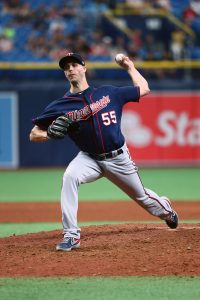 However, it wasn’t quite as bad as that ERA might seem. His 30.7% strikeout rate and 6.9% walk rate were both much better than average and roughly in line with his career marks. His 42.4% ground ball rate was below league average but only by half a percentage point. A 63.5% strand rate may have been a culprit, as that’s roughly 10% below his 74.1% career norm and the 72.6% league average in 2022.
Advanced metrics were much more fond of Rogers in 2022, as he posted a 3.31 FIP, 3.26 xFIP and 2.64 SIERA. Those numbers are also more in line with his pre-2022 form. With the Twins from 2016 to 2021, he made 319 appearances with a 3.15 ERA, 27.9% strikeout rate, 5.9% walk rate and 47.8% ground ball rate, with all of those numbers being a few ticks better than the league average hurler. Though the 4.76 ERA in 2022 didn’t look great, he has a lengthy track record as being a very effective big league reliever and that figure likely wasn’t deserved. MLBTR predicted he could secure a three-year, $30MM deal and he has come out ahead of that.
For the Giants, the signing of Rogers makes plenty of sense given their dearth of reliable southpaw relievers. Prior to this agreement, Scott Alexander and Sam Long were the only lefties projected to be in the bullpen. Alexander has had great results but is frequently injured, not reaching 20 MLB innings since 2018, and will be turning 34 next season. Long has just 40 games in the majors with a 4.55 ERA to show for it. Given those options, it makes plenty of sense that the club has targeted improvements in this area. Rogers should slot in behind closer Camilo Doval for some high-leverage work. For teams still looking for left-handed additions to their bullpen, the top options with Rogers off the board include Andrew Chafin, Matt Moore and Brad Hand.
Assuming an even distribution of the money in $11MM increments, Roster Resource now calculates the club’s payroll to just above $191MM and their competitive balance tax figure to be $208MM. That payroll is well beyond last year’s $155MM Opening Day number, per Cot’s Baseball Contracts, but they have gone above $200MM in the past. It’s unknown how much they plan on spending this winter, but they still have lots of room before reaching the $233MM base threshold of the luxury tax.
Image courtesy of USA Today Sports.
Rangers Sign Nathan Eovaldi
The Rangers announced another rotation addition, signing Nathan Eovaldi to a two-year deal with a vesting/player option for the 2025 campaign. The ACES client will be paid a $2MM signing bonus followed by $16MM salaries in each of the next two seasons. The option — which is valued at $20MM — would kick in as a player option if Eovaldi throws 300 combined innings from 2023-24. It’d also be triggered if the righty finishes in the top five in Cy Young voting in 2024 or finishes in the top seven that year and qualifies for the All-Star team. Eovaldi also has limited no-trade protection and innings-based incentives that could allow him to make as much as $63MM over the next three seasons.
Eovaldi has spent the past four-plus seasons with the Red Sox. Boston first acquired the righty from the Rays at the 2018 trade deadline, adding the impending free agent for their playoff push. Eovaldi was excellent in 12 regular season appearances, then added 22 1/3 innings of 1.61 ERA ball in the postseason. At year’s end, Boston rewarded him for his finish with a four-year, $68MM free agent deal.
That contract looked shaky in year one, as Eovaldi posted an ERA just south of 6.00 in 2019 — a season in which he missed a notable chunk of action due to loose bodies in his throwing elbow. He righted the ship in the second season, though, posting a 3.72 ERA through nine outings during the shortened 2020 campaign.
Eovaldi followed up with maybe the best full season of his career in 2021. He made all 32 starts and posted a 3.75 ERA through 182 1/3 innings, striking out 25.5% of opponents against a 4.6% walk rate. That showing earned him his first career All-Star selection, as well as a fourth place finish in AL Cy Young balloting.
Unfortunately, injury issues cropped back up in 2022. Eovaldi missed chunks of what proved to be his final season in Boston due to a pair of injured list stints. He lost time between June and July with lower back inflammation and missed most of August and September thanks to inflammation in his throwing shoulder. The pair of injuries kept him to 20 starts and 109 1/3 frames, although his production on a rate basis was around his career norms.
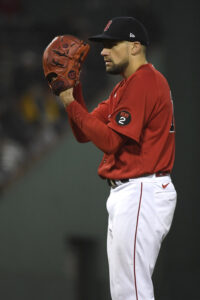
Eovaldi managed a 3.87 ERA, striking out a slightly above-average 22.4% of batters faced. He walked a minuscule 4.3% of opponents while inducing grounders on 47% of batted balls he surrendered. Eovaldi isn’t the ace his 2021 fourth-place Cy Young finish might suggest, but he’s an above-average mid-rotation arm when healthy.
That production doesn’t come the way one might expect given Eovaldi’s power arsenal. He’s one of the game’s hardest throwers, averaging north of 97 MPH for much of his career. However, he’s never posted the elite strikeout rates typically associated with that velocity. Eovaldi’s best trait is instead his ability to pound the strike zone. He’s walked fewer than 5% of opponents in each of the past three years; his cumulative 4.4% walk percentage since the start of 2020 is second-lowest among the 120 pitchers with 200+ frames over that stretch (trailing only the 4.3% mark of Clayton Kershaw).
Eovaldi’s willingness to attack the zone has led to home run issues at times. He’s allowed homers at a higher than average clip in three of the last four years, including an elevated 1.73 homers per nine innings this past season. That’s the only red flag in Eovaldi’s recent performance track record but his health and age presumably gave some teams pause. He’ll be 33 in February, making him one of the older options in a deep class of mid-rotation starters available in free agency.
In addition to this year’s shoulder and back concerns, he has a history of elbow problems. Eovaldi underwent Tommy John surgery in high school, then missed the 2017 campaign after undergoing the procedure a second time in August 2016. He hasn’t required any IL stints due to elbow concerns since the aforementioned 2019 loose bodies. The back and shoulder injuries of this past season might be more acute problems, as Eovaldi’s average fastball velocity dipped from its customary 96-97 MPH range early in the season to roughly 94 MPH after his first IL stint.
Those injuries seemed to depress Eovaldi’s market. Chris Bassitt landed a three-year, $63MM deal headed into his age-34 campaign, while players like Jameson Taillon and Taijuan Walker secured strong four-year pacts despite less consistent performance track records than Eovaldi’s. Many of the free agent starters this offseason landed stronger than expected deals, but Eovaldi’s guarantee exactly matches MLBTR’s prediction from the outset of the offseason.
Eovaldi’s camp was also working against the qualifying offer. He turned down a QO from Boston at the start of the winter, tying any signing team to draft compensation. That was also the case for Bassitt but didn’t come into play for Walker and Taillon.
Texas hasn’t shown much concern about losing draft choices to add quality talent via free agency. They surrendered two picks to sign Corey Seager and Marcus Semien last winter, and they’ll do so again this offseason. The Rangers already forfeited a draft choice to sign Jacob deGrom to a five-year deal. That lessens the price they’ll have to pay in Eovaldi’s case. Texas surrendered their second-highest draft choice in 2023 and $500K in international signing bonus space to add deGrom. They’ll be docked another $500K in signing bonus room and their third-highest pick for Eovaldi.
After the Seager and Semien splashes to bolster the lineup last offseason, the Rangers have thoroughly overhauled their starting staff this winter. Texas acquired Jake Odorizzi from the Braves within the first few days. Left-hander Martín Pérez soon after accepted a qualifying offer, but that didn’t slow down Texas GM Chris Young or his front office. Since free agency opened, they’ve nabbed deGrom on the largest pitching contract of the offseason and brought in Andrew Heaney and Eovaldi on two-year guarantees.
Eovaldi adds another mid-rotation caliber starter to what now looks like a potentially fearsome Rangers rotation. deGrom headlines the staff, backed up by Jon Gray, Eovaldi, Pérez and Heaney. Odorizzi and Dane Dunning seem as if they’ll be pushed into depth roles, though there’s enough injury uncertainty with most of the top five it’s understandable Texas wouldn’t take its foot off the gas in pursuing outside help.
Owner Ray Davis and the front office haven’t shown many qualms about spending. Tacking on Eovaldi’s $16MM salary to next year’s books brings their projected payroll around $196MM, per Roster Resource. That’ll be a franchise record, easily topping the organization’s previous Opening Day high-water mark of $165MM. The deal’s $17MM average annual value brings their competitive balance tax number around $220MM, per Roster Resource, leaving them $13MM shy of next year’s $233MM base tax threshold.
The rotation hefty lifting looks to be complete, but Texas is known to be seeking ways to upgrade in the corner outfield. There’s room for a mid-tier free agent pickup there if the team prefers to stay under the CBT marker, though it’s also possible Davis is comfortable pushing past that threshold. The franchise’s boldness this winter has backed up their claims they plan to compete for a playoff spot in 2023, as both the Rangers and Angels have worked to try to close the gap with the Astros and Mariners in the AL West.
It’s another free agent departure for the Red Sox, who have seen a few notable players head elsewhere. Eovaldi and Xander Bogaerts each left after declining a qualifying offer. Boston receives draft compensation for both, though that’s a rather minimal benefit in their case. The Red Sox narrowly exceeded the CBT threshold in 2022, a decision that didn’t pay off when the club stumbled to a last-place finish down the stretch. They only receive bonus selections after the fourth round in next year’s draft as a result.
Robert Murray of FanSided first reported the Rangers and Eovaldi were in agreement. Evan Grant of the Dallas Morning News was first to report it was a two-year deal with an option, as well as the specific financial breakdown. Jeff Passan of ESPN was first with the $34MM guarantee and the third-year option being a vesting/player provision, as well as the option specifics. Jon Heyman of the New York Post first reported the no-trade protection and potential to vest the option based on Cy Young voting.
Image courtesy of USA Today Sports.
Royals Designate Ryan O’Hearn For Assignment
The Royals have made their signing of right-hander Jordan Lyles official, announcing the move today. To make room on the 40-man roster, first baseman/outfielder Ryan O’Hearn was designated for assignment.
O’Hearn, 29, burst onto the scene with an incredible debut in 2018. He was selected to the club’s roster at the end of July and got into 44 games over the latter months of that campaign. He hit 12 home runs in that brief spell and produced a batting line of .262/.353/.597, with his 153 wRC+ indicating he was 53% better than league average in that time.
However, the subsequent four seasons have increasingly made that look like a mirage. From the beginning of 2019 to the present, O’Hearn has hit 26 home runs in 298 games and slashed .211/.282/.351, producing a wRC+ of just 68. That production was 32% below the league average hitter in that time but was especially disappointing given his defensive limitations. O’Hearn is primarily a first baseman who has occasionally seen time in the outfield corners. Since those positions come with higher expectations for offensive production, a tepid showing like O’Hearn’s was increasingly untenable.
It doesn’t seem as though the organization has completely given up on O’Hearn turning things around and becoming a valuable contributor again, as they’ve already tendered him a contract for 2023. At the non-tender deadline in mid-November, he and the club avoided arbitration by agreeing to a $1.4MM salary for the upcoming campaign. In previous years, arbitration salaries were not guaranteed until the end of Spring Training, giving the club some wiggle room to cut the player before the season began and only pay out a portion of the deal. However, under the new CBA, arbitration salaries are guaranteed as long as the two sides don’t go to a hearing.
The Royals will now have one week to trade O’Hearn or try to pass him through waivers. Since O’Hearn has more than three years of MLB service time, he would have the right to reject an outright assignment in the event he cleared waivers. However, he lacks the five years of service time necessary to both reject an outright assignment and retain his salary for the upcoming season, meaning he would have to leave that $1.4MM on the table in order to become a free agent. Given his struggles in recent years, it seems possible that he will clear waivers and accept an outright assignment, sticking around the organization with a slightly higher salary than a traditional depth piece. Vinnie Pasquantino seems to have taken over the first base job in Kansas City with MJ Melendez, Hunter Dozier, Nate Eaton and Nick Pratto options for designated hitter duty. O’Hearn could work his way back into the mix if he shows improved form and an injury creates an opportunity.
Royals Sign Jordan Lyles
Dec. 28: The Royals have officially announced their deal with Lyles.
Dec. 20: Lyles has a two-year, $17MM deal with the Royals, tweets Feinsand. The agreement also contains performance bonuses and is still pending the completion of a physical, tweets Andy Kostka of the Baltimore Banner.
Dec. 19: The Royals are nearing agreement on a contract with free agent starter Jordan Lyles, reports Jon Heyman of the New York Post (Twitter link). It’s likely to be a two-year contract for the Ballengee Group client, reports Mark Feinsand of MLB.com (on Twitter).
Assuming the deal eventually pushes across the finish line, it’ll be the eighth MLB organization for Lyles. The former first-rounder and top prospect has moved around the league in journeyman fashion, securing numerous opportunities on the strength of his durability and a strong clubhouse reputation. Lyles has made 28-plus starts in each of the past three full seasons, entirely avoiding the injured list since June 2019.
The right-hander doesn’t post especially eye-opening numbers on a rate basis. He’s pitched parts of 12 seasons in the majors and never managed an ERA below 4.00, allowing more than five earned runs per nine innings in eight years. Some of that is attributable to difficult environments, as he’s spent multiple seasons calling hitter-friendly venues like Coors Field and Globe Life Field home. Yet he also consistently runs lower than average strikeout rates, and the significant number of balls in play has helped lead to a 5.10 ERA through more than 1300 career innings.

To his credit, Lyles is coming off one of the better seasons of his career. Signed to a $7MM guarantee by Baltimore last offseason, he ably filled the role of ‘innings-eating veteran’ on an otherwise young pitching staff. Lyles took the ball all 32 times for the O’s, ranking 29th in the majors with 179 innings pitched. He threw strikes and posted a reasonable 4.42 ERA in arguably the game’s most hitter-friendly division. Lyles walked just 6.7% of batters faced this year, nearly a percentage point lower than the league average and his lowest rate since his 2011 rookie season.
The 32-year-old wasn’t overpowering. He averaged 91.8 MPH on his fastball while posting lower than average strikeout and swinging strike marks (18.6% and 9.3%, respectively). He was hit hard to a .278/.347/.500 clip by left-handed hitters, while he held same-handed opponents to a more manageable .275/.318/.418 line. Fielding independent metrics like FIP (4.40) and SIERA (4.36) generally pegged his production right in line with his actual run prevention mark.
Lyles performed as well as the Orioles could’ve reasonably anticipated at the time they signed him, logging plenty of serviceable but slightly below-average innings. Nevertheless, Baltimore paid him a $1MM buyout in lieu of an $11MM option at the start of the offseason. They reallocated the $10MM to fellow veteran Kyle Gibson, who inked a one-year free agent deal after a season and a half in Philadelphia. Dan Connolly of the Athletic wrote this evening that Baltimore had cursory conversations with Lyles about a potential reunion — presumably at a lower price point — but talks never advanced beyond the initial stages.
Instead, Lyles looks as if he’ll head to Kansas City to play the same role he did in Baltimore. The Royals have a young pitching staff that’s light on certainty. Brady Singer looks to have at least emerged as a mid-rotation starter after posting a 3.23 ERA across 153 1/3 innings. He’s the only of the Royals’ stable of talented young arms to do so thus far, as players like Daniel Lynch, Kris Bubic and Carlos Hernández haven’t found much consistency.
Adding some veteran stability to the mix seemed to be a priority for general manager J.J. Picollo and his front office. They’ve targeted the lower tiers of the free agent rotation market to that end. Last week, Kansas City inked southpaw Ryan Yarbrough to a $3MM guarantee. It seems they’ll follow with Lyles, bringing in two experienced arms to raise the unit’s floor. Singer, Lyles and Yarbrough seem as if they’ll take spots in the season-opening rotation, while players like Lynch, Bubic, Hernández and Brad Keller may jostle for roles at the back end.
Financial terms under discussion aren’t yet clear, though Lyles doesn’t figure to break the bank. Roster Resource projects K.C. for a player payroll around $79MM, a fair bit shy of last year’s season-opening mark in the $94MM range. The Royals could further clear some spending room by contemplating trades of arbitration-eligible players like Keller, Scott Barlow or Adalberto Mondesi or a deal involving center fielder Michael A. Taylor, who’s guaranteed $4.5MM in the second season of a two-year extension.
Image courtesy of USA Today Sports.
Braves Sign Sean Murphy To Six-Year Extension
The Braves tonight announced they’ve extended catcher Sean Murphy on a six-year, $73MM contract. The deal comes with a $15MM club option for 2029 which does not include a buyout. As part of the deal, Murphy will take home $4MM in 2023, $9MM in 2024, and $15MM in 2025-28. He’ll also donate 1% of his salary to the Atlanta Braves Foundation. Atlanta had only acquired the Rowley Sports Management client as the headliner of a three-team trade that included the Brewers and Athletics earlier this month. Murphy was first-year arbitration-eligible going into 2023, so this deal buys out his remaining three years of club control as well as potentially four free agent years.
The move continues Atlanta’s recent trend of extending their core of starting players, and Murphy joins Austin Riley, Matt Olson, Ronald Acuna Jr., Ozzie Albies, Spencer Strider and Michael Harris as players on the current roster that have received long-term extensions while still under club control. That group of players can now be controlled by Atlanta through 2027, while only Acuna Jr. and Albies have deals that expire before 2029.
The 28-year-old Murphy has established himself as one of the best catchers in all of baseball in recent seasons with Oakland. At the plate, he’s hit 46 home runs and a combined .236/.326/.429 line across parts of four big league seasons. That’s been good for a wRC+ of 116, indicating he’s been 16 percent better than the league average hitter. He took a step forward at the plate in 2022 as well, knocking around 5% off his career strikeout rate and posting a .250/.332/.426 line over 612 plate appearances.
Defensively, he’s posted 12 Defensive Runs Saved since 2020 which places him in the top ten league wide. Fangraphs framing metric ranks him as the third-best pitch framer in the sport in that same period as well. That combination of strong defense and above-average offense has amounted to a career haul of 10.6 fWAR, with 2022 accounting for 5.1 of that tally.
Murphy’s form, Oakland’s rebuild and a thin free agent market for catchers made him one of those most hotly talked about trade chips in the sport going into the off-season. Sure enough, as many as nine teams were connected with him in the weeks leading up to his December 12 trade. It was a good old-fashioned blockbuster as well, as the Braves sent Royber Salinas, Manny Pina, Kyle Muller and Freddy Tarnok to Oakland, and William Contreras and Justin Yeager to the Brewers to complete the deal.
The match with Atlanta wasn’t always the most obvious fit on paper, given the Braves had a strong catching trio of Travis D’Arnaud, Pina and Contreras on the books moving forward. Clearly though, general manager Alex Anthopolous saw an opportunity to upgrade that group and shipped out Pina and Contreras to make room for Murphy.
It’s now the second-successive winter that Atlanta have traded for one of Oakland’s stars and immediately extended him. Last off-season, they acquired Olson and a day later signed him to an eight-year, $168MM extension. Olson has already established himself as a key part of the Braves’ core, and now it seems Murphy will do the same from 2023 onwards.
As mentioned earlier, a raft of extensions have established a strong core in Atlanta. As well as those, they also have Max Fried under control through 2024, rookie Vaughn Grissom through 2028, and Kyle Wright through 2026. For a team that won 101 games in 2022, it’s certainly heartening for Braves fans to know that much of that core – and now their biggest off-season addition – will be around long term.
Per MLBTR contributor Matt Swartz’ predictions, Murphy was slated to earn $3.5MM in arbitration this season, so he’ll take home only a $500K raise on that figure for next season. That is significant for luxury tax calculations though, which account for a contract’s AAV. In Murphy’s case, that’ll be an AAV of just over $12MM which pushes the Braves into the first tier of luxury tax, despite RosterResource estimating their actual payroll sitting at around $198MM currently (the first luxury tax threshold is $233MM). Of course, the Braves could look to unload salary to get below that mark, but it’d only be a small penalty on any overage at this stage. Further, they’ll have just over $50MM worth of club options (with no buyouts) on Charlie Morton, D’Arnaud, Kirby Yates, Collin McHugh, Orlando Arcia and Eddie Rosario to decide on next winter, which could comfortably get them back under the threshold.