
Nationals Will Not Make Qualifying Offer To Wilson Ramos
The Nationals will not make a qualifying offer to catcher Wilson Ramos, according to Chelsea Janes of the Washington Post (via Twitter). That means that he’ll be able to enter the open market free of any requirement that a signing team part with a draft pick to add him.
Ramos certainly performed well enough to make the one-year, $17.2MM offer an easy decision for the Nats, but his late-year ACL tear drastically changed the calculus. The 29-year-old will likely not be available until the middle of the 2017 season, and may not be ready immediately for catching duties. For a National League team, especially, offering that amount for a half-season (or less) of Ramos was too great a risk to take. He’d have had a chance to lock in a big guarantee before re-entering the market next winter.
That Ramos may have been inclined to take such a sizable sum from the Nats does not mean he’ll be limited to one-year scenarios this winter. To the contrary, his representatives have given signals that they’ll be looking for a four or even five-year deal on the open market. While it’s still possible that some sort of pillow contract arrangement will ultimately make the most sense, there appears to be hope that some organization will take a shot at the upside in a lengthier pact.
After all, the catching market is quite shallow. And Ramos hit enough in 2016 to suggest he could provide value to an American League team as a DH even as he gets fully up to speed behind the dish. On the heels of a shaky 2015, Ramos underwent Lasik surgery and broke out with a .307/.354/.496 batting line and career-best 22 home runs over 523 plate appearances. The still-youthful receiver also showed well as a framer and displayed a big arm.
Clubs weighing a calculated gamble on Ramos will need to consider his checkered injury history and large frame in setting their price. This is the second time he has required ACL surgery, and he has previously dealt with hamstring issues. Ramos also missed a stretch in 2014 with a hamate break, though that was an acute injury and he obviously rebounded in the power department.
Nationals Pick Up Gio Gonzalez’s 2017 Option, Decline Yusmeiro Petit’s
The Nationals have exercised left-hander Gio Gonzalez‘s club option for 2017 and declined right-hander Yusmeiro Petit‘s, the team announced. Gonzalez will earn $12MM next season, while Petit will hit the open market after receiving a $500K buyout from the Nats.
After logging ERAs ranging from 2.89 ERA to 3.79 in each season from 2010-15, Gonzalez allowed runs at a 4.57 clip per nine innings this year. Picking up Gonzalez’s option was a no-brainer in spite of that, though, especially given that the Nats could take advantage of a weak free agent market and use the 31-year-old as trade bait. Despite his bloated ERA, he still posted solid strikeout and walk rates of 8.68 and 2.99, and generated ground balls at a 47.6 percent clip. Gonzalez threw 177 1/3 innings, his highest total since 2013, and his $12MM club option for 2018 will vest if he manages to rack up 180 frames next season.
Like Gonzalez, Petit took a step back this year, but his was damaging enough for Washington to pass on him at an inexpensive cost for 2017. Petit’s 7.11 K/9 and 2.18 BB/9 aren’t far from his career averages, and he set a career high with a 41.5 percent grounder rate, but his 4.50 ERA across 62 innings is the worst figure he has put up since 2009. Left-handed hitters caused most of the damage this year, teeing off on Petit with a .269/.336/.588 line. He was far more effective against right-handers (.267/.295/.403) and will now try to catch on elsewhere as a bullpen option.
NL East Notes: WBC, Nats, Gonzalez, Blevins, Braves
For those of you looking for some rain delay reading during one of the craziest games in World Series history, here are a few notes from the NL East…
- Nationals right fielder Bryce Harper isn’t likely to participate in the upcoming World Baseball Classic, but ace Max Scherzer is open to the idea, writes Chelsea Janes of the Washington Post. The WBC provides players with an opportunity to represent their country on a global stage but can be a source of scrutiny as well due to the enhanced risk of injury and, in pitchers’ cases, the increased workload they face when voluntarily adding some intense innings to their schedule before the regular season even gets underway.
- Janes also writes that the Nationals are likely to exercise their $12MM club option on lefty Gio Gonzalez. That doesn’t come as a significant surprise, as the free-agent market is devoid of starting pitching talent and, as she notes, Gonzalez would figure to command multi-year offers if he reached the open market. Furthermore, his contract contains a vesting option for the 2018 season, so he has two years of club control remaining, so long as he reaches 180 innings pitched in 2017. That’s no sure thing for Gonzalez, who is prone to abbreviated outings and high pitch counts. Those factors and the Nats’ bevy of young arms could prompt the team to explore the trade market for Gonzalez if they decide they’d like to move on, Janes notes, but I’d have to agree that simply declining his option makes little sense even if the team’s preference is to get younger.
- The Mets would like to have Jerry Blevins back in 2017 and covet a veteran lefty specialist to complement southpaws Josh Smoker and Josh Edgin, per ESPN New York’s Adam Rubin, but team officials expect that the 33-year-old Blevins will find a fairly lucrative multi-year deal in free agency this winter. Blevins was effective in 2016, tossing 42 innings of 2.79 ERA ball with 11.1 K/9, 3.2 BB/9 and a 45.8 percent ground-ball rate while earning a $4MM salary. A multi-year pact does indeed seem possible for the lefty in spite of some curious reverse platoon splits. The .258/.313/.324 line that Blevins yielded to lefties appears to be largely driven by a .368 BABIP from same-handed opponents, and the .637 OPS that he surrendered is hardly a robust mark anyhow.
- The Braves have hired Orioles bullpen coach Dom Chiti as their new senior director of pitching, according to MASNsports.com’s Roch Kubatko (Twitter links). Atlanta is also adding former O’s pitching coach Dave Wallace, per Kubatko. Wallace will function as a roving instructor throughout the team’s minor league system. Eduardo A. Encina of the Baltimore Sun writes that Wallace signed a two-year deal with the Braves and adds that the loss is notable for the Orioles organization, pointing out that Zach Britton credits the duo with his development into the dominant closer he has become.
Offseason Outlook: Washington Nationals
MLBTR is publishing Offseason Outlooks for all 30 teams. Click here for the other entries in this series.
The Nationals coasted to the NL East crown in 2016 but came up short in October. Washington’s still-loaded roster is primed to compete yet again, but it nevertheless promises to be an interesting winter in D.C.
Guaranteed Contracts
- Max Scherzer, SP: $180MM through 2021 (including scheduled signing bonus payments)
- Stephen Strasburg, SP: $175MM through 2023
- Ryan Zimmerman, 1B: $58MM through 2019 (including buyout on 2020 club option, post-career personal services contract)
- Daniel Murphy, 2B: $29.5MM through 2018
- Jayson Werth, OF: $21MM through 2017
- Shawn Kelley, RP: $11MM through 2018
- Oliver Perez, RP: $4MM through 2017
Arbitration Eligible Players (service time in parentheses; projections via MLB Trade Rumors)
- Ben Revere (5.149) – $6.3MM
- Jose Lobaton (5.138) – $1.6MM
- Danny Espinosa (5.113) – $5.3MM
- Bryce Harper (4.159) – $9.3MM
- Anthony Rendon (3.130) – $6.4MM
- Tanner Roark (3.055) – $6.1MM
- Non-tender candidates: Revere
Options
- Gio Gonzalez, SP: $12MM ($500K buyout)
- Yusmeiro Petit, RP: $3MM ($500K buyout)
Free Agents
- Aaron Barrett (elected free agency), Matt Belisle, Sean Burnett, Stephen Drew, Chris Heisey, Mat Latos, Mark Melancon, Wilson Ramos, Marc Rzepczynski
Washington Nationals Depth Chart; Washington Nationals Payroll Information
The Nationals answered what would have been one major offseason question early in the 2016 campaign, locking up righty Stephen Strasburg to a significant extension. While it came with a big price tag, the deal looked wise for most of the year — right up until Strasburg went down with what was diagnosed as a strained flexor mass. He’s expected to be ready for camp next year, but the injury raises yet more questions about the supremely talented, oft-injured starter.
Still, the Nats are in good shape in the rotation, which could feature the same five arms that opened 2016. Strasburg and Max Scherzer form a potent one-two punch, and Tanner Roark has established himself as another quality starter. Though his 2.83 ERA was not supported by ERA estimators, he has carved out a unique niche as a contact-manager with his five-pitch mix. Gio Gonzalez has been something of the opposite — a strikeout pitcher who generally underperforms his peripherals — though he’s still a good bet to provide innings. There’s enough upside in Gonzalez’s left arm to make his option an easy pick-up, particularly given his clean health history. And then there’s Joe Ross, who was putting up outstanding numbers for a fifth starter before going down with shoulder issues. If he can return to health, he’s another sure bet to take a spot on the staff.
That’s not to say there isn’t any potential for change. Washington GM Mike Rizzo will surely have his eye on quality outside options after the team again washed out in the NLDS following a third division title in five years. And the organization’s younger right-handed starting talent not only could pressure the five arms noted above, but might also represent intriguing trade fodder. Top prospect Lucas Giolito showed poorly in his limited time in the majors but remains a highly valuable asset. Some are just as impressed by fellow young fireballer Reynaldo Lopez, who was trusted with a postseason roster spot. A.J. Cole remains a factor after making eight MLB starts in which he showed some swing-and-miss potential but didn’t generate stellar results. And Erick Fedde reached Double-A, making him a plausible second-half contributor with top-100 prospect billing. There’s another near-MLB arm in the system who’s probably ready for the majors: Austin Voth, who finished with a 3.15 ERA over 157 Triple-A frames last year.
With open-market starting pitching nearly non-existent, and controllable starters as valuable as ever, the Nationals could take any number of different directions to utilize that mass of talent. Gonzalez, for instance, could be shipped out for a solid, not-so-cheap veteran at another position of need. (The Yankees are one team that would surely have interest and, as noted below, could have players who’d match.) Or one or more of the upper-level pitchers might be moved to add a quality regular position player. Rizzo has engineered a wide variety of quality trades over the years and will surely put his creativity and scouting instincts to the test again this winter.
Despite the impressive array of starting options, the team again finds itself with at least one notable pitching role in flux. The front office will need to address the ninth inning, hopefully providing manager Dusty Baker with a sure hand to lock up late-game leads, with mid-season acquisition Mark Melancon heading to the open market. He’s certainly a plausible target, as are top free agent relievers Aroldis Chapman and Kenley Jansen, though it’s far from certain that Washington will spend big to address the opening. Lower-priced free agents such as Koji Uehara, Greg Holland, Santiago Casilla, Sergio Romo, Joaquin Benoit, or Brad Ziegler could be brought in, though perhaps the Nationals will be more inclined to trust those veterans with set-up roles. The trade market holds some promise, too, with pen pieces such as Wade Davis, Francisco Rodriguez, David Robertson, and Sean Doolittle conceivably of interest.
Otherwise, Shawn Kelley and Blake Treinen look to be the two top set-up men from the right side, with Sammy Solis providing a power left-handed option if he can stay healthy. Youngster Koda Glover will compete for a job out of camp, and the team surely still has hopes for the live-armed Trevor Gott despite a generally disappointing 2016. Oliver Perez provides another southpaw, though it’s possible the team could still look to add another after parting with Felipe Rivero in the Melancon deal. It’s also possible that the Nats could filter some of their young rotation options into the bullpen. With Yusmeiro Petit fading badly in the second half, his option no longer seems likely to be exercised, perhaps opening a spot for Cole in a swingman capacity. And while the Nats would surely prefer to see Lopez succeed in the rotation, he could provide another power setup arm in a relief capacity. There’s probably not a need, strictly speaking, to add greater depth, but it wouldn’t at all be surprising to see Washington go after some of the veterans listed above, pursue a reunion with Matt Belisle, and/or bring in a few veterans on minor-league deals for a camp tryout.
On the position-player side, there are two everyday openings that could be filled with outside additions. The first is pretty straightforward: after suffering a late-season ACL tear that ended an excellent campaign, Wilson Ramos is heading to free agency. It’s not clear whether the team is giving serious consideration to making him a qualifying offer, but that’s a risky proposition. Taking a $17.2MM payday for what might be a half-season of play would be awfully enticing for the 29-year-old, even if he’s still holding out hope for a much lengthier contract.
Regardless, there’s a need here. The switch-hitting Jose Lobaton is useful but limited to a backup role. Athletic youngster Pedro Severino showed very well in his limited MLB action and can handle things defensively, but he has never hit much in the minors. For a team with obvious World Series aspirations, an addition has to be a strong consideration. Outside of Ramos, the open market’s best options are Matt Wieters and Jason Castro. They’ll surely be considered, but the many less-heralded free agent receivers probably won’t hold a ton of appeal given the presence of Lobaton and Severino. The trade market doesn’t seem terribly promising, but Brian McCann could make for an interesting fit, and Derek Norris might conceivably be a candidate to bounce back with his original professional organization. Otherwise, the options are slim: Welington Castillo could be had, perhaps, but the D-Backs may not be willing to part with him absent an overpay. And Miguel Montero — with whom Rizzo is familiar from their time in Arizona — could be shopped by the Cubs, though he’s expensive and didn’t impress at the plate in his age-32 season. With catching in high demand leaguewide, Rizzo will be put to the test in addressing this area.
The second major need features more options, but also less clarity of direction. Trea Turner emerged as a force upon his call-up in 2016, making him a definitive everyday option for the team. But it’s not clear where he’ll play: center field, which he learned on the fly, or his native shortstop. The Nats have internal alternatives at both positions, though the bet here is that the club looks to upgrade in one area while using Turner in the other. We’ll take each in turn.
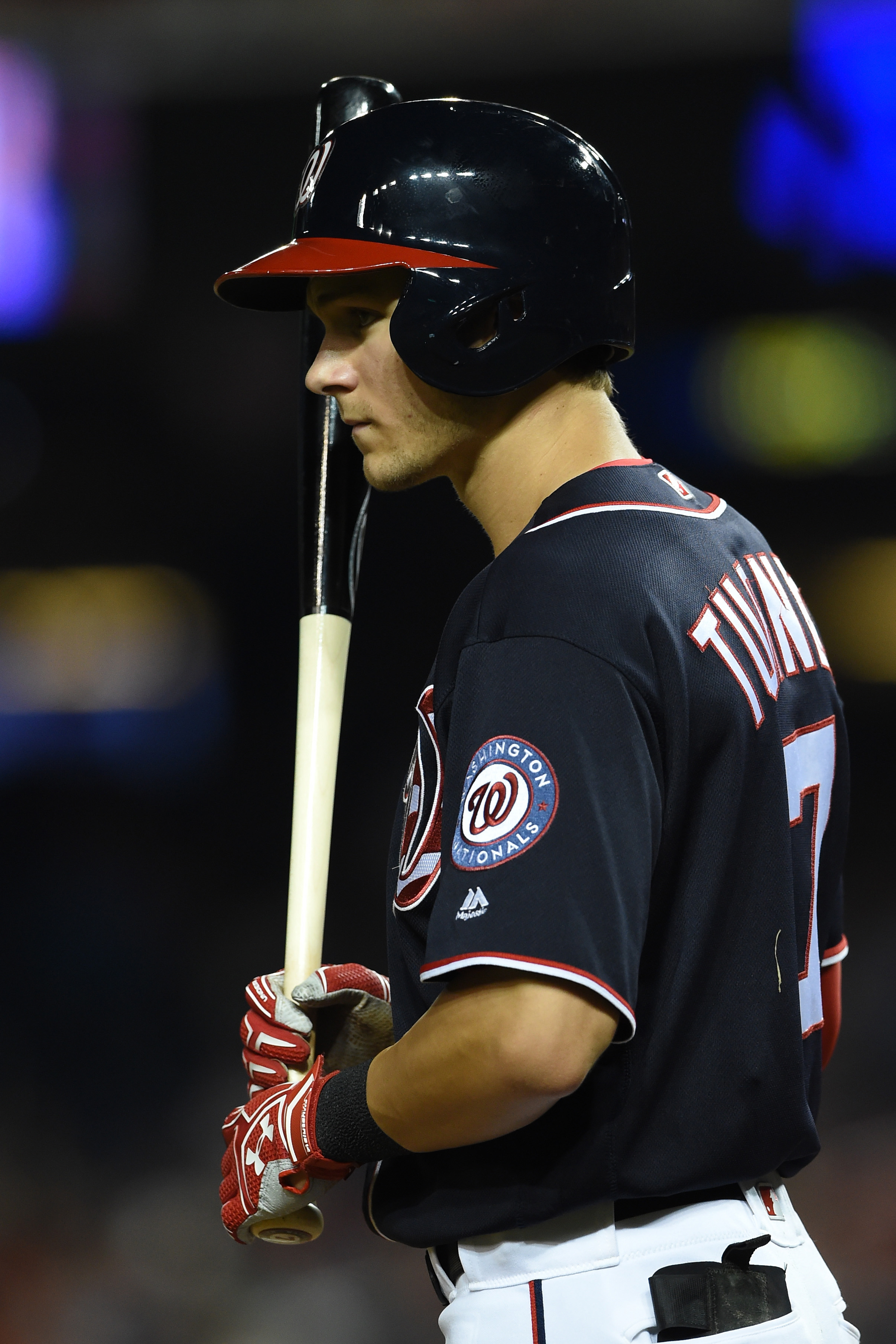
In the outfield, Bryce Harper will try to resume his presumed march to greatness while veteran Jayson Werth will play out the final year in D.C. There are plenty of options to play between them. Washington could platoon toolsy but strikeout-prone Michael Taylor with either of two lefties — Ben Revere and post-hype prospect Brian Goodwin, but that would mean multiple rolls of the dice. Odds are the team will non-tender Revere, who won’t come cheap and was dreadful in 2016. And Taylor and Goodwin seem more likely to compete for a reserve role — presumably, spelling Werth with some frequency — or continue to try to refine their talent at Triple-A.
Looking elsewhere, though Turner’s presence atop the order reduces the need for a true table-setter, switch-hitter Dexter Fowler‘s high-OBP bat would certainly slot in nicely. Other free agent possibilities include former Nats shortstop-turned Rangers center fielder Ian Desmond and Carlos Gomez. The trade market, too, has some intriguing possibilities. Rizzo has pursued younger veterans with two or three years of control before — e.g., Denard Span, Doug Fister — and that type of asset could line up nicely with the promotional timeline of skyrocketing center field prospect Victor Robles (who’d also be a heck of a trade chip). Charlie Blackmon of the Rockies fits that bill with two seasons of arb control remaining and is perhaps the best reasonably achievable trade target. The Nats reputedly had interest in him this summer. A.J. Pollock would be another two-year piece, though it’s not clear that Arizona will sell low after his injury-plagued campaign. With the Marlins reportedly considering dangling their three years of control over Marcell Ozuna in a bid to add pitching, there’s a possible match on paper. Indeed, the Nats reportedly pitched a deal to the Fish last year involving Gonzalez (though they were apparently trying to get Christian Yelich). Such an intra-division swap still feels like a bit of a stretch, and it’s perhaps even harder to see something coming together with the Braves for Ender Inciarte, who is another piece of the potential center field trade puzzle this winter. A readier match could be found with the pitching-needy Yankees, who might be interested in a swap involving Gonzalez and Brett Gardner (who has two guaranteed seasons plus an option remaining). If — big if — the Royals decided to market Lorenzo Cain, he’d presumably also be of interest.
There’s one other possible route to consider in the outfield. The Nationals put significant money on the table last winter for Yoenis Cespedes, who ultimately chose an opportunity to opt out after a year with the Mets over Washington’s heavily-deferred, five-year offer. Cespedes would give the team another premium bat, though either he or (perhaps more likely) Harper would need to spend part of the year in center to make that happen. It’s a bit of a strained fit, but it makes more sense when one considers that the Nats will be looking to replace Werth this time next fall. With Taylor and Goodwin available, the team could field Harper and Cespedes in the corners when Werth sits.
The other general strategy would be to keep Turner in center for at least another year or two, which would open the question of what to do at short. Taking that approach wouldn’t necessarily mandate a major acquisition, either, as Danny Espinosa has a final year of arbitration control after playing every day at short in 2016. But while the switch hitter provided 24 long balls, quality glovework, and excellent baserunning, his lack of contact (and resulting .209/.306/.378 batting line) make him a less-than-ideal choice. The Nationals would surely prefer to utilize him as a utility infielder.
Thing is, there’s a lot less out there at the shortstop position than there is in center. While the Nats could bring back Stephen Drew, pair Espinosa with young infielder Wilmer Difo, or sign another platoon partner, the free agent market doesn’t include any regulars. (Well, unless you really want to make things interesting and consider Desmond there.) Barring an exceedingly crafty trade for a high-quality young shortstop, there’s also not much of interest in the trade market. The clear target for teams hoping to improve at the position is Zack Cozart of the Reds, who has one more year of reasonably-priced control. Though he faded at the plate and ended the year with an injury, Cozart is a supremely talented gloveman with pop. It isn’t inconceivable that the Nats would look at the Cardinals’ Jhonny Peralta, too, though he’s 34 and struggled through an injury-ravaged 2016 season.
Regardless of how those issues are worked out, the Nats figure to rely upon familiar faces elsewhere in the infielder. Daniel Murphy and Anthony Rendon are stellar options at second and third. There are plenty of questions about longtime franchise face Ryan Zimmerman, but he’s set to remain the regular at first base. If his batting line doesn’t improve — and the team hopes it will, after a year in which good contact didn’t fall very frequently — and/or he is again limited by injury, then it will be useful to have alternatives.
That brings us to the bench mix, which will likely see some change as the team watches productive reserves like Drew and Chris Heisey return to the open market. Espinosa and/or Difo are likely candidates, as are the younger outfielders noted above. But the Nats may have some room to add impact with a market that’s chock full of platoon sluggers. The team has traditionally carried a power left-handed bat, a role filled most recently by Clint Robinson. He could be retained, but struggled mightily last year and isn’t really capable of playing the corner outfield. Particularly if the Nats don’t make a big move in center field, the team could make a play for free agent Brandon Moss, who might take 400 or more plate appearances while functioning as a complement to and insurance for Werth in left and Zimmerman at first. That sort of addition wouldn’t be particularly cheap and isn’t strictly necessary, of course: Murphy could also shift over if a need arises at first base, with Espinosa and Difo on hand for middle-infield protection.
In the final analysis, the Nationals have most of the pieces in place to believe they’re positioned for a repeat run at the NL East crown. It’s easy to imagine a relatively straightforward winter mostly spent shoring things up in a few areas. But holding off the Mets, and finally advancing in the postseason, may require more. The payroll already projects to include $139MM in commitments as things stand, but this is a team that opened the 2015 season with a payroll north of $160MM. If it’s willing to do so again, there’s still some room to add impact pieces. With intriguing roster flexibility provided by a deep reserve of pitching and the presence of Turner, Rizzo and co. may yet have some surprises up their sleeves.
Photo courtesy of USA Today Sports Images.
Nationals Notes: Turner, Zimmerman, Ramos, Melancon, Hernandez, Revere
Nats GM Mike Rizzo spoke with the press today about the offseason to come, as Mark Zuckerman of MASNsports.com reports. He expressed satisfaction with the “good, steady brand of baseball” that the club displayed, while acknowledging the disappointment of failing to advance in the playoffs. Rizzo wasn’t keen to offer up much in the way of details on the team’s planning, but did provide some insight. Here are the highlights from his press conference and a few more notes on the team:
- Rizzo praised his roster’s versatility, suggesting that it allows “a lot of different directions to improve our ballclub.” Trea Turner, in particular, could occupy a middle infield role or play in center — leaving the Nats free to pursue a center fielder, shortstop, or perhaps even a corner outfielder (while moving Bryce Harper to center). As Rizzo put it, Turner’s presence “allows us to build around that, meaning that it gives us more options in the marketplace to improve the ballclub.”
- One thing that won’t occur is a permanent move of Turner to second base, with Daniel Murphy taking over for Ryan Zimmerman at first. “No, Zim’s our first baseman going into this offseason and spring training,” Rizzo said. The veteran struggled to a .218/.272/.370 batting line this year, by far his worst as a big leaguer, but he made plenty of hard contact (34.7%) and may have been unfortunate to carry a .248 BABIP.
- The Nats have some notable free agents, of course, including catcher Wilson Ramos and closer Mark Melancon. Rizzo wouldn’t commit to a strategy on the burly backstop, whose season ended with ACL surgery. The plan is to “do all the due diligence on the medicals” before making a call on issuing Ramos a qualifying offer and deciding whether to pursue him.
- As for Melancon, Rizzo offered effusive praise for his work on the mound and presence in the clubhouse. Looking ahead, though, Rizzo suggested that he isn’t locked into Melancon or the other top relief options on the market. “It’s a broad, deep reliever market this year, and Mark is one of the elite relievers in the marketplace,” he said. “In a perfect world, you’d always like to have a guy that’s done it in the most competitive situations, but that’s not always possible. We’ve got a lot of options as far as guys with plus stuff and plus makeup, and it’s a deep relief market this year. So there’s different avenues to go and different routes that are attractive to us.” One possible internal candidate for ninth-inning duties, righty Shawn Kelley, is expected to be fully healthy after leaving the team’s final game with what looked to be a concerning injury, though it seems fair to expect the organization to pursue a closer regardless.
- The Nationals’ decision to ink Cuban outfielder Yadiel Hernandez was somewhat uncharacteristic, as Chelsea Janes of the Washington Post explores. Washington has largely sat out the market for Cuban players, but chose to take a limited risk ($200K bonus without promising a MLB roster spot) on the 29-year-old. Hernandez was worth the risk, per VP of international ops Johnny DiPuglia, because “he’s a legit left-handed hitter who grinds at-bats” and is capable of playing center field. Depending upon how the offseason progresses, Hernandez could conceivably position himself as a depth or even a bench piece, though the team hasn’t staked much on that possibility. “We thought we’d take a chance on him,” said DiPuglia. “He’s got a profile for us. We’ll find out.”
- One reason to add Hernandez? The fact that the team has an expensive decision to make on left-handed-hitting center fielder Ben Revere, who projects to earn $6.3MM in arbitration even after a dreadful campaign. Zuckerman looks at Revere’s 2016 season and the options for the Nats. From my perspective, there’s no real chance that the team will trust Revere with the regular job in center, making it hard to imagine that it will stake over $6MM on him. That’s especially true given the presence of Brian Goodwin, a former top prospect who made strides at Triple-A and showed well in his first taste of the majors.
Wilson Ramos Will Seek Four To Five Year Contract
Wilson Ramos‘ free agent stock took a sizable hit the moment he suffered a torn ACL on Sept. 26, but the catcher’s agent, Wil Polidor, tells Jorge Castillo of the Washington Post that Ramos still plans to seek a four- or five-year contract in free agency.
As Castillo writes, the Nationals aren’t likely to extend a qualifying offer to Ramos on the heels of his injury, and if that’s the case, his chances at securing a multi-year pact would certainly be enhanced. While some may consider the notion of a multi-year deal following Ramos’ ACL tear unrealistic, it’s also possible that there are teams that will consider this an opportunity to acquire a premium catcher at a bargain rate. Most clubs won’t want to make any type of sizable one-year commitment with Ramos potentially sidelined for a notable portion of the 2017 campaign, but the idea of offering a backloaded multi-year deal certainly has some merit. After all, prior to his knee injury, Ramos had positioned himself to target something in the vicinity of the five-year, $80-85MM deals recently signed by Brian McCann and Russell Martin. To teams interested in adding a catcher on a long-term deal, the notion of securing Ramos on a four-year deal at a lower annual rate probably holds some appeal, even if the return on investment is minimal in year one of the pact.
Of course, any long-term deal with Ramos does come with considerable risk. This is the second time that he’s torn the ACL in his right knee, and for a catcher that is listed at 6’1″ and 255 pounds, a pair of significant knee injuries to go along with his massive frame is a genuine cause for concern. Indeed, Ramos himself has already hinted at the fact that it may be beneficial for him to sign with an American League club, implying that the availability of a DH slot could be critical for him.
Polidor also tells Castillo that Ramos is set to undergo a four-week evaluation of his knee that will conclude in the second week of November, which lines up with the General Managers’ Meetings in Phoenix, Ariz. (not to be confused with December’s Winter Meetings in Washington D.C.). Upon completion of that evaluation, he’ll have a clearer timetable from his doctors. At last check, Ramos was slated for a seven-month rehab process, which would put him on target to wrap up around mid-May. Of course, that timeline also likely represents a best-case scenario, and even if Ramos achieves that ambitious goal, he’ll still need to be eased back into catching on a regular basis.
When healthy this season, Ramos was outstanding. In 523 plate appearances, the 28-year-old batted .307/.354/.496 with a career-high 22 home runs. He also caught 37 percent of opposing base-stealers — 10 percent better than the league average — and drew strong pitch-framing marks from Baseball Prospectus. Ramos ranked fifth on the final edition of MLBTR’s Free Agent Power Rankings, although that list was published prior to his knee injury.
Aaron Barrett Elects Free Agency
The Nationals announced on Wednesday that right-hander Aaron Barrett has cleared waivers and elected free agency rather than accepting an outright assignment to Triple-A Syracuse. The 28-year-old, who underwent Tommy John surgery in 2015, was placed on outright waivers over the weekend.
Barrett is now more than a year removed from Tommy John surgery, but he also suffered a setback in late July when he fractured his elbow and required a second surgery to repair that injury. Prior to suffering the ligament tear that preceded his initial operation, Barrett looked to be an emerging piece in the Nationals’ bullpen. In 70 Major League innings from 2014-15, he pitched to a 3.47 ERA with 10.8 K/9, 3.5 BB/9, a 44.9 percent ground-ball rate and a fastball that averaged 93.8 mph. The 2010 ninth-rounder was effective against both right-handed hitters and lefties alike, limiting righties to a paltry .225/.299/.294 while holding opposite-handed opponents to a .239/.333/.337 slash.
There aren’t yet specifics on Barrett’s timeline to return to the mound, though considering the second procedure took place just over three months ago, there’s probably a fair bit of time left in his rehab process. Nonetheless, it’s easy to envision Barrett attracting interest on a minor league pact and possibly working his way back to the Majors sometime in 2017. Certainly, given the nature of his injuries, a full comeback is no sure thing, but there’s little harm in a team taking a chance on a once-effective reliever that still has fewer than three years of Major League service time under his belt.
Had he remained on the Nationals’ 40-man roster, Barrett would’ve been arbitration eligible as a Super Two player and been in line for a nominal raise; MLBTR contributor Matt Swartz projected him for a salary of just $700K next season. If he is ultimately able to return to the Majors, his new team would be able to control him for four years (including next season) based on the two years and 144 days of MLB service Barrett has accrued thus far.
Indians Notes: Santana, Kluber, Miller, Lucroy
The Indians are at least opening the door to the possibility of utilizing Carlos Santana in left field when the World Series moves to Wrigley Field and takes the DH off of the table, as Paul Hoynes of the Plain Dealer reports. It doesn’t seem as if there are any clear plans to play him there — he hasn’t roamed the outfield grass since the minors — but the team is getting him some reps just in case. Even if Cleveland won’t start Santana in left just in order to get his and Mike Napoli‘s bats into the same lineup, it’s not impossible to imagine a late-game substitution scenario that calls for such a bold move.
Here’s more from Cleveland with the fall classic set to get underway:
- How exactly did World Series Game 1 starter Corey Kluber end up with the Indians? Derrick Goold of the St. Louis Post-Dispatch compiles something of an oral history of the 2010 trade that brought the relatively unknown righty to Cleveland. With the Padres and Cardinals each looking for veteran assets, the Indians were able to facilitate their needs by taking Kluber. Then-Cleveland GM Chris Antonetti said at the time that he preferred not to be on the prospect end of such trades, though certainly that move helped set up the team’s current run — which included a deal that sent young talent out for the player who’s the subject of the next bullet.
- We’ve increasingly heard chatter — as is typical this time of year — about how postseason teams can serve as a model for other organizations in the ensuing winter. While I’d argue that the value of premium relief arms seems worth paying attention to, it does seem curious to hear discussion of whether teams could look to emulate the specific pen usage of roving Indians out-machine Andrew Miller. That approach isn’t likely to carry over into the regular season, Russell Carleton of Baseball Prospectus suggests (subscription required — and recommended) in a detailed and interesting analysis. Relievers are simply not as effective when they re-appear for a second inning of work, Carleton finds, and managers rightly need to be more judicious in deploying their most valuable relief-pitching-innings — those handled by their best relievers — over the course of a long season. Unless and until some team decides to really push the boundaries of how much of an innings workload a reliever can handle, he says, we’ll likely continue to see a lot of one-inning relievers in relatively well-defined roles (for the bulk of the year, at least).
- When the Indians went and got Miller, it sent a meaningful message to the team’s players, second baseman Jason Kipnis tells MLB.com’s Jordan Bastian (Twitter link). But it came at a real price that could end up hurting down the line — as is the nature of deadline deals (see Kluber, Corey). Jon Heyman of Fan Rag reports that Cleveland offered much more than any other team to grab Miller. But that was what it took to pry him loose, since the Yankees were under no obligation to swing a deal for a player with two more seasons of control remaining. With the Giants unwilling to move Joe Panik and the Nationals not interested in boosting their offer of young pitching talent, New York would’ve held pat had the Indians not offered up a prospect package made up of outfielder Clint Frazier, southpaw Justus Sheffield, and right-handers Ben Heller and J.P. Feyereisen.
- Before getting that deal done, of course, the Indians had a pact in place for catcher Jonathan Lucroy that only fell through when he exercised his no-trade protection to nix it. As ESPN.com’s Jerry Crasnick reports, Lucroy doesn’t regret utilizing the clause — even with the Indians now in the World Series. The veteran receiver landed in a good spot, helping the Rangers lock up an AL West title, and he’s not interested in revisiting things now. “I’m not worried about it at all,” he said. “It’s over with and in the past.”
Minor MLB Transactions: 10/24/16
Here are the latest minor moves, via Matt Eddy of Baseball America:
- The Marlins outrighted first baseman/outfielder Xavier Scruggs off of the team’s 40-man roster. He has seen brief time in each of the last three seasons at the major league level, hitting just .227/.292/.303 in his 130 total plate appearances. This year was his first with an organization other than the Cardinals. While Scruggs didn’t perform in his 24-game run with Miami, he did post an excellent .290/.408/.565 slash with 21 long balls over 382 plate appearances at Triple-A while walking in 15.2% of his trips to the dish (against a 23.6% strikeout rate).
- The Mariners re-signed lefty Brad Mills to a minor league pact. The 31-year-old has seen action in parts of six major league seasons, though he has compiled just 79 total MLB innings with a 7.97 ERA. Mills made nine starts at Triple-A in 2016, pitching to a 5.28 ERA with 6.5 K/9 against 4.5 BB/9 over 44 1/3 frames.
- Catcher Jhonatan Solano will return to the Nationals on a minor league deal. The 31-year-old had cracked the bigs in each of the four preceding campaigns, but spent all of 2016 at Triple-A. He continued to struggle at the plate, as his .225/.286/.260 slash attests. With sturdy glovework behind the dish, though, he’ll function as organizational depth once again for the Nats — the only organization he has played for apart from a 2015 run with the Marlins.
Nationals Place Aaron Barrett On Outright Waivers
The Nationals have placed righty Aaron Barrett on outright waivers, Chelsea Janes of the Washington Post writes. Barrett would have been eligible for arbitration this offseason as a Super Two (and was projected to make a mere $700K), but the Nats have elected not to take him through that process.
The 28-year-old Barrett had Tommy John surgery late in the 2015 campaign. Late this season, while attempting a comeback from the injury, he fractured his elbow, requiring another surgery. Janes notes that Barrett is set to begin throwing again in a few weeks, but the Nationals’ decision to place him on outright waivers indicates that they’re not confident he’s likely to be a significant contributor next season. They might, however, be hoping to bring him back next season on a minor league deal.
Prior to Barrett’s recent run of bad luck, he was a key part of the Nationals’ bullpens in 2014 and 2015, pitching to a 3.47 ERA, 10.8 K/9 and 3.5 BB/9 in 70 innings over those two seasons. At his best, he boasted a mid-90s fastball and effective slider, although it’s unclear what his stuff might be like once he returns.