
Marlins Designate Tommy Medica, Andre Rienzo
The Marlins have designated infielder Tommy Medica and righty Andre Rienzo for assignment, according to a club announcement. The moves were made to clear 40-man space for the signings of Chris Johnson and Edwin Jackson, both of which were made official.
Medica, 27, was claimed late last season. He might have had a chance to compete for playing time as a right-handed-hitting bench bat, but Miami seems set to give that role to Johnson. Medica struggled at the Triple-A level last year. He owns a .246/.308/.417 batting line over 338 major league plate appearances.
Likewise, the 27-year-old Rienzo was displaced by the addition of Jackson. Both players profile as swingmen, and Miami obviously decided to give Jackson the first crack at that role. Rienzo has thrown 140 1/3 MLB frames, working to a 5.90 ERA with 6.7 K/9 against 4.7 BB/9.
Latest On Rays’ Pitching
With many — but not all — of the top free agent arms now gone from the market, the Rays appear to be ramping up discussions involving their pitchers. Tampa Bay has long been said to be willing to listen on its array of starters and late-inning relievers, though it hasn’t made any deals since shipping Nate Karns to the Mariners to kick off the winter’s activities.
Here’s the latest:
- The Rays are engaged in “‘many’ active trade conversations” involving pitching, Ken Rosenthal of FOX Sports reported yesterday on Twitter. It seems as if the club’s previous talks, which appeared to have some steam during the Winter Meetings, have been re-joined now that the market has gained additional clarity.
- Indeed, Tampa Bay has “picked up the pace” on discussions, ESPN.com’s Jerry Crasnick tweets. The team is still holding conversations involving top relievers Jake McGee and Brad Boxberger as well as various starters. The one name that clearly is not in play is staff ace Chris Archer.
- The Cubs have remained in “constant contact” with the Rays, reports Jim Bowden of ESPN.com (audio link). It’s previously been suggested that Chicago could have interest in Alex Cobb, but Bowden hints that Jake Odorizzi could make a nice fit for Chicago in a deal. The hang-up, though, is that the Cubs are trying to swing a deal without giving up Jorge Soler, Javier Baez, or other major league pieces.
Arbitration Breakdown: Manny Machado
Over the next few weeks, I will be discussing some of the higher profile upcoming arbitration cases. I will rely partly on my arbitration model developed exclusively for MLB Trade Rumors, but will also break out some interesting comparables and determine where the model might be wrong.
Manny Machado has reached arbitration eligibility at the young age of 23, and has already put up solid numbers in his career, including a breakout year in 2015. Machado hit .286 this past year, which is not all that much better than the .278 career mark he had going in, but his 35 home runs more than doubled his career high. After Machado’s 51 doubles in 2013 suggested he would eventually show more power than the 14 home runs that accompanied them, injuries in 2014 limited him to 354 PA. As a result, Machado’s pre-platform performance and overall career numbers are not as strong as his platform year, which makes him somewhat of a tricky case. Few comparables cases present themselves, so although his $5.9 million projected salary seems plausible, it could easily miss by a lot.
Machado’s strong defense also makes his case trickier as well. Although my model has repeatedly shown that defense does not consistently affect arbitration cases, many of the hitters who could be considered comparables for Machado were far worse fielders, and this could certainly help him earn more than them. Just because the model does not prove the importance of any specific defensive statistic, that does not mean that defense never enters into a case—we know from firsthand reports that it does. Machado’s relatively low number of RBIs for a guy who hit 35 home runs also makes his case unique as well.
Perhaps the best comparable could be Chris Davis’ case three years ago, although nearly everything about Davis’ case is slightly worse. Davis hit .270 with 33 home runs and 85 RBIs, which is a near match of Machado’s .286/35/86 in his platform year. Davis also did not have many home runs pre-platform, so his career 77 home runs at the time are not much different than Machado’s 68. However, Davis’ career average of .258 is way below Machado’s .281. Davis also plays an easier defensive position than Machado. However, the Orioles could certainly try to argue that Machado should not out-earn Davis’ $3.3 million award by too much.
Although it was seven years ago, Ryan Ludwick’s case looks very similar to Machado’s when Ludwick earned $3.7 million in 2009. He hit .299/37/113 in his platform year and had .273/65/209 career numbers, and although Ludwick’s platform numbers were slightly better, Machado’s career .281/65/215 is extremely similar. The Orioles could try to argue that a little salary inflation on Ludwick’s $3.7 million would put Machado between $4 and $5 million.
If Machado wants to argue for a salary closer to his $5.9 million projection, one potential comparable that Machado could consider is Dan Uggla, who had 32 home runs and 92 RBIs in his platform year before reaching arbitration eligibility, and who received $5.3 million. However, this was back in 2009 and cases that old are rarely used. Uggla also only hit .260, although he did have 90 career home runs, far exceeding Machado’s 68.
Another possibility Machado could use to try to push his salary closer to his projection, who is more recent than Uggla, is Giancarlo Stanton’s case just two years ago. Although Machado could be a similar match in terms of stardom, Stanton’s injuries kept him to 504 PA in his platform year and only 24 home runs, while he hit .249. He did have 117 career home runs though. While he played a different position, Stanton could be considered a comparable. He earned $6.5 million in 2014. Like with Uggla, the difficulty for Machado if he tries to argue for Stanton as a comparable is that both Uggla and Stanton had many more career home runs than Machado does.
Other potential comparables that Machado could use are Mark Trumbo, Chris Carter, and Pedro Alvarez, who all reached their first year of arbitration eligibility in the last couple years and earned $4.8, $4.175, and $4.25 million. They each hit between 34 and 37 home runs and between 88 to 100 RBIs in their platform year. Although they had more career home runs than Machado, ranging from 85 to 95 between them, their batting averages are much worse than Machado’s. They each hit between .227 and .233 in their platform year and between .222 and .250 in their careers. Machado could make the case that he had similar power to them, but a better average, so he deserves to have somewhere above $5 million.
It is difficult to find obvious cases where Machado exceeds his $5.9 million projection. There are a number of players with higher salaries who had similar platform years, but more home runs, while there are a couple of players who earned less money with career numbers that look similar to Machado, but whose cases are weaker in one way or another. Machado has a better batting average and defense than just about all of these players, including the players with more career home runs. However, I think Machado is probably likely to under-earn his projection.
A potential wild card that could come into play is a similar player who is also reaching his first year of eligibility this year, Nolan Arenado. With a similar breakout performance in 2015 along with strong defense at the same position, Arenado could easily help or hurt Machado’s case for arbitration this year if he reaches an agreement first.
156 Players File For Salary Arbitration
The Major League Baseball Players Association announced today that 156 players have filed for salary arbitration. Players and teams will formally exchange arbitration figures on Friday, and in the five to six weeks that follow, dozens of agreements will be reached. Players and teams that are unable to find a middle ground will head to arbitration hearings in mid to late February, and, on the flip-side of things, some will hammer out multi-year deals in order to avoid the process in the future (possibly even extending the contract into would-be free agent years).
We’re keeping track of all of the arbitration settlements in the 2016 version of MLBTR’s annual Arbitration Tracker (bear in mind that some agreements have already happened) and will continue to do so as each case is resolved, whether by one-year agreement, multi-year deal or hearing. Here’s a team-by-team rundown of the players that filed for arbitration, with each player’s service time in parenthesis in addition to MLBTR contributor Matt Swartz’s projected salary for each.
AL West
Angels
- Kole Calhoun (2.130) — $3.6MM
- Garrett Richards (3.148) – $6.8MM
- Fernando Salas (5.048) – $2.2MM
- Projected total spend: $12.6MM
Astros
- Jason Castro (5.104) – $4.6MM
- Josh Fields (3.000) – $800K
- Evan Gattis (3.000) – $3.4MM
- Marwin Gonzalez (3.133) – $1.9MM
- Dallas Keuchel (3.089) – $6.4MM
- Luis Valbuena (5.148) – $5.8MM
- Projected total spend: $22.9MM
Athletics
- Yonder Alonso (4.116) – $2.5MM
- Josh Reddick (5.050) – $7.0MM
- Fernando Rodriguez (4.032) – $1.3MM
- Danny Valencia (4.118) – $3.4MM
- Projected total spend: $14.2MM
Mariners
- Charlie Furbush (4.121) – $1.7MM
- Leonys Martin (3.063) – $3.75MM
- Evan Scribner (2.142) – $700K
- Projected total spend: $6.15MM
Rangers
- Robinson Chirinos (3.103) – $1.4MM
- Jake Diekman (3.049) – $1.0MM
- Mitch Moreland (5.067) – $5.6MM
- Jurickson Profar (2.167) – $508K
- Tanner Scheppers (3.111) – $800K
- Shawn Tolleson (3.122) – $2.6MM
- Tom Wilhelmsen (4.089) – $3.0MM
- Projected total spend: $14.908MM
AL Central
Indians
- Cody Allen (3.076) — $3.5MM
- Lonnie Chisenhall (3.158) — $3MM
- Jeff Manship (2.130) — $700K
- Bryan Shaw (4.081) — $2.8MM
- Josh Tomlin (4.151) — $3.1MM
- Projected total spend: $13.1MM
Royals
- Drew Butera (5.018) – $1.1MM
- Lorenzo Cain (4.074) – $6.1MM
- Louis Coleman (3.018) – $1.0MM
- Tony Cruz (4.105) – $1.0MM
- Danny Duffy (4.085) – $4.0MM
- Jarrod Dyson (4.088) – $1.7MM
- Mike Moustakas (4.111) – $5.7MM
- Projected total spend: $20.6MM
Tigers
- Jose Iglesias (3.036) – $1.5MM
- J.D. Martinez (4.036) – $7.8MM
- Andrew Romine (3.049) – $700K
- Justin Wilson (3.035) – $1.3MM
- Projected total spend: $11.3MM
Twins
- Eduardo Escobar (3.128) – $1.8MM
- Casey Fien (3.143) – $2.2MM
- Kevin Jepsen (5.163) – $6.0MM
- Tommy Milone (3.143) – $4.5MM
- Eduardo Nunez (4.090) – $1.5MM
- Trevor Plouffe (4.162) – $7.7MM
- Projected total spend: $23.7MM
White Sox
- Avisail Garcia (2.167) – $2.3MM
- Dan Jennings (2.171) – $700K
- Brett Lawrie (4.055) – $3.9MM
- Zach Putnam (2.135) – $800K
- Projected total spend: $7.7MM
AL East
Blue Jays
- Brett Cecil (5.152) – $3.4MM
- Jesse Chavez (5.108) – $4.7MM
- Steve Delabar (3.008) – $700K
- Josh Donaldson (3.158) – $12.0MM
- Drew Hutchison (3.128) – $2.6MM
- Aaron Loup (3.083) – $900K
- Michael Saunders (5.138) – $2.9MM
- Drew Storen (5.140) – $8.8MM
- Projected total spend: $36MM
Orioles
- Brad Brach (3.063) — $1.1MM
- Zach Britton (3.158) — $6.9MM
- Ryan Flaherty (4.000) — $1.5MM
- Miguel Gonzalez (4.095) — $4.9MM
- Manny Machado (3.056) — $5.9MM
- Brian Matusz (5.156) — $3.4MM
- Chris Tillman (4.113) — $6.2MM
- Mark Trumbo (5.027) — $9.1MM
- Projected total spend: $39MM
Rays
- Alex Cobb (4.061) – $4.0MM
- Hank Conger (4.051) – $1.8MM
- Logan Forsythe (4.113) – $3.3MM
- Brandon Guyer (3.066) – $1.3MM
- Desmond Jennings (4.101) – $3.1MM
- Jake McGee (4.127) – $4.7MM
- Logan Morrison (5.069) – $4.1MM
- Erasmo Ramirez (2.158) – $2.8MM
- Rene Rivera (4.082) – $1.6MM
- Drew Smyly (3.154) – $3.9MM
- Projected total spend: $30.6MM
Red Sox
- Joe Kelly (3.101) — $3.2MM
- Robbie Ross (3.100) — $1.1MM
- Junichi Tazawa (5.086) — $3.3MM
- Projected total spend: $7.6MM
Yankees
- Dustin Ackley (4.087) – $3.1MM
- Aroldis Chapman (5.034) – $12.9MM
- Nathan Eovaldi (4.013) – $5.7MM
- Didi Gregorius (2.159) – $2.1MM
- Ivan Nova (5.024) – $4.4MM
- Michael Pineda (4.099) – $4.6MM
- Projected total spend: $32.8MM
NL West
Diamondbacks
- Welington Castillo (4.009) – $3.6MM
- Patrick Corbin (3.105) – $2.3MM
- Randall Delgado (3.100) – $1.0MM
- Rubby De La Rosa (3.097) – $3.2MM
- Daniel Hudson (5.117) – $2.0MM
- Shelby Miller (3.030) — $4.9MM
- A.J. Pollock (3.052) – $4.3MM
- Projected total spend: $21.3MM
Dodgers
- Luis Avilan (3.077) – $1.1MM
- Yasmani Grandal (3.115) – $2.7MM
- Chris Hatcher (2.146) – $900K
- Kenley Jansen (5.073) – $11.4MM
- Justin Turner (5.045) – $5.3MM
- Scott Van Slyke (2.151) – $1.2MM
- Projected total spend: $22.6MM
Giants
- Brandon Belt (4.128) – $6.2MM
- George Kontos (2.171) – $1.0MM
- Projected total spend: $7.2MM
Padres
- Andrew Cashner (5.126) – $7.0MM
- Derek Norris (3.102) – $3.4MM
- Drew Pomeranz (3.013) – $1.3MM
- Tyson Ross (4.126) – $10.0MM
- Projected total spend: $21.7MM
Rockies
- Nolan Arenado (2.155) — $6.6MM
- Charlie Blackmon (3.102) — $4.5MM
- DJ LeMahieu (3.128) — $3.7MM
- Projected total spend: $14.8MM
NL Central
Brewers
- Wily Peralta (3.033) – $2.8MM
- Jean Segura (3.065) – $3.2MM
- Will Smith (2.155) – $1.2MM
- Projected total spend: $7.2MM
Cardinals
- Matt Adams (3.033) – $1.5MM
- Seth Maness (2.154) – $1.2MM
- Brandon Moss (5.160) – $7.9MM
- Trevor Rosenthal (3.058) – $6.5MM
- Projected total spend: $17.1MM
Cubs
- Jake Arrieta (4.145) — $10.4MM
- Chris Coghlan (5.148) — $3.9MM
- Justin Grimm (2.170) — $1MM
- Hector Rondon (3.000) — $3.6MM
- Pedro Strop (4.156) — $4.7MM
- Adam Warren (3.036) — $1.5MM
- Travis Wood (5.004) — $6.4MM
- Projected total spend: $31.5MM
Pirates
- Francisco Cervelli (5.146) – $2.5MM
- Jared Hughes (3.162) – $2.2MM
- Jeff Locke (3.020) – $3.5MM
- Mark Melancon (5.098) – $10.0MM
- Jordy Mercer (3.095) – $1.8MM
- Chris Stewart (5.091) – $1.6MM
- Tony Watson (4.101) – $4.6MM
- Projected total spend: $26.2MM
Reds
- Zack Cozart (4.084) — $2.9MM
- J.J. Hoover (3.102) — $1.1MM
- Projected total spend: $4MM
NL East
Braves
- Arodys Vizcaino (2.168) — $1.1MM
- Chris Withrow (2.132) — $600K
- Projected total spend: $1.7MM
Marlins
- Carter Capps (3.007) – $800K
- Jose Fernandez (3.000) – $2.2MM
- Dee Gordon (3.154) – $5.9MM
- Adeiny Hechavarria (3.060) – $2.3MM
- Tom Koehler (3.016) – $3.9MM
- Bryan Morris (3.011) – $1.1MM
- David Phelps (3.156) – $2.5MM
- A.J. Ramos (3.030) – $2.8MM
- Projected total spend: $21.5MM
Mets
- Lucas Duda (4.137) – $6.8MM
- Josh Edgin (3.015) – $600K
- Jeurys Familia (3.030) – $3.3MM
- Matt Harvey (3.072) – $4.7MM
- Jenrry Mejia (3.085) – $2.6MM
- Addison Reed (4.002) – $5.7MM
- Ruben Tejada (4.171) – $2.5MM
- Carlos Torres (3.114) – $800K
- Neil Walker (5.166) – $10.7MM
- Projected total spend: $37.7MM
Nationals
- Danny Espinosa (4.113) – $2.7MM
- Wilson Ramos (5.047) – $5.3MM
- Anthony Rendon (2.130) – $2.5MM
- Ben Revere (4.149) – $6.7MM
- Stephen Strasburg (5.118) – $10.5MM
- Projected total spend: $27.7MM
Phillies
- Freddy Galvis (3.021) – $1.9MM
- Jeanmar Gomez (4.063) – $1.5MM
- Jeremy Hellickson (5.045) – $6.6MM
- Projected total spend: $10MM
For more information on the arbitration process in general, readers can refer to our breakdown of Arbitration Basics. For those who wish to garner more insight into Swartz’s projection model, check out his explanation of the model and its limitations as well as MLBTR’s Arbitration Breakdown series, in which Swartz examines some unique cases that might leave the model more susceptible to inaccuracy than a standard arbitration case.
Padres’ Shortstop Search Nearing Conclusion; Desmond, Ramirez Considered Frontrunners
The Padres’ search for a shortstop is nearing the finish line, general manager A.J. Preller confirmed to Dennis Lin of the San Diego Union-Tribune. “We’ve gotten to a spot where we’ve looked at a lot of options,” Preller told Lin. “Things could come to a head in the next few days to a week.” While Preller didn’t specify any names, sources tell Lin that free agents Alexei Ramirez and Ian Desmond can be considered the favorites to fill San Diego’s shortstop vacancy.
The Padres have been connected to both free agents quite a bit of late, though the two would represent very different types of options. The 30-year-old Desmond figures to command a lengthier multi-year deal, whereas Ramirez could potentially be looked at as more of a stopgap to top prospect Javier Guerra, who was acquired from the Red Sox alongside three other minor leaguers in exchange for Craig Kimbrel. Because Desmond turned down a qualifying offer, he’d cost the Padres their top unprotected draft pick, while the veteran Ramirez could be had for only money.
Lin reported last week why the 30-year-old Desmond is appealing to Preller for reasons beyond just his strong track record from 2012-14 (his 2015 season, of course, was a difficult one). The GM also explained to Lin at that time why the presence of Guerra wouldn’t stop him from adding a shortstop on a multi-year deal, noting that a team can’t have too much up-the-middle talent. It’s also worth noting, of course, that there’s been speculation about Desmond changing positions this offseason. If and when Guerra emerges as a potential everyday option (which probably won’t happen until at least 2017), Desmond could conceivably more to another spot on the diamond.
A dismal first half in 2015 left Desmond with an unsightly .223/.290/.384 batting line last year, but the powerful infielder still hit 19 homers and chipped in 13 stolen bases. Additionally, he looked more like himself after the All-Star break, hitting .262/.331/.446 with a dozen homers and eight stolen bases in the season’s second half. And, while Desmond’s defensive lapses drew a lot of headlines early on when he made eight errors in the first 12 games of the season, he settled down and played considerably better defense for the remainder of the year. Of course, Desmond’s rapidly escalating strikeout rate (29 percent in 2015) is a cause for concern, and even his solid second half was buoyed to some extent by a BABIP spike, as he continued to whiff at a prolific rate (30.3 percent in the second half).
Ramirez has his own positive and negative attributes, of course. While he’s been a largely durable asset for the White Sox over the life of his big league career, showing both power and speed at times, he, too, fell victim to a woeful first half in 2015 when he batted just .224/.249/.292. Given the fact that he’s 34 years of age, the Padres probably have to be more wary of a potential decline for Ramirez. However, he batted a much more characteristic .277/.325/.432 with eight homers and seven steals following the All-Star break, and as previously noted, will presumably come at a cheaper cost not only in terms of overall dollars, but also in length of commitment and by the virtue of being unencumbered by draft pick compensation.
Whichever route the Padres go, it figures to be an upgrade over a 2015 campaign that saw Clint Barmes, Alexi Amarista, Will Middlebrooks and Jedd Gyorko combine to log a .228/.279/.365 while providing, on the whole, sub-par defense.
Free Agent Notes: Upton, Cespedes, Kennedy, ChiSox, Cardinals
Few could’ve predicted that Justin Upton‘s market would play out so slowly, writes ESPN’s Jerry Crasnick in a lengthy examination of Upton’s journey to the open market. Crasnick notes that Upton is somewhat a victim of borderline unreachable expectations, noting that some view him as a disappointment for being a considerably above-average outfielder as opposed to the generational talent that some hoped for when scouts began raving about him at age 14 and when some outlets compared him to Ken Griffey Jr. as a prospect. Crasnick spoke to executives and Upton’s former skipper, Fredi Gonzalez, with many heaping praise on the 28-year-old — Gonzalez in particular. “He’s been one of my favorite players that I’ve managed in my career,” said Gonzalez. “He shows up at the ballpark every day ready to play. He’s respectful. He knows the game. He’s a great teammate and clubhouse guy. … I’m very surprised that he’s still out there. I think there are a lot of teams missing the boat on him. I really do.” Crasnick also spoke to execs about Upton’s defense, examined his perceived attitude problems as a prospect and also spoke to some in the industry about the potential difficulty of watching his brother struggle alongside him with the Braves and the Padres.
A few more notes on the free-agent market…
- While many (myself included) have speculated that Chris Davis is holding up the market, to an extent, for the remaining corner bats, ESPN’s Jayson Stark believes that Yoenis Cespedes is holding up the market more than Davis at this point (Twitter link). Some of the slow-moving market for top bats is unrelated to either player, he adds. From my vantage point, with the Orioles focused on Davis but standing as a logical landing spot for either Upton or Cespedes, the argument could be made that Davis is slowing things down. Jeff Todd and I recently discussed as much on the MLBTR Podcast.
- Jon Heyman tweets that as the starting pitching market continues to narrow, the Royals, Nationals, Astros and Rockies are the most likely landing spots for right-hander Ian Kennedy. However, MLB.com’s Thomas Harding feels differently, tweeting that if the Rockies make a rotation upgrade, it’s going to come via trade rather than a high-priced free agent like Kennedy. The Royals’ spacious park and elite outfield defense would seem, to me, to be an ideal fit for a fly-ball pitcher like Kennedy, while those same fly-ball tendencies and Kennedy’s previous home run troubles make him a poor fit at Coors Field.
- In his daily Insider-only column (subscription required), ESPN’s Buster Olney writes that there’s a belief around the industry that the White Sox are open to outfield upgrades but don’t want to spend at the levels necessary to land Upton or Cespedes. A second-tier option makes more sense, Olney notes, and while he stops short of speculating on specific names, I’ll add that players such as Dexter Fowler and Austin Jackson could be fits for the South Siders. (Gerardo Parra, too, would’ve made sense but agreed to a three-year pact with the Rockies earlier today.)
- While many Cardinals fans would like to see the Redbirds enter the market for Cespedes, Upton or another high-profile outfield bat, GM John Mozeliak told MLB.com’s Jenifer Langosch that such a scenario isn’t likely. “I know that some people disagree and want us to do something else, but Matt Adams, having [Brandon] Moss, giving [Randal] Grichuk an opportunity to be the everyday center fielder feels right to us,” said Mozeliak. “If we go out and add an outfielder, where are they going to play? Who is not playing? How does that affect us? What does the short-term view look like compared to the long-term commitment? And honestly, we feel very comfortable with what we have.” Langosch writes that St. Louis has been watching the Upton, Cespedes, Fowler and Davis markets from the periphery but would only jump in if the price got to the point where the club felt the opportunity to add value was too good to pass up. Moss, according to Langosch, will get the chance to cement himself as primary option at first base.
Angels Notes: Santiago, Richards, Wilson, CarGo, Blackmon
Part of the reason that the Angels acted quickly in avoiding arbitration with left-hander Hector Santiago was due to trade interest they’ve received in the 28-year-old, reports MLB.com’s Alden Gonzalez (links to Twitter). While there isn’t one specific trade scenario on which the Angels were focused, the team wanted to eliminate as many variables as possible in order to simplify discussions with interested parties. Gonzalez adds that there’s nothing imminent on Santiago at this time. Coming off 180 2/3 innings of 3.59 ERA, 8.1 K/9 and 3.5 BB/9 with two years of club control remaining and a reasonable $5MM salary for the upcoming season, it’s easy to see why some clubs would be intrigued by Santiago. Then again, he also led the AL in home runs allowed (29) and recorded just a 29.9 percent ground-ball rate. Metrics like FIP (4.77), xFIP (5.00) and SIERA (4.50) are considerably less optimistic when viewing Santiago than traditional metrics like ERA, although it’s worth noting that his bottom-line results have always outpaced his peripheral stats in the Majors; Santiago has a 3.55 ERA in his career while the three aforementioned ERA estimators value his production in the 4.29 to 4.71 range.
Here’s more on the Halos…
- The Angels and ace Garrett Richards have been working to avoid arbitration, per Gonzalez, but the two sides still have “a ways to go,” he hears. The two sides will exchange arbitration numbers on Friday (assuming a deal doesn’t come together quickly before that date) and have another five or six weeks to negotiate in an effort to avoid a hearing.
- While there’s been plenty of speculation linking left-hander C.J. Wilson to the Rockies in various trade scenarios, such a trade almost certainly won’t happen. MLB.com’s Thomas Harding reports (via Twitter) that one of the eight teams to which Wilson can block a trade under the limited no-trade protection that comes in the final season of his five-year contract is the Rockies. Wilson could, of course, agree to waive that right, although it’s difficult to envision any pitcher — let alone one that is coming off surgery and entering a contract year — would green-light a trade to the hitters’ haven that is Coors Field.
- The Angels have interest in Rockies outfielder Charlie Blackmon, Jeff Fletcher of the Orange County Register tweets. While Fletcher noted as much yesterday, he adds today that the Halos do have some concerns about Blackmon’s splits. It’s not clear if Fletcher is referring to Blackmon’s platoon splits, home/road splits or both, but each dramatic split would be an understandable reason for pause. Blackmon has mashed at a .334/.386/.501 clip while playing at home over the course of his career but has mustered just a .241/.283/.370 slash away from Coors Field. And, while his platoon splits aren’t as pronounced, he has a .729 OPS against lefties compared to a .788 mark against righties in his career, and the discrepancy between those two numbers has grown in recent seasons. Fletcher also notes in his tweet that he is “99 percent sure” that the Angels won’t land Carlos Gonzalez in a trade due to the money remaining on Gonzalez’s deal. The 30-year-old Gonzalez is owed $37MM over the next two years and carries an $11.4MM average annual value (the number which counts against the luxury tax) on his seven-year, $80MM contract.
- Mike DiGiovanna of the L.A. Times writes that the Halos are about $5MM away from the luxury tax barrier, and owner Arte Moreno has yet to indicate any sort of willingness to exceed that $189MM threshold. The Angels haven’t had “substantive” talks about the Rockies’ trio of potentially available outfielders, a source tells DiGiovanna, who implies that an impact upgrade over the platoon of Daniel Nava and Craig Gentry seems unlikely. “We talk about players who are still available in free agency or who might be available in trades,” said GM Billy Eppler of his talks with Moreno. “We have our conversations, and that’s it. We’re discussing all of our options all of the time.” Eppler declined comment on specific players but told DiGiovanna that he would “of course” be satisfied if this ends up being the group he takes to Spring Training: “There are a lot of pieces on this team that were there last year until Game 162 scratching, clawing and fighting to keep themselves in it and were on the doorstep of a playoff appearance.”
Yankees Acquire Tyler Olson, Ronald Torreyes From Dodgers
The Yankees announced that they have acquired left-hander Tyler Olson and infielder Ronald Torreyes from the Dodgers in exchange for minor league infielder Rob Segedin and either a player to be named later or cash considerations. Both Olson and Torreyes had recently been designated for assignment by Los Angeles. With the two new acquisitions, New York’s 40-man roster is full.
Olson, 26, made his big league debut with the Mariners last season, pitching 13 1/3 innings out of the bullpen. The results weren’t particularly encouraging, as he surrendered eight runs on 18 hits and 10 walks, although in one of the more bizarre stats you’ll come across, seven of those 10 walks were intentional in nature. In 54 1/3 Triple-A innings, Olson managed a more palatable 4.47 ERA with 8.8 K/9 against 2.8 BB/9. However, after holding lefties to a .206/.280/.279 batting line in 2014, the Gonzaga product yielded a .253/.340/.448 slash to lefties between the Majors and minors in 2015. While the Yankees aren’t hurting for bullpen help, Olson will function as a depth piece behind the likes of Andrew Miller, Jacob Lindgren, Chasen Shreve and James Pazos.
Torreyes, who turned 23 in September, got a brief cup of coffee with L.A. in 2015 — his Major League debut — collecting a pair of hits in six at-bats/eight plate appearances. Torreyes has seen most of his professional defensive work come at second base, though he does have significant experience at shortstop (144 games) and third base (65 games) as well. He’s also seen a bit of time in the corner outfield. This past season, Torreyes batted .261/.308/.347 between Double-A and Triple-A across three organizations: the Astros, Blue Jays and Dodgers. While he’s never shown much pop, Torreyes has hit for average pretty consistently in the minors while displaying the aforementioned defensive versatility. He’s a lifetime .287/.330/.358 hitter at Triple-A and an overall .298/.353/.409 hitter in the minor leagues, making him a reasonable depth pickup for the Yankees.
As for the 27-year-old Segedin, he split this past season between Double-A and Triple-A, batting a combined .287/.360/426 with seven home runs in 284 plate appearances. Segedin saw the bulk of his time at the infield corners, although he has some experience in the outfield corners as well. Segedin wasn’t on the Yankees’ 40-man roster and thus will not need to be placed on L.A.’s 40-man roster. This marks the second minor swap made by the Dodgers today, who earlier traded righty Joe Wieland to the Mariners for another non-40-man minor league infielder (Erick Mejia).
Latest On Trade Interest In Rockies’ Outfielders
With the news that the Rockies have agreed to sign Gerardo Parra to join an already heavily-left-handed outfield mix, it seems increasingly likely that Colorado will strike a deal involving one of its current players. We’ve heard of wide-ranging possible matches for Carlos Gonzalez, Charlie Blackmon, and Corey Dickerson, any of whom could in theory be moved.
Here are the latest rumors on the Colorado outfield situation now that Parra is in the fold:
- The Tigers have also been in contact with the Rockies regarding their outfielders, tweets Ken Rosenthal of FOX Sports. No deal between the two sides is close, however, and it’s unclear which of Blackmon, Dickerson or Gonzalez intrigues Detroit the most at this juncture.
Earlier Updates
- The Orioles are still participating in “ongoing trade talks” with the Rockies regarding outfielders, Jon Morosi of FOX Sports reports on Twitter. Baltimore has been connected previously to Gonzalez, though it seems plausible to think that any of the Rockies’ outfield trade chips could hold interest.
- While the Angels have long seemed a plausible trade partner with Colorado, they have not been in contact on outfielders for several weeks, according to Mike DiGiovanna of the Los Angeles Times (Twitter link). Los Angeles has previously been called at least a hypothetical match on Blackmon, in particular. The team is still looking for a corner outfielder, though it seems possible the club could run out a platoon of Craig Gentry and Daniel Nava if it can’t line up an upgrade at a reasonable price.
- It’s interesting to wonder whether Colorado has already decided which (if any) of its outfielders it intends to move. There are several considerations at play, of course, but one simple truth is that the club needs someone to play center field next year. Blackmon took most of the reps up the middle last year, so parting with him could be extra painful — unless the team simply plans to use Parra there. But he has seen declining metrics that suggest a more challenging assignment may not be the best idea. And while both Gonzalez and Dickerson have appeared in center previously, neither looks like a good bet to receive regular time in that spot. I’d add, also, that the outfield market has changed quite a bit in recent weeks. Clubs like the Royals (Alex Gordon), Giants (Denard Span), and Nationals (Ben Revere) have made additions that either take them out of the market altogether or significantly reduce their need.
Mariners Acquire Joe Wieland, Designate A.J. Schugel For Assignment
The Mariners and Dodgers announced a relatively minor trade on Thursday that will send right-hander Joe Wieland to Seattle in exchange for minor league infielder Erick Mejia. In order to clear room for Wieland on their 40-man roster, the Mariners have designated fellow righty A.J. Schugel for assignment. From L.A.’s perspective, the departure of Wieland in exchange for a non-40-man player clears way for right-hander Yaisel Sierra, who reportedly agreed to a six-year deal with the Dodgers earlier today.
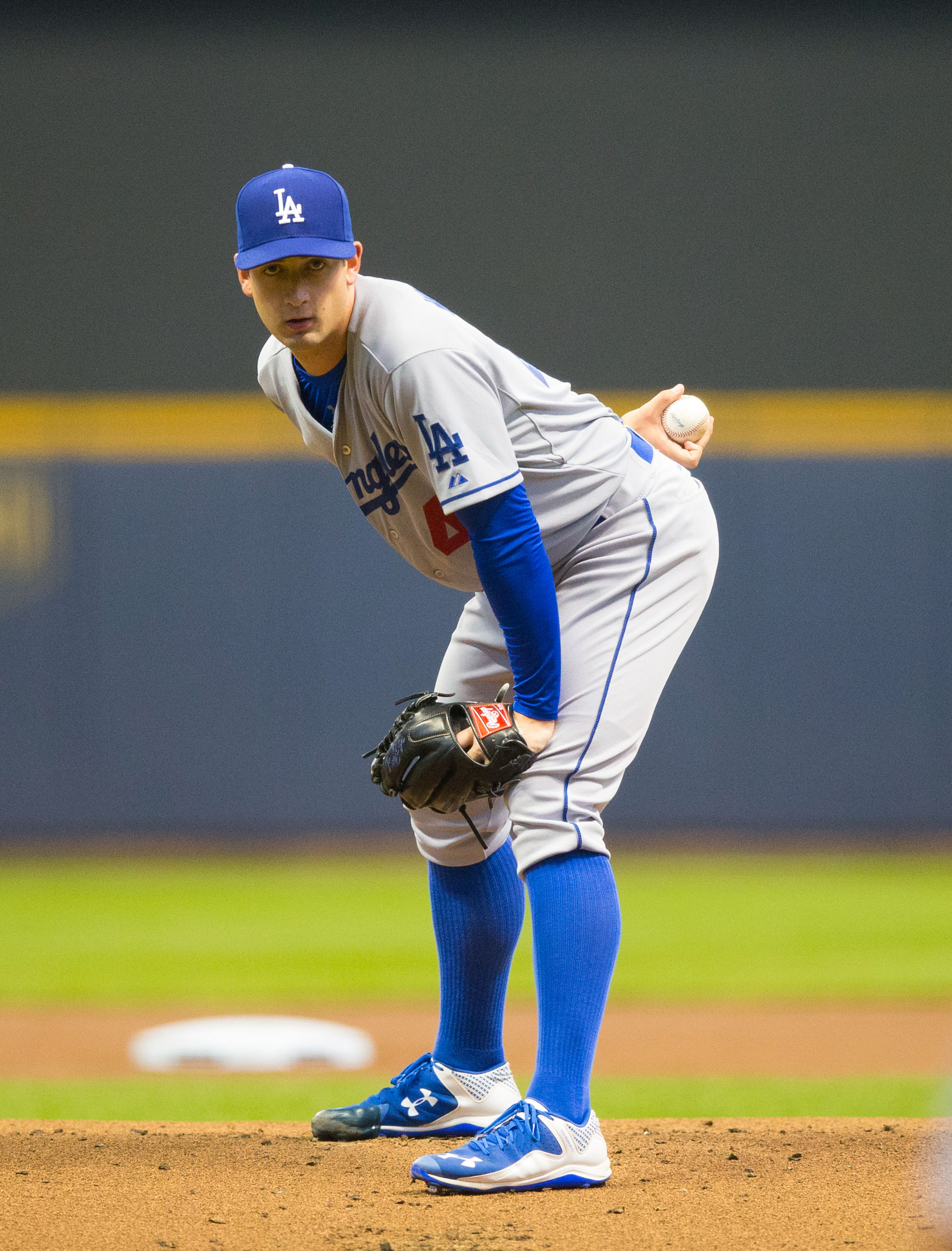
Wieland, who turns 26 next week, will provide the Mariners with some inexpensive rotation depth. The right-hander has already avoided arbitration by agreeing to a $590K salary with the Dodgers, who opted to give him that marginal raise despite the fact that injuries have limited Wieland to just 47 2/3 innings over his three-plus years of Major League service time. Most notably Wieland underwent Tommy John surgery in 2012 and missed the entire 2013 season.
To this point in his brief and injury-marred Major League career, Wieland has logged just a 5.85 ERA with 6.8 K/9, 3.6 BB/9 and a 39.4 percent ground-ball rate. He’s fared somewhat better at the Triple-A level, compiling a career 4.34 ERA while pitching exclusively in the hitter-friendly Pacific Coast League. Throughout his minor league tenure, Wieland has displayed the ability to miss bats at a reasonable level (8.2 K/9) as well as a knack for keeping the ball in the strike zone (1.9 BB/9). While there doesn’t appear to be an immediate place for him in the Mariner rotation — Felix Hernandez, Hisashi Iwakuma, Wade Miley, Taijuan Walker, James Paxton and Nate Karns are all ahead of him on the depth chart — Wieland can function as Triple-A depth or perhaps compete for a slot in the Seattle bullpen.
Mejia, 21, saw action at four levels last year in his age-20 season, batting a combined .282/.346/.339 with 20 stolen bases. He’s shown virtually no power to this point in his pro career, homering just once in 528 plate appearances, though he’s also displayed a solid knowledge of the strike zone, walking at a 10.8 percent clip against a strikeout rate of just 14.8 percent. Mejia didn’t rank among the Mariners’ top 30 prospects according to either MLB.com, but Baseball America did rank him 21st among Seattle farmhands last offseason. In that same offseason, Fangraphs mentioned Mejia as a “player of note” even though he didn’t rank among Seattle’s best prospects, with former FG scribe Kiley McDaniel writing that Mejia was an average runner with “enough glove to stick at short and enough bat that it matters.”
Schugel, 26, posted a 4.84 ERA with 6.2 K/9 against 2.5 BB/9 in 115 1/3 innings of work for the D-backs’ Triple-A affiliate in Reno this past season. While it’s a notoriously hitter-friendly environment, those results were nonetheless discouraging after a solid 2014 season at the Double-A level. He’d come to the Mariners by way of waiver claim after having been designated for assignment by the D-backs in order to clear a roster spot for Zack Greinke.
Jeff Passan of Yahoo Sports first reported that Wieland had been traded to Seattle (Twitter link).
Photo courtesy of USA Today Sports Images.