
Tigers Sell Contract Of Dean Green To Japan’s Yakult Swallows
The Tigers announced today that the contract of first baseman/DH Dean Green has been sold to the Yakult Swallows of Japan’s Nippon Professional Baseball. Presumably, Green has negotiated a salary with his new organization for the 2017 season.
Green, 27, is a former 11th-round draft pick who has played in the upper minors in Detroit’s system over the last several seasons. He has not yet reached the majors, and would again have been eligible for the Rule 5 draft had he not been moved to Japan. In all likelihood, though, his major league prospects weren’t great. He has spent most of his time in the minors serving as a DH, and has never played any position in the field other than first base.
Still, there’s a lot to like about Green’s bat. He mashed at Double-A (as he had over the prior two seasons) and kept things up following a call-up to Triple-A last year, posting a cumulative .296/.356/.500 batting line with 23 home runs over 534 plate appearances.
Offseason Outlook: Washington Nationals
MLBTR is publishing Offseason Outlooks for all 30 teams. Click here for the other entries in this series.
The Nationals coasted to the NL East crown in 2016 but came up short in October. Washington’s still-loaded roster is primed to compete yet again, but it nevertheless promises to be an interesting winter in D.C.
Guaranteed Contracts
- Max Scherzer, SP: $180MM through 2021 (including scheduled signing bonus payments)
- Stephen Strasburg, SP: $175MM through 2023
- Ryan Zimmerman, 1B: $58MM through 2019 (including buyout on 2020 club option, post-career personal services contract)
- Daniel Murphy, 2B: $29.5MM through 2018
- Jayson Werth, OF: $21MM through 2017
- Shawn Kelley, RP: $11MM through 2018
- Oliver Perez, RP: $4MM through 2017
Arbitration Eligible Players (service time in parentheses; projections via MLB Trade Rumors)
- Ben Revere (5.149) – $6.3MM
- Jose Lobaton (5.138) – $1.6MM
- Danny Espinosa (5.113) – $5.3MM
- Bryce Harper (4.159) – $9.3MM
- Anthony Rendon (3.130) – $6.4MM
- Tanner Roark (3.055) – $6.1MM
- Non-tender candidates: Revere
Options
- Gio Gonzalez, SP: $12MM ($500K buyout)
- Yusmeiro Petit, RP: $3MM ($500K buyout)
Free Agents
- Aaron Barrett (elected free agency), Matt Belisle, Sean Burnett, Stephen Drew, Chris Heisey, Mat Latos, Mark Melancon, Wilson Ramos, Marc Rzepczynski
Washington Nationals Depth Chart; Washington Nationals Payroll Information
The Nationals answered what would have been one major offseason question early in the 2016 campaign, locking up righty Stephen Strasburg to a significant extension. While it came with a big price tag, the deal looked wise for most of the year — right up until Strasburg went down with what was diagnosed as a strained flexor mass. He’s expected to be ready for camp next year, but the injury raises yet more questions about the supremely talented, oft-injured starter.
Still, the Nats are in good shape in the rotation, which could feature the same five arms that opened 2016. Strasburg and Max Scherzer form a potent one-two punch, and Tanner Roark has established himself as another quality starter. Though his 2.83 ERA was not supported by ERA estimators, he has carved out a unique niche as a contact-manager with his five-pitch mix. Gio Gonzalez has been something of the opposite — a strikeout pitcher who generally underperforms his peripherals — though he’s still a good bet to provide innings. There’s enough upside in Gonzalez’s left arm to make his option an easy pick-up, particularly given his clean health history. And then there’s Joe Ross, who was putting up outstanding numbers for a fifth starter before going down with shoulder issues. If he can return to health, he’s another sure bet to take a spot on the staff.
That’s not to say there isn’t any potential for change. Washington GM Mike Rizzo will surely have his eye on quality outside options after the team again washed out in the NLDS following a third division title in five years. And the organization’s younger right-handed starting talent not only could pressure the five arms noted above, but might also represent intriguing trade fodder. Top prospect Lucas Giolito showed poorly in his limited time in the majors but remains a highly valuable asset. Some are just as impressed by fellow young fireballer Reynaldo Lopez, who was trusted with a postseason roster spot. A.J. Cole remains a factor after making eight MLB starts in which he showed some swing-and-miss potential but didn’t generate stellar results. And Erick Fedde reached Double-A, making him a plausible second-half contributor with top-100 prospect billing. There’s another near-MLB arm in the system who’s probably ready for the majors: Austin Voth, who finished with a 3.15 ERA over 157 Triple-A frames last year.
With open-market starting pitching nearly non-existent, and controllable starters as valuable as ever, the Nationals could take any number of different directions to utilize that mass of talent. Gonzalez, for instance, could be shipped out for a solid, not-so-cheap veteran at another position of need. (The Yankees are one team that would surely have interest and, as noted below, could have players who’d match.) Or one or more of the upper-level pitchers might be moved to add a quality regular position player. Rizzo has engineered a wide variety of quality trades over the years and will surely put his creativity and scouting instincts to the test again this winter.
Despite the impressive array of starting options, the team again finds itself with at least one notable pitching role in flux. The front office will need to address the ninth inning, hopefully providing manager Dusty Baker with a sure hand to lock up late-game leads, with mid-season acquisition Mark Melancon heading to the open market. He’s certainly a plausible target, as are top free agent relievers Aroldis Chapman and Kenley Jansen, though it’s far from certain that Washington will spend big to address the opening. Lower-priced free agents such as Koji Uehara, Greg Holland, Santiago Casilla, Sergio Romo, Joaquin Benoit, or Brad Ziegler could be brought in, though perhaps the Nationals will be more inclined to trust those veterans with set-up roles. The trade market holds some promise, too, with pen pieces such as Wade Davis, Francisco Rodriguez, David Robertson, and Sean Doolittle conceivably of interest.
Otherwise, Shawn Kelley and Blake Treinen look to be the two top set-up men from the right side, with Sammy Solis providing a power left-handed option if he can stay healthy. Youngster Koda Glover will compete for a job out of camp, and the team surely still has hopes for the live-armed Trevor Gott despite a generally disappointing 2016. Oliver Perez provides another southpaw, though it’s possible the team could still look to add another after parting with Felipe Rivero in the Melancon deal. It’s also possible that the Nats could filter some of their young rotation options into the bullpen. With Yusmeiro Petit fading badly in the second half, his option no longer seems likely to be exercised, perhaps opening a spot for Cole in a swingman capacity. And while the Nats would surely prefer to see Lopez succeed in the rotation, he could provide another power setup arm in a relief capacity. There’s probably not a need, strictly speaking, to add greater depth, but it wouldn’t at all be surprising to see Washington go after some of the veterans listed above, pursue a reunion with Matt Belisle, and/or bring in a few veterans on minor-league deals for a camp tryout.
On the position-player side, there are two everyday openings that could be filled with outside additions. The first is pretty straightforward: after suffering a late-season ACL tear that ended an excellent campaign, Wilson Ramos is heading to free agency. It’s not clear whether the team is giving serious consideration to making him a qualifying offer, but that’s a risky proposition. Taking a $17.2MM payday for what might be a half-season of play would be awfully enticing for the 29-year-old, even if he’s still holding out hope for a much lengthier contract.
Regardless, there’s a need here. The switch-hitting Jose Lobaton is useful but limited to a backup role. Athletic youngster Pedro Severino showed very well in his limited MLB action and can handle things defensively, but he has never hit much in the minors. For a team with obvious World Series aspirations, an addition has to be a strong consideration. Outside of Ramos, the open market’s best options are Matt Wieters and Jason Castro. They’ll surely be considered, but the many less-heralded free agent receivers probably won’t hold a ton of appeal given the presence of Lobaton and Severino. The trade market doesn’t seem terribly promising, but Brian McCann could make for an interesting fit, and Derek Norris might conceivably be a candidate to bounce back with his original professional organization. Otherwise, the options are slim: Welington Castillo could be had, perhaps, but the D-Backs may not be willing to part with him absent an overpay. And Miguel Montero — with whom Rizzo is familiar from their time in Arizona — could be shopped by the Cubs, though he’s expensive and didn’t impress at the plate in his age-32 season. With catching in high demand leaguewide, Rizzo will be put to the test in addressing this area.
The second major need features more options, but also less clarity of direction. Trea Turner emerged as a force upon his call-up in 2016, making him a definitive everyday option for the team. But it’s not clear where he’ll play: center field, which he learned on the fly, or his native shortstop. The Nats have internal alternatives at both positions, though the bet here is that the club looks to upgrade in one area while using Turner in the other. We’ll take each in turn.
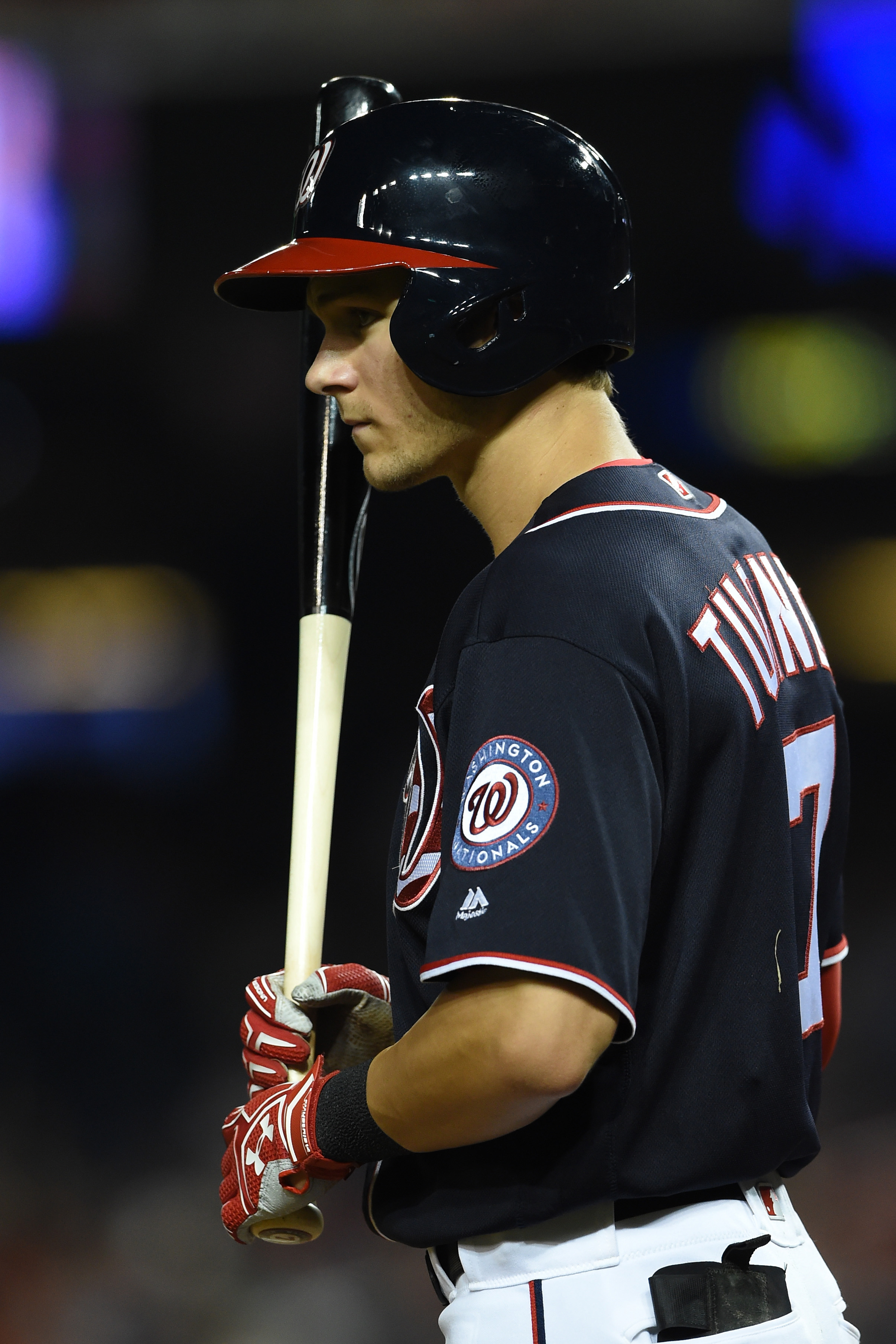
In the outfield, Bryce Harper will try to resume his presumed march to greatness while veteran Jayson Werth will play out the final year in D.C. There are plenty of options to play between them. Washington could platoon toolsy but strikeout-prone Michael Taylor with either of two lefties — Ben Revere and post-hype prospect Brian Goodwin, but that would mean multiple rolls of the dice. Odds are the team will non-tender Revere, who won’t come cheap and was dreadful in 2016. And Taylor and Goodwin seem more likely to compete for a reserve role — presumably, spelling Werth with some frequency — or continue to try to refine their talent at Triple-A.
Looking elsewhere, though Turner’s presence atop the order reduces the need for a true table-setter, switch-hitter Dexter Fowler‘s high-OBP bat would certainly slot in nicely. Other free agent possibilities include former Nats shortstop-turned Rangers center fielder Ian Desmond and Carlos Gomez. The trade market, too, has some intriguing possibilities. Rizzo has pursued younger veterans with two or three years of control before — e.g., Denard Span, Doug Fister — and that type of asset could line up nicely with the promotional timeline of skyrocketing center field prospect Victor Robles (who’d also be a heck of a trade chip). Charlie Blackmon of the Rockies fits that bill with two seasons of arb control remaining and is perhaps the best reasonably achievable trade target. The Nats reputedly had interest in him this summer. A.J. Pollock would be another two-year piece, though it’s not clear that Arizona will sell low after his injury-plagued campaign. With the Marlins reportedly considering dangling their three years of control over Marcell Ozuna in a bid to add pitching, there’s a possible match on paper. Indeed, the Nats reportedly pitched a deal to the Fish last year involving Gonzalez (though they were apparently trying to get Christian Yelich). Such an intra-division swap still feels like a bit of a stretch, and it’s perhaps even harder to see something coming together with the Braves for Ender Inciarte, who is another piece of the potential center field trade puzzle this winter. A readier match could be found with the pitching-needy Yankees, who might be interested in a swap involving Gonzalez and Brett Gardner (who has two guaranteed seasons plus an option remaining). If — big if — the Royals decided to market Lorenzo Cain, he’d presumably also be of interest.
There’s one other possible route to consider in the outfield. The Nationals put significant money on the table last winter for Yoenis Cespedes, who ultimately chose an opportunity to opt out after a year with the Mets over Washington’s heavily-deferred, five-year offer. Cespedes would give the team another premium bat, though either he or (perhaps more likely) Harper would need to spend part of the year in center to make that happen. It’s a bit of a strained fit, but it makes more sense when one considers that the Nats will be looking to replace Werth this time next fall. With Taylor and Goodwin available, the team could field Harper and Cespedes in the corners when Werth sits.
The other general strategy would be to keep Turner in center for at least another year or two, which would open the question of what to do at short. Taking that approach wouldn’t necessarily mandate a major acquisition, either, as Danny Espinosa has a final year of arbitration control after playing every day at short in 2016. But while the switch hitter provided 24 long balls, quality glovework, and excellent baserunning, his lack of contact (and resulting .209/.306/.378 batting line) make him a less-than-ideal choice. The Nationals would surely prefer to utilize him as a utility infielder.
Thing is, there’s a lot less out there at the shortstop position than there is in center. While the Nats could bring back Stephen Drew, pair Espinosa with young infielder Wilmer Difo, or sign another platoon partner, the free agent market doesn’t include any regulars. (Well, unless you really want to make things interesting and consider Desmond there.) Barring an exceedingly crafty trade for a high-quality young shortstop, there’s also not much of interest in the trade market. The clear target for teams hoping to improve at the position is Zack Cozart of the Reds, who has one more year of reasonably-priced control. Though he faded at the plate and ended the year with an injury, Cozart is a supremely talented gloveman with pop. It isn’t inconceivable that the Nats would look at the Cardinals’ Jhonny Peralta, too, though he’s 34 and struggled through an injury-ravaged 2016 season.
Regardless of how those issues are worked out, the Nats figure to rely upon familiar faces elsewhere in the infielder. Daniel Murphy and Anthony Rendon are stellar options at second and third. There are plenty of questions about longtime franchise face Ryan Zimmerman, but he’s set to remain the regular at first base. If his batting line doesn’t improve — and the team hopes it will, after a year in which good contact didn’t fall very frequently — and/or he is again limited by injury, then it will be useful to have alternatives.
That brings us to the bench mix, which will likely see some change as the team watches productive reserves like Drew and Chris Heisey return to the open market. Espinosa and/or Difo are likely candidates, as are the younger outfielders noted above. But the Nats may have some room to add impact with a market that’s chock full of platoon sluggers. The team has traditionally carried a power left-handed bat, a role filled most recently by Clint Robinson. He could be retained, but struggled mightily last year and isn’t really capable of playing the corner outfield. Particularly if the Nats don’t make a big move in center field, the team could make a play for free agent Brandon Moss, who might take 400 or more plate appearances while functioning as a complement to and insurance for Werth in left and Zimmerman at first. That sort of addition wouldn’t be particularly cheap and isn’t strictly necessary, of course: Murphy could also shift over if a need arises at first base, with Espinosa and Difo on hand for middle-infield protection.
In the final analysis, the Nationals have most of the pieces in place to believe they’re positioned for a repeat run at the NL East crown. It’s easy to imagine a relatively straightforward winter mostly spent shoring things up in a few areas. But holding off the Mets, and finally advancing in the postseason, may require more. The payroll already projects to include $139MM in commitments as things stand, but this is a team that opened the 2015 season with a payroll north of $160MM. If it’s willing to do so again, there’s still some room to add impact pieces. With intriguing roster flexibility provided by a deep reserve of pitching and the presence of Turner, Rizzo and co. may yet have some surprises up their sleeves.
Photo courtesy of USA Today Sports Images.
Latest On CBA Negotiations: Revenue Sharing, Schedule, Rosters
Word of various potential changes in the MLB-MLBPA collective bargaining agreement has been trickling out of late, and Susan Slusser of the San Francisco Chronicle reports on a series of new matters under consideration. In particular, she looks at discussions involving the cash flow to the Athletics.
Revenue sharing is the key topic of interest for Oakland, which has been allowed to participate in the system despite its large-market status because of its inability to find a new ballpark. The O.Co coliseum has allowed the team to continue receiving funds, which Slusser pegs at $34MM in 2016.
Some around the game — including rival teams and the union — believe that the A’s aren’t putting those funds to use as intended. Reduction or even elimination of Oakland’s participation has “definitely been a topic” of discussion, a union source tells Slusser.
The interplay with the longstanding stadium question is complicated, as the report details. There’s a concern in some quarters not only that the club isn’t funneling enough cash into player salaries, but also that the team has been slow to settle its ballpark situation. (Of course, there’s a counter-argument to be found as well.)
If the team ultimately has its revenue-sharing pipeline narrowed, with a resulting hit to profitability, sources tell Slusser that there could be ownership changes. That might involve a minority owner leaving or even a full-on sale of the organization, she suggests.
There are a variety of other possible changes being discussed that could have even wider-ranging impact, per the report. That includes the possibility of trimming the regular season down to 154 games and inserting more off-days.
Even more intriguingly, perhaps, there’s apparently at least some consideration being given to expanding rosters from 25 to 26 players. That would certainly reduce the need to utilize the 15-day DL, increase teams’ flexibility to carry more specialty players, and perhaps add to the frequency of reliever usage during the regular season. It would also seem likely to enhance the value of somewhat marginal roster pieces (lefty specialists, power bench bats, glove-first players) who might otherwise be without a spot, while perhaps increasing the viability of the Rule 5 draft and opening service-time opportunities for less-developed players who’d otherwise be left playing in the upper minors.
MLBTR contributor Ryan Spilborghs recently advocated for several such provisions, reasoning that both teams and players could benefit. The current grind is arguably too great, leading to injuries (and rushed returns) that can harm players’ earning capacities as well as the investments already made by organizations.
Ian Desmond Switches Agencies
Impending free agent Ian Desmond has changed representation and is now a client of CAA Baseball, Robert Murray of FanRag Sports reported today (via Twitter).
Desmond’s switch will come on the eve of free agency as he seeks what will be the largest contract of his life. The 31-year-old notoriously rejected a qualifying offer from the Nationals last offseason, and while it’s not known exactly what he sought upon initially entering the open market on the heels of a down season, he ultimately settled for a late one-year deal in February that came with just an $8MM guarantee and a position change. Desmond is also known to have turned down a seven-year extension offer with the Nats prior to the 2014 season that would’ve paid him about $107MM, though it reportedly came with significant deferrals.
Furthermore, on the heels of a terrific first season in Texas, Desmond stands a good chance at recouping a good portion of that missed fortune. He’s already taken home $25.5MM over what would’ve been the first three seasons of that deal, and he could very well secure a contract of at least four years this winter after hitting .285/.335/.446 with 22 homers and 21 steals while proving a capable outfielder during the 2016 season. Desmond drew positive marks for his work in left field according to both Defensive Runs Saved and Ultimate Zone Rating, and while he took home negative marks as a center fielder, he didn’t rate horribly and could be reasonably expected to show some improvement with a full season of work now under his belt. It’s also possible that Desmond could also market himself as a Ben Zobrist-style Swiss army knife that can play multiple positions in the infield and the outfield, which would allow teams with needs virtually anywhere on the diamond to consider him a viable option for improvement.
In joining CAA, Desmond will be enlisting one of the game’s larger agencies, one whose current slate of free agents includes Yoenis Cespedes (in a joint representation with Roc Nation Sports), Andrew Cashner, a resurgent Joe Blanton, Jon Jay, Boone Logan, Jake Peavy, Drew Storen and Ryan Howard. All of that info, of course, can be found in MLBTR’s Agency Database, which contains agent information on more than 2,500 Major League and Minor League players (and now reflects Desmond’s switch). If you see any notable errors or omissions, please let us know via email: mlbtrdatabase@gmail.com.
Giants, Josh Johnson Agree To Minor League Deal
The Giants and right-hander Josh Johnson are in agreement on a minor league contract, per the MiLB Roster Tracker account on Twitter (MLBTR has confirmed the move). Set to turn 33 in January, Johnson hasn’t appeared in a Major League game since the 2013 season due a cavalcade of injury issues.
Most notably, Johnson underwent Tommy John surgery in early 2014 after signing a one-year, $8MM deal with the Padres the preceding offseason. Johnson re-upped with San Diego on a one-year deal worth about $1MM for the 2015 season, but his rehab was slowed by a nerve issue in his neck and recurring soreness in his elbow later that year. The 2015 season brought the third Tommy John surgery of Johnson’s career — a procedure from which he is now attempting to return.
While the odds are certainly stacked against Johnson, the allure is easy to see. When Johnson was healthy and at his best, he was a top-of-the-rotation talent, as evidenced by an NL-leading 2.30 ERA in 2011 and a collective 2.99 ERA in 644 1/3 innings from 2009-12 while anchoring the Marlins’ rotation. Injuries have routinely been a problem for Johnson throughout his professional career, though, and the right-hander’s last MLB action saw him post a 6.20 ERA through 81 1/3 innings in an injury-shortened season with the Blue Jays after being included in the Jose Reyes/Mark Buehrle blockbuster.
Johnson, obviously, is somewhat of a lottery ticket for the Giants and amounts to little more than a low-risk depth move. The team currently has a deep rotation mix including Madison Bumgarner, Johnny Cueto, Jeff Samardzija and Matt Moore as locks, with former ace Matt Cain and intriguing young lefty Ty Blach both serving as options in the No. 5 slot. The bullpen may be a better option for Johnson in his attempt to return from a three-year absence from a Major League field. The Giants have Hunter Strickland, Will Smith, Derek Law and George Kontos among those who will be penciled into the ‘pen next season.
Greg Holland Set For Showcase Within The Next Week
Former Royals closer Greg Holland, who missed the 2016 season while recovering from Tommy John surgery that he underwent last October, has thrown off a mound three to four times and is set to host a showcase for interested teams within the next week, agent Scott Boras tells Joel Sherman of the New York Post. Per Boras, Holland’s velocity is currently in the low 90s, and the showcase will take place either at Boras’ sports facility in Florida or near Holland’s North Carolina home.
Holland, 30, was one of the game’s elite relievers prior to tearing his ulnar collateral ligament and requiring surgery. From 2011-14, he amassed 113 saves for the Royals while recording a minuscule 1.86 ERA with a 358-to-91 K/BB ratio in 256 1/3 innings (12.6 K/9, 3.2 BB/9). Adding in his postseason work in 2015 tacks on another 11 innings of one-run ball with 15 strikeouts against five walks.
However, Holland’s numbers took a turn for the worse in 2015, as he worked to a solid-but-unspectacular 3.83 ERA with 9.9 K/9 against 5.2 BB/9. His average fastball, which once sat a tick over 96 mph, was instead a more pedestrian 93.6 mph. Clearly, something was wrong with Holland, and manager Ned Yost made the shocking revelation at the time his ligament tear was reported that it appeared Holland actually tore his UCL late in the 2014 season, meaning he pitched the entire 2014 postseason and the entire 2015 campaign with a torn UCL. The extent of the tear was likely minimal in nature at first, but by the end of that ’15 season, it was reported to be a “significant” tear — hardly a surprise after more than a year of pitching through the injury.
Back to the present day, Boras tells Sherman that his client is “back at it full steam” and suggested that his client’s market will be “interesting” in light of the value that is being placed on premium bullpen arms in the postseason. While Holland comes with considerably less certainty than the free-agent market’s top relief arms — Aroldis Chapman, Kenley Jansen and Mark Melancon — the upside of signing him is tantalizing, especially considering the fact that he’ll 17 months removed from Tommy John surgery when Spring Training opens.
Holland has already been linked to the Royals recently, but teams in search of top-tier bullpen arms figure to certainly check in with Boras — especially those that miss out on the aforementioned free agents. Teams that seem likely to pursue high-end relief arms this winter include the Giants, Cubs, Dodgers, Yankees and Nationals, though Holland’s price point should be reasonable enough that even clubs that won’t go anywhere near the big three relievers at their expected asking prices could view Holland as an opportunity to add a comparable talent at a reduced rate.
David Robertson Undergoes Knee Surgery
White Sox closer David Robertson underwent arthroscopic surgery to repair a damaged meniscus in his left knee which plagued him for a portion of the 2016 season, reports MLB.com’s Scott Merkin. The White Sox expect Robertson to be at full strength come Spring Training 2017, Merkin adds.
Robertson, 32 next April, pitched to a 3.47 ERA in 62 1/3 innings this year in the second season of a four-year, $46MM pact inked at the 2014 Winter Meetings. That marks the second straight season with a mid-3.00s ERA for Robertson, which likely falls shy of the White Sox’ expectations upon signing him, though his strikeout rate remains excellent and his ground-ball rate bounced back in 2016 after a sudden drop-off in 2015. Robertson’s chief problem this past season was that his control eluded him; his 4.6 BB/9 rate was the highest its been since 2011, when he had only just begun to establish himself as one of the American League’s premier relievers.
It’s not known to what extent the meniscus damage impacted Robertson’s 2016 performance, but it didn’t appear to be significant enough to deter him from taking the hill with regularity over the season’s final months, and he performed quite well down the stretch. Robertson logged a 1.64 ERA with 26 strikeouts against 11 walks in his final 22 innings on the season. The strong finish and the seemingly minor nature of the procedure bode well for his 2017 status.
As Merkin notes, Robertson could potentially be a trade chip this offseason if the White Sox do ultimately decide to sell off veteran assets rather than make another run at contending. However, with a core of Chris Sale, Jose Quintana, Carlos Rodon, Jose Abreu, Adam Eaton and Tim Anderson all under control for another three seasons or more, there’s plenty of reason for the Sox to continue their attempt to put a winning product on the field. Any of their most frequently cited trade assets — namely Sale and Quintana, but also Robertson to a lesser extent — should still be marketable next summer or next winter. Additionally, outside of the Indians, the AL Central doesn’t look especially imposing at the moment. The GMs of both the Tigers and Royals have suggested that their teams will scale back the payroll this offseason, and the Twins finished the 2016 season with baseball’s worst record.
Nonetheless, if the Sox do look to shed some veterans in either a partial or total tear-down this winter, Robertson’s operation doesn’t seem serious enough that it would do any major damage to his trade value. He’d be one of many appealing late-inning options for interested parties, as the free-agent market features the likes of Aroldis Chapman, Kenley Jansen and Mark Melancon, while the trade market could see names like Wade Davis or Francisco Rodriguez added to the list of available relievers.
Mariners Interested In Re-Signing Dae-Ho Lee
Korean slugger Dae-ho Lee recently returned home after his first season in the Majors and spoke to reporters at Incheon International Airport in Korea, revealing that manager Scott Servais and second baseman Robinson Cano have already informed him that they hope he’ll return for a second season with Seattle in 2017 (via the Korea Times). And Bob Dutton of the Tacoma News Tribune reports that Mariners general manager Jerry Dipoto has confirmed his desire to re-sign the 34-year-old slugger as well, citing a lack of quality right-handed platoon bats on the open market.
However, while Lee sounds open to returning to Major League Baseball, he stressed to reporters that playing time will be a major factor in his decision. Seattle seems likely to give lefty swinging Dan Vogelbach, acquired in the July trade that sent southpaw Mike Montgomery to the Cubs, every opportunity to establish himself in the Majors next season. That could leave Lee in a part-time role once again if he returns to the Mariners, which may prompt him to look elsewhere.
“Playing time is an important factor to consider when choosing a team,” Lee said (via the aforementioned Korean Times link). “…Early on, it was fun to come off the bench to pinch hit, but it started to hurt my pride later. I wanted to play more, but it’s entirely up to the manager how he runs the team. I have no hard feelings for manager Servais. If anything, I should have played better and tried harder.”
Lee, 35 next June, was a superstar in both Korea and Japan before testing international free agency but had to settle for a minor league deal and a $1MM base salary with incentives this past winter in order to prove himself to Major League clubs. He succeeded in doing so, though, hitting .253/.312/.428 with 14 home runs in just 317 plate appearances despite calling the pitcher-friendly Safeco Field his home. Lee did strike out at a higher clip against right-handed opponents (25 percent) than left-handed opponents (22 percent), and his overall production against righties (.244/.292/.407) was weaker than his output when holding the platoon advantage (.261/.329/.446). That said, Lee’s overall offense was better than the league average, although he faded in the final months of the season after getting off to a strong start.
A contending club may not leap to sign Lee as its starting first baseman or DH, but it’s easy to envision him once again drawing interest in a bench or platoon capacity. It’s also not out of the question that a rebuilding club could look to plug Lee into a more regular first base/designated hitter role as an affordable source of pop. He did slug at a 26- to 27-homer pace in a pitcher-friendly setting this past season, and neither Ultimate Zone Rating (+1.8) nor Defensive Runs Saved (-3) felt that his glovework through 622 innings was a significant detriment. Alternatively, if he wishes to continue playing, I’d imagine there would be plenty of interest from Japan’s Nippon Professional Baseball and the Korea Baseball Organization, though Lee did specifically note that he “learned a great deal from playing with good players on a big stage,” in Major League Baseball.
MLBTR Chat Transcript
Click here to read a transcript of today’s chat with MLBTR’s Steve Adams.
MLBTR Poll: Should The Rockies Trade An Outfielder?
In addressing the three biggest needs for the Rockies heading into the offseason, I advocated that the team trade away Carlos Gonzalez and his hefty $20MM salary. You can read the full reasoning here, but it boils down to the fact that he’s expensive and isn’t as necessary to the organization given its other left-handed-hitting options and many other needs. The emergence of David Dahl gives the Rox three southpaw-swinging outfielders, and it’s probably sub-optimal to have so many resources tied up in such players.
Still, there’s an argument to be made that Colorado ought instead to pursue deals involving another player. Charlie Blackmon‘s monster 2016 season and two affordable years of control make him a highly appealing piece, especially with numerous rival organizations in the market for a center fielder. Of course, he’s also the Rockies’ primary option up the middle, though there are some alternative strategies.
The club could conceivably pair Gerardo Parra with a cheaper right-handed-hitting bat in center. Free agents such as Rajai Davis, Austin Jackson, Peter Bourjos, and Drew Stubbs should all be available on short-term deals. If trusting Parra up the middle isn’t desirable, Jon Jay or Michael Bourn could fill that role. Colorado could even provide a highly appealing bounceback locale for Carlos Gomez, though he’ll likely cost nearly as much as Gonzalez.
Parra himself could also be moved, though that would involve eating some salary. The Rockies owe him another $19.5MM over two years, including the buyout on a 2019 option. That’s a reasonable-enough commitment for the Parra of old, but he posted a 65 OPS+ in an injury-marred 2016 — which followed up a disappointing second-half run with the Orioles in 2015.
Dahl, meanwhile, only debuted last year, and seems much more likely to represent a foundational piece in Colorado than trade fodder. He spent most of his time in the minors in center field, and appeared a few times there last year, so could potentially step in for Blackmon rather than occupying a corner spot. Certainly, trading him now wouldn’t make a whole lot of sense for a team with limited willingness to spend. His development, following numerous other success stories on the position player side, demonstrates that the Rockies may be well-situated to ship out position players who are closer to free agency in exchange for pitching, as they did last year with Corey Dickerson. The team has struggled to attract free agent arms (or, at least in the past, to develop their own) even as they churn out quality bats.
Dealing Gonzalez or Blackmon would hold out the promise not only of opening some salary, but also of bringing back some interesting pieces in return. The Rockies are always hunting for pitching, of course. Even if the team is in better shape in the rotation than it has been in years, there’s room to add there. And the bullpen remains an area of concern. Plus, Colorado has needs behind the plate and at first base that could be addressed.
So, let’s put it to a vote … should the Rockies pursue a trade of an outfielder, and if so which one? (Link for mobile users.)
Should The Rockies Trade An Outfielder?
-
It's time to trade CarGo 49% (2,945)
-
Cash in Blackmon 29% (1,767)
-
Cut bait on Parra 16% (950)
-
Nah, keep this trio and pursue alternative strategies 6% (389)
Total votes: 6,051