
Minor MLB Transactions: 6/9/18
The latest minor moves from around baseball:
- Mets left-hander Buddy Baumann and infielder Phillip Evans cleared waivers and will be assigned to Triple-A Las Vegas, Tim Healey of Newsday tweets. The club designated both players for assignment earlier this week. The 30-year-old Baumann allowed 10 earned runs on nine hits and seven walks during 3 1/3 disastrous innings with the Mets this season prior to his designation. Evans, 25, has collected one hit in nine MLB plate appearances this year. Over a much larger sample size (165 PAs) at the Triple-A level this season, he has slashed .255/.321/.544 hitter with 12 home runs.
Blue Jays Claim Preston Guilmet, Designate Deck McGuire
The Blue Jays have claimed right-hander Preston Guilmet off waivers from the Cardinals, per an announcement from Toronto. To make room for Guilmet, the Jays designated righty Deck McGuire for assignment.
This will be Guilmet’s second stint with the Toronto organization, as he previously tossed 14 1/3 innings with its Triple-A affiliate in 2015. The 30-year-old has combined for 260 1/3 innings at Triple-A with multiple franchises and logged a 2.39 ERA with 10.0 K/9 against 1.9 BB/9. However, Guilmet hasn’t been anywhere near that successful across 25 major league frames (9.36 ERA, 7.92 K/9, 3.24 BB/9) with the Indians, Orioles, Brewers, Rays and Cardinals. He made a pair of appearances with St. Louis this week and yielded five earned runs in two innings, leading the Redbirds to designate him on Thursday.
The Jays selected McGuire 10th overall in the 2010 draft, and he has finally seen his first action with the club this season, allowing six earned runs in 8 1/3 innings. The 28-year-old – who, like Guilmet, is in his second stint with the Jays – also garnered a bit of experience in the majors with the Reds last season. Most of his work has come in the upper levels of the minors, including 334 frames at Triple-A, where he has registered a 4.99 ERA with 7.0 K/9 and 3.4 BB/9.
NL Injury Notes: Acuna, Cueto, Thames, Phils, Bucs, Rox
Braves outfielder Ronald Acuna is progressing in his recovery from a sprained left ACL, Mark Bowman of MLB.com explains, and could return as early as next weekend. The 20-year-old phenom, who went down May 27, would only miss around three weeks in that scenario. Acuna’s injury looked like a potential season-ender when it occurred, making his quick recovery all the more welcome for Atlanta. “What he’s doing right now is amazing after looking at what happened,” manager Brian Snitker said. “What he’s doing now is really good.”
More injury notes from around the NL…
- Giants right-hander Johnny Cueto is “cautiously optimistic” he’ll be able to come off the 60-day DL when he’s first eligible (June 30), Chris Haft of MLB.com writes. Cueto hasn’t pitched since suffering an elbow injury at the end of April, when he was among the majors’ best starters (0.84 ERA, 2.74 FIP in 32 innings). But even without Cueto and ace Madison Bumgarner, who just made his 2018 debut Tuesday after his own lengthy absence, the Giants have managed a 32-31 record to stay in the thick of what has been a mediocre NL West.
- The Brewers expect first baseman Eric Thames back at the beginning of the upcoming week, Joe Bloss of MLB.com relays. Thames landed on the DL on April 27 with a torn ulnar collateral ligament in his left thumb, derailing a start in which he slashed .250/.351/.625 with seven home runs in 74 plate appearances. Fellow first baseman Jesus Aguilar has been outstanding in Thames’ absence, however, with a .296/.369/.556 line and 11 homers in 187 PAs this year.
- Phillies pitching prospect Sixto Sanchez is headed to the DL with right elbow inflammation, Jim Salisbury of NBC Sports Philadelphia reports. The club doesn’t believe it’s a serious issue, however. The 19-year-old right-hander, Baseball America’s 16th-ranked prospect (subscription required), has logged a 2.51 ERA with 8.68 K/9 and 2.12 BB/9 in 46 2/3 innings at the High-A level this season. He was closing in on a Double-A promotion prior to the DL placement, according to Salisbury, but that’s now on hold.
- The Pirates have sent righty reliever Richard Rodriguez to the DL with shoulder inflammation, Elizabeth Bloom of the Pittsburgh Post-Gazette writes. The club recalled righty Dovydas Neverauskas from Triple-A in a corresponding move. Pittsburgh doesn’t expect Rodriguez to miss a significant amount of time, but even a short-term absence could hurt. The 28-year-old rookie has burst on the scene with a 2.38 ERA and 13.1 K/9 against 1.19 BB/9 in 22 2/3 innings this season.
- The Rockies placed lefty reliever Mike Dunn on the DL and recalled righty Jeff Hoffman from Triple-A on Friday, Patrick Saunders of the Denver Post tweets. Dunn’s dealing with an upper-body injury – a left rhomboid strain, to be exact. The DL placement continues what has been a trying second season in Colorado for Dunn, who inked a three-year, $19MM guarantee with the team entering 2017. So far in 2018, the 33-year-old has posted a 9.00 ERA with more walks than strikeouts (17 to 12) in 16 innings.
White Sox Release Robbie Ross
The White Sox have released left-handed reliever Robbie Ross, according to an announcement from their Triple-A affiliate in Charlotte (h/t: James Fegan of The Athletic).
The 28-year-old Ross joined the White Sox on a minor league deal in March, which came after he saw MLB action with the Rangers (2012-14) and Red Sox (2015-17) over the previous six seasons. Ross had some success during that span, particularly during the 2012, ’13 and ’15 campaigns, and combined for a 3.92 ERA with 7.46 K/9, 3.27 BB/9 and a 52.2 percent groundball rate in 330 2/3 innings. He didn’t show a significant platoon split, either, as he held same-handed hitters to a .250/.331/.381 line and righty-swingers to a .269/.344/.376 mark.
Injuries, including elbow and back problems, limited Ross to nine major league frames a year ago. In his return to the mound this season, he struggled in Charlotte, where he logged an 11.81 ERA with 9.28 K/9 and 14.34 BB/9 in 10 2/3 innings.
Free Agent Stock Watch: Eduardo Escobar
Eduardo Escobar wasn’t supposed to get this much playing time in 2018. Heading into the season, he was set to be a utility player extraordinaire, backing up Twins shortstop Jorge Polanco, third baseman Miguel Sano and second baseman Brian Dozier — perhaps with an occasional day at DH or a brief foray into an outfield corner. But an 80-game suspension for Polanco following a failed PED test and an early injury for Sano thrust Escobar into the lineup with regularity. And more surprisingly, Escobar’s sensational performance has thrust him into the cleanup spot for the Twins more often than not.
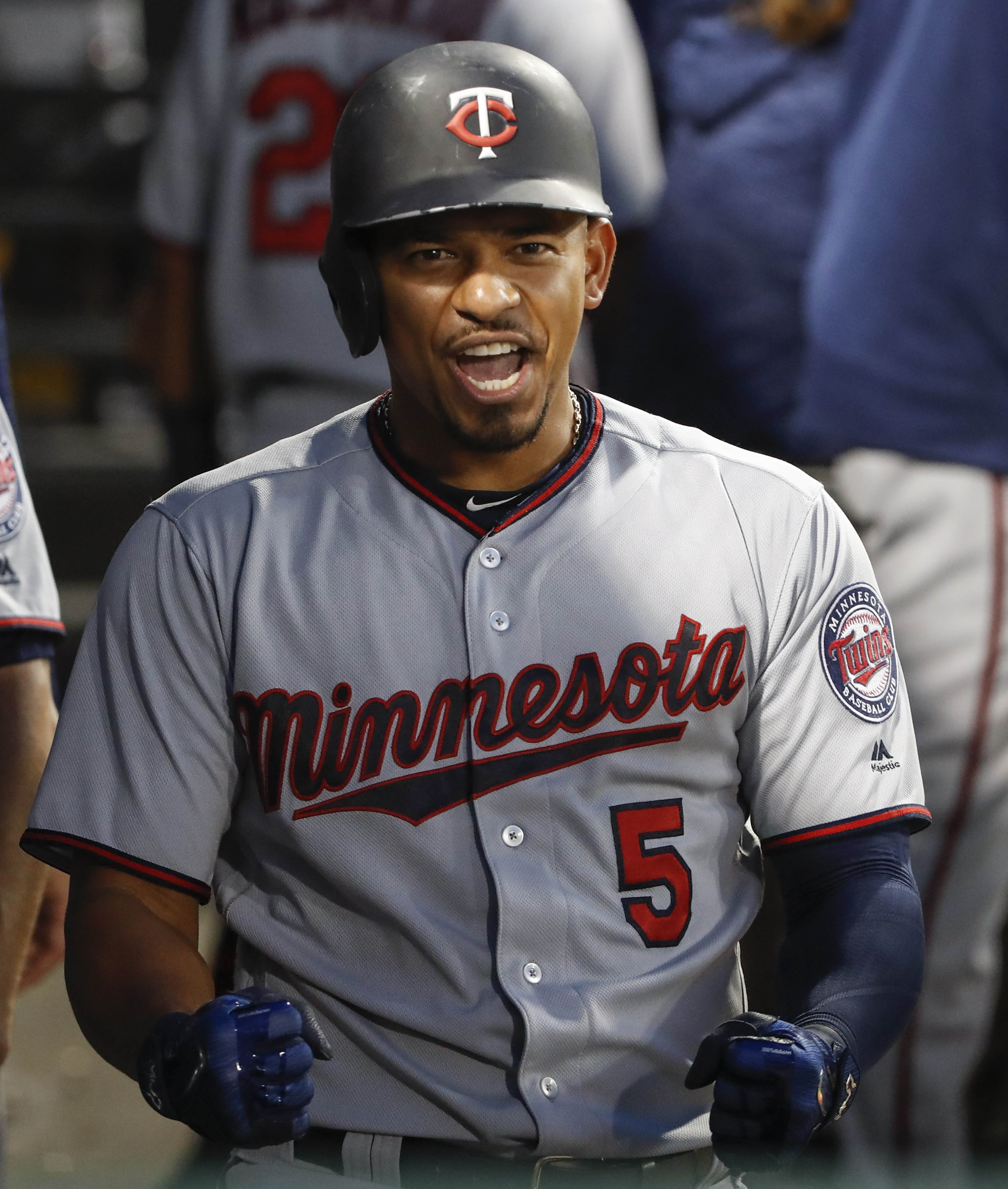
There are undoubtedly readers out there who literally don’t know who Escobar is. He’s long been a quality utility piece for the Twins, but he’s taken his offensive game to new heights over the past two seasons. Now, four months away from free agency, he looks potentially poised for a payday that would’ve sounded unthinkable for him entering the 2017 season.
Escobar, 29, is off to a ridiculous .286/.340/.562 start to the 2018 season (143 OPS+, 139 wRC+). The switch-hitter already belted a dozen home runs and racked up an incredible 24 doubles through his first 238 trips to the plate. It’s an excellent followup to last year’s career-high 21 homers, and he’s already just nine long balls and 11 doubles shy of his career-bests with about 60 percent of the season still to play.
While it’s not always obvious to see the areas from which a player’s offensive breakout stems, Escobar has made some very noticeable changes to his approach at the plate. He looks to be one of the many success stories from 2017’s “fly-ball revolution,” having increased his launch angle from 15 degrees in 2016 to 17.5 degrees in 2017 to 20.8 degrees in 2018. Back in 2016, Escobar was putting the ball on the ground nearly 40 percent of the time he made contact. But his fly-ball rate jumped from 37.4 percent in 2016 to 45.3 percent last season. This year, it’s sitting at a career-high 47.9 percent. His average exit velocity of 87.6 mph isn’t elite, but it’s steadily risen by about 1 mph in each of the past two seasons.
That seems like a deliberate focus on putting the ball in the air and hitting for more power, and it’s somewhat predictably come with some other, more negative changes. Escobar has traded some contact for his newfound power, striking out at a career-worst 22.7 percent so far in 2018. He’s chasing a whopping 40.4 percent out-of-zone pitches, and his swinging-strike rate is a career-worst 12.7 percent as well. That said, his strikeout rate is far from egregious, and he’s also sporting career-bests in hard-contact rate, line-drive rate and barreled-ball rate. His .327 average on balls in play is a bit north of his career .299 mark, but that can be somewhat explained by his increase in barreled balls and quality contact. In short, he looks like a legitimately improved hitter.
Defensively, Escobar is more of a mixed bag. He has extensive experience at both positions on the left side of the infield in addition to 348 innings at second base and 275 innings in the outfield (eight in center and 267 in left field). That’s desirable versatility, but he’s not exactly a standout defender anywhere. Third base has been his best position in the Majors, and by measure of both Ultimate Zone Rating and Defensive Runs Saved, he’s a serviceable defender at the hot corner. DRS pegs him at -5 runs 1735 innings, while UZR/150 has him at -0.4. His ratings at shortstop, particularly in 2018, are far less appealing (-8 DRS in 168 innings, -2.1 UZR), but he’d graded out passably (even favorably, per UZR) at the position in prior seasons.
At the very least, a team would likely feel comfortable installing Escobar at shortstop once or twice per week, knowing he could be re-positioned elsewhere in a late defensive switch by a superior defender. And it stands to reason that most clubs would feel comfortable with his glove at third base.
The question for Escobar in free agency, of course, will be one of how exactly he’ll be valued by other clubs. Escobar isn’t going to sustain a .276 isolated power mark (that is, slugging percentage minus batting average). By his own admission, many of his doubles are of the “hustle” variety (such as this one), and his 15.2 percent homer-to-flyball ratio is well above his career norm. Still, at least much of the gains he’s made in the power department seem legitimate. He’s also sporting a modest increase in walk rate (career-high 7.6 percent) to go along with his improved contact and defensive versatility. Some teams figure to value him in as a high-end utility player, while others yet may feel he’s capable of shouldering an everyday workload.
Looking for recent comparables, there aren’t many examples of bat-first utility players that stack up nicely with Escobar’s case. Ben Zobrist‘s four-year, $56MM contract was signed when Zobrist had a considerably lengthier track record and seems too ambitious a comparison for Escobar. On the other hand, former teammate Eduardo Nunez‘s modest deal to return to the Red Sox this year feels like it can be similarly dismissed, given Nunez’s late knee injury and lack of power. Luis Valbuena‘s two-year, $15MM contract feels too low, given Escobar’s ability to play some shortstop, his switch-hitting capability and his superior offensive output. Jed Lowrie‘s three-year, $23MM deal with the A’s may even be light. That contract began when Lowrie was 32 years of age and came on the heels of a season in which he played in just 69 games. Escobar will turn 30 next January.
Perhaps, then, Escobar will forge his own path, to an extent. He’s experiencing an offensive breakout similar to the one that Zack Cozart exhibited in his two years leading up to a three-year, $38MM deal from the Angels, though Cozart was considered a premium defensive shortstop who could provide significant defensive value at third base as well. Then again, he hadn’t been as healthy as Escobar and was two years older. That could serve as something of a ceiling for Escobar, and perhaps a four-year deal at a lower annual rate (something in the vein of Omar Infante‘s admittedly dated four-year, $30.25MM deal with Kansas City) shouldn’t be entirely ruled out, given Escobar’s relative youth.
All of this, of course, is predicated on Escobar sustaining a pace that at least approximates his current output. That’s far from a given, especially considering the fact that Polanco’s eventual return will cut into his playing time to some degree. But heading into the 2018 season, the general thought was that if there was one switch-hitting utility player poised for a significant payday, it’d be Houston’s Marwin Gonzalez. With Gonzalez struggling and Escobar thriving, that reality looks to have shifted. There are under-the-radar free agents who emerge from relative anonymity every season, and Escobar is making his case to become the latest such example with a strong start to the year.
Photo courtesy of USA Today Sports Images.
Yankees Sign First-Rounder Anthony Seigler
The Yankees have signed their first-round pick, 23rd overall choice Anthony Seigler, George A. King III of the New York Post reports. The high school catcher’s bonus is worth $2.815,900, the exact value of the pick, Jim Callis of MLB.com tweets.
Seigler, an 18-year-old Georgia native, ranked among the top 50 prospects entering the draft, according to FanGraphs (28th), Baseball America (41st), ESPN’s Keith Law (43rd) and MLB.com (46th). Seigler’s “agile behind the plate, has a quick transfer that helps his arm play as plus at times and shows promise as a receiver and pitch framer,” per MLB.com, which likens him to Austin Barnes of the Dodgers. Barnes has shown an ability to play second base, and Seigler also has the athleticism to line up at the keystone, according to MLB.com.
Offensively, the switch-hitting Seigler is a contact hitter capable of using all fields, and he could develop into a double-digit home run threat, MLB.com notes. He’s also relatively fast for a catcher. Interestingly, like major leaguer Pat Venditte (also of the Dodgers), Seigler has switch-pitching capability. He brings upper-80s heat and equal effectiveness from both sides, though he’ll sink or swim in the pros as a catcher.
Top 50 MLB Trade Candidates
We’re bringing back our annual series in the run-up to the trade deadline, drawing from our power ranking approach to pending free agents. As the summer trade market develops on a fairly tight timeline, you can expect more regular updates when modifications to the list are warranted.
The methodology — if you can call it that — is pretty straightforward. We’re ordering players based upon a combination of trade value and trade likelihood.
In terms of trade value, we’re starting with overall on-field value — with a premium on an ability to make an impact in the current season — and then adjusting for contract and market factors. With contenders’ needs in relatively sharp focus, limitations such as future contract status, age, and niche role (platoon bats, relief-only pitchers) tend to have less of a drag on value — though obviously they still matter quite a bit.
With regard to trade likelihood, the focus is on potential selling teams’ motivation to deal, with contract status, near and long-term roster fit, and overall competitiveness all weighing heavily. Some teams simply aren’t presently in a position where it makes sense to include their top potential trade chips, but that will evolve over the coming weeks.
It’s subjective; it’s debatable; and that’s what makes it fun. Here’s the first list, with some additional names and teams to keep an eye on appended at the end (all statistics current as of June 6):
1. Manny Machado, SS, Orioles: Are you considering the purchase of a mid-prime superstar on the left side of the infield this offseason? Why not try before you buy? Look, there’s not a ton to say here. Machado is raking, with 18 bombs and a 170 wRC+, and though he isn’t drawing primo metrics for his work at short, he’s about as good a rental asset as exists. Plus, several contenders will be considering pursuit of him on the open market, which might help with the sticker shock. Just how much he’ll return will depend on demand, but he could be an absolute game changer and will be priced accordingly.
2. Kelvin Herrera, RP, Royals: All you really need to know here is that Herrera has allowed two earned runs and no walks in his 23 2/3 innings this year. After scuffling last year, Herrera has been unstoppable in 2018. His swinging-strike rate is back to 14.6%, near his 2016 peak. While his fastball is down two ticks from his early-career levels, it’s still a healthy 97.2 mph. Sure, his 96.2% strand rate won’t last, and Statcast suggests there’s regression to come on the batted ball outcomes (.191 wOBA vs. .277 xwOBA), but there’s little doubt that Herrera is in fine form at the moment.
3-4. J.A. Happ, SP, Blue Jays; Cole Hamels, SP, Rangers: Comparing these two mid-30s southpaw starters would have seemed ludicrous a few years back, but age has treated them differently. Both have taken 100 starts since the beginning of the 2015 season. In that span, Hamels carries a solid 3.67 ERA with 8.4 K/9 and 3.1 BB/9 over 633 innings. And Happ? He has worked 583 frames of 3.50 ERA ball with 8.4 K/9 and 2.6 BB/9. Though Happ carries only a 4.08 ERA thus far in 2018, he has posted a career-high 11.2% swinging-strike and healthy combination of 11.1 K/9 with 2.6 BB/9. Hamels, too, has boosted his whiff and K numbers after a worrying dive last year, and also boasts a much lengthier postseason resume. Ultimately, different teams may prefer one over the other for a variety of reasons, but the biggest point of separation could be their varying contract situations. Happ is owed $13MM in the final year of his contract, a manageable sum that comes without further complications. Hamels, on the other hand, is due $22.5MM this year as well as a $6MM buyout on a $20MM club option (it won’t vest) for 2019. Despite the hefty strike price, that option could be seen as something of an asset for the right team, though it’s an added complication. Plus, Hamels can block trades to 20 teams.
5. Mike Moustakas, 3B, Royals: He may not have succeeded in free agency, but Moose has done all he can to set the stage for another entry onto the open market. He’s humming along at a strong .272/.328/.494 clip with a dozen long balls in 268 plate appearances while turning in league-average work at third. With a cost-efficient $5.5MM salary, and a $1MM buyout owed for a 2019 mutual option that almost certainly won’t be exercised, there’s plenty of excess value for the Royals to work with in trade talks. Ongoing uncertainty surrounding Josh Donaldson (who’s among the DL-bound players listed below) could boost Moustakas’s potential market value.
6. Wilson Ramos, C, Rays: The Buffalo is swinging the stick nearly as well as he did in a 2016 season that seemed destined to end in a big free-agent payday until he was felled by an ACL tear. With the Rays already showing a willingness to deal, it seems quite likely they’ll see what they can get for a player that could be in quite some demand as a high-quality rental catcher. Ramos is earning a reasonable $10.5MM salary this year, so he’ll fit most budgets rather comfortably.
7. Tyson Ross, SP, Padres: The 31-year-old increasingly seems to be back in business after two lost seasons. His injury woes and miserable 2017 showing won’t be forgotten entirely, of course, but teams facing salary and/or luxury tax constraints will surely like the fact that he is playing on a deal that promises just $1.75MM and includes a $4.25MM incentive package. Ross carries a 3.31 ERA and peripherals that largely match, with 9.0 K/9 and 3.3 BB/9. His 44.8% groundball rate sits a bit over the league average but significantly lags his peak levels. Ross is also bringing about 2 mph less heat with his fastball and not getting as many swings and misses (9.9%), but it’s still a vast improvement over last year.
8-9. Brad Hand, RP, Padres; Raisel Iglesias, RP, Reds: These two closers have dominant track records, are pitching quite well this year, and come with multiple, affordable years of control. With Alex Colome already changing hands, these are the top targets for clubs that need premium bullpen arms but don’t want to give up too much young talent for rental pieces. Neither team will feel compelled to make a deal, but surely both will listen to offers — and ask for loads of prospect value in return.
10. J.T. Realmuto, C, Marlins: Similarly, the Fish are in a clear selling posture but need not make a move on Realmuto. The 27-year-old is affordable ($2.9MM salary) and controllable for two more years. He’s also perhaps the game’s most athletic backstop and has thus far reached new heights offensively (.311/.376/.534 in 179 plate appearances). It’ll take a big haul to get Realmuto, but there are several teams with the necessary ammo, as well as the present and future need behind the dish. We broke down his status in full a month ago, and the Nats are reported to be maintaining interest.
11-12. Brad Brach, RP, Orioles; Joakim Soria, RP, White Sox: These are probably the best non-closer rental relievers at the moment. Brach is averaging nearly five walks per nine but is still getting Ks and carries a 3.33 FIP. Soria has a 3.57 ERA and 2.54 FIP, the latter of which is supported by his excellent K/BB numbers (10.4 K/9 against 1.7 BB/9). Neither pitcher is particularly cheap and both have had their issues in recent years, but they’d also fit nicely in most bullpens around the league.
13. Craig Stammen, RHP, Padres: The two-year, $4.5MM investment the Pads made in Stammen after a solid bounceback 2017 campaign has already paid off nicely. Now, the team will get to decide whether to cash in on the contract. Through 28 2/3 frames, Stammen has allowed just six earned on 22 hits while racking up 30 strikeouts against only five walks. The guess here is that the Friars’ front office will affix a relatively steep sticker price to the veteran reliever, but he certainly could be dealt if a young player of interest can be had in return. Alternatively, this is the type of contract that we’ve also seen packaged with another trade chip in recent years as a means of bolstering the return.
14. Scooter Gennett, 2B, Reds: We did a long look at Gennett’s trade candidacy quite recently, so won’t spend much time on him here. With another season of control and uncertain market demand, it’s still not clear whether the Reds will deal him, but he’ll certainly come up in talks after continuing an outstanding offensive breakout.
15. Jose Abreu, 1B, White Sox: Abreu is mashing again and comes with another season of arb control, though that won’t be cheap. The greater question, however, is whether the Sox will get an offer that really piques their interest given the lack of demand we’ve seen of late in slugging first basemen and a generally questionable market situation. The Chicago organization clearly values Abreu quite a bit for his leadership and clubhouse presence. Given that the Sox are hoping to turn things around sooner than later, they may prefer to hold him and pursue an extension unless a club knocks their socks off.
16-17. Adrian Beltre, 3B, Rangers; Adam Jones, OF, Orioles: There’ll be interest in these high-priced, pending free agents, each of whom has 10-and-5 rights that allows him to veto any trade. Those lofty salary numbers are particularly relevant given Beltre’s health questions and Jones’s good-but-not-great offensive numbers (107 OPS+). Ultimately, these organizations may simply not be all that interested in moving these longstanding, highly identifiable veterans, both of whom could end up returning even if they hit the open market first.
18-20. Justin Smoak, 1B, Blue Jays; Yangervis Solarte, INF & Blue Jays; Nicholas Castellanos, OF, Tigers: These players are all putting up good numbers for middling teams, but come with affordable future control. Smoak has doubled down on his breakout 2017 campaign and Solarte has been a quality asset, but both are controllable by way of cheap options (the latter for two more seasons) and could well be in the team’s plans. As for Castellanos, the Tigers have tried to extend him in the past and could do so again with another arb year still to come. It seems fair to assume they’ll put a high asking price on him given his quality offensive output this year, though it’s hard to see a big offer coming in given his mediocre glovework. Plus, Castellanos hasn’t made strides at drawing walks, so he’s riding an unsustainable .409 batting average on balls in play to prop up his on-base percentage (currently, a strong .371). Still, all three players could be targeted by organizations that would also value this trio’s future contract rights.
White Sox Activate Carlos Rodon, Designate Chris Beck
The White Sox have activated left-hander Carlos Rodon from the 60-day disabled list and designated righty Chris Beck for assignment, Daryl Van Schouwen of the Chicago Sun-Times was among those to report.
The 25-year-old Rodon will make his season debut against the Red Sox on Saturday after missing the first couple months of 2018 while working back from arthroscopic left shoulder surgery. Rodon underwent the procedure last September to repair a “significant” case of bursitis that helped limit him to 69 1/3 innings. However, he looked strong during his four-start rehab assignment, including three outings with Triple-A Charlotte, where he pitched to a 1.42 ERA with 22 strikeouts against five walks in 12 2/3 innings.
Rodon hasn’t been nearly that dominant during his major league career, but he has emerged as a solid starter since going third in the 2014 draft. Overall, Rodon has recorded a 3.95 ERA, 9.22 K/9, 3.76 BB/9 and a 45.1 percent groundball rate across 373 2/3 innings. He’s currently making a $2.3MM salary in the first of four potential arbitration-eligible seasons.
Beck, 27, has been a member of the White Sox since they selected him in the second round of the 2012 draft. He debuted in the majors in 2015, the same year as Rodon, but hasn’t been nearly as successful as his teammate. Beck has registered a 5.94 ERA with 6.09 K/9, 4.96 BB/9 and a 42.1 percent grounder rate in 119 2/3 innings (97 appearances, one start). He opened 2018 with 23 2/3 innings of 4.18 ERA ball and 6.08 K/9 against 4.18 BB/9 prior to his designation.
AL Notes: Tanaka, Hamels, Kiermaier, Orioles
Yankees right-hander Masahiro Tanaka left his start against the Mets on Friday after five innings because of stiffness in both hamstrings. He’ll undergo an MRI on Saturday to determine the severity of the issue, though odds are he’ll require a stint on the disabled list, Randy Miller of NJ.com suggests. Tanaka suffered the injury on the bases, thus cutting short a performance in which he allowed one run on one hit and a walk and struck out eight. The 29-year-old’s amid a second straight underwhelming season from a run prevention standpoint (4.58 ERA), but losing him would still be a significant blow for the starter-needy Yankees, who already lost lefty Jordan Montgomery for the season (and some of 2019) earlier this week.
- Given that it’s likely in the market for a starter, New York has come up as a speculative fit for Rangers left-hander Cole Hamels in advance of the July 31 non-waiver trade deadline. However, if Hamels’ home run issues don’t subside, the Rangers will have trouble getting much back for him in a trade, Evan Grant of the Dallas Morning News observes. The 34-year-old is currently yielding 1.93 homers per nine, well above his career mark (1.04) and the American League average for starters (1.23). Hamels has still logged a respectable 3.86 ERA, but his secondary numbers are less encouraging. He’s not exactly teeming with trade value, then, especially considering Hamels’ ability to block deals to 20 teams and his $22.5MM salary this season (plus either a $20MM club option or a $6MM buyout in 2019).
- Rays center fielder Kevin Kiermaier expects to return from the disabled list around June 20, according to Bill Chastain of MLB.com. The defensive standout has been on the shelf since suffering a torn ligament in his right thumb on April 15, thus limiting him to 48 plate appearances so far. Fill-in Mallex Smith has performed respectably in the aggregate (.271/.340/.351 with 11 steals in 211 PAs), but his production has dropped off a cliff this month. The Rays, meanwhile, have lost eight in a row since May 31 to fall six games below .500.
- The Orioles will activate reliever Darren O’Day from the DL on Saturday, per Keegan Matheson of MLB.com. O’Day has been out for over a month with a hyperextended right elbow. With Baltimore well out of contention, the 35-year-old O’Day could spend the next several weeks auditioning for other teams as the deadline nears, though he’s still under contract at $9MM for next season. Meanwhile, teammate and impending free-agent reliever Zach Britton could return as early as Monday, Matheson notes. Britton hasn’t pitched at all this season after suffering a ruptured Achilles during the winter.
Nationals Activate Adam Eaton, Release Rafael Bautista
The Nationals have activated outfielder Adam Eaton from the 60-day disabled list, per a team announcement. In corresponding moves, the Nationals released outfielder Rafael Bautista and optioned right-hander Wander Suero to Triple-A.
Eaton hasn’t played since April 8 because of a right ankle issue, one which required surgery in early May, thus continuing an injury-plagued tenure in Washington for the 29-year-old. Since the Nationals acquired Eaton from the White Sox in a December 2016 blockbuster, he has played in just 31 of a possible 223 regular-season games. Eaton missed all but 23 games last season after tearing both his left ACL and meniscus at the end of April.
When Eaton has been healthy enough to take the field for the Nationals, he has continued to post the type of strong production he offered in Chicago from 2014-16. Across 140 plate appearances since last year, the lefty-swinger has slashed .308/.400/.508 with four home runs and nearly as many walks (17) as strikeouts (20). He’ll now rejoin a crowded outfield in D.C. that also consists of right fielder Bryce Harper, stunningly great 19-year-old left fielder Juan Soto, center fielder Michael Taylor and reserve Brian Goodwin.
It’s unclear how the Nats will divvy up playing time among their outfielders, though Soto and Taylor do have minor league options remaining. Soto has perhaps been too effective to demote, however, having batted .339/.431/.571 with three homers, nine walks and 10 strikeouts in the first 65 PAs of his career.
Bautista, 25, had been occupying a spot on Washington’s 40-man roster, but a serious knee injury derailed his season and, barring a re-signing, his career with the franchise. He tore the ACL, LCL and meniscus in his left knee while playing with Triple-A Syracuse three weeks ago. Bautista had been a quality prospect before then, though, as Baseball America (15th), FanGraphs (16th) and MLB.com (19th) each placed him among the Nationals’ top 20 farmhands in recent months.