
The Winter Meetings are now in full swing, so it’s time to keep this ball rolling and move on to our 11th team. Here are links to the previous team payroll projections:
Philadelphia Phillies
Los Angeles Dodgers
Los Angeles Angels
Atlanta Braves
New York Yankees
Chicago White Sox
Boston Red Sox
Minnesota Twins
Milwaukee Brewers
San Francisco Giants
If you have questions about financial information made available to the public and the assumptions used in this series, please refer to the Phillies piece linked above.
Today, we look into a club who has missed the playoffs for three consecutive years for the first time since the 1990s and has already made (possibly) its biggest offseason splash: the St. Louis Cardinals.
Team Leadership
After over 40 years of Anheuser-Busch ownership, the Cardinals were sold to former St. Louis Browns bat boy and American businessman Bill DeWitt Jr. in 1995. DeWitt has maintained ownership of the club since that time, involving his family in the management thereof. DeWitt’s son, Bill DeWitt III, is has been team president for the past decade. St. Louis missed the playoffs each year from 1988-95, a seven-year postseason drought (nobody made the playoffs in 1994), and they made the playoffs only once during the first five years of DeWitt ownership from 1995-99, reaching the National League Championship Series in 1996. Beginning with the 2000 season, however, St. Louis has made 12 postseason visits while missing out on the tournament only seven times, a remarkable run of success.
The front office is lead by President of Baseball Operations John Mozeliak. Mozeliak joined the Cardinals organization in 1996 as a scouting assistant and climbed the ladder, finally becoming General Manager in October 2007 before ascending to his current post in June 2017. In a move that coincided with Mozeliak’s ascension, Mike Girsch was named General Manager.
Historical Payrolls
Before hitting the numbers, please recall that we use data from Cot’s Baseball Contracts, we’ll use average annual value (“AAV”) on historical deals but actual cash for 2019 and beyond, and deferrals will be reflected where appropriate. And, of course, the value of examining historical payrolls is twofold: they show us either what type of payroll a team’s market can support or how significantly a given ownership group is willing to spend. In the most useful cases, they show us both. We’ll focus on a 15-year span for the Cardinals, covering 2005-18 for historical data as a means to understanding year 15: 2019. This period covers a time of tremendous success for the Cardinals. We’ll also use Opening Day payrolls as those better approximate expected spending by ownership.
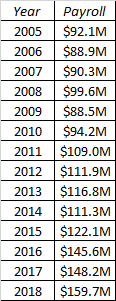
St. Louis spending was largely unchanged for the latter half of the past decade, sticking just south of $100 million each year from 2005-10 before finally crossing the threshold in 2011. Nevertheless, spending didn’t take a big leap for the Cardinals until the rival Cubs emerged as a force in 2015, perhaps fueling a payroll surge in 2016 that hasn’t subsided.
Despite this increased Major League spending, the Cardinals have never paid the luxury tax, nor have they been players for the most significant international free agents. Their laudable ability to develop talent internally has enabled them to eschew massive spending or risk taking in their pursuit of wins.
Future Liabilities
The Cardinals have something of an all-in approach for 2019. See below.

There are some big-money salaries on here, but most of the Cardinals’ commitments are in the form of mid-market deals for relatively short periods of time, many of which expire or feature options for the 2020 season.
Nevertheless, the team’s best hitter, the newly-acquired Paul Goldschmidt, and their best pitcher, the recently-acquired Miles Mikolas, both figure to get massive raises when they hit free agency in 11 months. If both players produce as stars, the club will either make a big play to keep one or both or they’ll enjoy the compensation draft picks that come along with having a pair of free agents decline qualifying offers and sign elsewhere.
The multi-year commitment to franchise icons Molina and Martinez look like good investments. Molina figures to spend his entire career in St. Louis. His 2017 extension all but ensured that. His top-level defense renders this deal a fine use of cash, albeit not the most efficient one. Martinez struggled with injuries in 2018, but he has consistently pitched as an ace, comes at bargain prices thanks to his 2017 extension, and is still, incredibly, just 27 years old.
Contrarily, the multi-year commitment to Fowler looks like a bad one. The former Cub enjoyed a strong year with his bat in 2017, but 2018 was an unmitigated disaster as Fowler failed to get on bad or hit the ball with authority. For a player with a lengthy injury history, he also missed substantial time with a foot injury. He is rapidly nearing pumpkin territory.
The Cardinals feature a trio of players with club options for the 2020 season that are auditioning for that payday. Carpenter is overwhelmingly likely to have his option exercised as the offensive force with defensive versatility fits on every team. Gyorko has recovered nicely after arriving in St. Louis after bottoming out post-extension in San Diego, but his option is a coin flip at best. Gregerson washed out in 2018 with shoulder issues, but a strong 2019 that shows a return to his 2009-16 success could change the script.
Cecil largely provided the desired results after arriving in 2017, but he flopped in 2018, struggling with homers and especially walks. At 32 and having lost two miles per hour on his pitches across the board, he could be dead weight for the club absent a surprising rebound.
One more franchise icon, Wainwright returns for a last hurrah in 2019 on an incentive-laden deal that contemplates a starting or relieving role. Regardless of who he has left in the tank, he won’t cost the club much.
Finally, there are a pair of extensions for athletic middle infielders. Wong came with a first-round pedigree, but his bat has never fully justified that history, save for a strong BABIP season in 2017. His glove and wheels, however, have rendered him a solid regular. DeJong, on the other hand, the 131st pick in the 2015 draft, positively exploded onto the scene in 2017 and showed that it was no fluke with a strong repeat performance in 2018, albeit one that was based more on his glove than his offensive prowess. Nevertheless, DeJong appears to be a league-average bat with legitimate defensive chops at shortstop.
Finally, we hit the dead money. Like so many clubs in the last decade, the Cardinals featured deferred money in big-money deals for Holliday and Pujols, owing the pair $2.6 million annually throughout the 2020s. That’s not backbreaking money, but it’s more than nothing.
As with the Giants before them, given this amount of guaranteed money, it is perhaps unsurprising that the Cardinals have very little in the way of arbitration eligible talent. Ozuna is the big fish with a seat at the arbitration table as he makes his final trip through the process in advance of free agency next winter. Here are their arbitration projections, noting that Chasen Shreve has already come to an agreement at $900,000, a bit below that projected by MLBTR and Matt Swartz:
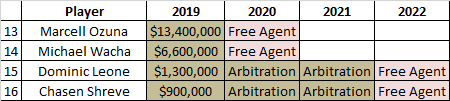
In addition to Ozuna, Wacha figures to play a key role despite having lost much of 2018 to a lingering oblique injury.
What Does Team Leadership Have to Say?
The Cardinals are talking like an organization ready to push in a whole bunch of chips on the 2019 table, with Mozeliak stating at the Winter Meetings that “simply, we realize the importance of 2019.”
DeWitt turned things up a notch last month, explaining that “there is value in star players” and adding that “we’re aggressive and we’ve got resources to deploy if the right situation emerges.” Incredibly, DeWitt even specifically addressed spending on free agents when commenting about his desire to build a team that perennially wins 90 games, offering up that “frankly, we felt that incremental benefit (of free agents) could get us those last few wins.”
This is not an organization that seems content to watch the Cubs and Brewers rule the National League Central for the next few years.
Are the Cardinals a Player for Bryce Harper or Manny Machado?
No matter what you hear elsewhere, the answer here is simple: absolutely yes.
Although the Cardinals haven’t signed a player to a contract larger than Matt Holliday‘s seven-year, $120 million pact, they made competitive offers for Jason Heyward and David Price approaching $200 million each while agreeing to take on over $250 million for Giancarlo Stanton before he ended up in the Bronx last winter. The team hasn’t shied away from monster offers.
As for their roster, even after shipping out Luke Weaver in the Goldschmidt trade, St. Louis is dripping with cheap, controllable pitching behind Mikolas, Wainwright, and Wacha in the form of Martinez, Jack Flaherty, super-prospect Alex Reyes (despite his injuries), and Dakota Hudson, and that’s before factoring in John Gant‘s surprising 2018 season. They don’t really need starting pitching help.
The team is loaded up with right-handed bats featuring good-to-great power in Goldschmidt, Ozuna, DeJong, Molina, and defensively-homeless Jose Martinez. Harper would provide an awfully attractive complement in the middle of that order. I’m not sure if Machado fits as smoothly, but Harper sure does.
Watch out for St. Louis on Harper. They make a ton of sense.
What Will the 2019 Payroll Be?
The Cardinals will almost certainly avoid reaching taxpayer status in 2019. They’ve never shown a penchant to spend to that degree. However, I wouldn’t be surprised if spending received another boost based on the fact that the team has missed the playoffs for three straight years and given the amount of resources poured into the Goldschmidt and Ozuna acquisitions.
As currently constructed, St. Louis has a payroll of just $148.7 million, $149.3 million for luxury tax purposes. Given historical trends and the pressure to win now, I expect to see a notable one-year jump in spending before the team regroups for 2020 with Mikolas, Ozuna, and Goldschmidt all hitting free agency at the same time.
If spending spikes to $180 million, the team would have $31.3 million of space, nearly enough to sign Harper without any other roster maneuvering. I don’t think that things will get quite that lofty, but even a bit below that figure, there’s enough space for the team to make a relatively simple move — like trading Gyorko for salary relief with the third baseman displaced by Carpenter’s move back across the diamond — to clear space for Harper.
Projected 2019 Payroll: $175 million
Projected 2019 Payroll Space: $26.3 million
spending but not getting a ring in return.
Yeah that’s how it works for 29 teams every year.
Yankees won’t be getting one this year.
Yup, I’d say $175M is spot on.
I figure they’ll go into OD around $170M, with the ability to make a trade at the deadline if they find a new need.
Figure they’ll still sign one of the relievers on the market (like a Britton) and probably make some small trades and sign a backup catcher.
Lol! Got em!^
just enough space for a superstar signing. gee, i wonder if any superstars are available?
Maybe, but only if you want the bullpen to remain a huge weakness.
you can free plenty of salary by moving the moveable pieces, and still add brittons and will smiths annual salary while staying under threshhold.
First, I hope the Cards don’t chase Harper. Not at what Bor-äss presumably wants.
Second, I think they look pitching first. I’m sure they’d love Miller if the price is right, and I wouldn’t be surprised if they look for a second reliever while they’re at it. With Gyorko dead weight and Jose Martinez a DH apprentice, a trade to an AL team for either a starter (looking at you, Tribe) or a reliever is certainly possible.
To next year?
I think they’ll do all they can to resign Goldy.
Ozuna … if he bounces back (he won’t, totally, 2017 was a career year IMO), they’ll look at 4-5 year deal?
Wacha, given his ongoing shoulder-related issues, any contract the Cards offer should have a certain amount of incentives structure.
I’ve heard on radio stations that it’s not the money for Harper but the years…which…on the surface I understand 10 yr contracts are iffy at best, but he’s 26, 10 years assuming he doesn’t opt out he will be 35-36.
Holliday was 29 when they offered him 7 years. They said they want to resign Goldschmidt but…he’s gonna be 32 once the potential extension kicks in…so I’m honestly asking not trying to be snarky or ungrateful; how does that make sense? It’s just weird logic to me I guess.
You would be right if 10 years was the number. I don’t think they’d be too unhappy handing a 26 year old 10. But Handing him 13? That is too many declining years.
Harper and Goldy are two vastly different players. With Goldschmidt, you see his trajectory already. He is a player that, by all appearances, will age gracefully. Consistent average/OBP, homers that come as a result of good contact (not hunting for them), steals based on smarts, and GG defense. Harper might be that as well. But he might not. The volatile stats, violent swing, home run approach (looking to hit them), and less than stellar defense tell you that if he isn’t hitting home runs, you have a problem, because he will not help your team. And giving him a contract that ties your franchise to him until he’s 39? Waaaaaay too much can happen there.
Yeah I suppose that’s true. A lot of people including myself at times have just assumed it was 10 years. But I’ll bet you’re right Boras is asking in the range of a 12-14 year contract.
It’s probably one of the reasons he’s still unsigned.
Whether or not him being unsigned is a Boras thing or not, his field is definitely smaller because of it.
Heck, I keep thinking that they should sign him, forgetting the fact that it could be 14 years. No way I want any part of that.
The word from the local media is that the Cardinals only want to offer 5 to 7 years to Harper
Which is insane
I’m also in St. Louis. I’ve heard they weren’t interested in 10 or more. I would imagine several other teams might jump in for five to seven years.
Some have wondered what a two- or three-year contract would look like but I assume he’s looking for the longest contract with two or three opt-outs.
I still think a front loaded 13 year contract would work out.
6 years @ $45 mil a year then 2 years at 40 a 30 a 20 (10 years 400) then have a series of 10 mil per year for 3 more. (13 yrs 430)
Have some opt outs… one after the last 45 mil, then every year after the 30 mil.
That seems very high. The Cardinals should stay away from anything over 9 years/$350. As much as I want to see them spend their money (and breath a little life to the organization), a commitment like that would be bad for the franchise in the long run.
With my offer, he’d have an opt out at 32. He might try the market again because he would be in line for 6 years $120 mil…. He could possibly get more if he walked. Especially if he walked after the 30 mil year. He’d be 34 and be at 4 year $50 mil.
When did they say they want to resign Goldschmidt? Honestly, they’d be better off letting him walk and trying to resign the younger Ozuna instead.
I think the GM said it during the press conference. He didn’t make it sound like they were gonna jump on it right away but they had it in their mind.
goldy is way more proven and consistent. we still aren’t sure what the “real” ozuna looks like. I like him and i hope they extend both, but I disagree ozuna is the better pick. especially considering the glut of OF and lack of legit 1B we have.
how about we wait and see what Goldy & Ozuna do before making long term contract offers? just how fortunate the Redbirds are they DIDN’T sign Pujols or Heyward?
10’s fine, but Boras may be pushing it too far to get a “lifetime” contract for Harper that goes even further in order to get that gawdy 400 million number to make sense for some team.
He’ll also definitely get a pre-30 opt-out of some quality, whether it’s after 3 or 4 years or whatever so he can re-sign for that career ending contract after the market has bumped up.
I think they can sign Harper for 10 years at 35-36/year but not much more than that. Goldschmidt might have to leave if he’s expecting to get a 6-8 year deal at 32 and they’re probably banking on that happening which is why they didn’t stick their feet in on a pre-trade extension. (an extension would probably have ruled out Harper since this team is probably not going to have a 200m payroll, but you never know!)
Cards have had a strong minor league development over the years where they have found hidden gems. Kudos to the coaches at the lower levels for preparing the players.
Team is in trouble after 2019. If they miss the playoffs in 2019, the drought might reach 7 years, as they could go until 2022 or beyond with no success..
They have a ton of young pitching and almost no cash on the books after next year.
Are you kidding? You’ll be paying 50 mil to players who wont be productive. That’s a lot of wasted money. 5 year rebuild needed. Unless your trying to go into the luxury tax for maybe a WC berth.
With their wealth of talented young pitching and younger position stars like DeJong, Wong, and Bader, there’s no need for a rebuild. They also have guys like O’Neill, Gorman, and Knitzner who can possibly replace some of the departed players, and it’s not like they’ll be sitting out of the free agent market over the next couple years.
Sure, $50M in wasted funds (if Fowler, Gregerson, and/or Cecil don’t bounce back) may seem like a lot, but that’s only combined over the next 3 seasons. It’s manageable for a mid market team like the Cardinals when taken one season at a time.
It’s well established that you don’t know anything and are counting the chickens on the Pads 20 year rebuild before any have even poked a beak through their eggs.
There’s juicey popping out of the woodwork with his baseball “facts!” Missed ya bud
Fact: luxury tax is at 200 mil
My opinion: in 2020, the Cardinals will spend 50 mil dollars on unproductive players.
If you sign any significant free agents over the next 2 years (which you would need to in order to compete with Cubs, Brewers, and now the Reds) you’ll be over the luxury tax threshold.
That means 25% of your payroll is dead weight, only delusional Cardinals fans think they are a contender.
I remember this same narrative with Shelby Miller, Marco Gonzales, Luke Weaver, Joe Kelly, Randal Grichuk, Stephen Piscotty, Kozma, Wallace and on and on.
That’s not how the luxury tax works. It’s not $50 mil in one year.
If 50 mil of close to 200 mil annual salary is unproductive…200 mil puts you over the threshold. Im betting fowler, gyroko, yadi, all those relivers, wong will all be dead weight, basically replacement level or below which some already are, in 2020. Those salaries adds up to…
And that is how it works,
If the cards did go out and sign two mega players to 10/$350M deals, their expected luxury tax payroll would only be $214M
They could simply trade Gregerson and Cecil or Jedd and pay for them to play elsewhere and avoid the penalty.
But, that’s not their issue. Their issue is that they couldn’t absorb that sort of payroll.
Also, it’s laughable to think they need to overpay to get a free agent in order to hang with the Cubs, much less the Reds or the Brewers.
The cards are in a great position, if they can fix their bullpen, they’ll take the division with their rotation and lineup.
You are operating under the assumption that the Cardinals wouldn’t make any additional moves to shed payroll to complement a big signing. Which is just a ridiculous assumption to make. The Cardinals can do things like that just like everybody else can.
Why eat $ when the team isnt good? And not gonna compete? I dont understand? Cards fans actually think this team is a contender? You’re already paying matt and Albert til 2029, do you want more dead $?
Mane you are more down on this team than any other person on these boards. Honestly the NL central is a bit of a toss up and the only division in baseball without a true tanking team. These teams beat up on each other all year long and have been tough on the rest of the league through the last couple of seasons. The cardinals mistake last year was not addressing the bullpen or young rotation at the deadline and trying to do addition by subtraction of a productive player because he was vocal and told it how it is. For me NL central baseball has been pretty solid for the last forever, and the last time it wasn’t the Cards won the world series with an 83 win team.
He’s refusing to color his thoughts with even a little bit of reality. The Cardinals won 88 games last year with a dumpster fire bullpen and no superstar hitter. They have already added Goldschmidt and they have stated that they will be revamping the bullpen and they are supposed to get worse? Sure man.
They are a contender year after year. Decade after decade. Never in there history have they ever tanked on purpose like that hick town up north does. So don’t worry your head about what if’s in this following year.
Hick town? Your insult made me chuckle.
Did this clown just refer to Chicago as a “hick town”?!? Seriously? A STL fan?! Hahahahaha, the same PO dunk town that can’t afford to keep a NFL team? Have they ever even had a NBA team? Do their family trees even fork? Hahaha, it’s no wonder everyone constantly makes fun of themed, actually, I don’t think he can possibly be this ignorant… even for a Cards fan. It has to be a troll pretending to be a Cards fan to make them look bad…. look worse I should say.
St. Louis Hawks — 1x NBA champion, lost in the finals 3 times. Yes, STL has lost two NFL franchises…one was taken from Chicago.
You let a troll get to you lol.
Yeah, well…
Sorry, my reply was to Bryzzo, not you triteon.
Do you really think ANY St. Louis fans take you seriously? Gosh, you guys win one, and fall from stardom within a mere two seasons. Poor Chicago fans – esp. Cubbies fans, So much anger, and to compare either of your MLB teams to us, the second biggest winners in Major League history… really? pretty sad
The Cubs are absolutely on a downward trend. Lose Maddon, and maybe you can hope for a spot in third or fourth place
@ themed:
Sorry, didn’t realize I was talking to a sheep.
in that case, baaa baa baaa ba ba ba.
Is that you OJ Simpson? Juice? You sound just like him. But most cub fans do when thinking of the Cards superiority over the cubs in the past 40 years or so.
Good one, themed. Uhhhh Cubs 3 WS titles. Cardinals 11 WS titles. Sizzzzzzzles & burrrrrns!
They haven’t always contended “decade after decade,” but it is true that they’ve never needed to tank. They’ve only finished in last place in their division or league (before divisional play) ONCE (1990) since they invented the farm system back in the early ’20s.
How many times have the cubs finished dead last in that same amount of time?
12 times since 1969
Don’t make fun of their 100 year rebuild.
I always laugh at Cardinals fan talking about their superior system and yet they need a competitive balance pick.
Like how Cashman is a genius that needs a $250 million payroll?
Dont forget the hacker…
The competitive pick has nothing to do with a “superior system,” it has to do with revenue and/or market size
m.mlb.com/glossary/transactions/competitive-balanc…
At least the Cardinals, dont follow the trend that the Yanks started umpteen years ago. Now the Cubs do exactly the same thing, buy their way to the top. The Cardinals don’t need to do that. Our club still plays by the rules that keeps baseball great, AAA, Boston and Dodgers join the Cubs for the most money “blown” in busting the MLB cap over past two years. Sad… ruining baseball
Cards have the best firewall in baseball (“BFIB”)
These past 3 seasons and this 5 rebuild that needs to happen, proves you wrong.
That will be 7-8 seasons with no playoffs, book it. Hope your still the BFIB, 3 million strong or whatever
As much as Boras would like to push in the media that many teams are in on Harper, the more likely scenario is that he doesn’t have any teams interested at the contract they are trying to get. If he wants to be the highest paid player EVER I would make sure yearly targets are written into the contract that have to be met to achieve that, but that won’t happen. Example, if OPS is less than 900 then AAV drops $5 mill that year. You could get creative.
I don’t think the last part will happen, and quite frankly, it probably shouldn’t. That’s unneeded pressure.
BUT, what you say about the teams in is, at least partially, correct. I don’t think the field is nearly as big as everyone thought it would be. Of course, all you need are two teams and that’s all it takes for a bidding war. And generally, the Cards simply will not get pulled into that. Which takes a lot of prudence and a LOT of patience and the ability to let it go.
Do you need two real teams? It seems like Mystery Team is always going to ratchet up the bidding.
Personally, I think Machado is worth more money than Harper, anyway. He’s been a lot more consistent in his career and plays better defense at more premium positions.
Meanwhile, Harper has only had one season (his MVP year in 2015) when he’s managed to live up to his potential, yet he and Boras somehow think he’s worth so much as to expect that kind of performance on at least a semi-regular basis.
I said this after the season and I’ll say it again. Fowler’s foot was the MVP of the Cardinals season. Shildt didn’t stop the skid. It stopped when Fowler went down.
Great, but is there a team MVP for a team that didn’t even make the playoffs? Essentially the team got “hot” but that ridiculous salsa garbage basically landed them in the middle of the NL pack. The worst place to be, no playoffs again and basically just netting poor draft position.
Come June, you’ll wish the Cards just continued to spiral so they could have a shot an impact player in the draft.
Oh look…the Cubs fan already forgot this exact same Cardinals team missed the playoffs by 2 games and just added Goldschmidt without giving up anything of value
No one wishes they continued to spiral dude, who tanks in the MLB for a prospect that takes on average 2-4 years to reach The Show…what are you even talking about?
You gotta admit though. The salsa thing was pretty ridiculous
True that. Go for caviar next time lol
How is that dynasty shaping up?
Salsa was stupid just like flying that stupid W for a cubs win is.
I think in the end the Cardinals will be there for Harper. I think there equal interest. I think Harper would like to play in St Louis if a deal can be made. But make no mistake there won’t be any discount the cardinals will have to pony up the money.
They aren’t even talking to Harper. They didn’t meet him in Vegas and the local media (which the Cardinals essentially control) is in damage control mode, lecturing the fans that not signing Harper is a good thing.
No, the Cardinals are NOT in on Harper unless they can trade Fowler first, which is very unlikely. As you said, it would take all (if not more) of their remaining budget to sign Harper, which would leave them unable to sign any free agent relievers, which is clearly their biggest need right now.
Machado is a flat out NO, since they have nowhere for him to play.
DeJong is more than just a league average bat. He was on his way to being an All-Star until a wrist injury cost him significant time and likely affected his offense for the rest of the season once he did return.
He’s just a kid. He has alot to learn, but also to show us in the future. Believe in him, and he’ll catch fire again.
I like what Gyorko brings to this team but he could be traded along with Martinez to bring in bullpen help. Sign Harper to hit 3rd between Goldy and Ozuna. It makes too much sense to happen.
I do know, indirectly, that the Cardinals organization is one of Harpers top 3 teams to play for.
“Have they ever even had a NBA team?”
Somewhere Bob Pettit is shaking his head sadly.
Stop with the homer Chicago vs Stl arguments. Chicago is a far superior city. Poll everyone not from either city and ask where the preferred destination would be baseball aside and it’s Chicago easy. Cardinals have a far superior baseball organization. The Cubs are historically dreadful while the Cardinals trail only the Yankees in titles.
Truth.
Yup.
Having lived in both cities, this is exactly right.
The city of Chicago destroys the city of stl.
The only thing St. Louis has over Chicago is baseball. But that’s it.
It’s almost as if Chicago is a bigger city…
I personally prefer the convenience of St Louis. Traffic is never that terrible unless there’s an accident and nothing is ever more than 15-20 minutes away.
The surrounding areas also offer better caving and floating experiences.
Yes sir.
My family, (wife, 7 year old, and 3 year old) much prefer to vacation in St. Louis and we’ve done both.
Cards are certainly interested in Harper and would probably offer $35MM for 8 eight years but that is pretty close to the $30MM offer from the Nats for 10 years so I do not see the Cards being a realistic landing spot for Harper. Someone is going to offer $30MM for 12 years or $36MM for 10 years and win the auction.
Cards will focus on a top shelf lefty reliever and perhaps a move at the trade deadline if they need an extra push and will save their salary flexibility for next year to try and resign Mikolas, Goldschmidt and Ozuna assuming that all perform well this season.
Congrats Rob! Welcome aboard!! Great article! Looking for more great stuff to come!!
Cardinals need LH bat; why not Michael Brantley?
Because he’s another Dexter Fowler and they have three right fielders as is
We deployed Nelly successfully.
If everything goes according to plan, we’ll dump Gyorko and Cecil, then Harper will come here for 1 year/$40 million to play for a legitimate contender, hitting between two 2018 MVP candidates.
The FO went to the Fowler residence to convince him to either accept a trade or take a back seat to Harper in ’19.
Purely speculation, of course. I’m sure Dexter’s wife could just be known for her lasagna.
My guess is that the cards would only be interested in Harper at 6-8 years, but wouldn’t have a problem with a high AAV (like 35-37M). But that wouldn’t get him, one of the Phillies, Yankees, Sox, or Dodgers will blink and give him too many years, even if the AAV is way lower. I’m thinking 12-14 year deal with opt-outs.
But, even if he’d fall into that area price wise for the Cards, they wouldn’t do it unless they could work out another deal to unload some salary, and a position player.
Ideally, it would be Fowler but he has no trade value and the same agent as Goldie and a NTC (I mention the agent, because I think they want to do right by Fowler).
And Fowler has a lot of rebound value, and Signing Harper would mean likely no Ozuna long term. So having O’Neill and Fowler around for 2020 simply makes sense.
Jedd is the only other expendable position player that makes any money, and that’s only $8M
They could trade Jose for a reliever of course, but the bullpen is the issue, and they have the resources to make 1-3 upgrades to it, depending how crazy they want to go.
I don’t think Harper is realistic or likely, and I don’t think he solves a need.
If they had never signed Fowler, then I think they’d be all over him, for one of those mega deals too. Because not only would they have the money to get him, but also the money and talent to address the bullpen.
Cardinals will offer Harper 5/125 and then say they made a competitive offer. LOL
Since Luhnow left, how many WS have the Cards won with all these “top notch prospects?”
While Luhnow was here, what “top notch prospects” did he bring in?
Luhnow had Pujols to carry any supporting cast on the field. He isn’t responsible for Pujols btw.
Luhnow joined the front office of the St. Louis Cardinals in 2003. Cardinals owner William DeWitt Jr. had noticed what the Oakland A’s had done with their Moneyball tactics and was looking to run his team in a more analytical, data-driven manner when he first hired Luhnow as vice president in 2003. Luhnow knew DeWitt’s son-in-law from working at McKinsey & Company and from there, Luhnow met DeWitt and landed the job. Luhnow’s hiring initially raised eyebrows, since he had no previous experience in baseball and had not played the sport since high school. He was derided with nicknames like “the accountant” and “Harry Potter.”
Luhnow began as the Cardinals’ vice president of baseball development, as he established a baseball academy in the Dominican Republic and extended the Cardinals’ scouting in Venezuela.The Cardinals promoted him in 2005 to the role of vice president of player procurement, which made him the director of amateur, international and domestic scouting. He was named vice president of scouting and player development in 2006.
During his time with the Cardinals, he developed a reputation for scouting and player development, and he is credited with having a key role in the team’s successes in the minor leagues. The Cardinals won five minor league championships under his watch, and had the best system-wide minor league record in 2010. From 2005 to 2007, the first three Cardinals drafts overseen by Luhnow produced 24 future major leaguers, the most of any team during that period. Several players who made important contributions to the Cardinals’ victory in the 2011 World Series, including Jaime Garcia, Allen Craig, Jon Jay and Lance Lynn, were drafted during Luhnow’s tenure.
What else would you like to know?
If Jamie Garcia, Allen Craig, and Jon Jay are the highlight of nearly a decade of work, you deserve to be fired, not a better job.
I’d like to know if you pulled all of that off Wikipedia or Luhnow’s book “I’m a Genius.” Thanks for asking.
I guess you’re not impressed by the “Most Major Leguers produced” in that span over any other team? How about Carpenter in 2009? Or Ottavino, who is now a top notch FA reliever? There’s more, but I’m sure you will just overlook it all, Not to mention Luhnow was so well regarded that Mo had to assign a lackey on him to spy and got caught. So once again, what have the Cardinals won and produced since Luhnow left? A fired manager and 3 straight post season misses?
You both bring up valid points. I would be love to see a list of VPs/GMS/scouts/desk jockeys and who they’re directly responsible for drafting. Obviously there are a lot of variables (player development systems/ coaches/ ballparks/ etc) that play into an individual’s success at the highest level- but it would be interesting to see which execs around baseball are best at identifying talent. Most major leaguers produced is a logical place to start. Luhnow is undeniably good at his job- as a Cardinals fan, I was very sad to see him and Sid go. Why the DeWitts didn’t bump Mo up to VP to keep Luhnow here as GM is beyond me. After a year of Girsch, I’m not really sure what he’s bringing to the table… granted, as Coordinator of Amateur Scouting from 06-07, he would have worked very closely with Lunhow to pick all those future major leaguers… maybe he’s really the genuis behind it all. One thing is for sure- the FO has done a bad job marketing Girsch to the fans (which is too bad because I’ve grown tired of Mo’s pretentious personality and bow ties).
Girsch is Pinocchio. Mozeliak is Gepetto. Nothing will improve here as long as Mozeliak is in charge. His arrogant, condescending, pompous persona has run it’s course. Girsch is strictly a puppet who has no clue how to talk or present himself. They are better off just hiding him in a room to play on a computer.
Most major leaguers produced?
It’s very easy to produce major leaguers when you’re setting the mark for most injuries over the span of a decade.
Not saying he’s an idiot. I just don’t like how he’s a genius for finding all these diamonds in the rough late in the draft when his early rounds are largely failures.
how about we wait and see what Goldy & Ozuna do before making long term contract offers? just how fortunate the Redbirds are they DIDN’T sign Pujols or Heyward?
IMHO, the Birds need to get stronger defensively up the middle. DeJong is not close to being Ozzie. Wang isn’t any better at second. Herzog made the Cards of the 80’s champs with bold moves to make the team better defensively. He traded Ted Simmnons and brought on Darrel Porter. He got rid of Garry Templeton and got Ozzie. He got Willie McGee from the yanks to ;play center and inherited Tommy Herr at second.
Better defense up the middle??
According to fangraphs:
Wong has the highest defensive rating at 2B in MLB. The eye test checks out.
DeJong is the best defensive SS in the NL. Eye test questionable, but he’s very solid nonetheless.
Bader among the best defensive CF in baseball. Eye test more than checks out.
DeJong is no Ozzie, true. But who is? Maybe Simmons. DeJong hits to all fields with power and has more homeruns in 2 seasons than Ozzie had in 18. I’ll take it.