
With the Winter Meetings set to kick off next weekend, we’re moving to the tenth installment of this series. Here are links to the previous team payroll projections:
Philadelphia Phillies
Los Angeles Dodgers
Los Angeles Angels
Atlanta Braves
New York Yankees
Chicago White Sox
Boston Red Sox
Minnesota Twins
Milwaukee Brewers
If you have questions about financial information made available to the public and the assumptions used in this series, please refer to the Phillies piece linked above.
Today, we look into a club whose on-the-fly re-stocking in 2018 largely backfired, keeping them out of the playoffs for the second consecutive season for the first time since 2009: the San Francisco Giants.
Team Leadership
Unlike many of the teams that we have examined in this series, the Giants’ ownership structure is highly diversified and somewhat secretive. 2008 began with Peter Magowan’s 15th year as managing general partner of the club. Magowan began the year in turmoil in the aftermath of the Mitchell Report and ended the year having transitioned his management role to Bill Neukom. Neukom ran the show only until 2011 at which time Charles B. Johnson became the plurality member in the LLC that owns the ball club. Johnson reportedly owns approximately 25 percent of the team as part of a group of approximately 29 co-owners.
Despite the complicated ownership structure, the front office enjoyed tremendous continuity. Brian Sabean ascended to the role of general manager in 1997 and held that job through the 2014 season before climbing to Executive Vice President of Baseball Operations, with Bobby Evans handling day-to-day operations starting in 2015. No more. Sabean was reassigned out of Baseball Operations following the 2018 season, at which time Evans was fired.
The executive tasked with re-imagining the San Francisco front office? Former Dodgers general manager Farhan Zaidi. Zaidi spent a decade in the Bay Area with Oakland before spending the last four years in Los Angeles. As the new President of Baseball Operations, Zaidi will oversee the first major transition in San Francisco’s baseball management in two decades.
Historical Payrolls
Before hitting the numbers, please recall that we use data from Cot’s Baseball Contracts, we’ll use average annual value (“AAV”) on historical deals but actual cash for 2019 and beyond, and deferrals will be reflected where appropriate. And, of course, the value of examining historical payrolls is twofold: they show us either what type of payroll a team’s market can support or how significantly a given ownership group is willing to spend. In the most useful cases, they show us both. We’ll focus on a 15-year span for the Giants, covering 2005-18 for historical data as a means to understanding year 15: 2019. For the Giants, this time frame covers a period of rebuilding that ultimately fueled three World Series winners. We’ll also use Opening Day payrolls as those better approximate expected spending by ownership.
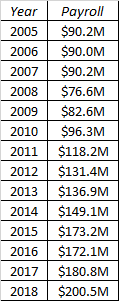
Those payrolls were remarkably stagnant through 2010 before taking a leap in 2011 that became an annual tradition throughout much of the years that followed.
During this period of increased spending, the Giants did reach luxury taxpayer status for the first time in 2015, remaining there for each of the next two seasons before resetting their status in 2018 by falling under the threshold. The team paid just $8.8 million in aggregate luxury tax payments over those three seasons, so the tax hasn’t substantially impacted team spending over our time frame.
While Major League spending has increased dramatically over the time period above, the Giants haven’t allocated substantial resources to international amateur bonuses. It seems as though the cash increases were focused nearly exclusively on the Major League roster that made regular trips to late October throughout this decade.
Future Liabilities
Get ready for lots of big numbers for multiple years.
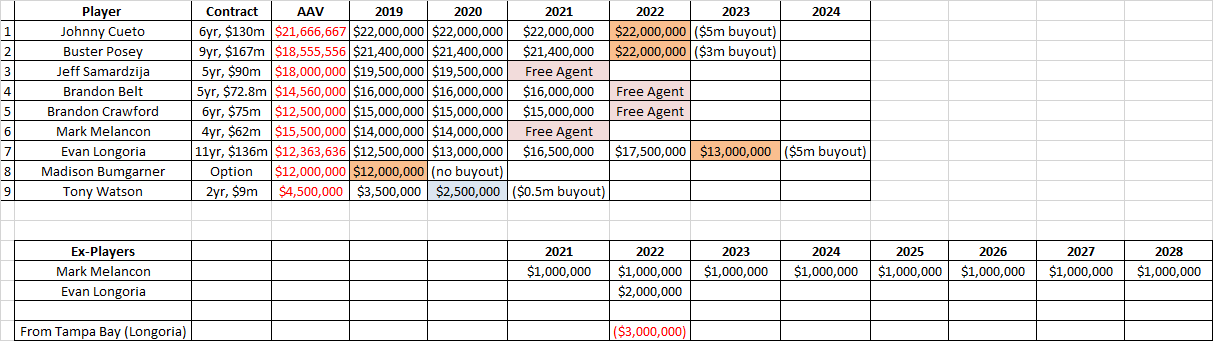
The big-money, long-term commitments are staggering.
Cueto, owed $71 million over the next three years presuming that the Giants buy out his 2022 option, was a star during his debut season with San Francisco in 2016, producing 5.5 WAR in leading the team’s rotation as they made their most recent playoff trip. Cueto’s 2017 season was marred by numerous injuries, including the dreaded forearm strain that served as a precursor to a nightmarish 2018 spent largely on the disabled list before he underwent Tommy John surgery last August. As a result, the Giants likely expect little to nothing from him again in 2019.
Like Cueto, Posey underwent a significant operation in August. Unlike Cueto, Posey has produced at a consistently elite level throughout the course of his contract, until this year’s career-worst 106 wRC+. While Posey’s hip operation figures to hamper his efforts to prepare for the season, he should be ready around Opening Day.
Samardzija was solid during his first year in San Francisco before a strong second year in 2017. Unfortunately, the remarkably durable righty finally succumbed to the injury bug, losing most of 2018 to a shoulder injury that lingered into the start of the offseason. With only two years left on his deal, it’s possible that the Giants have received as much value as they’ll be getting from that contract.
The next two players are both longtime Giants who played key roles on championship teams but have settled into roles as solid regulars instead of impact stars. Both Belt and Crawford are young and talented enough to rebound in 2019, but neither contract represents excellent value, especially Belt’s as the first base market has largely collapsed since he signed his extension.
The next two contracts look bad. Really bad. Melancon arrived in San Francisco to shore up the back of a wobbly bullpen. However, bouts with forearm injuries have limited his chance to make an impact. When he has pitched, he’s been solid but certainly nothing close to what the Giants expected from him given his contract. Longoria appears headed down a startlingly similar path, struggling mightily in his first season since arriving from Tampa Bay via trade. At 33, Longoria faces long odds to reattain star status, but the Giants would likely be happy if he returned to being a solid regular for at least a few more years.
We’ll skip to Watson for a moment. The veteran lefty structured his contract in such a way that the Giants stayed just under the luxury tax threshold, and he rewarded the team by delivering the finest season of his career in 2018, despite an across-the-board drop in velocity.
Now for the skipped contract: Bumgarner. The longtime ace and World Series hero finds himself at a crossroads that would have been inconceivable two years ago. Bumgarner made at least 31 starts each year from 2010-16, but an April 2017 shoulder injury suffered in a dirt bike accident, perhaps combined with years of significant usage, has changed his trajectory going forward. The Giants are willing to listen on their ace as he heads toward free agency next year.
In the aggregate, San Francisco is as committed to their current roster as any team in the league. Overhauling the roster would require a bevy of big-salary moves from Zaidi.
Given this amount of guaranteed money, it is perhaps unsurprising that the Giants have very little in the way of arbitration-eligible talent. After they said goodbye to Hunter Strickland and Gorkys Hernandez, key reliever Will Smith is, incredibly, the only arbitration-eligible Giant who hasn’t already agreed to terms with the club. Here are their arbitration projections, noting that both Sam Dyson and Joe Panik have already come in at salaries south of those projected by MLBTR and Matt Swartz:

While Smith missed all of 2017, he returned in 2018 and filled the role of bullpen ace that Giants leadership hoped to see Melancon fill.
What Does Team Leadership Have to Say?
Very little regarding the specifics of the 2019 payroll. Given their recent payroll push into the baseball stratosphere of spending, the Giants are largely expected to maintain a significant payroll next year. While Zaidi has hinted at something of a mini-rebuild — perhaps including a Bumgarner trade — there’s no indication from management or ownership that payroll will plummet.
Kerry Crowley of The Mercury News expects payroll to stay in line with that of current years, coming in shy of the luxury tax line but among the top figures in the league.
Are the Giants a Player for Bryce Harper or Manny Machado?
Probably. It’s a bit tougher to see a Machado fit given that the Giants would likely have a whale of a time trying to move Crawford or Longoria right now. But Harper makes plenty of sense for a team in need of youth, power, and an influx of talent. He certainly checks all three boxes. As a kid from Nevada, it’s likely that the Giants at least get a chance to pitch the young slugger on the benefit of playing on the West Coast.
What Will the 2019 Payroll Be?
The Giants are much tougher to peg than most other teams given the relative silence of their front office and the equally likely possibilities that they rebuild on the fly or go for a return to glory in 2019.
Entering the next phase of the offseason, the Giants hold a payroll of $156.0 million, $162.8 million for luxury tax purposes.
If the Giants can get Harper to commit to the team, I expect that his commitment will be accompanied by ownership’s commitment to enter taxpayer territory for the next two or three years in order to field a viable winner. It’s going to take additional cash to get there.
If Harper doesn’t come to town, expect to see the team remain under the tax line, albeit arriving close to that figure. With the tax threshold at $206 million and somewhere north of $13 million counting for player benefits, the Giants figure to want that tax payroll to come in around $190 million to leave them with a bit of wiggle room.
Projected 2019 Payroll: $185 million cash ($204 million for luxury tax)
Projected 2019 Payroll Space: $29 million
WRONG. It’s absurd to say they will probably be a player for Harper or Machado. You just listed ample $$$ reason they won’t be. And it’s not Zaidi’s style. Not happening.
Harper is a decision that will come from ownership, not Zaidi. Plain and simple.
Based on their dogged pursuit of Stanton last winter, it’s pretty evident the ownership wants a young superstar.
Does Harper sign with San Francisco? I don’t know. But if he goes elsewhere, it won’t be because the Giants didn’t try.
I have to think before Zaidi signed on they had this discussion. I highly doubt on day one he would sit back while the ownership decides about a $300+ million contract.
I predict Zaidi came in to do to the Giants what Zaidi helped do to the Dodgers and the A’s. Grab decent players to contribute while building an epic farm system based on analytical scouting. Will they meet with Harper? Absolutely. However, it’s quite apparent he will go to the highest bidder and I don’t think Zaidi will want to pay that since it will hinder his progress over the next five years.
Only way Harper or Machado would sign if the Giants out bid everyone by a big amount. That would mean over paying. There is no need for Machado since his position is filled. With new leadership Giants will go for a good veteran free agent but doesn’t break the bank.
Just so everyone knows, Mike Krukow(Giants Broadcaster) who is a major insider, stated that they will be in on Harper, and the only way they could possibly entice Harper to come to the Bay is if they offer some of the land that is being developed next to the park that the Giants own. That would be an investment for the rest of his life, just to offset the taxes that California collects. Is that enough? No one knows, as I’ve said in the past, and those who understand free agency, the player goes to the highest bidder. I personally don’t think Harper is worth anything more then the 300 mill for 10 he was offered.
I sure hope the Giants are all in on Harper. Given the transition to Zaidi, that seem implausible to me; but, I would love to see the Giants do what it takes to get him. Between what is already on the books and what would be required to land Harper. the Giants would continue to chase their tail for another 6-8 years.
“Only way Harper…would sign if the Giants out bid everyone by a big amount.”
Pure conjecture and probably wrong. Harper will sign where he gets the best contract, period. To say that the Giants need to go way beyond what other teams offer is a huge assumption. SF has a lot to offer, and Harper knows the Giants will try as hard as any team. which includes spending big, to field a winning team. Harper is young enough that he doesn’t need to win right away. If Harper looks big picture, there’s no need for the Giants to go far beyond what anyone else is offering.
That is not what Kruk said. Unless if you can find an actual quote, he echoed what Kuiper said on KNBR. Which was, if SF wanted to sign Harper, they could try to entice with some of the property currently being developed down 3rd st. It was 2 announcers speculating what SF could offer to offset the tax jump Harper would see in SF, Cali. It wasnt any inside word.
But there is, the taxes in California would put a big dent in actual earnings so they would have to offer incentives.
Isn’t that what I just said? I said the exact same thing you did. Read again. And what he said was broadcasted with both of them. Not knbr.
If the owners really, really want Harper and Zaidi said, “I’m not signing Bryce Harper, no matter what”, Farhan Zaidi would not have the job he has now.
Except California, NY ( especially NY, NY) and Massachusetts all have high taxes- so if players were that worried abut taxes free agents wouldn’t go t0 the Yankees, Mets, Red Sox, Dodgers, Giants, Angels, Warriors, lakers, Clippers, Celtics, Nets, Knicks, Rangers, etc etc ……
I think the tax angle is overblown
Harper – no
You are not good at math. In 3 years Giants will be under 115 million and right now are still fine at 150 million. Dodgers are at almost 200 million so it seems rather ironic for you to be talking about money problems…
Zaidi is running the show.ownership gets it now that one guy isnt going to change things.
Let me tell you this. You work in a company: you have a boss. Does your boss have the final say on a crucial, company-changing decision, or you, a lower ranked individual.
There’s a reason he’s the DIR OF OPERATIONS.. Now sure, if he wanted to get Harper, ownership would have to sign off on it. But it’s his call. He was hired to run the show.
Baer has said it’s Zaidii’s call but he doesn’t see the wisdom in spending so much on one guy now.
I have a really strong suspicion that the topic of Bryce Harper came up in the interview for Zaidi’s role. Along with that, I suspect the owners approved a President of Baseball Operations whose idea matched many of theirs.
I imagine Baer and the other owners approved Zaidi because he agrees with their direction on many major future decisions (one of them perhaps being Harper).
It only makes sense that Zaidi shares the same sense of direction when it comes to the owners. This is likely a mutual idea.
Zaidi is coming in with a vision, I’m sure he’s thinking of multiple ways to get these boys back into contention, at the most it’s going to be a retooling other then a rebuild due to all the contracts, unless you move Longo, Watson, Smith, Belt for some serious reason like a package you can’t refuse. I don’t see a team giving up good talent for them. So retooling it must be. So management has the money, Zaidi has the brains, if Zaidi says not a good idea, and this is why, then management will concede to Zaidi, why hire him to not listen. Low chance Giants sign Harper! Remember, Trout could be out there in a couple years. I would wait for that kid. He’s already in California and understands the taxes
They didn’t hire him to not listen. Trust me, they hired a guy who shares a similar vision for the direction of this team.
Does Harper fall in line with that vision? I don’t know. But I can’t imagine the Giants ownership suddenly did a 180 on wanting a superstar in black & orange in 12 months.
I doubt that Zaidi was hired around a narrow defined framework as to signing Harper. Zaidi was signed because of his track record. It’s general knowledge that contracts like Stanton’s, Pujols, the coming ones to Harper and Machado, and the future contract for Trout are all owner decisions. There is no way that Giants ownership didn’t have an opinion on signing Harper prior to Zaidi being hired. And I’m sure Zaidi would not have turned down the Giants offer if he was told that they want to go after Harper. Zaidi may be the guy running the day-to-day baseball operations, but his voice is not the determining factor in trying to sign Harper.
Money hasnt been an issue for Giants ownership the past couple of years I doubt it would be now if they felt Harper was a piece to get them back to contention.
Just like Biggie said, “Giant money, giant problems”.
Man, loking at that list of “future liabilities” just reminds me how insanely cheap that Bumgarner extension was, and what a great deal he is, even with the reduced stuff. 12M/year in today’s market for a 29 y/o potential ace is unbelievable. Heck, even that yearly outlay for Longoria is a pretty good deal although the years are problematic.
Longoria is a horrible baseball player now though, so it is a terrible contract.
Meh. Not really. Longoria was a 2-win player last year. He is paid like a two-win player. He’s not remotely horrible. He’s basically Chase Headley now, and is paid less than Headley was in his big contract years.
some of that payroll really needs tomove, wheter it be longoria, belt, shark (if he can rebound) or melancon (maybe they eat money at the deadline).
Belt needs to be traded for prospects, not salary relief. He’s still a top 10 1B in the game. Money is not a problem for the Giants, it’s just that there’s no depth in the OF in the minors.
Sorry bro, but with belts contract and his injuries, there isn’t much of a return for him. Maybe trade deadline. Same goes for the rest of the squad. That’s where the talent is, all at the deadline. Just need good production out of them this year, but the crazy part is, if all those players give good numbers, they could be in contention, doesn’t mean they will be, but could be, then what? Hard choices!
“they could be in contention” Better chance the Grinch is real!
“Better chance the Grinch is real!”
Seriously? Despite multiple key injuries they were in contention last year until the wheels fell off in September. They could easily be in contention for a WC if they have a bit of luck at staying healthy.
Yes that’s my point. I think the giants should take on most of belts salary in return for a decent OF prospect and a pitching prospect. Something like a combo of Myles Straw, Rogelio Armenteros, and Ronnie Dawson from the Astros for Belt. None of those prospects are in the Astros top 10, and it could deepen the giants farm a bit. Straw could take in CF as a platoon with Duggar, Dawson is just depth in the minors, and Armenteros could make the bullpen next year with a chance at being the no. 5 starter.
Also the aim with that package for the giants in my perspective is quantity over quality. Although none of the prospects they’d receive are “impact” it’s more so that the system is more deep, and I would assume that Straw may crack the top 10 organizational prospect list for the Giants. Same with Armenteros. Just better to get something out of Belt rather than wasting his talent. The Astros would be a lot better with arguably the best defensive first baseman in baseball, and Belt has 30 HR potential in a small home park.
If the Giants are taking on most of Belt’s salary, they will sure as heck get a better return than platoon OF, a number 5 starter, or a guy that “may crack their top 10 prospects”.
If Belt is truly a top 10 first baseman in the game, and the Giants are paying most of his salary, they’ll want a very good return, and for good reason.
Slevin, Better chance you’ll grow a brain and shut the hell up for once goofball, you have zero insight of baseball and the way it works. Graduation kindergarten first before you speak again
True, however given his injury history Im assuming interest is low. Still, Straw is very intriguing and I’ve watched him in the minors. No power but he’s one of the fastest athletes in the game.
Wolf Chan..thanks for being a voice of reason!
Slevin do you actually believe yourself when you talk? Voice of reason? That’s one aspect you don’t have. You’re an imbecile! It’s like you follow me around or something on this site. Find a new hobby. Like kicking cows or something
That may be the worst payroll to talent ratio in baseball. Not one of those guys is a difference maker and they will likely only get worse or stay level at best due to their ages.
Plus they are such long deals, no one will take them back plus the farm system is terrible. Id rather ne almost any other team in MLB at this point. Wow, what a huge mess.
The Rays gave Longoria that contract? he hasn’t been good for like 5 years now
Belt and Shark must demonstrate a healthy return from their injuries before teams are even interested in any deals, and Zaidi knew this coming in. As such, if both are healthy in June/July, Zaidi will move both for young talent of any type. Same with Melancon: if they are healthy in July, they won’t be there in 2020. I suspect that both Panik and Dyson will also be moved during next season if not sooner.
The real intrigue surrounds what lengths Zaidi would go to offload the Longoria contract, since it would involve either 1) taking on someone else’s bad, shorter contract, and/or giving up one of their own good minor-league pieces as part of any deal to find a taker.
Because they have so much work to do to get the payroll reoriented into a productive environment, I don’t see them making a play this offseason for Harper since there are too many unknowns about 2019. Having said that, I do think all the upcoming moves would be about Trout down the road as the next centerpiece.
Mr. Zaidi sure has his plate full with fixing the Giants. What a mess they are. It’s as if some casual fan has been running that team these last few years.
It’s going to take atleast 3 years to clear out the deadwood.