
A’s Sign Brent Rooker To Five-Year Extension
The A’s have officially announced a five-year contract extension with designated hitter Brent Rooker. The deal includes a club/vesting option for 2030. Rooker, a client of The Bledsoe Agency, is reportedly guaranteed $60MM. The option’s base value is $22MM and could push as high as $30MM based on his MVP finishes. Rooker had been under arbitration control for three seasons, so the deal buys out at least two free agent years.
Rooker receives a $10MM signing bonus and a $2MM salary for the upcoming season. He’ll make $6MM in 2026, $12MM in ’27, $13MM in ’28 and $17MM in ’29. The $22MM option would vest if Rooker reaches 500 plate appearances in 2029 or combines for 900 PAs between 2028-29. He’d also unlock the option with two top 10 MVP finishes between 2027-29. Finishing in the top 10 in MVP balloting in any of the next five years could escalate the option value.
It’s another significant investment in what has been a huge offseason by A’s standards. As shown on MLBTR’s Contract Tracker, Rooker becomes the first A’s player to sign a five-year deal since the club extended starting pitcher Trevor Cahill for $30.5MM in 2011. It’s the team’s second investment for $60MM+ this winter. Last month, they added Luis Severino on a three-year, $67MM free agent deal that represented the largest contract in franchise history.
Rooker securing such a contract would have been impossible to envision two years ago. He landed with the A’s on a waiver claim early in the 2022-23 offseason. Rooker was a 28-year-old DH/corner outfielder who had bounced between the Twins, Padres and Royals without getting much of a look at any stop. As a former top 35 overall draft pick who had hit well in the minors, he was a sensible waiver target. The A’s certainly didn’t envision it working out this well, though.
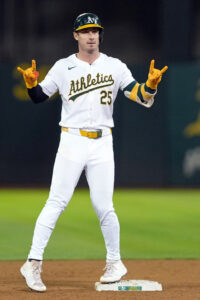
The righty-swinging Rooker has become not only one of the most successful waiver claims in recent memory but one of baseball’s best hitters. He popped 30 home runs in 526 plate appearances to earn an All-Star selection in 2023. While he was snubbed from the Midsummer Classic last season, Rooker took another major step forward. He connected on 39 homers, 26 doubles and a pair of triples with a massive .293/.365/.562 batting line across 614 plate appearances.
Rooker finished tied for fifth (alongside José Ramírez and Marcell Ozuna) in home runs. Only Aaron Judge, Shohei Ohtani, Anthony Santander and Juan Soto hit more. Among hitters with at least 500 PAs, Rooker ranked in the top 20 in all three slash stats. He finished sixth in slugging — trailing Judge, Ohtani, Bobby Witt Jr., Soto, and Yordan Alvarez.
It’s now two seasons of borderline elite offensive production. Rooker has a .272/.348/.528 slash through more than 1100 plate appearances in an A’s uniform. He’s in the top 15 in slugging percentage and ranks ninth in homers since the start of the ’23 campaign. He’s a middle-of-the-order presence.
There is a decent amount of swing-and-miss to his game. Rooker has fanned in more than 30% of his plate appearances with the A’s. Last year’s production was driven in part by a .362 average on balls in play that’ll be difficult to maintain. Rooker makes a ton of hard contact, though, so he’s probably in line for a modest BABIP regression rather than a huge drop-off.
The ball-in-play normalization happened at the end of last season. Rooker carried an unsustainable .390 BABIP into the All-Star Break. That dropped to .333 in the second half. To his credit, Rooker compensated by cutting his strikeout rate to a much more manageable 24.1% clip during that stretch. It remains to be seen whether he’ll maintain that level of contact, but it’s an encouraging development that presumably affirmed the front office’s confidence in his hitting acumen.
Even if he doesn’t hit .290 while pushing 40 home runs on an annual basis, Rooker should remain an impact bat. The A’s have made clear they envisioned him as the long-term anchor of their lineup. The team reportedly took him off the market in advance of last summer’s trade deadline. They had no interest in allowing trade rumors to rekindle during the offseason. GM David Forst declared within a week of the offseason beginning that the A’s weren’t dealing Rooker. They’re doubling down by committing to him through at least the 2029 season.
Rooker surpassed three years of major league service last season. He was entering his first of three arbitration seasons. MLBTR contributor Matt Swartz had projected a $5.1MM salary for next year. Rooker will reportedly receive $30MM over what would have been his arbitration window. That leaves an average of $15MM annually for the two free agent seasons. It’s not quite a front-loaded contract, but it appears Rooker will make a little more in the next couple years than he would have had he gone through the arbitration process.
The team makes that tradeoff for the chance to keep him at below-market rates during the 2028-29 seasons — which are scheduled to be their first two years in Las Vegas. The A’s didn’t have any money guaranteed beyond 2027. Severino and recent trade pickup Jeffrey Springs were their only players signed past next season.
The A’s revenue sharing status has been a significant storyline this offseason. Evan Drellich and Ken Rosenthal of the Athletic reported last month that the team could need to push its competitive balance tax payroll to roughly $105MM to avoid an MLBPA grievance. Teams are required to spend revenue sharing money on the on-field product.
Extending Rooker will push their tax number up, though it’s not by a huge amount. The contract comes with a $12MM average annual value. The AAV is the number used for tax purposes, so it wouldn’t matter how the salaries are distributed. Rooker had already been expected to make around $5MM next season. This adds roughly $7MM to the team’s tax number, which will check in around $97MM (as calculated by RosterResource).
The tax number isn’t finalized until the end of the year, so the remainder of the A’s offseason and in-season activity can push that further. Tax considerations are relevant but are far from the only reason for the A’s to make this deal. If they were solely concerned about pushing next season’s CBT number, they could have signed a handful of mid-tier free agents to one-year contracts.
Rooker turned 30 in November. A five-year commitment runs through his age-34 season. There’s some risk in a five-year deal for a player in his 30s who doesn’t provide much defensive value. Yet if Rooker continues hitting at anywhere near this level, his arbitration price tag would have climbed quickly anyhow. He could have put himself in position for an AAV in the $20-25MM range once he hit free agency, a number that the A’s may have been disinclined to match.
At the same time, it’s easy to see the appeal for Rooker of locking in the security. It wasn’t that long ago that he looked like a fringe roster player. He wouldn’t have gotten to free agency until his age-33 season, when a three- or four-year deal might’ve been the ceiling. Sacrificing a little bit of long-term earning upside to avoid injury risk over the next couple seasons is understandable.
This should also solidify Rooker’s spot in what looks to be an up-and-coming A’s lineup. Lawrence Butler, Jacob Wilson, Tyler Soderstrom, Shea Langeliers, JJ Bleday and rebound candidate Zack Gelof have promise as an offensive core. Last summer’s fourth overall pick Nick Kurtz could move quickly as a polished college hitter. The A’s still need a lot to break right to contend in 2025, but things are starting to come into focus. Soderstrom and Kurtz fit best at first base, so perhaps there’ll be a logjam down the line with Rooker locked in at designated hitter. That’d be a good problem to have if both young first basemen reach their offensive ceilings and Rooker continues to hit at an All-Star level.
Ken Rosenthal of the Athletic first reported that the A’s and Rooker were in agreement on a five-year, $60MM deal with a vesting option that could get to $30MM. Jeff Passan of ESPN reported that the option’s base was $22MM and that Rooker would make $30MM over the first three seasons. Jon Heyman of the New York Post reported the salary breakdown and the vesting provisions.
Image courtesy of Imagn.
Diamondbacks Acquire Grae Kessinger
The D-Backs have acquired infielder Grae Kessinger from the Astros for minor league pitcher Matthew Linskey, as first reported by Chandler Rome and Ken Rosenthal of The Athletic. Houston had designated Kessinger for assignment before the holiday break as the corresponding move for the Christian Walker pickup. Arizona had a trio of 40-man roster spots available, so no further move was necessary. Both teams have now announced the trade.
Kessinger was Houston’s second-round pick in 2019. The righty-hitting utilityman has made 49 big league appearances over the past two seasons. Kessinger has hit .131 with one homer while striking out 19 times over his first 70 trips to the plate. The Ole Miss product has taken 524 Triple-A plate appearances over the last two years. He’s a .271/.363/.407 hitter at that level. Kessinger has walked at a strong 12.4% clip against a manageable 21.5% strikeout rate in the Pacific Coast League.
While Kessinger isn’t going to bring much power upside, his plate discipline gives him a chance to be a valuable bench piece. He was a college shortstop and has logged nearly 2000 innings there professionally. He also has significant experience at each of second and third base with limited work at first base. Kessinger still has two options remaining, allowing the Snakes to keep him at Triple-A Reno for a while.
Linskey, 22, is a 6’7″ righty reliever. He turned in a 2.78 earned run average over 32 1/3 innings in the low minors last season. He posted a massive 38.3% strikeout rate but also walked 12% of batters faced. Linskey was a 16th-round draftee out of Rice in 2023.
Royals Re-Sign Michael Lorenzen
Jan. 8: Lorenzen has passed his physical, and the Royals have formally announced his new contract. Their 40-man roster is now up to 39 players.
Jan. 6: The Royals and Michael Lorenzen are reportedly in agreement on a one-year, $7MM contract. The deal, which is pending a physical, comes with a $5.5MM salary for next season. There’s a $12MM mutual option for 2026 that would come with a $1.5MM buyout if the Royals decline their end of the option. The contract also contains $1MM in performance bonuses for the CAA client.
Lorenzen heads back to Kansas City after finishing the ’24 campaign with the Royals. Kansas City acquired him from the Rangers in a deadline deal that sent reliever Walter Pennington to Texas. Lorenzen made a strong first impression, turning in a 1.57 ERA across 28 2/3 innings while starting six of his seven outings.
That capped off one of the better seasons of his decade-long MLB career. Lorenzen finished the year with a combined 3.31 earned run average over 130 1/3 innings. He started all but two of his 26 appearances. It was the third straight solid year since Lorenzen moved to the rotation. He’d turned in a 4.24 ERA over 18 starts for the Angels in 2022 and combined for a 4.18 mark in 153 innings between the Tigers and Phillies in ’23.

In each of those seasons, Lorenzen has found bottom line success despite an unimpressive strikeout and walk profile. That was particularly true last year. His 18.1% strikeout percentage and 11.2% walk rate are a few points worse than the respective league averages. Lorenzen has missed bats on fewer than 10% of his pitches in consecutive seasons. Last year’s 9.1% swinging strike rate was his lowest mark since 2018.
Lorenzen nevertheless carries a 3.90 ERA across nearly 400 innings over the last three seasons. While he has outperformed his peripherals in each season, teams seemingly remain skeptical about his chances of doing so yet again. Lorenzen has been limited to one-year contracts with base salaries below eight figures in each of the last four offseasons. He reportedly sought a two-year deal last winter. Lorenzen lingered in free agency deep into Spring Training before heading to Arlington on a modest $4.5MM guarantee with $2.5MM in performance bonuses.
The 33-year-old jumped on a deal earlier in the winter this time around. Lorenzen earns a slight pay bump relative to last season. He’ll also get the benefit of sticking with the same organization with which he ended the previous year. This is the first time since Lorenzen’s early-career run in the Cincinnati bullpen that he’ll stick with the same team over an offseason.
Kansas City lost some mid-rotation stability when they swapped Brady Singer for Jonathan India early in the offseason. That vacated a rotation spot for Kyle Wright, who is coming back from shoulder surgery that cost him the entire 2024 season. Lorenzen could compete with Wright and Alec Marsh for the fifth rotation spot behind Cole Ragans, Seth Lugo, Michael Wacha and Kris Bubic. Skipper Matt Quatraro could also turn to a six-man rotation or keep Lorenzen in long relief with the flexibility to move back into the rotation as injuries arise or workload management necessitates.
Previous reporting had indicated that Lorenzen, who had a bit of outfield experience with Cincinnati early in his career, could sign with a non-contender to take some at-bats. The idea would’ve been to reach the 20 games as a hitter necessary to qualify as a two-way player. That would’ve meant he would not have counted against a team’s 13-pitcher limit. There is no indication that the Royals — a team that made the Division Series last year and certainly intends to reach the playoffs again — is planning to do that.
Lorenzen’s salary brings the Royals’ payroll to roughly $121MM, according to the RosterResource calculations. They’d been around last year’s spending level before this signing, their first MLB contract since they re-signed Wacha shortly before free agency officially opened. It’s not clear how much room remains in the budget. Kansas City has reportedly looked for a middle-of-the-order bat after acquiring India to hit atop the lineup. Corner outfield and bullpen help are the biggest needs on paper.
ESPN’s Jeff Passan first reported the Royals and Lorenzen had agreed to a one-year, $7MM deal that included a $12MM mutual option. Anne Rogers of MLB.com reported the salary and the option buyout. Ken Rosenthal of the Athletic was first to mention the $1MM in bonuses. Image courtesy of Imagn.
Reds Hire Simon Mathews As Assistant Pitching Coach
The Reds informed reporters (including Gordon Wittenmyer of the Cincinnati Enquirer) that they’ve hired Simon Mathews as assistant pitching coach. That is expected to round out Terry Francona’s first staff in Cincinnati.
Mathews, 29, pitched at Georgetown and Temple. He spent three years pitching in the Angels system before moving into coaching. Mathews has worked for the Reds since 2021, including the last two seasons as the organization’s assistant coordinator of rehabilitation and pitching initiatives. This is his first MLB coaching assignment.
He’ll work as an assistant under seventh-year pitching coach Derek Johnson. Cincinnati lost their previous assistant pitching coach, Alon Leichman, who took the same position with the Marlins last month.
Bob Veale Passes Away
Two-time All-Star Bob Veale passed away, the Pirates announced on Tuesday. He was 89.
Veale, a Birmingham native, signed with the Pirates out of college in 1958. He spent parts of five seasons in the minors before cracking the big league roster in ’62. Veale worked mostly out of the bullpen during his first full major league season the following year. He turned in a 1.04 ERA across 77 2/3 innings to get a full-time rotation role heading into 1964.
The 6’6″ southpaw had a dominant first season as a starter. He started 38 of 40 games and worked to a 2.74 ERA over 279 2/3 innings. Veale won 18 games and led the majors with 250 strikeouts. He maintained a similar pace for the next few seasons. Veale made consecutive All-Star teams in 1965 and ’66. He struck out a career-best 276 hitters while turning in a 2.84 ERA with a 17-12 record in 1965. He won another 16 games while recording 229 strikeouts across 268 1/3 innings the following year.
Veale was among the top handful of pitchers over that three-season stretch. He ranked sixth in the majors — trailing only Hall of Famers Don Drysdale, Jim Bunning, Sandy Koufax, Juan Marichal and Bob Gibson — in innings between 1964-66. Koufax was the only pitcher to strike out more hitters. Veale ranked in the top 15 in earned run average among pitchers with at least 400 innings.
While he didn’t quite maintain that pace into his early 30s, Veale remained a productive pitcher throughout the decade. He topped 200 innings with a sub-4.00 ERA in each season between 1967-70. Veale turned in a 2.05 earned run average — his best mark as a starter — across 245 1/3 frames in 1968. That was the 10th-best mark in MLB (minimum 150 innings) even in the so-called Year of the Pitcher. Veale never had great command — he led the National League in walks in four of the five seasons between ’64 and ’68 — but he had some of the game’s best swing-and-miss stuff during his heyday.
Veale’s production dropped sharply in 1971. He was moved to the bullpen and allowed nearly seven earned runs per nine. While it wasn’t a good season individually, the Bucs knocked off the Orioles in a seven-game World Series. Veale made one playoff appearance, giving up a run in two-thirds of an inning. Pittsburgh released him the following year. Veale signed with the Red Sox and worked out of the Boston ‘pen through 1974 before retiring. He’d work as a pitching coach in the Braves and Yankees farm systems after his playing days.
Over an MLB run that spanned parts of 13 seasons, Veale threw 1926 innings. He finished with a 3.07 earned run average while striking out more than 1700 hitters. His 1652 punchouts in a Pittsburgh uniform rank him second in franchise history, trailing only his former teammate Bob Friend. Veale won 120 games and picked up 21 saves during his late-career run as a reliever. MLBTR sends our condolences to his family, friends and loved ones.
Sale Of Twins Could Be Reached By Opening Day
In October, Twins owner Joe Pohlad announced that his family was exploring a sale of the franchise. The Pohlad family has owned the Twins for 40 years, so the sale process set the stage for a monumental change for the organization. That could seemingly move quickly.
Dan Hayes of The Athletic reports that there’s robust interest from potential buyers. Hayes suggests that a sale agreement could be in place as soon as Opening Day. He notes that MLB has already begun vetting interested parties and will drill down on certain candidates as the process nears its conclusion.
The identities of most of those suitors are unknown. Bloomberg reported last month that Justin and Mat Ishbia, owners of the Phoenix franchises in the NBA and WNBA, were interested in the Twins. While Mat Ishbia is the majority owner of the basketball teams, Justin Ishbia would get the bulk of the ownership stake in the Twins if the family submits the winning bid.
They’re clearly facing some level of competition. One family that does not seem to be in the mix: the Wilfs, owners of the NFL’s Vikings. Mark Wilf tells Ben Goessling of the Minnesota Star-Tribune that they “have (their) hands full with the Vikings, in a good way.” Wilf acknowledged that he’d “always discuss those things” when an opportunity like the Twins presented itself but downplayed the idea of getting involved in the bidding.
In any case, Hayes reports that the Pohlads are planning to sell the franchise in full to whomever ends up as the purchaser. A new ownership group would assume control as soon as the sale is approved by Major League Baseball, which requires a 75% vote from the league’s other ownership groups. That should eventually impact the spending capacity available to the front office, but it’s not likely to affect this offseason. Minnesota has done nothing in free agency and has signaled that they’re working with little financial margin unless they shed money in trade.
The most recent franchise to be sold was the Orioles, which a David Rubenstein-led group bought from the Angelos family for $1.725 billion last January. Forbes valued the Twins at $1.46 billion last year. The Pohlad family paid $44 million to purchase the franchise in 1984.
Padres, Luis Patino Agree To Minor League Deal
The Padres have re-signed Luis Patiño to a minor league contract, as reflected on the MLB.com transaction log. Mad Friars first reported the agreement last month.
Patiño, 25, underwent Tommy John surgery in April and missed the entire ’24 season. San Diego kept him on the 60-day injured list during the season and opted not to tender him a contract in November. Patiño’s projected $800K arbitration salary was barely above the MLB minimum. San Diego didn’t want to keep him on the 40-man all winter, though, so they sent him to free agency. They succeeded in bringing him back without dedicating a roster spot.
The timing of the surgery means that Patiño is unlikely to be ready for game action until at least the halfway point next season. He’ll be able to build into shape at various minor league levels before presumably heading to Triple-A El Paso. The Colombian-born righty has a 5.12 ERA across 123 Triple-A frames. He has appeared in parts of four MLB seasons between the Padres, Rays and White Sox. Patiño carries a 5.02 ERA over 136 1/3 major league innings. He owns a 20.2% strikeout rate and has issued walks to 11.4% of opponents.
While Patiño has yet to find sustained success at either the major league or Triple-A level, he was once considered one of the sport’s most talented pitching prospects. He was arguably the headliner of the four-player package that San Diego sent to the Rays for Blake Snell. The Friars brought Patiño back via waivers last offseason. He is out of options, so if the Padres call him up once he gets healthy, they’d need to keep him in the majors or expose him to waivers.
Red Sox Showing Interest In A.J. Minter
The Red Sox have had multiple conversations with free agent reliever A.J. Minter this offseason, writes Chris Cotillo of MassLive. Cotillo lists a few other relievers with whom the Sox have had discussions: Carlos Estévez, Tommy Kahnle and Andrew Kittredge. However, he suggests that Boston could be on the periphery of the Estévez market and that “nothing has heated up” in their conversations with Kahnle.
Minter has been linked to the Blue Jays, Rangers and Cubs in recent weeks. Texas has already made a handful of bullpen signings, including last night’s one-year deal with former Boston righty Chris Martin. The Jays and Cubs should still be involved in the relief market. During the season, Minter had expressed some interest in returning to the Braves, though it’s not clear how seriously Atlanta has pushed for a reunion.
The 31-year-old has been one of the game’s more reliable lefty setup arms during his career. Between 2020-23, he combined for a 2.89 earned run average while striking out more than 30% of opposing hitters in more than 200 innings. Minter’s platform year was a little more questionable. He still managed good numbers, turning in a 2.62 ERA with a solid 26.1% strikeout rate. Left hip issues limited him to 39 appearances, though. He underwent surgery that ended his season in the middle of August.
Minter could be ready early in the year, so the injury should not be too detrimental to his market. That said, it may limit him to two years when he seemed on track for a three-year pact earlier in 2024. At the beginning of the offseason, MLBTR predicted a two-year, $16MM deal.
The relief market has moved slowly. Boston’s $10.75MM deal with Aroldis Chapman is one of four eight-figure reliever contracts thus far. The Sox also brought in Justin Wilson on a one-year deal at a low cost ($2.25MM). Minter would complete a trifecta of new southpaws in Alex Cora’s late-inning mix.
Kahnle is a righty who generally fares better against left-handed hitters. That’s a reflection of how often he uses his changeup. Kahnle turned to the “offspeed” pitch more than 70% of the time last season. It’s tough to argue with the results, as he turned in a 2.11 ERA while striking out more than a quarter of opponents across 42 2/3 innings for the Yankees. Kittredge, a righty who leans on his slider roughly half the time, is coming off a strong season for the Cardinals. The 34-year-old worked 70 2/3 innings of 2.80 ERA ball with a league average 23.3% strikeout rate.
Brian Matusz Passes Away
Former Orioles pitcher Brian Matusz has passed away at age 37, reports Roch Kubatko of MASNsports.com.
Matusz, a left-hander, starred at the University of San Diego. The Orioles drafted him fourth overall in 2008. The 6’5″ hurler reached the majors by the end of his first full professional season. He took a full slate of 32 turns through the rotation the following year. Matusz posted a 4.30 earned run average across 175 2/3 innings and finished fifth in AL Rookie of the Year balloting.
After running into some struggles over the next two seasons, Matusz moved to the bullpen. He tossed around 50 innings with an ERA of 3.53 or better in each season between 2013-15. Baltimore traded Matusz to Atlanta early in the ’16 season. The Braves released him without getting him into a game, but he returned to the majors with the Cubs later in the year. Matusz finished his career with stints in Triple-A, Mexico and independent ball.
Over parts of eight seasons, Matusz pitched to a 4.92 ERA through 528 2/3 innings. He won 27 games and recorded 462 strikeouts. He started 69 of his 280 MLB appearances. MLBTR sends our condolences to Matusz’s family, friends and former teammates.
Rangers Sign Chris Martin
Jan. 7: Martin’s deal with the Rangers guarantees him $5.5MM, Robert Murray of FanSided reports. Murray adds that Martin turned down more money from other clubs to return to his hometown club for what’ll be the final season of his career. WEEI’s Rob Bradford reports that the Red Sox were one team that made a more lucrative offer.
Jan. 6: The Rangers announced the signing of veteran reliever Chris Martin to a one-year deal. Financial terms remain unreported. Martin is represented by ISE Baseball. Texas designated Matt Festa for assignment to open a 40-man roster spot.
Martin, an Arlington native, heads home for what’ll likely be his final season. The 38-year-old righty said in September that he’s 95% confident he’ll retire after 2025. That’s not because of a dip in effectiveness. Martin remains a capable high-leverage arm and is coming off a strong two-year run in Boston.
The Red Sox inked Martin to a $17.5MM free agent deal over the 2022-23 offseason. It was a bit of a gamble considering his age, but the nine-year MLB veteran made good on that investment within one season. Martin turned in a dazzling 1.05 earned run average across 51 1/3 innings in 2023. He earned a couple down-ballot Cy Young votes in the process.
Last season was more good than dominant. Martin worked to a 3.45 ERA while throwing 44 1/3 innings. He had a brief injured list stint related to anxiety in the middle of June. Martin also missed a month with elbow inflammation between early July and the first week of August. He returned with 10 innings and only one earned run over the next couple weeks before allowing six runs in eight September frames.

Martin was almost certainly not going to manage an ERA around 1.00 in consecutive seasons. His strikeout and walk profile actually improved last year. He fanned 27.8% of batters faced after running a 23.1% strikeout rate in 2023. Martin cut his already pristine walk rate from 4% to a career-low 1.7% clip. He’s arguably the best strike-thrower in the majors. No pitcher with at least 100 innings over the last three seasons has issued walks at a lower rate than Martin (2.6%).
Over his two seasons with the Sox, Martin managed a 2.16 ERA across 95 1/3 innings. He has found success at every stop since returning from a stint in Japan between 2016-17. That includes a previous run in Texas. The Rangers were the team that gave Martin a chance during the 2017-18 offseason. He combined for 79 2/3 innings of 3.84 ERA ball before being traded to the Braves at the 2019 deadline.
Texas has loaded on up on short-term additions to fix a bullpen that could lose each of Kirby Yates, David Robertson, José Leclerc and José Ureña. They’ve signed Shawn Armstrong, Jacob Webb and Hoby Milner on one-year contracts worth $2.5MM or less. Texas also brought in southpaw Robert Garcia from Washington in the Nathaniel Lowe trade. While finances on Martin are unreported, it’s fair to assume he’ll be the most expensive of Chris Young’s bullpen acquisitions to this point. Still, there’s limited downside with a one-year deal.
Martin is the most experienced of the Texas relievers. He has worked in a setup capacity throughout his career and has never saved more than four games in a season. It’s unclear if the Rangers plan for him to close or will use him in leverage spots. Yates and Robertson have far more closing experience and are still free agents. Whatever the role, Martin adds much needed stability to a bullpen that might still be the team’s biggest question.
Texas signed Festa, 31, to a minor league deal last season. The Rangers selected his contract in August. He made 18 appearances over the final six weeks, working to a 4.37 ERA across 22 2/3 innings. The righty had made a brief appearance for the Mets earlier in the year. He has spent the bulk of his career with the Mariners, with whom he posted a 4.32 ERA in 89 outings over four seasons. Texas will have five days to trade Festa or place him on waivers.
Image courtesy of USA Today Sports.