
Phillies Acquire Jose Bautista
The Phillies have officially worked out a deal with the Mets to acquire veteran outfielder/third baseman Jose Bautista, as Joel Sherman of the New York Post reports on Twitter. Philadelphia had claimed the veteran on revocable trade waivers.
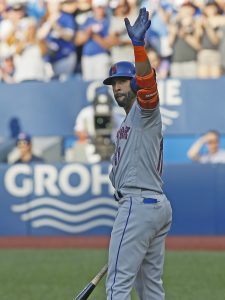
New York will receive a player to be named later or cash to complete the deal, per Jim Salisbury of NBC Sports Philadelphia (via Twitter). Bautista is only earning the league-minimum salary, so he won’t cost the Phils much in dollars.
The Phillies have already managed to squeeze in one defensively-limited slugger onto their roster, acquiring Justin Bour earlier in the summer. Now, they’ll shoehorn Bautista into the mix.
Of course, active roster space won’t be an issue in a few days’ time, as rosters are set to expand on Saturday. The Phillies will need to tie up a 40-man spot in order to carry Bautista, though.
Bautista is no longer the feared slugger of yore, and owns a sub-Mendoza batting average, though he can still drive the ball out of the park and draw a walk. His overall output on the season — .196/.339/.364 with 11 home runs in 342 plate appearances — translates to roughly league-average productivity (98 OPS+; 99 wRC+).
Perhaps there’s an argument to be made, though, that Bautista’s exceptional plate discipline and remaining pop make him a particularly interesting late-game pinch-hitting option. And the organization no doubt knows that it’s infusing a fiery competitor into its clubhouse at a moment when the team seemingly needs a jolt.
Photo courtesy of USA Today Sports Images.
MLBPA Hires New CBA Negotiator
The Major League Baseball Players Association announced yesterday that it has hired veteran attorney Bruce Meyer to serve as its senior director of collective bargaining & legal. He is expected to play a leading role in the MLBPA’s negotiation efforts with MLB.
According to the announcement, Meyer “will report to [MLBPA executive director] Tony Clark while focusing on all facets of the negotiation and the enforcement of baseball’s collective bargaining agreement.”
Meyer comes to the game of baseball after decades of experience with unions of other sports. Most recently, he worked for the National Hockey League Player’s Association. There, he functioned alongside NHLPA executive director Don Fehr, the former longtime MLBPA director.
Fehr’s notable run at the helm of the MLBPA — which spanned several contentious and controversial episodes in labor relations — came to an end when he stepped down in 2009, handing the reins to Michael Weiner. Upon Weiner’s untimely death in late 2013, the top job passed down to Clark.
The addition of Meyer atop the MLBPA negotiation team comes nearly two years after the most recent round of CBA negotiations. The resulting agreement in many ways maintained preexisting approaches to managing the contractual interactions of players and teams, but included several notable rules tweaks that many believe operated to the detriment of players (see, e.g., this post from Baseball America’s J.J. Cooper).
In particular, the luxury tax line and international spending limitations have arguably harmed MLB players’ earning upside, particularly for quality veterans seeking long-term deals in free agency. It’s worth bearing in mind, though, that there’s another fascinating market test coming up this winter. While multiple big-market organizations made sure in the last offseason to reset their luxury tax rates (which increase upon consecutive seasons in excess of the spending line), those same teams and others could now be freed to loosen their purse strings somewhat.
Three more years remain for the union to gather evidence and plot a strategic course before a ramp-up toward a new CBA. In the meantime, the MLBPA has already launched a grievance action against four teams for allegedly failing to properly utilize funds received through revenue-sharing rules.
Just how the Meyer hiring will influence the progress of labor relations remains to be seen. With his litigation background — the announcement notes he has worked on “several landmark grievances and lawsuits brought on behalf of Players across each of the North American major professional sports” — Meyer certainly has experience in more confrontational means of engaging with sports leagues and owners. Surely, though, the preference on all sides will remain the avoidance of any disruptions to business, particularly as the game of baseball encounters some tricky issues with respect to the nature of the game, its competitive balance, and its delivery to consumers in person and through a screen.
For his part, Meyer says the move represents an “opportunity to continue my commitment as a Player advocate.” He also noted in his statement that he “believe[s] in Tony’s vision for the Players and for the organization,” a message evidently intended to convey internal solidarity and affirm Clark’s leadership position in light of the criticism he has received.
Nationals Place Ryan Madson On Revocable Trade Waivers
The Nationals placed veteran reliever Ryan Madson on revocable trade waivers yesterday, per Jorge Castillo of the Washington Post (via Twitter). He’ll be on the wire until tomorrow.
It’s true, of course, that almost all major league players are run through trade waivers at some point. But the timing is still relevant, particularly in this case, as the placement kicks off a two-day waiver period. If a claim is made, the team that sought waivers (in this case, the Nationals) has another two-day stretch in which to work out a trade, pull back the player, or allow the contract to move to the claiming team without compensation.
[RELATED: How August Trades Work]
With Madson returning from the DL, and immediately thereafter hitting waivers, the Nats may have an opportunity to recoup some value — or, at least, save some salary — for the hurler. Having already moved veteran hitters Daniel Murphy and Matt Adams, and then lost pending free-agent reliever Kelvin Herrera to an injury, it seems likely that the D.C. organization will be quite motivated to move Madson.
Though he’s now 38 years of age, Madson still delivers plenty of velocity. Indeed, he’s averaging a career-high 96.4 mph with his four-seamer and getting swings and misses on 12.4% of his deliveries.
Those stats may help contending organizations look past some of the less-than-promising figures on Madson’s 2018 stat line. After posting a sparkling 1.83 ERA last year, he’s working at an ugly 5.28 clip through 44 1/3 innings this season, with only 8.3 K/9 against 3.0 BB/9.
Opposing hitters are carrying a .326 batting average on balls in play and averaging a 13.0% HR/FB rate against Madson, both of which sit above his typical recent levels. His 66.6% strand rate also hints at some potential poor fortune. Whether those numbers are due primarily to natural variability or an erosion in his skills is a matter for scouts to assess.
National League organizations will have first crack at Madson, who is earning $7.5MM on the season before reaching free agency this fall. Presently, the Dodgers and Phillies are the two clear contenders with the worst records in the league. Both could consider a move for Madson, though surely there are other players under consideration as well.
Josh Harrison Clears Trade Waivers
Pirates utilityman Josh Harrison has cleared revocable trade waivers, per Jon Heyman of Fancred (via Twitter). That means the veteran can be traded freely for the rest of the season — though he’d need to be moved by the end of August to be eligible for postseason play with a new organization.
Of course, clearing waivers hardly indicates a player is likely to be dealt. In this case, there’s no particular indication to this point that the Bucs are expected to find a taker for the 31-year-old.
It’s still notable, though, that Harrison is now among the players known to have cleared waivers. Those and others are still available for contenders in need of further upgrades.
There’s always a reason when a player does make it through waivers. Sometimes, it’s because no contending teams expect that player to be traded, as with some younger/more controllable players. Quite often, it’s simply a value proposition: placing a claim means you’re willing to take over a player’s entire contract, as the team that sought waivers has the option of revoking the waiver request, working out a trade, or simply allowing the claiming team to step into its shoes in the agreement.
This case, surely, is one of the latter variety. Harrison is earning a $10MM salary this year and is owed $1.5MM in buyouts on successive club options that are priced at $10.5MM and $11.5MM.
At times, those prices have seemed reasonable for Harrison, who at his best adds value in all facets of the game. He has appeared in the rumor mill as a possible trade candidate quite frequently in recent years. Unfortunately, his bat has been inconsistent in recent seasons and has never produced anything like the output he showed in the breakout 2014 campaign that preceded his extension with Pittsburgh.
Thus far in 2018, Harrison is hitting just .257/.299/.365 with seven home runs over 343 plate appearances. There’s not a lot to love in the underlying numbers, either. Statcast, for instance, suggests that his contact quality has merited exactly the middling output that has resulted (.288 wOBA vs. .291 xwOBA).
It’s fair to note, too, that defensive metrics have soured on Harrison, who normally grades as a clear positive. That said, he’s still receiving only slightly below-average marks and it’s hard to read too much into those figures. While he isn’t stealing as many bags as he has in past seasons, Harrison still rates as a quality overall baserunner.
All things considered, it’s still reasonable to imagine contending teams liking the idea of adding Harrison down the stretch, though clearly they’ll need some help with the salary — especially, the option buyouts — to make it worthwhile. If the Bucs decide they won’t pay Harrison in 2019, then perhaps the club will be willing to hold onto the option obligations and work out a deal. While the Pittsburgh organization made some buy-side moves at the non-waiver deadline, after all, it has since faded out of contention.
Orioles To Select Josh Rogers
The Orioles announced today that they will select the contract of lefty Josh Rogers, as Roch Kubatko of MASNsports.com tweeted earlier. Righty Cody Carroll was optioned to create space on the active roster.
Rogers, 24, will make his MLB debut tomorrow. It has been just over a month since he was acquired (along with Carroll and Dillon Tate) in the swap that sent Zach Britton to the Yankees.
While he was the least-hyped piece of that swap, Rogers has been stingy during his time at Triple-A Norfolk. He’s carrying a 2.08 ERA through 30 1/3 innings, though he has managed only 5.3 K/9 to go with 2.1 BB/9 and a 41.7% groundball rate. An 11th-round pick in the 2015 draft out of Louisville, Rogers has generally turned in good results while climbing the ladder.
Blue Jays Designate Luis Santos, Select Murphy Smith
The Blue Jays have designated right-hander Luis Santos for assignment, Shi Davidi of Sportsnet.ca tweets. That opens a 40-man spot for fellow righty Murphy Smith, whose contract was selected.
Those aren’t the only righty relievers changing places. Toronto also announced that Danny Barnes is heading up from Triple-A. Justin Shafer and Jake Petricka are being optioned down to create active roster space.
This isn’t the first time the Jays have designated Santos, who was knocked around in twenty MLB innings but had turned in 41 innings of 2.85 ERA ball at Triple-A. He’ll have the right to elect free agency if he clears waivers.
As for Smith, he’ll see the majors for the first time in his tenth professional season. The 31-year-old has worked to a 3.59 ERA in 62 2/3 innings at Triple-A, though he also carries an uninspiring 42:25 K/BB ratio.
Barnes, meanwhile, has spent most of the past two seasons working out of the major-league bullpen. He recorded an 11:1 K/BB ratio in 8 2/3 frames with Buffalo. He’ll come up in preference to Shafer and Petricka. The former threw five scoreless innings in his MLB debut this year, but managed only a pair of strikeouts.
Petricka, of course, is the player with the most experience on this transactions roll. He has worked 36 innings in the big leagues this year, compiling a 4.25 ERA with 7.3 K/9 and 2.8 BB/9. Petricka carries a strong 51.8% groundball rate, though that’s nothing like the 60%+ rates he managed earlier in his career.
Yankees Sign Quintin Berry
The Yankees announced today that they have signed outfielder Quintin Berry to a minor-league deal. Sam Dykstra of MiLB.com had reported the news on Twitter.
Berry had spent the season in the minors in the Brewers organization before his recent release. In 98 plate appearances on the year, the 33-year-old carries a .216/.296/.318 slash. He was also successful on ten of eleven stolen-base attempts, however. Likewise, through over two thousand career plate appearances at the highest level of the minors, Berry is just a .241/.337/.309 hitter but has swiped 159 bags.
It’s something of an annual tradition for Berry to pop up on the radar at this time of year. He has been utilized as a late-season and even postseason bench piece, owing to his sterling reputation as a baserunner. It’s possible, then, that he’ll show up on the Yankees roster at some point once rosters expand, though the organization would have to open a 40-man spot to utilize him in the majors.
Giants’ Leadership Addresses Organization’s Plans
With it becoming increasingly apparent that the Giants won’t be mounting a late run at the postseason, the team’s top organizational figures have spent some time giving their impressions of the current season and the future outlook. CEO Larry Baer chatted with Tim Kawakami of The Athletic (audio/subscription link), while president of baseball operations Brian Sabean spoke with John Shea of the San Francisco Chronicle.
Both men made clear that they don’t see the ballclub as being in the midst of a massive transition. “I don’t characterize it as a rebuild,” said Baer. Sabean, the club’s top baseball decisionmaker, said much the same: “We’re used to winning. We don’t feel we’re in a position, as a result of that, to have, quote, a complete face-lift.”
At the same time, there was certainly an acknowledgement that change will be needed. Sabean noted that the front office will “have to probably be ready to make some tough decisions.” And Baer acknowledged that, in applying what he described as Sabean’s “win and develop” approach to staying competitive while building for the future, it may be necessary to “”lean more toward the development” side of the fence.
If there’s a clear plan, it’s not clear from these interviews just what it is and how it’ll be implemented. When asked whether he expects to acquire a big-money player — which Henry Schulman of the San Francisco Chronicle argued today could be pursued even if the club otherwise doesn’t really expect to contend — Baer said it’s just too soon to know. His top baseball ops mean, though, said the club “still want[s] to put the most productive product on the field that we can,” which seems to keep the door open.
Certainly, it’s tough to see how the Giants would manage to embark upon anything like a true rebuilding effort with so many hard-to-move obligations on the books. That wasn’t necessarily the case last winter, when several veterans on long-term deals held greater trade value than they do now.
While the decision to push for a return to contention in 2018 hasn’t resulted in a postseason trajectory, that doesn’t mean the organization regrets it. Sabean says there was value in having “distanced ourselves from how last year went.” Both men suggested that the organization is pleased with having unearthed some young talent, too.
Of course, expectations were that this roster would struggle to keep pace in the division, just as has occurred. Some might have been higher on the Giants heading into 2018 had the team landed Giancarlo Stanton. In Baer’s estimation, the organization failed to convince the slugger to waive his no-trade protection to come to San Francisco mostly because Stanton was already frustrated with “the process” the Marlins undertook to try to deal him. Anyway, Baer says, the near-term payroll space that would have been locked up by Stanton was “re-expressed” in veterans Andrew McCutchen, Evan Longoria, and Tony Watson — a fact that actually left the club “very content” this spring, Baer says.
Longoria’s contract now looks to be another underperforming asset, further clogging the future balance sheets after the club so diligently stayed below the luxury tax line this year. But those are the risks it takes to acquire or keep established veterans. And the Giants obviously believe in their approach, having seen it result in three recent World Series titles.
It seems that, most broadly, the organization will back off the throttle in some respects — McCutchen could certainly be traded in the coming days, for example — but will otherwise push forward with its tried and true methods of roster building. Certainly, there’s every indication that Sabean and skipper Bruce Bochy will remain in their posts, with Baer telling Kawakami that the pair has an unmatched pedigree and expressing confidence in them with one more season left on their most recent extensions.
Injury Notes: Chapman, Judge, Sale, Santana, Goody, Iwakuma
Yankees closer Aroldis Chapman went in for a platelet-rich plasma treatment on his ailing left knee, David Lennon of Newsday tweets. Skipper Aaron Boone indicated that the plan is to reevaluate the high-powered lefty in two weeks’ time. That’s a bit less promising than the initial suggestion that Chapman could be back after the minimum ten-day DL stint, though there’s no indication as of yet that there’s any real concern that the injury could carry over into the postseason. For a Yankees team that is all but locked into a Wild Card play-in game, getting Chapman up to full speed by the end of September is of much greater importance than having him available for the final month of the regular season.
- Meanwhile, the Yankees are still waiting for a breakthrough from star outfielder Aaron Judge. As Boone stated, and MLB.com’s Bryan Hoch tweeted, the team has “stopped guessing” as to when Judge’s fractured wrist will be in good enough shape to allow him to resume swinging. In this case, perhaps, there’s a bit more reason to be anxious. It has been a long layoff for Judge, after all, and he’ll want to get as many plate appearances as possible before October arrives. Clearly, though, there’s not much the team can do but wait and hope the wrist improves.
- The news is slightly more promising — though no less clear — on Red Sox southpaw Chris Sale. He’s “doing better” and “getting close,” per Boston manger Alex Cora, as Jason Mastrodonato of the Boston Herald reports on Twitter. With a healthy division lead, the Boston organization is in no need of Sale’s services for the next five weeks. But he’s essential to the team’s World Series hopes, so getting his balky shoulder sorted out is a top priority.
- The injured finger of Twins hurler Ervin Santana won’t require surgery, skipper Paul Molitor said and Phil Miller of the Star-Tribune tweeted. That said, the veteran is going to remain shut down until “doctors come up with a plan.” With the Twins’ season sunk and Santana not looking himself since making a brief return to the majors, the objective here is to set him up as well as possible for the future rather than rushing him back in 2018. While no decision has been made as to whether Santana will pitch again for the Twins this year, it could well be that he has already taken the mound for the club for the last time. Minnesota is unlikely to pick up its $14MM option over the right-hander, who will presumably be a popular bounceback target in the offseason to come.
- Indians righty Nick Goody isn’t in need of a new ulnar collateral ligament, Jordan Bastian of MLB.com tweets, but he is headed in for some kind of procedure. That’s rather promising news, given that the 27-year-old was making the rounds to several noted surgeons recently. Goody has missed much of the 2018 season with arm woes, making for a disappointing follow-up to his strong 2017 performance. Last year, Goody worked to a 2.80 ERA with 11.9 K/9 and 3.3 BB/9 over 54 2/3 frames. He had been on track to reach arbitration via Super Two status this fall. While he’ll have enough MLB service time to reach it, he won’t be eligible since he has not spent 86 days on the active roster this season.
- It seems the Mariners and Hisashi Iwakuma haven’t given up entirely on the veteran hurler this year. Seattle GM Jerry Dipoto said in a regular appearance on 710 ESPN (write-up via Brent Stecker) that the 37-year-old is nearing a rehab stint, in fact, though it doesn’t sound as if there’s particular cause for optimism that he’ll be a real factor this year. Iwakuma only made six starts in 2017 and hasn’t made it back to competitive action this season. Still, Dipoto suggested he’d do everything possible to get him up to the majors as a reliever down the stretch.
Mets Activate Jay Bruce, Option Dominic Smith
The Mets are planning to give veteran Jay Bruce a long look at first base over the final five weeks of the season, as Tim Healey of Newsday reports. Bruce was activated today from a long stay on the disabled list, with the club optioning former top first base prospect Dominic Smith as part of the day’s roster maneuvering.
It seems the idea is to assess what skipper Mickey Callaway called the “possibility” that Bruce could enter the 2019 campaign as a regular at first base. As the organization looks ahead to an offseason that will likely be overseen by a new general manager, no decisions have been made. Rather, Bruce will have an opportunity to show whether he looks to be a viable option at first and/or his customary corner outfield. Callaway says the veteran will appear in the infield “quite a bit moving forward.”
Of course, the Mets largely know what they have in Bruce, who was signed over the winter to a three-year, $39MM contract that includes consecutive $13MM salaries for the coming two campaigns. The 31-year-old has struggled to a .212/.292/.321 slash this year, though it’s probably reasonable to anticipate he’ll bounce back toward his typically above-average offensive levels. This is his 11th season in the majors, so there isn’t much mystery about his skillset with the bat (generally: good power and limited on-base ability).
Smith, though, is a former first-round pick who only just turned 23 years of age this summer. He carries only a .197/.251/.389 batting line in 263 MLB plate appearances over the past two seasons and also hasn’t hit much this year at Triple-A. But it wasn’t long ago that he was seen as a high-quality prospect; indeed, Smith earned his way into the majors in 2017 with a .330/.386/.519 performance in 500 plate appearances for Las Vegas last year.
Nevertheless, Smith is on his way back to Triple-A. While he’ll presumably re-join the MLB roster at some point in September, it seems he won’t receive a particularly close look in the final month of the season. Indeed, Callaway had some eye-opening comments on the youngster. “The deal here is you might not ever get a look,” he said. “That’s how it goes in the major leagues. Nothing is fair. It is what it is. But he has to keep on grinding and putting himself in a position where he can come up here and get at-bats.”
While it’s understandable that the organization may want Smith to force the issue somewhat, the decisionmaking process seems a mite curious, as David Lennon of Newsday suggested recently. True, another prospect — Peter Alonso — has likely now eclipsed Smith in the organization’s eyes. But Alonso is actually 190 days older than Smith. And as impressive as the 2016 second-rounder has been, the Mets surely would at a minimum prefer to boost Smith’s trade value if he’s going to end up making way for Bruce and/or Alonso in the near future.