
Marlins “Making Progress” In Extension Talks With Dee Gordon
The Marlins held extension discussions today with Dee Gordon‘s representatives at Beverly Hills Sports Council, MLB.com’s Joe Frisaro reports on Twitter. The sides are “making progress,” per the report.
Gordon played at an extremely high level for Miami last year after coming over in a Winter Meetings swap from the Dodgers. He led the league with 58 stolen bases and a .333 batting average. He put up an overall 114 OPS+ for the season and drew rave reviews for his defense, making him worth about four to five wins above replacement.
The Fish control Gordon through 2018 via arbitration. MLBTR projects him to earn $5.9MM through the arb process in 2016. We learned yesterday that the sides were expected to explore a deal in Nashville.
AL West Notes: Wilson, Angels, Kendrick, Rangers, Pearce, Lewis, Catchers, Mariners
The Angels are telling clubs they’ll listen to offers on lefty C.J. Wilson, Scott Miller of Bleacher Report reports on Twitter. It seems that Los Angeles would be interested in clearing some payroll in a bid to address the multiple areas of need on the position-player side of the equation.
More from L.A. and the AL West:
- Angels GM Billy Eppler told reporters that he’s looked into deals for a short-term option in the corner outfield, Jeff Fletcher of the Orange County Register tweets. As Fletcher notes, Jay Bruce of the Reds is one player who could meet that description, though it’s not clear that he’s a target for the Halos.
- Free agent second baseman Howie Kendrick is “definitely open” to returning to his long-time club, Mike DiGiovanna of the Los Angeles Times tweets. While Eppler and co. have reached out to the veteran, that isn’t “on the front burner” for the team at present.
- The Rangers have had internal discussions about adding free agent first baseman/outfielder Steve Pearce, T.R. Sullivan of MLB.com reports via Twitter. Pearce has long seemed a good match on paper for Texas, which has a heavily left-handed lineup.
- Meanwhile, the Rangers are looking at bringing Colby Lewis back and want to add at least two starters, Sullivan tweets. Texas would be looking for a rotation piece in any theoretical deal of first baseman Mitch Moreland.
- While the Rangers‘ interest in righty Joe Kelly now seems dead in the water after Boston dealt Wade Miley, Texas could also look to chat with the Red Sox about a possible deal for a catcher, Jeff Wilson of the Fort Worth Star-Telegram tweets. Tigers backstop Bryan Holaday could draw some attention from Texas as well, Sullivan adds on Twitter. As MLB.com’s Jason Beck notes on Twitter, Holaday is out of options and could hit the waiver wire if he loses the team’s reserve catching job to the just-signed Jarrod Saltalamacchia.
- In other Rangers-related backstop news, Tom Haudricourt of the Milwaukee Journal-Sentinel tweets that he’s told the team “covets” Brewers receiver Jonathan Lucroy. Of course, as he adds, Milwaukee likely won’t move Lucroy unless it can achieve a “huge return.”
- The Mariners are not looking at any major rotation upgrades after acquiring Miley, GM Jerry Dipoto tells Bob Dutton of the Tacoma News-Tribune (via Twitter). Dipoto also noted that he wasn’t willing to guarantee Hisashi Iwakuma a third year, which is why the club reportedly lost out on him to the Dodgers, MLB.com’s Greg Johns tweets. Miley was the M’s “Plan A” after missing on Iwakuma, added Dipoto.
Fifteen Teams Have Expressed Interest In Cliff Lee
Free agent lefty Cliff Lee is drawing interest from no fewer than fifteen teams around the league, Jon Heyman of CBSSports.com reports on Twitter. The long-time ace is reportedly preparing to return to the mound in 2016.
It’s certainly not surprising to hear that so many organizations are looking into the southpaw. While he’s 37 and will be looking to make his way back from a flexor tendon tear without surgery, Lee offers unmatched upside among the bounceback candidates on the free agent market.
It’s far from clear, of course, whether teams are willing at present to commit big dollars to Lee. Certainly, they’ll want to learn more about his progress and prognosis. But the report does make clear that there’ll be no shortage of teams lined up to pursue Lee if he shows promise of returning to the form that made him one of the game’s best pitchers well into his mid-30s.
Indians Claim Joey Butler, Designate Jayson Aquino
The Indians have claimed outfielder Joey Butler off waivers from the Rays, the team announced. Lefty Jayson Aquino was designated for assignment to create 40-man space.
Butler will be going into his age-30 campaign with less than 300 plate appearances to his name. But the vast majority of those came last year, when he put up a solid .276/.326/.416 batting line with eight home runs and five steals. He also drew solid marks on defense. On the whole, Butler looks like a plausible fourth outfielder and if nothing else could provide some insurance as Cleveland looks to add bats.
Aquino went to the Indians in a minor move at last year’s trade deadline. The 23-year-old spent all of last year at the High-A level, working to a strong 3.28 ERA in 137 1/3 innings with 5.6 K/9 against 2.0 BB/9. There have been a lot of travels already for the southpaw, who opened the year in the Blue Jays organization after previously being claimed from the Rockies.
Kris Bryant, Maikel Franco File Service Time Grievances
A pair of outstanding rookie third basemen, Kris Bryant of the Cubs and Maikel Franco of the Phillis, have filed grievances claiming that their service time was manipulated in an effort to delay their future entry onto the free agent market, Jeff Passan of Yahoo Sports reports.
No shortage of attention will be paid to these cases. Bryant, of course, won the National League’s Rookie of the Year award, while Franco might have staked his own claim to that title had he not been injured late in the year. In that regard, then, the stakes are high for the players and teams; if a panel were to award additional service time, both would stand to qualify one year earlier for free agency.
Most important of all, however is the heightened relevance of the matter with collective bargaining talks set to begin in earnest. The matter of whether, when, and why top young players are brought up to the majors — and thus begin accruing credit for time spent on an active MLB roster — has long seemed an area ripe for consideration (if not acrimony) between the league and the player’s association.
For those unfamiliar with how things work, teams have a powerful incentive to hold back talented young players — even those they believe to be ready for the majors — to slow their march towards free agency. A less powerful, but also relevant incentive exists to keep a player down long enough to prevent them from qualifying for “Super Two” arbitration status.
A player only accrues a full season of MLB service when he reaches 172 days on the active roster (that includes off days), and it takes six full seasons of service time to reach free agency. As a practical matter, then, teams can milk nearly seven years of control over players if they just keep them in the minors for a few weeks at the start of the year.
Indeed, that’s exactly what happened with Bryant and Franco, who accrued 171 and 170 days of service last year, respectively. While there were surely legitimate baseball reasons that also supported the decisions to start those players in the minors, it’s not hard to see what line of argument their agents will pursue.
Of course, many such matters are resolved before they get to a hearing, though in these cases it would seem a creative arrangement would be necessary. It will be most interesting to see how things proceed between the larger entities with stakes in the pair of disputes: MLB and the MLBPA. The sides have about a year to negotiate a new CBA, and the service-time issue presents not only a point of possible contention, but also rather a tricky problem to solve in practice even if agreement on a general direction can be found. While bargaining could certainly override any precedent struck in a hypothetical grievance, a victory in front of an arbitration panel would transfer leverage to one side or the other.
Jonathan Papelbon Files Grievance Against Nationals
DEC. 7: Ken Rosenthal of FOX Sports tweets that the MLBPA filed a grievance against the Nationals on Papelbon’s behalf two days after the suspension was issued. The team considered the filing to be “obligatory,” and Rosenthal adds that it will be addressed this spring.
DEC. 6: Nationals closer Jonathan Papelbon has filed a grievance against the Nationals challenging the team’s decision to impose a suspension without pay for the final four games of the 2015 season, WEEI.com’s Rob Bradford reports. Papelbon received the ban for his role in a dugout scuffle with star outfielder Bryce Harper.
Per the report, Papelbon and his representatives brought the action based on the position that the team lacked precedent for withholding Papelbon’s pay in relation to the suspension. Clearly, the dispute is about much more than the dollars involved, as those four games represented just over 2% (about $300K) of Papelbon’s $13MM total salary on the year.
The degree of ongoing animus between player and team remains unclear. But if nothing else the matter also raises issues of the broader relations between teams and players under the collective bargaining agreement. Those considerations are surely heightened given that negotiations on a new CBA are set to take place over the coming year.
Article XII of the CBA addresses disciplinary matters, providing that clubs have the authority to impose “disciplinary action for just cause.” While that section does not specifically authorize or forbid certain forms of punishment, it does contemplate both fines and suspensions resulting in lost salary (in providing that a team must make a player “whole” if the decision is overturned). A player subject to disciplinary action may challenge it through a grievance proceeding before an arbitral panel, which in turn must assess whether “just cause” existed for the punishment that was meted out.
The embattled reliever remains under contract in D.C. next year for $11MM, as part of the agreement he reached with the club when he was traded from the Phillies in July. He’s probably worth every penny as a player, as he continues to put up strong results at the back of the pen, but his issues off of the mound continue to mount.
Relations between Papelbon and the Nats were surely already strained, though we’ve heard varying accounts of the extent to which conciliation may be possible. It certainly seems likely that this dispute will only ratchet up tensions. Washington has, of course, been rumored to be weighing a trade of the veteran, though the market for his services remains rather cloudy.
Bradford adds that there’s no date for a hearing at present. It’s unclear whether there will be any possibility of negotiations to forestall further airing of the unfortunate matter.
Free Agent Profile: Yoenis Cespedes
Yoenis Cespedes did more to boost his stock in 2015 than any other free agent (with the arguable exception of Zack Greinke), but will teams buy fully into the superstar’s sky-high ceiling?
Pros/Strengths
There’s no denying that Cespedes just put up a full season of superstar production. His age-29 season started off with an excellent showing for the Tigers and continued with an even better run after a mid-season trade to the Mets.
All told, the 30-year-old Cuban native put up a .291/.328/.542 slash over 676 plate appearances with 35 home runs and 105 runs batted in. It was every bit the season one would hope for from a middle-of-the-order bat, and then some.
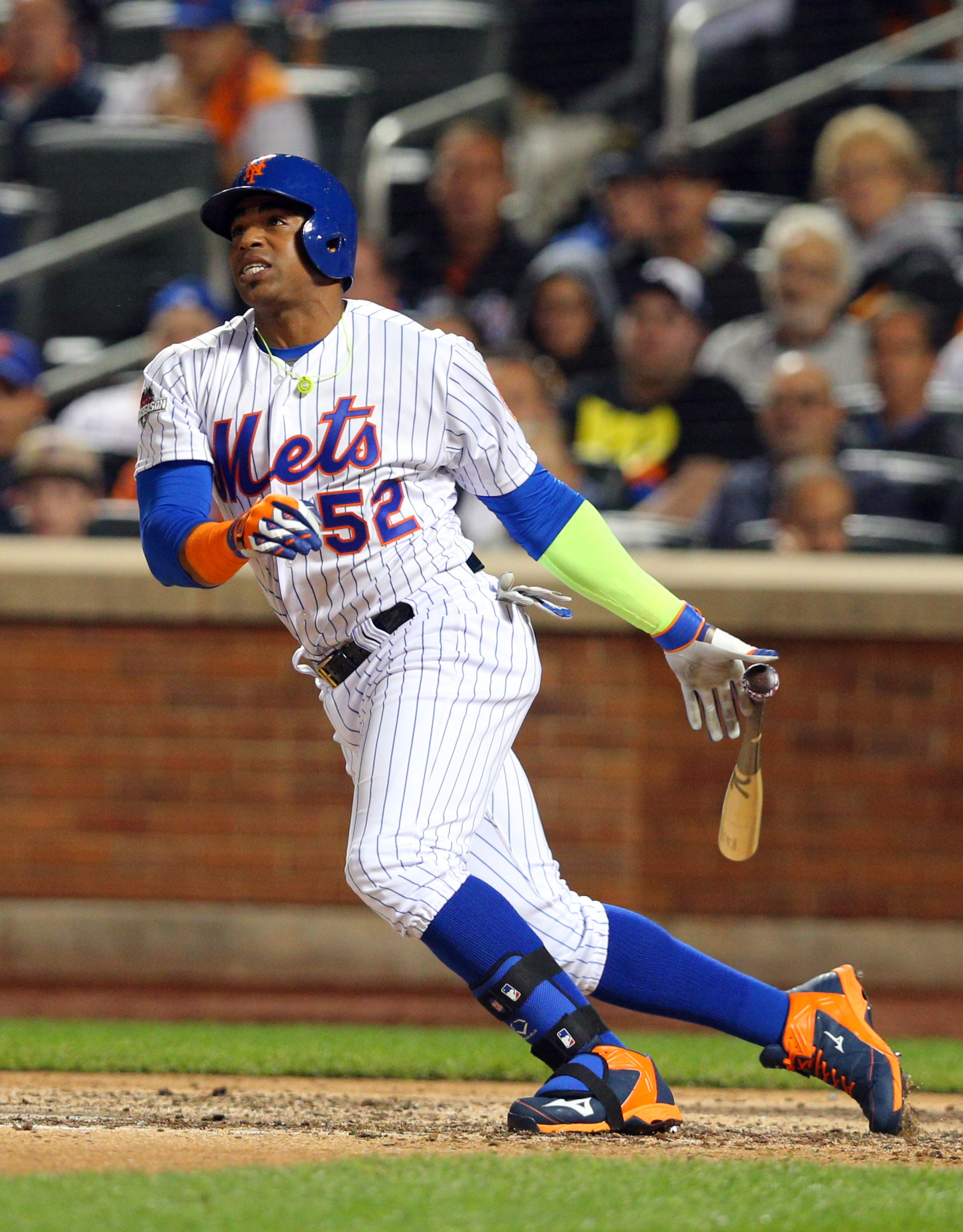
That showing validated the incredible breakout season Cespedes had as a 26-year-old rookie back in 2012. He set career marks last year not only in the traditional power categories noted above, but also in ISO (.251).
Cespedes also put up personal bests in hard contact, line-drive rate, and home runs per flyball (while hitting less flies than ever before). Another indicator of the qualify of contact is the infield fly, and Cespedes dropped to single digits in that mark for the first time ever. And it’s worth noting, too, that Cespedes carries a strikeout rate of around 20%, right at the league average and quite a fair mark for a slugger.
Production at the plate isn’t the only area that Cespedes excelled last year. He also continued to draw outstanding defensive ratings in left field, racking up double-digit DRS and UZR tallies for the second consecutive year while demonstrating a highlight-reel arm. And he showed that he can handle center in a pinch, though certainly prospective shoppers will be well aware that he’s not a natural option up the middle.
It’s worth noting, too, that Cespedes rates out as an excellent baserunner. He has continually measured well in Fangraphs’ BsR metric, never moreso than last year.
The defense and baserunning points serve not only to demonstrate the overall value that Cespedes brings, but also to highlight his outstanding athleticism. He is as loaded with tools as players come and is still putting them to use at a prime level as he hits the market. And he has a good overall track record of durability: despite dealing with some dings and dents at times, he’s only missed minor stretches as a professional.
Add it all up, and you have a player that has shown — very recently — that he’s capable of putting up over six wins above replacement, which is exactly what Cespedes did last year. While it’s true that there were two less-than-exciting seasons sandwiched between 2012 and 2015, he still averaged out at about three WAR in those years, suggesting a palatable floor.
Cons/Weaknesses
The biggest questions with Cespedes relate to those two intervening years noted above. Just as you can’t look past a monster 2015, you can’t ignore his (relatively) sub-par 2013-14 campaigns.
That lesser version of Cespedes was still a good player, as noted above. But it wasn’t one that teams would be lining up to get with a nine-figure guarantee. Over that span, Cespedes slashed .251/.298/.446 — good for a 106 wRC+ — while swatting 48 long balls.
Clearly, the pop has been there all along, even if it hasn’t always been quite as strong as it was last season. But Cespedes’s on-base troubles are not easily glossed over. His 2015 effort was driven in part by a .323 BABIP that lands about twenty points above his career mark. In years where that dips, his OBP falls with it. Indeed, Cespedes has shown a declining walk rate in every season, falling last year to below five percent.
Defensively, Cespedes hasn’t always enjoyed the sterling reputation his numbers would suggest. That’s true, in part, because he’s never before rated as above-average in terms of range. While his arm will surely remain a weapon for some time, it’s fair to wonder if he’ll be able to repeat the overall defensive showing from 2015.
While overall baserunning effectiveness is far more important than stat-padding stolen bases, it’s worth noting also that Cespedes has never returned to the 16 swipe-level he showed in just 129 games as a rookie.
There are some other, less stat-driven questions surrounding Cespedes. He’s been traded three times in the last two years, and while there were readily apparent team-specific reasons on each occasion, it’s telling to some that so many teams were willing to let him go. And there have been off-the-record whispers that Cespedes marches to his own drum, though as explained in that link, there’s little substantial evidence that he’s ever been a problem in the clubhouse or failed to put in the necessary work.
Personal
Cespedes was born and raised in Cuba, and played for his home province’s club, the Alazanes of Granma. He was a Serie Nacionale star from the moment he broke in, putting up a strong .302/.379/.503 batting line in the top Cuban league at just 17 years of age. Susan Slusser and Demian Bulwa of the San Francisco Chronicle have penned an interesting look into the unfortunate travails that Cespedes and his family went through to make it to the United States and Major League Baseball.
Notably, after entertaining an active bidding war for his services prior to the 2012 season, Cespedes chose to take a lesser deal in order to move up his free-agent timeline. While there were reports that he could’ve landed six years, he took four with the A’s and negotiated a clause requiring that he be released at the end of the contract. (That ultimately rendered him ineligible for a qualifying offer, which was a factor in his various trades. The Mets negotiated with him to modify the provision, making it possible for the team to sign him, after the threat of the QO had already been removed by a mid-season swap.)
It seems fair to say, then, that Cespedes put a high value on reaching the open market, and he’s said to have something of a businessman’s appreciation for the transactional side of the game. Marketing is not an insignificant consideration in the entertainment industry, of course, and he and his representatives spared no expense in extolling his value to prospective new employers. Now, presumably, he’ll wait for the pitches to roll in.
Among the pursuits that Cespedes has picked up since coming to the United States is golf. Though a mid-playoff round created some controversy recently, he’s said to be something of a prodigy on the links.
Market
Looking at 2015 alone, Cespedes stands out among free agent outfielders. After all, he had a better overall season than any of the players he’s competing against on the open market.
But that doesn’t mean teams will prefer him unanimously. Jason Heyward and Justin Upton are both significantly younger, with the former representing a strong all-around package and the latter delivering much of the same pop with better on-base abilities. Chris Davis offers stunning power, though he might not be viewed as a true corner outfield option, while Alex Gordon will command less years owing to his age and has been a more consistent performer.
(We’ve already profiled Heyward, Upton, and Davis.)
Interestingly, we haven’t heard much to distinguish the different markets of these players, many of whom figure to appeal to the same teams. It could be that the market is waiting for one motivated team or one motivated player to push for a deal to set the market and get the action going. As against the competition, though, Cespedes does have one distinct advantage: all the others turned down qualifying offers and come with draft compensation attached, whereas Cespedes was ineligible and thus can be acquired for cash alone.
Cespedes could conceivably end up with any of a variety of clubs. That includes the Mets, though that relationship seems destined to end as a summer/fall fling. Clubs with deep enough pockets and the most obvious need are the Angels and Giants. The Tigers, Cardinals, Orioles, and White Sox could probably afford him and arguably have the need — or, at least, the want — though it’s not clear whether any would be willing to devote that much cash. Smaller spenders like the Royals and Padres could be a fit, particularly if the asking price falls, and big-market teams such as the Cubs, Dodgers, Rangers, and Nationals might conceivably line up if they were to shift other assets.
It’s hard to put any single one of those organizations on Cespedes specifically — or any of the other top free agent corner outfielders — but it seems there ought to be enough demand to go around.
Expected Contract
There are a broad range of possible outcomes here. On the one hand, he’s been inconsistent and there are younger options on the market (as well as other alternatives in Gordon and, to an extent, Davis). On the other, we’re seeing some ridiculous new salary heights and Cespedes has the kind of star power and possible impact that could lead to a bidding frenzy.
I find myself leaning slightly toward the lower end, but evidence of continued upward movement in MLB spending has pushed up my expectations. I’ll join in the earlier prediction of MLBTR’s Tim Dierkes: six years and $140MM.
Dodgers To Sign Hisashi Iwakuma
DEC. 7, 9:30am: Iwakuma will land a three-year, $45MM contract, according to Jon Heyman of CBS Sports (via Twitter). That would match MLBTR’s prediction from early November.
DEC. 6, 8:45pm: There is a deal in place that is believed to be for a three-year term, Jon Heyman of CBSSports.com reports on Twitter. If that’s the case, then Los Angeles will be acquiring the age-35 through age-37 campaigns of the veteran.
7:24pm: The Dodgers are nearing agreement on a deal with free agent righty Hisashi Iwakuma, according to multiple reports. Indeed, ESPN.com’s Jim Bowden reports on Twitter that an agreement is already in place, while Joel Sherman of the New York Post hears it’s not yet done (Twitter link) but says other clubs think a pact will be finalized. The sides are “moving toward completion” of a contract, per Ken Rosenthal of FOX Sports (via Twitter).
Possible financial terms remain unreported. Iwakuma, a client of the Wasserman Media Group, got off to a slow start and dealt with shoulder issues last year, but ended up turning in a typically excellent campaign for the Mariners. Over 129 2/3 innings, he worked to a 3.54 ERA with 7.7 K/9 against 1.5 BB/9.
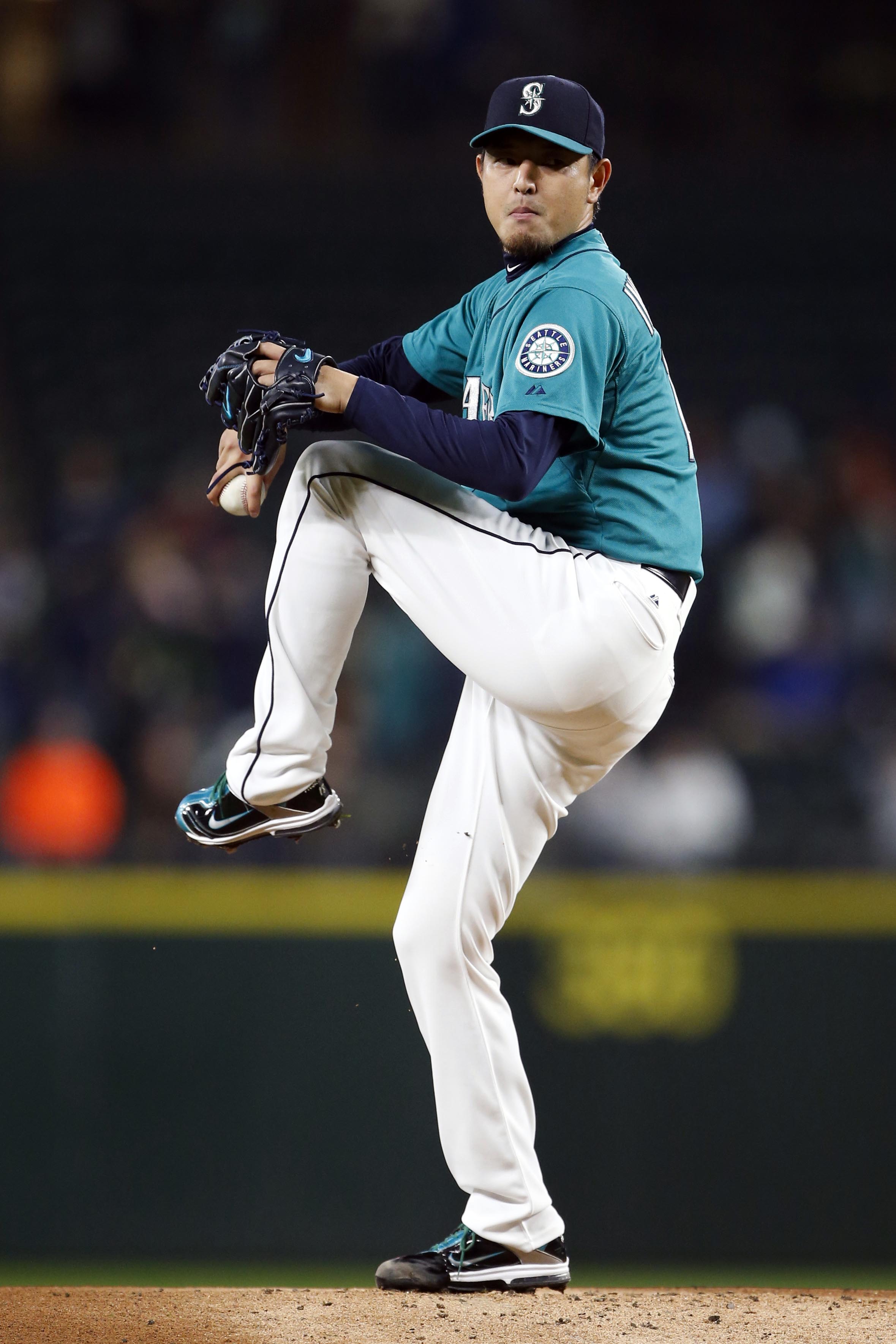
Remarkably enough, that’s the worst single-season earned run average the 34-year-old has compiled over a single campaign. He’s been remarkably good since coming to Seattle from Japan before the 2012 season. In 653 2/3 total MLB frames, Iwakuma has allowed just 3.17 earned runs per regulation game.
ERA estimators largely support the results. Iwakuma posted a 3.36 SIERA last year and carries a 3.33 mark over his four seasons. In addition to a sparkling 16.2% K-BB%, Iwakuma has induced groundballs on just over half of the occasions that a batter has put one of his pitches in play.
Never reliant on velocity, Iwakuma has experienced only a slow drop in fastball velocity. Last year, he averaged 88.9 mph on his fastball, down from the 90.3 he maintained back in 2012.
It is worth noting, though, that Iwakuma missed starts in each of the last two seasons. He was sidelined for about a dozen outings last year, though he obviously ended the year producing solid results from the rotation. Iwakuma has also been somewhat susceptible to the long ball, allowing a 13.8% HR/FB rate and 1.10 home runs per nine over his career.
In rating Iwakuma the 25th-best free agent available, MLBTR’s Tim Dierkes predicted that he’d be able to find three years and $45MM on the open market. Aside from age, the major factor weighing down the righty’s value is the fact that a signing team will be required to part with a draft pick.
It’s easy to see why the Dodgers would be interested in the veteran. Paying a hefty average annual value won’t stress the club’s payroll much (if at all), but by adding an older player the club would be able to avoid a lengthy entanglement. Los Angeles had, of course, reportedly pursued several other high-profile pitchers only to fall short in the bidding.
Photo courtesy of USA Today Sports Images.
Tigers Nearing Two-Year Deal With Mark Lowe
The Tigers are nearing a two-year pact with free agent righty Mark Lowe, ESPN.com’s Jerry Crasnick reports on Twitter. Lowe is represented by Frye McCann Sports.
Lowe, 32, jump started his career with a stellar 2015 season. After joining the Mariners on a minor league deal, he put up one of the most dominating pitching lines of the season’s first half, tossing 36 frames of 1.00 ERA pitching with 11.8 K/9 against 2.8 BB/9. That led to a mid-season trade that sent Lowe to the Blue Jays in exchange for a trio of young pitchers.
While he wasn’t quite as excellent in Toronto, Lowe was still quite an effective reliever down the stretch. He allowed eight earned runs while striking out 14 and allowing just one walk in his 19 innings. Lowe went on to permit two earned in his 4 1/3 postseason frames.
Lowe’s success was attributed, at least in part, to a revived fastball. He averaged over 95 mph with the heater on the year, a mark he hadn’t reached since way back in 2011. That was also the last season in which Lowe topped forty big league innings prior to 2015. As Eno Sarris of Fangraphs explained at the time of the trade, the emergence of Lowe’s fastball also helped him post stellar results with his slider. All told, Lowe ended the year with a career-best 14.1% swinging strike rate.
For Detroit, Lowe would presumably factor in the setup mix in front of recently-added closer Francisco Rodriguez. New general manager Al Avila has already added significant arms to both the rotation and then pen in advance of the Winter Meetings, along with an outfield option in Cameron Maybin, and Lowe could wrap up most of the team’s highest-priority business.
Mets Willing To Give Ben Zobrist Four-Year Deal; Others Still In Mix
10:13pm: Zobrist’s priority is to play for a winning club, tweets Ken Rosenthal of FOX Sports, leaving the Braves “behind” in the race.
Meanwhile, Mets assistant GM John Ricco acknowledged today that the club has serious interest, as ESPNNewYork.com’s Adam Rubin reports. “We’ve had conversations with his guys,” said Ricco of Zobrist, “and we’ll definitely be meeting with them [at the Winter Meetings].” He added: “It’s pretty obvious we think he’s a fit.”
New York expects a decision to be made in the coming days, though it hasn’t apparently been given any such assurances by Zobrist’s camp. The club is “not sure … which direction [it] would go” if Zobrist heads elsewhere, Ricco said. He notes that the Mets haven’t ruled out Daniel Murphy and acknowledged that the team has “touched base” with “all of the free agents,” including middle infielder Asdrubal Cabrera, who Chris Cotillo of SB Nation reported (Twitter link) could be an option.
7:57pm: More than one team is willing to guarantee four seasons in a contract with free agent super-utilityman Ben Zobrist, according to Jon Heyman of CBSSports.com (via Twitter). The Mets are one such club, per the report, which indicates that there are others as well.
Other teams in the mix include the Mets, Nationals, Giants, and a “mystery team,” Heyman says. Earlier today, Marc Carig of Newsday reported (Twitter links) that six clubs remained involved with Zobrist to some extent.
Zobrist wrapped up his on-site visits with a trip to the Giants’ AT&T Park today, MLBTR’s Tim Dierkes has learned. And the hotly-pursued veteran appears to be lined up for a decision in the coming days, as Carig adds.
But that doesn’t mean he’s done with meetings. Indeed, ESPN.com’s Buster Olney tweeted earlier today that Zobrist would meet with representatives of the Nationals at the Winter Meetings — which are being held in his home town of Nashville. And it stands to reason that he’ll have cause to chat with other organizations as well.