
Yankees, Phillies Among Teams With Interest In Tommy Kahnle
Dec. 5: The Phillies have also checked in on both Kahnle and Holmes this winter, reports Matt Gelb of The Athletic. They’re known to be in the market for at least one high-leverage reliever this offseason, adding to a late-inning group that currently includes righty Orion Kerkering and lefties Matt Strahm and Jose Alvarado. Their interest in Holmes is strictly as a reliever. If he ends up signing as a starting pitcher, it won’t be in Philadelphia.
Dec. 4: The Yankees have interest in another reunion with right-hander Tommy Kahnle, reports Jon Heyman of the New York Post, though the veteran reliever has drawn at least some level of interest from as many as seven other clubs. Kahnle said after the Yankees’ season ended that he hoped to return to the Bronx as a free agent, so the interest seems mutual. He’s one of three free agent relievers coming out of the Yankees’ bullpen this offseason, joining Clay Holmes and Tim Hill. The Post’s Dan Martin writes that Holmes is expected to sign elsewhere in free agency.
The 35-year-old Kahnle and the Yankees continue to find their way back to one another. New York drafted the righty in the fifth round back in 2010, lost him to the Rockies in the 2013 Rule 5 Draft, acquired him from the White Sox at the 2017 trade deadline and then signed him as a free agent in the 2022-23 offseason. He’s spent parts of six seasons in pinstripes, logging a combined 3.31 ERA out of the Yankees’ bullpen.
Kahnle’s most recent stint with the Yankees saw him log a combined 2.38 ERA in 83 1/3 regular-season innings from 2023-24. He fanned a strong 27.3% of his opponents in that time but also issued walks at an unpalatable 11% clip. He missed time in each of those seasons with shoulder troubles, however.
Kahnle kept the ball in the yard nicely over the past couple seasons (1.08 HR/9) despite Yankee Stadium’s short porch in right field. That’s in part because the overwhelming use of his changeup helped him neutralize left-handed hitters. Nearly three quarters of Kahnle’s pitches in 2023-24 were changeups. Lefties posted an awful .172/.267/.338 slash against him in that time. Spamming his changeup to that extent has also helped Kahnle keep the ball on the ground at a hearty 54.1% clip in that time — including a gaudy 58.9% mark in 2024. The Yankees typically show an affinity for grounder-heavy pitchers in the bullpen.
Of course, what was a generally successful third stint with the Yankees ended on a sour note. Kahnle rattled off seven scoreless innings between the ALDS and ALCS during the 2024 postseason and got out to a fine start in the World Series as well, yielding only an unearned run in his first two appearances (1 2/3 innings). However, it was Kahnle who loaded the bases on a pair of singles and a walk while trying to protect a 6-5 lead in the decisive Game 5 of the World Series. He was lifted without recording an out and saddled with the loss after two of his baserunners eventually came around to score. That showing apparently didn’t sour the Yankees on the changeup specialist, but for now they’re just one of several teams in the mix for his services.
Blue Jays Recently Met With Corbin Burnes
The Blue Jays held a recent in-person meeting with free agent righty Corbin Burnes, MLB Network’s Jon Morosi reports (video link). Toronto was already connected to Burnes earlier in the offseason, but an in-person meeting between the two parties is of some note all the same. Burnes is one of multiple high-end free agents linked to the Jays in recent weeks. Toronto is, of course, one of the remaining bidders for Juan Soto and has also been tied to lefty Max Fried, outfielder Anthony Santander, infielder Willy Adames and fellow infielder Alex Bregman.
There’s a pervading sense in the industry that the Jays are highly motivated, if not desperate to make a splash in the free agent and/or trade market this offseason. Vladimir Guerrero Jr. and Bo Bichette are entering their final seasons of club control. Chris Bassitt is also a free agent next winter. Kevin Gausman is only signed through 2026. Meanwhile, team president Mark Shapiro is entering the final season of his contract, while general manager Ross Atkins is signed through 2026. They’ve now been atop the Jays’ baseball operations hierarchy for nearly a decade but haven’t won a postseason game since 2016 — their first year on the job. Speculation about the pair’s job security has continued to mount as the team has underperformed.
It’s hard to envision a scenario where the Jays put down more than $600MM for Soto and then turn to give Burnes would could be a $200MM+ deal of his own. More likely, the Jays are laying some groundwork for contingency efforts in the event that Soto spurns their offer for one of his other suitors in New York, Boston or Los Angeles. For the same $600MM+ that Soto will command, the Jays could potentially extend Guerrero, sign one of Burnes/Fried and also sign one of Adames/Bregman/Santander. There’s some inherent logic to diversifying the risk when talking about a sum of $600MM+, but it’s also true that players like Burnes, Fried, Adames, Santander and Bregman are also considerably older than the 26-year-old Soto and are likelier to begin declining sooner.
With regard to Burnes in particular, he’d be a clear upgrade to what’s already a talented Jays rotation. Toronto has Gausman, Bassitt, Jose Berrios in the top three spots. Burnes, who just pitched 194 1/3 innings of 2.92 ERA ball for the division-rival Orioles, could join that trio and make up one of the best one-through-four combinations in the sport. Right-handers Bowden Francis and Yariel Rodriguez would then compete for the fifth spot. Rodriguez, notably, spent a portion of the ’24 season in the bullpen already. Toronto is generally lacking in experienced rotation depth, so adding a durable workhorse like Burnes — third in the majors in innings and fourth in ERA since 2020 — ought to hold extra appeal.
Burnes — or any of the free agents who rejected a qualifying offer — would require the forfeiture of at least the Blue Jays’ second-highest draft pick and $500K of space from next year’s bonus pool for international amateur free agency. The Jays reportedly ducked under the luxury tax threshold by a narrow margin this season, though final tax calculations haven’t yet been released. If they end up slightly over the line, they’d forfeit their second- and fifth-highest picks and $1MM of international bonus pool space.
The Yankees also met with Burnes late last month. The 2021 NL Cy Young winner has also drawn interest from the Giants and Red Sox. The incumbent Orioles have said they’d love to keep Burnes, but it remains to be seen if new owner David Rubenstein will authorize the kind of spending necessary to retain him. If he does sign elsewhere, the O’s would receive a compensatory pick after the first round of the 2025 draft, because Burnes rejected a $21.05MM qualifying offer. They’d receive the same compensation if Santander signs elsewhere after rejecting his own QO, potentially setting the Orioles up for a massive draft in 2025.
Diamondbacks’ Starters Drawing Trade Interest
As free agent starters begin to find new homes — Blake Snell, Yusei Kikuchi, Frankie Montas, Matthew Boyd and Kyle Hendricks have all signed in the past two weeks — interest in the Diamondbacks’ collection of rotation arms has “started to pick up,” general manager Mike Hazen tells Nick Piecoro of the Arizona Republic. The D-backs have at least six starters on the roster at present: Zac Gallen, Merrill Kelly, Eduardo Rodriguez, Brandon Pfaadt, Ryne Nelson and Jordan Montgomery.
Of the six, Montgomery is the most obvious trade candidate, following a rough 2024 showing and owner Ken Kendrick’s public, verbal thrashing of the player. In October, Kendrick openly lamented ever pushing his front office to sign Montgomery late in the 2023-24 offseason, calling it a “horrible decision to have invested that money in a guy that performed as poorly as he did” and “our biggest mistake this season from a talent standpoint.” Montgomery unsurprisingly exercised a $22.5MM player option even after being called out by Kendrick — a straightforward decision for a pitcher coming off an injury-shortened year with career-worst marks in ERA (6.23), strikeout rate (15.6%) and walk rate (8.3%).
For all the focus placed on Montgomery’s struggles last year, the other veteran lefty signed by Arizona last offseason also fell well short of expectations. Rodriguez signed a four-year, $80MM pact with the Snakes but was limited to just 10 starts after opening the season on the injured list due to a shoulder strain. He pitched 50 innings of 5.04 ERA ball while showing diminished life on his four-seamer and sinker. Rodriguez is owed $20MM for the coming season, $21MM in 2026 and $19MM in 2027. He’s also guaranteed a $6MM buyout on a $17MM mutual option for the 2028 season — an option that could automatically vest based on his innings tallies in 2026-27. While Montgomery’s contract is underwater, the three years and $66MM remaining on Rodriguez’s pact very likely make him even harder to unload.
Any of the other four arms in Arizona’s rotation would be hard to pry loose. Ace Zac Gallen is a Cy Young contender when healthy, evidenced by fifth- and third-place finishes in 2022 and 2023 balloting. He missed about a month of action with a hamstring strain in 2024 and flashed worse command than usual (relative to his excellent standards, anyhow), but any team would love to have the right-hander. He’s projected by MLBTR contributor Matt Swartz to earn $14.1MM in his final season of club control before becoming a free agent next winter. Gallen is not being shopped, to be clear. Hazen even chuckled at the mere notion of Gallen being a prominent trade candidate in a mid-November appearance on Arizona Sports 98.7’s Wolf & Luke Show (2:35 mark). That’s unlikely to stop other teams from trying.
Kelly, like Gallen, is a free agent next offseason. He missed more than three months in 2024 with a shoulder strain but was generally effective when healthy, logging a 4.03 ERA with a slightly below-average 21% strikeout rate and a strong 6.3% walk rate. Arizona made an easy call to exercise a $7MM club option on Kelly for the upcoming season.
Nelson and Pfaadt are both controllable and thus quite valuable to the Snakes. The 26-year-old Nelson is under club control for four more seasons and just tossed 150 2/3 innings with a 4.24 ERA, 20% strikeout rate and outstanding 5.4% walk rate in 2024. Those numbers are skewed by a slow start, but from July onward, Nelson posted a 3.05 ERA, 24.8 K% and 5.0 BB% in 82 2/3 frames. He’s not yet eligible for arbitration.
Pfaadt, also 26, paced the D-backs with 181 2/3 innings and 32 starts. His 4.71 ERA doesn’t stand out, but his 24.3% strikeout rate, 5.5% walk rate, 3.61 FIP and 3.65 SIERA are all far more encouraging. He might’ve worn down a bit late in the season as he pushed through that new career-high workload, as his worst months were August and September. A disproportionate amount of the damage against Pfaadt this season came in one nightmare September outing, wherein the Brewers tagged him for eight runs in just 1 2/3 innings. Lopping off even that one start would cause his season-long ERA to drop by nearly 40 points. Regardless, the former top prospect is a 2025 breakout candidate when considering his pedigree and rate stats that far outpace his pedestrian earned run average. Of the arms on the big league staff, he’s probably the most difficult for another team to acquire.
There’s depth even beyond that sextet. Right-hander Drey Jameson will be back from 2023 Tommy John surgery next year. He’s already had some big league success. There are another five starters on the 40-man roster and likely ticketed for Triple-A, all of whom have minor league options remaining and at least a bit of MLB experience: Yilber Diaz, Slade Cecconi, Blake Walston, Cristian Mena and Tommy Henry. Few organizations boast a stockpile of arms so deep.
All of that is to say — it’s hardly a surprise that clubs are calling the D-backs about their starters. The same is true of their outfielders, as Hazen already acknowledged a couple weeks back. Piecoro writes that (naturally) Montgomery is both the likeliest to move and the pitcher whom the team would most strongly prefer to deal. Hazen stated that Kendrick’s comments regarding the left-hander have “zero” impact on the urgency to trade him, though there’s likely some public-facing lip service at play there.
Piecoro adds that the D-backs would be willing to take on another contract of some note in return for Montgomery (if said player filled a roster need) or perhaps pursue more of a traditional salary dump, where they shed as much of the contract as possible for little to no return. Of note, Hazen suggested that if he’s to ultimately move Montgomery in deal that is primarily rooted in salary relief, the trade would need to come together before the bulk of quality free agents come off the board: “At some point, it doesn’t make sense because your pivot moves are picking at the edges rather than getting somebody (who is more of a target).”
Yankees Recently Met With Max Fried, Corbin Burnes
The Yankees’ efforts to re-sign Juan Soto have dominated headlines in the Bronx this offseason, but they’re also laying the groundwork for other free agent possibilities. The Yankees held a 90-minute meeting with longtime Braves lefty Max Fried this week, as first reported by the YES Network’s Michael Kay, who adds that the talk went well and the two sides are expected to meet again. Mike Puma and Joel Sherman of the New York Post also report that the two sides met, with the Yankees’ contingent consisting of GM Brian Cashman, manager Aaron Boone, pitching coach Matt Blake and as many as six other team officials. Puma and Sherman further add that the Yankees met with Corbin Burnes late last month.
Soto, of course, remains the Yankees’ top focus. It seems unlikely that they’d sign him to what increasingly appears to be a $600MM+ contract and then put down more than $150MM on one of Fried or Burnes — though the Yanks certainly have the resources to do so. Still, it’s only natural for any Soto suitor to be doing homework on potential contingency plans in the event that he signs elsewhere. Loading up on high-end starting pitching and addressing the lineup in other ways would be one such possibility. (Notably, the Yankees have also recently been linked to infielder Willy Adames, who’s willing to play third base or second base with a new club.)
The Yankees already have one of the most expensive staffs in the sport. Gerrit Cole, Carlos Rodon and Marcus Stroman are owed a combined $81MM next year. Nestor Cortes is projected by MLBTR contributor Matt Swartz to earn $7.7MM. Righty Clarke Schmidt is projected at $3.5MM. Newly minted Rookie of the Year Luis Gil is still in his pre-arbitration years. There’s been speculation about the Yankees moving either Stroman or Cortes this winter, both of which seem plausible. Adding someone the caliber of Fried of Burnes would make a trade elsewhere in the rotation a virtual inevitability.
Either Burnes or Fried would join Cole right atop what could be a powerhouse Yankees rotation. Both pitchers rejected qualifying offers from their former clubs, meaning both would cost the Yankees their second- and fifth-highest draft selections, in addition to $1MM of space from their 2025 bonus pool in international free agency. For a pitcher of either caliber, that’s a small price to pay.
Fried, 31 in January, has rattled off 659 innings of 2.81 ERA ball dating back to the 2020 season. He’s third among all qualified starting pitchers in ERA in that time, trailing only Brandon Woodruff (2.76) and Clayton Kershaw (2.79). Fried has thrown nearly 200 more innings than both those pitchers. His 2024 season wasn’t his best, but only relative to his lofty standards. He made 29 starts, totaling 174 1/3 innings, and notched a tidy 3.25 ERA.
Fried doesn’t miss bats like the prototypical ace but has a slightly better-than-average 23.6% strikeout rate over the past five seasons. He sports a strong 6.3% walk rate in that time and is among the game’s very best when it comes to minimizing hard contact and avoiding opponents’ barrels. He also racks up grounders at a plus rate (54.2% since 2020) — highlighted by a career-best 58.8% mark in 2024. Fried has generally been durable, although he was limited to 14 starts in 2023 due to a forearm strain that did not end up requiring surgery. He missed three starts in 2024 due to a nerve issue in that same forearm, but that’s ostensibly a different issue than the one that sidelined him in ’23.
Burnes is nearly a full year younger, having turned 30 about five weeks ago. He’s solidified himself as a true workhorse, ranking third in the majors in innings pitched over the past five seasons and sitting narrowly behind Fried with a fourth-ranked 2.88 ERA in that same span. Burnes was traded from the Brewers to the Orioles last offseason and proved himself against many of the very same AL East lineups he’d be facing as a Yankee. He made 32 starts and pitched 194 1/3 innings of 2.92 ERA ball for the O’s, adding eight innings of one-run excellence in Baltimore’s brief postseason foray.
Dominant as Burnes has been at times in his career, his recent work bears some resemblance to that of Fried. That’s not a bad thing, of course, but his once sky-high strikeout rate now sits at a roughly league-average rate (23.1% in 2024). Like Fried, he’s countered the diminished strikeout tendencies with sharp command and a knack for dodging hard contact. Burnes doesn’t generate grounders at the same level, but his 46.9% career mark and 2024’s 48.8% rate are both still comfortably above average.
The general thinking has been that Burnes will sign the largest contract of any pitcher this offseason. He’s two years younger than Blake Snell — who signed for five years and $182MM with the Dodgers (albeit with some deferrals) — and a year younger than Fried. His blend of durability and effectiveness is unmatched among this year’s crop of free agents. Fried, however, should command a deal well north of $100MM himself — quite possibly approaching or even exceeding the $162MM the Yankees promised to Rodon two winters ago.
The Yankees currently project for a payroll around $230MM, per RosterResource. They’re currently below the luxury tax threshold, but only nominally so. Even minor additions in free agency or on the trade market will push them into luxury territory. They’ve been a tax payor in each of the past three seasons, however, and their pursuits of various high-end free agents makes it clear they’re comfortable not only paying the tax for a fourth straight season but perhaps pushing into the highest tier of penalty again — at least for the 2025 season.
Managing partner Hal Steinbrenner has said that trotting out a payroll of that magnitude every season isn’t sustainable in the long run. However, that’s probably the reality for the immediate future, so long as the Yanks are paying Aaron Judge, Cole and Rodon a combined $103MM annually through 2028 (to say nothing of weighty commitments to Giancarlo Stanton, DJ LeMahieu, Stroman and any forthcoming free agent/trade additions).
Michael Soroka Drawing More Interest As Starter Than Reliever
Michael Soroka lost his spot in the lowly White Sox rotation in mid-May after posting a 6.39 ERA in nine starts. He was moved to the bullpen and proceeded to go on an absolute tear, prompting some thought that he could draw a surprisingly strong contract in free agency as a reliever this winter. While some clubs have indeed expressed interest in Soroka as a bullpen option, he’s drawn more interest as a starting pitcher through the early stages of the offseason, according to Will Sammon, Katie Woo and Ken Rosenthal of The Athletic.
The Mets are among the teams with interest, per the report, which adds that the only teams viewing Soroka as a reliever are those that already have largely full rotations. Few clubs can make that claim, though perhaps the Mariners, Rays, Phillies or Astros could view Soroka as a bullpen option (speaking from a purely speculative standpoint).
Those who didn’t closely follow Soroka’s season may not find the notion of him returning to a starting role all that surprising or interesting. He has, after all, worked primarily as a starter throughout his professional career. Prior to a staggeringly unfortunate run of injuries in Atlanta, the former top prospect looked to be emerging as a high-end rotation piece with the Braves. From 2018-19, he pitched 200 1/3 innings with a 2.79 ERA, 20% strikeout rate and 5.9% walk rate.
Since that time, Soroka has had a pair of Achilles tendon tears and three separate IL stints related to shoulder issues — including a strain that sidelined him for two months this past season. He’s pitched only 125 2/3 innings over the past five seasons. That lack of durability is another reason to consider him for a relief role, but Soroka did toss 87 2/3 innings this past season, creating at least some optimism that maybe he could hold up better than in prior years.
The broader reason for his appeal in the bullpen was simply the manner in which he performed there in 2024, however. Soroka had only three professional relief appearances heading into 2024. He made 16 relief appearances for the South Siders this past season, and the results were eye-popping. As I wrote on our Top 50 Free Agent list back in early November:
Beginning with a four-inning long relief showing at Yankee Stadium, Soroka punched out seven batters. He went on to fan 15 in 9 1/3 frames over his first three relief outings. From May 18 through season’s end, Soroka pitched to a 2.75 ERA and struck out a gargantuan 39% of his opponents. That includes a two-month absence due to a shoulder strain, but Soroka returned in late September averaging an improved 94.5 mph on his heater and closed out the season with 7 1/3 shutout innings and a 13-to-2 K/BB ratio.
Soroka still didn’t have good command in relief. He issued a walk to 13% of his opponents. That’s going to give plenty of interested teams pause. Still, few relievers can pile up strikeouts at such an overwhelming level over any kind of prolonged sample. Sixty punchouts in 36 innings is tough to overlook.
That said, it’s understandable if teams are dreaming on sustaining some of that production and stretching it out over a larger role. Soroka is still only 27 and won’t turn 28 until next August. He’s considerably younger than the standard free agent — particularly relative to starting pitchers. It’s also been a bull market for starters in the early stages of free agency, with Matthew Boyd and Frankie Montas in particular exceeding most expectations with the contracts they signed. Montas posted a 4.84 ERA with an exactly league-average 22.6% strikeout rate and a 10.1% walk rate in 150 2/3 innings. He still commanded two years and $34MM with an opt-out. Plus velocity and a late-season strikeout surge notwithstanding, it was a notable contract for a pitcher coming off a decidedly pedestrian season.
Given the strong early market for starters, some clubs might be inclined to put forth a lower-AAV offer to Soroka in hopes of catching lightning in a bottle for their starting staff, knowing the bullpen route is there as a fallback option. The Mets are apparently included in that bunch, and Soroka seems to fit the mold of pitcher that president of baseball operations David Stearns has targeted since joining the Mets: a formerly high-profile arm with some recently demonstrated upside who’s (presumably) available on a short-term deal.
Reds Exploring Outfield Market
The return of Nick Martinez and the acquisition of Brady Singer have solidified the Reds’ rotation and now have the club looking to upgrade the offense. President of baseball operations Nick Krall tells Mark Sheldon of MLB.com that the Reds “are looking to add hitters” now. And while Krall wouldn’t expressly rule out the addition of another infielder, he did suggest that any new acquisitions would “most likely” be in the outfield. Sheldon’s piece has several quotes from Krall, so Reds fans in particular will want to check it out in full.
The extent to which Reds ownership is willing to increase payroll isn’t yet clear. Reds COO Doug Healy said last month that payroll would be at or above 2024 levels. Cincinnati finished out last year with a $100MM payroll and is currently projected for a $101MM payroll in 2025, per RosterResource. They’ll need to be willing to push that number a good bit higher, find a way to subtract an existing contract (e.g. Jeimer Candelario, Emilio Pagan), or strike a trade for a pre-arbitration bat to further bolster the lineup.
Krall noted that he’s exploring both free agent and trade possibilities as he looks to beef up an outfield mix that currently includes Jake Fraley, TJ Friedl, Spencer Steer, Will Benson, Stuart Fairchild, Blake Dunn and Rece Hinds.
Steer can also play multiple infield positions, but the Reds have a crowded — if inexperienced — infield mix as well. Elly De La Cruz is locked in at shortstop. Matt McLain is likely to handle second base on an everyday basis now that India has been traded. Things are less certain at the corners after Candelario struggled in year one of a three-year contract. He’ll be in the mix at both corners, while former top prospect Noelvi Marte will also see time at third and Christian Encarnacion-Strand will see time at first. Marte missed half the season due to a PED suspension and hit terribly upon returning. Encarnacion-Strand was even less impactful in 123 plate appearances before undergoing season-ending wrist surgery.
Given the uncertainty regarding the infield corners, it’s at least possible Steer could eventually see more time in the infield. He was strictly an infielder with the Twins (the organization that drafted him) and only began experimenting in the outfield with the Reds in 2023 due to their glut of infielders.
The type of outfield acquisition the Reds make will in some ways dictate the infield alignment. It seems likely that the target will be a corner bat, both due to a lack of viable center field options on the market and due to the presence of Friedl in center field. Friedl’s defensive grades plummeted last season, though that’s likely attributable to a hamstring injury that shelved him for a month in the summer. Friedl drew plus marks for his glovework and sprint speed in 2023. In 2024, his average sprint speed (as measured by Statcast) fell from 28.3 feet per second (74th percentile of MLB players) to 26.5 ft/sec (26th percentile). Friedl went 6-for-6 in stolen base attempts through his first 26 games of the season. He played 59 games upon returning from the hamstring strain and only attempted four more steals (going 3-for-4). It seems clear his legs weren’t at full strength.
Among the corner options on the market are Anthony Santander, Teoscar Hernandez, Tyler O’Neill, Jurickson Profar, Michael Conforto, Max Kepler, Mike Tauchman and old friend Jesse Winker. After Martinez accepted the $21.05MM qualifying offer, it’d be a bit surprising to see Cincinnati go to the likely $20MM+ annual value range needed to sign Hernandez or Santander. The Reds also have a largely right-handed lineup at present, perhaps making a left-handed bat more appealing.
Looking For A Match In An Alec Bohm Trade
Alec Bohm‘s availability on the trade market isn’t exactly a secret. The former No. 3 overall pick and current Phillies third baseman has been a regular in Philadelphia since 2020, but the Phils are looking for ways to augment a group of position players that hasn’t performed as hoped. They’ve reportedly shown interest in both Alex Bregman and Willy Adames in free agency. They’ll surely be tied to Nolan Arenado on the trade market at next week’s Winter Meetings.
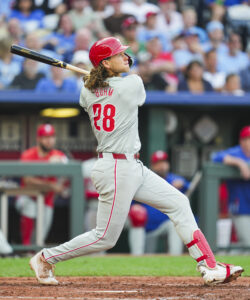
Bohm, 28, certainly isn’t a bad player or even a sub-par hitter. However, he’s only been a bit better than average over the past three years (106 wRC+), and while his 2024 campaign looked early on like a potential breakout, he cooled after a dominant April and hit .258/.303/.410 down the stretch (96 wRC+). He made some strides with the glove this year but had graded as a poor defender in each of his prior MLB campaigns.
More vital to Bohm’s trade candidacy is the simple fact that he’s tradeable in a way that many of the Phillies’ other hitters are not. No one is taking the final two years and $40MM on Nick Castellanos‘ contract unless the Phillies take back a similarly unenviable contract. Bryce Harper and Trea Turner aren’t going anywhere — not when both of their massive contracts contain full no-trade protection (and when both are important lineup cogs as well). Kyle Schwarber and J.T. Realmuto don’t have that same no-trade protection, but they’re both in the final seasons of weighty multi-year deals. Schwarber was the team’s second-best hitter behind Harper. Realmuto offers a good bat at a thin position where the market offers little to no way of replacing his production.
Bohm isn’t the only Phillie who’s likely being discussed in trades. Any of Brandon Marsh, Johan Rojas, Bryson Stott or Ranger Suarez could be of appeal to other clubs. None of the group is signed long-term. But Bohm best checks the combination of boxes that make him a trade candidate: dwindling club control (arb-eligible through 2026), productive output, plays a position that Philadelphia can fill with financial resources that some interested partners lack. Bohm alone probably isn’t going to net the Phillies the high-end closer they covet, but he could be moved for some degree of bullpen help or controllable/optionable rotation depth — another area in which the Phillies are lacking.
Let’s run through some speculative fits based on rival clubs’ roster needs and payroll situations:
Clear Fits
Angels: The Halos are paying Anthony Rendon for another two years but can’t count on him to stay in the lineup or produce at this point. Bohm gives them a more dependable and likely more productive option. He could also platoon with Nolan Schanuel at first base when the Angels face a tough lefty, or even step over there full-time if Rendon is healthy but Schanuel experiences growing pains. The Angels’ farm system isn’t a good one, but they have plenty of optionable, unproven young starters on a 40-man roster that has added veterans Yusei Kikuchi and Kyle Hendricks in free agency this offseason.
Astros: The priority is Bregman, but the Astros will need to go to lengths they’ve never approached under owner Jim Crane in order to retain their longtime third baseman. If Bregman ends up signing elsewhere, Houston could turn its focus to Willy Adames … unless he signs before Bregman, of course. They’ve considered a variety of contingencies, reportedly including an outside-the-box option in veteran second baseman Jorge Polanco. Bohm is a more straightforward fit. The Astros have some rotation depth and outfield depth to spare, both in the form of young players with MLB experience and upper-minors names who could debut in 2025.
Blue Jays: The Jays are in the Juan Soto hunt, but they’re more broadly just looking to beef up an offense that lacked depth and quality bats last season. If Bohm is Toronto’s primary acquisition toward that end, it’d be a disappointment for Jays fans. If he’s one of two or three newcomers, it looks more palatable. Toronto has toyed with the idea of giving Vladimir Guerrero Jr. more time at third base next year and has been linked to both Bregman and Adames. They’re clearly open to upgrades in the infield. Ernie Clement and prospects Orelvis Martinez, Will Wagner and Addison Barger are the primary options at the hot corner right now. Toronto is light on expendable rotation and bullpen depth, which could be a roadblock here.
Brewers: The Brewers aren’t going to re-sign Adames at market value. They’re fortunate to have two shortstop-caliber infielders elsewhere on the diamond in third baseman Joey Ortiz and Platinum Glove winner Brice Turang. Moving Turang to another position after that Platinum Glove might be a reach, but Ortiz could slide from third base to shortstop and give the Brewers the freedom to look for more offense at third base. Bohm’s salary is modest enough for the Brewers to stomach. There will be natural Bohm/Devin Williams speculation with both being trade candidates, but the Brewers have some younger arms they could dangle if they prefer not to deal from the big league roster.
Mariners: The Mariners are working on a limited budget this offseason and looking to add at first base and one of third base or second base (likely the former). Bohm isn’t the big power bat the M’s would probably prefer, but that might not be available to them if the front office is unwilling to trade from a vaunted big league rotation and if ownership indeed isn’t willing to increase last year’s payroll much. Bohm would at least accomplish the team’s ongoing goal of reducing its strikeout rate. There’s probably good reason to be wary of the Mariners acquiring a good-not-great hitter and hoping he can sustain or improve his production at T-Mobile Park, though. Nearly every veteran bat the Mariners have acquired/signed in recent years has gone on to have a career-worst season (e.g. Jorge Polanco, Mitch Garver, Kolten Wong, Teoscar Hernandez, Jesse Winker).
Royals: The Royals moved quickly to re-sign Michael Wacha and have since turned the focus to upgrading the lineup. Shipping Brady Singer to Cincinnati in exchange for Jonathan India gave them a contact- and OBP-driven leadoff option to put atop the lineup. Bohm is in many ways similar to India as a contact-heavy hitter with a mixed-bag defensive track reputation and average power. He’s not necessarily the impact bat the Royals are seeking, but he’d add another solid veteran to a lineup that’s built around putting the ball in play. They’ve reportedly expressed interest in Bohm already. Kansas City lines up nicely as a trade partner, given that they could offer the Phils some much-needed option rotation depth. Current third baseman Maikel Garcia is a light hitter but plus defender who could thrive in a utility role (or hold appeal to teams looking for affordable shortstop help).
Tigers: Detroit isn’t set at either infield corner. The hope is that former No. 1 pick Spencer Torkelson can yet solidify himself as a consistent power threat at first base, but that hasn’t happened yet. At third base, the Tigers are looking at a combination of Matt Vierling, Zach McKinstry, Andy Ibanez and top prospect Jace Jung. That last option, in particular, comes with high hopes but isn’t a sure thing by any means. The Tigers could acquire Bohm both as a solid option at third base but also a first base fallback in the event of continued struggles from Torkelson. Adding him would also theoretically make it easier to trade Jung in a package for a significant at another area of need, such as in the rotation or in left field.
Yankees: Assuming the plan is to move Jazz Chisholm Jr. back to second base, the Yankees don’t have a clear answer at third base next year. DJ LeMahieu isn’t aging well. Younger players like Oswald Peraza, Oswaldo Cabrera and Jorbit Vivas have yet to establish themselves. Bohm’s salary would be an affordable addition — of extra importance if the Yankees ultimately re-sign Soto — and his contact skills would differentiate from a Yankees roster that has a lot of swing-and-miss in the middle of the order.
Longer Shots
It’s plenty feasible that other trade options will become available as additional offseason dominos fall. There’s been plenty of speculation about the Red Sox dealing Triston Casas to add some pitching and also facilitate a move from third base to first base for Rafael Devers. In that scenario, Bohm could emerge as a third base option for Boston. The Pirates could consider Bohm if they miss on other targets at first base. If the Phils are willing to deal within their own division — perhaps a long shot for that very reason — the Mets could make sense if Pete Alonso leaves and Mark Vientos slides to first base. The Nats could view Bohm as an affordable candidate to keep third base warm for prospect Brady House before sliding over to first base. If the A’s strike out on free agents, they could feasibly look to the trade market as a way to add some payroll and ensure their ability to retain their status as a revenue-sharing recipient. The Reds have a crowded mix of young infielder but are lacking in established contributors. Bohm could fit there in the wake of Cincinnati’s Jonathan India-for-Brady Singer swap, but an outfield bat seems like a cleaner fit.
Rays’ Jeffrey Springs, Pete Fairbanks Drawing Trade Interest
There’s never an offseason where the Rays don’t have multiple players circulating the rumor mill, and this winter is no exception. Tampa Bay already flipped center fielder Jose Siri to the Mets last month, and there’s been plenty of speculation about the possibility of trades of some of their veteran players earning notable salaries. Yandy Diaz has often been the focus, but he’s one of several players who could draw interest. MLB Network’s Jon Morosi reports that closer Pete Fairbanks and left-hander Jeffrey Springs are among the Rays who’ve been popular in trade talks recently.
It’s not a huge surprise to see either player’s name pop up in trade rumblings. Fairbanks featured prominently on MLBTR’s list of top offseason trade candidates back in early November. Springs is the most expensive of at least six healthy rotation options for the Rays. Both players are signed for multiple seasons.
Springs, 32, has two years and $21MM remaining on a four-year, $31MM extension he signed prior to the 2023 season. The contract contains a $15MM club option for the 2027 season ($750K buyout). To this point, that contract hasn’t panned out as hoped, though not necessarily through any real fault of Springs. The journeyman southpaw broke out with the Rays in 2022, posting a sparkling 2.46 ERA with a strong 26.2% strikeout rate and terrific 5.6% walk rate in 135 2/3 innings. He looked like another late-blooming diamond in the rough unearthed by a Rays front office with a knack for just that type of discovery.
Unfortunately, Springs hasn’t been healthy since. He made three dominant starts to open the 2023 season (16 innings, one run allowed, 24-to-4 K/BB ratio) and then suffered a UCL tear that required Tommy John surgery. He missed the remainder of the ’23 campaign and made it back to the mound for seven big league starts and 33 innings late last year. The results were good in that limited sample. Springs posted a sharp 3.27 earned run average, fanned 26.1% of opponents and held his walks to a 7.7% rate. His average four-seamer was down from 91.4 mph in 2022 to 89.8 mph in 2024, however, and he saw similar velocity drops on his slider and changeup. Springs’ 12.9% swinging-strike rate was still strong, but it’s down from the 14.2% clip he displayed in 2021-23.
In addition to Springs, the Rays have Drew Rasmussen, Ryan Pepiot, Zack Littell, Taj Bradley, Shane Baz and a returning Shane McClanahan (2022 Tommy John surgery) all in the mix for starts next year. That’s in addition to yet-to-debut prospects like Joe Rock and Ian Seymour, who both excelled in the upper minors last year. Springs has looked the part of a high-end starter in the past but only for a fleeting span of about 150 innings across 2022-23. The Rays would be selling a bit low, but his $10.5MM salary is steep for them under normal circumstances — let alone at a time when the club is facing likely revenue losses following Hurricane Milton’s decimation of Tropicana Field’s roof and the club’s subsequent agreement to play at Tampa’s Steinbrenner Field — the spring training and Class-A home of the Yankees.
Fairbanks, 30, has been terrific when healthy in five seasons with the Rays. “When healthy” is an unfortunately crucial caveat, however, as the flamethrowing 6’6″ righty has never reached 50 appearances or topped 45 1/3 innings in a big league season. Dating back to 2020, Fairbanks touts a 2.89 ERA. He fanned nearly 35% of his opponents from 2020-23 but saw that number slip to a roughly average 23.7% this past season. Fairbanks didn’t have a huge loss of velocity on his heater, but it dipped from an average of 98 mph from ’20-’23 to 97.3 mph in 2024. His slider saw a larger drop, going from an average of 86.4 mph to 85 mph over those same periods.
The Rays signed Fairbanks to a three-year, $12MM contract that bought out all three arbitration years (2023-25) and guaranteed them control over his first free-agent season in the form of a 2026 club option. He’s owed $3.666MM this season with a $7MM option ($1MM buyout) on his ’26 campaign. Even for a partial season of a reliever with Fairbanks’ upside, it’s a pretty modest price to pay. As such, there’s no inherent urgency for the Rays to move him. They might feel a bit more motivated to move Springs and his weightier salary, but to this point it’s not clear the Rays are necessarily shopping either — just that they’ve drawn interest.
The Rays’ lot in life, of course, is to constantly listen on all of their players as they progress through their arbitration years or the latter stages of any contract extensions. This year’s stadium troubles and the uncertainty surrounding their home in 2026 and beyond only add to that.
At the same time, Tampa Bay already significantly culled payroll with their series of deadline trades and via the departures of some arb-eligible players (via trade and non-tender). RosterResource projects a bit less than $79MM in payroll for the Rays this coming season — already a drop of more than $10MM from their 2024 levels. Trading Springs, Fairbanks or other veterans like the aforementioned Diaz or Brandon Lowe could further reduce spending and free up the Rays to take on some money in other trades. With regard to free agency, they’re in a similar spot to the A’s in that they’ll have to persuade players to sign on for at least one year (and likely more) playing their home games in a minor league facility.
MLBTR Chat Transcript
Click here to read a transcript of Tuesday’s chat with MLBTR’s Steve Adams.
Mariners Looking At Corner Infield Upgrades More Than Second Base
The Mariners are known to be looking for upgrades at multiple infield positions this offseason, with shortstop J.P. Crawford standing as their only locked-in starter. The M’s have strong interest in bringing back either Justin Turner or Carlos Santana for a second go with the organization at first base, and they’ve reportedly been exploring their options at both second base and third base. Ken Rosenthal of The Athletic now writes that Seattle’s focus is more on third base options than at second base. The M’s currently have in-house options like Ryan Bliss, Dylan Moore and top prospect Cole Young at second base.
As it stands, Moore and recent DFA acquisition Austin Shenton are the most prominent options at third base. Moore and fellow infielder Leo Rivas profile better as utility options, with Moore in particular representing a potential short-side platoon option if the M’s add a left-handed bat.
Payroll stands as an obvious obstacle for the Mariners once again. Seattle ownership anticipates an increase in 2025, but likely not by a notable amount. Following the team’s non-tenders of Josh Rojas, Austin Voth, Sam Haggerty and JT Chargois, Adam Jude of the Seattle Times suggested the M’s could have somewhere in the vicinity of $16MM with which to work. There’s surely some wiggle room there, but it’s unlikely the Mariners are going to cannonball into the free agent pool with a splash for, say, Alex Bregman or Willy Adames. Even if the funds for such a move were there, president of baseball operations Jerry Dipoto prefers to operate primarily on the trade market. In nine years with the Mariners, he’s only given a multi-year deal to one position-player free agent (Mitch Garver at two years and $24MM).
Trade options aren’t exactly plentiful, but there are some names known to be on the block. The Phillies have been shopping Alec Bohm around as they look to change up their offense. Bohm isn’t an elite bat and has a mixed-bag of defensive results at the hot corner, but he’s available and affordable enough, with a projected $8.1MM salary (courtesy of MLBTR contributor Matt Swartz). Elsewhere in the NL East, former Mets top prospect Brett Baty stands a change of scenery candidate following the emergence of Mark Vientos. Even if the Mets allow Pete Alonso to walk in free agency and move Vientos across the diamond, they could look to bring in a higher-profile third baseman.
Nolan Arenado is also widely known to be available, but he’s owed $32MM next season (plus $27MM in 2026 and $15MM in 2027). The Rockies are paying $5MM of that in each of the next two seasons under the terms of the trade that sent Arenado from Denver to St. Louis, but that’s still a big contract for a team that ostensibly has limited budget space. Speculatively speaking, the Mariners and Twins could line up on a deal for a second straight winter. Minnesota has a crowded infield mix and could consider moving Jose Miranda with both Brooks Lee and Royce Lewis as options to flank shortstop Carlos Correa. Then again, Miranda could just move across the diamond to first base, so it’s not as though he’s lacking a clear opportunity in Minneapolis. The Marlins would probably listen on Jake Burger, but he’s the type of low-OBP, strikeout-prone slugger from whom the Mariners have been trying to move away in recent seasons.
The Mariners’ options on the trade market would surely open up if they were willing to deal from their rotation. However, at season’s end, Dipoto not only indicated that moving a controllable starter wasn’t Plan A or B for the Mariners — he likened the notion to “Plan Z” (link via MLB.com’s Daniel Kramer).
Dipoto and GM Justin Hollander have both spoken openly about their fondness for the Mariners’ excellent young rotation and both expressed reluctance to move on from the group. Still, if Seattle were to make any of Logan Gilbert, George Kirby, Bryce Miller or Bryan Woo available, they’d perhaps be in position to seek similarly appealing young hitters (e.g. Baltimore’s Jordan Westburg or Coby Mayo).
One point worth considering is that the Mariners’ depth beyond the current rotation isn’t as deep as some might think. Former No. 6 overall pick Emerson Hancock‘s stock is down considerably, and he’s viewed largely as a back-end starter. Righty Taylor Dollard has only pitched 8 1/3 innings over the past two seasons. Logan Evans, a 12th-rounder in 2023, significantly boosted his stock with a big 2024 but still hasn’t pitched above Double-A. It’s a similar story with 2021 third-rounder Michael Morales. The Mariners already know they’re not likely to be as fortunate with pitcher health as they were in 2024, and trading one of the current arms only further creates the potential to overexpose some of those inexperienced arms in the event of an injury in the big league rotation.