
Angels, Nationals Have Discussed Jeimer Candelario Trade
The Angels have had talks with the Nationals about third baseman Jeimer Candelario, reports Jon Morosi of MLB.com (Twitter link). The Halos just pulled off the biggest trade of deadline season thus far and continue to look for ways to upgrade the roster. It’s unclear whether a deal between the clubs is likely to come together.
Candelario, 29, spent several years as the Tigers’ primary third baseman before struggling through a career-worst season in 2022, when he hit just .217/.272/.361 in 124 games. Detroit non-tendered him rather than giving him a raise in what would’ve been his final year of arbitration eligibility, and the Nationals scooped him up on a one-year, $5MM deal in free agency. The gambit could scarcely have worked out better for the Nats.
In 94 games and 398 plate appearances, Candelario has rebounded with a .257/.338/.486 batting line, swatting 16 homers in addition to 29 doubles and a pair of triples. He’s already swiped five bases, a career-high, and should surpass his career-best mark of 19 home runs before long. The switch-hitting Candelario has never been known for his glovework, but he’s posted positive marks at third base in the estimation of Defensive Runs Saved (1), Ultimate Zone Rating (2.0) and especially Statcast’s Outs Above Average (6) so far in 2023.
The Halos certainly didn’t foresee themselves in position to be poking around the third base market at any trade deadlines in the near future three years ago, when they signed Anthony Rendon to a seven-year, $245MM contract. At the time, they hoped to be adding a perennial MVP candidate into a lineup that already featured MVP-caliber talents Mike Trout and Shohei Ohtani. Rendon garnered MVP votes each season from 2017-19, including a third-place finish in his final season with the Nats before he became a free agent.
Although he was excellent for the Halos in the shortened 2020 season, things haven’t gone well since. Rendon has played in just 148 games since Opening Day 2021, hitting .235/.338/.364 while battling myriad injuries along the way. He’s currently on the shelf with a shin injury. The Angels have already acquired third base options Mike Moustakas and Eduardo Escobar in earlier summer trades, to say nothing of their signing of Brandon Drury as a free agent this past offseason. They’re not necessarily lacking in options at the hot corner, but Candelario would nonetheless provide an affordable, high-quality bat to slot into the lineup. If Rendon were to come back from the injured list and reclaim the third base job, Candelario could certainly fit into the mix at first base; he’s logged 518 career innings at the position.
The Angels sudden, blockbuster acquisition of Lucas Giolito and Reynaldo Lopez from the White Sox has already pushed them north of the luxury tax line, so the remaining $1.8MM that Candelario would add to their luxury ledger isn’t likely to be a major deterrent. They’ve already taken Ohtani off the trade market, and the Giolito/Lopez trade — for their two top prospects — only underscores the notion that owner Arte Moreno and GM Perry Minasian are going for broke in Ohtani’s final year of club control. Whether or not a deal involving Candelario comes together, it seems quite likely that the Angels will be in the market for further upgrades in the lineup. At this point, there’s no sense in holding anything back. They’ve committed to pushing in for a 2023 postseason bid, and there’s no turning back.
Astros Activate Yordan Alvarez, Jose Altuve
The Astros announced Wednesday that outfielder/DH Yordan Alvarez and second baseman Jose Altuve have been reinstated from the injured list. First baseman/outfielder Bligh Madris and infielder David Hensley were optioned to Triple-A in a corresponding pair of moves.
Alvarez, who just turned 26 last month, has cemented himself as one of the sport’s best young hitters in recent seasons. He boasts a .277/.388/.589 slash and 17 homers in just 232 plate appearances this season but has missed more than six weeks due to an oblique strain.
The Astros have posted a solid .252/.323/.433 line as a team even since Alvarez’s injury, but it’s still difficult to overstate just how big a boost his return will provide. Houston general manager Dana Brown has been quite candid about his desire to add a left-handed bat prior to next week’s trade deadline, but Alvarez’s return will at least lessen some of the urgency for such an acquisition.
Altuve has also been on the shelf with an oblique strain, though his wasn’t as severe as the one sustained by Alvarez. He hit the IL nearly a month after his teammate, on July 4, but will nonetheless return on the same day — just three weeks after landing on the shelf.
It’s been an even more frustrating season for Altuve than for Alvarez, from a health standpoint. He missed nearly two months early in the season after suffering a broken thumb during the World Baseball Classic and has only managed to get into the lineup for 32 of the Astros’ games this year. He’s been characteristically excellent when on the field, batting .264/.371/.479 with a career-best 14% walk rate in 143 trips to the plate.
It’s a major pair of returns for Houston that’ll augment the lineup more than any trade might have, but the ‘Stros still figure to be active between now and next Tuesday. In addition to Brown’s stated desire to add a left-handed bat with some defensive versatility, he’s also been open about his hopes to add a starting pitcher and a reliever while trades are still permitted.
Braves Outright Lucas Luetge, Dereck Rodriguez
The Braves announced Wednesday that left-hander Lucas Luetge and righty Dereck Rodriguez were both assigned outright to Triple-A Gwinnett after clearing waivers. Both were designated for assignment earlier this week, and both will have the option of rejecting an outright assignment in favor of free agency (though Luetge would forfeit the remainder of his $1.55MM salary in order to do so and is thus likely to accept).
Luetge, 36, came over from the Yankees in an offseason trade following a somewhat surprise DFA in the Bronx. He’d pitched to a 2.71 ERA with excellent strikeout and walk rates over 129 2/3 innings for the Yanks from 2021-22, but the decision to move on in spite of that success looks rather prescient; in 11 2/3 innings with Atlanta, Luetge has been tagged for 11 runs on 17 hits and seven walks. He’s been better in Gwinnett, where he’s allowed four runs with an 8-to-1 K/BB ratio in 9 2/3 innings.
Rodriguez, the son of Hall of Fame catcher Ivan Rodriguez, was claimed off waivers from the Twins earlier this season and has appeared in two games with the Braves, tossing 2 2/3 shutout innings. He’s spent the bulk of the season in Triple-A between the Twins and Braves, pitching to a combined 5.79 ERA in 42 innings.
The 31-year-old Rodriguez, a sixth-round pick of the Twins back in 2011, has a career 4.22 ERA in 232 1/3 big league innings and a 5.12 ERA in 302 1/3 frames in parts of five Triple-A seasons.
Zach Eflin Headed For MRI On Left Knee
Rays right-hander Zach Eflin exited today’s game after just four innings, and he’s now headed for an MRI after experiencing discomfort in his left knee, Marc Topkin of the Tampa Bay Times tweets. It’s an ominous development both for a pitcher with chronic knee issues and a Rays rotation that has already been clobbered by injuries in 2023.
Eflin, 29, signed a three-year deal worth a guaranteed $40MM in Tampa Bay this offseason — the largest free-agent expenditure (though not the largest overall contract) in Rays history. He entered play with a 3.36 ERA, 25.7% strikeout rate and sensational 3.6% walk rate in 112 1/3 innings — already his highest total since 2019. However, Eflin was hit hard today, yielding five runs on seven hits and a walk, and he departed after four innings.
Eflin has spoken openly about his battles with knee problems that date back to before he was even drafted. He underwent surgery to repair the patellar tendon in both knees back in 2016, and in 2021 he underwent a second surgery on his right knee. Further problems in that right knee sidelined Eflin for more than two months last summer.
That Eflin’s current issue is in his left knee and not his twice-repaired right knee isn’t likely to be a source of much comfort for the Rays and their fans. The team was surely wary of the risk of renewed knee problems when signing Eflin, though his performance to this point in the season does plenty to highlight why the Tampa Bay front office was willing to take that gamble.
The Rays are already dealing with several notable injuries in the rotation. Shane Baz had Tommy John surgery last September and isn’t expected to pitch in 2023. Jeffrey Springs underwent Tommy John surgery earlier this year and won’t return until 2024. Drew Rasmussen‘s season is also over, owing to surgery to repair a flexor tear. Lefty Josh Fleming is on the 60-day injured list due to an elbow issue.
Tampa Bay is already known to be on the hunt for rotation upgrades, and any absence of note for Eflin would only hasten their pursuits. They’ve been linked to the Cardinals’ rental starters and were reported this morning to be in talks with the White Sox on right-hander Lance Lynn.
With sudden uncertainty regarding Eflin’s health, the Rays’ only three healthy starters are Shane McClanahan, Tyler Glasnow and rookie Taj Bradley. It’s a talented trio, but injuries have thinned out the team’s depth and contributed to the Rays’ slide in the standings after a dominant start to the season. President of baseball operations Erik Neander, GM Peter Bendix and the rest of the staff seem all but certain to augment the rotation between now and next Tuesday’s trade deadline.
MLB Owners Vote To Extend Commissioner Rob Manfred
Major League Baseball’s owners have voted to extend the contract of commissioner Rob Manfred through the 2028 season, reports Evan Drellich of The Athletic. The four-year extension will run through Jan. 25, 2029. The league has since announced the extension via press release.
“It is an honor to serve the best game in the world and to continue the pursuit of strengthening our sport on and off the field,” Manfred said within today’s press release. “This season our players are displaying the most vibrant version of our game, and sports fans are responding in a manner that is great for Major League Baseball’s future. Together, all of us in the game will work toward presenting our sport at its finest and broadening its reach and impact for our loyal fans.”
A new contract for Manfred was seen as a foregone conclusion. Manfred was unanimously approved for a five-year extension when his contract was last up for vote, and he needed only a simple majority to be extended once again. He’s been the commissioner since 2014, when he succeeded the retiring Bud Selig.
“At a critical moment in the history of our game, Commissioner Manfred has listened to our fans and worked closely with our players to improve America’s pastime,” said Mariners chairman John Stanton, who also served as the chair for the meeting in which the vote was held. “Under his leadership, we have been responsive to the fans’ desire for more action and better pace, continued the game’s spirit of innovation, expanded MLB’s role in youth baseball and softball, and beyond. The significant momentum that MLB has built reflects his ongoing initiatives that are advancing the game.”
While Manfred is unpopular with a notable portion of the fanbase — many bristle at recent rule changes, expansion of the playoff format, the commissioner’s past comments calling the World Series trophy a “piece of metal,” etc. — the owners have good reason to extend his contract. Manfred has helmed negotiations of lucrative national television contracts with FOX, Turner Sports and ESPN, in addition to brokering highly profitable streaming deals with Apple and NBC Universal (Peacock). Heading into the 2022 season, Forbes reported that each MLB team was set to receive a hefty $65MM from those national television and streaming deals alone — before even considering gate revenue, local television deals, etc.
Manfred also navigated two of the most challenging period in recent MLB history, representing the owners’ interest along the way during return-to-play negotiations during the pandemic-shortened 2020 season and during the recent wave of collective bargaining with the MLB Players Association.
The league implemented what ended up being a 99-day lockout following the 2021 season, but after months of negotiation with the MLBPA, the two sides wound up reaching an agreement on a new collective bargaining agreement spanning the 2022-26 seasons. The eleventh-hour deal was reached in time for a full slate of 162 games to be played last year — this time with a newly expanded 12-team postseason format.
Broadly speaking, the business of baseball is as profitable as ever. Manfred told Bill Shaikin of the Los Angeles Times last year that league revenues were approaching a record $11 billion for the 2022 season. It likely wasn’t coincidental that MLB took the time this morning to highlight how last night’s average MLB attendance was its best non-holiday performance on a Tuesday since 2015 and second-best since 2008. As the sport moves further and further from that shortened 2020 season that was played in the absence of fan attendance, ownership is clearly confident in Manfred’s ability to bring about further revenue growth.
Tigers’ Jose Cisnero, Chasen Shreve Garnering Trade Interest
Tigers relievers Alex Lange and Jason Foley are the club’s most valuable trade chips in the bullpen, but veterans Jose Cisnero and Chasen Shreve are drawing interest as well, per Chris McCosky of the Detroit News. Both are free agents at season’s end, giving both a good chance to be moved by next Tuesday’s deadline.
Cisnero, a 34-year-old righty, has pitched to a 3.96 ERA in 38 1/3 innings this season and carries a 3.19 ERA in 155 frames dating back to the 2020 season. He’s averaging 96.1 mph on his heater, striking out 25.7% of his opponents against an 8.4% walk rate, and inducing grounders at a health 45.2% clip in 2023. He’s earning $2,287,500 this season.
Shreve, who turned 33 earlier this month, is sporting a less-appealing 4.82 ERA but has a more appetizing secondary profile. He’s punching out a strong 24.2% of his opponents against a 6.8% walk rate, sports a nice 12.9% swinging-strike rate and has kept the ball on the ground at a 47.7% clip. Fielding-independent metrics (3.89 xFIP, 3.57 SIERA) feel he’s performed far better than that ERA would suggest. Notably, five of the 20 runs Shreve has allowed this year came in one nightmare outing; he has a 3.67 ERA and 31-to-7 K/BB ratio in 27 innings since.
Originally signed to a minor league deal, Shreve is earning a $1.25MM base salary in Detroit, though his contract was an incentive-laden deal and he’s already begun to tap into those bonuses. He’s already triggered a trio of $75K bonuses for reaching 20, 30 and 35 innings pitched, and he’ll unlock another $75K bonus when he hits 40 innings. Shreve’s contract also pays him $100K at 45 and 50 innings and $125K innings at both 55 and 60 innings.
Neither reliever figures to draw a substantial haul of talent on his own, but the 46-55 Tigers figure to be open to dealing either, given their looming free agency. Neither would receive a qualifying offer, and Detroit could use those spots in the bullpen to look at younger arms down the stretch. Speculatively, either could be paired up with one of the Tigers’ other clear-cut trade candidates — Eduardo Rodriguez, Michael Lorenzen — to enhance the return.
McCosky writes that Cisnero and Shreve have thus far generated more trade interest than either Lange or Foley, though that’s surely just due to likely asking price on the latter duo. Both Lange and Foley are under Tigers control through the 2027 season, and while neither can be entirely ruled out as a trade candidate, that remaining club control will naturally lead to a much higher asking price. Be that as it may, ESPN’s Jeff Passan suggests that some clubs could eventually turn to names like Lange and Foley in their quest for bullpen upgrades, given the underwhelming slate of names on this summer’s rental market.
Twins Eyeing Bullpen Help, Right-Handed Bats
The Twins are the only team in the AL Central above .500, and president of baseball operations Derek Falvey unsurprisingly tells Aaron Gleeman of The Athletic that they’ll accordingly operate as buyers at this year’s deadline. Bullpen help and right-handed bats are the primary areas of focus for Minnesota between now and next Tuesday’s deadline.
One club the Twins have spoken to has both to offer. Darren Wolfson of SKOR North Radio and 5 Eyewitness News tweets that the Twins have talked with the Nationals, who have been scouting Minnesota’s Triple-A affiliate in St. Paul. The Nats are just one of many teams the Twins have spoken too, of course, but the presence of outfielder Lane Thomas and surely available relievers like Kyle Finnegan present some obvious fits.
Falvey suggested that the Twins will be in the market for more “complementary” pieces, which might take someone like Thomas off the table, though as a lefty-mashing outfielder with multiple seasons of club control remaining beyond the current year, he’s an on-paper fit at the very least.
Falvey noted, however, that he’s amenable to trading for rental players. The trade market figures to have plenty of righty-swinging options who fit that bill — Randal Grichuk, Tommy Pham, Mark Canha and Adam Duvall potentially among them. (Canha has a 2024 option.)
The Twins are hitting just .219/.293/.369 against left-handed pitching this season, thanks in no small part to a glut of left-handed-hitting outfielders that at one point looked likely to lead to an offseason trade. That never materialized, however.
[Related: Twins’ Outfielders Drawing Trade Attention]
Many of the Twins’ offseason acquisitions who were added with an eye toward bolstering the lineup against southpaws have fallen shy of expectation in that regard. Christian Vazquez, Donovan Solano and Michael A. Taylor all have some past success against lefties, but none has been more than average against southpaws in 2023. Kyle Farmer has hit lefties well but not up to his prior standards.
Incumbent righty bats like Byron Buxton and the previously optioned (and now injured) Jose Miranda, meanwhile, have struggled against southpaws. Royce Lewis and Jorge Polanco have hit lefties well, but both are on sitting alongside Miranda on the injured list. Polanco has been out since early June. Lewis hit the IL in early July and isn’t expected back until next month.
Similarly, the Twins are missing some key contributors in the bullpen. Left-hander Caleb Thielbar has quietly become an excellent setup man since his 2020 return to the big leagues after a five-year absence. The 36-year-old has pitched to a 3.10 ERA with a 30% strikeout rate and 7.7% walk rate since 2020 but has just 10 1/3 innings this year due to a pair of oblique injuries.
Brock Stewart, another diamond-in-the-rough find for the Twins, returned to the Majors for the first time since 2019 this year and has posted a 0.70 ERA and 35.4% strikeout rate for the Twins. However, he’s been out since late July with an elbow issue. Stewart threw his first bullpen session today and will throw another Saturday, per Do-Hyoung Park of MLB.com (Twitter link), but it’s not yet clear just when he’ll be back in the Twins’ bullpen. The absence of both Thielbar and Stewart was felt last night when the Twins’ relief corps squandered a four-run lead and strong start from Pablo Lopez in a game they eventually dropped to the Mariners by a score of 9-7.
White Sox Discussing Lance Lynn With Rays, Dodgers
11:53am: The Sox and Rays are indeed discussing Lynn, Marc Topkin of the Tampa Bay Times tweets, but a deal between the two parties is not yet seen as imminent. The Rays have interest in a number of starters and are in active talks on multiple starting pitchers.
Likewise, the White Sox aren’t locked in on the Rays alone as a potential trade partner for Lynn. Nightengale follows up by tweeting that the Dodgers remain interested in both Lynn and right-hander Lucas Giolito and continue to discuss both with the ChiSox.
With Dustin May out for the season and each of Clayton Kershaw, Ryan Pepiot, Noah Syndergaard and Walker Buehler on the injured list, the Dodgers have a trio of rookies (Bobby Miller, Emmet Sheehan, Michael Grove) behind Julio Urias and Tony Gonsolin in the rotation at the moment. All of the Dodgers’ Opening Day rotation members have been on the injured list at some point this season, so it’s only natural for them to explore upgrades — particularly as their collection of young starters continues to push their workloads to previously unreached levels.
9:49am: The White Sox and Rays are in active discussions on a trade regarding right-hander Lance Lynn, tweets Bob Nightengale of USA Today. The two teams have been exchanging names of potential minor leaguers in the swap.
Tampa Bay is one of the 10 teams on Lynn’s no-trade list, but talks have apparently advanced to the point where the White Sox have already approached him about the possibility of approving the deal. Nightengale adds that Lynn has informed the team he would waive that no-trade protection for a chance to pitch for a contending Rays club.
Lynn, 36, is in the second season of a two-year, $38MM extension he signed with the White Sox two years ago. The veteran right-hander was a durable an excellent pitcher for the Rangers and ChiSox from 2019-22, pitching to a combined 3.42 ERA with plus strikeout and walk rates in 571 innings during that time, but the 2023 season has been a struggle.
While Lynn is still missing bats at a high level (27.3% strikeout rate, 14% swinging-strike rate), he’s been more homer-prone this season that any point in his lengthy Major League career. The 6’5″ righty has yielded an average of 2.19 homers per nine innings pitched, which has contributed to what would be a career-worst 6.18 ERA on the season.
That mark is unsightly, of course, but Lynn has seen what’s surely an anomalous 21.5% of his fly-balls turn into home runs. That’s more than double his 10.1% career mark and nearly nine percentage points higher than the league average of 12.4%. Homer-to-flyball rate tends to stabilize over larger samples, and any team acquiring Lynn would surely be hoping there’s regression in that regard. That seems inevitable; Lynn’s current 21.5% homer-to-flyball rate would be the fourth-highest mark of any pitcher in the past decade. Furthermore, one can imagine that getting out of the homer-friendly Guaranteed Rate Field would help to alleviate those home run woes.
The Rays didn’t look like a team that’d need to acquire outside help for the rotation early in the year. Tampa Bay began the season in dominant fashion, but the Rays have seen Jeffrey Springs (Tommy John surgery) and Drew Rasmussen (flexor surgery) go down with season-ending injuries. Depth starter Josh Fleming is on the 60-day IL due to an elbow issue.
At present, the Rays are running out a strong quartet of Shane McClanahan, Tyler Glasnow, Zach Eflin and top prospect Taj Bradley. Lynn would slot into that group and give the Rays an upside play for the final spot in the rotation. At worst, he’d be a durable innings eater who could spare the bullpen and round out the rotation. At best, he could become the Rays’ latest pitching reclamation. Tampa Bay has a reputation for getting the best out of its pitchers — thanks to a combination of its renowned analytics department, advance scouting, coaching and player development — and if the Rays can get Lynn back into his 2019-22 form, he’d be a bona fide playoff-caliber starter.
Lynn’s contract contains an $18MM option for the 2024 season. There’s a $1MM buyout on that provision, making it a net $17MM decision. As it stands, he’s clearly trending toward a buyout, but with a big finish to the season it’s conceivable he could yet play his way into having that option picked up.
That’d be a steep price for the Rays of all teams, but Tampa Bay has shown increased willingness to spend in recent years. The Rays made a legitimate run at signing Freddie Freeman in free agency, reportedly putting forth a six-year offer in the $150MM range. They also extended Glasnow on a deal that’ll pay him $25MM next year and signed shortstop Wander Franco to an 11-year, $182MM deal. Even this past offseason’s signing of Eflin at three years and $40MM was a notable departure from the team’s typical stinginess on the open market.
Lynn is owed about $6.8MM of this year’s $18.5MM salary between now and the end of the season, plus at least that $1MM buyout on the option. Between that salary and his struggles with home runs, his trade value certainly isn’t close to where it might’ve been entering the season, but the Sox could sweeten their return by offering to pay down some or all of the remaining money he’s guaranteed in 2023.
Padres Have Turned Away Interest In Blake Snell, Josh Hader
The Padres’ season has been an abject disappointment, but despite a 10-game deficit in the NL West and a six-game gap in the NL Wild Card chase, they apparently remain intent on keeping the roster together. ESPN’s Jeff Passan writes that the Friars have received and thus far rebuffed interest in lefties Blake Snell and Josh Hader.
Both southpaws are free agents at season’s end. Snell is wrapping up the final season of a five-year, $50MM contract extension originally signed with the Rays. He’s earning $16MM this season. Hader is in his final season of arbitration eligibility and being paid $14.1MM.
After a rocky start to the season, the 30-year-old Snell has rediscovered the form that helped him win the American League Cy Young Award in 2018. Dating back to mid-May, Snell has pitched to a preposterous 0.78 ERA and 35.9% strikeout rate in 69 innings. He’s walked an ugly 13.4% of his opponents during that time, although that number is at least partially skewed by one anomalous start in which he issued seven free passes. Overall, Snell carries a 2.61 ERA. He’s running a strikeout rate north of 30% for the sixth consecutive season.
Hader, similarly, has rebounded this season. Much was made of the lefty’s struggles prior to last July’s trade to San Diego and subsequent rough patch early in his Padres tenure. However, he closed out the year with a dominant stretch and was excellent throughout the postseason as well. He’s backed that up with 38 innings of 0.95 ERA ball, 24 saves and a massive 38.4% strikeout rate in 2023. Like Snell, he’s too prone to free passes (13.2% walk rate), but Hader’s penchant for missing bats has helped to mitigate any potential damage.
Both pitchers would be clear candidates to receive qualifying offers at season’s end, and both would surely reject in search of a lucrative multi-year deal in free agency (barring a notable second-half injury or collapse). As such, the Padres can feel confident that they’ll at least come away with a pair of compensatory picks in next year’s draft. However, since they’re luxury-tax payors, those picks would land after the fourth round rather than the standard slotting between Competitive Balance Round B and Round 3 of the draft.
The luxury tax comes into play in another regard for the Padres, too. San Diego is currently about $4MM north of the third line of luxury penalization ($273MM), per Roster Resource. That’s the point at which a team’s top pick is pushed back by 10 selections in the following summer’s draft. Trading Snell and the remainder of his $10MM luxury hit ($3.655MM, as of this writing) wouldn’t drop the Padres under that threshold. Hader ($5.154MM still owed to him) would do so. To be clear, there’s no indication the Padres are endeavoring to drop below that line at this time.
For much of the offseason, the Padres appeared reluctant to cross that third luxury barrier. Many of the team’s late-offseason dealings were structured in convoluted ways designed to tamp down their luxury-tax implications, including their extension of Yu Darvish and signing of Michael Wacha. They’ve nevertheless wound up north of that line and are currently on pace to have next summer’s top pick dropped by 10 spots.
If owner Peter Seidler’s comments earlier this month are any indication, the loss of draft capital isn’t likely to be a deterrent. On July 2, when the Padres were eight games under .500, 11.5 games back in the division and 8.5 games out of the Wild Card chase, Seidler pledged that his team would not “reverse course.” San Diego has played better since that time, going 11-7 and trimming that Wild Card deficit by two and a half games.
There’s an argument to be made that the Padres could explore deals for Snell and/or Hader, prioritizing near-MLB help and simultaneously looking to back-fill the roster with lower-cost rentals. I explored as much in a piece for MLBTR Front Office subscribers a couple weeks back. Doing so could net talent that would help in 2024 and beyond while simultaneously improving their 2024 draft outlook and at least loosely keeping their 2023 postseason aspirations afloat. That’d be a fine line to walk, however, and the Padres’ postseason chances are obviously greater if they simply hold onto Snell and Hader.
At least for now, that appears to be the front office’s plan. Passan suggests the Padres could look to add to their bullpen and perhaps turn to the farm system if those efforts come up empty.
The remaining handful of games between now and next Tuesday’s trade deadline remain worth monitoring. The Friars have their series finale against a free-falling Pirates club right now and will play the last-place Rockies next Monday, the final day before the deadline. That pair of favorable matchups bookends a pivotal three-game set against the AL West-leading Rangers.
If the Padres can pull themselves up to .500 or at least pick up another game or two in the Wild Card hunt, it stands to reason they’ll continue their all-in approach to the current season. On the other hand, a series of losses could conceivably make the front office give more consideration to a soft sell of rental pieces. As with so many clubs around the league, the next few games will be critical in shaping the Padres’ approach to the deadline.
Dodgers Acquire Enrique Hernandez
Enrique Hernandez is back with the Dodgers. Los Angeles announced they’ve acquired the utilityman (along with cash considerations) from the Red Sox for relievers Nick Robertson and Justin Hagenman. Boston is reportedly paying down $2.5MM of the approximate $3.6MM remaining on Hernandez’s contract.
Hernandez, 31, is struggling through one of the worst seasons of his career, batting just .222/.279/.320 in 323 plate appearances. The offseason injury of Trevor Story — which required elbow surgery — prompted the Sox to move Hernandez from center field to shortstop. The results weren’t pretty, with Hernandez returning to a position he’d barely played since 2018 and posting some of the lowest defensive grades of any player at any position (-6 Defensive Runs Saved, -13 Outs Above Average in just 484 innings).
The extent to which the defensive struggles also impacted Hernandez’s mindset at the plate can’t be known, but his production hasn’t dipped to this level since the 2016 season. He’s hitting .260 against left-handed pitching — albeit with a lowly .314 OBP and .338 slugging percentage — but has been a nonfactor against right-handed pitching (.209/.266/.314).
Struggles on both sides of the ball notwithstanding, Hernandez is a career .259/.346/.465 hitter against southpaws. The Dodgers will hope that a return to the team he called home for the majority of his career can bring about a turnaround at the plate and/or on the field. Los Angeles has hit well against lefties as a team, but that’s generally been in spite of poor production from a cast of outfielders that has looked lost against southpaws.
All of David Peralta, Trayce Thompson and Jason Heyward have struggled in that regard. James Outman is getting on base at a .366 pace against lefties but not hitting for power and striking out at a 34% clip. Chris Taylor has gotten on base at a lowly .268 rate but at least hits lefties for power.
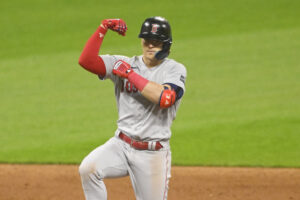
There’s no guarantee that Hernandez will improve the team’s overall production against southpaws, but he’s a low-cost roll of the dice as a bench player who’s had success in just this type of limited role before — with this very team, no less. Given that the Dodgers have been cycling through journeyman like Yonny Hernandez and Jake Marisnick on the bench, there’s some sense to seeking lower-cost stability. Hernandez figures to be a boon in the clubhouse at the very least, and any big early hits following the swap will clearly be well-received by a fanbase with which he was popular during his last tenure. There’s minimal risk in displacing Hernandez, though the Dodger faithful will surely be hoping this trade is merely a footnote among a larger slate of deadline transactions rather than a focal point of the front office’s approach to upgrading the roster.
For the Red Sox, with Story nearing a return, they’ll subtract Hernandez from their glut of middle-infield and outfield options. Jarren Duran‘s emergence in center field put a serious dent in Hernandez’s role with the team — particularly with Masataka Yoshida and Alex Verdugo locked into the corners. Yu Chang is a more versatile infield defender, meanwhile, and the Sox apparently prefer to continue giving the more controllable Christian Arroyo opportunities over Hernandez — a pending free agent playing on a one-year, $10MM contract extension he signed last winter.
Per Roster Resource, the Dodgers had a $228MM payroll and $245MM luxury-tax bill prior to the trade. Tacking on roughly $1.1MM won’t put them anywhere near the third tier of luxury-tax penalization, which begins at $273MM and is the point at which teams see their top pick in the following year’s draft pushed back by 10 spots. As a third-time luxury tax offender in the midst of the first penalty bracket, the Dodgers would pay a 50% dollar-for-dollar tax on all overages. As such, Hernandez’s remaining $1.1MM actually amounts to about $1.65MM in terms of total expenditure.
In return for picking up the bulk of the tab, Boston lands a couple pitchers who add desired right-handed middle relief depth. Robertson, 25, is on the 40-man roster and has made nine big league appearances for Los Angeles this season. The rookie righty has allowed 10 runs (seven earned) over his first 10 1/3 frames. He’s fanned 13 against four walks, though, missing bats at a decent 11.4% clip. Robertson is a fastball-changeup pitcher who has averaged a little under 95 MPH on his heater in his brief MLB look.
He’s having an excellent year in Triple-A. Over 28 1/3 innings with the Dodgers’ top affiliate in Oklahoma City, the 6’6″ hurler owns a 2.54 ERA. Robertson has punched out an excellent 37.5% of batters faced at the top minor league level, where he’s also inducing grounders on half the batted balls he allows. The former seventh-round pick owns a 3.54 ERA with a 30% strikeout rate over parts of four minor league campaigns. He’ll start his Boston tenure on optional assignment to Triple-A Worcester but could be recalled to work out of the big league bullpen at any point.
Hagenman has never played in the majors. Like Robertson, he’s having a strong year in Triple-A. Through 55 innings spread over 25 appearances, the 26-year-old righty has a 2.78 ERA. He’s punching hitters out at a solid 27% clip while keeping his walks to a tidy 5% rate. The Penn State product went unselected in last year’s Rule 5 draft after posting a 6.08 ERA in Triple-A; he’d be eligible for the Rule 5 again next winter but has a good chance to earn a spot on the Sox’s 40-man roster before then after his much better second season at the top minor league level.
David Vassegh of SportsNet Los Angeles noted this afternoon the Sox and Dodgers were discussing Hernandez trades. Ken Rosenthal and Fabian Ardaya of the Athletic first reported the Dodgers were acquiring Hernandez. Alex Speier of the Boston Globe reported the Red Sox would receive two upper minors relief pitchers. Chris Cotillo of MassLive first suggested Robertson and Hagenman were potentially involved in the deal. Tom Caron of NESN confirmed Hagenman’s inclusion, while Jeff Passan of ESPN first confirmed the package was Robertson and Hagenman. Speier was first to report the cash considerations.
Image courtesy of USA Today Sports.