
Twins Notes: First Base, Kirilloff, Henriquez, Rotation
The Twins don’t plan on using a dedicated first baseman in 2023, manager Rocco Baldelli told reporters this week (link via Dan Hayes of The Athletic). Minnesota will utilize a rotation of players through the position, giving looks to Alex Kirilloff, Jose Miranda, utilityman Nick Gordon and offseason signees Joey Gallo and Donovan Solano at the position. The Twins cycled through various DH options last season after three years with Nelson Cruz as the mainstay in that spot of the lineup, and it seems as though they’ll now go with a that rotational approach at both DH and first base.
Kirilloff told Hayes that he’s feeling “optimistic” about his twice-surgically repaired wrist, which is improving by the week. A healthy Kirilloff would be the favorite for work at first base. The former No. 15 overall draft pick climbed as high as the ninth-ranked prospect in all of baseball on MLB.com’s top-100 list prior to the 2019 season (and No. 15 at Baseball America), and the Twins thought highly enough of him to give him his MLB debut during the 2020 postseason.
Injuries have derailed both his 2021 and 2022 seasons, however, and after a hot start in 2021, his production began to slide. He currently has just a .251/.298/.398 batting line in 387 Major League plate appearances, but Kirilloff is also a .323/.378/.518 hitter in the minor leagues and comes with substantial upside at the plate. He could be an option in the outfield as well — he’s played all three spots in his career — but the Twins are deep in the outfield and clearly have more playing time for him at first base.
Of the options to split time at first base, the newly signed Solano could be a frequent one. Twins president of baseball ops Derek Falvey told reporters this week Solano will get a “good amount” of time at the position (link via Betsy Helfand of the St. Paul Pioneer Press). Helfand writes that the Twins first reached out to Solano back in early January, though a deal obviously took quite a bit longer to formally come together. Solano adds that other clubs made him offers, but it seems some might’ve come from rebuilding teams, as he cited the Twins’ desire to compete in 2023 as a reason for signing in Minnesota.
Elsewhere in camp, pitching prospect Ronny Henriquez, who recently underwent an MRI after experiencing posterior elbow soreness, per Do-Hyoung Park of MLB.com (Twitter link). The right-hander received an injection and will be reevaluated in a week’s time.
The 22-year-old Henriquez, acquired alongside Isiah Kiner-Falefa in the trade that sent catcher Mitch Garver to the Rangers, made his big league debut in 2022 and tossed 11 2/3 innings of 2.31 ERA ball. He struggled to a 5.66 ERA in 95 1/3 Triple-A frames, thanks largely to an inflated 1.79 HR/9 mark, but his 25.7% strikeout rate and 8% walk rate were more encouraging. He currently ranks 23rd among Twins farmhands at Baseball America. A strong performance in camp and/or in Triple-A to begin the season could put him in the mix for a bullpen spot during the upcoming campaign.
Henriquez has been primarily a starter in the minors, but with a rotation consisting of Sonny Gray, Pablo Lopez, Joe Ryan, Tyler Mahle and Kenta Maeda — plus Bailey Ober looming as a solid sixth option — it’d be an uphill battle to get into the starting mix. It’s a deep collection of starters for the Twins — one that Baldelli will likely treat differently than in 2022, when pitchers like Chris Archer and Dylan Bundy were deployed in short starts by design. Via Phil Miller of the Minneapolis Star Tribune, Baldelli said this week that he expects Twins starters to work deep into games this year.
“I expect more out of our starters this year,” Baldelli said. “…We have several guys that, what they probably take most pride in, is giving you a good, deep effort into a ballgame. Guys that are not satisfied giving you five good innings. They want more than that out of themselves.”
The now-26-year-old Ryan led all Twins pitchers with just 147 innings pitched in 2022. Part of that was due to rampant injuries up and down the roster, but part of it was also an ostensibly conscious effort to shield starters from facing a lineup three times in an outing. Twins starting pitchers averaged just 4.83 innings per outing in 2022. The group ranked as a middle-of-the-pack unit in terms of results, landing 20th in MLB with a 4.11 ERA. Archer, in particular, averaged just 4.11 innings per start. Lopez, acquired from the Marlins last month, averaged 5.63 innings per start and pitched at least six frames in 16 of his 32 starts.
Offseason In Review Chat: Oakland Athletics
MLBTR will be hosting team-specific chats in conjunction with each entry of our Offseason In Review series. Earlier today, we released the Athletics entry in the series. Click here to read a transcript of today’s A’s-centric chat.
Offseason In Review: Oakland Athletics
In conjunction with the A’s offseason review, we’ll be hosting an A’s-focused chat later this afternoon at 2pm CT. You can submit a question in advance, and check back to participate at 2:00.
The A’s began the offseason with a changing of the guard in baseball operations, as longtime executive vice president of baseball ops Billy Beane shifted into an advisory role and turned autonomy over to general manager David Forst. The A’s probably spent more in free agency than some expected — a low bar to clear — but they continued to trade away established talent with an eye toward the future. Whether that future will be in Oakland, Las Vegas or another city remains an open question; the team’s current stadium lease expires after the 2024 season and there’s been no agreement with the city of Oakland on a site for a new stadium.
Major League Signings
- Aledmys Diaz, INF: Two years, $14.5MM
- Jace Peterson, INF: Two years, $9.5MM
- Trevor May, RHP: One year, $7MM
- Shintaro Fujinami, RHP: One year, $3.25MM
- Jesus Aguilar, 1B: One year, $3MM
- Drew Rucinski, RHP: One year, $3MM
- Total spend: $40.25MM
Option Decisions
- None
Trades and Claims
- Traded C Sean Murphy to the Braves and RHP Joel Payamps to the Brewers in a three-team deal netting LHP Kyle Muller, RHP Freddy Tarnok, RHP Royber Salinas and C Manny Pina from Atlanta, as well as OF Esteury Ruiz from Milwaukee
- Traded LHP Cole Irvin and RHP Kyle Virbitsky to the Orioles in exchange for INF Darell Hernaiz
- Traded LHP A.J. Puk to the Marlins in exchange for OF JJ Bleday
- Acquired RHP Chad Smith from the Rockies in exchange for RHP Jeff Criswell
- Claimed OF Brent Rooker off waivers from the Royals
- Claimed INF Yonny Hernandez off waivers from the D-backs
- Traded INF Yonny Hernandez to the Dodgers in exchange for cash
- Selected 1B/OF Ryan Noda from the Dodgers in the 2022 Rule 5 Draft
Notable Minor League Signings
- Drew Steckenrider, Greg Deichmann, Tyler Wade, Pablo Reyes, Deolis Guerra, Austin Pruitt, Jake Fishman, Yohel Pozo, Joe Wieland
Extensions
- None
Notable Losses
- Sean Murphy, Cole Irvin, A.J. Puk, Joel Payamps, Stephen Vogt (retired), Chad Pinder
Heading into the offseason, the A’s were in a virtually unprecedented spot: zero dollars in guaranteed salary on the 2023 payroll, a small arbitration class (that featured a few trade/non-tender candidates) and very little in the way of established big leaguers on the roster. It was a blank slate that both lent itself to some degree of creativity and also spoke to the dire situation in Oakland, where the initial stages of a fire sale designed to scale back payroll and build up the farm had only succeeded in the former of those two goals.
The possibility of a Sean Murphy trade loomed large over the Athletics’ offseason and dominated A’s-related headlines throughout the winter. It’s easy enough to see why. Murphy has cemented himself as one of the game’s top defenders behind the plate, and he jumped from a roughly average showing with the bat in 2021 to a well above-average year in 2022 (with a particularly strong finish to the season). Add in that he entered the offseason as a first-time arbitration-eligible player with three remaining years of club control, and there simply weren’t many teams where Murphy didn’t make sense as a target.
Despite that, Murphy arguably landed on one of those very clubs that didn’t appear to be a logical suitor. Though the Cardinals, D-backs, Giants, Astros, Cubs, Guardians, White Sox, Twins and Rays were among the teams to inquire on Murphy’s services, it was the Braves — who already had three catchers on the roster — who wound up orchestrating a three-team trade to bring Murphy to Atlanta.
Oakland’s return in the Murphy trade has generally been panned; the Braves were not only a surprise trade partner for Murphy due to their own catching surplus (Travis d’Arnaud, William Contreras, Manny Pina) but also because their prior series of trades and prospect graduations had thinned out a once-vaunted farm system. Atlanta was willing to part with Contreras, who broke out with a .278/.354/.506 batting line over 97 games in 2022 and had five remaining seasons of club control, largely because Murphy is viewed as a vastly superior defender. Rather than accept Contreras as a headliner, though, the A’s flipped him to Milwaukee (along with reliever Joel Payamps) in order to acquire center field prospect Esteury Ruiz, whom the Brewers had acquired from the Padres a few months prior in the Josh Hader blockbuster.
The Murphy return is generally viewed as a quantity-over-quality collection of players. Ruiz brings elite speed — he stole a ridiculous 86 bases in 103 tries in 2022 — but doesn’t have much ability for making hard contact. Muller has solid Triple-A numbers but hasn’t had much success in limited big league time yet and is considered more of a potential fourth starter than a higher-end pitching prospect. The other arms in the deal — Freddy Tarnok and Royber Salinas — have had success in the minors but also come with a fair bit of bullpen risk. It wouldn’t necessarily be a surprise to see any of the three pitchers enjoy a run in the A’s rotation, nor is it out of the question that Ruiz’s blazing speed and baserunning acumen make him a table-setting type of outfielder for the foreseeable future.
Still, the general expectation when trading a player of Murphy’s caliber — particularly three years of control over such a player — is more certainty and more ceiling. The Athletics have had success with bulk returns that don’t necessarily feature high-end prospects in the past (e.g. acquiring Marcus Semien, Chris Bassitt and Josh Phegley in exchange for a year of Jeff Samardzija), in part because they seem to habitually buck the industry consensus when it comes to prospect evaluation. Part of that is surely recognizing that the unique dimensions of their home park tend to allow back-end starters (Cole Irvin, for example) to find success even if they’re not prototypical, highly touted pitching prospects.
Speaking of Irvin, he joined Murphy amid the latest offseason exodus in Oakland. Traded to the Orioles alongside minor league righty Kyle Virbitsky, he brought infield prospect Darell Hernaiz to the A’s. Irvin wasn’t a clear-cut trade candidate, as he had four years of team control remaining and wasn’t even eligible for arbitration yet, but the A’s surely feel good about acquiring him in exchange for cash in 2021 and flipping him for a prospect of some note just two years later. Keith Law pegs Hernaiz No. 6 among A’s prospects over at The Athletic, calling him a potential regular at second base or a super-utility option who can bounce around the infield. Either would be a nice outcome for an Oakland system that was light on infield depth.
It should be noted, too, that Irvin is a pitch-to-contact starter who’s thrived with the A’s partly due to the spacious confines of the Coliseum. He has pronounced home/road splits and has been quite susceptible to the long ball when pitching away from Oakland. He also finished out the 2022 season in a prolonged slump, and there was certainly risk that with a poor start to his 2023 season or an injury, the trade value he possessed might’ve quickly dried up.
The third notable A’s trade of the offseason shipped lefty A.J. Puk to the Marlins in exchange for minor league outfielder JJ Bleday. It was a “challenge” trade to some extent — a direct swap of the 2016 No. 6 overall pick (Puk) for the 2019 No. 4 overall selection (Bleday).
In this instance, the A’s gave up the player with big league success in order to acquire the younger, more recent draftee, but it was another somewhat curious swap for Oakland. The 6’7″ Puk rattled off 66 1/3 innings of 3.12 ERA ball in 2022, fanning a well above-average 27% of his opponents against a solid 8.2% walk rate and 43.4% ground-ball rate. Five of the 23 runs surrendered by Puk came in one nightmare outing against the White Sox, and his ERA outside that disastrous showing was an even sharper 2.47. Puk may not ever pan out as a starter — he’s already had shoulder surgery and Tommy John surgery since being drafted, and that injury history surely factored in Oakland’s decision to trade him — but he at least looks the part of a potential high-end reliever.
Bleday, meanwhile, is a career .225/.337/.409 hitter across three minor league levels with strikeout rates that have risen as he’s ascended the organizational ladder. He’s punched out in 27% of his Triple-A plate appearances and fanned at a 28.2% clip in 238 big league plate appearances last year, finishing with a .167/.277/.309 output in his debut effort. Bleday walks at a high clip but doesn’t make much contact and hasn’t shown more than above-average power to this point.
The Marlins have spent two offseasons looking for a center fielder and, despite coming up empty, felt comfortable trading Bleday, who has spent more time in center field than in the corners to this point in his career. The A’s are making a big bet on Bleday. We know the type of packages a southpaw like Puk could command at the trade deadline if he’s healthy and in the midst of a big season. One of these two teams is quite wrong about Bleday, and for the A’s to reverse their trend of underwhelming trade returns over the past calendar year, it’s paramount that they got this one right.
The rest of Oakland’s offseason featured a handful of sensible free-agent additions. Aledmys Diaz and Jace Peterson give the A’s some affordable infield flexibility — veterans who can hold down a starting position but handle multiple spots if a younger farmhand usurps their spot in the lineup. Peterson’s OBP-and-defense skill set at the hot corner, in particular, feels like a vintage Oakland play. Neither veteran’s signing garnered significant attention, but they’re solid hands who could easily hold some trade appeal — particularly Peterson, given his lower salary.
The Athletics also tapped into the KBO and NPB markets, signing righties Drew Rucinski and Shintaro Fujinami to cheap one-year contracts in hopes of catching lightning in a bottle. At 34, Rucinski is an older MLB reclamation project but has been nothing short of sensational in South Korea (732 2/3 innings, 3.06 ERA, 21.5% strikeout rate, 6.3% walk rate, 66% ground-ball rate). The younger Fujinami is a 28-year-old flamethrower who was once a high school rival of Shohei Ohtani (and a similarly touted prospect). He was dominant as a starter early in his NPB career but has battled command woes in recent years as his stock has dropped. For a one-year commitment at this price point, there’s little to dislike about the A’s taking a chance and hoping to unlock something in the 6’6″ right-hander.
One-year deals with Trevor May and Jesus Aguilar give the A’s a potential late-game bullpen option and a cheap roll of the dice on a power bat who’ll hope to turn things around in a change of scenery. May limped through an injury-plagued 2022 season but from 2016-21 had a solid 3.71 ERA with a massive 32.2% strikeout rate. Home runs have been an issue, but his new home park will help with that. Aguilar, meanwhile, is no stranger to pitcher-friendly parks, having swatted 22 homers in just 130 games with the Marlins as recently as 2021. Last year’s .235/.281/.379 slash was an eyesore, but dating back to 2017 he’s a .257/.326/.456 hitter with 109 round-trippers.
While many of the Athletics’ free-agent additions were sensible in a vacuum, they also underscore the manner in which the 2021-22 offseason’s slate of trades has come up short thus far. None of the pitching prospects the A’s acquired in trades of Matt Olson, Matt Chapman, Chris Bassitt and Sean Manaea has solidified a spot on the roster yet, despite several arms receiving opportunities to do just that. Left-hander Zach Logue, acquired in the Chapman deal, was designated for assignment and lost to the Tigers on waivers less than a year after being acquired.
In the lineup, both center fielder Cristian Pache and third baseman Kevin Smith struggled enormously. Pache is now out of minor league options after batting just .166/.218/.241 in 260 plate appearances with Oakland last year. He’ll have to try to refine his offensive skill set at the big league level, but with Ruiz and Bleday now joining veteran Ramon Laureano, it’s not entirely clear that Pache will be given an everyday role, which only further complicates his development.
Broadly speaking, that’s a microcosm of the entire 2023 season for the A’s. It’ll be one of large-scale auditions for young players as Oakland hopes to piece together the makings of a core that unfortunately did not begin to take form in 2022. The only somewhat established starter in the rotation is righty Paul Blackburn, who had an out-of-the-blue, All-Star first half in 2022 before a torn tendon in his hand tanked his numbers in the second half. Others vying for spots will include Rucinski, Fujinami, Muller, Tarnok, Ken Waldichuk, Adrian Martinez, JP Sears and James Kaprielian.
In addition to Pache, Bleday and Ruiz in the outfield, the A’s will hope some combination of catcher Shea Langeliers (acquired in the Olson trade) and top prospect Zack Gelof (drafted 60th overall in 2021) can emerge as mainstays on the roster. Shortstop Nick Allen, a light hitter but high-end defender, will get another crack at shortstop, and the aforementioned Smith will likely get a big league mulligan at some point somewhere in the infield as well.
As the summer approaches, more A’s veterans will surface in trade talks. Expect each of Blackburn, Pina, Laureano, second baseman/outfielder Tony Kemp, first baseman/outfielder Seth Brown to surface in trade chatter this summer along with this offseason’s veteran signees — particularly those who inked one-year deals.
It’s a tough time for A’s fans, with no viable path to contention and — despite the gutting of a core that helped produce a 316-230 record from 2018-21 — one of the worst-ranked farm systems in the game. There will be plenty of opportunity for young players, and some of the veteran additions will help, but year two of the team’s rebuild feels a lot more like year one than it should.
How would you grade the Athletics’ offseason? (Link to poll)
How would you grade the Athletics' offseason?
-
F 34% (1,065)
-
D 32% (1,000)
-
C 23% (736)
-
B 8% (244)
-
A 3% (102)
Total votes: 3,147
Ozzie Albies Underwent Offseason Shoulder Surgery
11:22am: Albies will serve as a designated hitter in tomorrow’s spring opener, tweets David O’Brien of The Athletic. Manager Brian Snitker indicated, however, that Albies could be playing second base in Grapefruit League games as soon as next week.
10:18am: Second baseman Ozzie Albies revealed at Braves camp this week that he underwent surgery back in October to address an impingement in his right shoulder, reports Justin Toscano of the Atlanta Journal-Constitution. Albies’ buildup this spring is slightly behind schedule as a result of the operation, but he tells Toscano he “100 percent” expects to be ready for Opening Day.
It’s been a tough year, health-wise, for Albies, who played in just 64 games this past season due to a fractured left foot and a fractured right pinkie. He tallied only 269 plate appearances with Atlanta in 2022, turning in the first below-average offensive season of his career: .247/.294/.409 (93 wRC+).
Albies, who adds that he’s been playing through shoulder pain for multiple years, hit .259/.310/.488 with 30 home runs as recently as 2021 and is a lifetime .271/.322/.470 hitter with 98 homers, 63 steals, a 6.8% walk rate and 17.7% strikeout rate in 2709 trips to the plate. He’s won a pair of Silver Sluggers and made two All-Star teams along the way.
Certainly, it’ll be worth keeping an eye on Albies as he progresses through spring, but there’s no indication from the player or the team that he’ll be sidelined to begin the season. If he does incur any kind of setback, the Braves would likely deploy both Vaughn Grissom and Orlando Arcia in the middle infield, while veterans Yolmer Sanchez, Adeiny Hechavarria and Ehire Adrianza provide further depth as non-roster invitees in spring training.
Though Albies is entering his seventh Major League season, he only just turned 26 years old last month. The 2023 campaign will be the fifth year of a seven-year, $35MM contract extension he inked back in April of 2019. He’s set to earn $7MM this season and in each of the next two campaigns as well. The Braves also hold a pair of $7MM options on Albies for the 2026 and 2027 seasons.
Red Sox Sign Daniel Palka To Minor League Deal
The Red Sox announced Friday that added first baseman/outfielder Daniel Palka has been added to camp as a non-roster invitee (thus indicating he’s inked a minor league deal with the team). He’ll add some left-handed pop to their bench mix.
The 31-year-old Palka has spent parts of two seasons in the big leagues, smashing 27 home runs as a rookie with the 2018 White Sox while hitting .240/.294/.484 along the way. Palka’s 34.1% strikeout rate, however, was a major red flag, and he fanned at an even higher 37.6% clip in 2019 while hitting just .107/.194/.179 in 93 plate appearances before losing his spot on the roster. He struggled through a tough season in the KBO in 2020 before rebounding with the Triple-A clubs for the Nats and the Mets over the past two seasons.
Palka’s big league success is limited, but he’s a .261/.349/.486 hitter in parts of six Triple-A seasons and, as evidenced by his 27 homers in 449 plate appearances as a rookie, has plus raw power. He’s graded out as a sub-par defender in the outfield corners, and the Mets played him more at first base than in the outfield in Triple-A last year.
The Red Sox are set with Masataka Yoshida and Alex Verdugo in the outfield corners, Triston Casas at first base and Justin Turner at designated hitter. However, they’re thin on first basemen in the upper minors, unless Bobby Dalbec is optioned, so Palka will provide an option in that regard while also hoping to play his way into a bench role this spring.
Read The Transcript Of Our Chat Hosted By Former MLB Catcher And Pro Scout Brian Johnson
Brian Johnson was a 16th-round pick by the Yankees in 1989 out of Stanford University, where he’d been the football team’s quarterback and a jack-of-all-trades on a baseball club that won a pair of College World Series titles. Ironically, one of the only positions Johnson didn’t play in college was catcher, which wound up being his primary position over the course of an eight-year Major League career.
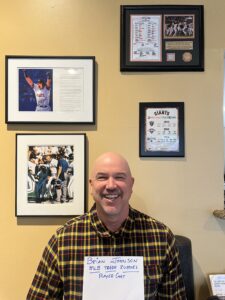
Johnson spent parts of three seasons in the Yankees’ system but wound up debuting with the Padres in the strike-shortened 1994 season, batting .247/.283/.409 and connecting on the first three of his 49 big league home runs. Johnson spent three seasons in San Diego, batting .260/.288/.392 along the way, before being traded to the Tigers in a trade that shipped left-hander Joey Eischen back to the Padres.
While his run in Detroit proved brief — 45 games before being flipped to the Giants in a one-for-one swap for fellow catcher Marcus Jensen — Johnson found himself with the Giants and closed out the year with his most productive stretch as a big leaguer. Following the trade, he raked at a .279/.333/.525 clip, swatting 11 home runs in 201 trips to the plate. He spent a second year with the Giants, hitting .237/.310/.396 in 99 games, before bouncing through one-year stints with the Reds, Royals and Dodgers.
All told, Johnson’s career drew to a close with a .248/.291/.403 batting line, 49 home runs, 60 doubles, six triples, 132 runs scored, 196 RBIs, a stolen base and a 29% caught-stealing rate behind the plate. He was part of a pair of NL West division winners: the ’96 Padres and ’97 Giants. Some of the pitchers he homered against include Al Leiter, Rick Reed (twice), Mark Portugal, Mike Remlinger and, in 2000, a rookie left-hander by the name of Johan Santana. On Sept. 18, 1997, Johnson’s clubbed a 12th-inning, walkoff homer that put the Giants into a tie for the NL West lead and is still fondly remembered by Giants faithful as “the Brian Johnson game” (YouTube link).
Following his playing days, Johnson returned to the Giants organization, where he spent 10 seasons in their pro scouting department. That included all three of San Francisco’s World Series victories in 2010, 2012 and 2014.
These days, Brian is a diversity consultant with the Chicago-based Kaleidoscope Group. We were thrilled to have him answer reader questions about his experiences on the field, in the clubhouse and as a big league scout for a trio of World Series winners. Brian graciously took two hours of his time to talk with fans, sharing memories of teaming with legends like Trevor Hoffman and Tony Gwynn, insight on what pro scouts look for when recommending trades, thoughts on the changes in the current game and his experiences and opinions on playing at the height of the steroid era. Click here to read a transcript of today’s chat!
Rays Sign Ben Gamel To Minor League Deal
Feb. 23: Gamel passed his physical, tweets Topkin. His deal with the Rays is now complete.
Feb. 22: The Rays are finalizing a minor league contract with free-agent outfielder Ben Gamel, reports Marc Topkin of the Tampa Bay Times (via Twitter). The Wasserman client will be in big league camp and compete for a spot on Tampa Bay’s roster once he passes a physical.
Gamel, 30, spent the 2022 season with the Pirates, appearing in 115 games and tallying 423 plate appearances with a .232/.324/.369 batting line, nine homers, an 11.3% walk rate and a 23.2% strikeout rate. Gamel was one of a handful of platoon options remaining on the free agent market and will give a heavily right-handed Tampa Bay club an option from the left side of the dish if he makes the club.
Gamel has seen Major League time in each of the past seven seasons, dating back to his 2016 debut with the Yankees. He’s a lifetime .253/.333/.385 hitter (97 wRC+) in just over 2200 plate appearances, and while he’s typically been light on power — career-high 11 homers, .132 career ISO — he’s drawn walks at a strong clip for the majority of his big league tenure (10.2%).
Looking at his career as a whole, Gamel’s track record against right-handed pitching is roughly average. That’s skewed somewhat by some shaky performances earlier in his career, however. Dating back to Opening Day 2021, Gamel carries a solid .255/.351/.408 slash against right-handed pitchers — about 12% better than league-average after weighting for his home park and league run-scoring environment, by measure of wRC+. During that time, he’s walked at a stout 13.9% clip in platoon matchups.
Gamel rated as s solid outfield defender early in his career, but publicly available defensive metrics have soured his glovework in recent seasons. Statcast has given decreasingly favorable reviews to his outfield jumps and dropped his arm strength from above-average to roughly average in 2022. Gamel’s sprint speed still landed in the 65th percentile of MLB players in 2022, but he was in at least the 80th percentile in each of his first three MLB campaigns (including an 87th percentile showing in his debut season).
The Rays’ primary outfielders — Randy Arozarena, Jose Siri, Manuel Margot and Harold Ramirez — all bat from the right side of the dish, so there’s plenty of sense in adding some left-handed help. Tampa Bay has lefties Jonathan Aranda, Luke Raley and Josh Lowe on the 40-man roster, plus switch-hitting infielder/outfielder Vidal Brujan. Second baseman Brandon Lowe has some experience in the outfield, too.
Still, of that group of lefty options, none are sure bets. Aranda has mashed throughout the minors but is regarded as something of a positionless nomad on the defensive spectrum. Raley has a huge minor league track record but is 28 and has yet to hit in a pair of big league seasons. Josh Lowe is a former top prospect who’s still searching for an MLB breakout. The same goes for Brujan. As for Brandon Lowe, he’s logged just 331 career innings in the outfield, and last year’s three frames in right field represented the entirety of his outfield work on the season.
Gamel will head to Rays camp as the most experienced outfield option among the team’s non-roster invitees, and presumably with a good spring showing, he’ll have a decent chance at cracking the roster. He does have some experience in center field, though it’s limited and he’s best-suited for corner work. That said, both Siri and Margot are plus defenders at any outfield spot, which lessens the need for the Rays’ reserve options to be adept in center.
Yankees’ Ben Rortvedt, Frankie Montas Undergo Surgery
Yankees catcher Ben Rortvedt and right-hander Frankie Montas both underwent surgery Wednesday, manager Aaron Boone announced to reporters (Twitter links via Bryan Hoch of MLB.com). Montas was already known to require arthroscopic surgery on his shoulder, and today’s procedure is now being classified as a cleanup of his labrum. His rotator cuff did not require repair. Montas will be cleared to resume throwing in approximately 12 weeks and could still return this season.
Rortvedt, meanwhile, has been bothered by a finger ailment that doctors had been unable to pinpoint in recent days. He met with a specialist yesterday. The operation addressed an aneurysm near the posterior in his left shoulder, which had impacted the circulation in his hand and finger. He’ll be shut down from all baseball activity for at least the next month.
The injury to Montas is an obvious blow for a Yankees club that hoped for a healthy Montas in 2023 — one that resembled his standout form with the Athletics more than the diminished version of Montas they saw following last summer’s trade. The right-hander had dealt with shoulder troubles shortly before the trade deadline, but the Yankees were clearly convinced that the issue was minor and that they’d be getting something close to the pitcher who’d posted a 3.30 ERA with strong strikeout and walk rates from Opening Day 2021 through the 2022 trade deadline.
Instead, the Yankees received eight rough outings from Montas down the stretch and will now be without him for the majority of the 2023 campaign, after which he’s slated to become a free agent. New York also picked up righty reliever Lou Trivino in that swap, and he delivered 21 2/3 innings of 1.94 ERA ball down the stretch. He’s controlled through the 2024 season, but the trade with the A’s will still feel rather steep, given that the Yankees sent prospects Ken Waldichuk, JP Sears, Luis Medina and Cooper Bowman to Oakland in return for Montas and Trivino. The Yankees reportedly do not plan to pursue a trade to replenish the pitching depth lost with Montas’ injury.
As for Rortvedt, he came over to the Yankees alongside Josh Donaldson and Isiah Kiner-Falefa in the trade that sent Gio Urshela and Gary Sanchez to the Twins last offseason. A former second-round pick who’s regarded as a glove-first option behind the dish, the 25-year-old Rortvedt played in only 48 minor league games in 2022. He spent most of the season on the Major League injured list due to a severe oblique strain and was optioned upon activation. He spent six games in the low minors before heading to Triple-A Scranton/Wilkes-Barre, where he turned in a .221/.307/.396 batting line with six home runs and a 10.2% walk rate but also a troubling 32.2% strikeout rate in 177 plate appearances.
Rortvedt has appeared in 39 big league games, all with the Twins, and posted a .169/.229/.281 batting line with a 29.6% strikeout rate in 98 trips to the plate. He has a minor league option year remaining — which is crucial, given that Jose Trevino and Kyle Higashioka are lined up as the primary catchers to begin the season — and can be controlled for at least five more years.
Reds Claim Bennett Sousa
The Reds announced Wednesday that they’ve claimed lefty Bennett Sousa off waivers from the White Sox. Chicago had designated him for assignment on Monday when finalizing their one-year deal with Elvis Andrus. Cincinnati placed right-hander Vladimir Gutierrez, who underwent Tommy John surgery last July, on the 60-day injured list to clear a spot on the 40-man roster.
The 27-year-old Sousa made his MLB debut with the Sox last year but was knocked around for 19 runs on 25 hits and 10 walks in 25 1/3 frames — an 8.31 ERA. Ugly as that showing was, he’s regularly turned in sub-4.00 ERAs in the upper minors while displaying above-average strikeout and ground-ball rates. Command issues have plagued him at times, however, and while Sousa looked to have turned a corner with a tiny 5.3% walk rate in 2021, he walked 10.3% of his opponent in a similar sample size of Triple-A innings this past season.
Overall, Sousa has a 3.96 ERA, a 32.2% strikeout rate and 8.1% walk rate in 50 Triple-A frames, in addition to a 2.96 ERA, 35.6% strikeout rate and 13.9% walk rate in 27 1/3 innings at the Double-A level. Sousa has a pair of minor league option years remaining and averaged a solid 94.3 mph on his heater in the big leagues last year. Paired with his 11.7% swinging-strike rate (and history of missing bats in the minors) there could be improvement on the horizon for the unsightly 12.5% strikeout rate he posted in the Majors last year.
Sousa joins Reiver Sanmartin as a lefty option for manager David Bell‘s bullpen. That’s the only pair of southpaw options on the 40-man roster — outside of prospect Brandon Williamson, who’ll surely continue to be utilized as a starter — but Sousa will have competition in camp in the form of non-roster invitees like Daniel Norris and Alex Young.
White Sox Sign Bryan Shaw To Minor League Deal
The White Sox have signed veteran reliever Bryan Shaw to a minor league contract and invited him to spring training, the team announced. The CAA client will vie for a spot in Chicago’s bullpen over the next several weeks.
Shaw, 35, has spent the bulk of his career — including the past two seasons — in Cleveland. He struggled to a 5.40 ERA in 58 1/3 innings with the Guardians in 2022, thanks to one of the lowest strand rates of his career (66.3%) and one of the highest home-run rates he’s ever yielded (1.39 HR/9, 15.5% homer-to-flyball ratio).
Shaw was one of the most consistent and most durable relievers in the game from 2013-17, thrice leading the American League in appearances and twice leading all of MLB in that category. In that span, he tossed 358 2/3 innings of 3.11 ERA ball, which set the stage for a three-year, $27MM deal in Colorado that almost immediately proved regrettable for the Rockies. Shaw was tagged for a 5.61 ERA in two seasons with Colorado before being released and struggling with the Mariners the following season.
While things have gone poorly for Shaw dating back to 2018 — 5.23 ERA, 268 1/3 innings — his 2021 season offered a glimpse of his vintage form. He’s only one year removed from 77 1/3 frames of 3.49 ERA ball in his first of two seasons back in Cleveland. Even as he’s struggled, Shaw has maintained solid velocity (94.6 mph average four-seamer over the past couple seasons) and above-average ground-ball tendencies.
Shaw will give the ChiSox a durable veteran arm who can potentially be stashed in he upper minors, and if he’s able to round into 2021 form, he can help the Sox to weather the absences of Garrett Crochet (April 2022 Tommy John surgery) and Liam Hendriks (undergoing treatment for non-Hodgkins lymphoma). As things currently stand, Chicago’s primary late-inning relievers include Kendall Graveman, Joe Kelly, Aaron Bummer, Reynaldo Lopez and Jake Diekman.