
Red Sox Release Eric Hosmer
December 22: As expected, Hosmer has been released, per Chris Cotillo of MassLive.
December 16: The Red Sox have acquired right-hander Wyatt Mills from the Royals in exchange for minor league righty Jacob Wallace and opened a spot on the roster by designating first baseman Eric Hosmer for assignment, per a team announcement.
Hosmer came to the Sox in a deadline deal just a few months ago. The Padres signed him to an eight-year, $144MM contract going into 2018, a deal that most observers considered an overpay from the moment it was announced. Hosmer’s production dipped thereafter, which only added to the albatross nature of the deal.
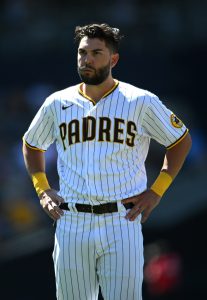 In 2017, his last year with the Royals, Hosmer hit .318/.385/.498 for a wRC+ of 135, indicating that he was 35% better than league average. But in his first season as a Padre, he produced a line of .253/.322/.398 for a wRC+ of 95. Apart from a surge in the shortened 2020 campaign, he’s been around league average in each season and frequently mentioned in trade rumors with San Diego hoping to get rid of him. As the deadline approached this past summer, Hosmer was originally included in the blockbuster deal that was to send Juan Soto and Josh Bell to San Diego. However, Hosmer had a limited no-trade clause that included the Nationals, allowing him to veto the deal. Instead, Luke Voit was sent to Washington in his place, but the Padres then quickly dealt Hosmer to the Red Sox, who were not on his no-trade list.
As part of that deal, the Red Sox would only have to pay Hosmer the league minimum salary, with the Padres remaining on the hook for the rest of it. With this move just a few months later, it seems the trade was more about the young players involved, as Boston sent pitching prospect Jay Groome to the Padres but received a couple prospects as well in Corey Rosier and Max Ferguson. It’s also possible that the club viewed Hosmer as a bit of a safety net at first base, where Bobby Dalbec had been struggling and prospect Triston Casas had yet to reach the majors. Casas was called up in September and launched five home runs down the stretch as well as walking in 20% of his plate appearances, leading to a batting line of .197/.358/.408, wRC+ of 120. Perhaps that debut gave them enough confidence to proceed without Hosmer.
Whatever the motivation, Hosmer’s time in Boston seems likely to end after just 14 games. The club will have one week to trade him or put him on waivers, though a trade will be difficult to arrange. As part of Hosmer’s contract, he gained a full no-trade clause after being dealt by the Padres. It’s also possible that a team might have interest in claiming Hosmer off release waivers, as his minimal salary would create a no-risk scenario for the claiming club. However, players on release waivers are allowed to reject claims and elect free agency, which likely means no team would bother putting in a claim. It seems the most likely scenario is that Hosmer ends up released and returns to the open market.
Though he hasn’t produced more than 0.8 fWAR in any season since 2017, it’s likely some teams that need help at first base or designated hitter would have some interest. The Padres are on the hook for the $39MM owed to Hosmer over the next three years and any team that signs him would only have to pay him the prorated league minimum for any time spent on the roster, with that amount subtracted from what the Padres pay.
Over the last three seasons, his batting line is .271/.335/.407 for a wRC+ of 107, or 7% above league average. That doesn’t lead to a lot of value overall as he is generally graded as a poor defender, but it’s possible he could find a bit of uptick at the plate next year. The upcoming rules on defensive shifts are expected to primarily benefit left-handed hitters like Hosmer, as teams stack the right side of the infield with defenders. Hosmer’s worst trait as a hitter is his incredibly high ground ball tendencies, as his career rate is 54.5%. For reference, this year’s league average as 42.9%.
Many of the top first baseman from this winter’s free agent class have already been signed, with José Abreu, Josh Bell and Anthony Rizzo off the board. For clubs still looking for upgrades there, Hosmer will likely join the remaining options, such as Trey Mancini, Brandon Drury, Matt Carpenter, Wil Myers and Brandon Belt.
As for the other players involved in today’s announcement, Mills, 28 next month, was designated for assignment by the Royals when they signed Ryan Yarbrough earlier this week. The Royals had only acquired him a few months earlier as part of the Carlos Santana trade. He tossed 29 1/3 innings for the Royals with a 4.60 ERA, but the Red Sox are likely more interested in his minor league numbers. In 33 2/3 Triple-A innings this year, he posted a 2.14 ERA while striking out 29.9% of batters faced, though he also walked 12.7% of them. He still has an option year remaining, giving them an intriguing depth option with roster flexibility.
Wallace, 24, was drafted by the Rockies but came to the Red Sox as the player to be named later in the Kevin Pillar trade. He spent this year in Double-A, tossing 56 2/3 innings with a 3.81 ERA and 30.4% strikeout rate, though a huge 19.6% walk rate.
Image courtesy of USA Today Sports.
Padres Sign Seth Lugo
Dec. 22: The Padres have officially announced Lugo’s signing.
Dec. 19, 1:33pm: Lugo will be guaranteed a bit more than $15MM on the contract and can opt out of the deal following the 2023 season, tweets Fabian Ardaya of The Athletic. Heyman adds that the deal pays Lugo $7.5MM in 2023 before he’ll decide on a $7.5MM player option for 2024.
1:13pm: The Padres are finalizing a contract with free-agent righty Seth Lugo, reports Jon Heyman of the New York Post. Ken Rosenthal of The Athletic tweets the two sides have agreed to a deal. The Post’s Joel Sherman adds that the Padres plan for Lugo to join the starting rotation. San Diego and the division-rival Dodgers were reportedly the two likeliest landing spots for the Ballengee Group client.

Lugo, 33, has been a reliable member of the Mets’ bullpen for the past two seasons but has ample starting experience in his career and had been hoping to land with a team that would give him an opportunity to start. The Padres can likely offer just such an opportunity, as the fifth spot in their rotation behind Joe Musgrove, Yu Darvish, Blake Snell and Nick Martinez is currently unsettled. Left-hander and former top prospect Adrian Morejon had previously been seen as a front-runner for that spot, but he’ll now act as a depth option alongside minor league hurlers Ryan Weathers, Jay Groome, Pedro Avila and Reiss Knehr.
Over the past two seasons in the Mets’ bullpen, Lugo has turned in a 3.56 ERA with a 26.6% strikeout rate against a 7.9% walk rate and a 44.4% ground-ball rate. His average four-seamer has clocked in at 94.4 mph in that time, and while it’s possible that velocity will dip a bit when working in longer stints, Lugo has far more secondary offerings than the standard reliever. In addition to that four-seamer, he’ll also throw a plus curveball, a sinker, an occasional slider and a more seldom-used changeup.
That repertoire of four, if not five pitches, surely emboldened some teams to consider him as a potential addition to the rotation. Lugo has made 38 starts in his career — all of which has been spent with the Mets to this point — and once looked as though he might have a chance to solidify himself on the starting staff in Queens. However, a “slight” tear of his right elbow’s ulnar collateral ligament back in 2017 derailed his season.
The tear was minimal enough that surgery was not recommended, however. Lugo received a platelet-rich plasma injection, opted for a rest-and-rehab approach, and returned to the mound as a reliever in 2018. By the time required surgery to remove a bone spur from the elbow in 2021, his surgeon remarked that he was “impressed with how [the UCL] wound up” (link via MLB.com’s Anthony DiComo).
With a clean bill of health and some quality recent results out of the ‘pen, Lugo becomes an interesting upside candidate in the fifth spot of the Padres’ rotation. Moving him to the bullpen will always be there as a safety net, but Lugo has a 4.35 ERA in 194 career innings as a starter, and those numbers are skewed by a disastrous showing in the shortened 2020 season. From 2016-18, Lugo tossed 168 1/3 innings as a starter and recorded a more palatable 4.06 ERA. He hasn’t seen an enormous spike in opponents’ productivity when facing them a second or third time in a game; in fact, his opponents’ numbers have actually worsened when facing him a second/third time — though it’s unlikely that trend will continue.
Lugo’s $7.5MM annual salary will push the Padres’ 2023 payroll north of $240MM, while the team’s projected luxury-tax ledger will jump just north of $262MM, per Roster Resource. The Padres are currently lined up to exceed the tax threshold for a third consecutive season. As such, they’re paying a 50% penalty on the first $20MM by which they exceed the $233MM first-tier barrier, and a 62% overage on the next $20MM. The Friars were already more than $20MM over the tax line, so they’ll pay a 62% overage on Lugo’s $7.5MM AAV — a sum of $4.65MM.
Such penalties are seemingly of little consequence to an ultra-aggressive Padres club that has succeeded in high-profile pursuits of Juan Soto, Josh Hader and Xander Bogaerts in the past six months alone. Owner Peter Seidler appears steadfastly committed to his “championship at all costs” mindset, even if that means spending a total of $12.15MM (salary and luxury hit combined) on a fifth starter while including the downside (for the team) of a 2024 player option.
It’s a nice deal for Lugo, who’ll command the same type of guarantee many setup men of his caliber receive in free agency — but with the opportunity to opt back into free agency a year from now if the rotation experiment works out. Even if Lugo is ultimately moved to the ‘pen for one reason or another, so long as he continues at his prior pace with the Mets, he could even opt out and land a larger commitment as a pure reliever next winter. And, of course, if he ends up injured or sees his performance completely crater, he’ll have the security of a substantial salary already locked in for the 2024 season.
Yankees Sign Aaron Judge To Nine-Year Deal
December 21: Judge will make even salaries of $40MM throughout the course of the deal, per Jon Heyman of The New York Post.
December 20: The Yankees have made it official today, announcing the deal.
December 7: The reigning American League MVP isn’t going anywhere. Free-agent outfielder Aaron Judge has agreed to terms on a new contract with the Yankees, reports Jon Morosi of MLB.com. The deal, which is still pending a physical, will guarantee Judge $360MM over a nine-year term, reports Ken Rosenthal of The Athletic.

It’s the largest free-agent contract in MLB history, handily topping Bryce Harper‘s previous $330MM record. The $40MM average annual value on the contract establishes a new record among position players and trails only the matching $43.333MM AAVs of Max Scherzer and Justin Verlander — both of whom are on shorter-term deals — for the largest in MLB history. Judge is represented by Page Odle of PSI Sports Management.
Judge’s decision to remain in New York puts an end to a weeks-long saga that saw him primarily fixated on the Yankees and Giants, his two most serious suitors from the moment he rejected a qualifying offer issued by the Yankees. The Giants were reported to have made a similar offer yesterday, and Morosi tweets that Judge turned down higher offers after ultimately deciding he preferred to remain a Yankee. The Padres, notably, made a late offer worth a reported $400MM in an attempt to woo Judge, albeit to no avail. Judge will now likely spend his entire career in Yankee pinstripes, as the new contract will run through his age-39 season.
Judge famously bet on himself heading into the 2022 season, turning down a seven-year, $213.5MM extension offer from the Yankees in Spring Training. General manager Brian Cashman took the uncommon step of announcing the terms of the Yankees’ final offer to the public. While that unorthodox tactic upset Judge — as the outfielder himself has since publicly stated — it also leaves no doubt as to the numbers that were offered and thus gives a clear window into just how much the 2022 MVP gained in betting on himself. Judge’s gamble drew some scrutiny, but in the end, he secured an additional two years and a jaw-dropping $146.5MM — a 68.6% increase over the originally proposed guarantee.
It’s a massive win for Judge — one that was earned on the heels of a season the likes of which baseball fans have not seen since Barry Bonds dominated during the steroid era. Judge led the Majors in home runs, runs scored, RBIs, on-base percentage, slugging percentage and total bases, finishing out the year with a comical .311/.425/.686 batting line and a new American League record of 62 home runs.
It’s nearly impossible to draw up a better platform season for a free agent. Judge not only captivated baseball fans but caught the attention of sports fans everywhere while chasing down Roger Maris’ longstanding record, evidenced by being named Time Magazine’s Athlete of the Year. Judge thrived in a national spotlight with the game’s highest-profile team and also almost singlehandedly prevented a second-half collapse by the Yankees. Judge mashed at a .349/.502/.784 clip following the All-Star break, belting 29 home runs and reaching base in more than half of his 307 plate appearances. The rest of the lineup, meanwhile, looked utterly lifeless in the season’s final months; non-Judge Yankees hitters combined for a disastrous .223/.292/.360 slash after the All-Star break.
Those heroics simultaneously pushed the Yankees to a division crown in the AL East (thus landing them a first-round bye in the newly expanded playoff format) and painted a gruesome picture for Cashman and owner Hal Steinbrenner of just what a Judge-less Yankee team might look like moving forward. While Judge finally went cold with a 1-for-16 slump in a brutal ALCS that saw his team score just nine total runs in a sweep at the hands of the eventual-champion Astros, it’s unlikely the Yankees would’ve even reached that point had he not put the team on his back in such dramatic fashion.
By measure of wRC+, which weights for a hitter’s league environment and home park, Judge was 107% better than an average big league hitter in 2022. It’s the highest single-season mark any qualified hitter has posted since Bonds in 2004, and if you prefer to set Bonds aside for PED reasons, Judge’s 2022 wRC+ is the best of any hitter since Ted Williams in 1957. There’s no overstating just how remarkable his 2022 season proved to be.
Of course, Judge is hardly a one-year wonder. Setting aside some struggles in a brief 2016 call-up that saw him tally just 95 plate appearances, the former No. 32 overall draft pick has been one of baseball’s best hitters for the past six seasons. A 52-homer campaign in 2017 earned Judge not only a unanimous selection as the American League Rookie of the Year but also a second-place finish in AL MVP voting. Injuries impacted each of his next three seasons, however. Judge missed nearly two months in 2018 when he fractured his wrist upon being hit by a pitch, and he missed time in 2019-20 with a severe oblique strain and a pair of calf strains.
Over the past two seasons, however, Judge has appeared in 94% of the Yankees’ games and been among the game’s very best players in the process. In addition to his 2022 MVP win, he earned a fourth-place finish in MVP balloting in 2021 after slashing .287/.373/.544 with 39 home runs. Virtually every batted-ball metric under the sun supports the notion that Judge is a generational talent at the plate. He led the Majors in average exit velocity, hard-hit rate and max exit velocity in each of the past two seasons, according to Statcast, which also ranks Judge as MLB’s leader in “expected” slugging percentage and weighted on-base average in that span.
Judge’s power profile is so prodigious that it’s easy to overlook his defensive skill set, but doing so would undersell his all-around value. Listed at 6’7″ and 282 pounds, Judge might draw the assumption that he’s a plodding slugger who’s a liability with the glove, but that’s in no way reflective of reality. To the contrary, Judge’s 61 Defensive Runs Saved since his Major League debut tie him for eighth among all MLB players, regardless of position. Statcast placed his sprint speed in the 50th percentile among MLB players in 2022, while his arm strength landed in the 93rd percentile. Judge will surely slow down over the life of the contract, but at least for the time being, he’s even a viable option in center field, where he logged a career-high 632 innings this past season and turned in above-average marks in DRS, Ultimate Zone Rating and Outs Above Average.
Since Judge’s first full season came at age 25 and he’s set to turn 31 early in the first season of his new contract, it’s easy to see why the Yankees initially tried to limit the contract to a seven-year term. Instead, Judge’s legendary 2022 campaign pushed them to compete with other teams in free agency and offer a nine-year contract that will carry him through age 39. Long-term contracts paying even through age 38 have been exceedingly rare in the last decade. Arguably the only other player who’s done that without compromising on the average annual value is Mike Trout, who tacked on ten years and $360MM in a March 2019 extension. In contrast, Phillies-for-life Bryce Harper and Trea Turner accepted AAVs of $25.4MM and $27.3MM, respectively.
Judge’s aging curve will be an issue for another day. Looking at financial component of this agreement for 2023, it comes at an even larger cost to the Yankees than the bottom-line, $360MM guarantee. New York was about $5.8MM shy of the luxury-tax barrier prior to agreeing to terms with Judge, as projected by Roster Resource, and his $40MM AAV now catapults them into the second tier of luxury penalization.
As a second-time offender, they’re subject to a 30% tax on the first $20MM by which they exceed the luxury threshold and a 42.5% tax for the next $20MM. They’ll pay a 75% tax on the next $20MM by which they exceed the threshold and a 90% tax on every dollar spent thereafter. Judge bumps the Yankees to a projected $267.2MM worth of luxury obligations, meaning if the Yankees called it an offseason right now, they’d be on the hook for approximately $12.035MM in penalties. That seems unlikely, however, and any further additions will come with substantial taxes, as New York now sits $5.8MM shy of the third tier of penalties (and the aforementioned 75% tax rate). The Yankees have been reported to hold strong interest in free-agent ace Carlos Rodon, though it’s not clear whether Steinbrenner has the appetite for a $40MM AAV on Judge and an AAV approaching or even exceeding $30MM for Rodon.
It’s possible, if not likely, that they’ll look to get out from underneath the remainder of their onerous commitments to Josh Donaldson or Aaron Hicks via the trade market, but the Yankees would need to pay down a substantial portion of either player’s salary to facilitate such a trade (or take on another bad contract in return). There’s also been speculation about the Yankees possibly dealing from their sizable arbitration class, with infielder Gleyber Torres a commonly cited possibility.
Judge’s enormous AAV not only makes the Yankees a lock to repeat as a second-time luxury payor — it also makes them quite likely to be a third-time offender in 2024, when they’re already projected for nearly $170MM in luxury obligations. That figure doesn’t include any of the team’s arbitration-eligible players, and any multi-year additions this winter will increase that number. With Luis Severino, Frankie Montas and Harrison Bader all set for free agency following the 2023 campaign, the Yankees will likely be on the lookout for both rotation and outfield help in the next 12 to 15 months.
Those moving parts coalesce to demonstrate how quickly the Yankees’ luxury figure could balloon. Teams crossing the luxury tax for the third consecutive season are taxed at rates of 50% (first $20MM), 65% (next $20MM), 95% (next $20MM) and 110% (all dollars thereafter).
All of that is secondary to the Yankees, however, who entered the offseason hell-bent on retaining the league MVP and burgeoning franchise icon. They went to record-setting levels in order to make it happen, furthering the future market for star-caliber free agents in the process, but it’s surely a day for celebration in the organization regardless of any down-the-road consequences.
From a broader market perspective, Judge’s deal with the Yankees not only puts a bow on one of the highest-profile free agencies in recent memory — it’s also likely to serve as a facilitator for a flurry of subsequent moves. So much of the 2022-23 offseason hinged on Judge’s decision, that several teams and other top-tier free agents have been reluctant to act.
For instance, with Judge now remaining in New York, the Giants will likely turn their attention to the shortstop market, where they reportedly have Carlos Correa atop their list of targets. The Twins have been angling to re-sign Correa, but it was always in Correa’s best interest to see if the Giants might miss on Judge and jump into the bidding. If Correa departs Minnesota, the Twins reportedly view Xander Bogaerts as their top fallback option. As with Correa, then, it was in Bogaerts’ best interest to know where Judge landed before he made any sort of decision. All the while, the Red Sox have been hoping to keep Bogaerts, just as the Braves have been hoping to keep Dansby Swanson. But the Cubs, Dodgers and Cardinals have each been tied to the shortstop market, and the Padres have been aggressive in trying to add a marquee player of any shape or size and clearly still have money to spend.
The previously mentioned Rodon, too, likely needed to wait on Judge, given the Yankees’ interest. And it’s feasible that the next tier of free-agent pitchers, including Chris Bassitt and Kodai Senga, prefer to wait until Rodon comes off the board so that they can stand as the two top options and perhaps have increased leverage among rotation-hungry teams.
Viewed through that lens, Judge’s contract is far more than a watershed moment in Yankees franchise history, it’s a catalyst that’ll set off a chain reaction of franchise-altering decisions and megadeals throughout the sport — quite possibly within the next few days or weeks. While elated echoes of “All Rise” ring out through the Bronx, things are just getting started for the rest of the league.
Nationals Sign Erasmo Ramirez To One-Year Deal
December 20: The Nats have made it official, announcing the deal today. Ramirez will earn a base salary of $1MM, reports Andrew Golden of The Washington Post, though there are a further $1MM in incentives available.
December 15: The Nationals and free-agent righty Erasmo Ramirez are working to finalize a one-year, Major League contract, tweets Jesse Dougherty of the Washington Post. Jon Heyman of the New York Post first reported the talks and indicated that Ramirez’s contract will contain bonuses that can push his salary north of $2MM, suggesting that the base salary is a ways south of that sum. Ramirez is represented by Mato Sports Management.
The well-traveled Ramirez has bounced around the league in journeyman fashion over the past half decade but will now spend consecutive seasons with the same team for the first time since 2017-18. Ramirez originally joined the Nationals, his fifth team in five years, on a minor league deal last March but quickly emerged as an important long reliever just a few weeks into the season. The veteran righty appeared in 60 games for Washington, tallying 86 1/3 innings of 2.92 ERA ball. His outings were regularly in low-leverage, long relief situations — often with the games already out of hand — but Ramirez’s results were still strong.
Last year’s 93.9 mph average fastball was a career-best mark for the 32-year-old Ramirez, as was his minimal 4.0% walk rate. The increased velocity and improve command still only resulted in a below-average 17.6% strikeout rate, but Ramirez kept the ball in the yard for the most part (1.15 HR/9) and did a decent job avoiding hard contact (88.7 mph exit velocity, 4.9% barrel rate, 35.7% hard-hit rate). For a journeyman addition on a minor league contract, the Ramirez deal worked out about as well as the Nationals could’ve realistically hoped.
He’ll now return to a bullpen that was quietly a solid group for Washington in 2022, ranking 15th in the Majors with a 3.84 ERA. Ramirez won’t supplant any of Kyle Finnegan, Carl Edwards Jr., Hunter Harvey or top Rule 5 Draft pick Thad Ward in Dave Martinez’s bullpen, but there are enough journeymen and unproven options that it shouldn’t be that difficult to clear out a spot in the ‘pen. The Nats will have to make a corresponding 40-man move to accommodate Ramirez’s return.
Padres Sign Matt Carpenter
2:00pm: The Padres have officially announced the signing.
12:52pm: The Padres added some punch to their lineup Tuesday, reportedly agreeing to a two-year, $12MM contract with veteran infielder/outfielder Matt Carpenter. Carpenter, a client of SSG Baseball, can opt out of the contract after the 2023 season by declining a 2024 player option. The contract pays Carpenter a $3MM signing bonus and $3.5MM salary for the 2023 campaign, and he’ll have to decide on a $5.5MM player option next winter. He can also reportedly earn $500K bonuses for reaching each of 300, 350, 400, 450, 500 and 550 plate appearances in both seasons of the contract.
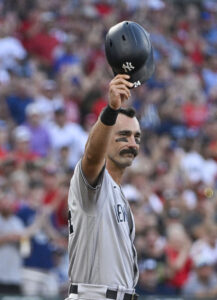
Carpenter, who turned 37 years old last month, enjoyed one of the more remarkable rebound campaigns in recent memory this past season. A three-time All-Star with the Cardinals, Carpenter looked to be on the downswing when he posted a combined .176/.313/.291 batting line in 418 plate appearances with St. Louis from 2020-21.
Last offseason, Ken Rosenthal of The Athletic detailed the manner in which Carpenter reinvented himself, taking a data-driven approach to hitting and enlisting feedback from the likes of Joey Votto, Matt Holliday and a private hitting coach as he revamped his swing and his entire approach at the plate. The Rangers were intrigued enough to sign him to a minor league contract.
We often see stories of veterans making changes late in their careers, but few have found the level of success enjoyed by Carpenter. After hitting .275/.379/.613 in 21 games with the Rangers’ Triple-A affiliate, Carpenter was released by Texas (oops) and signed a Major League deal with the Yankees, for whom he posted a borderline comical .305/.412/.727 slash. Carpenter mashed 15 home runs in just 154 plate appearances, and while he was surely aided to an extent by the dimensions of Yankee Stadium, he still popped six of those round-trippers and batted .253/.333/.506 on the road.
Simply put — and in rather stunning fashion — Carpenter was baseball’s best hitter on a rate basis in 2022 (min. 100 plate appearances). He led all of baseball in slugging percentage, isolated power (slugging minus batting average) and wRC+ (217), ranked second to only Aaron Judge in terms of on-base percentage, and posted the 12th-best batting average of any player in the game. Carpenter’s rate of “barreled” balls (as defined by Statcast) was elite, and his average exit velocity and hard-hit rate both clocked in comfortably north of the league average. There’s no realistic way to expect him to sustain that pace, but Carpenter has clearly put himself back on the map as a viable big league slugger.
Unfortunately for both team and player, the revitalized Carpenter fouled a ball into his foot in early August, resulting in a fracture that wiped out the remainder of his regular season. A predictably rusty Carpenter jumped directly back onto the Yankees’ playoff roster but went just 1-for-12 with an alarming nine strikeouts between the ALDS and the ALCS.
With the Padres, Carpenter becomes the favorite for DH work, though the Yankees played him at both corner infield slots and in both corner outfield positions in 2022. He’s also logged more than 1900 innings at second base in his career, though defensive metrics on his limited work there in 2021 were unsightly, to say the least. Still, he could potentially serve as an option there in an emergency.
The agreement with Carpenter pushes the Padres to more than $246MM in actual cash payroll for the 2023 season and bumps their luxury-tax ledger to nearly $267MM, as projected by Roster Resource. The Padres are already well into the second tier of penalization and, given that they’re entering their third straight season over the luxury line, are being taxed at a 62% rate on every dollar in the second bracket ($253MM to $273MM). As such, Carpenter will cost them an additional $3.72MM in taxes for the 2023 campaign.
AJ Cassavell of MLB.com first reported the two sides had agreed to a deal with a 2024 player option. Ken Rosenthal of The Athletic reported the terms and financial details (Twitter links).
MLBTR Chat Transcript
Click here to read a transcript of Tuesday’s chat with MLBTR’s Steve Adams.
Latest On Michael Conforto’s Market
The Rangers made Michael Conforto an offer over the summer and have maintained interest in the free-agent outfielder throughout the offseason, Evan Grant of the Dallas Morning News reports. That interest has led to recent talks with agent Scott Boras, who said earlier in the offseason that Conforto was eyeing a two-year contract with an opt-out opportunity after the first season.
Texas isn’t alone in courting Conforto. Ken Rosenthal of The Athletic reports that both the Blue Jays and Mets are still showing interest as well. (The Mets, of course, are the only team for which Conforto has ever played.) Patrick Saunders of the Denver Post adds (via Twitter) that the Rockies checked in but are not seen as a likely landing spot. Saunders lists the Cubs, Marlins and Rangers as teams more prominently involved in the Conforto bidding. Seattle and Houston were linked to Conforto earlier in the offseason, though the Astros’ reunion with Michael Brantley seemingly takes them out of the Conforto mix.
The Rangers are the most commonly cited suitor for Conforto, though that hardly ensures that he’ll be suiting up at Globe Life Field in 2023. Still, Texas has had a clear need for at least one outfielder all season but has thus far focused its free-agent and trade pursuits on pitchers. Conforto, 30 in March, would be a risky investment on a multi-year deal but would come with substantial upside; the former first-round pick posted a combined .265/.369/.495 batting line with 97 home runs, 86 doubles, three triples, a 12.7% walk rate and 24.4% strikeout rate in 1959 plate appearances from 2017-20.
Conforto’s platform year before reaching free agency, however, was disappointing. He followed that strong four-year run with a more pedestrian .232/.344/.384 batting line in his age-28 season in 2021. Conforto still rejected a qualifying offer from the Mets, banking on a team being willing to forfeit a draft pick based on the strength of his overall track record. That didn’t happen prior to last winter’s lockout, though, and Conforto went on to suffer an offseason shoulder injury that required surgery in the spring. Despite interest from the Astros and the apparent offer from the Rangers, Conforto did not sign over the summer, instead ostensibly preferring to wait for an offseason deal and a fully healthy return to baseball. (Had he played last summer, it’s believed he’d have been limited to designated hitter duties.)
Rosenthal suggests that some teams are concerned about Conforto’s throwing in the wake of that surgery, though he’s currently throwing from a distance of 150 feet. For the Rangers, Conforto could potentially slot into left field, given Adolis Garcia‘s presence in right field. That might help to mitigate some concerns about his arm strength — if Texas even has any at the moment. Rangers left fielders were far and away the worst in MLB last season, batting a combined .186/.253/.255. Every one of those rate stats ranked dead-last in the Majors, as did the resulting 47 wRC+. Texas, incredibly, gave 13 different players a look in left field last season.
While the Rangers stand as an obvious and perhaps the best fit for Conforto, his other reported suitors are all sensible landing spots, to varying degrees. The Blue Jays have a nearly all-right-handed lineup and have seen Lourdes Gurriel Jr.‘s offensive contributions wane in recent seasons; Gurriel still hit for a strong .291 average in 2022, but his power vanished and his defensive grades have never been particularly strong. GM Ross Atkins said just yesterday that his focus was shifting to upgrading the offense — ideally by adding a lefty bat who could slot into the outfield. Conforto checks a lot of boxes for them. As with the Rangers, Conforto could likely slot into left field with Toronto, lessening potential concerns about his throwing arm.
The Mets, meanwhile, already have a crowded roster and a bloated payroll, but owner Steve Cohen and GM Billy Eppler seem undeterred by either of those factors. Conforto could factor into Buck Showalter’s lineup as a left fielder and designated hitter, perhaps pushing Daniel Vogelbach into more of a bench role than the platoon DH role for which he’s currently set. It might not be an especially clean fit, but the Mets perhaps feel they’d be a deeper and better team by adding Conforto, which could well bump Darin Ruf (who struggled following his acquisition over the summer) or high-priced catcher James McCann from the roster.
The Cubs’ outfield is largely set, with Ian Happ, Cody Bellinger and Seiya Suzuki lined up from left to right, but there’s plenty of opportunity for Conforto to join the mix and rotate through the outfield corners and designated hitter. Neither the Rockies nor Marlins are ideal fits, but it’s nevertheless notable that both have looked into a potential match with Conforto. Both teams need center fielders more than a corner outfielder, however. Colorado could push Randal Grichuk to center, but he’s generally graded out as a better defender in right field. Miami, meanwhile, already has a pair of corner outfielders — Avisail Garcia, Jorge Soler — in search of a rebound, though the latter figures to spend the bulk of his time at designated hitter in 2023.
Between a fair number of teams with interest and this offseason’s rash of free-agent deals that allow players to opt back into the market as early as next offseason, Conforto’s chances of reaching that goal of a multi-year deal with an opt-out seems attainable.
KBO’s NC Dinos Sign Erick Fedde
The NC Dinos of the Korea Baseball Organization have signed former Nationals right-hander Erick Fedde to a one-year contract, per Jeeho Yoo of South Korea’s Yonhap News Agency (Twitter link). The Boras Corporation client will earn $1MM on the deal, in the form of an $800K salary and $200K signing bonus. That $1MM guarantee is the maximum amount that KBO clubs are able to commit to foreign players in their first year in the league.
Fedde, 30 in February, was the No. 18 overall pick by the Nationals back in 2014 and was long considered one of the sport’s top pitching prospects before making his Major League debut. A standout at UNLV, Fedde might have been selected even higher in the draft had he not required Tommy John surgery during his junior season. The Nats took him in the first round despite the health concerns, and Fedde breezed through the minors once healthy, regularly posting ERAs in the low- to mid-3.00s before making his MLB debut in 2017.
Unfortunately, Fedde’s mostly healthy run through the minor leagues hasn’t carried over into the big leagues. He’s required 60-day IL stints for both flexor and shoulder troubles during a six-year big league career, in addition to shorter-term IL stints for shoulder inflammation and oblique injuries. He’s also struggled to miss bats in the big leagues, issued walks at an above-average clip and struggled to keep the ball in the yard.
In 454 1/3 innings at the MLB level, Fedde has a career 5.41 ERA with a 17.5% strikeout rate, 9.5% walk rate, 1.55 HR/9 and a 48.9% ground-ball rate. His sinker averaged 93.7 mph in 2017-18 and sat at 93.9 mph as recently as 2021, but this past season’s 92.5 mph average was a career-low mark.
Recent struggles notwithstanding, Fedde was once a high-profile pitching prospect who skated through the minor leagues and reached the Majors as a 24-year-old. He’s still yet to turn 30, so a strong run in the KBO could pave the way for Fedde to return to the Majors — perhaps even on a multi-year contract. Merrill Kelly, Chris Flexen and Josh Lindblom are just a few recent examples of pitchers reinventing themselves in the KBO and subsequently cashing in on a multi-year deal upon returning to pro ball in North America. Cardinals righty Miles Mikolas is the prominent overseas success story, though he found his success in a three-year stint in Japan rather than South Korea. Fedde will look to chart a similar path, and given his relative youth and former prospect status, he’ll be a particularly interesting case to follow with the Dinos in the upcoming season.
Finding A Trade Partner For The Blue Jays’ Catching Surplus
Entering the offseason, there were several high-profile catchers available for teams seeking upgrades — and the list of teams in search of an upgrade was quite long. Two months into the offseason, however, the options have dwindled in a hurry. Willson Contreras broke the hearts of many Cubs fans by signing for five years with the division-rival Cardinals. Christian Vazquez, the No. 2 catching option on the free-agent market, is headed to Minnesota on a three-year contract. Sean Murphy, the top option overall, was traded to a team that didn’t even expressly need a catcher — the Braves — and as a result of what wound up being a three-team swap, the Brewers saw William Contreras fall into their laps. Omar Narvaez signed with the Mets on a two-year, $15MM deal that gives him a chance to return to the market next winter.
Other teams have made smaller-scale moves. Cleveland added former Rays and Mariners slugger Mike Zunino on a one-year deal, likely removing them from the market. The A’s wound up taking Manny Pina‘s contract from the Braves in that Murphy deal, so they’re unlikely to pursue a backup to prospect Shea Langeliers. The Reds inked Cincinnati native Luke Maile to back up Tyler Stephenson.
As MLBTR’s Darragh McDonald explored last week, the catching market has been largely picked over — with one notable exception. The Blue Jays have yet to trade any of their three big league-caliber catchers: Danny Jansen, Alejandro Kirk or Gabriel Moreno. There’s no dire need in Toronto to move any of that trio, but the Jays are a win-now team with a catching surplus and needs elsewhere on the roster (left-handed bat, bullpen help). Trading one of those catchers could bring back some needed help for the 2023 campaign while simultaneously adding a prospect or two to their system.
Blue Jays general manager Ross Atkins acknowledged the Jays’ surplus today, calling the catching market “exceptionally strong” but also expressing he’d be comfortable carrying all three of his catchers into the 2023 season (Twitter links via Ben Nicholson-Smith of Sportsnet). Moreover, Atkins suggested his focus is now shifting to improving the lineup — likely by adding a left-handed bat that could slot somewhere into the outfield mix. With many (but not all) of the top options on the free-agent market already picked over, it stands to reason the Jays could leverage their catching surplus to help address that need.
Of course, with so many teams having already filled their catching needs, the Blue Jays’ trade partners aren’t quite as plentiful as they might have been a few weeks ago. However, while they’ll likely be dealing with a smaller number of clubs now, the Jays have more leverage with those teams still seeking a catcher, because there just isn’t much else available in terms of starting-caliber difference makers behind the plate. Toronto’s wealth of catching options makes for one of the more fascinating trade scenarios around the league, so it seems worth it to take a closer look at the situation as a whole.
The potential trade candidates
Danny Jansen, 27, controlled through 2024 via arbitration (projected $3.7MM salary, per MLBTR contributor Matt Swartz)
It’s been an up-and-down career at the plate for Jansen, in part because injuries have intervened at times. Jansen missed more than a month in 2022 with separate injuries (broken finger, oblique strain) and missed a combined two months of the 2021 season with two separate hamstring strains. He’s played in just 142 games over the past two seasons.
On the flip side, Jansen has been anywhere from an above-average to excellent hitter in three of his five Major League seasons. He struggled in 2019-20 but since Opening Day 2021 carries a .243/.321/.496 batting line with 26 home runs in just 453 plate appearances. Jansen has easily the most power of the Jays’ three potentially available catchers and could realistically pop 25-plus homers if he were to stay healthy for a full season.
Defensively, Jansen has been about average in terms of caught-stealing rate and has above-average framing marks for his career, though those dipped to below-average in 2022 (perhaps not coincidentally, given that the aforementioned fractured finger was on his glove hand). Jansen has two arb years left but shouldn’t break the bank in that time. There are health concerns, but he’s a clear starting-caliber catcher who’d be an improvement for more than a third of the teams in MLB.
Alejandro Kirk, 24, controlled through 2026 (pre-arbitration in 2023)
Kirk only turned 24 in November but already has two years of Major League service time, an All-Star nod and a Silver Slugger under his belt. He appeared in 139 games for the Jays in 2022, serving as their primary catcher while Jansen missed time due to the aforementioned injuries. Along the way, Kirk hit .285/.372/.415 with 14 homers and 19 doubles. A hit-over-power player, Kirk has a career .278/.362/.426 slash with an 11% walk rate against an 11.1% strikeout rate (83 walks to 84 strikeouts).
Strong as the bat is, Kirk isn’t without limitations. He’s one of the slowest players in baseball (third percentile sprint speed, per Statcast) and has a below-average caught-stealing rate, due in part to slow “pop times” when coming out of his crouch; Statcast rated his pop time to second base in the 32nd percentile of MLB catchers. On the other hand, Kirk draws outstanding framing marks and above-average grades for blocking pitches in the dirt.
Gabriel Moreno, 22, controlled through at least 2028 (pre-arbitration in 2023)
Moreno is likely the most difficult of the entire bunch to move, given his remaining six years of club control and status as one of the five best prospects in baseball. He’ll turn 23 in February and just wrapped up a season that saw him bat .315/.386/.420 in 267 Triple-A plate appearances before batting .319/.356/.377 with just an 11% strikeout rate in 73 MLB plate appearances as a rookie.
While he’s not billed as a major power threat — Moreno’s career-high in homers is 12, and he hit just four in 2022 — Moreno draws praise from scouting reports for a potential plus-plus hit tool and strong glovework behind the dish. He’s not necessarily “fast,” but he’s not the plodder many would expect from any catcher. He drew average grades for his speed on scouting reports, and Statcast pegged him right in the 50th percentile for sprint speed this past season. Even if he’s not hitting more than 10 to 15 homers per year, Moreno has the potential to post high batting averages and on-base percentages while providing better-than-average defense behind the plate.
Which teams are likely OUT on a catcher
Teams that already added a starter this winter
Any of the Jays’ three catchers would be viewed as a potential starter on a substantial portion of MLB’s 30 teams, but as noted above, a fair number of teams have already found a new starting catcher this winter. Don’t expect the Cardinals (Willson Contreras), Twins (Christian Vazquez), Braves (Sean Murhpy), Brewers (William Contreras), Guardians (Mike Zunino) or Mets (Omar Narvaez) to make a play for one of Jansen, Kirk or Moreno after all six of those clubs already landed a new starting backstop this winter.
Teams that already have a standout or promising young incumbent
The Braves’ acquisition of Murphy shows that teams can never fully be ruled out of finding a creative way to acquire a new, impact player — but it still seems unlikely that any of the remaining clubs with a high-end starter behind the dish will make a play for a Jays catcher. That means the Phillies (J.T. Realmuto), Dodgers (Will Smith), Orioles (Adley Rutschman), Reds (Tyler Stephenson) and Royals (Salvador Perez, defensive issues notwithstanding) all seem unlikely to pursue any of Toronto’s backstops.
Teams with controllable young catchers of their own will also likely steer clear. Seattle’s Cal Raleigh had his OBP woes in ’22 but also hit with more power than any catcher in MLB. Top Angels prospect Logan O’Hoppe will get every opportunity to establish himself in 2023. The Rangers’ Jonah Heim and Yankees’ Jose Trevino, both standout defenders with several years of club control remaining, remove any urgency for either club to dive headlong into this market as well.
Rebuilding clubs with young catchers
You could certainly make that argument that a rebuilding team like the Nationals, A’s or Pirates would be wise to pursue Kirk or especially Moreno, but the Jays are going to want controllable, MLB-ready help in return, which a lot of rebuilding clubs don’t have in spades. Add in the fact that the Nats (Keibert Ruiz), A’s (Shea Langeliers, Tyler Soderstrom) and Pirates (Henry Davis, Endy Rodriguez) all have young catchers of note already in house, and a trade becomes more difficult to see.
Long shot teams (for one reason or another)
The White Sox would probably be thrilled to get their hands on a Jays catcher, but Toronto’s top need is a left-handed-hitting outfielder, and Gavin Sheets isn’t going to be the centerpiece for anyone in this Toronto catching corps. The Sox also have a year and $18.25MM to go on their deal with Yasmani Grandal — a contract not easily moved. I’m sure the Tigers would love Kirk or Moreno, but they’re lacking in MLB talent from which to deal.
The Padres got a disappointing year from Austin Nola in 2022 but also have ballyhooed top prospect Luis Campusano as an in-house alternative. The Marlins still need catching help after a poor showing from Jacob Stallings but lack the MLB-ready outfield help the Jays might covet in trade. The Rockies are in a similar boat, having received a dismal showing from Elias Diaz in 2023. Like the Marlins, they’re short on the type of big league help the Jays would seek.
The most logical trade partners (listed alphabetically)
- Astros: After missing out on Willson Contreras in free agency, the Astros will once again entrust light-hitting Martin Maldonado behind the plate. Maldonado played through a hernia and a broken bone in his hand, but his lack of production can’t be blamed on those injuries alone. Dating back to 2015, Maldonado’s 72 wRC+ is 16th-worst among 459 qualified MLB hitters. The Astros love Maldonado’s defense, game calling, game planning, and clubhouse leadership — and to his/their credit, they won a World Series with Maldonado as their primary catcher. That said, he’ll be 37 next summer and is on a one-year deal. Prospect Korey Lee hasn’t hit much above A-ball. There’s a good on-paper fit here, though the elephant in the room is that the Astros lack the MLB-ready bat the Jays might covet in return; Kyle Tucker surely isn’t going anywhere.
- Cubs: The Cubs let Contreras walk, deferring to the older and more defensively-minded Yan Gomes while waiting for prospect Miguel Amaya, who missed much of last season while recovering from Tommy John surgery. Any of the three Jays catchers would be an upgrade to the Cubs’ roster, and either Kirk or Moreno would supplant Amaya as the organization’s catcher of the future. The Cubs don’t have the controllable, big-league-ready bat the Jays might prefer, but they could send a year of switch-hitting outfielder Ian Happ and a prospect package behind him if they were to become serious about landing a Toronto catcher.
- D-backs: The cleanest fit for a good-old-fashioned “baseball” trade, the D-backs have four left-handed-hitting outfielders — Jake McCarthy, Daulton Varsho, Alek Thomas and Corbin Carroll — and are open to offers in a similar capacity to the Jays with regard to their catchers. Carroll seems all but untouchable, but any of McCarthy, Varsho or Thomas seems like a feasible starting point when looking at Toronto’s more controllable catchers (Kirk, Moreno). Toronto and Arizona are excellent trade partners, in this regard.
- Giants: There’s likely still hope in San Francisco that Joey Bart can solidify himself as the everyday catcher, but he’s seen MLB time in three seasons now and owns a .222/.294/.351 slash in 408 plate appearances. Bart hasn’t dominated Triple-A pitching, either, and the Giants at least inquired with the A’s about Murphy before his trade to Atlanta. Like the ‘Stros, however, I’m not sure the Giants have the sort of immediate upgrades Toronto would seek. Mike Yastrzemski and LaMonte Wade Jr. are both lefty-swinging outfielders with three remaining years of club control, but both are coming off down seasons at the plate.
- Rays: Francisco Mejia hasn’t developed into the hitter anyone hoped, and journeyman Christian Bethancourt posted a .265 OBP with the Rays in 2022. The Rays were a rumored suitor for Murphy and checked in on Willson Contreras at the trade deadline. They’re clearly open to augmenting the catching staff, though payroll is always a consideration. The Rays aren’t deep in left-handed bats, but Brandon Lowe, Josh Lowe and Jonathan Aranda could all have some appeal to the Jays. The former Lowe is still signed affordably for four years, though, while the latter has yet to deliver on his former top prospect status. Aranda, meanwhile, has torn through upper-minors pitching but is a poor defender who lacks a clear defensive home. With the Rays, of course, it’s worth wondering whether division rivals would even be amenable to swapping long-term pieces.
- Red Sox: That last point on the Rays applies here, too, but the trade of Vazquez (and his subsequent deal with the Twins) leaves the Sox with a combination of Reese McGuire and Connor Wong behind the plate. Boston doesn’t have another catcher on the 40-man roster, and the closest they have to an MLB-ready catching prospect is Ronaldo Hernandez, who went unclaimed on waivers two weeks ago. This is an organization that would benefit either from a two-year bridge like Jansen or, more improbably, a long-term solution like Kirk or Moreno. Perhaps there’d need to be some pieces added to balance both sides of the deal, but either Alex Verdugo or Jarren Duran fall into the bucket of MLB-ready outfield help the Jays could consider.
The D-backs represent the cleanest fit, in my view, though there are plenty of other options to consider, particularly if you want to brainstorm potential three-teams swaps like the one that sent Murphy to Atlanta. The bottom line, however, is that while many catching-needy teams have filled their vacancies, the Jays should still have plenty of interest in their catchers in the weeks to come. At this point, the majority of the roads on the catching market run through Toronto.
Dodgers, Padres Among Teams Pursuing Seth Lugo
Former Mets righty Seth Lugo has drawn interest from a wide range of clubs this winter, hoping to land an opportunity as a starting pitcher wherever he signs. Jon Heyman of the New York Post reports that the Dodgers and Padres are the likeliest landing spots at this point, though the Nationals have been involved to a lesser degree. Ken Rosenthal and Fabian Ardaya of The Athletic, meanwhile, reported over the weekend that the Dodgers are in the mix for Lugo and would indeed likely build him up as a starter.
Between Los Angeles and San Diego, the latter has a clearer path to rotation innings, if the Padres indeed have interest in giving Lugo a look as a starting pitcher. Joe Musgrove, Yu Darvish, Blake Snell and Nick Martinez are expected to occupy the top four spots in the rotation, but the No. 5 spot is generally unsettled. Former top prospect Adrian Morejon seems the likeliest option, but Ryan Weathers, Pedro Avila and Jay Groome are all on the 40-man roster as well.
Over in Los Angeles, it’s a slightly more crowded situation. Clayton Kershaw re-signed on a one-year deal, rejoining Julio Urias, Tony Gonsolin and Dustin May in a projected rotation that was largely rounded out by the Dodgers’ recent signing of Noah Syndergaard. That said, both May and Gonsolin missed substantial time due to injury in 2022. May missed the first three-plus months recovering from 2020 Tommy John surgery, while Gonsolin was slowed late in the year by forearm troubles. He still made 24 starts and tallied 130 1/3 innings, but May logged just 30 regular-season frames and will probably have his workload monitored. Prospects like Ryan Pepiot, Bobby Miller and Michael Grove could provide depth even without an additional veteran signing, though.
As for the Nats, while Heyman suggests they’re no longer prominent players for Lugo, he’d be a similar signing to their recent addition of Trevor Williams. Beyond the fact that both Williams and Lugo pitched for the Mets this past season, both have been used as relievers recently but carry a starter’s repertoire, making them intriguing buy-low options in that regard. That said, the Nats now have Stephen Strasburg, Patrick Corbin, Williams and youngsters MacKenzie Gore, Josiah Gray and Cade Cavalli all as rotation options.
Lugo, 33, has been shuttled between the Mets’ rotation and bullpen multiple times in his career but has been primarily a reliever in 2021-22. He’s notched a solid 3.56 ERA with a 26.6% strikeout rate, 7.9% walk rate and 44% ground-ball rate in that time, averaging 94.4 mph with his fastball and generally sitting at or near the top of the league in terms of spin rate on his curveball. More broadly, Lugo has long been a quality member of the relief corps in Queens; he’s totaled exactly 300 innings out of the bullpen and boasts a 2.91 ERA in that time.
That said, Lugo has a four-seamer, sinker, curveball, slider and seldom-used changeup — a deep arsenal for a relief pitcher that could lend itself to a return to the rotation. He was hit hard working out of the rotation in the shortened 2020 season, but Lugo has a 4.35 ERA in 194 career innings as a starter. He’s missed more bats out of the bullpen, as one might expect, but his walk rate as a starter is slightly better than as a reliever and Lugo’s opponents haven’t seen dramatic spikes in production when facing him for a second or even third time in a game.
In addition to the Dodgers, Padres and Nats, Lugo has also reportedly drawn at least some degree of interest from the Angels, Red Sox and Tigers.