
Reds Designate Josh Osich For Assignment
The Reds announced that they’ve designated lefty Josh Osich for assignment in order to open a spot on the roster for right-hander Mychal Givens, whose previously reported acquisition from the Rockies has now been formally announced by the club.
Osich, 32, signed a minor league deal with the Reds last December and has pitched 14 1/3 innings out of the bullpen this season. He’s yielded nine runs (eight earned) on 15 hits and five walks with nine strikeouts in that time, resulting in a 5.02 ERA. Those numbers are in line with Osich’s career marks; he’s spent parts of seven seasons in the Majors with five big league clubs, pitching to a combined 5.02 ERA, a 20.7 percent strikeout rate and a 9.0 percent walk rate.
The Reds can try to find a trade partner for Osich between now and Friday’s deadline, but it seems likelier that they’ll place him on outright waivers. If he goes unclaimed, Osich has enough service time to reject an outright assignment to Triple-A Louisville and instead test free agency.
Reds Acquire Mychal Givens
The Reds have added their third bullpen arm in the past 12 hours, announcing the acquisition of right-hander Mychal Givens from the Rockies. Colorado will receive minor league right-handers Case Williams and Noah Davis in return. Cincinnati also picked up Luis Cessa and Justin Wilson from the Yankees in a late trade last night.
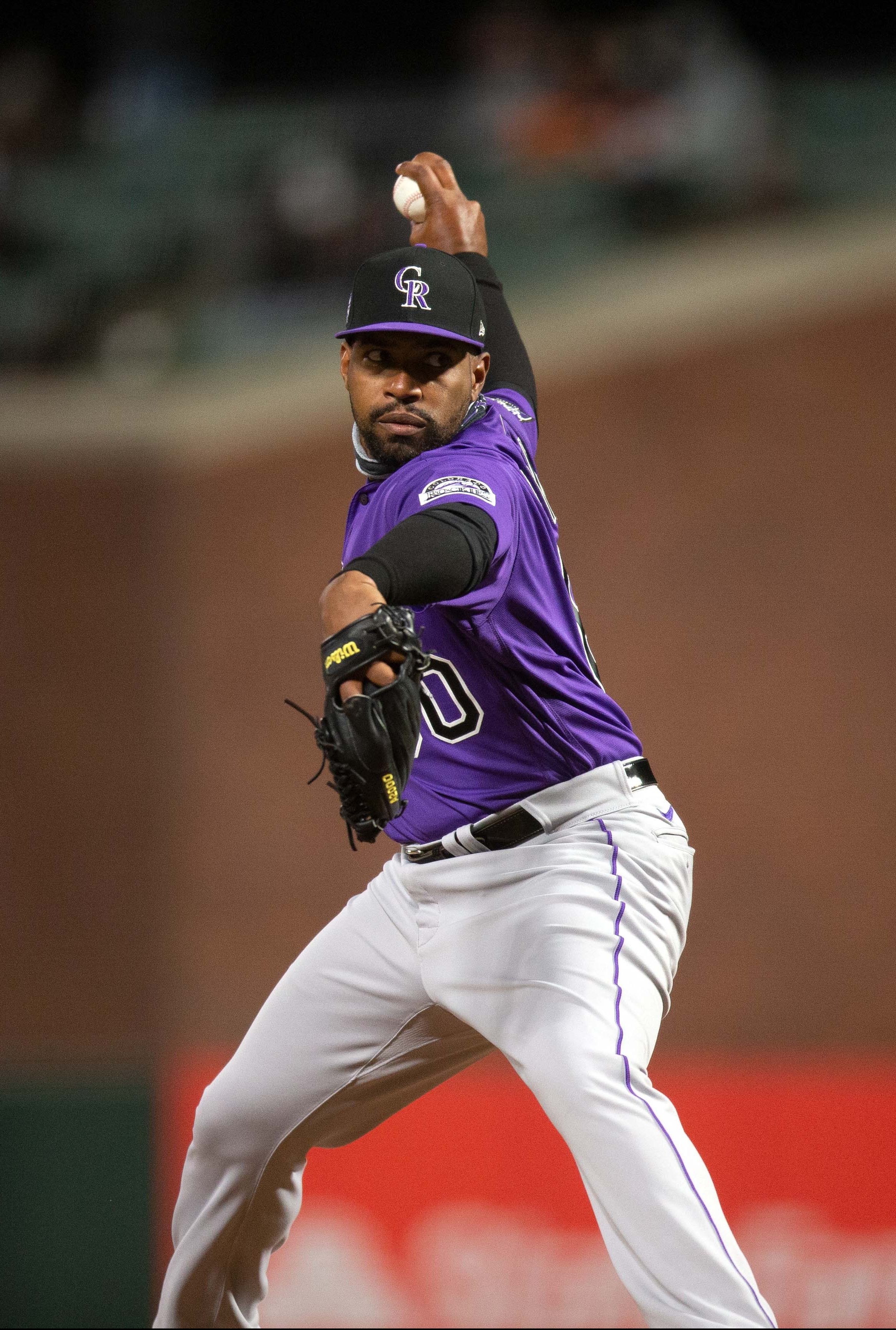
Givens, 31, will join the Reds as a rental for the remainder of the season before becoming a free agent. He’s being paid $4.05MM this year and has about $1.48MM of that sum yet to be paid out between now and season’s end. The longtime Orioles righty landed in Colorado at last year’s deadline, and while he had a bit of a rough time in May before eventually landing on the IL with a back strain, he’s been sharp as of late.
Overall, Givens has a 2.73 ERA on the year, which he’s complemented with strong 27.4 percent strikeout rate but an elevated 11.3 percent walk rate. His 31.3 percent ground-ball rate is, as usual, well below the league average. Givens has always been more of a fly-ball pitcher, and while he managed to avoid many home runs early in his career in spite of that tendency (and in spite of the AL East), he’s been more homer-prone in recent years. Dating back to 2019, he’s yielded 23 home runs in 115 frames (1.8 HR/9).
Still, Givens is an accomplished reliever with a long track record of missing bats and performing in high-leverage situations. He’s posted a sub-4.00 ERA in six of his seven MLB seasons (2021 included) and fanned at least a quarter of his opponents in all seven of his seasons — even earlier in his career when the league-wide strikeout rate was demonstrably lower than in today’s Major League climate.
Bullpen help has been an acute need for Cincinnati for much of the season, as the Reds have dealt with injuries to key relievers Tejay Antone, Michael Lorenzen and Lucas Sims at various points. The Cincinnati bullpen ranks last in the Majors in ERA (5.36) and FIP (4.86). Reds relievers, to their credit, do rank sixth in baseball with a collective 26.7 percent strikeout rate, but they also have the game’s second-highest combined walk rate, at 12 percent. No team’s relief corps has surrendered more home runs than Cincinnati’s 66. Part of that has to be attributed to their homer-friendly home park, but it’s been an ugly year for Reds relievers on the whole.
Of course, much of those bullpen woes have been self-inflicted. The Reds traded closer Raisel Iglesias to the Angels in a salary dump that netted them right-hander Noe Ramirez and Leonardo Rivas. (Ramirez was released in Spring Training and returned to the Angels; he’s now pitching well for the D-backs.) Cincinnati also non-tendered Archie Bradley, their primary deadline pickup from last summer’s trade deadline. Bradley has spent much of the 2021 season on the injured list in Philadelphia but at the time was a rather surprising cut by the Reds.
The subsequent bullpen woes have no doubt played a role in the Reds’ seven-game NL Central deficit and the six-game gap they’re facing in the NL Wild Card standings. The quick flurry of bullpen strikes shows that they’re endeavoring to patch that hole and make a push for a postseason berth in the final third of the season. Given their “early” deals (relative to the rest of the league more so than the trade deadline itself, which is barely more than 48 hours away), it’s likely we’ll see the Reds continue to explore further upgrades.
Williams was the Rockies’ fourth-round pick in last summer’s draft, but he was traded to the Reds alongside Jeff Hoffman in the deal that brought Robert Stephenson and outfield prospect Jameson Hannah to Colorado.
Williams has spent the season with the Reds’ Class-A affiliate, pitching to a 5.55 ERA with nearly as many walks (33) as strikeouts (34) in 47 innings of work. The 19-year-old Williams has also hit six batters and thrown eight wild pitches.
It’s been a rough debut for Williams, but he’s about three years younger than his average competition in that league and is effectively jumping to A-ball after not pitching in more than a year due to last year’s scrapped seasons. The Rockies have seen a good bit of their front office and player evaluation team depart, so it’s perhaps not surprising to see them reacquire a player with whom they’re already rather familiar.
The 24-year-old Davis has made 13 starts with Cincinnati’s Class-A Advanced affiliate in 2021, pitching to a 3.60 ERA with a sharp 27.6 percent strikeout rate but a lofty 12.5 percent walk rate. He’s induced grounders at a 38.9 percent clip.
Davis relies primarily on a four-seamer and slider, per Baseball America, who ranked him as Cincinnati’s No. 15 prospect entering the year. He also throws a curveball that’s a bit behind those offerings. FanGraphs’ Eric Longenhagen currently ranks him 36th in Cincinnati’s system, calling him a potential sixth starter/spot starter and noting that Davis had Tommy John surgery during his junior season at UC Santa Barbara.
Mark Feinsand of MLB.com reported (via Twitter) that the Reds were nearing a deal to acquire Givens. MLB Network’s Jon Heyman tweeted that an agreement had been reached. MLB.com’s Thomas Harding reported (via Twitter) Williams’ inclusion in the deal. Feinsand added that Davis was the second piece going to Colorado.
Rangers Sign Jack Leiter
The Rangers announced Wednesday that they’ve signed No. 2 overall draft pick Jack Leiter. He’ll join the club on a bonus worth a bit more than $7.9MM, ESPN’s Jeff Passan reports (via Twitter). That checks in slightly above the $7.7899MM slot value associated with the selection. It’s also more than $1MM north of the $6.5MM bonus for #1 overall pick Henry Davis and seems likely to wind up as the top bonus in this year’s class.
That’s not too surprising considering Leiter’s pedigree. The 21-year-old has been touted as one of the likely top picks in the draft for more than a year and only reinforced that hype with a dominant season at Vanderbilt in 2021. In 110 innings, the 6’1″, 205-pound righty pitched to a pristine 2.13 ERA while punching out 41.6 percent of his opponents. His 179 total strikeouts tied with Vandy teammate Kumar Rocker for tops in the country among Division I hurlers.
Leiter entered the draft as the consensus top arm available. Each of Kiley McDaniel of ESPN, Baseball America and Keith Law of the Athletic placed the righty as the best pitcher on their pre-draft rankings and among the five most talented players in the class overall. Leiter’s arsenal is headlined by a mid-90’s fastball with excellent life that plays above barrels at the top of the strike zone. His assortment of secondary offerings are solid, and Leiter has the athleticism and mechanics to project as an obvious starting pitcher. He’s polished enough that he should arrive in the majors rather quickly.
Latest On Max Scherzer
As of last night, there were at least eight clubs interested in Nationals ace Max Scherzer, who is open to waiving his no-trade rights but said to have a preference for a West Coast club that has the ability to keep him longer-term.
Scherzer figures to be one of the most talked-about trade candidates in recent memory, but his stay on the market may not go down to the wire like some other stars. The Athletic’s Ken Rosenthal reports that the Nationals want to get a framework for a trade in place as quickly as possible, in order to leave enough time to work out the details surrounding Scherzer’s no-trade rights and any compensation he’d require to waive them. MLB.com’s Jon Morosi tweets that some involved in negotiations believe an agreement could come together by tonight.
While Scherzer has been connected to more than a quarter of the league, Rosenthal and Morosi both suggest that the three NL West contenders — the Padres, Dodgers and Giants — are the likeliest destinations at this time. MLB.com’s Mark Feinsand suggested something similar yesterday. Both SNY’s Andy Martino and The Athletic’s Jayson Stark, meanwhile, have indicated that Scherzer would not approve a trade to either New York club.
Any of the three NL West contenders make for a sensible landing spot. The Giants hold the best record in Major League Baseball and ought to be motivated to aggressively strengthen their club down the stretch. The Dodgers’ rotation strength has dwindled since the season began, and the Padres are without several key rotation options themselves at the moment.
Of the bunch, only the Giants could acquire Scherzer without incurring any luxury-tax penalization. Scherzer’s deferral-heavy contract comes with an annual luxury hit of just under $30MM, and the prorated remainder of that hit as of this writing would be $10.49MM. (It’d drop to $10.03MM after the deadline.) The Dodgers, already in the top tax bracket for year-one offenders, would pay a 62.5 percent tax on that $10.03MM overage. The Padres are barely over the threshold at the moment and exploring some ambitious ways to drop back below the barrier; at the moment, they’d pay a 20 percent overage penalty.
Scherzer, who turned 37 yesterday, has pitched to a 2.83 ERA with a 35.1 percent strikeout rate (tying a career-high) and a 4.2 percent walk rate in 105 innings this year. He’s playing on a $35MM salary this year in the final season of a seven-year, $210MM contract, though the bulk of that 2021 salary is deferred to 2028. Schezer was scratched from his Saturday start against the Orioles due to a triceps issue, though the Nationals have indicated that an MRI came back clean. He’s listed as the probable starter for Thursday’s game against the Phillies. Of course, that recent health scare only muddies the water as teams try to put together a framework with the Nats.
Rockies Rumors: Cron, Givens, Marquez
Rockies first baseman C.J. Cron left last night’s game with a groin strain and will be further evaluated today. Manager Bud Black said after the game that the Rockies have their “fingers crossed” that Cron won’t require a trip to the 10-day injured list (Twitter link via The Athletic’s Nick Groke), though that very comment is seemingly an acknowledgement of such a possibility. If Cron does head to the injured list, that would likely dash any hopes of the Rockies trading him — or at least of receiving much at all in return. (Injured players can still be traded.)
Cron has had a solid bounceback from last year’s knee surgery. Signed over the winter to a minor league contract with just a $1MM base salary, he’s batted .245/.357/.460 with 14 home runs. Cron played in just 13 games with the Tigers last season before incurring his season-ending knee injury, but he showed a massive uptick in plate discipline during that time — one that he’s carried over into 2021. This year’s 12.1 percent walk rate is more than double the career mark that Cron carried into the year. As a pending free agent with defensive limitations, he wouldn’t have commanded a huge return, but a healthy Cron earning barely more than league minimum would be a player of interest to contending clubs, even if it’s only as a bench bat against lefties.
More out of Denver…
- Righty Mychal Givens is drawing plenty of interest on the market, tweets Mark Feinsand of MLB.com. That’s to be expected, as Givens is another impending free agent on a Rockies club that has zero postseason aspirations. He’s also a reasonably established late-inning reliever in the midst of a solid season, having pitched to a 2.73 ERA in 29 1/3 innings. Givens’ 27.4 percent strikeout rate is down about six percent from its 2019 peak, and his 11.3 percent walk rate is his highest since posting an 11.5 percent mark back in 2016. Both have been trending in the right direction over the past couple months, however. Givens would obviously help a contender’s bullpen, and with about $1.42MM of his $4.05MM salary owed beyond Friday’s deadline, he’s a pretty affordable option for other teams.
- The Rockies remain “dead set” on keeping right-hander German Marquez, writes Nick Groke of The Athletic in his latest mailbag. Manager Bud Black plainly said earlier this month that the Rockies wouldn’t trade Marquez, noting that ownership and the front office felt similarly. Black indicated that the Rockies had already informed Marquez and several other players that they wouldn’t be moved at this year’s deadline. It’s a puzzling stance to take for a club in Colorado’s position, particularly if, as Groke later writes in response to another question, owner Dick Monfort wants interim Bill Schmidt to become the full-time general manager in the offseason. It’d be one thing if a club didn’t want an interim GM to make what could be a franchise-altering trade, but if the Rockies’ eventual GM search leads them back to the same executive who’s already pulling the strings, then there’s little reason to not at least listen to offers on Marquez — even if the preference is to keep him.
Two Orioles Lefties Commanding Trade Interest
Baltimore left-handers Paul Fry and Tanner Scott aren’t household names, but both are drawing ample trade interest as Friday afternoon’s deadline approaches, per both Dan Connolly of The Athletic and Roch Kubatko of MASNsports.com. Right-handers Cole Sulser and Dillon Tate have also drawn some interest, but they’re both controlled four more years after the current season and won’t even be arbitration-eligible until the 2022-23 offseason at the earliest.
The 29-year-old Fry and 27-year-old Scott both offer plenty of club control in their own right. Both pitchers have an additional year of MLB service time over Sulser and Tate, making both arb-eligible this winter and controllable through the 2024 campaign. Either pitcher would make for an affordable upgrade who could impact his new club for several years down the road, and both pitchers have become increasingly appealing as the market context has changed this week.
This summer’s trade market was never particularly deep in high-quality left-handed relief help. But the injury to Minnesota’s Taylor Rogers, recent struggles for Washington’s Brad Hand, and the Athletics’ Monday acquisition of Andrew Chafin from the Cubs can only make the pair of Baltimore lefties all the more appealing.
Fry (60 2/3 innings) and Scott (61 innings) have near-identical innings totals over the past two seasons and have been similarly effective, relying on well above-average strikeout and ground-ball rates. Scott’s 2.51 ERA in that time has the edge on Fry’s 3.12 mark, but Fry has the edge in strikeout percentage (31.9 to 30.9) and ground-ball percentage (54.6 percent to 52.2 percent). Fry’s walk rate of 10.8 percent is worse than the league average but considerably lower than Scott’s mark of 14.3 percent. Scott, however, offers a blazing heater that has averaged 97 mph in 2021 and generates far more swinging strikes than Paul and his 93 mph fastball. It’s easy to see a club dreaming more on Scott’s stuff, but Fry’s demonstrably better control of the strike zone is a major point in his favor.
Naturally, Connolly suggests that there’s a split in other teams’ opinions on the pair of southpaws. Some figure prefer Fry’s less-dynamic repertoire but steadier control. Others will be drawn to Scott’s power arsenal. Kubatko reports that the Phillies, who have several former O’s execs in their front office, have been keeping tabs on the Baltimore bullpen. He also lists the Padres as a possibility.
Generally speaking, Fry and Scott are two of the market’s most appealing lefty relievers. The aforementioned Hand is sure to be available as the Nationals pivot to selling, but he’s also earning a $10.5MM salary this season and has surrendered eight runs in his past nine innings of work. It’s feasible that the Angels could move veteran Tony Watson, but their deadline direction remains unsettled and he’s a free agent at season’s end. Chasen Shreve, having a solid but unspectacular year in Pittsburgh, would also be a rental. Miami’s Richard Bleier is a quietly effective name who could likely be had in a trade, and even with Rogers down, the Twins have another interesting lefty in Caleb Thielbar. Both Bleier and Thielbar are 34 and lack even average fastball velocity, however.
Fry and Scott arguably offer the best combination of bottom-line results, quality stuff, age and remaining club control on the market at this point. That makes them more expensive in terms of prospects than rental veterans like Hand, Watson or Shreve, of course, but either would be a quality get for a contender’s relief corps.
Tyler Anderson Talks Between Phillies, Pirates Hit Late Obstacle
10:22 pm: The Pirates have raised some concerns about Hernandez’s medical evaluation, reports Jim Salisbury of NBC Sports Philadelphia. It remains possible a deal sending Anderson to Philly still gets done, although that might require “modifications” to Pittsburgh’s return, per Salisbury.
4:52pm: Despite multiple reports indicating the deal had been finalized, the trade now looks to have hit a “snag,” tweets Jon Heyman of MLB Network. Mackey tweets that Anderson is now in Pirates gear and throwing in the Pittsburgh bullpen. The Athletic’s Ken Rosenthal tweets that there’s some sort of issue with one of the two prospects in the deal.
That said, Anderson still isn’t starting tonight’s Bucs game. Pittsburgh has announced Luis Oviedo will make his first MLB start in place of Anderson. There’s no indication yet that the trade sending Anderson to Philadelphia is completely off, and it remains possible that the two parties could simply amend the deal to push it across the finish line. The Post-Gazette’s Mike Persak tweets that righty Max Kranick is at PNC Park, likely to replace Anderson on the roster, though he may have been summoned before any late obstacles arose.
3:07pm: The two sides are in agreement on a trade, reports Jason Mackey of the Pittsburgh Post-Gazette (Twitter link). The Phillies are sending 21-year-old catcher Abrahan Gutierrez and 20-year-old righty Cristian Hernandez to the Pirates in return. The deal is “final,” per Mackey.
2:42pm: The Pirates and Phillies are in “serious” talks on a trade that would send left-handed starter Tyler Anderson from Pittsburgh to Philadelphia, reports Jayson Stark of The Athletic (Twitter link). The deal in question would send a pair of prospects back to Pittsburgh. FanSided’s Robert Murray first noted talks between Philly and Pittsburgh. Mike Persak of the Pittsburgh Post-Gazette tweets that Anderson has been scratched from tonight’s start, which certainly suggests a move is imminent.

The potential return isn’t yet clear, though Stark characterizes the prospects being discussed as “second tier” and notes in a second tweet that catching prospect Rafael Marchan is not part of the proposed package.
That’s not exactly surprising, as while Anderson is a solid starter, he’s more the type of arm to stabilize a rotation than to push it to new heights. A free agent at season’s end, Anderson is playing on a one-year, $2.5MM contract and is still owed about $901K of that sum between now and the end of the year.
Anderson, 31, has made 18 starts for the Buccos this season and pitched at least five innings in all of them. That may not seem like a high bar, but the Phillies have routinely received short starts from the likes of Chase Anderson, Vince Velasquez and Matt Moore. A reliable source of five to six solid innings per outing is something the club could badly use — particularly with right-hander Zach Eflin currently on the shelf.
Thus far, Anderson has given the Pirates 103 1/3 innings of 4.35 ERA ball, although he’s been a bit more consistent than that number might appear at first glance. The lefty was shelled for nine runs in five frames against the Braves back on May 21 but has yielded three or fewer earned runs in 15 of his 18 starts. Setting aside that awful night against the Braves, Anderson carries a 3.75 ERA in his other 17 appearances.
Anderson doesn’t miss tons of bats (20 percent strikeout rate) or induce tons of grounders (37.3 percent), but Anderson has excellent control (5.8 percent walk rate) and has induced plenty of weak contact in the air. Among the 276 pitchers who’ve had at least 100 batted balls against them so far in 2021, Anderson’s average exit velocity of 91.7 mph on balls in the air sits in the 86th percentile.
When the Phils are at full strength, Anderson would step in as the team’s fourth starter behind Zack Wheeler, Aaron Nola and the aforementioned Eflin. He may not be locked in as a postseason starter, should Philadelphia qualify, but he could be a multi-inning option in a short postseason series or potentially a Game 3 starter, depending on the health elsewhere in the rotation. He also takes one target off the board for the division-rival Mets, who are eyeing rental starters and had been connected to Anderson as recently as this morning.
Turning to the Pirates’ end of the deal, they’ll receive some far-off but promising youngsters who joined the Phillies via international free agency. Gutierrez was originally signed by the Braves but reentered the free-agent market after Atlanta was penalized for international signing violations. He’s climbed as high as Class-A in 2021 and is enjoying an excellent season there, batting .285/.418/.424 with five homers, nine doubles and a solid 30 percent caught-stealing rate in 48 games.
Baseball America ranked Gutierrez 26th among Phillies farmhands prior to the season, calling him a line-drive hitter with average power and good knowledge of the strike zone. He landed 32nd on FanGraphs’ rankings of the Phillies system.
Hernandez is another player who didn’t rank prominently on preseason rankings of the Phillies’ system but has likely elevated his status with a strong 2021 showing. He’s pitched 56 2/3 innings at A-ball — presumably throwing to Gutierrez with regularity — and notched a 3.49 ERA with a big 31.2 percent strikeout rate and a 9.3 percent walk rate. MLB.com tabbed him 29th among Phillies prospects entering the season, noting that despite a modest $120K bonus when he signed, he might emerge as the best arm of Philadelphia’s 2017-18 signing class. Their report on him cites an above-average fastball that reaches 97 mph, a solid slider and a still-developing changeup as reasons to be optimistic about the 6’3″, 180-pound righty.
At Least Eight Teams In The Mix For Max Scherzer
As many as eight clubs are in the mix for Nationals ace and three-time Cy Young winner Max Scherzer, per Jayson Stark of The Athletic (Twitter link). The Dodgers, Giants, Padres, Red Sox, Rays, Blue Jays, Astros and Mets are all interested, according to Stark, who adds that the Yankees also inquired but were told Scherzer isn’t likely to waive his no-trade rights for a move to New York. That meshes with recent reporting from SNY’s Andy Martino, who wrote earlier this afternoon that Scherzer wouldn’t approve a trade to the Mets (nor would the Nationals be keen on dealing their ace to the current division leaders).
MLB.com’s Mark Feinsand reported earlier in the day that Scherzer preferred a West Coast club, though MLB Network’s Jon Heyman adds that the ostensible West Coast preference is more about Scherzer wanting to go to a team with a chance to win in 2021 and beyond. Scherzer prefers to go to “a team he could stay with” on a possible extension, per Heyman. Agent Scott Boras indicated as much earlier in the summer, although at the time Boras suggested an extension might be necessary in order for Scherzer to waive his no-trade protection at all. That no longer seems to be the case, but as evidenced by Scherzer’s unwillingness to go to a New York club, the no-trade rights can help him choose his eventual landing spot.
If the Nats are to ultimately trade Scherzer, tweets Ken Rosenthal of The Athletic, the team’s preference is to do so within the next 48 hours. Doing so would leave ample time to sort through the no-trade obstacles and any potential compensation for waiving those rights (e.g. alterations to deferrals, taxes, etc.).
That said, a trade taking place prior to Thursday’s game would put an acquiring team in a tough spot. Scherzer was scratched from his weekend start due to a triceps issue and is set to return to the mound Thursday. A recent MRI came back clean, and any team acquiring Scherzer would obviously have access to the results from that imaging and other testing. Still, a clean MRI may not inspire as much confidence as seeing Scherzer go out and actually perform. If interested clubs prefer to wait until Scherzer has taken the mound, there’d be fewer than 24 hours between the conclusion of Thursday’s start and Friday afternoon’s deadline.
Any trade involving Scherzer is going to be financially complicated, but looking at Stark’s list of interested parties, there are a few particularly complex scenarios. The Dodgers are already into the final luxury-tax bracket, meaning they’d pay a 62.5 percent overage penalty on any additional money added to the books. For Scherzer, whose remaining luxury hit clocks in at roughly $10.03MM post-deadline and $10.49MM as of this writing, that’d mean paying between $6.27MM and $6.56MM on top of the approximately $12.2MM he’s still owed in actual 2021 salary. (Luxury tax is calculated based on a contract’s average annual value, but Scherzer’s backloaded contract comes with a $35MM salary in 2021 — albeit with much of that sum deferred.)
The Padres are reportedly just above the luxury tax threshold, but are still considering moves that could take them back under that line. A Scherzer acquisition, however, would push them well above the mark. That’s also true of the Astros and the Red Sox, who are both within just a few million of the $210MM threshold. The Rays, of course, have an entirely different sort of financial obstacles to consider (namely, their perennially cellar-level payroll). The Jays and Giants, as teams with deep pockets and no real luxury concerns of which to speak, ostensibly represent the “cleanest” fits of the bunch.
That’s not to say that the Dodgers, Padres, Astros, Rays or Red Sox shouldn’t be considered legitimate contenders for Scherzer. (Although if Scherzer is hoping to stay with the club that acquires him, the low-payroll Rays are an admittedly tough fit.) Most clubs this summer have voiced some iteration of a “we’d exceed the threshold for the ‘right’ player” stance. It’s hard to imagine a player who fits that billing more than a bona fide ace and three-time Cy Young winner who has a 2.92 ERA in 49 1/3 postseason innings with the Nats since 2016. But with the Nats theoretically negotiating with a rapidly ticking clock, any complicated financial elements of a deal are magnified.
MLBTR Chat Transcript
Click here to read a transcript of tonight’s chat with MLBTR’s Steve Adams.
Mariners, Astros Swap Kendall Graveman For Abraham Toro In Four-Player Trade
In a rare and rather stunning swap between a pair of division rivals who are both in contention, the Mariners have traded closer Kendall Graveman and recently designated-for-assignment righty Rafael Montero to the Astros in exchange for young infielder Abraham Toro and veteran righty Joe Smith, according to both clubs. The trade is even more eye-opening when considering that the two clubs are gearing up to play each other in the second game of a three-game set tonight.
Trading Graveman at all registers as a moderate surprise, given the Mariners’ recent climb in the standings and stated desire to improve the 2021 roster. To see him traded to the division-leading Astros while the two squads are playing one another is downright jarring. That said, Graveman is a free agent at season’s end, and in Toro, the Mariners are acquiring five seasons of control over an infielder who has been considered one of Houston’s more promising young prospects for the past few years.
In speaking to the media about the trade, Seattle general manager Jerry Dipoto plainly acknowledged that as a standalone transaction, it’s a head-scratching move. But Dipoto also emphasized some patience, suggesting this move is but one of a sequence of trades designed to improve the Mariners’ chances both in 2021 and over the long-term down the road (Twitter thread via MLB.com’s Daniel Kramer). Dipoto suggested a subsequent trade or trades could come together as soon as tonight or in the coming days, but it seems as though this is but one of a series of moves for which the Mariners are angling; time will tell just how the moves look when judged in their totality.
Toro, 24, hasn’t yet pieced things together in limited big league action, but he’s decimated Triple-A pitching (.392/.497/.600 in 33 games) and posted strong numbers in pitcher-friendly Double-A settings (.282/.369/.468 in 148 games). The switch-hitting Toro provides the Mariners with a possible long-term option at third base, but he’s also logged considerable time at second base — another area where the Mariners have been known to be seeking help. That long-term fit isn’t likely to matter much to the clubhouse, however, and Divish rather unsurprisingly tweets that the decision to trade Graveman to their top division rival was not well-received among Seattle players.
That’s understandable on Seattle’s end, given just how dominant Graveman has become since transitioning to the bullpen late in the 2020 season. The former Athletics starter has bounced back from an injury-lost 2019 season to emerge as one of the American League’s more effective relievers. In 33 innings this season, Graveman has pitched to a 0.82 ERA with a 28.1 percent strikeout rate, a 6.6 walk rate and a 53.9 percent ground-ball rate. Dating back to his shift to the bullpen in 2020, he’s compiled 43 innings of 1.47 ERA ball.
Graveman is likely all the more appealing to the luxury-conscious Astros because of his affordable salary. He’s playing on a one-year, $1.25MM contract. Incentives have already boosted that base salary by $400K, and the contract overall contains a total of $3MM in reachable incentives. That said, $1.5MM of those are tied up in games finished, and manager Dusty Baker has already indicated that Ryan Pressly is likely to continue as his closer. Graveman could still collect six more stray games finished to reach his first of three would-be $500K bonuses tied to games finished, but it’s unlikely he reaches the 30 and 40 games finished needed to unlock the next pair of $500K bonuses. In all, the contract will likely top out paying him somewhere in the range of $2.65MM based on incentives tied to days on the roster, games finished and total innings pitched.
Montero’s inclusion in the trade is likely a pure accounting measure. The combined salaries of Montero and Graveman ought to clock in somewhere in the same ballpark as Smith’s $4MM salary and luxury-tax hit, though depending on the status of Graveman’s incentives, the Astros could come out either a bit ahead or a bit behind where they were previously projected.
Montero opened the season as the closer in Seattle but struggled early and has been mired in a catastrophic slump of late, yielding 16 runs in his past 11 innings. The ‘Stros may have their own ideas on how to help a reliever who was quite good with the Rangers in 2019-20 right the ship, but Montero’s inclusion doesn’t appear to be a key part of the swap. At best he’s a roll of the dice, and at worst he’s a financial counterweight who could be cut loose quickly if his struggles persist.
The same is largely true of Smith, who opted out of the 2020 season after signing a two-year deal in Houston and has been clobbered for a 7.48 ERA in 21 2/3 innings this year. Some of that has been attributable to a sky-high .413 batting average on balls in play, but Smith is sporting a career-low strikeout rate, a grounder rate that’s well off his peak levels and has also been quite homer-prone. As with Houston and Montero, perhaps the Mariners have an idea or two about how to get the veteran righty back on track, but the trade is much more about Graveman and Toro than about the struggling relievers accompanying those two players.
Ryan Divish of the Seattle Times first tweeted that Toro and a reliever were going to the Mariners in exchange for two players. MLB.com’s Brian McTaggart provided the full context on the trade.