
Offseason In Review: Minnesota Twins
The reigning AL Central champs moved on from their longtime left fielder, retained their top slugger and improved their defense. They’ll face stiff competition in their quest for a third straight division title, however.
Major League Signings
- Nelson Cruz, DH: One year, $13MM
- Andrelton Simmons, SS: One year, $10.5MM
- J.A. Happ, LHP: One year, $8MM
- Alex Colome, RHP: One year, $6.25MM (includes buyout of 2022 mutual option)
- Matt Shoemaker, RHP: One year, $2MM
- Hansel Robles, RHP: One year, $2MM
- Total spend: $41.5MM
Trades and Claims
- Acquired RHP Shaun Anderson from the Giants in exchange for OF LaMonte Wade Jr.
- Claimed RHP Ian Hamilton off waivers from the Phillies (later outrighted to Triple-A)
- Claimed LHP Brandon Waddell off waivers from the Pirates (later outrighted to Triple-A)
- Claimed RHP Ian Gibaut off waivers from the Rays (later outrighted to Triple-A)
- Claimed OF Kyle Garlick off waivers from the Braves
Notable Minor League Signings
- Keon Broxton, Rob Refsnyder, Tzu-Wei Lin, Danny Coulombe, Andrew Romine, JT Riddle, Tomas Telis, Glenn Sparkman, Luke Farrell, Derek Law, Juan Minaya, Andrew Albers, Chandler Shepherd
Extensions
- None
Notable Losses
- Jake Odorizzi, Eddie Rosario, Trevor May, Tyler Clippard, Sergio Romo, Rich Hill, Matt Wisler, Marwin Gonzalez, Homer Bailey, Alex Avila, Ehire Adrianza, Sean Poppen
For the first time in half a decade, the Twins will open the season with someone other than Eddie Rosario patrolling left field. The homegrown slugger held that spot for the better part of six years, but faced with Rosario’s final raise in arbitration and with multiple high-end prospects on the horizon, the Twins felt that money was better spent elsewhere. The league seemingly agreed, as Rosario went unclaimed on outright waivers before being non-tendered. He’d go on to sign in Cleveland for an $8MM salary that gives him a modest raise over 2020’s $7.75MM mark but still falls shy of what he’d have earned in arbitration.
While it was at least a mild surprise that no club jumped to grab Rosario on outright waivers, the Twins’ decision to move on in some capacity was largely foreseeable. Rosario is a fine player with above-average pop, but given his sub-par on-base skills and rising price tag, the writing was on the wall.
The Twins have two of the game’s top overall outfield prospects, Alex Kirilloff and Trevor Larnach, nearly ready for a long-term audition in the outfield. Kirilloff, who has a chance to make the Opening Day roster, made his big league debut in last year’s postseason and seems to be first in line for the left field vacancy. The Twins also saw former No. 35 overall pick Brent Rooker, a left fielder/first baseman, make his big league debut last year. Jake Cave gives them another option in left should injuries or struggles keep the prospects from taking over.
It may not have surprised as many fans as the Rosario move, but the Twins’ non-tender of righty Matt Wisler was also unexpected. Having plucked the former top prospect off waivers to begin the 2019-20 offseason, the Twins pushed Wisler to throw his slider at a staggering 83 percent clip. The experiment was an unequivocal success, as Wisler turned in a 1.07 ERA and punched out nearly a third of the batters he faced. His 13 percent walk rate was far too high, however, and though his projected arbitration salary wasn’t much more than $1MM, the Twins appeared confident they could replace his production.
With that pair of non-tenders saving $10MM or more, the Twins’ payroll outlook in early December was relatively pristine. Josh Donaldson is earning $23MM annually, but the 2021 projected payroll at that point was a mere $90MM — down from more than $130MM in 2020. The number plummets in 2022, when the Twins have just $48MM in guaranteed contracts on the books.
As such, the Twins had the financial wherewithal to pursue just about any free agent, but it quickly became clear they were focused primarily on one-year additions. Whether the driving factor there was uncertainty about further revenue losses in 2021, the desire to keep a clean outlook for next year’s mega-crop of free agents or a combination of multiple factors, the trend is clear both in the free agents they signed and in the names they pursued.
Minnesota tried for one of the market’s bigger names out of the gate, reportedly making a strong offer for Charlie Morton before he took an early deal with the Braves. The Athletic’s Dan Hayes wrote back in November that the Twins were a “finalist” for Morton, but the righty’s strong preference to pitch near his family home in Bradenton, Fla. has long been known.
Pursuits of Corey Kluber and James Paxton led to similar results. After spending months rehabbing at a facility run by Yankees director of health and performance Eric Cressey, Kluber went to the Bronx. Paxton re-upped with the Mariners, and Seattle GM Jerry Dipoto said afterward that Paxton “wanted to be a Mariner” gave the club a “hometown discount” of sorts on his $8.5MM salary.
The Twins did ultimately add a pair of veterans to the rotation, inking 38-year-old lefty J.A. Happ to a one-year deal worth $8MM and signing righty Matt Shoemaker to a one-year, $2MM deal after an injury-wrecked pair of seasons. In many ways, the signings mirror last winter’s signings of Homer Bailey and Rich Hill. The more expensive of the two additions is designed to stabilize the rotation, while the more affordable one carries more upside and a greater risk of injury. The combined $10MM price point is a dead match with the combined $10MM base salaries of Bailey ($7MM) and Hill ($3MM).
While neither Happ nor Shoemaker gives the Twins a top-of-the-rotation presence, the organizational hope is surely that last year’s breakout from Kenta Maeda gives them the ace-caliber arm they’ve lacked since Johan Santana. Between Maeda, Jose Berrios, Michael Pineda, Happ and Shoemaker, the Twins have a solid Opening Day rotation. Randy Dobnak, Devin Smeltzer and Lewis Thorpe give them a trio of younger options with some big league experience (and a good bit of success, in Dobnak’s case). Right-handers Jordan Balazovic and Jhoan Duran, both top 100 prospects according to FanGraphs and The Athletic, loom in the upper minors and could debut in 2021.
Jake Odorizzi remained on the Twins’ radar for much of the offseason, but his desire for a multi-year deal never seemed to align with the team’s general approach. While the eventual terms of his deal with the Astros may arguably have been a better investment than the one-year deals with Happ and Shoemaker, Odorizzi was reported to be seeking a three-year deal at $13-15MM annually for much of the winter. By the times his asking price dropped, the Twins had signed multiple pitchers and turned the page on the 2019 All-Star.
Looking to the bullpen, the Twins lost nearly their entire setup corps with Trevor May, Sergio Romo, Tyler Clippard and Wisler hitting the market. All four will pitch elsewhere in 2021. In place of that trio, Minnesota signed former division rival Alex Colome to a one-year deal and took a chance on a Hansel Robles rebound. Both have closing experience, and Colome has been particularly effective in terms of ERA over the past couple seasons with the White Sox. Even though Colome’s secondary marks don’t look as appealing as his ERA, it’s hard to find fault with the $6.25MM price tag. He’s expected to share closing duties with holdover Taylor Rogers, who took a slight step back in 2020 but has amassed a generally strong late-inning track record since 2018.
The Twins’ acquisition of righty Shaun Anderson didn’t draw much attention, but he gives the club a spin-rate project on which they can dream. Anderson has elite spin on both his four-seamer and, in particular, his slider. Walks have been a significant problem thus far in his big league career, but Anderson has a pair of minor league options remaining, so the Twins can take their time in trying to shape him into a quality reliever.
In the meantime, the Twins will look for incumbent options to step up. Tyler Duffey broke out as one of the game’s best relievers in 2019-20 (2.31 ERA, 2.72 SIERA, 34.2 K%, 6.1 BB%). Flamethrower Jorge Alcala had a quietly excellent showing in 2020, and righty Cody Stashak is another largely anonymous but highly effective reliever through his first 40 big league frames. Southpaw Caleb Thielbar was tendered a contract in December after a strong season, continuing his emotional comeback effort following a five-year absence from MLB.
On the offensive side of the coin, the main storyline for the Twins entering the winter (beyond Rosario) was whether they’d re-sign veteran slugger Nelson Cruz. A reunion with Cruz was dependent on the universal designated hitter — or the lack thereof. Cruz reportedly sought a two-year contract, while the Twins were steadfast in their preference to keep the commitment to one year. With few AL contenders having the capacity to add a pure DH, however, Cruz seemingly needed the universal DH to be permanently implemented if he was going to create enough market pressure to get to a two-year deal. That still hasn’t happened, and Cruz eventually signed on for a third season at Target Field after the Twins upped their one-year offer to match the AAV from his first two years there.
As noted when previewing their offseason, the Twins didn’t necessarily have a true “need” in the middle infield, but it represented an opportunity to get creative. President of baseball ops Derek Falvey, GM Thad Levine and their front office crew did just that, pursuing one-year pacts with free-agent shortstops Andrelton Simmons and Marcus Semien. When Semien took a larger offer in Toronto, the Twins quickly wrapped things up with Simmons.
In doing so, they secured a historically gifted defender and pushed incumbent shortstop Jorge Polanco to second base. Versatile Luis Arraez will slide into the vacant super-utility role previously held by Marwin Gonzalez, who signed with the Red Sox as a free agent. Arraez, a .331/.390/.429 hitter through his first 124 MLB games, will get into the lineup regularly by filling in around the infield and in left field.
Both Simmons and Polanco have battled significant ankle issues the past two seasons, but the hope is that after a pair of surgeries, Polanco will be back to full strength for the first time since 2018. If Simmons is healthy, he and Josh Donaldson could form one of the game’s best left-side tandems on defense. Polanco has never rated as a strong defensive shortstop, but the Twins feel he can be above-average at second base.
If that’s indeed the case, the Twins could be one of the game’s best defensive clubs. Miguel Sano isn’t going to win any awards for his glovework at first base, but the rest of the infield, combined with strong defenders behind the dish (Ryan Jeffers, Mitch Garver) and elite defenders in the outfield (Byron Buxton, Max Kepler) should be formidable.
The Twins were dealt a tough blow early in Spring Training, when it was learned on report day that some knee discomfort being experienced by Royce Lewis, the No. 1 overall pick in 2017, was due to an ACL tear that will end his 2021 season before it begins. Lewis, widely regarded among the game’s top 30 or so prospects, hurt his knee during offseason workouts and aggravated it when he slipped during the blizzards near his Texas home. He’ll now go more than two years between competitive games, although at just 21 years old, he has youth on his side.
The 2021 Twins have a different feel to them than 2019’s “Bomba Squad,” but this looks to be an improved defensive club with a good bit of thunder in the middle of the lineup and a deep pitching staff. The Indians’ trades of Francisco Lindor and Carlos Carrasco have dropped them a ways back in projections, but improvements on the White Sox roster mean the Twins will still face stiff competition as they look for an AL Central threepeat. Meanwhile, both the Royals and Tigers added some veterans to complement rosters that are seeing the fruits of their rebuilding efforts percolate to the big league level.
This should be the best iteration of the AL Central we’ve seen in years. The Twins have again positioned themselves as clear contenders in 2021 and done so while maintaining the long-term flexibility to be prominent players in next year’s stacked free-agent market.
How would you grade the Twins’ offseason? (Link to poll for Trade Rumors iOS/Android app users)
Grade the Twins' offseason:
-
B 54% (2,293)
-
C 30% (1,292)
-
A 8% (342)
-
D 5% (199)
-
F 3% (121)
Total votes: 4,247
Offseason In Review: Miami Marlins
Led by a new general manager, the Marlins overhauled their bullpen and added a group of low-cost veterans they hope can supplement a growing core of young big leaguers.
Major League Signings
- Anthony Bass, RHP: Two years, $5MM
- Adam Duvall, OF: One year, $5MM
- Ross Detwiler, LHP: One year, $850K
- Total spend: $10.85MM
Trades and Claims
- Acquired RHP Dylan Floro from the Dodgers in exchange for LHP Alex Vesia and RHP Kyle Hurt
- Acquired RHP John Curtiss from the Rays in exchange for 1B Evan Edwards
- Acquired RHP Adam Cimber from the Indians in exchange for cash
- Traded RHP Jordan Yamamoto to the Mets in exchange for INF Federico Polanco
- Selected RHP Paul Campbell from the Rays in the Rule 5 Draft
- Acquired Rule 5 RHP Zach Pop from the D-backs in exchange for PTBNL
Notable Minor League Signings
Extensions
- None
Notable Losses
- Brandon Kintzler, Harold Ramirez, Ryne Stanek, Matt Joyce, Francisco Cervelli, Brad Boxberger, Jose Urena, Drew Steckenrider, Pat Venditte, Mike Morin, Josh A. Smith
The Marlins’ winter began with the news that longtime president of baseball ops Michael Hill would depart the club after the two sides weren’t able to come to terms on an extension. Hill went on to take a job in the league offices, while the Marlins made history by tabbing Kim Ng as MLB’s first female general manager.
Ng has been considered a potential GM for years now, having previously served as an assistant GM with multiple clubs in addition to holding a prominent post within the league offices herself. She’s interviewed for several openings, and she’ll now be given the keys to a promising, up-and-coming club fresh off a surprise postseason berth. A return to the playoffs will be a tall task in a stacked division and with fewer postseason spots up for grabs in 2021.
As is often the case when new front office regimes take over, the first winter was a relatively quiet one under Ng. The Marlins were connected to come notable names — free agent Marcell Ozuna and trade candidate Willson Contreras among them — but the moves the team actually did make were far more measured when all was said and done.
Some of that is surely due to the presence of intriguing youngsters at various positions on the roster, while some is likely due to ownership’s commitment to limit spending early in its tenure. Marlins CEO Derek Jeter sought to distance the organization from a leaked payroll projection plan in his first winter on the job — one in which payroll was to drop from $115MM in 2017 to the low $80MMs in 2019-20. However, the Marlins haven’t done much to suggest that plan was not accurate, and last year’s revenue losses couldn’t have accelerated plans to spend.
That being said, the Fish still made a handful of notable additions, beginning with the signing of righty Anthony Bass to a modest two-year pact. Bass has done well in reviving his career after a nice run in Japan, and he parlayed a strong showing in Toronto last year into a guaranteed multi-year pact.
Bass is the favorite to close games in Miami this year, and while he’s not the prototypical high-strikeout, high-leverage reliever, Bass fits a similar profile to that of 2020 closer Brandon Kintzler. The 33-year-old Bass sports a sinker that averages around 95 mph, and last season’s 62.3% ground-ball rate was the tenth-highest among the 490 pitchers who threw at least 10 innings. If you up the minimum to 20 innings pitched, Bass ranked fourth among all MLB pitchers.
While Bass was the most expensive addition to the team’s bullpen, he was far from the only one. In fact, the Marlins added several relievers with a similar profile to Bass, suggesting that while they knew they wouldn’t be able to spend on the market’s top strikeout artists, they’re confident they can build a bullpen that thrives on grounders and weak contact.
Inking journeyman lefty Ross Detwiler to a big league deal came as something of a surprise, but at $850K, the price was minimal. And, like Bass, Detwiler was flat-out elite in ground-ball production last year, turning in a 58.3% mark that ranked 30th of the 490 pitchers with 10 or more innings. Dylan Floro, acquired in a trade with the Dodgers, ranked 44th on that same list. Adam Cimber, picked from DFA limbo in a deal that sent cash to Cleveland, was tied for 74th at 52.4%. Rule 5 trade acquisition Zach Pop has a career grounder rate north of 60% in the minors.
The exceptions to the ground-ball rule were righty John Curtiss, acquired in a small trade with the Rays, and Rule 5 pick Paul Campbell. Curtiss hasn’t established himself in the big leagues over a large sample but was the stingiest reliever in the game in terms of walks last year. Campbell is a spin-rate darling who doesn’t miss as many bats as one would expect.
Miami completely overhauled its bullpen mix without spending much money or surrendering much in the way of prospects, as Ng and her staff bucked the industry trend of paying up for late-inning whiffs. They’re not the only club to invest in this area this winter — the A’s also went heavy into weak contact, at least prior to inking Trevor Rosenthal — but it’ll be telling to see if the club succeeds with this approach. There are too many weak contact/ground-ball specialists here to think it’s mere coincidence, so it seems like the Marlins made a deliberate bet on a skill set they felt was undervalued.
Beyond that slew of bullpen additions, the Marlins’ primary add was former division-rival slugger Adam Duvall. Non-tendered by the Braves on the heels of a productive 2020 season, Duvall now figures to slot in as Miami’s everyday right fielder, with 2020 deadline pickup Starling Marte in center and 2019-20 offseason signee Corey Dickerson in left field. It’s a veteran group that ought to provide some value on both sides of the ball. Duvall is a low-OBP, high-powered slugger with a strong glove in the outfield corners, and the Marlins landed him at a rather reasonable $5MM rate for the upcoming season.
That the Marlins are trotting out a trio of veterans to serve as their starting outfield in 2021 highlights the disappointment stemming from a group of prospects once considered to be the future there. Lewis Brinson, Magneuris Sierra, Monte Harrison and Jesus Sanchez were all billed as top prospects at various times and were all key pieces in the Marlins’ last tear-down. To this point, none of the quartet has solidified himself as a big leaguer or really even come close to doing so. Each of Brinson, Harrison and Sanchez at least has a minor league option remaining, so there’s still some leash yet to break out.
Sierra, meanwhile, is out of options and struggling in Spring Training. We’ll find out before long whether the restructured front office is as bullish on his outlook as the regime that acquired him as part of the Marcell Ozuna trade with the Cardinals (alongside Sandy Alcantara and Zac Gallen). Miami already parted with one semi-notable piece of its rebuild haul, as righty Jordan Yamamoto was sent to the Mets after being designated for assignment to clear space on the roster for Bass. Yamamoto was considered the fourth-best piece in the Christian Yelich swap behind Brinson, Harrison and Isan Diaz, but he was the only one of the four to find some reasonable big league success to this point.
Elsewhere in the lineup, there’s a good bit of continuity. Brian Anderson will reprise his role at third base and in the heart of the order, providing the Marlins with a solid, underrated cornerstone. He and the former front office discussed an extension last spring, but Ng suggested over the winter that she wants a chance to evaluate Anderson firsthand before determining whether to sign him to a long-term deal. The third baseman is currently controlled through the 2023 season.
Team leader Miguel Rojas is back at shortstop, and he’ll pair with Anderson to form a strong defensive tandem on the left side of the infield — one that bodes well for the Marlins’ grounder-heavy bullpen. At second base, the hope is that Diaz can cement his spot after opting out of most of the 2020 season, but he’ll compete for time with veteran Jon Berti and have prospect Jazz Chisholm looming as well. Jesus Aguilar and Garrett Cooper will hold things down at first base, and Cooper can play some corner outfield should an injury arise. Cooper drew some offseason trade interest once Duvall was signed, but the Marlins opted not to move him.
Speaking of offseason trade interest, the Marlins’ catcher position was the source of some intrigue early in the winter. Reports of the team’s interest in Contreras led to plenty of speculation and even elicited a reaction from Contreras himself on social media, but a deal never came to pass. Miami was linked to some other options behind the dish, mostly in more speculative fashion, but in the end they’ll give another chance to Jorge Alfaro and Chad Wallach. It seems fair to believe that pairing doesn’t take a step forward in 2021, changes could be on the horizon.
As it stands, Sandy Leon was the only backstop option brought in from outside the organization, and that came on a minor league deal. He’s one of just two prominent names in camp as a non-roster invitee this spring, joining hometown “kid” Gio Gonzalez. The veteran lefty inked a minor league deal not long after camp began and is in the mix for a rotation spot. Given every team’s need for depth and innings as they exercise caution ramping pitchers back up, Gonzalez ought to have a decent chance to make the club. He’s competing with prospects like Trevor Rogers, Nick Neidert and Braxton Garrett for that spot, but he’d be a sensible add to the Opening Day roster even as more of a long reliever.
All in all, it was a relatively quiet winter for the Marlins. The bullpen has been turned over considerably, but much of the club’s fate lies with the development of burgeoning young rotation cogs like Alcantara, Pablo Lopez and the tantalizing Sixto Sanchez. Elieser Hernandez, fresh off a strong but abbreviated showing in 2020, is likely to start plenty of games this season as well. It’s an interesting and exciting mix of young arms for the Fish — one that could very well be the foundation of a more competitive wave of clubs than we’ve seen for years in Miami, with new ownership and new management now fully entrenched. The odds are against them for a playoff berth in 2021, but the future still looks bright.
How would you grade the Marlins’ offseason? (Link to poll for Trade Rumors iOS/Android app users)
Grade the Marlins' offseason:
-
C 44% (1,251)
-
B 26% (722)
-
D 18% (509)
-
F 8% (215)
-
A 4% (127)
Total votes: 2,824
MLBTR Chat Transcript
Click here to read a transcript of Tuesday’s chat with MLBTR’s Steve Adams.
Indians Release Billy Hamilton
TODAY: The Indians announced that Hamilton has been released.
MARCH 11: The Indians have informed veteran outfielder Billy Hamilton, who is in camp with them on a minor league deal, that he will not make the Opening Day roster, manager Terry Francona announced to reporters this morning (Twitter link via MLB.com’s Mandy Bell). The organization made the decision quickly and will “attempt to help him land” with another club, per Francona.
Hamilton always faced an uphill battle in making the Indians’ roster, given the presence of Eddie Rosario, Oscar Mercado, Josh Naylor, Jordan Luplow, Bradley Zimmer, Daniel Johnson, Amed Rosario and Jake Bauers on the 40-man roster. But Cleveland’s outfield picture got even more crowded not two weeks after Hamilton inked his deal with the club on Feb. 12, as the Indians wound up claiming Harold Ramirez off waivers from the Marlins.
It’s not clear whether Cleveland will quickly release Hamilton or simply try to find a nominal trade that could send him to another club with more of a need in the outfield. Either way, it seems likely Hamilton will be with another club before too long.
The 30-year-old speedster was a fixture in the Reds’ outfield from 2013-18 but has begun to bounce around the league in journeyman fashion since that time. He split the 2019 season between the Royals and the Braves before spending time with the Giants, Mets and Cubs organizations in 2020. (He did not appear in the Majors with San Francisco.) Hamilton remains one of the game’s fastest players and most gifted outfield defenders, but he’s batted just .237/.294/.317 across his past four seasons in a total of 1578 plate appearances.
Nick Markakis Retires
Veteran outfielder Nick Markakis is calling it a career after 15 seasons at the Major League level, he tells David O’Brien and Dan Connolly of The Athletic. The 37-year-old says he made up his mind shortly after the postseason ended and did not pursue any opportunities this winter. “My No. 1 decision and my main focus on this is obviously my kids and my family,” Markakis said, adding that he’s both fortunate and thankful to have been able to play the game as long as he has.
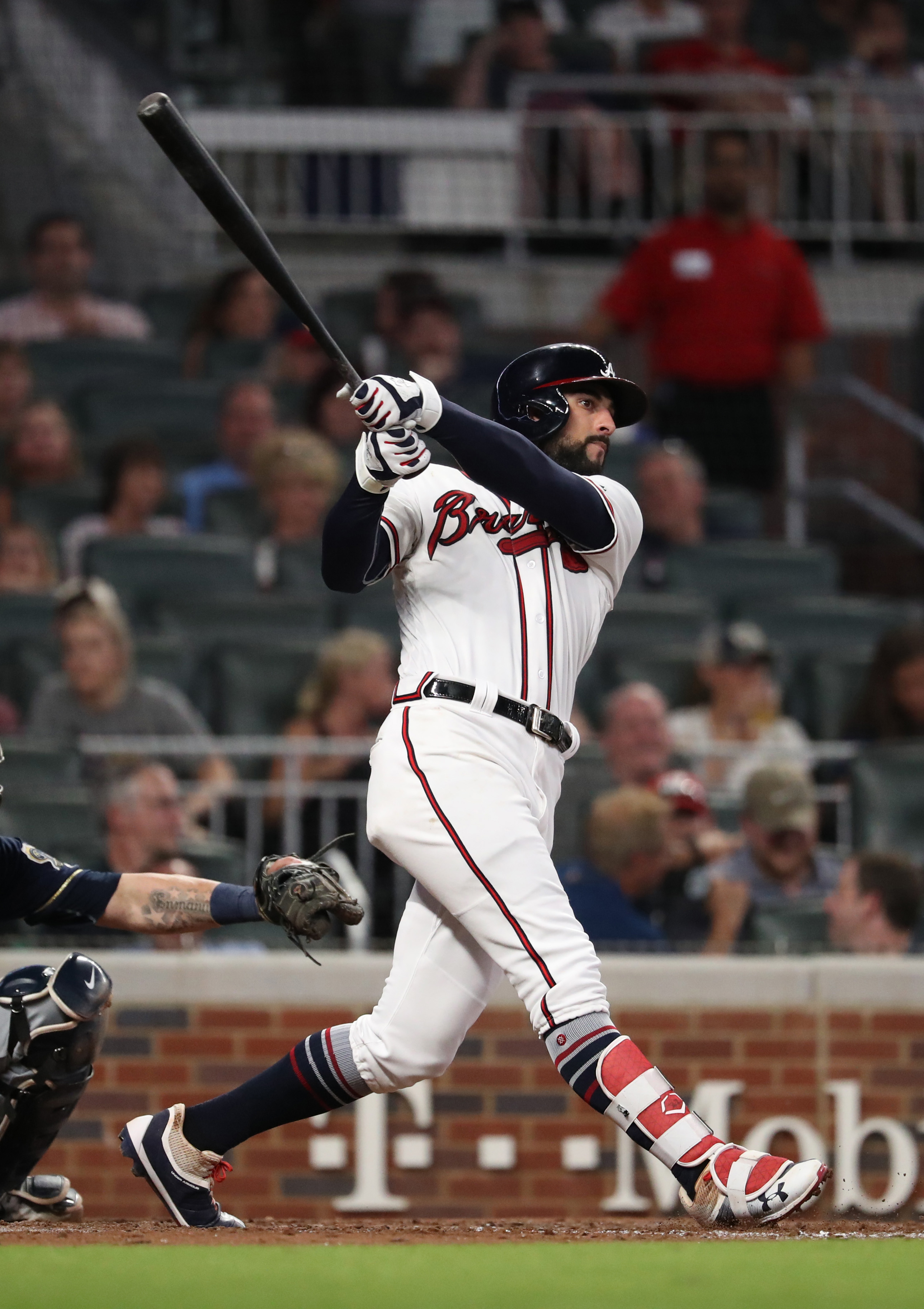
The seventh overall pick back in 2003, Markakis spent fewer than three years in the minors before debuting as a 22-year-old and never looking back. He hit .291/.351/.448 in 147 games and finished sixth in 2006 American League Rookie of the Year voting with the Orioles, setting the stage for a nine-year run of strong play with the organization which originally drafted him.
Baltimore signed Markakis to a six-year, $66MM extension that covered the 2009-14 seasons, keeping him with the O’s for three would-be free agent seasons. Markakis helped the Orioles to playoff berths in 2012 and in 2014, and in total he posted a strong .290/.358/.435 slash through 5966 plate appearances as an Oriole, winning two Gold Gloves along the way.
Free agency took Markakis to his native Georgia, however, as he inked a four-year, $44MM contract to join an up-and-coming Braves club as their primary right fielder. He spent his next (and final) six seasons in Atlanta, batting a combined .283/.357/.402 and making his lone All-Star appearance with the ’18 Braves — a season in which he also took home a Silver Slugger Award and his third career Gold Glove.
Markakis was a workhorse both in Baltimore and Atlanta, averaging 151 games played from his 2006 debut up through the 2019 season. His only two injuries of note were a fractured hamate bone 2012 and a fractured wrist in 2019. He played in all 162 games of the 2018 season — one of seven seasons in which the ultra-durable Markakis played at least 160 games.
All in all, Markakis will wrap up his career as a .288/.357/.423 batter over the life of 9321 plate appearances. He racked up 2388 hits along the way, including 189 home runs, 514 doubles and 22 triples to go along with 66 steals, 1046 runs batted in and 1119 runs scored. Always somewhat of an under-the-radar star, Markakis derived much of his value from strong on-base percentages and terrific defense for much of his career — one that was valued at 28.7 wins above replacement by FanGraphs and 34 WAR by Baseball-Reference. Markakis earned more than $120MM over 15 seasons in the big leagues and will be remembered as a beloved member of two franchises.
Latest On Allegations Against Yasiel Puig
As outfielder Yasiel Puig remains unsigned and hopeful of a return to Major League Baseball, the sexual assault allegations brought forth against him earlier this offseason continue to cloud his market. Both Andy McCullough of The Athletic and John Barr of ESPN looked at the situation and the allegations in depth this week. McCullough spoke to Puig’s agent Rachel Luba, and Barr interviewed both the alleged victim and her brother. Luba declined to comment on the ongoing litigation when asked by The Athletic, choosing instead to focus on the outfielder’s baseball resume and desire to return to the game.
No police reports or criminal charges have been filed against Puig, although he is the subject of a civil suit filed by his accuser. The report from Barr is the first indication that the league has looked into the matter, although a full investigation has yet to take place. As Barr details, the league informed the plaintiff and her attorney that further investigation would not be possible because she has yet to provide her name. She tells Barr that she prefers to keep her identity out of public reporting on the matter because she runs an L.A.-area business wherein she works with other professional athletes. For the purposes of the suit against Puig and her interview with Barr, she is referenced only as “Jane Roe.”
The alleged incident, which is said to have occurred when Puig followed the woman into a bathroom at a 2018 Lakers game, is detailed at length in the linked reports from ESPN and The Athletic. Barr notes that court filings also detail a series of text messages from Puig to his accuser in the days after the Lakers game in question, wherein Puig sought to arrange a private meeting between the two. The woman tells Barr she does not recall when she gave Puig her number but that it would not have been unusual to do so for business purposes.
McCullough and colleagues Ken Rosenthal and Katie Strang note that Puig’s camp has filed a motion to have the suit dismissed, taking the position that publicizing the lawsuit while remaining anonymous seeks only to “convict Mr. Puig in the court of public opinion, before Mr. Puig even has an opportunity to defend himself.” The plaintiff’s attorney calls that motion a “thinly veiled attempt by Defendant Puig to humiliate, harass, and punish” her client and pressure the woman into dropping the charges.
There’s no indication at this point as to when a judge will rule on on the suit or the motion to dismiss, although Barr writes that the suit itself is enough to dissuade many clubs from showing legitimate interest in Puig. The 30-year-old Puig has been a lightning rod for controversy even before these allegations surfaced in November, and one front office executive tells Barr that teams simply do not “want the headache” associated with signing him.
Puig has twice been arrested for reckless driving in the past, and he has drawn team-issued discipline at times in the past for being late to the field — though Luba contends that was due to an undiagnosed case of ADHD which is now being treated. Puig has not played in a Major League game since the conclusion of the 2019 season, as a reported one-year agreement with the Braves last winter fell through when Puig tested positive for Covid-19.
Miles Mikolas Shut Down For Seven To Ten Days
March 12: Mikolas won’t throw for the next seven to ten days, Mozeliak tells Goold. An MRI taken of his right shoulder did not reveal any structural issues but did show some inflammation. Mikolas will undergo further testing in the coming days once the inflammation subsides a bit.
March 11: Cardinals right-hander Miles Mikolas has been slowed by shoulder troubles thus far this spring, but the club received generally positive results after a wave of imaging yesterday, it seems. Manager Mike Shildt told reporters this morning that Wednesday’s wave of tests did not reveal any structural damage in Mikolas’ shoulder or elsewhere in his arm (Twitter link via Rob Rains of StlSportsPage.com). Shildt described the results as “favorable,” but he’ll also be backed off his throwing program for the time being.
It’s unclear at this point just when Mikolas will be ready to return to the mound. The Post-Dispatch’s Derrick Goold wrote yesterday that the club does not expect Mikolas to be ready to begin the regular season in the rotation, which would create some uncertainty at the back of the rotation early in the year. President of baseball operations John Mozeliak has already indicated that touted but oft-injured righty Alex Reyes will be used as a multi-inning piece out of the bullpen, with a target of around 100 innings hopefully on the docket.
At present, the Cardinals’ top three options are set with Jack Flaherty, Adam Wainwright and Kwang Hyun Kim all locked in. Righty Carlos Martinez has oscillated between starter and reliever over the course of his five-year contract extension, but given this year’s $11MM salary and the growing need for starters, it seems likely he’ll open the year in the rotation as well.
The Cards have plenty of depth options in their ranks. Righty Daniel Ponce de Leon has fared better as a reliever in his limited big league career to this point, but he does have 20 serviceable MLB starts under his belt. Fellow right-hander John Gant was used exclusively out of the ‘pen in 2019-20 but also made 19 starts for the Cardinals in 2018 and threw well in that showing. Lefty Genesis Cabrera has been used primarily as a reliever in the Majors over the past two seasons but has almost exclusively started as a minor leaguer. Prospects Johan Oviedo and Jake Woodford both made their Major League debuts in 2020 as well.
It wouldn’t be a shock if the Cardinals looked into some additional starting options — they reportedly had some degree of interest in Jake Odorizzi — though the in-house depth they have should be able to hold things down as long as Mikolas isn’t in line for a significant absence. If the Cardinals do want to add some veteran depth, there are still a few free agents of note on the market, including Rick Porcello, Trevor Cahill and Homer Bailey. Others could hit the market in the coming weeks as veterans exercise opt-out provisions in non-roster deals around the league, and at least a handful of depth options figure to hit waivers as teams continue to inch closer to setting Opening Day rosters.
Indians Trade Mike Freeman To Reds
Indians manager Terry Francona announced this morning that Cleveland has traded veteran infielder Mike Freeman to the Reds (Twitter link via Mandy Bell of MLB.com). Cincinnati sent cash to Cleveland to complete the minor swap, C. Trent Rosecrans of The Athletic tweets. Freeman was in camp with Cleveland as a non-roster invitee, so he won’t go onto Cincinnati’s 40-man roster at this time.
The 33-year-old Freeman spent the past two seasons with Cleveland, working as a utilityman and posting a combined .270/.352/.377 batting line through 256 trips to the plate. He’s spent time at all four infield spots and in both outfield corners during that time, although the bulk of his work has come as a second baseman and third baseman. Freeman doesn’t offer much power and has a fairly limited MLB track record, but he’s a career .304/.369/.418 hitter with quality strikeout and walk rates in parts of six Triple-A seasons.
Freeman had been vying for a bench spot in Cleveland, and he’ll give the Reds another option as they try to sort out who will get playing time at shortstop this year. He has 1901 career innings at the position between the minors and the big leagues, although he hasn’t played there on a semi-regular basis since his 2018 run with the Cubs’ Triple-A affiliate.
Still, Freeman at the very least gives the Reds a possible bench option who can handle the position. At the moment, the favorites for playing time at shortstop appear to be Kyle Farmer, Kyle Holder and non-roster veteran Dee Strange-Gordon. In the long run, the hope is that top prospect Jose Garcia can handle the spot, but the 22-year-old looked overmatched in his first taste of MLB action last year, hitting just .194/.206/.194 in 68 plate appearances.
Over in Cleveland, Freeman’s departure lends a bit of clarity to the infield mix. Andres Gimenez and Amed Rosario are vying for starting reps at shortstop, and if Gimenez wins out that would seemingly push Rosario into an infield/outfield role off the bench. Yu Chang could join him as a utility piece off the bench. If the club decides to send Gimenez to the minors to begin the year, Rosario would likely take the reins at short, with Chang serving as the primary backup around the infield.
Latest On Maikel Franco
Free agent third baseman Maikel Franco is likely to choose his next club either today or tomorrow, tweets MLB Network’s Jon Heyman. The former Phillies and Royals slugger has been connected to both the Mets and the Orioles over the past week, and Heyman now adds that the Braves are among the teams “in the mix” for Franco.
While Franco has been connected to three clubs over the past week now, there have been indicators that not every rumored club is a serious player for his services. The Athletic’s Tim Britton reported that although the Mets indeed checked in on Franco at one point, they also don’t believe a deal will come together at this time. Meanwhile, in the days since the Orioles were first tied to Franco, Baltimore general manager Mike Elias has publicly stated that he does not foresee any free-agent additions for his team (link via MASNsports.com’s Roch Kubatko).
“I don’t feel that there are any imminent additions at this time coming from the free agent market.” Elias said as recently as Wednesday. “That could change, but I don’t see anything kind of barreling down the pike here right this second.” Certainly, that doesn’t rule out the possibility that Franco could land there, but it does throw some cold water on the possibility.
Turning to the latest rumored fit, the Braves make some sense as a potential landing spot for Franco, although they’ve already added veteran corner infielder Jake Lamb to the third base competition. Lamb signed a one-year, $1MM contract earlier in the spring, and while the deal isn’t fully guaranteed, it did place him on Atlanta’s 40-man roster. That gives the Braves three possible options already, as Lamb joins holdovers Austin Riley and Johan Camargo in the mix for playing time.
Riley excited fans and the organization alike with a huge first month in the big leagues back in 2019, he’s struggled since that point. Over his past 380 Major League plate appearances, Riley has posted a .211/.274/.387 slash with a 31.1 percent strikeout rate. Add in last year’s postseason numbers, and the overall line dips to .207/.270/.371 in a sample of 429 trips to the plate. Camargo, meanwhile, turned in an impressive 2018 effort but has posted a dismal .222/.267/.378 slash in 375 plate appearances since. As for Lamb, his 2018-19 seasons were ruined by shoulder injuries, and he got out to a miserable start in 2020 as well. After being cut loose in Arizona and landing in Oakland, however, he looked like the Lamb of old in 13 games down the stretch with the A’s.
Riley is a former top prospect who won’t turn 24 until next month, so there’s still quite a bit of upside in the former No. 41 overall draft pick. Lamb gives the Braves upside as well. He belted 59 home runs from 2016-17 in Arizona and made the 2017 All-Star team. Camargo, at the very least, is a strong defender at the hot corner and a switch-hitter at the plate.
Franco could still fit into the mix, particularly if he’s open to a minor league pact. It’s also possible that the Braves aren’t thrilled with Lamb’s slow start this spring — he’s 1-for-12 with a walk and a HBP — and could look to pivot. Lamb could be cut from his non-guaranteed deal prior to Opening Day for $161K or $242K, depending on the point at which the club makes the move, although 14 plate appearances would be an extraordinarily brief audition.
Baltimore represents the cleanest and most obvious fit of the three teams rumored to be in the mix for Franco. Incumbent Rio Ruiz hasn’t hit much over the past two seasons and is out to a slow start in camp. He also has a pair of minor league options remaining. Prospect Rylan Bannon figures to eventually get a look in 2021, but he’s only played 20 games of Triple-A ball and could potentially benefit from some additional development time.
Franco was at least a mildly surprising non-tender by the Royals back in December, as he’d turned in a solid 2020 season and drawn public praise from both his manager and general manager. Appearing in all 60 games for Kansas City, the former top prospect posted a .278/.321/.457 batting line with eight homers, 16 doubles and improved defensive marks at the hot corner. The Royals, however, cut him loose and moved Hunter Dozier back to third base, opting instead to add several players to their outfield mix.
AL West Notes: Correa, France, Athletics
Astros shortstop Carlos Correa projects as one of the top free agents on next year’s market, though both he and the team have made clear that they hope to hammer out an extension before he reaches the market. Correa told reporters today that those talks have yet to begin, noting that the finger injury to Framber Valdez and the front office’s subsequent negotiations with free agents may have delayed the beginning of talks (Twitter link, with video, via Mark Berman of FOX 26). Correa was understanding of that and remains motivated to talk contract, though as is often the case with extension candidates, he placed a firm Opening Day deadline on any talks for a new deal. Houston GM James Click said in late February that the Astros “want to have some conversations” with Correa’s camp to see if the two sides can align on a deal to keep him long term.
Astros fans may also be interested to hear skipper Dusty Baker talk of Correa as a potential leadoff candidate in 2021. Correa hit leadoff today and told reporters he’s excited for the possibility of taking on that challenge (video link via Berman). Leadoff duties have traditionally been George Springer‘s department in Houston, of course, but his departure creates a vacancy atop the lineup.
More from the division…
- Ty France may not have a set position with the Mariners, but the team plans to get him 500-plus plate appearances in 2020, writes Ryan Divish of the Seattle Times. As Divish notes, Seattle GM Jerry Dipoto tried to pry France away from the Padres on multiple occasions before successfully landing him as part of the Austin Nola trade last summer. Manager Scott Servais spoke glowingly of France’s work so far this spring, and Divish suggests that France could get semi-regular work at designated hitter while also seeing occasional starts at third base, second base and first base to keep the Mariners’ infielders fresh. France is 8-for-13 with a pair of doubles, three homers, a walk and no strikeouts this spring. He batted .305/.368/.468 in 155 big league plate appearances last year and is a career .372/.454/.713 hitter in 458 Triple-A plate appearances (albeit in a supercharged Pacific Coast League offensive environment).
- The Athletics will continue to build up southpaw Cole Irvin as a starting pitcher in camp, writes Matt Kawahara of the San Francisco Chronicle. Oakland acquired the lefty from the Phillies in exchange for cash over the winter, and although the bulk of his work in the Majors has come out of the ‘pen, the A’s plan to continue building him up to serve as a possible depth option behind their current rotation. Only three of Irvin’s 19 Major League appearances with the Phils were starts, but 41 of his 43 career appearances in Triple-A came out of the rotation. The 27-year-old carries a 3.07 ERA at that level, and while his 18.8 percent strikeout rate is a good ways shy of average, his 4.7 percent walk rate is excellent.