
Marlins Notes: Park Dimensions, Outfield, Catcher, Villar, Aguilar
Changes are coming to Marlins Park, as the team announced Wednesday that the fences will be moved in and new synthetic grass will be installed prior to Opening Day 2020. “In going through the process of evaluating the playing surface at Marlins Park in 2019, we set out to find a solution to combat the challenges we have experienced with growing natural grass in Marlins Park,” CEO Derek Jeter said in announcing a partnership with Shaw Sports Turf.
As far as the park dimensions, the center-field and right-center field walls will each be moved in by 12 feet, making the distance to straightaway center an even 400 feet, while the right-center power alley will now be 387 feet deep. “We made the decision to adjust the distance of the outfield fence, which will now be more in line with the field dimensions you see across many of today’s ballparks,” said Jeter.
Here’s more out of Miami…
- The Marlins are looking for free-agent outfielders who are willing to sign one- and two-year contracts as they look to bolster their lineup in 2020, writes Joe Frisaro of MLB.com. Frisaro lists Avisail Garcia and Yasiel Puig as potential fits for the club, whereas Nicholas Castellanos, another appealing target, is likelier to secure a lengthier pact. Puig, of course, has a long and checkered history with manager Don Mattingly dating back to the pair’s days with the Dodgers, although presumably if talks between the two sides begin in earnest, they’ll work to bury whatever hard feelings (if any) still exist. Garcia, meanwhile, was linked to Miami last week, and the fit makes plenty of sense on paper; MLBTR predicted that Garcia would land with the Fish when ranking our top 50 free agents at the outset of the offseason. Recently non-tendered Steven Souza Jr., too, “will be explored” as a possibility, per Frisaro. The former Rays right fielder missed most of the past two seasons with the D-backs due to injury but topped 30 homers back in 2017.
- Frisaro also suggests that the Marlins will be in the market for a part-time catcher to pair with Jorge Alfaro, pointing out that free agent Francisco Cervelli and Jeter were teammates when Cervelli first arrived on the scene with the Yankees. The 33-year-old Cervelli’s career has been slowed considerably by concussions in recent seasons — including just a 48-game effort in 2019 due to concussion symptoms — but he hit .259/.378/.431 with the Pirates as recently as 2018 and has been an on-base machine throughout his career.
- The Marlins plan to utilize newly acquired Jonathan Villar in a super utility role rather than play him at just one position, as Mattingly explained to Kyle Sielaff and Paul Severino in a podcast appearance. In addition to his customary second base and shortstop, Villar figures to be deployed at third base and in the outfield at times. Jesus Aguilar, meanwhile, will be given ample opportunity to cement himself as the Marlins’ primary first baseman next season, Mattingly suggested. A return to 2018 form for Aguilar, who hit .274/.352/.539 with 35 homers that season, would be a particularly positive development for Miami. Unlike Villar, who is a free agent next winter, Aguilar can be controlled through the 2022 season.
Steve Cohen In Talks To Increase Investment In Mets
The Mets announced this afternoon that minority owner Steve Cohen and the Sterling Partners (owner Fred Wilpon’s company) are negotiating a deal in which Cohen “would increase his investment in the New York Mets.” The Athletic’s Ken Rosenthal first reported the news just minutes before the organization made a formal announcement (Twitter link).
The arrangement would make Cohen the new majority owner of the Mets if it is indeed completed, as Bloomberg reports that the proposed sale of shares would give him an 80 percent share of the team, which is being valued at $2.6 billion. Newsday’s Tim Healey tweets that Cohen would become the Mets’ control person heading into the 2025 season under the current proposal.
Under the terms of the yet-to-be-finalized agreement, Fred Wilpon (the co-founder and senior partner of Sterling Equities) would remain the Mets’ CEO and control person for another five years. His son, Jeff Wilpon, would also remain COO for another five years. Cohen will continue on as CEO of Point72 Asset Management, per the announcement.
Any ownership-level shakeup, of course, can have payroll implications for a team, but there’s no immediate indication that the Mets will increase spending in the near future. To the contrary, multiple reports this week have indicated that the Mets may need to move some undesirable contracts before spending further this winter — a reality that has long since been apparent to any who’ve closely examined the team’s payroll outlook. As for what would happen with regard to team payroll down the line, that can’t be known at this time, but it’s worth highlighting that the Bloomberg Billionaire Index lists Cohen’s net worth at a staggering $9.2 billion.
Today’s announcement seemingly puts a finite window on the Wilpons’ rein atop the organization and, as ESPN’s Buster Olney points out (Twitter link), perhaps explains why the club has been so focused on winning as soon as possible and making splashy moves toward that end. The Wilpon family has long been among the most highly scrutinized ownership groups in all of Major League Baseball, with reports of organizational dysfunction and over-involvement in more granular aspects of day-to-day operations becoming commonplace in recent years.
Angels Acquire Dylan Bundy
4:16pm: The Orioles have announced the move. Their 40-man roster is down to 37 players.
3:41pm: Also going to the Orioles in the deal are right-handers Zach Peek, Kyle Bradish and Kyle Brnovich, Jeff Passan of ESPN.com reports (Twitter link).
3:06pm: The Angels have reached a deal to acquire right-hander Dylan Bundy from the Orioles, Ken Rosenthal of The Athletic reports (via Twitter). Minor league right-hander Isaac Mattson is among the players headed back to the Orioles in the trade, which should be the first of several moves made to add to the Angels’ rotation this winter. Jon Meoli of the Baltimore Sun reports that the Orioles will acquire a total of four minor league pitchers in the deal (Twitter link).
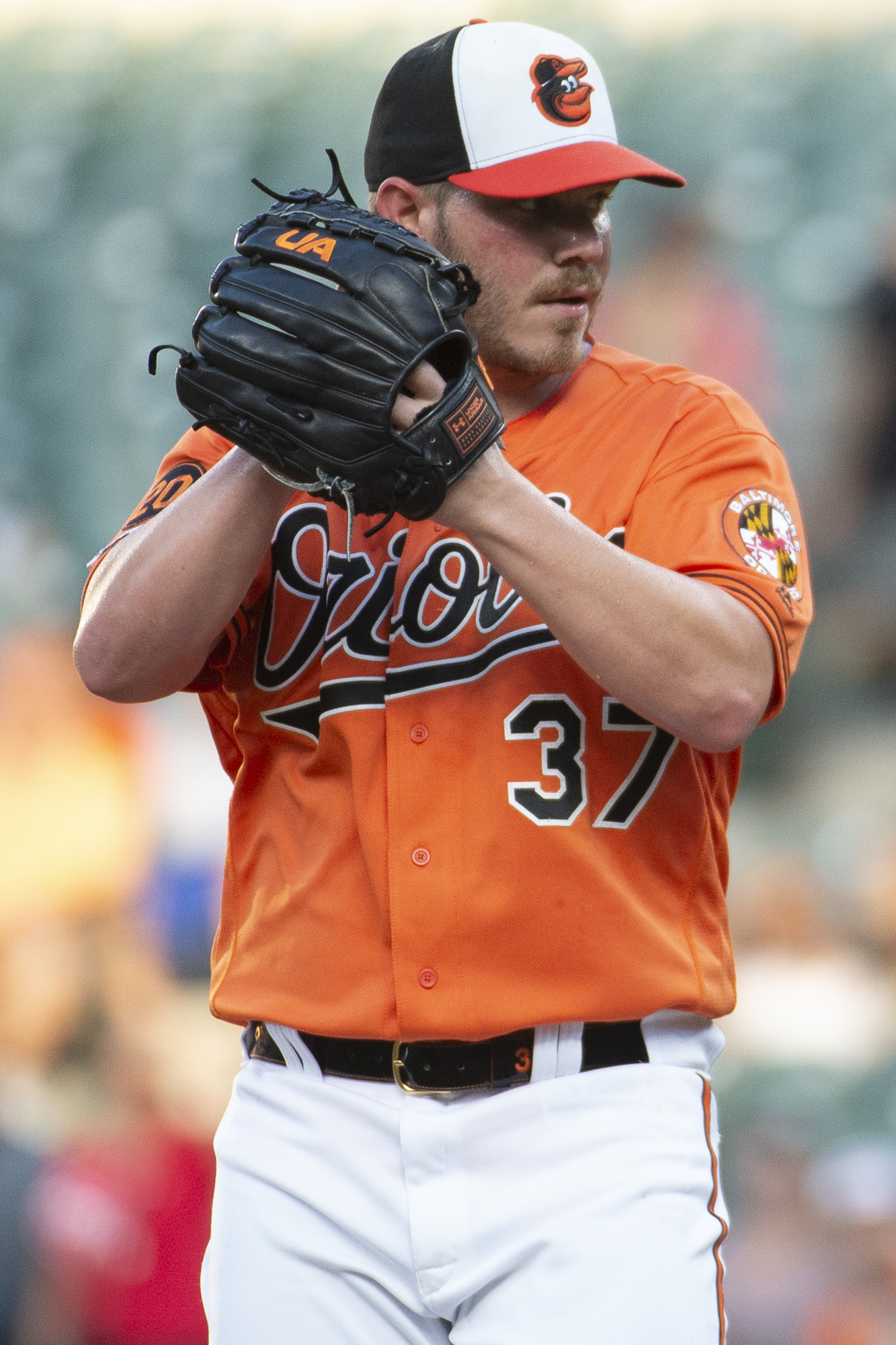
Bundy, 27, was the fourth overall pick by the Orioles back in 2011 and was touted as one of the game’s premier pitching prospects before a slew of injuries slowed his path to the big leagues. Once heralded as a potential ace, he’s instead settled in as a back-of-the-rotation arm in Baltimore, although despite a loss of velocity on his formerly blazing heater, Bundy still creates some optimism that there could be more in the tank.
First and foremost, it should be noted that he’s largely distanced himself from his early-career injury troubles, making 89 starts across the past three seasons as the lone source of consistency in the Baltimore rotation. He’s averaged better than a strikeout per inning over the past two seasons as well, and in 2019 posted a career-high 12.9 percent swinging-strike rate and 35.7 percent opponents’ chase rate on pitches outside the strike zone.
Bundy averages just 91.2 mph on his fastball at this point, but his ability to miss bats is undeniable. Drilling down a bit deeper, the spin rate on Bundy’s fastball ranked in the 95th percentile of MLB hurlers back in 2017 and has fallen in the 86th percentile in each of the past two seasons. His slider has generated whiffs at a near-25 percent clip over the past three seasons as well.
All of that said, Bundy’s bottom-line results simply haven’t been that inspiring since establishing himself as a rotation regular in Baltimore. He’s totaled 503 innings dating back to 2017 but pitched to a lowly 4.83 ERA and 4.76 FIP in that time. Home runs have been a particular problem for Bundy, who served up a league-high 41 long balls in 2018.
Bundy did work to counteract that in 2019, throwing fewer four-seamers and more changeups. The resulting 41.5 percent ground-ball rate was the highest of his career, and if he can continue to induce grounders on a more regular basis, he should be aided by an improved infield defense in Anaheim, where Andrelton Simmons and David Fletcher both grade as standouts with the glove. Simply moving away from Camden Yards and the many hitter-friendly parks the AL East has to offer could also shave a few home runs off his total moving forward as well.
From a contractual standpoint, there’s plenty to like about Bundy. He’ll be eligible for arbitration both this winter and next before reaching the open market upon completion of the 2021 season, and he’s projected by MLBTR contributor Matt Swartz to earn an affordable $5.7MM salary for the upcoming 2020 season.
The Angels, perhaps more than any team in baseball, have been decimated by injuries in recent years, so Bundy’s average of 29.7 starts over the past three seasons alone surely holds appeal to the Halos. He’ll slot into a rotation mix that features a returning Shohei Ohtani (who should be recovered from 2018 Tommy John surgery), Andrew Heaney and youngsters like Griffin Canning, Patrick Sandoval, Jaime Barria and Jose Suarez.
Of course, the Angels are also known to be in the hunt for much bigger fish in free agency this winter, with Gerrit Cole and Stephen Strasburg both rumored to be of interest to GM Billy Eppler and his staff. Other names on the market include Madison Bumgarner, Hyun-Jin Ryu and Dallas Keuchel, and it’d be a rather notable surprise if the Angels didn’t add at least one high-end arm to join Bundy in the updated rotation — be it via free agency or via trade. Given Bundy’s relatively low salary, there’s ample financial room for the Angels to do just that; they’re currently projected to come in around $150MM in 2020 payroll, and their luxury tax considerations are only a bit north of that mark.
Turning to the Orioles’ return, the 24-year-old Mattson, 24 will slot into the upper levels of the Baltimore farm system. He’s not a high-end prospect and wasn’t considered to be among the 30 best minor leaguers in the Angels’ system by either MLB.com or FanGraphs, but he enjoyed a strong 2019 season. A 19th-round pick in 2017, Matttson soared through the Angels’ system with 73 1/3 innings of 2.33 ERA ball and reached Triple-A late in the year. He posted a gaudy 13.5 K/9 mark against 3.3 BB/9 out of the bullpen and went on to post even better numbers in the Arizona Fall League; in 10 2/3 innings of relief in the AFL, Mattson allowed two earned runs (1.69 ERA) on nine hits and three walks with 12 strikeouts. He’s generated average or better ground-ball numbers throughout his minor league tenure and should be a near-term option for the ‘pen in Baltimore.
Bradish turned 23 in September and spent the season with the Angels’ Class-A Advanced affiliate after being selected in the fourth round of the 2018 draft. He logged a 4.28 ERA, 10.7 K/9 and 4.7 BB/9 while running up a 43.9 percent ground-ball rate in 101 innings. MLB.com ranked him 21st among Angels prospects, praising his four-pitch mix and deceptive delivery but noting that said delivery also leads to control issues.
Both Peek (sixth round) and Brnovich (eighth round) were college arms drafted by the Angels this summer. However, neither pitched following the draft, as the Angels shut both down per an organizational policy for college arms (as noted by MLB.com’s Joe Trezza, on Twitter). Baseball America ranked Brnovich 107th in the draft class and Peek 193rd, while MLB.com ranked both just inside the top 200 (Peek 178th, Brnovich 185th).
The subtraction of Bundy leaves what already looked to be perhaps the worst rotation in baseball in even more grisly shape, although the Baltimore organization has made it abundantly clear that winning games in 2020 isn’t a priority. To the contrary — the Orioles are quite likely gunning for the No. 1 overall pick in the 2021 draft as part of what looks to be an Astros-esque rebuild under second-year GM Mike Elias (who was hired out of the Houston organization). The next several seasons won’t be pretty for Orioles fans, and there’s no guarantee that they’ll come out on top of this rebuild like the Astros and Cubs did, but their aim to do so is readily evident.
Giants Sign Tyler Anderson
DECEMBER 4: Anderson receives a $1.775MM base salary, per Bob Nightengale of USA Today (via Twitter). There’s a roster bonus of $500K after 150 days of activity as well as $350K in incentives for throwing at least 130 innings.
DECEMBER 3: The Giants have signed lefty Tyler Anderson to a one-year, Major League contract, the team announced Tuesday evening. Anderson, who was claimed off waivers out of the Rockies organization, had been non-tendered yesterday. Terms of the contract weren’t disclosed, but it’s safe to assume that the GSE Worldwide client will take home less than the $2.625MM he’d been projected to earn in arbitration.
Anderson, 30 later this month, underwent knee surgery over the summer and was limited to 20 2/3 innings with the Rockies in 2019 as a result. The former first-round pick had an impressive debut season with the Rox in 2016 when he pitched 114 1/3 innings of 3.54 ERA ball with 7.8 K/9, 2.2 BB/9 and a hefty 50.9 percent ground-ball rate. But Anderson’s results took a turn for the worse in 2017-18, as his ground-ball rate deteriorated and he became increasingly homer prone. Anderson did rack up 176 innings and make 32 starts for Colorado as recently as 2018, and he has a minor league option remaining, making him a somewhat intriguing depth piece for the Giants in 2020.
Anderson isn’t likely to be guaranteed a job in the rotation next season, but there’s enough uncertainty on the Giants’ starting staff that he should have ample opportunity to vie for a spot this spring. Johnny Cueto and Jeff Samardzija have starting spots locked down, but the remaining spots currently look to be up for grabs in a competition featuring Anderson, Tyler Beede, Conner Menez, Logan Webb, Dereck Rodriguez and Andrew Suarez. That mix would change, of course, if (or perhaps when) the Giants make some additions via free agency or the trade market.
If Anderson is able to return to form, the Giants will be able to control him through the 2021 season via arbitration.
Red Sox, Marco Hernandez Agree To New Deal
The Red Sox and infielder Marco Hernandez are in agreement on a new contract, Robert Murray reports (via Twitter). Boston non-tendered the 27-year-old yesterday.
Presumably, the two sides have struck up a minor league pact and an invite to Spring Training, as Hernandez was only projected to earn $700K in arbitration prior to being non-tendered — just $136K north of the league minimum. Hernandez has been up and down with the Red Sox over the past few seasons, seeing time at second base, third base and shortstop but struggling to produce much at the plate. In 271 plate appearances at the MLB level, Hernandez is a .265/.300/.342 hitter — including a .250/.279/.338 this past season in a career-high 155 plate appearances.
Padres Re-Sign Miguel Diaz, Pedro Avila
The Padres announced that they’ve re-signed righties Miguel Diaz and Pedro Avila to minor league contracts and assigned both to Triple-A El Paso. Both right-handers were non-tendered yesterday and will quickly return to the organization without occupying a 40-man roster spot.
Diaz, 25, has the most big league experience of the pair. The hard-throwing righty spent the 2017 season in San Diego’s bullpen after being selected out of the Brewers organization in the 2016 Rule 5 Draft. As one would expect for a 22-year-old jumping from Class-A ball to the Majors, it was a struggle for Diaz that year, as he was knocked around for a 7.34 ERA with 7.1 K/9, 5.4 BB/9 and a whopping 2.38 HR/9 in 41 2/3 frames.
After successfully navigating his Rule 5 rookie season in the Majors, Diaz opened the ’18 campaign in Double-A and pitched quite well through 65 1/3 innings there, logging a 2.35 ERA, 9.1 K/9, 4.1 BB/9 and a 56.4 percent grounder rate. Diaz was limited to just 36 2/3 innings between the the minors and the big leagues in 2019, however, as a torn meniscus in his knee required surgery and shelved him for much of the year. The Padres will now get another look at him while still gaining some 40-man flexibility.
Avila, just 22, made his MLB debut with a start against the D-backs in early April this season, allowing just one run in 5 1/3 innings. Unfortunately, an elbow strain wiped out most of his season, and he eventually underwent Tommy John surgery in a season that saw him toss just 29 1/3 innings. Acquired in a 2016 trade with the Nationals, Avila has still barely pitched above Class-A Advanced (just three Double-A starts in addition to his lone MLB appearance), and he’ll now be out until late in the 2020 season (if not the entirety of the year). He has a long road ahead of him before reemerging as a viable MLB option, but he won’t even turn 23 until January, so age is on his side.
White Sox Re-Sign Ryan Burr, Caleb Frare
The White Sox have re-signed right-hander Ryan Burr and lefty Caleb Frare to minor league contracts and invited them to Major League Spring Training, tweets Daryl Van Schouwen of the Chicago Sun-Times. Both were non-tendered yesterday but quickly rejoined the organization on new minor league pacts that don’t require the Sox to allocate a spot on the 40-man roster.
Burr, 25, pitched 19 2/3 innings for the ChiSox in 2019 and posted a 4.58 ERA with a 20-to-8 K/BB ratio and a 47.4 percent ground-ball rate in that time. He throws fairly hard, averaging 95 mph on his heater, but he wasn’t able to generate many swinging strikes in his limited time in the big leagues (8.4 percent). The Arizona State product was a star closer in college and has a strong minor league track record (2.02 ERA, 10.8 K/9 in 173 1/3 innings), so the Sox are surely glad to get him back in the organization as a depth piece.
Frare, meanwhile, has logged 9 2/3 innings with the Sox over the past two seasons with 12 punchouts against eight walks. The 26-year-old was acquired from the Yankees prior to the 2018 deadline in a swap that sent international funds to New York, but his 2019 campaign in Triple-A was the worst of his career. Frare whiffed an impressive 34 hitters in just 22 1/3 innings, but he also issued 19 walks, hit three batters and allowed five homers en route to a 7.33 ERA. He’s dominated up through Double-A in the minors and routinely posts big strikeout totals, however, so perhaps he can eventually unlock something more at the game’s top levels.
Dodgers, White Sox Have Had “Preliminary” Trade Talks On Joc Pederson
For a second consecutive offseason, the White Sox are showing some interest in Dodgers outfielder Joc Pederson, writes USA Today’s Bob Nightengale. Last winter’s talks between the two sides (obviously) didn’t lead to a deal, but the Sox and Dodgers have once again “engaged in preliminary trade talks” surrounding Pederson, per the report.
Chicago’s need for a right fielder is evident just by looking up and down the roster, and GM Rick Hahn has clearly indicated that right field could be an area of focus this winter. Pederson would provide a short-term option for the Sox in that regard, as he’s entering his final season of club control and is projected by MLBTR contributor Matt Swartz to earn $8.5MM in 2020.
Pederson, 28 next April, hit .249/.339/.538 in 514 plate appearances with the Dodgers in 2019, belting a career-high 36 home runs along the way (although any home run totals from 2019 should be taken with a grain of salt, given the juiced ball and leaguewide home run boom). Both OPS+ and wRC+ regarded Pederson as 27 percent better than a league-average hitter — the third time in the past four years that he’s been to 25 to 28 percent better than average in the estimation of those park- and league-adjusted metrics. For a White Sox club that saw its right fielders post an astonishingly terrible .220/.277/.288 batting line in 2019, Pederson’s appeal isn’t hard to see.
That said, it’s also worth noting that Pederson has been used primarily as a platoon player, so he’s not exactly a cure-all to the White Sox’ ailments in right. The Dodgers afforded Pederson just 50 plate appearances against lefties in 2019, and in 375 career plate appearances against same-handed pitchers, he’s a .188/.263/.310 hitter. The Sox (or any other club) would surely need a right-handed-hitting complement for Pederson in 2020, but a part-time asset in that mold shouldn’t be too tough to unearth.
As for the Dodgers, their motivation for moving Pederson likely comes down to a potential outfield surplus. Cody Bellinger, Alex Verdugo, A.J. Pollock, Chris Taylor and Enrique Hernandez are all viable option in the outfield, and Matt Beaty also saw time in left field after spending most of his minor league career as a corner infielder. Outfielder Kyle Garlick made his MLB debut in 2019 as well.
That’s not to say that Pederson is purely expendable, but the Dodgers’ outfield depth is a clear source of strength. And with Pederson set to hit the open market in a year’s time, flipping him for some help in another area of need — the bullpen, perhaps — while freeing up additional dollars to spend in free agency could be a sensible pursuit. That’d be all the more true were the front office to succeed in signing one of Anthony Rendon or Josh Donaldson, both of whom are reported to be of interest. A successful pursuit of either premium third baseman could push Justin Turner to first or second base, crowding the right side of the infield and making Bellinger even likelier to spend all of his time in the outfield. (Alternatively, it could make Turner himself a trade candidate.)
Of course, the Dodgers have perhaps the deepest pockets of any club in baseball, so there’s an argument that they should simply keep Pederson, pick up an additional high-end talent or two, and operate with an unparalleled level of depth in spite of the cost. But that hasn’t been this front office or ownership group’s preferred course of action in recent years; the Dodgers haven’t paid the luxury tax since 2016 and are currently about $29MM shy of the $208MM luxury barrier, per Jason Martinez of Roster Resource.
MLBTR Chat Transcript
Click here to read a transcript of Tuesday’s chat with MLBTR’s Steve Adams.
Athletics Sign Jake Diekman
1:45pm: The Athletics have formally announced the signing.
1:21pm: The Athletics and free-agent lefty Jake Diekman have agreed to a two-year contract with a club option for a third season, ESPN’s Jeff Passan reports (Twitter links). The Beverly Hills Sports Council client will be guaranteed $7.5MM over the life of the pact.
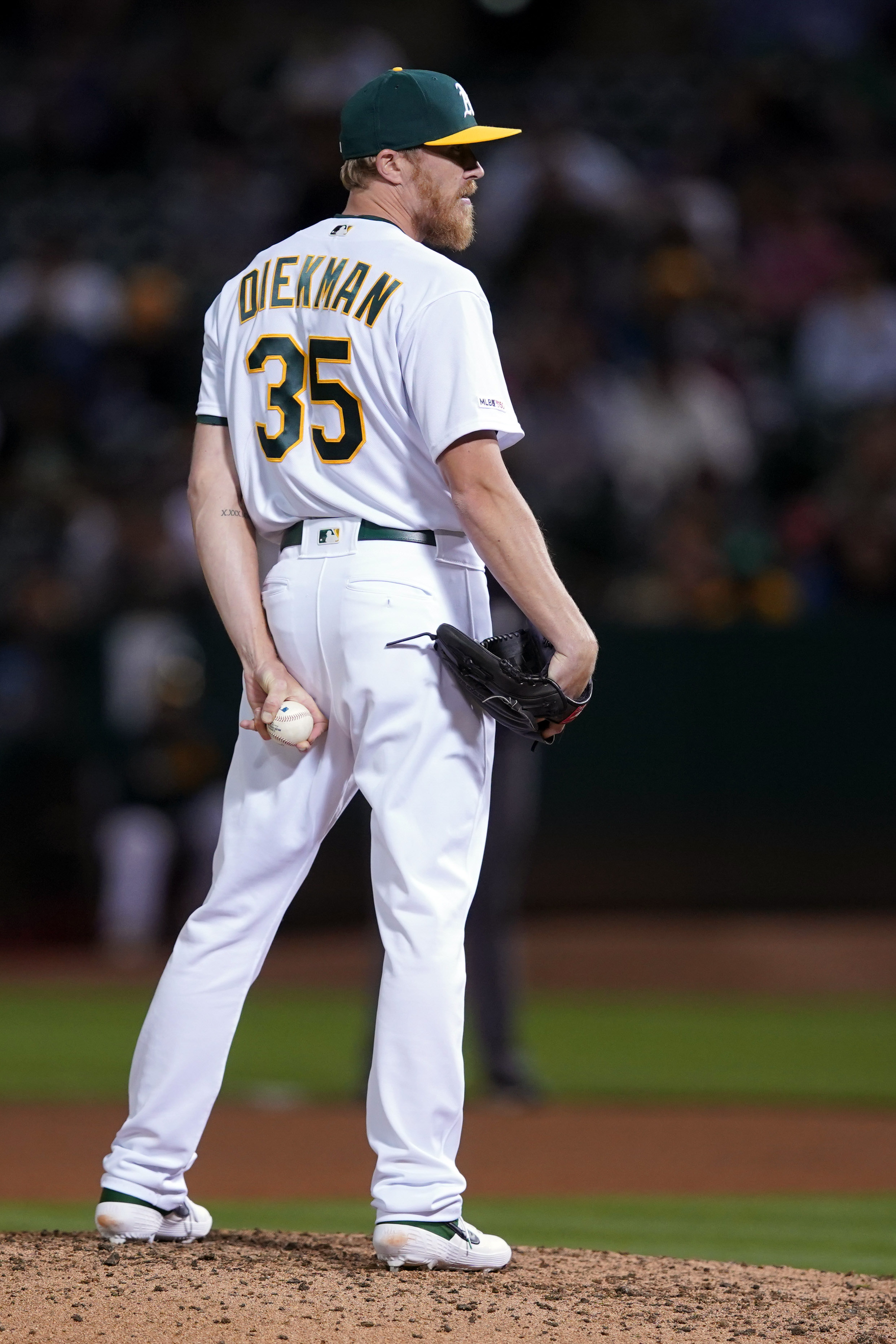
Diekman, 33 next month, inked a one-year, $2.75MM pact with the Royals last winter and was traded to the A’s prior to the July 31 deadline. The veteran southpaw pitched to a 4.43 ERA with 21 strikeouts but 16 walks and three hit batsmen through 20 1/3 innings with the A’s, continuing control problems that have plagued him for much of his MLB tenure. Diekman clearly made a strong impression on the Oakland organization, though, and he’s now in line to call it home for the next two seasons.
Control issues notwithstanding, the appeal in Diekman is easy to see, as his raw stuff is tantalizing. His 95.8 mph average heater is one of the fastest among all left-handed relievers in baseball, and Diekman’s overall 16.1 percent swinging-strike rate ranked 18th among 158 qualified reliever this past season. He’s averaged better than 11 strikeouts per nine innings pitched in his MLB career and fanned 28.2 percent of the hitters he’s faced in the big leagues. A look at his Statcast profile reveals that Diekman was one of the best in the game at limiting hard contact — specifically in allowing opponents to barrel up his offerings.
Diekman will pair with lefty T.J. McFarland, whom the A’s claimed off waivers last month and inked to a one-year deal to avoid arbitration yesterday, giving manager Bob Melvin multiple lefties to deploy in 2020. The Oakland ‘pen will once again be anchored by emergent closer Liam Hendriks, with Yusmeiro Petit, Joakim Soria and rebound hopeful Lou Trivino adding to the setup corps as well.
The move to add Diekman comes just a day after Oakland traded Jurickson Profar to the Padres and non-tendered Blake Treinen, Ryan Buchter and Josh Phegley — substantially reducing payroll in the process; that quartet had been projected to earn a combined $17.6MM on a perennially low-payroll A’s club.
Some of those funds will be immediately reallocated to Diekman, it seems, but the Oakland payroll still projects to come in north of previous levels. Last year’s $92MM Opening Day mark was a club record, and the A’s projected to come in around $95MM even before bringing Diekman aboard. It’s always possible that they’ll move some veteran contracts, but the A’s at the very least appear poised for a second season above the $90MM mark, which is unheard of territory for the organization.