
Trey Mancini Discusses Cancer Diagnosis, Outlook
Trey Mancini has penned a must-read post for The Players’ Tribune in which he discusses his shocking colon cancer diagnosis and ongoing outlook. His uplifting attitude is most welcome in these difficult times.
As baseball tries to get back to the field in 2020, Mancini is sorting out the complicated logistics of treatment in the midst of the coronavirus pandemic. He discloses that he has been diagnosed with Stage III cancer, which will require six months of bi-weekly chemotherapy.
As Mancini acknowledges, that timeline makes it rather unlikely he’ll suit up for the Orioles in 2020, if indeed there is a season. As he puts it, “I just want to make sure that I am physically fine before I go out there and start trying to perform again at a major league level.”
It goes without saying that Mancini’s recovery is of primary importance. He says he hopes to remain active, but he’ll first need to beat the disease before he’s able to build back toward professional athletics. Additionally, added care is warranted to ensure that Mancini does not become exposed to COVID-19, as his diagnosis and treatment put him at greater risk of serious complications.
It’s hard to see such a vibrant young man dealing with this kind of adversity, but Mancini’s outlook is at once hopeful and inspiring. MLBTR extends its very best wishes to Mancini and his loved ones.
Did The Orioles Find A Rotation Building Block Out Of Nowhere?
A team in a total rebuild is open to giving any player a chance, particularly when that team is drastically short on starting pitching. With the Orioles in such a state in April 2019, it paved the way for John Means to enter the Orioles’ rotation, on the heels of three relief outings earlier that season and one (disastrous) 3 1/3-inning appearance in his Major League debut on September 26, 2018. That outing saw Means surrender five earned runs, giving him an ugly 13.50 ERA heading into the 2019 campaign.
Means didn’t exactly force his way into the rotation during Spring Training, with only a 5.40 ERA over 13 1/3 frames of 2019 Grapefruit League action. Still, the southpaw did manage 15 strikeouts against just four walks, and given the lack of other pitching options available in Baltimore, the O’s figured it was worth giving Means a shot.
The result was one of the only bright spots of a 108-loss season for the Orioles. Over 27 outings and 147 1/3 innings as a starting pitcher, Means posted a 3.73 ERA, 3.09 K/BB rate, and 6.6 K/9. The majority of that production came in the first half of the season, as Means carried a 2.50 ERA through his first 82 2/3 innings and ended up as Baltimore’s All-Star representative.
Means struggled to a 8.34 ERA in his first five post-break starts, though he did manage to get on track with a 3.26 ERA over his final 49 2/3 frames of his rookie season. As a nod to his breakout performance, Means finished second in AL Rookie Of The Year voting, albeit a distant runner-up behind unanimous winner Yordan Alvarez.
Whenever (or if) the 2020 season gets underway, Means will stand as the de facto ace of the Orioles’ staff — an unlikely development given where he was slightly more than a year ago. An 11th-round pick in the 2014 draft, Means moved through the farm system with unspectacular but solid numbers over his 622 2/3 minor league innings, posting a 3.83 ERA, 7.1 K/9, and 3.50 K/BB rate. There isn’t much variance in Means’ year-to-year cumulative stats in the minors, or even in his MLB numbers in 2019.
That type of consistency gives the O’s some hope that Means can at least somewhat replicate his 2019 performance going forward, despite some of the red flags raised by advanced metrics. Means’ ERA predictors weren’t impressive, with a FIP (4.41), xFIP (5.48), and SIERA (5.02) that were all markedly higher than his actual 3.60 ERA. The lack of a high strikeout total hurts Means in this respect, and he also isn’t a hard thrower (average fastball velocity of 91.8 mph) or a ground-ball machine.
What he does offer is the ability to limit the damage when opposing batters do hit his offerings. As per Statcast, Means finished in the 90th percentile of all pitchers in fewest hard-hit balls allowed, while also sitting comfortably above average (72nd percentile) in exit velocity. Means also had only a 9.9% homer/fly ball rate last season, the fourth-lowest mark of any pitcher in baseball with at least 150 IP and a particularly useful skill for a hurler in the tough AL East.
Means’ heater isn’t particularly fast, though he does generate some good spin, as indicated by his spot in the 75th percentile of fastball spin rate. His top pitch, however, is a changeup that Fangraphs ranked as one of the best in the league last season. Only six pitchers with 150+ innings thrown had a better pitch value score on a changeup than Means’ +12.3 number.
Means just turned 27 yesterday and is under team control through the 2024 season (and not arbitration-eligible until the 2021-22 offseason), giving the O’s plenty of flexibility with his future. Given the long rebuild ahead for the Orioles, it may be a reach to count on Means to still be a productive member of the rotation by the time Baltimore is next ready to contend, so the O’s could eventually consider him as a trade chip.
There wasn’t much buzz about Means on the rumor mill this past winter, as while Baltimore is still at the point of its rebuild that any trade option must be considered, the club might prefer to see what they have with the left-hander in his sophomore year. A case could be made that the O’s should have sold high on Means given his lack of a track record, and yet even with some regression baked into his future numbers, the potential of Means being a solid innings-eater going forward carries a lot of value. For a team with so little pitching depth on hand, an unheralded prospect blossoming into at least a decent MLB-level arm counts as a big success.
When Trusting The Decline Phase Goes Wrong: The Reds’ Decision To Trade Frank Robinson
Let’s begin this look back at perhaps the most famous (or infamous) age-related trade in baseball history with a simple point: the decline phase is real. Both analytical data and just plain common sense dictates that players become less productive as they get older, and this logic has been the backbone of countless transactions over the decades. We see several examples every year of teams being willing to invest in younger free agents, or being willing to give up more in a trade for a younger player (who, in most cases, also comes with more years of team control), while also being less willing to surrender trade assets or big free agent dollars for players in their 30’s, out of a fear that those players might quickly hit the wall.
So in this sense, Reds owner/GM Bill DeWitt wasn’t entirely off the mark by deciding to trade Frank Robinson to the Orioles for a three-player package back on December 9, 1965. It’s always better to move a player a year too early than a year too late, and since Baltimore was willing to give up a promising 26-year-old right-hander in Milt Pappas as the headliner of the trade return, DeWitt felt it was a swap worth making.
Pappas was coming off an All-Star season in 1965, the second time the Detroit native had been named to the Midsummer Classic in a four-season span. Despite his still-young age, Pappas was already a veteran of nine MLB seasons, with an impressive 3.24 ERA (113 ERA+) to show for his 1632 career innings. He was the type of arm that seemingly promised an immediate rotation upgrade, and the inclusion of veteran righty reliever Jack Baldschun only made the deal more tempting for the Reds. Cincinnati pitchers had a cumulative 3.88 ERA in 1965, ranking the Reds 16th out of the 20 Major League teams.
And thus, the O’s sent Pappas, Baldschun, and 21-year-old outfielder Dick Simpson to Cincinnati for Robinson. It was a classic pitching-for-hitting type of swap that saw both teams deal from a surplus in order to address a need, and on paper, the trade made some sense.
On paper.
In practice, no discussion of baseball’s most lopsided deals is complete without mention of this trade, which ended up sparking a golden age of Orioles baseball. The thing about baseball’s aging curve is that those who can defy it tend to defy it in a very big way — great players are defined, after all, by sustaining that greatness over an extended period of time. Any player can have one big season or even several big seasons, but those who can keep that production up across the decades are the ones that truly stand out as all-time legends.
Case in point, Frank Robinson, who was a superstar from essentially day one. Robinson won NL Rookie Of The Year honors in 1956 and also finished seventh in NL MVP voting in his first season, kicking off a dominant ten-year run in Cincinnati. Over 1502 games and 6408 plate appearances from 1956-65, Robinson hit .303/.389/.554 with 324 home runs, making eight All-Star appearances and winning the NL MVP Award in 1961 (a year that saw the Reds win the NL pennant).
There wasn’t much evidence that Robinson was slowing down in 1965, though the slugger did turn 30 years old that August. This detail is maybe the key factor in why this trade is so memorable over 54 years later. Asked why he dealt one of baseball’s best hitters, DeWitt described Robinson as either “an old 30” or “not a young 30,” depending on the source.
Naturally, trading Frank Robinson for any reason wouldn’t have been a fond memory for Reds fans regardless of the specific details. But DeWitt’s mention of Robinson’s age created an easy hook for both the media and maybe even for Robinson himself, who by all accounts was very motivated to prove that the Reds erred in trading him.
That motivation led to Robinson’s 1966 campaign, one of more wall-to-wall dominant seasons any player has ever enjoyed. Robinson won the Triple Crown (49 homers, 122 RBI, .316 average) while also leading the AL in runs (122), OBP (.410) and slugging percentage (.637) for good measure. He proceeded to post a 1.232 OPS in the World Series, leading to Series MVP honors as the Orioles won the first World Series championship in franchise history. As you might expect, Robinson was named AL MVP, making him the first and still only player to ever win MVP honors in both the American and National Leagues.
Robinson hit .301/.401/.543 with 179 homers over his six seasons in Baltimore. This was good for a 169 OPS+, which topped his 150 OPS+ during his previous decade in a Reds uniform. The Orioles reached the World Series four times in Robinson’s six years on the roster, winning another championship in 1970. Ultimately, Robinson didn’t start to slow down at the plate until 1976, his 21st and final season.
As any Reds fan can sadly recount, Cincinnati’s end of the trade didn’t work out nearly as well. Baldschun and Simpson didn’t contribute much over two seasons with the Reds and both didn’t play in the majors after 1970. While Pappas only posted a 4.04 ERA over 490 innings for the Reds before being dealt to the Braves in June 1968, it’s unfair to label him as a bust — it’s just that anything short of Cy Young-level performance would have paled in comparison to Robinson’s Orioles dominance. Pappas went on to pitch eight more seasons in the big leagues, with a 3.57 ERA that represented only a relatively minor step back from his heyday in Baltimore.
The Reds struggled to a 76-84 record in 1966, and DeWitt both stepped down from the GM role and sold the club during the offseason. Though DeWitt had a long career as an executive that included two pennant winners (the 1961 Reds and the 1944 St. Louis Browns — ironically, the franchise that would later become the Orioles), the Robinson trade is the move that DeWitt is most remembered for today, in large part because of his “not a young 30” quote.
The deal has become maybe the all-time cautionary tale for any team thinking about moving an aging but still-productive star. Though there are far more examples of teams either correctly parting ways with a player before their eventual decline, or (by contrast) hanging onto a star player too long and watching him decline on their watch, no GM wants to be the one responsible for trading away a legend. Father Time may not undefeated, as the saying goes, though Robinson put up as good of a battle against the aging curve as any just about any player in any sport.
AL East Notes: Red Sox, Judge, Cobb
Here’s the latest chatter from the AL East …
- So, that whole Red Sox sign-stealing saga is over with now … right? Not entirely, as Evan Drellich and Ken Rosenthal of The Athletic write (subscription link). The determinations of commissioner Rob Manfred create quite a few questions — not least of which involving his decision to focus the brunt of his punitive power on one Red Sox employee (replay operator J.T. Watkins). Manfred’s actions haven’t sated MLBTR readers, at least, according to the early results of our poll on the punishments. Perhaps the most interesting issue, from a broader perspective, involves the league’s responsibility for managing all this. As Red Sox chief baseball officer Chaim Bloom puts it: “I also think structurally we ought to do everything we can to make sure that confusion can’t occur and that these aspects of our game are beyond reproach.” Another way to frame the matter: the rules and enforcement regime needs to be set up to ensure results rather than dealing with fallout on an ad hoc basis.
- It seemed the Yankees were going to spend the early part of the 2020 season dealing with another odd slate of injuries before the season went on pause. Now that star outfielder Aaron Judge has had plenty of time to figure out what was bothering him (rib stress fracture) and to recuperate … might that be avoided? MLB.com’s Bryan Hoch writes that Judge is working out at the Yankees’ spring complex and taking his time to avoid any unnecessary complications. Judge says he expects to be ready for “doing a little more here in about a week or two,” at which point he can hopefully begin building towards baseball readiness. There’s still nothing close to a clear starting point for the 2020 season, so there’s obviously no rush.
- Alex Cobb‘s signing is one of several big-contract misfires that have hamstrung the Orioles over the years. But he had seemingly fully recovered from the hip problem that plagued him last year, MLB.com’s Joe Trezza writes. Cobb had a rough 2018 season and made only three starts last year, but there’s still time for the 32-year-old to provide at least some value. The best-case scenario probably would’ve been a bounce back during the first half of the 2020 season, potentially setting the stage for a mid-summer deal. Perhaps now the O’s will end up attempting to move Cobb — who’s owed $14MM in 2020 and $15MM in 2021 — over the ensuing offseason, depending upon what (if anything) he’s able to show this year.
Steve Pearce Announces Retirement
Veteran infielder Steve Pearce is officially hanging up his spikes, he tells WEEI’s Mike Mutnansky (writeup via Rob Bradford). He was not currently under contract with any MLB organization.
Pearce, who turned 37 yesterday, had already indicated he was unlikely to resume his playing career. Though he kept the door open late last year, he has now put to rest any possibility of a surprise return.
Last year turned out to be an injury-ruined disappointment — hardly the only time that Pearce’s body has betrayed him over the years. He managed to appear in 13 campaigns and achieve a full decade of MLB service in spite of his many health woes, but was limited to 2,555 plate appearances over that span.
Now that he has formally wrapped up his playing career, we can put a final wrap on it. Pearce owns a cumulative .254/.332/.440 batting line with 91 home runs. He appeared with seven organizations at the game’s highest level: the Pirates, Orioles, Red Sox, Blue Jays, Rays, Yankees, and Astros.
Pearce will be remembered most for his surprising breakout years in Baltimore and his brief but notable late run in Boston. He entered his age-30 season with a completely unremarkable record in the majors. He ended up making virtually his entire contribution at the game’s highest level over the ensuing six-year stretch (2013-18), over which he recorded a .266/.347/.479 slash (123 OPS+).
After moving to the Red Sox at the 2018 deadline, Pearce delivered a monster effort down the stretch before a three-homer showing in the 2018 World Series that earned him the MVP award for the series. In his recent comments, Pearce rejected the notion that the 2018 Red Sox benefited from illicit sign-stealing efforts — a matter that still remains unresolved by league investigation, at least publicly.
Latest On Trey Mancini’s Recovery
Orioles GM Mike Elias provided an update on outfielder Trey Mancini, who is recovering from surgery to remove a malignant tumor. Among those to cover the discussion was Rich Dubroff of BaltimoreBaseball.com.
Mancini is said to be “doing well” now, one month after the tumor was removed. But the timeline for his return to regular baseball activities will be measured in “months rather than weeks,” per the O’s GM.
Mancini’s personal well-being would be the top priority regardless, but there’s certainly no reason now to accelerate his return with the season on pause. That Mancini’s baseball career is even a reasonable topic of discussion is itself a good sign. Elias emphasizes that it was not only a “major procedure” but also a “major life event” for the 28-year-old.
Fortunately, the broader outlook seems to be about as good as could be hoped given the underlying condition. Elias explains: “His health status personally, the way that the operation went and the demographics age-wise and health-wise that he resides in going into this puts him in a really good spot to make a 100 percent recovery both from a general health standpoint, but also a baseball sense.”
Mancini is coming off of his best of three full MLB seasons. In 2019, he swatted 35 home runs and turned in an excellent .291/.364/.535 batting line in 679 plate appearances. Hopefully he’ll have a chance to build off of that strong performance sooner than later.
Mark Reynolds Announces Retirement
Veteran slugger Mark Reynolds, who enjoyed a 13-year big league career split between the Diamondbacks, Rockies, Orioles, Indians, Cardinals, Nationals, Yankees and Brewers, announced in an appearance on Mad Dog Sports Radio on SiriusXM that he’s officially retired (Twitter link, with audio).
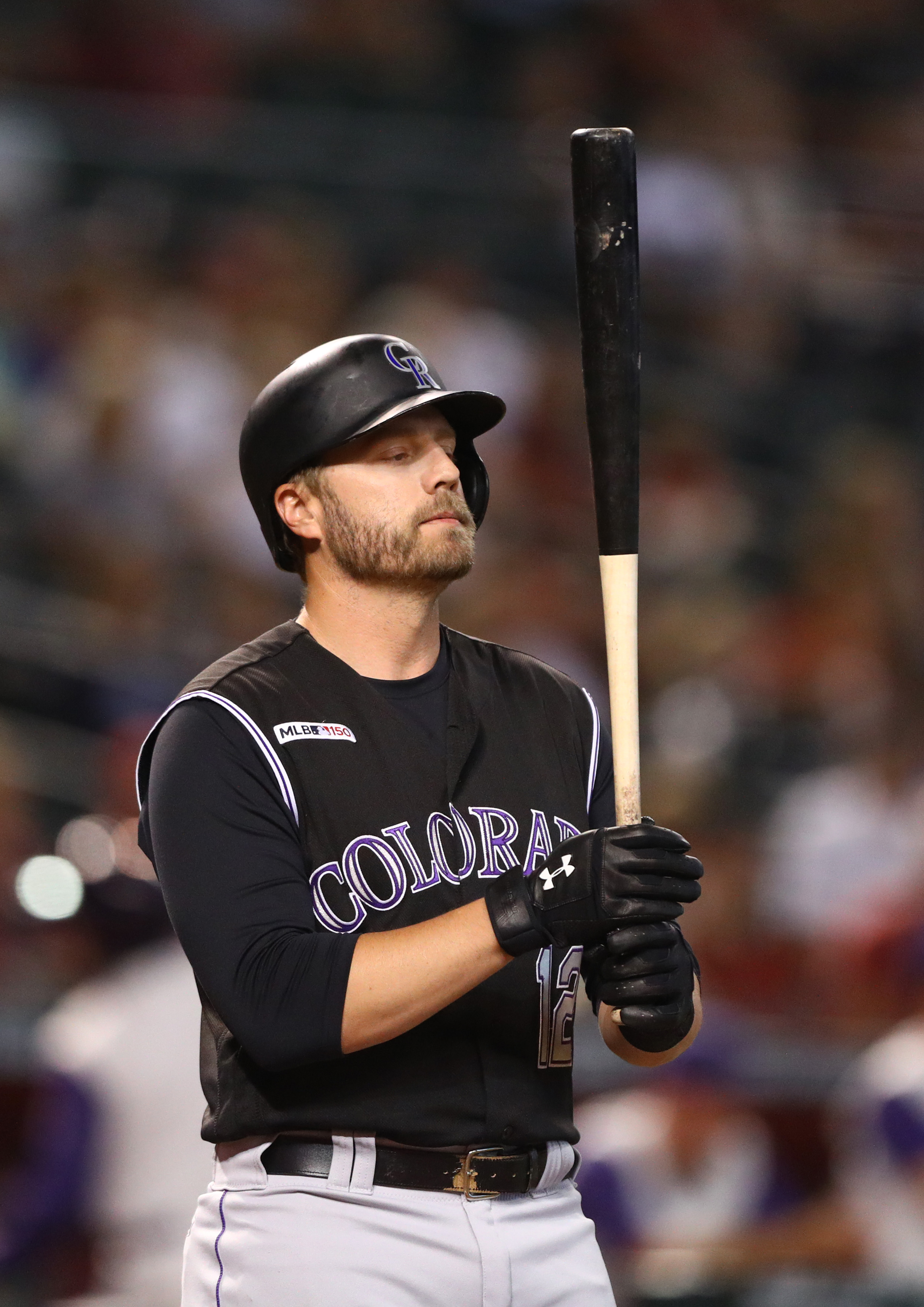
“I’ve moved beyond that,” Reynolds said when asked if he planned to seek another contract once MLB’s transaction freeze has been lifted. “I’ve retired. … I’m really enjoying time with my family, and it’s time for me to move on and find something else to do.”
The 36-year-old Reynolds spent the majority of the 2019 season in the Rockies organization, serving as a part-time first baseman and a bench bat until he was cut loose on July 28. He’d enjoyed a quality season with the Nationals a year prior in 2018, but Reynolds struggled to the lowest offensive numbers of his career with the Rox last year.
Originally a 16th-round pick of the Diamondbacks out of the University of Virginia back in 2004, Reynolds made his big league debut less than three years after being drafted. Reynolds was never considered one of the organization’s premier prospects — his No. 7 ranking on Baseball America’s list of D-backs prospects prior to the ’07 campaign was the only time he broke their top 30 — Reynolds hit the ground running. He was promoted to the big leagues in mid-May and closed out the remainder of the season as a regular in the lineup, hitting .279/.349/.495 with 17 home runs.
By 2008, Reynolds was Arizona’s everyday third baseman. His power was unquestionable, although the same could be said of his questionable contact skills. Reynolds became one of the game’s quintessential boom-or-bust players, regularly headlining home run and strikeout leaderboards alike. From 2008-11, he averaged 35 big flies per season but also led his league in strikeouts each year along the way. At that time, a player who was punching out in roughly a third of his plate appearances was an alarming anomaly; the league average strikeout rate back in Reynolds’ first full year was 17.5 percent — a full six percent lower than 2019’s mark.
Reynolds had a rough year in 2010, prompting the D-backs to trade him to the Orioles in return for reliever David Hernandez and prospect Kam Mickolio. He bounced back with the Birds and helped them to the postseason in 2012, but Baltimore declined an $11MM club option over Reynolds’ final arbitration year that offseason and non-tendered him, making him a free agent for the first time in his career.
Reynolds would bounce from Cleveland to New York to Milwaukee to St. Louis to Colorado to D.C. and back to Colorado on a series of one-year and minor league deals from that point forth. He delivered some productive seasons along the way and even popped 30 homers for the 2017 Rockies before giving the Nationals an absurd 5-for-5, two-homer, 10-RBI day in 2018 (video link).
Reynolds will conclude his playing career with a .236/.328/.453 batting line over the life of 6243 plate appearances and 1688 Major League games. In that time, he belted 298 home runs, 253 doubles, 14 triples and stole 64 bases while also scoring 794 times and knocking in 871 runs. The slugger took home nearly $30MM in career earnings while providing a litany of tape-measure home runs on which we can all fondly look back. Best wishes to Reynolds and his family in whatever lies ahead.
Mike Elias’ First Year Of Trades
It’s obviously way too soon to judge Orioles GM Mike Elias on his handling of a much-needed Baltimore rebuilding effort. He has only been on the job since November of 2018 and didn’t exactly inherit a slate of players that offered ample opportunity to wheel and deal. Most of the GMs we’ve profiled to date in our GM Trade History series have been on the job at least three times as long as Elias. Still, we can take a look at his initial trade history to glean some initial impressions …
2019-20 Offseason
- Acquired RHPs Isaac Mattson, Zach Peek, Kyle Bradish and Kyle Brnovich from Angels for RHP Dylan Bundy
- Acquired LHP Easton Lucas from Marlins for INF Jonathan Villar
2019 Season
- Acquired OF Elio Prado and INF Noelberth Romero from Red Sox for RHP Andrew Cashner
- Acquired RHP Asher Wojciechowski from Indians for cash
- Acquired OF Keon Broxton from Mets for international bonus availability
- Acquired RHP Tyler Herb from Giants for OF Mike Yastrzemski
2018-19 Offseason
- Acquired OF Dwight Smith Jr. from Blue Jays for international bonus availability
- Acquired RHP Pedro Araujo from Cubs for international bonus availability
- Acquired RHP Xavier Moore from Twins for international bonus availability
- Acquired RHP David Lebron from Rangers for international bonus availability
—
It’s not even quite time for a midterm report card, but we’ll ask anyway: how do you grade Elias’s trades to this early point? (Poll link for app users.)
Grade Mike Elias's trades with Orioles:
-
C 40% (1,608)
-
B 22% (877)
-
D 22% (857)
-
F 10% (401)
-
A 6% (235)
Total votes: 3,978
Curious to look back on additional GMs and their trade histories? We’ve already polled on Diamondbacks GM Mike Hazen, recently fired Astros president Jeff Luhnow, Brewers president of baseball ops David Stearns, Angels GM Billy Eppler, Rockies GM Jeff Bridich, Tigers GM Al Avila, Braves GM Alex Anthopoulos, Blue Jays GM Ross Atkins, Mariners GM Jerry Dipoto, Phillies GM Matt Klentak, Padres GM A.J. Preller, Dodgers president of baseball operations Andrew Friedman, Rays GM Erik Neander, ex-Red Sox front office leader Dave Dombrowski, Mets GM Brodie Van Wagenen, and Reds GM Dick Williams.
AL East Notes: Darwinzon, Cone, Armstrong
Although he enjoyed a strong finish to the 2019 season in the bullpen, Red Sox lefty Darwinzon Hernandez tells Peter Abraham of the Boston Globe that he still prefers to work as a starter in the long run. The 23-year-old emphasized that being on the team, whether as a starter or reliever, is still his top priority and voiced a willingness to pitch in any role the club fits. Notably, though, Abraham suggests that while former skipper Alex Cora believed Hernandez is best-suited for a short relief role, new manager Ron Roenicke agrees with Hernandez that he should be in the mix for a starting job. “You have to consider it,” Roenicke told Abraham. “He’s still a young pitcher, and there’s a lot to work with.”
Hernandez punched out nearly 39 percent of the hitters he faced in the Majors last year (57 in 30 1/3 innings) but also issued 16 walks in that time. Control has been a longstanding issue for the big lefty, evidenced by a career 5.5 BB/9 mark in the minors. Still, the Red Sox’ rotation is anything but settled at the moment, with Eduardo Rodriguez, Nathan Eovaldi, reclamation project Martin Perez and journeyman Ryan Weber occupying the top four spots. Certainly, there’s room to take a look to see if Hernandez can finally rein in his control and work as an effective big league starter.
More from the AL East to kick off the week…
- It’s already known that the Yankees interviewed former Cy Young winner and current YES Network Analyst David Cone for their pitching coach vacancy before hiring Matt Blake last November, but Cone talked more about the interview process and another potential role that was discussed in an interview with the New Jersey Star-Ledger’s Bob Klapisch. The pitching coach talks were “more exploratory” in nature, per Cone, but the two sides discussed a role in which he’d serve as a liaison between the club’s pitchers and the analytics department — utilizing his experience as a pitcher to help bridge the gap between data from the front office and implementation in a game setting. That role didn’t come together, clearly, but it’s nevertheless interesting both in a “what might’ve been” lens in addition to looking down the line at what could yet be in store if the two sides rekindle talks.
- Orioles righty Shawn Armstrong was considered a “sure thing” to make the bullpen heading into camp, writes Roch Kubatko of MASNsports.com, and he did nothing to change that thinking with six shutout frames and 11 punchouts. Expanded rosters early in a potentially delayed season would only make it easier for the club to hang onto the right-hander. The 29-year-old Armstrong went from Cleveland to Seattle to Baltimore over the past couple of seasons but only this past year got a full look in the Majors. He struggled to an ERA just north of 5.00 in Baltimore but also averaged 9.9 K/9 with an overall 24.2 percent strikeout rate and elite spin on his four-seamer. His 2018 work with Seattle — 14 2/3 innings, 1.23 ERA, 15-to-3 K/BB ratio — lends some reason for optimism as well. Armstrong is out of minor league options, so the Orioles would have to run him through waivers if they wanted to send him down to Triple-A Norfolk.
Breakout Candidate: Anthony Santander
The past two years have not been kind to the Baltimore Orioles. All-world prospect Adley Rutschman has joined the fray and is perhaps a harbinger of the franchise’s turning fortunes, but the fact is that two consecutive 100-loss seasons have highlighted a glaring dearth of projectable talent on the Major League roster. But that’s not to say that the big league club is entirely without players worth following. Just about a year-and-a-half into Mike Elias’s tenure as general manager, the rebuild in Baltimore still isn’t particularly far along, but I want to discuss an intriguing player brought in by the previous regime who might have done enough to catch Elias’s attention.
Enter 25-year-old outfielder Anthony Santander. Signed by the Indians as an international amateur in 2011, Santander joined the O’s organization as a Rule 5 draft selection prior to the 2016 season. He’s gotten brief looks in the big leagues since then, but he got his first extended chance with the Orioles in 2019 and turned some heads. And with only 544 MLB plate appearances—just about a full season’s worth—under his belt, there’s development still to be done here.
I don’t fancy myself a scout, but let me propose the following comparison: Santander possesses a skillset and physique that is perhaps reminiscent of the Brewers’ Avisail Garcia. Both are big outfielders with a body that points itself to good power output, but they sneak up on you with deceptive athleticism and speed for their size. I see Santander as having the tools to produce numbers similar to those Garcia put up with the Rays last year. And Garcia might not be a star, but don’t get it twisted: he’s a valuable Major League player who fulfilled a role on a playoff club and parlayed that into $20MM last winter.
At 6-2, 190 pounds, Santander’s measurables are definitely a step below the 6-4, 250 lb. Garcia, but Santander has a thick frame and a strong upper body, and definitely looks bigger than his listed weight. And that’s not a bad thing, especially if he can maintain good mobility to go with an imposing presence at the plate: his Statcast sprint speed ranked in the 64th percentile.
Believe it or not, he reached the 20 home run threshold last year, but he still feels like something of an unknown commodity given 2019’s trivialization of that benchmark. He only notched 380 ABs last year, which places him squarely at 19.0 AB/HR, right in line with the likes of Anthony Rizzo, Jose Abreu, and Rhys Hoskins. Obviously, AB/HR is not the go-to for evaluating a batter’s power, but it gives you an idea of what kind of output is possible with a full year of at-bats. Did I mention he’s a switch-hitter?
His batted ball profile (courtesy of Baseball Savant) corroborates that endorsement of his power: his average exit velocity of 89.6 mph ranked in the 61st percentile of Major League hitters, while his average launch angle (14.8˚) is right in the ideal range for power production. For what it’s worth, his maximum 112.9 mph puts him among the top 25% of hitters with at least 100 batted balls in 2019, so his ceiling might be even higher.
Even so, Santander’s power doesn’t compromise his ability to make contact. He struck out in just 21.2% of his plate appearances, which is right about league average—certainly acceptable for someone with his power capability. Now, part of that relatively low strikeout rate might be due to an aggressive approach: his 51.8% swing rate was the 37th-highest among 207 hitters with at least 400 PAs. That said, his swinging strike rate is surprisingly low, at just 9.7%. That’s pretty impressive for someone who can hit the ball as hard as he does. With that in mind, it’s possible that he could afford to be more choosy at the plate; his strikeout rate might climb ever so slightly, but he makes contact consistently enough that he might not suffer by being in deeper counts.
On a similar note, the biggest hole in Santander’s offensive game is his low walk rate. At just 4.7% in 2019, he only managed a .297 OBP. In an ideal world, we’d see that number climb up to about 8%, or roughly league average. That might be a best-case scenario, given that Santander’s already 25 and routinely posted minuscule walk rates during his minor league career. There’s no doubt that Santander’s maturation as a player hinges partly on this skill, and it could be the difference between him becoming, say, Randal Grichuk, or something more.
To this point in Santander’s career, he’s graded out as a roughly average defender, but there may be potential for more here. Last year, he spent 156 innings (or about 1/5 of his total time in the field) in center field, where he notched -4 Defensive Runs Saved. But that number climbed to a very respectable 5 DRS when he was stationed in right field. We know that defensive metrics are notoriously unreliable in small sample sizes, but still: those numbers suggest that if he shifts to a corner full-time, Santander could establish himself as a firmly above average outfielder, which would go a long way towards rounding out his game.
A profile that includes solid defense, above-average speed, and legitimate power from both sides of the plate is hard to come by. The possibility that Santander could grow into a player that provides exactly that makes him, by my estimation, one of the more intriguing players in the Orioles organization, and a possible installment in the lineup for the foreseeable future.