
AL East Notes: Paxton, Rays, Iglesias, Martin
After undergoing back surgery in early February, Yankees southpaw James Paxton was given a timeline of three-to-four months before he could return to the field. As we approach the end of that estimated recovery period, Paxton described his back as “a non-issue” in an interview Friday on the YES Network (hat tip to ESPN.com). “I feel totally healthy, so I’ll be ready to go as soon as the season comes about….I think I’m back to full strength,” Paxton said, noting that he has already thrown an estimated 12-14 bullpen sessions.
If there is any silver lining for the Yankees in this league-wide shutdown, the lack of game action has allowed several injured Yankees to recover without missing any time. As such, should the 2020 season begin in early July as rumored, New York could have Paxton, Giancarlo Stanton, and possibly Aaron Judge and Aaron Hicks all available for the roster. It will be a particularly important season for Paxton, who is scheduled to hit free agency this winter and projects to be one of the top starters available on the open market. While the back surgery only adds to Paxton’s not-insubstantial injury history, a big performance in whatever consists of a 2020 season would certainly help Paxton’s case at a healthy multi-year contract in the offseason.
More from the AL East…
- Rays players will begin limited workouts at Tropicana Field on Monday, and the Tampa Bay Times’ Marc Topkin details how the club will take a very measured approach to restarting its preseason preparations. “There’s a lot more downside to moving too fast than too slow,” GM Erik Neander said. “Our priority remains the health and safety of our players, staff and their families. We will learn a lot through this initial, conservative step, and that will serve us well as we continue to ramp up.” Only small groupings of players will be allowed to work out or use the field at any given time, rather than the entire roster; the Rays will take some time before deciding whether to bring Yoshitomo Tsutsugo and Ji-Man Choi back to North America.
- The Orioles inked Jose Iglesias to a one-year deal last winter with the expectation that the veteran could help both on the field and in the clubhouse. Third base coach and infield instructor Jose Flores tells Roch Kubatko of MASNsports.com that Iglesias already started to develop a mentor/student relationship with young shortstop Richie Martin. “Josie shares a lot of his ideas, we share with Richie, and he seems to take all that into play,” Flores said. “And I think Richie has actually become a better infielder just by having Josie working out with him during the course of Spring Training.”
- It remains to be seen if Martin will make Baltimore’s MLB roster if/when the season gets underway, as while the former Rule 5 pick definitely wasn’t ready for big league competition last year, Martin won’t be able to get any further minor league seasoning if there isn’t any official minor league ball in 2020. Therefore, Martin could wind up on the “taxi squad” rumored to be planned in support of teams’ Major League rosters, or an expanded 30-man roster could provide room for Martin to land more playing time with the Orioles. Flores noted that Martin had been playing some second base during spring camp in order to help boost his versatility and chances of making the club as a backup infielder. For what it’s worth, Martin had also been hitting well before Spring Training was shut down, with an .869 OPS over 30 plate appearances.
The Rays Left An Asset Unprotected And A Division Rival Noticed
It’s no secret that the Baltimore Orioles need pitching. While GM Mike Elias and company work on building a development pipeline, the O’s are spending a lot of time scouring other organizations for excess talent to skim off the top.
Take 30-year-old right-hander Cole Sulser. Baltimore’s waiver claim in early October doesn’t jump out as an impact move, but there’s potential beneath the surface for Sulser and the birds. Before digging into Sulser’s prospects, let’s cover the backstory.
In December of 2018, the Indians, Mariners, and Rays engaged in a three-way deal that shuffled around first baseman candidates. In this rare three-way challenge trade, each team came away with a major-league first baseman. The Rays chose Yandy Diaz, the Mariners Edwin Encarnacion, and the Indians actually snagged two first basemen in the deal: Jake Bauers and Carlos Santana. Tagging along, Sulser went from the Indians to the Rays, for whom he made 7 scoreless appearances last season. But the Rays are no longer in line to be the beneficiaries of a potential Sulser breakout.
Granted, it’s suspect that the Indians and Rays – two organizations with strong reputations for identifying and developing pitching – both passed up on the opportunity to roster Sulser. Sulser isn’t locked into a roster spot with the Orioles either, but he should have an easier time carving out a role with the pitching-needy Orioles than he did with either of his previous organizations. The short season very well may expand rosters, too, giving Sulser a greater opportunity to toe the rubber in Baltimore.
So where does the optimism for Sulser come from? Last year Sulser made 49 appearances (4 starts), spanning a robust 66 innings with a 3.29 ERA. His peripherals look good with a 12.1 K/9 to 3.3 BB/9. He put together similar numbers the year prior while in the Indians system (3.86 ERA over 60 ⅔ innings with 14.1 K/9 to 2.5 BB/9). Those numbers were helped by including a 9-inning scoreless stint in Double-A, without which a 4.53 ERA in Triple-A doesn’t look quite as impressive.
It is, however, a positive sign to see Sulser improve year-over-year when repeating the level. The Dartmouth grad doesn’t have overwhelming stuff, but he’s made himself into a double-digit strikeout-per-nine guy over the last couple of seasons. Sulser could yet turn himself into a late-blooming bullpen piece. He’s probably not Nick Anderson, but there’s value to unearth from an arm like Sulser. Breakouts for players on the wrong side of thirty aren’t exactly commonplace, of course, but late bloomers often emerge in the bullpen. Sulser doesn’t have to become the next Kirby Yates to add value to the O’s organization. With 5 appearances in spring training with a 1.53 ERA and 8 strikeouts in 4 ⅔ innings, he was off to a good start.
The Orioles may not have a lot of crucial innings to lockdown, but if they can help Sulser establish himself as a reliable arm, he could become the type of cost-controlled asset teams in contention ask after. For the Orioles these days, that’s more-or-less the goal.
Orioles Release 37 Minor Leaguers
While roster moves in Major League Baseball are not allowed during the shutdown, teams can still make minor league transactions. For instance, the Rockies cut right-hander Tim Melville earlier this week. And now the Orioles are among the clubs paring down minor league player personnel. The Orioles just released 37 low-level farmhands, Dan Connolly of The Athletic reports (subscription link). Connolly provides the full list of players in his piece.
While the Orioles, of course, didn’t part with any premium prospects, there are a few familiar names in the bunch. Sons of former Orioles Chris Hoiles (outfielder Dalton Hoiles) and Rafael Palmeiro (infielder Preston Palmeiro) were let go. Also of interest, the Orioles said goodbye to infielder Jomar Reyes, who was a well-regarded prospect earlier in his professional career.
Baltimore signed Reyes for $350K out of the Dominican Republic in 2014, when then-general manager Dan Duquette said Reyes and fellow signing Carlos Diaz could be “potential everyday major league players that can hit in the middle of the lineup.” That obviously hasn’t come to fruition so far, as Reyes has only managed a .269/.313/.395 line in 2,159 minor league plate appearances. Now 23 years old, he spent most of last season in High-A and batted .283/.320/.406.
Latest On MLB Teams’ Plans For Employees
A variety of MLB teams have already revealed plans for the year for non-player employees. Some have instituted furloughs and/or pay cuts while others have committed to carry employees through the fall. Still other teams are taking things on a month-to-month basis, with several revealing their latest plans in recent days.
At least three teams have decided to continue paying employees in full through at least the end of June. The Cardinals are one such team, Derrick Goold of the St. Louis Post-Dispatch reports on Twitter. The Twins are also in that camp, Jeff Passan of ESPN.com tweets. And the White Sox are adjusting work hours but not take-home pay, per Ken Rosenthal of The Athletic (via Twitter).
Elsewhere in the central divisions, there were some cuts. The Cubs are keeping their full slate of employees at full-time capacity, but are instituting some salary reductions, Jeff Passan of ESPN.com reported on Twitter. And though the Pirates will not draw down their baseball operations staff, they will reduce pay in that arena while furloughing some business employees, as Jason Mackey of the Pittsburgh Post-Gazette reports.
Out west, the Giants will retain their entire full-time staff but will be trimming pay for those earning over $75K, Henry Schulman of the San Francisco Chronicle reports. Part-timers have been furloughed.
The Astros have committed to maintaining full pay and benefits for full-time employees, but only through June 5th, Chandler Rome of the Houston Chronicle reports. Whether some action could occur beyond that point remains to be seen. The Orioles are also still in flux, but the organization appears to be leaning towards keeping staff as usual through June, per Dan Connolly of The Athletic (via Twitter).
Which 15 Players Should The Orioles Protect In An Expansion Draft?
In a few weeks, we’ll be running a two-team mock expansion draft here at MLBTR. Currently, we’re creating 15-player protected lists for each of the existing 30 teams. You can catch up on the rules for player eligibility here.
So far, we’ve done the Yankees, Red Sox, and Blue Jays. The Orioles are next.
Free agent Jose Iglesias has a club option for 2021, but we won’t force the Orioles to use a protected spot on him. We will make them include Chris Davis and Alex Cobb, players with full or partial no-trade rights. After those two, I’ll lock in seven more players:
Trey Mancini
John Means
Austin Hays
Hunter Harvey
Hanser Alberto
Renato Nunez
Anthony Santander
That leaves six spots for these 23 players:
Shawn Armstrong
Richard Bleier
Miguel Castro
Paul Fry
Mychal Givens
David Hess
Travis Lakins
Richie Martin
Cedric Mullins
Evan Phillips
Rio Ruiz
Tanner Scott
Pedro Severino
Chance Sisco
Dwight Smith Jr.
DJ Stewart
Kohl Stewart
Cole Sulser
Dillon Tate
Andrew Velazquez
Hector Velazquez
Asher Wojciechowski
Austin Wynns
With that, we turn it over to the MLBTR readership! In the poll below, please select exactly six players you think the Orioles should protect in our upcoming mock expansion draft. Click here to view the results.
Davis, Cobb Account For Bulk Of Orioles’ Future Guaranteed Salary
2020 salary terms are set to be hammered out in the coming days. But what about what’s owed to players beyond that point? The near-term economic picture remains questionable at best. That’ll make teams all the more cautious with guaranteed future salaries.
Every organization has some amount of future cash committed to players, all of it done before the coronavirus pandemic swept the globe. There are several different ways to look at salaries; for instance, for purposes of calculating the luxury tax, the average annual value is the touchstone, with up-front bonuses spread over the life of the deal. For this exercise, we’ll focus on actual cash outlays that still have yet to be paid.
We’ll run through every team, with a big assist from the Cot’s Baseball Contracts database. Next up is the O’s:
Orioles Total Future Cash Obligation: $106MM
*includes deferred money in Chris Davis, Alex Cobb contracts
(click to expand/view detail list)

The O’s Intriguing Short-Season Trade Chip
With MLB set to propose a half-season of 2020 baseball, followed by an expanded postseason, we could be on the verge of a campaign unlike any other. There’ll be one-off rules on a whole host of topics, among them the player transactions that take place before and during the season.
While we don’t yet know when and how players will be shuttled between rosters, we have a pretty clear picture of the competitive picture that awaits. This is going to be a sprint in which every game counts. Limping through the truncated regular season could leave a talented team outside the playoff picture, or in it but in a disadvantaged position. And the broadened postseason tourney will likewise enhance the importance of winning high-leverage situations.
For teams that are built to compete right now, there’s an opportunity to salvage something out of a season that’s already sure to be a promotional and financial disappointment. While everyone will be watching the bottom line and thinking about sustainability and cost-efficiency, now more than ever, it’s also going to be harder than ever to take a wait-and-see at the trade deadline approach to roster management.
There are loads of potential consequences here for every team. We’ll surely be exploring many of them as the situation gains clarity. The one highlighted here is far from the most important, but it’s indicative of the sort of shifts in the trade marketplace we might see.
In many respects, Orioles reliever Mychal Givens is the perfect trade candidate. Let us count the ways.
Most rebuilding teams have already dealt away their most obvious veteran trade pieces. But the Baltimore organization hadn’t received sufficiently enticing offers on Givens and didn’t feel compelled to move him just yet with one more season of arbitration control remaining. The idea, no doubt, was to let him (hopefully) mow down hitters over the first half of 2020 before cashing him in at the trade deadline. Contenders would feel justified in giving up more value since they’d control him for 2021.
Now, that plan has run into some difficulties … but also some added opportunity. We don’t know if there’ll be a typical trade deadline, but even if there is, it won’t involve a slow build-up that Orioles GM Mike Elias can use to develop scenarios surrounding Givens.
On the other hand, the short-season burst will leave contenders hunting for replacements without the luxury of watching a lot of 2020 baseball. The focus will be on physical tools as demonstrated most recently, results be damned. Teams typically have more than 82 games to witness repeat testing of players before making deadline decisions. By that point, the season will be over. Teams that want to improve mid-season will have to simply imagine what is possible.
It’s reasonable to expect Givens to fare well in this analysis, whether he’s discussed in trades before or during the season. He looks the part of a monster on the mound, consistently averaging over 95 mph with his fastball in every season of his career. Ramping up the use of his change-up to equal status with his slider, and pairing it with that heater, enabled Givens to jump to a hefty 15.8% swinging-strike rate and 12.3 K/9 in 2019. True, he also coughed up 1.86 homers per nine innings, but it’s not hard to imagine that number moving back towards his career mean (0.95 per nine), especially once he’s removed from Camden Yards and the AL East. If you’re a team that routinely re-envisions how your pitchers use their arsenals, there’s no better raw material to work with.
And that also brings us back around to the point we started with: the importance of leverage. Locking up winnable games, both during the regular season and through the postseason, is going to be key. The O’s know this better than anyone, having benefited from several campaigns in which they thrived in one-run contests. Even a talented team with good health and generally good performance can experience rather significant swings in actual victories based upon just a few moments in certain close contests. And that’s all the more true in knockout rounds of the playoffs.
Givens becomes quite an appealing weapon under these parameters. He has been a workhorse, averaging over seventy frames annually over his four full seasons in the majors. More than ever, an acquiring team could envision a significant impact on its fortunes from inserting a pitcher with this skillset into its relief corps.
Further greasing the wheels here is a favorable contract situation. As noted, Givens is controlled for 2021. His salary this season is only $3.225MM and can only move northward by so much through the arbitration process. As clubs think ahead to building a winner in lean economic times, this is precisely the sort of asset they’ll wish to have.
It remains all but entirely unknown how the transactional landscape will develop. But so long as some player movement is permitted, I’m guessing that Givens will be one of the most-discussed and most-watched players as MLB’s 2020 season relaunches.
From Waiver Fodder To MLB Regular?
If you’re a hitter who records a wRC+ of 150 during a season, it means you were absolutely tremendous and 50 percent better than the average offensive player. The Diamondbacks’ Ketel Marte finished with exactly that number last season, and as most who follow baseball know, he was a contender for National League Most Valuable Player honors. Shifting to the AL, the Orioles essentially had their own offensive version of Marte, at least against left-handed pitchers. While facing southpaws, little-known infielder Hanser Alberto batted an eyebrow-raising .398/.414/.534 in 227 plate appearances. Only J.D. Martinez (.404) bettered the right-handed Alberto’s average versus lefties, while just 18 batters defeated his 151 wRC+ against them.
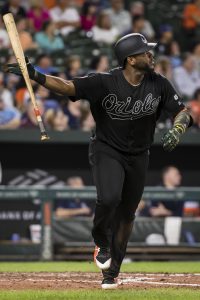
Alberto’s ownership of southpaws was a rare bright spot during a 54-win campaign for the Orioles, and no one could have expected it after he was passed around so much during the previous offseason. The Rangers, with whom Alberto appeared in the majors from 2015-16 and again in 2018, designated Alberto for assignment and he left the organization when the Yankees claimed him on waivers in November 2018. He never suited up for the Yankees, though, as they lost him to the Orioles via waivers in January 2019. That was not the end of a busy offseason for Alberto, whom the Giants picked up on waivers in February before the Orioles claimed him yet again in March.
You have to give credit to the 27-year-old Alberto for persevering through a whirlwind of transactions and emerging as one of the O’s most productive players a season ago. The question now is whether Baltimore has a keeper or at least a valuable trade chip in Alberto.
First of all, the fact that Alberto thrashed lefties last year isn’t the only positive. He’s also versatile enough to play multiple infield positions (second and third) and under affordable control via arbitration through 2022. Problem is that it’s hard to envision Alberto sustaining his 2019 production. Prior to then, he was just a .192/.210/.231 hitter with zero home runs in 192 major league plate appearances. That doesn’t mean the light bulb couldn’t have gone on – Alberto was a solid .309/.330/.438 batter over 1,000 Triple-A attempts before last season – but it appears there was a substantial amount of luck lifting him up during his first year in Baltimore.
Alberto concluded last season with an overall line of .305/.329/.422 (96 wRC+) and 12 dingers and 1.9 fWAR in 550 PA. He also led the league in strikeout percentage (9.1) and came in 10th in contact percentage (86.5). Looks like good news, but was it impactful contact? Not really. According to FanGraphs, Alberto ranked dead last among 135 qualified hitters in hard-contact percentage (24.6). Statcast also wasn’t enthralled, ranking Alberto in the bottom 1 percent of the majors in hard-hit rate, average exit velocity and walk percentage. Alberto did place in the game’s 88th percentile in expected batting average (.290), but even that looks as if it will be difficult to maintain. Just about all of his damage came off southpaws (righties held him to an awful 57 wRC+), but he posted a .435 batting average on balls in play against them that you can’t reasonably expect to carry over.
While Alberto’s bottom-line production versus lefties was otherworldly last year, chances are that it won’t continue. But even if it doesn’t, you can’t criticize Baltimore in this case. The team has already gotten far more value from Alberto than it could have realistically anticipated when it added him to its roster.
Photo courtesy of USA Today Sports Images.
Offseason In Review: Baltimore Orioles
The Orioles kept pretty quiet again this winter. They added a couple veteran stopgaps to temper the timelines of their young players. They also lost two Baltimore mainstays: Dylan Bundy and Mark Trumbo – both of whom had been with the big league club since 2016. Chris Davis and Mychal Givens are the only players left on the roster who have seen postseason action in an Orioles’ uniform.
Guaranteed Contracts
- Jose Iglesias, SS: one-year, $3MM (includes $3.5MM club option for 2021)
- Kohl Stewart, RHP: one-year, $800K if he stays in majors
- Total spend: $3.8MM
Trades and Claims
- Traded RHP Dylan Bundy to Angels for RHP Isaac Mattson, RHP Zach Peek, RHP Kyle Brnovich and RHP Kyle Bradish
- Traded IF Jonathan Villar to Marlins for LHP Easton Lucas
- Claimed RHP Hector Velazquez off waivers from Red Sox
- Claimed IF Andrew Velazquez off waivers from Indians
- Claimed IF Ramon Urias off waivers from Cardinals
- Claimed RHP Travis Lakins off waivers from Cubs
- Claimed IF Pat Valaika off waivers from Diamondbacks
- Claimed IF Richard Urena off waivers from Blue Jays
Notable Minor League Signings
Notable Losses
The Orioles are an interesting team from a short-season perspective. They don’t have the depth to compete over a full slate of 162 ballgames, but in some bizarro post-coronavirus tournament? They’re still probably not competitors – but they could be peskier than most suspect. Then again, that goes for all potential cellar-dwellers.
Specific to the Orioles, GM Mike Elias made clear early in the offseason what his priority number one would be: pitching depth. Elias found himself repeatedly scouring other organizations in 2019 for low-cost pitching to stanch the bleeding, and he didn’t want the O’s to be in that position again. Rushing minor-league talent to fill the void is not a palatable option for Elias. His offseason focus wasn’t so much about building a talent base in the majors as it was about protecting the future talent from the ill effects of hurried development. In that very-limited scope, Elias’ plan is sound. So while fans might not get goose bumps over the Orioles’ new arms, in this context, Tommy Milone and Wade LeBlanc are legitimate gets.
Milone has pitched in the majors in every season since 2011, and he very well might lead the majors in earned travel miles over that span. After making his debut with the Nationals, Milone pitched for the A’s for 2 1/2 years and Twins for 2 1/2 years, ably filling a rotation slot with a 4.14 ERA/4.36 FIP. 2017 was less kind as he produced lackluster results with the Brewers and Mets before taking a second turn with the Nats in 2018. Last season, however, Milone turned back the clock a tad, providing 111 2/3 innings of 4.76 ERA/5.00 FIP ball for the Mariners. Similar production would suit the Orioles’ needs just fine in 2020, especially under the conditions of a shortened season. It’s pretty darn close to a lateral move from, say, Aaron Brooks, one of last season’s stopgaps, but important nonetheless for the pitching-poor Orioles.
LeBlanc has a longer track record, but of similar shape and sound to Milone’s career. LeBlanc started his career with the Padres from 2008 to 2011. From there he went to the Marlins to the Astros, before boomeranging in 2014 from the Angels to the Yankees and back to the Angels again in the span of the 2014 season. He missed all of 2015, rehabbed with the Blue Jays’ Triple-A team in 2016 before reappearing in the majors for the Mariners and Pirates. “Boomerang” LeBlanc returned to the Mariners in 2018, where he enjoyed a semblance of stability for a pair of seasons, going 15-12 with a 4.57 ERA/4.80 FIP across 283 1/3 innings.
No, LeBlanc, 35, and Milone, 33, aren’t the same pitcher, but you’d be forgiven for getting them confused. 4.46 ERA to 4.47 ERA, 4.68 FIP to 4.58 FIP, 6.6 K/9 to 6.7 K/9. Both are among the absolute softest-tossers in the league, with Milone’s fastball averaging 87.1 mph, while LeBlanc, according to Statcast, has a “heater” that averages 86.3 mph (though he only throws it 5.7% of the time). Here’s a fun fact: LeBlanc appears in the 0th percentile for fastball velocity. Call it a case of baseball rubbernecking, but I personally would love to see a rotation with Milone, LeBlanc, and John Means, whose 91.7 mph fastball may look downright Johnsonian in comparison.
Whether either or both makes the team, let alone the rotation, is still very much in doubt (before the coronavirus craziness, MASN’s Roch Kubatko thought LeBlanc a lock to make the roster). Fellow newcomer Kohl Stewart might be a safer bet to line up behind Means, Alex Cobb and Asher Wojciechowski – though not because of his track record. Stewart comes from sturdier prospect stock as the fourth overall pick of the 2013 draft, and he’s still just 25-years-old. He arrives in Baltimore with just 62 big league innings and a matching 4.79 ERA/FIP.
On paper, Stewart is a fine low-cost gamble for a team like the Orioles, but whether or not he’s actually worth a look will depend on what the Orioles see in him that the Twins did not. If it’s just a paper gambit, there’s not a ton in Stewart’s recent history to get all that excited about – not with just 1.31 K/BB and a long list of injuries that have sapped him of his once-strong potential. But if they can improve his pitch sequencing, there may still exist some version of top-prospect Stewart to unearth. On the whole, these arms (Milone, LeBlanc, Stewart) were brought in specifically to keep younger arms out of the fire, but if/when the O’s tire of this approach, they have a number of hurlers in the upper minors to keep on your rookie radar.
On the offensive end, the most obvious plus from the 2019 season hit the most worrying snag possible: Trey Mancini doesn’t expect to play baseball in 2020, not after a Stage III Colon Cancer diagnosis. Read his piece in the Players’ Tribune, however, and you’ll be more encouraged about Baltimore baseball than before. Mancini hit .291/.364/.535 with 35 home runs, 106 runs and 97 RBIs in 2019. His 3.5 bWAR/3.6 fWAR (132 wRC+) places him in legitimate All-Star territory, even if that distinction was bestowed upon Means in 2019. If there’s baseball in 2020, Mancini will be missed.
But if Mancini can find the silver lining in his diagnosis, we can find it for the on-field Orioles. Playing time is a limited commodity – more so in 2020 than usual – and Mancini’s absence means ample opportunities for other Orioles to establish their credibility. Our own George Miller wrote about Anthony Santander as a potential breakout candidate, and he might be the most direct beneficiary of Mancini’s absence. But waiver claims like Pat Valaika or Andrew Velazquez could see the trickle down effect while coming off the bench. Velazquez, in particular, impressed manager Brandon Hyde and his staff this spring. DJ Stewart is another candidate to see time keeping Mancini’s spot warm, along with Dwight Smith Jr., Cedric Mullins, Ryan McKenna or Yusniel Diaz.
Ryan Mountcastle could also eventually make the big league club and see time either at first, third, DH, or the outfield. Mountcastle is in the conversation as the best power hitter in the Orioles’ system, and he might be the first of a new wave of Orioles’ prospects to get excited about. He just needs a defensive position.
On the dirt, the Orioles should feature a mostly new middle infield. Richie Martin and Jonathan Villar saw the most time up the middle in 2019. Villar finds himself in a Marlins’ uniform these days, while Martin will have to earn his keep to stay on the major league roster. Last year’s Rule 5 selection could use seasoning time in the minors, though he will compete for a roster spot. Moving on from Villar was somewhat surprising, even if his price tag was getting a little high ($8.2MM in 2020). It’s not as if the Orioles have a ton of financial commitments on the roster, and he’d been a rare plus on the offensive end (107 wRC+). Still, he has just one season left of control, and there might not have been much action on the trade market. Elias did well to at least get something in return for Villar, though Easton, a 23-year-old 14th-round draft pick from 2019, does feel like a light return.
In their stead, Jose Iglesias and Hanser Alberto figure to get most of the playing time up the middle. Iglesias brings a steady glove and consistent major league production to a lineup sorely lacking in veteran experience. But he’s also a textbook second division starter, never having produced more than 2.5 bWAR in a single season, and just as often coming up shy of the 2.0 bWAR mark. Still, his glove should help.
Alberto hit .305/.329/.422 last season, a breakout of sorts of the versatile infielder. Parts of three previous seasons with the Rangers produced a mere .192/.210/.231 line. Even the current version of Alberto isn’t a clear plus on that end (96 wRC+), not with a 2.9% BB%, even if he does put the ball in play (9.1% K%).
Alberto and Iglesias don’t have a real firm hold on their positions atop the depth chart (although it’s not as if Ramon Urias, Dilson Herrera, Stevie Wilkerson and Jose Rondon are beating the door down). Velazquez may steal some at-bats, though like Alberto, he can move around the diamond, and there’s probably room for both in 2020. Richard Urena – a waiver claim from the Blue Jays – is a semi-interesting name to keep in mind. He didn’t impress enough over his time in Toronto to keep a 40-man spot, and most of the buzz around him comes from his strong showings in rookie ball. But if the switch-hitting infielder were ever to walk at the rate he did back then, he could develop into a useful bat as he enters his prime years. For now, however, he’ll start the year with Triple-A Norfolk.
Lastly, the Orioles said goodbye to Mark Trumbo and Dylan Bundy, two of their longest-tenured players. Trumbo and the Orioles had some good times, but health issues and too much of an all-or-nothing approach limited his utility. Orioles fans can look back fondly on his first year in orange and black, however, when Trumbo hit .256/.316/.533 as the AL’s home run king. He slugged 47 long balls in 2016 as a big part of that Wild Card team. Unfortunately for both team and player, Trumbo came nowhere close to repeating that production in the three years since (.242/.295/.413 with 40 home runs across 992 plate appearances). Trumbo appeared in just 12 games in 2019. At 34-years-old, there’s a decent chance he’s played his last game in the majors.
Bundy was a much-heralded prospect coming up, appearing for the first time for two appearances as a 19-year-old way back in 2012. He didn’t reappear in the majors until 2016, and he never quite took off. He finished his Baltimore career with a 38-45 record across 127 games with a 4.67 ERA/4.75 FIP. Still just 27-years-old, Bundy will look to join a long list of former Orioles to find their groove elsewhere. Elias sent Bundy to the Angels for four pitchers. None are huge prospects, with Kyle Bradish the highest ranked, landing as the Orioles #22 prospect (per Fangraphs). Isaac Mattson lands at #31, Zach Peek at #37, while Kyle Brnovich does not rank. There’s not an obvious star there, but the Orioles need prospects of all shapes and sizes, and there’s something to be said for returning three ranked arms and a flyer for a back-end starter (*though not all outlets include the four on the O’s top-30 prospects list).
2020 Outlook
For those not paying attention, you might assume the Orioles were the worst team in baseball again in 2019. But the Tigers swooped in and took that title, leaving the 108-loss Orioles without a distinction on which to hang their hats. It’s not as flashy, but we’ll give them this: the Orioles had the 4th largest year-over-year improvement from 2018 to 2019 in the American League. Their 7-win improvement (from 47 to 54 wins) outpaced all but the Twins, White Sox, and Rangers in that department. If Manager Brandon Hyde can just quadruple that feat in 2020, why, they’d be over .500. More likely, the Orioles are ticketed for a fourth consecutive season in the AL East basement.
How would you grade the Orioles’ offseason moves? (Link for app users.)
How would you grade the Orioles' offseason moves?
-
C 34% (728)
-
D 30% (639)
-
F 20% (438)
-
B 12% (267)
-
A 4% (92)
Total votes: 2,164
10 MLB Teams Whose Business Initiatives Face Coronavirus Hurdles
Like most every person or business, all thirty MLB teams face tough questions during the time of COVID-19. Some are relatively similar for all ballclubs, but there are obviously quite a few unique issues — some more pressing than others.
Dealing with the implications of this pandemic is probably toughest for organizations that are in the midst of executing or planning major business initiatives. We’ll run down some of those here.
Angels: The team has been cooking up potentially massive plans to develop the area around Angel Stadium. Fortunately, nothing is really in process at the moment, but it stands to reason that the project could end up being reduced in scope and/or delayed.
Athletics: Oof. The A’s have done a ton of work to put a highly ambitious stadium plan in motion. Massive uncertainty of this type can’t help. It isn’t clear just yet how the effort will be impacted, but it seems reasonable to believe the organization is pondering some tough decisions.
Braves: Luckily for the Atlanta-area organization, the team’s new park and most of the surrounding development is already fully operational. But with the added earning capacity from retail operations in a ballpark village comes greater exposure to turmoil.
Cubs: Like the Braves, the Cubs have already done most of the work at and around their park, but were counting on big revenue to pay back what’s owed (and then some). Plus, the Cubbies have a new TV network to bring up to speed.
Diamondbacks: Vegas?! Vancouver?! Probably not, but the Snakes do want to find a new home somewhere in Arizona. That effort is sure to be dented. Plus, the team’s recent initiative to host non-baseball events at Chase Field will now go on hiatus.
Marlins: The new ownership group has had some good vibes going and hoped to convert some of the positivity into a healthy new TV deal. That critical negotiation will now take place in a brutal economic environment.
Mets: So … this is probably not an optimal moment to be selling your sports franchise. The Wilpon family is pressing ahead with an effort to strike a new deal after their prior one broke down (at the worst possible time).
Orioles: That bitter television rights fee dispute that just won’t stop … it’s not going to be easier to find a resolution with less cash coming through the door. It was already setting up to be a rough stretch for the Baltimore org, with past TV money due to the Nationals and more bills to come, even while going through brutally lean years on the playing field.
Rangers: The new park is now built. While taxpayers footed much of the bill, the club still has to pay back a $600MM loan. Suffice to say the Rangers (and municipal authorities) anticipated game day revenues of more than $0 in year one when they planned out the loan repayment method.
Rays: The club’s preferred Ybor City option flamed out and it is currently engaged in a somewhat confusing effort to split time between the Tampa Bay area and Montreal. Existing hurdles to that arrangement seem only to be taller in the age of the coronavirus.
Others: We may be missing some, but it seems most other organizations are engaged more in usual-course sorts of business initiatives rather than franchise-altering efforts. For instance, the Nats have an interest in that TV deal as well. The Red Sox have been working to redevelop areas around Fenway Park. The Blue Jays are dabbling in future plans. And the Dodgers have a new TV rights deal, though that came to fruition after the pandemic hit and may not be impacted any more than any other existing carriage arrangements.