
Free Agent Stock Watch: Andrew Cashner
Andrew Cashner took a one-year, $10MM deal with the Rangers last winter — far shy of the kind of earning power that was anticipated a few years back, when Cashner seemed to be one of the better young pitchers in baseball. Still, that was a significant one-year payout and came with hopes for a bigger payday this winter.
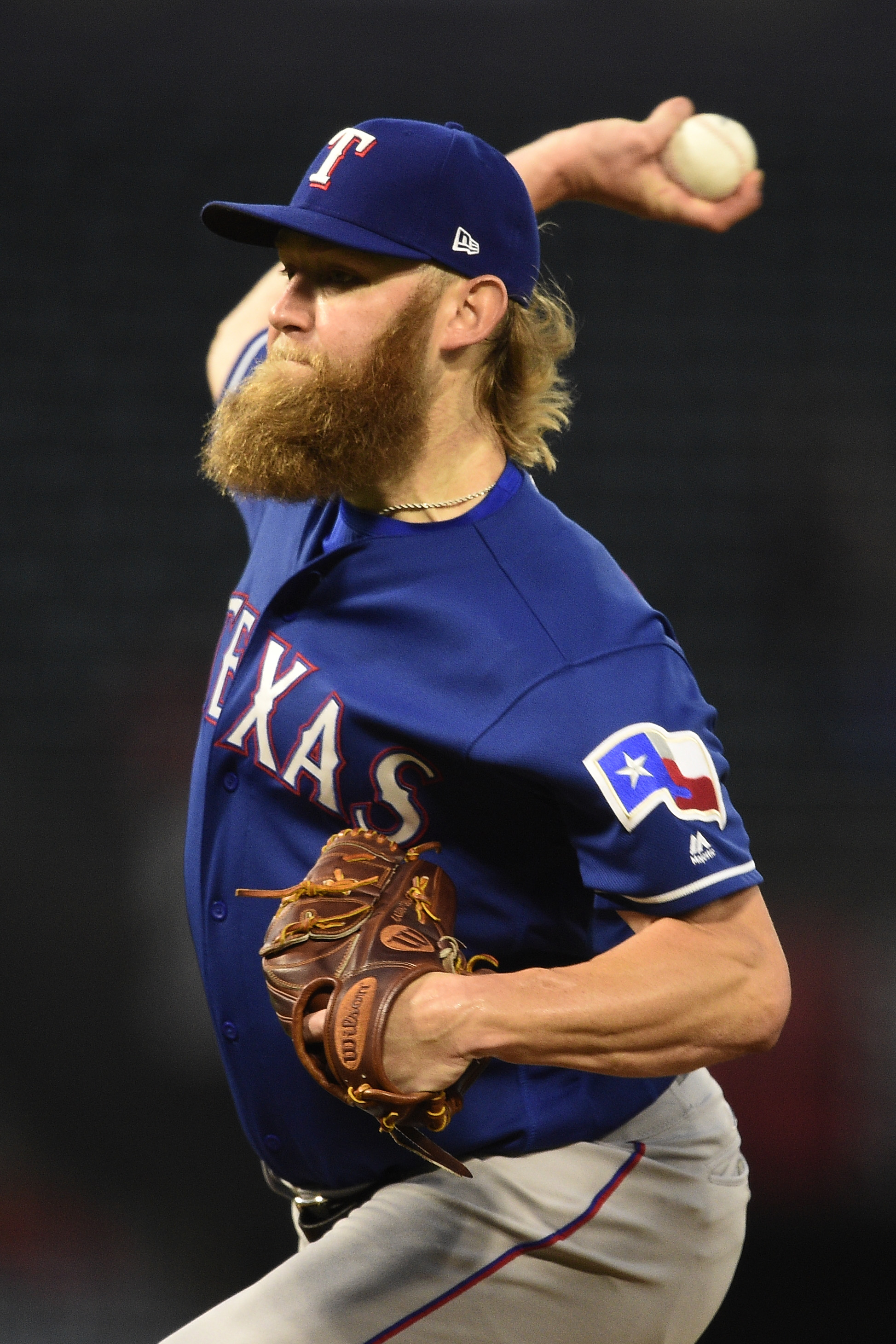 Cashner has certainly made good on the deal from the Rangers’ perspective, as he has turned in 139 2/3 innings of 3.29 ERA pitching over 23 starts. That’s a great return on the team’s investment, helping to balance out the miss on Cashner’s former Padres teammate, Tyson Ross, who also joined the Texas staff in hopes of a turnaround.
Those superficial results, however, don’t tell us all we need to know about Cashner’s interesting upcoming foray into free agency. While it’s tempting simply to assume that the notably talented right-hander has finally found health and figured things out, organizations — including the Rangers — will be looking at quite a bit more information in valuing the rights to his future production.
It’s hard not to raise an eyebrow at Cashner’s ugly K/BB numbers. He has recorded just 4.8 K/9 — second-lowest among all qualified starters — against 3.3 BB/9 on the year. He also sports a meager 5.7% swinging-strike rate that not only falls well below his career average but also ranks dead last among qualified starting pitchers.
The hurler has continued to maintain solid ground-ball numbers, with a 48.4% rate thus far in 2017. And perhaps there’s some indication of contact management in the .267 batting average on balls in play to which he has limited opposing hitters; while that’s surely a sign that there Cashner has benefited from some good fortune, the 28.2 percent hard-hit rate he’s allowed is the eighth-lowest in MLB. Cashner has tamped down on the homers that hurt him last year (8.3% HR/FB, 0.77 HR/9), though again it’s tough to see that as a fully sustainable skill.
Clearly, the underlying metrics paint quite a different picture than do the bottom-line results. Unsurprisingly, ERA estimators are not enthused with Cashner’s work this year. SIERA (5.41) and xFIP (5.16) have never before been this bearish on the right-hander, while FIP (4.42) only prefers his work this year to his more homer-prone 2016 (when he carried a 4.84 mark).
Beyond the matters of present and projected talent, long-term durability remains something of a question given that Cashner has missed some time with arm issues in the past. He’ll turn 31 in a few days, so he isn’t old, but he’s also not particularly young for a free-agent pitcher. Notably, too, Cashner’s velocity has trended downward. This year, he’s sitting at 94 mph with his four-seamer and 92.9 mph with his sinker — around one full tick below the prior year in both cases (and yet further behind his peak levels).
So, what might the market make of all this? It’s rather difficult to say, truthfully, since it’s hard to find pitchers with anything approaching this kind of profile. While bounceback hurlers such as Rich Hill and Scott Kazmir have scored three-year, $48MM contracts in recent years after returning from rough stretches, they did so after carrying good results and peripherals for one or more prior seasons.
Frankly, it’s hard to see Cashner commanding that sort of AAV. That’s particularly true given the relatively robust slate of mid- and back-of-the-rotation hurlers lined up on the market behind the biggest names. Cashner will be competing with pitchers such as Jeremy Hellickson, Marco Estrada, Lance Lynn, Alex Cobb, Jaime Garcia, Miguel Gonzalez, Tyler Chatwood, John Lackey, and a host of others.
Cashner’s inability to generate swings and misses makes a qualifying offer (reportedly set to be worth about $18.1MM) seem unlikely. Hellickson, after all, had a more impressive overall body of work in 2016 but still accepted a $17.2MM QO from the Phillies. Texas may not really want to chance that outcome in the hopes of securing the now-reduced draft compensation that could be available if he declines and signs elsewhere. Or, perhaps, if both team and player enjoy the current arrangement, the sides could pursue a multi-year arrangement during the exclusive negotiating window. (That’s how the Blue Jays got Estrada to stay for two years and $26MM two years ago.)
With or without compensation, Cashner seems more likely to receive offers in that $8MM to $12MM annual range, dependent upon the length of the term. We have seen quite a few solid but flawed arms land in that admittedly wide bucket — often scoring long-term commitments. Three-year pacts have gone to J.A. Happ ($36MM) and Ivan Nova ($26MM) — both of which have held up rather well thus far. Pitchers such as Ricky Nolasco and Brandon McCarthy have secured ~$12MM annually over four-year terms, though they had stronger free-agent cases based on their underlying metrics than Cashner. We’ve even seen some lower-AAV, longer-term deals, such as those landed by Phil Hughes (three years, $24MM) and Jason Vargas (four years, $32MM), which function as a reminder that the market can always create one-off contract scenarios.
Perhaps the most interesting analogy, all things considered, comes from Yovani Gallardo‘s recent trip into free agency. At the time, he was coming off of a year in which he put up 184 1/3 innings of 3.42 ERA pitching with a solid ground-ball rate but just 5.9 K/9 and 3.3 BB/9. He was younger than Cashner by about a year, with a lengthier track record of performance and durability, though he also had shown a more significant velocity decrease before entering the market. Gallardo was initially able to secure a $35MM guarantee over three years, but he ultimately had to settle for a promise of $22MM with a third-year option after a shoulder issue came up in his physical. Hopefully, Cashner can avoid any medical complications; he may also not come with draft compensation, which surely impacted Gallardo (who didn’t sign until late February).
While it’s hardly a perfect comp, the experience of Gallardo suggests there are some limits — but also that there’s real earning potential — for pitchers who have managed to post a solid ERA despite underwhelming peripheral indicators. Just how Cashner’s market will shape up is hard to guess at the moment, but he’ll be an interesting player to watch this winter.
Photo courtesy of USA Today Sports Images.
Rangers Outright Anthony Bass
- The Rangers have outrighted right-hander Anthony Bass to Triple-A Round Rock, executive vice president of communications John Blake tweets. Texas designated Bass on Thursday when it acquired righty Miguel Gonzalez from the White Sox. Bass’ most recent extensive big league action came during a 64-inning campaign with the Rangers in 2015, when he pitched to a 4.50 ERA. He has made two appearances with the Rangers this season, but his work has otherwise come at Triple-A, where the 29-year-old has put up a 4.18 ERA with 10.39 K/9 and 3.35 BB/9 in 75 1/3 frames.
Rangers Designate Marinez, Rodriguez, Alvarez; Activate Jake Diekman
The Rangers have announced a series of moves today as the month of September begins. Texas designated righty Jhan Marinez and lefty Joely Rodriguez to open two 40-man roster spots. Texas has also designated lefty Dario Alvarez, MLB.com’s T.R. Sullivan tweets.
Those three hurlers are a few of the many that have cycled through the Texas pen this year, as the organization has scrambled to make up for injured and/or ineffective pitching. Marinez has produced mostly solid results in time with three organizations this year, though clearly teams view him as a fill-in asset. Rodriguez has allowed exactly 19 earned runs in 27 frames at both the MLB and Triple-A levels this year. And Alvarez actually managed to carry a 2.76 ERA over 16 1/3 MLB innings this year, but he was averaging 7.7 B/9 to go with 9.4 K/9.
Leading the team’s September call-up list is lefty Jake Diekman, whose absence to date was one of the drivers of the bullpen churn. Diekman had missed the entire season after undergoing surgery just before camp to address inflammatory bowel disease. (You can and should read more about his journey here.) The Rangers can control the southpaw for one more season via arbitration; in all likelihood, he won’t command much of a raise on his current $2.55MM salary since he doesn’t have much time to accrue innings.
Recently acquired righty Paolo Espino, infielder Will Middlebrooks, and catcher A.J. Jimenez have also been tabbed to join the MLB club.
Adrian Beltre Expected To Miss 4 Weeks With Hamstring Strain
Veteran Rangers third baseman Adrian Beltre is expected to miss at least four weeks of action after being diagnosed with a grade 2 hamstring strain, per an announcement from club executive VP of communications John Blake. With one month left in the regular season, it appears unlikely that Beltre will return in 2017 unless Texas can secure a postseason berth in his absence.
That’s unfortunate news for the Rangers, who just picked up righty Miguel Gonzalez last night to help out down the stretch. While the Rangers are on the outside looking in right now, the team is still a plausible contender with four games to make up in the AL Wild Card race.
Of course, even getting to the play-in game will be much tougher now with Beltre out. Advancing age — he’s already 38 — may well have impacted his ability to stay healthy, as Beltre has suited up for just eighty games this season. But it has not robbed him of his immense abilities on the field.
Through 341 plate appearances in 2017, Beltre is slashing .315/.393/.553 — which translates to a 145 wRC+ that tops any of his prior full-season efforts since his monumental 2004 campaign. Beltre has launched 16 long balls on the year while walking more than ever (10.9%) and continuing to make plenty of contact (12.9% strikeout rate). He’s also still a well-above-average defender, even if metrics haven’t rated him as quite the premium gloveman that he has long been.
Though he has been limited, Beltre is playing at a six-WAR pace, so he has arguably still earned the $18MM he’s owed this year. Texas will employ the future Hall-of-Famer for one more year at the same rate under the extension he signed last spring.
In Beltre’s absence, the Rangers could turn to a number of different internal options. Breakout slugger Joey Gallo could man the hot corner. The club might also give some time to Will Middlebrooks, who’s coming up as part of the wave of September call-ups. One player that isn’t making an immediate appearance in the majors, though, is former top prospect Jurickson Profar; he, too, could see action at third, if and when he returns to the majors.
Rangers Acquire Miguel Gonzalez
The Rangers have struck a deal to add righty Miguel Gonzalez from the White Sox, as Eduardo Encina of the Baltimore Sun first reported (Twitter link). Per the report, the Orioles were also attempting to bring back the veteran starter, but weren’t willing to meet the asking price. Infielder Ti’Quan Forbes will go to Chicago in return. The Rangers have designated righty Anthony Bass to open a roster spot.
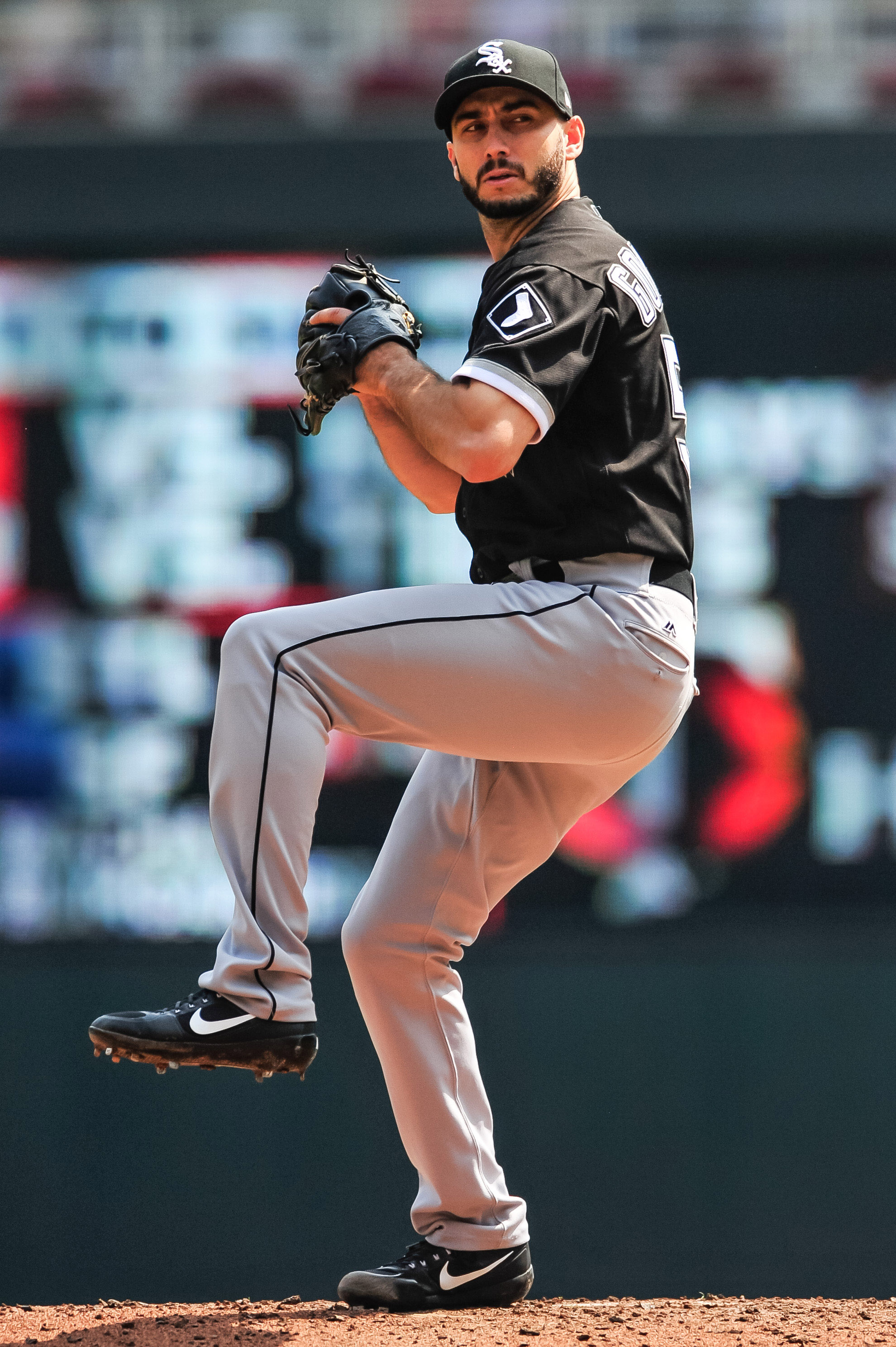
Though Texas isn’t exactly in prime position to snag a Wild Card berth — the team entered play today three games out and dropped its contest — it seems the club is at least interested in keeping that possibility open. Gonzalez will help bolster a rotation that no longer features Yu Darvish and has seen numerous other pitchers struggle. If they can crack the postseason, the Rangers will be able to utilize Gonzalez on their roster.
The White Sox have been quite aggressive in moving veterans, and Gonzalez now becomes the latest to go. The 33-year-old has been a steady presence since coming to Chicago after a four-year run in Baltimore. He’s earning $5.9MM this year — about $1MM of which remains to be paid — and will be a free agent at season’s end.
On the season, Gonzalez owns a 4.30 ERA with 5.6 K/9 and 3.2 BB/9 to go with a 38.1% groundball rate over 127 2/3 innings. He has been quite good since returning from a mid-summer DL stint, spinning 49 frames of 2.94 ERA ball — albeit still with just 35 strikeouts against 19 walks.
Despite the underwhelming peripherals, Gonzalez has typically managed to limit hard contact and suppress batting average on balls in play; opposing hitters carry a .278 BABIP against him over his six-year career. He doesn’t work with much velocity, but mixes five pitches and has managed to post a lifetime 3.88 ERA over 843 MLB frames.
Forbes only just turned 21 and was a second-round pick in 2014. But he has not really shown much yet as a professional. While playing mostly at third base this season, which he has split between the Class A and High-A levels, Forbes carries a meager .234/.281/.344 batting line with 11 home runs through 517 plate appearances.
The 29-year-old Bass has seen action in six MLB campaigns, but was bombed in two appearances this year with Texas. He has pitched to a 4.17 ERA in 84 1/3 Triple-A innings, though, with 10.2 K/9 against 3.2 BB/9.
Photo courtesy of USA Today Sports Images.
Details On Failed Darvish Talks Between Rangers, Astros
- Prior to trading Yu Darvish to the Dodgers, the Rangers “made clear” that they were “completely willing” to trade Darvish to the Astros. The Rangers, according to Heyman, asked for top-tier prospects from their division rivals, however, before ultimately landing on a package comprised largely of high-ceiling players in A-ball. Houston offered currently suspended (PEDs) top prospect David Paulino in a deal, and the two sides apparently never got especially close to reaching an agreement.
[SOURCE LINK]
Outrighted: Selsky, House, Scheppers
The following players have been outrighted, according to announcements from their respective teams:
- Outfielder Steve Selsky will remain with the Red Sox organization after he cleared waivers. Unlike the other two players listed here, Selsky did not have the right to decline an assignment. He was designated recently to clear the way for the team’s acquisition of Rajai Davis. The 28-year-old was called up briefly to the majors but has mostly played at Triple-A Pawtucket this year, batting .215/.270/.360 with 11 home runs in 322 trips to the plate.
- The Blue Jays will retain southpaw T.J. House after he accepted an outright assignment to Triple-A. He’ll instead be eligible to take free agency at season’s end. House, who’ll turn 28 in a month, appeared in two contests for Toronto but has spent most of the season at the highest level of the minors. In 130 2/3 frames at Buffalo, he owns a 4.27 ERA with 7.2 K/9 and 4.3 BB/9.
- Thirty-year-old righty Tanner Scheppers will also remain with the Rangers organization for the time being. He has seen only minimal MLB time this year, but has thrown 183 total frames at the game’s highest level over the past six years. Far and away his most effective season came back in 2013, when he put up 76 2/3 innings of 1.88 ERA ball. Over 46 1/3 frames at Triple-A in 2017, Scheppers carries a 5.05 ERA with 6.8 strikeouts, 2.7 walks, and 1.7 home runs per nine innings.
Giants Have Reportedly Expressed Strongest Interest In Giancarlo Stanton
The Phillies, Cardinals and Rangers are among the teams that have reached out to the Marlins to express interest in slugger Giancarlo Stanton, but USA Today’s Bob Nightengale cites a “high-ranking Marlins executive” in reporting that the Giants are the club that has expressed the most interest.
Miami has surged back to within striking distance of an NL Wild Card spot (largely due to Stanton’s recent heroics), so Stanton won’t be changing hands until this offseason, at the earliest. However, despite the recent offensive spike — Stanton is hitting .356/.462/.925 with 29 homers in his past 47 games — there are still numerous obstacles to a potential Stanton swap. Stanton’s 13-year contract affords him full no-trade protection, and Nightengale adds that not one prospective trade partner has expressed a willingness to absorb the remaining 10 years and $295MM on Stanton’s contract beyond the 2017 season.
Beyond that, the Giants’ minor league system is not very well regarded. Tyler Beede entered the year as the top pitching prospect in San Francisco’s minor league ranks, but he’s had a poor season in Triple-A this year (albeit in a very hitter friendly environment). He’s now likely to miss the final two months of the season with a groin injury. Fellow right-hander Joan Gregorio posted a 3.04 ERA in 74 Triple-A innings but carried some questionable secondary metrics and saw his season end in early July due to a PED suspension.
On paper, the Giants make a fair amount of sense as a trading partner for Stanton. San Francisco, as a team, ranks dead last in the Majors with 101 home runs this season. Stanton alone has nearly half that number, while the 29th-ranked Padres have out-homered the Giants by 25. That lack of pop is all the more glaring at a time when home runs are being hit at a record pace throughout the league.
More specifically, the Giants’ outfield has been the worst in baseball this year by measure of slugging percentage, OPS and fWAR. They rank 29th in on-base percentage, ISO and wRC+ as well. Incumbent right fielder Hunter Pence will turn 35 next April and has struggled to a career-worst .254/.306/.378 batting line through 431 plate appearances this season. Stanton would provide a thunderous jolt to any lineup he joined, but there’s very arguably no team that has a more acute need for his skill set than the Giants.
As for the Phillies, there may not be a team in baseball that can better handle his contract from a financial standpoint. Philadelphia’s only long-term commitment at present is to Odubel Herrera, and they have a history of lofty payrolls when contending. The Cardinals have been rumored to be in the market for an impact bat to place in the middle of their lineup since June, and the Rangers have little certainty in their outfield mix beyond 2017.
All of this, of course, is putting the cart before the horse. There’s no guarantee that the new Marlins ownership group will be in a rush to trade Stanton on the heels of the best season of his excellent young career. Doing so would come with massive public relations repercussions and could start the Bruce Sherman/Derek Jeter-led ownership group out on the wrong foot with a fan base that has long harbored a potent distrust of previous owner Jeffrey Loria. That’s especially true when considering the fact that the Marlins would likely have to pay Stanton’s contract down to the point where an interested partner felt it carried enough surplus value not only to acquire Stanton but also to part with well-regarded young talent.
The Marlins’ preference under new ownership, according to Nightengale, is to keep the payroll around $100MM, and Stanton’s salary will jump to $25MM next season. He’ll be paid $26MM in both 2019 and 2020, after which he can opt out of the remaining seven years of the deal. If he forgoes the opt-out, Stanton will be paid $29MM in 2021-22, $32MM in 2023-25, $29MM in 2026 and $25MM in 2027. Stanton’s contract also includes a $25MM option for the 2018 season, which comes with a $10MM buyout.
After Trades, Rangers Changing Approach To Pitching Development
In light of the damage wrought by Tropical Storm Harvey, the Astros have released a statement about their plans for the coming week. The team, after playing the Angels in California this weekend, is currently scheduled to host the Rangers in Houston on Tuesday. However, the team now plans to fly to Dallas, and will provide an update on their schedule on Monday. It seems reasonable to speculate that the upcoming series will be moved to Arlington. “At this point, our focus is on the safety of our fans, our players and their families and our front office staff and their families,” says Astros president of business operations Reid Ryan. “As we continue to monitor the conditions, we have been in communication with Major League Baseball and the Texas Rangers and will provide an update on Monday.” Obviously, these potential changes to the baseball calendar pale in importance to the continued dangers Harvey poses, and we at MLBTR send our thoughts to any readers currently dealing with the devastation of the storm.
- A series of trades left the Rangers‘ minor-league system light on starting pitching talent, so the organization has changed its priorities to accommodate their talent vacuum, Evan Grant of the Dallas Morning News writes. While pushing for a World Series title, the Rangers dealt Jerad Eickhoff, Alec Asher and Jake Thompson (in the Cole Hamels deal), Luis Ortiz (in the Jonathan Lucroy trade) and Dillon Tate (for Carlos Beltran). In the wake of those departures, the team focused on their prospects’ fastball command and slowed down the pace at which they moved through the system. The team’s remaining top pitching prospect, Yohander Mendez, has exemplified those changes, as Grant points out — last year, Mendez went all the way from Class A+ High Desert to the Majors, mostly with fine results, probably thanks in part to an excellent changeup. This year, though, he’s spent the entire season with Double-A Frisco. “I was uncomfortable at first,” Mendez says. “I was not used to pitching like that. But I was falling in love with my secondary stuff and it hurt me. If I know my mechanics and could locate the fastball, it would make my secondary pitches better.”
Rangers Acquire Paolo Espino, Designate Tanner Scheppers
The Rangers have acquired right-hander Paolo Espino from the Brewers for cash considerations and designated fellow righty Tanner Scheppers for assignment, Jeff Wilson of the Fort Worth Star-Telegram tweets. Espino will report to Triple-A with his new organization.
The Brewers designated Espino on Wednesday after the 30-year-old had a difficult 17 2/3-inning major league debut with the club this season. Across six appearances and two starts, Espino logged a 6.11 ERA with 6.62 K/9 against 4.08 BB/9. He has been better this year at Triple-A (4.52 ERA, 8.68 K/9, 1.67 BB/9 in 75 2/3 frames) and has generally fared well at that level since ascending to it in 2010. He’s now in his fourth organization since the Indians chose him in the 10th round of the 2006 draft.
Scheppers, also 30, is certainly the more proven major leaguer of the two, but his career has gone off the rails thanks in part to a spate of injuries over the past several seasons. At his best, the 2009 first-round pick was a key member of the Rangers’ bullpen in 2013, after which Texas attempted to turn him into a starter. The hard-throwing Scheppers took the ball for the Rangers to open the 2014 season, but he only totaled four starts in eight appearances that year and posted a 9.00 ERA in 23 innings. He hasn’t worked extensively in the majors since recording a 5.63 ERA and a 5.4 BB/9 in 38 1/3 relief innings in 2015. Scheppers’ struggles have continued this season with Triple-A Round Rock, where he has registered a 5.05 ERA despite passable strikeout and walk numbers (6.8 K/9 and 2.72 BB/9) through 46 1/3 frames.