
Free Agent Stock Watch: Michael Brantley
When the 2017 campaign came to a close, it was an open question whether the Indians should and would exercise a $12MM club option over outfielder Michael Brantley. The alternative — which MLBTR poll respondents narrowly preferred — was to send him onto free agency with a $1MM buyout.
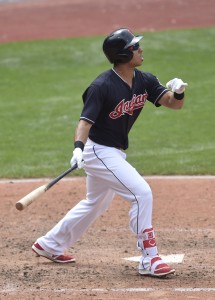
As it turned out, of course, Cleveland elected to roll the dice on Brantley, betting that he’d have his first healthy season since 2015 — when he was a high-end offensive performer. Significant shoulder and ankle problems conspired to limit Brantley to just 101 total games over the ensuing two seasons. Though he hit well in 2017, turning in a .299/.357/.444 with nine home runs in 375 plate appearances, that wasn’t near the top-level output he had turned in previously. All said, it was open to question just what Brantley would contribute in 2018
For the budget-conscious contenders, it wasn’t an easy call, particularly with a variety of potential buy-low targets available in free agency and other needs clamoring for attention. While the overall roster performance hasn’t been quite to expectations in 2018, though, the decision to hang onto Brantley has paid off handsomely.
Through 245 plate appearances on the year, Brantley carries a .316/.359/.529 slash with 11 home runs. He has returned to striking out in less than ten percent of his plate appearances. And while he isn’t walking as much as he did in 2015, with a slightly below-average 6.1% rate, Brantley is producing more power (.213 isolated slugging) than he ever has in a full season. Better still, Statcast thinks there’s more in the tank, as it credits him with a .410 xwOBA that significantly exceeds the .374 wOBA mark that has resulted.
Still, there are some questions facing Brantley away from the plate. Typically a plus runner, he has rated as a negative thus far in 2018 under Fangraphs’ BsR measure. More worrisome, perhaps, is the slippage in his defensive metrics. Most of his career has been spent in range of average in left field, but Brantley has been panned by both DRS (-8) and UZR (-5.6) in 2018.
In regard to the baserunning and glovework, a full-season sample or finer analysis could change the picture. Still, though, those aren’t the most promising developments for a player who is already 31 years of age and has fought through major health concerns of late. Brantley has also typically carried fairly significant platoon splits over his career, though he has generally produced palatable numbers against southpaws.
If Brantley can maintain his current offensive trajectory, and perhaps exhibit reasonable form in the other areas of play as well, then he’ll have quite an interesting free-agent case. His premium plate discipline and contact skills ought to play well in the market — former teammate Carlos Santana got $20MM annually last winter despite being limited to first base defensively — though age will certainly come into play.
Frankly, there are no shortage of interest market markers to consider here. On the lower end, the agreement that Denard Span inked with the Giants covered his age-32 through age-34 campaigns. Like Brantley, he was coming off of some injury-marred campaigns with questions about how he’d bounce back. Melky Cabrera was more youthful but not as accomplished as Brantley when he signed his three-year, $42MM pact with the White Sox. The same is true of Jay Bruce, who was born months apart from Brantley but reached the market one year sooner, securing $39MM over three seasons.
There’s certainly a ready argument that Brantley ought to out-perform those contracts, particularly if teams still view him as a plausible corner outfielder for most or all of the contractual term. Players of a similarly advanced age have secured five-year guarantees, with recent examples including Lorenzo Cain ($80MM), Dexter Fowler ($82.5MM), and Ian Desmond ($70MM). In each of those cases, though, the length of the deal was perhaps less concerning since the players involved were considered capable of playing center field (as well as the infield, in Desmond’s case), even if Brantley still carries a better offensive profile.
Barring an unreal run to finish the year, Brantley will likely struggle to command a fifth year, particularly as we’ve generally seen a movement toward shorter contracts in free agency. Even with the injury history, though, might he be a strong candidate for a fourth year? Curtis Granderson got to four years, at a $15MM rate, at a more advanced age. He was coming off of an injury-shortened season, though he was also an established 40-homer bat at a time when that meant more than it does today. Alex Gordon landed $72MM on a four-year term, but didn’t face the kinds of long-term health questions that Brantley does. Nick Swisher was 32 years old when he signed for four years and $56MM after a run as a steadier, but lower-ceiling hitter than Brantley. Of course, those four-year contracts are also somewhat out of date. Josh Reddick recently secured four years and $52MM. But he was entering his age-30 campaign.
Taken together, that’s quite a broad range. Given his return to form thus far, one could reasonably craft an argument that Brantley ought to rate in the Granderson-Gordon range as a high-quality, veteran corner bat. Then again, teams will need to examine and weigh his long-term medical outlook quite closely, as Brantley has dealt with quite a bit more than the sort of acute injuries that take place in the course of playing baseball. In that view, perhaps the three-year arrangements provide a better model, though even in that event Brantley is on track to staking a claim to a significant AAV.
Photo courtesy of USA Today Sports Images.
Indians Release Matt Belisle
The Indians’ top affiliate has announced that righty Matt Belisle was given his unconditional release. He had been pitching with the Columbus Clippers since signing a minors deal in mid-May.
Belisle, who just turned 38, had opened the season in the MLB pen for the Indians after turning in a solid overall effort last year with the Twins. He was designated for assignment just over a month into the season, though, after surrendering six earned runs on nine hits in 10 1/3 innings.
In some regards, Belisle has produced similar results in an identical number of frames since reporting to Triple-A. While he has surrendered five earned on ten hits, though, the underlying numbers are much more promising. After managing only four strikeouts during his time in the majors this year, Belisle has recorded an 11:1 K/BB mix for Columbus.
It is not immediately clear whether Belisle had an opt-out opportunity or otherwise requested his release. Based only upon his recent track record and showing, however, it seems reasonable to guess he’ll land in a spot where he’ll have a clear chance at returning to the majors.
Amateur Draft Signings: 6/11/18
Here are Monday’s agreements from the top few rounds of the draft (rankings referenced are courtesy of Baseball America, MLB.com, Fangraphs and ESPN’s Keith Law — with the scouting reports from MLB and Fangraphs both coming free to the general public)…
- The Athletics have a deal in place with second-rounder Jameson Hannah, per Jon Heyman of Fan Rag (via Twitter). He’ll take home a $1.8MM bonus, a fair bit north of the $1,414,200 allocation that came with the 50th overall selection. Coming into the draft, MLB.com was by far the most bullish outlet on Hannah, grading the Dallas Baptist product as the 32nd-best player available. He’s said to possess outstanding speed, some decent power projection, and a solid hit tool at the plate along with the chops to play center.
Earlier Updates
- The Cardinals agreed to terms with Wake Forest right-hander Griffin Roberts on a $1,664,200 bonus — the full slot value of his No. 43 selection — per MLB.com’s Jim Callis (on Twitter). Opinions on Roberts were somewhat split, with Baseball America most favorably ranking him 47th in the class, while Fangraphs pegged him 84th overall. Reports on him praise Roberts for possessing one of the best sliders of any amateur in the country, but there’s also quite a bit of uncertainty as to whether he can be a starter at the professional level or if he’ll be a bullpen piece. He also had control issues prior to the 2018 season.
- MLB.com’s Jonathan Mayo tweets that the Angels are in agreement with second-round pick Jeremiah Jackson on a $1,196,500 bonus that represents a full-slot signing. Law’s ranking of Jackson as the No. 23 prospect in the class was the most aggressive, as he wrote that while Jackson was unlikely to be the first high school shortstop off the board, he was perhaps the most promising. Kiley McDaniel and Eric Longenhagen of Fangraphs write that Jackson’s stock soared once he began wearing glasses and immediately began raking. McDaniel and Longenhagen note that opposing teams simply opted to intentionally walk Jackson in 11 of his final 13 plate appearances in high school and peg him as a potential everyday third baseman.
- In a fairly sizable over-slot signing, FanRag’s Jon Heyman tweets the Indians agreed to a $900K bonus with sixth-rounder Raynel Delgado, whose No. 193 overall selection came with a value of $235,600. The switch-hitting prep infielder out of Florida has impressed scouts with his bat speed and hit tool from both sides of the dish, but questions about his defense and a commitment to Florida International pushed him down the board a bit. BA ranked him 83rd, touting the potential for plus power from both sides of the dish. Callis and Mayo peg him as a potential offensive-minded second or third baseman down the line.
Indians Promote Francisco Mejia
The Indians have promoted top prospect Francisco Mejia, per a club announcement. Right-hander Evan Marshall was optioned to create active roster space.
Mejia, who’s known most for his bat, was announced as a catcher/outfielder. It’s still unknown just how the team will deploy him in the mid and long-term, but he’ll fill in for backup catcher Roberto Perez for the meantime. Though the team says Perez is not going on the DL — at least, not yet — he is expected to miss some time after being struck by a pitch in the hand yesterday.
Mejia, who made a brief MLB cameo last year, entered the season as a consensus top-twenty prospect leaguewide, with many assuming he would hit his way into the MLB mix sooner than later. Defensively, though, there are far greater questions. Thus far in 2018, he has split his time about evenly behind the plate and in the grass.
While he has worked to find a defensive home, Mejia hasn’t produced to his typical levels at the plate. In 214 plate appearances at the highest level of the minors, he owns a .214/.271/.33 slash. That said, as the team notes in its release, the switch-hitting Mejia has been on a hot streak of late. And he came into the season with a track record and reputation as a polished hitter from both sides of the plate.
While the Cleveland organization gets a sense for what kind of contribution it can expect from Mejia now and in the future, the 22-year-old will accrue MLB service time. He already had 31 days from 2017, and can earn as many as 112 from this point through the end of the current season, so he could profile as a future Super Two qualifier if he stays up for good.
Mejia made the news earlier this season when he brought a lawsuit seeking to abrogate his contractual relationship with an entity called Big League Advance. The litigation will determine whether Mejia is forced to pay a portion of his ongoing MLB earnings.
Indians Release Richie Shaffer
The Indians announced that they’ve released corner infielder Richie Shaffer from their Triple-A affiliate in Columbus. The 27-year-old former first-round pick had been in his second season with the organization.
Selected 25th overall by the Rays back in 2012, Shaffer logged fairly pedestrian numbers in the low minors before breaking out with a big 2015 in which he batted .267/.357/.539 in 108 games between Double-A and Triple-A as a 24-year-old. Tampa Bay brought him to the Majors late that season, but he managed just a .213/.310/.410 slash with five homers in 142 plate appearances with the Rays from 2015-16. The Rays traded Shaffer and Taylor Motter to the Mariners in exchange for three minor league pitchers (including Andrew Kittredge) that offseason, and he bounced around the waiver wire before settling in with Cleveland prior to the 2017 campaign.
Shaffer notched an .802 OPS with 30 homers for Cleveland’s top affiliate in 2017, but he’s off to an ugly start in 2018, having batted .164/.216/.310 through 125 PAs in his second season with Columbus. He’s primarily been a third baseman in the minors but also has significant experience at first base and in both corner outfield slots.
AL Central Notes: Santana, Rupp, Rodon, Miller
Let’s check in on the latest from the AL Central:
- There’s good news for Twins starter Ervin Santana, as conveyed by Mike Berardino of the St. Paul Pioneer-Press on Twitter. After putting a hold on his rehab assignment a week ago, Santana is now just about ready to begin throwing again and may do so as soon as tomorrow. The solid veteran hurler will still need to complete a full ramp-up before he returns to the majors, but it seems promising that his earlier setback has only required a brief respite.
- New Twins backstop Cameron Rupp has an opt-out opportunity on July 15th, per Darren Wolfson of 1500 ESPN (via Twitter). That will give the team some time to assess its situation at the MLB level, and to get familiar with Rupp, before deciding whether to promote him. At the same time, it allows the backstop a chance to find a new opportunity before the trade deadline, if he doesn’t come up with the Twins.
- The White Sox are finally set to welcome back lefty Carlos Rodon, as Daryl Van Schouwen of the Chicago Sun-Times tweets. It seems he’ll take a start this weekend, though it’s not yet clear who’ll end up being bumped from the rotation. Considered a can’t-miss prospect when he was drafted, Rodon zipped to the majors and has mostly been effective, with a 3.95 ERA over 373 2/3 career innings. While he surely could still iron some things out — in particular, limiting walks and long balls — the real question is his health after shoulder surgery late last year. Rodon has certainly bee in form on his rehab assignment, allowing three earned and carrying a 28:5 K/BB ratio in 17 2/3 innings.
- Indians lefty Andrew Miller seems to be making progress from the right knee problems that sent him to the DL. Per MLB.com’s Jordan Bastian, via Twitter, Miller will do some mound work today that will help with an assessment as to whether he needs a rehab stint. That seems generally to be a positive sign given the uncertainty when Miller was sidelined. Inflammation is hardly the most ominous diagnosis, to be sure, but in this case Miller has dealt with repeat problems in the same joint. He has also been unusually human on the mound this year, allowing seven earned runs and issuing an uncharacteristic ten walks over his 14 1/3 innings.
Indians Option Bradley Zimmer, Activate Lonnie Chisenhall
The Indians announced on Tuesday that they’ve activated outfielder Lonnie Chisenhall from the 10-day disabled list and opened a roster spot by optioning struggling center fielder Bradley Zimmer to Triple-A Columbus.
[Related: Updated Cleveland Indians depth chart]
Zimmer, 25, has turned in quality contributions on the bases and in the outfield this season, but he’s had a dreadful time at the plate, batting just .226/.281/.330 with a pair of homers in 114 trips to the plate. Those struggles are largely a continuation of a poor 2017 second half for the former first-rounder. Zimmer debuted and hit .285/.339/.450 prior to the All-Star break last season before fading badly down the stretch with a .196/.275/.318 line to close out the season. Zimmer struck out at a 33.5 percent clip in the second half last season, and he’s posted an even more alarming 38.6 percent strikeout rate in 2018.
As for the 29-year-old Chisenhall, he’ll return from a calf strain that has held him out of action since landing on the disabled list way back on April 8. He’s made just 21 plate appearances this season in what is likely the most important campaign of his big league career. Chisenhall, who hit .288/.360/.521 in 270 PAs last season, is set to hit free agency for the first time following the 2018 season. While durability appears to be a legitimate concern for him, he’s been productive at the plate in three of the past four seasons and will look to rebuild his stock as best he can in the four months between now and season’s end.
Indians Sign George Kontos
The Indians have signed reliever George Kontos to a minor league contract, according to an announcement from the team.
Kontos debuted in the majors with the Yankees in 2011 and has since pitched for the Giants and Pirates. The Bucs released the 32-year-old this week after he opened the season with 18 2/3 innings of 5.03 ERA ball. Kontos has generally been successful in the majors, however, as he carries a 3.11 ERA with 7.25 K/9, 2.6 BB/9 and a 43.3 percent groundball rate over 350 innings. Along the way, the righty has held same-handed hitters to a a paltry .228/.270/.374 line and limited lefties to a .236/.325/.381 mark.
Kontos seemingly stands a chance of returning to the bigs in Cleveland, whose bullpen has been a disaster this year. Indians relievers rank dead last in ERA (5.92) and third from the bottom in fWAR (minus-0.6). The club has been on the lookout for established relievers as a result, and already signed Oliver Perez this weekend before adding Kontos.
Indians Sign Oliver Perez, Designate Jeff Beliveau
The Indians search for bullpen help continues, as Jordan Bastian of MLB.com reports that the club has signed lefty Oliver Perez to a major league deal. The club has designated fellow left-hander Jeff Beliveau for assignment in a corresponding move.
The Yankees released Perez from his minors contract just yesterday; as MLBTR’s Jeff Todd pointed out at that time, he’d received a June 1st opt-out date in his contract with the club due to his status as an Article XX(B) free agent. Perez struck out 10.5 batters per nine innings while walking 3.9 across the past two seasons with the Washington Nationals, and the Indians will hope he can serve as another reliable lefty reliever behind Tyler Olson while former ALCS MVP Andrew Miller rehabs a knee issue.
As Bastian aptly pointed out, Perez will end up being the 15th relief pitcher used by the Indians this season, whereas they only used 13 relievers for the entirety of 2017 (position players and starters coming out of the bullpen excluded). Those relievers have combined to post an ERA north of 6, good for the worst mark in the majors. While it would be silly to think that Perez can have a significant impact on that figure, he’s got a long resume of effective performance against same-handed hitters. On the whole, he’s limited those lefties to a .228/.318/.365.
In any case, that makes him an upgrade over Beliveau, who’s at times seemed incapable of getting any outs at all. Beliveau’s got a gargantuan ERA of 11.57 this season, and remarkably, his FIP suggests he’s been lucky to have posted even that figure. Of course, this all comes in a 4 2/3 inning sample size, but Indians fans will surely be glad to see Beliveau replaced in the bullpen regardless.
Latest On Danny Salazar
The Indians are still searching for answers on Danny Salazar‘s ailing right shoulder, writes Paul Hoynes of the Cleveland Plain Dealer. Salazar, 28, has been out all season due to a right shoulder impingement that is causing tendinitis, and he’s currently not throwing after receiving a pair of injections in his shoulder this month. He will be re-evaluated by team medical officials in the coming days.
FanRag’s Jon Heyman, though, paints an even more ominous picture when it comes to Salazar, reporting in this week’s notes column that the Indians don’t expect Salazar to return until September, if he returns at all this season. For a club that has seen considerable struggles both at the fifth spot in the rotation and in the bullpen, that’s a most unwelcome timeline for a clearly talented arm that, if healthy, would give Cleveland one of the top rotations in all of baseball.
Fans of the team, clearly, will hope that there’s still some possibility of a more optimistic prognosis. The recent track record, though, does not inspire much confidence. Shoulder troubles slowed Salazar in 2017 as well, when the right-hander was limited to just 103 innings. More generally, durability concerns have plagued him throughout his MLB tenure, as he’s topped 25 appearances and 140 innings in just one season — his 185-inning 2015 campaign.
If Salazar is indeed out of the picture for the foreseeable future, the Indians will have to determine whether Shane Bieber or Adam Plutko will occupy the fifth spot in the rotation behind Corey Kluber, Carlos Carrasco, Trevor Bauer and Mike Clevinger now that Josh Tomlin has been dropped to the bullpen. They’ll also need to plan for ways in which they can upgrade their bullpen without relying on the possibility of a healthy Salazar returning to supplement a group that has struggled through multiple DL stints to Andrew Miller. Clearly, the team has missed the reliable innings it got last year from setup men Bryan Shaw and Joe Smith (though Shaw has struggled considerably in his own right in his first season with the Rockies).
A prolonged absence for Salazar would not only be a blow to the Indians but would also potentially impact his future standing with the organization. Salazar entered the 2018 season with three years, 162 days of Major League service time and will be arbitration-eligible for the third time as a Super Two player this offseason. He’s earning $5MM this year and would likely command that same figure in arbitration were he to miss the whole year, while he’d probably receive a small bump if he returns to contribute in any capacity this September. While that’s hardly an exorbitant amount to pay for a pitcher of Salazar’s considerable upside, the Indians don’t generally have ample cash reserves to work with and could end up facing a tough call.