
Royals Designate Joel Payamps For Assignment
The Royals have designated right-hander Joel Payamps for assignment and optioned infielder Maikel Garcia to Triple-A Omaha, per a club announcement. That pair of moves will open roster space for Hunter Dozier to return from the paternity list and for righty Max Castillo to be recalled from Omaha. Castillo, whom the Royals acquired in the trade that sent Whit Merrifield to Toronto, will start tonight’s game in place of veteran Brad Keller, who has been moved from the rotation to the bullpen.
Payamps, 28, has been a solid member of the Kansas City bullpen this season, working to a 3.16 ERA with a 17.6% strikeout rate, an 8.5% walk rate and a hearty 53.3% ground-ball rate, all of which makes his DFA at least a mild surprise. Fielding-independent metrics aren’t quite as bullish on the righty, who’s benefited from an elevated 78.9% left-on-base rate and given up a fair bit of hard contact (40.9%). Still, Payamps is averaging a career-high 95 mph on his heater, keeping the ball on the ground at a career-best rate and sporting a career-best 10.1% swinging-strike rate.
It’s not an elite package of results and secondary marks, but Payamps has had a better year than the standard DFA casualty and figures to have a decent chance of being claimed on waivers. That’ll be the Royals’ only course of action, as he can’t be traded now that the deadline has passed. Payamps is controllable for another four years beyond the current season but is out of minor league options, so any team to claim him will have to carry him on the MLB roster.
Castillo, 23, slotted in as the Royals’ No. 24 prospect at Baseball America in their post-deadline reranking of the system. He made his big league debut with Toronto earlier in the season, appearing in nine games (two of them starts) and working to a 3.05 ERA with a 20-to-5 K/BB ratio in 20 2/3 innings. It’s been a strong season on the whole for Castillo, who notched a 3.10 ERA in Double-A before jumping to Triple-A and yielding six runs in 31 innings (1.74 ERA).
Castillo isn’t a power pitcher but has displayed solid walk and ground-ball rates while garnering praise for an above-average changeup and command of the strike zone. The Royals will take at least some of the remainder of the season to evaluate him as a potential rotation piece, though it’s always possible that he ultimately slots in as a multi-inning reliever or swing man. For now, he’ll join Zack Greinke, Brady Singer, Daniel Lynch and Kris Bubic on the starting staff.
Royals Move Brad Keller To Bullpen
The Royals have moved right-hander Brad Keller from the rotation to the bullpen, manager Mike Matheny announced to reporters (link via Lynn Worthy of the Kansas City Star). For now, Matheny indicated the plan is merely to “take a look” at Keller in this role, suggesting the organization hasn’t necessarily giving up on him as a starter entirely.
Keller’s shift to the ‘pen is a reminder of how quickly things can change in baseball. Just a month ago, he looked the part of an appealing trade chip for the Royals, having pitched to a 3.96 ERA through his first 17 starts. Keller’s 16.4% strikeout rate in that time was well south of the league average, but he also boasted better-than-average walk and ground-ball rates (7.8% and 51.6%, respectively). He’d done a fine job managing hard contact and, while obviously not an overpowering pitcher, looked well on his way to another season as a solid back-of-the-rotation innings eater.
In five starts since that time, however, Keller has been rocked for 25 runs (24 earned) through just 24 2/3 innings of work. He’s twice surrendered eight runs in a start and yielded five home runs in that time (after allowing just four in his prior 43 innings of work). Keller has also walked an uncharacteristic 12.3% of his opponents during this stretch, and after allowing an 88.5 mph average exit velocity and 38.8% hard-hit rate through his first 17 starts, has yielded a 92.1 mph average exit velo and 50% hard-hit rate during this recent slump.
It’s a jarring stretch, one that mirrors many of the struggles the 27-year-old endured in a down 2021 year that, until recently, looked like an aberration. Keller was a steady member of the Kansas City staff from 2018-20 before slipping in ’21 and posting an unsightly 5.39 ERA in 133 2/3 frames (26 starts). The primary factors behind his struggles were spikes in both his walk rate and home-run rate, as has been the case over the past month. Even with those 2021 struggles and this recent stretch of five dismal outings, Keller still carries a career 4.19 ERA with well above-average ground-ball tendencies.
As is always the case, there’s a certain level of intrigue when taking a starter and dropping him into a relief role. Pitchers typically throw harder when they know they’re working in short stints and can thus throw at a higher intensity without needing to worry about saving some gas for second and third trips through the batting order. Keller’s slider has long graded out as a plus pitch, and we know he can rack up grounders. If a few extra ticks of velocity can improve the results on his sinker or generate some extra whiffs with his four-seamer (which already has above-average spin), it’s possible the bullpen version of Keller could turn some heads.
On the other side of the coin, of course, continued struggles in his new role could muddy the waters for Keller and his outlook with the Royals. He’s already in his fifth season with Kansas City, and the former Rule 5 draft pick — one of the best Rule 5 selections in recent memory, to the Royals’ credit — is only under team control through the 2023 season. He’ll be due a raise on this year’s $4.825MM salary in his final trip through arbitration this offseason, and although his struggles will limit the magnitude of that raise, he could still pull in something north of $6MM.
The Royals may tender Keller a contract regardless, considering that a reasonable price to pay for a pitcher with his track record — 2022 struggles notwithstanding. Still, a nice finish to the season — whether pitching well enough out of the ‘pen to win back a rotation spot or simply shining as a reliever down the stretch — would solidify the ground on which he’s standing. The Royals did discuss Keller with other teams prior to the trade deadline, so it’s likely that those interested parties will also be keeping tabs on how he performs in a new role.
With Keller stepping to the side, the Royals’ rotation will have some fluidity. Zack Greinke will remain in place as a veteran workhorse, followed by right-hander Brady Singer, who appears in the midst of a breakout. Lefties Daniel Lynch and Kris Bubic have pedestrian numbers overall but have both been quite sharp in their past eight starts. Any of Jonathan Heasley, Jackson Kowar, Drew Parrish or Max Castillo could be options to step into Keller’s rotation spot down the stretch.
Royals Select Nate Eaton
The Royals have selected Nate Eaton onto the big league roster, per a club announcement. Maikel García was optioned to Triple-A Omaha to open an active roster spot, while the team transferred outfielder Edward Olivares from the 10-day to the 60-day injured list to create a spot on the 40-man roster.
Eaton is up for the second time this season, although this promotion should be more lasting than his previous stint. The 25-year-old was called up as one of a swath of virus substitutes during the Royals road series in Toronto. He collected two hits (including his first MLB home run) in 12 at-bats. As a designated substitute, he was returned to the minors without occupying a 40-man roster spot at the end of the series.
This time, Eaton’s promotion involves the more typical contract selection. He’d now have to pass through waivers for Kansas City to remove him from the 40-man, although it’s likely the retooling club will give him a decent leash for the stretch run. The former 21st-rounder is having a breakout year in the upper minors. He started the season relatively slowly, hitting .271/.331/.400 through 37 games at Double-A Northwest Arkansas. He nevertheless received a bump to Triple-A Omaha at the end of May, and he’s taken to the minors highest level well. Through 209 plate appearances there, Eaton is hitting .303/.373/.524 with nine home runs and stolen bases apiece.
Eaton would’ve been eligible for the Rule 5 draft this winter, and Kansas City will give him a 40-man spot a couple months early to get a look at him down the stretch. He’s played primarily third base and right field in the minors, with brief stints in left and center field. That bit of defensive flexibility should give manager Mike Matheny a few possibilities to get his bat into the lineup.
Olivares just landed on the IL a few weeks ago with a left quad strain. It’s evidently a severe injury, as the Royals rather quickly ruled him out for a couple months. He’ll be eligible to return 60 days from the time of his original placement on July 22, but even a best-case scenario would see him log around more weeks of action this year. The righty-hitting outfielder has had a nice showing in 36 games this season, hitting .303/.358/.434 with a trio of longballs.
Royals Select Michael Massey
1:00pm: The Royals announced to reporters, including Alec Lewis of The Athletic, that Zerpa has a small tear in the patellar tendon of his right knee.
11:42am: The Royals announced Wednesday that they’ve selected the contract of second baseman Michael Massey and recalled catcher Sebastian Rivero from Triple-A Omaha. Massey will take Whit Merrifield‘s spot on the active roster, while Rivero is up in place of backup Cam Gallagher. Both Merrifield and Gallagher were traded prior to yesterday’s deadline. Lefty Angel Zerpa was moved to the 60-day injured list to open a spot on the 40-man roster for Massey.
Massey, the Royals’ fourth-round pick in 2019, is in enjoying an outstanding season in the minors, posting a combined .312/.371/.532 with 16 home runs, 28 doubles and 13 steals through 391 plate appearances. That includes a massive .325/.392/.595 batting line (158 wRC+) in 143 trips to the plate at the Triple-A level. Baseball America tabbed him eighth among Kansas City prospects on their midseason ranking of the system, giving him above-average grades for his hit tool, power and glove at second base.
With Merrifield traded, there’s a clear opening for the 24-year-old Massey to join Bobby Witt Jr. as a staple in the Kansas City infield. He’s certainly not as ballyhooed a prospect as Witt was prior to his debut, but Massey was selected with the 109th overall draft pick not long ago and has done nothing but hit since making his professional debut. For a 41-63 Royals club that is clearly playing for the future for the remainder of the current season, Massey is just the type of promising youngster who ought to command everyday at-bats in hopes of seizing a spot on next year’s roster.
As for the 23-year-old Rivero, he’ll give Kansas City a third catching option behind Salvador Perez and MJ Melendez. With that duo on the roster for the foreseeable future, it’ll be tough for Rivero to carve out much of a role, but he has a minor league option remaining beyond the current season. Rivero hasn’t hit in a tiny sample of 58 big league plate appearances, but he has a .266/.322/.380 line in 171 Triple-A plate appearances that’s at least passable for a catcher, particularly an organization’s No. 3 catcher on the 40-man roster.
Zerpa, 22, is one of the organization’s more promising pitching prospects, but a move to the 60-day injured list could very well mean the end of his season. The Royals placed him on the 15-day injured list due to a right knee injury last week but have yet to provide more details surrounding today’s shift to the 60-day IL.
Deadline Recap: American League
A wild trade deadline has now passed, with contenders fortifying themselves for a World Series run or a playoff push, rebuilding teams looking towards the future, and some teams in both camps being more cautious in their moves. Here is the recap of every American League club’s most notable trades of the last few days, with the NL wrap-up coming on Wednesday….
New York: Though the Yankees’ rotation had been a big reason for their first-half dominance, the team still added Frankie Montas (one of the biggest trade candidates of the last few months) to reinforce the pitching staff. Bringing in Montas and reliever Lou Trivino cost New York four noteworthy prospects, yet the Yankees were able to hang onto everyone in their true top tier. Beyond Trivino, the Yankees further bolstered the relief corps by landing Scott Effross from the Cubs. Acquiring Montas also gave New York the rotation depth for a fascinating one-for-one trade, as Jordan Montgomery was sent to the Cardinals for Gold Glove-winning center fielder Harrison Bader.
Assuming Bader returns from his current bout of plantar fasciitis in his normal form, he’ll form quite a defensive tandem with another reigning Gold Glover in Andrew Benintendi, acquired from the Royals earlier in the week. The struggling Joey Gallo was subtracted from the outfield mix, as New York sent Gallo (a big get at last year’s trade deadline) to the Dodgers for pitching prospect Clayton Beeter. Gallo is an example of how sometimes the best deadline moves on paper don’t work out, but the Yankees look to have fortified themselves well for a return to the World Series.
Houston: The Astros are in hot pursuit of the Yankees for top spot in the AL, and also made multiple moves to shore up some weaker spots on the roster. With catcher Martin Maldonado and first baseman Yuli Gurriel both struggling at the plate, Houston brought in two longtime faces of AL East franchises — former Oriole stalwart Trey Mancini and former Red Sox catcher Christian Vazquez, for the combined cost of three prospects and young center fielder Jose Siri.
The Astros also dipped into their rotation depth to move veteran Jake Odorizzi for an experienced bullpen arm, moving Odorizzi to the Braves for Will Smith. One need Houston didn’t address was center field, so it looks like the team will stick with the tandem of Jake Meyers and Chas McCormick down the stretch.
Seattle: The Mariners are chomping at the bit to finally make it back to the playoffs for the first time since 2001, and this aggressiveness manifested itself in one of the summer’s biggest blockbusters. After months of speculation, the Reds finally moved Luis Castillo, and it was the Mariners who stepped up with a big package of four prospects (including top-50 types Noelvi Marte and Edwin Arroyo) to land the All-Star right-hander.
Castillo only adds to a rotation that was already among baseball’s best, and on deadline day itself, the M’s patched a few more holes. Curt Casali and Jake Lamb were acquired for bench depth, and Matthew Boyd was acquired from the Giants as an intriguing flier for September. Boyd has missed the entire season rehabbing from flexor tendon surgery, but if he is able to return, he projects as a left-handed option for a bullpen short on southpaws.
Minnesota: Speaking of trading for Reds starters, the Twins nabbed Cincinnati’s other available (and controllable through 2023) righty in Tyler Mahle, after checking in on most of the bigger starters available. While Castillo’s better track record meant the Mariners had to pay more, Minnesota’s concession was nothing to sneeze at, with three young prospects headlined by infielder Spencer Steer. Still, having Mahle for as many as two postseason runs was worth the cost in the Twins’ view, and Mahle should only help a Twins rotation that has already been quite respectable amidst several injuries.
The bullpen was the greater pitching need, and the upgrades came at the cost of a total of five prospects. But, the Twins made two significant trades in landing Jorge Lopez from the Orioles and Michael Fulmer from the Tigers. The duo could instantly step right in as Minnesota’s primary late-game combo, or at least take some of the pressure off rookie Jhoan Duran and second-year hurler Griffin Jax. The Twins also got Sandy Leon in a minor trade with the Guardians, bringing some catching depth on board with Ryan Jeffers still injured.
Toronto: The Blue Jays also mostly checked in on pitching, reportedly coming close to landing Noah Syndergaard and also being linked to such pitchers as Raisel Iglesias, Michael Fulmer, Luis Castillo, and Frankie Montas. Instead of a headline-grabbing move, Toronto settled for reinforcing the bullpen by acquiring the hard-throwing Zach Pop and former Jay Anthony Bass from the Marlins, and getting swingman Mitch White from the Dodgers. The Jays had to move some of their own young pitching to get White, and dealt top-100 prospect (but struggling at Triple-A) Jordan Groshans to Miami.
The Cubs’ Ian Happ was frequently mentioned as a Blue Jays target leading up to deadline day, yet Happ wasn’t dealt anywhere, and the Jays instead obtained longtime Royal Whit Merrifield. The former All-Star is struggling through his worst season, but the Jays are hoping that a change of scenery will help Merrifield get back into form, and add depth at multiple positions around the diamond. The trade with Kansas City was presumably made with the knowledge that Merrifield will be able to play in Toronto, as he recently missed a Royals/Blue Jays series because he wasn’t vaccinated.
Tampa Bay: Beset by injuries in the outfield, the Rays adjusted by acquiring Siri from the Astros (for young righties Seth Johnson and Jayden Murray) and David Peralta from the Diamondbacks (for catching prospect Christian Cerda). While fan favorite outfielder Brett Phillips was designated for assignment and then traded to the Orioles to make room, the Rays feel they’ve reinforced their lineup — the weak link on a wild card contender with excellent pitching.
Garrett Cleavinger and Jeremy Walker also acquired from the Dodgers and Giants to bring a couple more arms into the pipeline. The Rays did at least explore a real eye-opening move in checking in with the Nationals about Juan Soto, and one position left unaddressed was the catching position, though Tampa reportedly had interest in Willson Contreras.
Cleveland: The Guardians are another team with a longstanding need at catcher, and it seemed like Cleveland was getting close to a deal for A’s backstop Sean Murphy — especially since the Guards were reportedly open to making a big move by offering one of their controllable starters. However, though the Guardians were said to be looking hard for pitching of their own and also flirted with the idea of an offer for Juan Soto, all of the talk resulted in a very quiet deadline.
Other than moving Sandy Leon to Minnesota, the Guardians didn’t make a single trade. Especially with so many other contenders fortifying their rosters, the Guards’ inaction was a risky move for a team in the thick of the AL Central and wild card races. Cleveland is counting on its internal mix to step up over the last two months, but if the Guardians fall short of the postseason, there will be some what-ifs asked about this deadline.
Chicago: In somewhat similar fashion to the Guardians, the White Sox are in the AL Central/wild card races, checked in on a big name (Shohei Ohtani), focused on pitching additions (linked to such familiar Chicago names as Jose Quintana, David Robertson, and Mychal Givens) and…ended up coming away without much on deadline day. White Sox GM Rick Hahn even openly stated that he was “disappointed” at his team’s relative inaction. The Sox did add some needed left-handed depth to the bullpen in landing Jake Diekman from the Red Sox in an exchange for backup catching Reese McGuire, even if Diekman’s control problems don’t exactly promise drama-free innings.
Boston: With a dismal July record, the Red Sox were exploring trading their veteran players leading up to the deadline, and to some extent this did happen when Christian Vazquez and Jake Diekman. But, the likes of Nathan Eovaldi, J.D. Martinez, and Rich Hill are all still in Red Sox uniforms, and the Sox even added two more veterans in Tommy Pham and Eric Hosmer. In Pham’s case, he’ll likely be a rental player due to his mutual option for 2023, but Hosmer is signed through 2025.
In an odd turn of events, Hosmer used his no-trade clause to refuse heading to the Nationals as part of the Juan Soto blockbuster, and has now landed in Boston along with two prospects in exchange for former first-rounder Jay Groome. Since the Padres are paying virtually all of Hosmer’s salary, in a way it’s kind of a no-lose proposition for the Red Sox, except for the fact that Hosmer has been more or less a league-average player for the last four-plus seasons. It wouldn’t be a surprise to see the Sox look to flip Hosmer again after the season, but for now, the idea is that Hosmer and Pham can help the club regroup and make a late run at a wild card slot.
Baltimore: The surprisingly competitive Orioles entered today’s play 2.5 games out of a wild card berth, but rather than make a true playoff push, the O’s kept their eyes focused on the future. As a result, team leader Trey Mancini and breakout closer Jorge Lopez were each traded, with a total of six pitching prospects coming back as further reinforcements to Baltimore’s minor league system. The three-team Mancini trade involving the Astros and Rays also unofficially netted the Orioles Brett Phillips, as the O’s acquired Phillips as backup outfield depth after Tampa Bay designated him for assignment. It surely isn’t the outcome that Baltimore fans wanted to see after so many years of rebuilding, but with the steps forward the team has made in 2022, it now seems possible that the Orioles could again be on the buyer side of the ledger by the 2023 deadline.
Texas: Another “wait until next year” team, the Rangers spent a ton on its roster in the offseason but 2023 seemed like the real target point for the club’s return to contention. Perhaps reflecting this in-between state, Texas didn’t do much buying or selling at the deadline, apart from moving reliever Matt Bush to the Brewers in a swap for the versatile Mark Mathias and left-handed pitching prospect Antoine Kelly.
Detroit: 2022 was the go-for-it year for the Tigers, yet a swath of injuries and slumping players quickly put the team back into seller mode. Reflecting the disastrous nature of the season, the Tigers were reportedly willing to discuss “just about everyone” in trade talks, but rather than a truly transformative move, Detroit played it pretty safe on the trade front. Impending free agents Michael Fulmer (to the Twins) and Robbie Grossman (to the Braves) were dealt, but though Detroit had plenty of good bullpen arms on offer, GM Al Avila felt “the market was flooded with relievers,” limiting the Tigers’ leverage.
Kansas City: Trading Carlos Santana to the Mariners in late June gave the Royals an early jump on their trade plans, and they ended up making more significant deals in swapping Andrew Benintendi to the Yankees and longtime Royal Whit Merrifield to Toronto. It was pretty easy to figure out Kansas City’s goal — six of the seven young players acquired in those three trades were pitchers, adding more arms to all levels of the farm system. There was plenty of interest in other Kansas City veterans like Michael A. Taylor or Josh Staumont, but the Royals to some extent held steady on a true housecleaning.
The Royals also brought in a more experienced arm in Luke Weaver, giving K.C. a pitcher (who may used either as as a reliever or starter) controlled through the 2023 season. For Weaver, the Royals sent the Diamondbacks Emmanuel Rivera, who was likely an odd man out amidst Kansas City’s multitude of infield options. The Royals also acquired Brent Rooker to help fill the holes in the outfield, landing Rooker from the Padres for backup catcher Cam Gallagher.
Oakland: The Athletics have been in rebuild mode for months, and Frankie Montas was finally moved after countless rumors. As in their offseason moves of star players, the A’s continued to pursue a mix of big league-ready and longer-term prospects, getting four young pitchers back in return from the Yankees for Montas and Lou Trivino. JP Sears has already made his MLB debut and Ken Waldichuk is the highest-ranked prospect of the quartet.
With Montas so widely expected to be dealt, his situation took up much of the buzz surrounding the Athletics, though the club also looked into moving Sean Murphy and Ramon Laureano. Since Murphy and Laureano are each under arbitration control through 2025, however, the A’s didn’t quite have as much urgency in working out a trade immediately. Despite those years of control, it’s probably safe to expect Oakland to continue taking calls on both players this winter as the A’s continue their latest roster overhaul.
Los Angeles: Another disappointing season led the Angels to take perhaps more of a bigger-picture view of their roster, as the team at least heard out other clubs’ offers for Shohei Ohtani, even if nobody met the Halos’ understandably huge asking price. However, the Angels were still quite busy, and reloaded by dealing away Noah Syndergaard and Brandon Marsh to the Phillies, and Raisel Iglesias to the Braves.
Getting Iglesias’ remaining $51MM in salary off the books is itself a win for Anaheim, but the team also obtained a top young catching prospect (Logan O’Hoppe), a controllable starter (Tucker Davidson), a familiar face of a veteran pitcher (Jesse Chavez), an outfield prospect (Jadiel Sanchez) and a lottery ticket of a former first overall pick (Mickey Moniak). It is an interesting array that falls a bit short of a true reload for 2023, but it gives the Angels some options, flexibility, and plans for the future as they work out their next steps.
Blue Jays Acquire Whit Merrifield
The Blue Jays announced they’ve acquired infielder Whit Merrifield from the Royals, with right-hander Max Castillo and minor league infielder Samad Taylor going to Kansas City,
The deal officially ends a run of more than a decade in the Kansas City organization for Merrifield, who entered pro ball as a 2010 draftee. He reached the big leagues in 2016 and had cemented himself as a regular by the following season. He’d spent the next few seasons as a top-of-the-order presence and consistently productive contact hitter. Merrifield twice led the American League in steals, twice more led the league in hits and was selected to a pair of All-Star Games. As recently as last season, he paced the circuit in doubles and swiped 40 bags, although his overall offensive output had begun to dip.
Merrifield’s production has continued to fall this year, as he’s amidst the worst offensive season of his career. He’s hitting .240/.290/.352 through 420 plate appearances, although that’s largely a reflection of a dismal April in which he hit .141/.190/.179. From May 1 onwards, he has a roughly league average .266/.315/.397 mark, striking out in only 14.9% of his plate appearances. He’s connected on just six home runs, but Merrifield brings a high-contact bat to the Jays lineup.
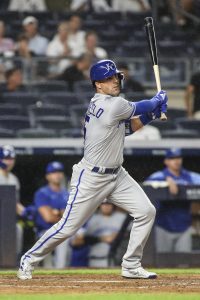
The 33-year-old is also a versatile defensive option capable of covering either of second base or in corner outfield. Public defensive metrics have been mixed on his performance at the keystone so far this season, but he’s typically a highly-regarded defender there. Santiago Espinal has had a nice season overall as the Jays primary second baseman, but he slumped offensively in July. Merrifield adds some cover there while also adding some extra right-handed depth to a bench that currently skews left-handed.
The Jays are a bit of a surprising destination for Merrifield, who was placed on the restricted list during a recent series while still with K.C. That indicates he wasn’t vaccinated against COVID-19 at the time — and was thus ineligible to cross the border — but Merrifield indicated he was open to receiving the vaccine to contribute to a playoff contender. General manager Ross Atkins declined to comment when asked about Merrifield’s vaccination status this evening (via Ben Nicholson-Smith of Sportsnet), but it’s difficult to imagine Toronto topping the trade market if they weren’t confident he’d be available for half their games.
Merrifield is under contract for another season and a half. He and the Royals agreed to a restructured deal just before Opening Day. He’s making $7MM this season, around $2.5MM of which is still to be paid out. He’ll receive a $6.75MM figure next season, and he’s due a $500K buyout on an $18MM mutual option for 2024. That’s a more than reasonable tab for the Jays if they believe Merrifield has put his rough April behind him.
Kansas City has resisted trade overtures on Merrifield for years, holding onto him throughout their recent rebuild. Amidst another down season and with his window of club control falling, however, president of baseball operations Dayton Moore and his staff finally made him available this summer. In exchange, they bring back a pair of young players with extended windows of club control who could contribute to the major league team shortly.
Castillo has already gotten to the big leagues, making his debut in mid-June. The 23-year-old righty has a 3.05 ERA through his first 20 2/3 frames, primarily working as a multi-inning option out of the bullpen. He’s punched out 24.7% of batters faced, induced grounders on more than half his batted balls, and only walked 6.2% of opponents. The Venezuela native has averaged around 93 MPH on his fastball and leaned heavily on his changeup during his limited big league time.
Baseball America recently named Castillo the #14 prospect in the Jays farm system, praising his feel for pitching and crediting him with average command. The outlet suggests his lack of a true plus offering is likely to relegate him to a back-of-the-rotation or swing role, but there’s still value in that kind of arm while he’s affordable. Castillo won’t reach arbitration-eligibility until 2025 at the earliest, and he still has all three minor league option years remaining. He gives the Jays an affordable rotation depth option for the coming seasons.
Taylor, 24, is an upper minors infielder. A former tenth-round pick, he’s played his way to Triple-A and had a decent season in Buffalo. Through 280 plate appearances, the righty-hitting second baseman owns a .258/.337/.426 line with nine home runs and 23 stolen bases. BA slotted Taylor 23rd in the Toronto farm system, writing that he could be a utility type in the big leagues. He’ll be eligible for the Rule 5 draft if he’s not added to the 40-man roster at the end of the season.
Mark Feinsand of MLB.com first reported the Royals were trading Merrifield, while Jon Heyman of the New York Post was first to report the Jays were the acquiring team. Feinsand was first with the return.
Image courtesy of USA Today Sports.
Padres, Royals Swap Brent Rooker, Cam Gallagher
The Padres have traded outfielder Brent Rooker to the Royals for catcher Cam Gallagher, according to Dennis Lin and Ken Rosenthal of The Athletic.
Rooker, 27, is an outfielder who has hit well at every level he’s played, with the notable exception of the big leagues. Drafted by the Twins in 2017, he made it to the bigs in 2020 and got into 65 games as a Twin before heading to the Padres in the deal Chris Paddack–Taylor Rogers trade.
After getting into two games as a Padre this year, he now has 67 MLB games on his ledger, with a tepid .205/.290/.400 line. That production is about 10% below league average, as evidenced by his wRC+ of 90. But he’s always done better at other levels, including this year. In 61 Triple-A games, he’s hit 19 home runs and slashed .272/.385/.605 for a wRC+ of 137.
Despite his lack of success at the big league level, the Royals are clearly willing to be on that minor league track record. Rooker still has options and will finish this season between one and two years of MLB service time, meaning the Royals have time to figure out how to maximize his talents. With Whit Merrifield and Andrew Benintendi having been traded in recent days, Rooker will help shore up some of the outfield depth that has been subtracted.
As for Gallagher, 29, he was a second round pick of the Royals back in 2011 and has been with them since. He made his MLB debut in 2017 and has largely served as backup to Salvador Perez in that time. However, with this year’s promotion of MJ Melendez, it seems he was nudged out of the plans for KC. In 171 career games, he has a slash line of .240/.302/.355, wRC+ of 77. Due to his strong defensive work, he’s produced 1.5 wins above replacement in that time, according to FanGraphs. For the Padres, he figures to serve as depth behind Jorge Alfaro and Austin Nola, with prospect Luis Campusano around as well.
Royals Discussing Several Veterans In Trade Talks
1:55pm: Starter Brad Keller is also garnering interest, per Feinsand. The 27-year-old righty has a 4.18 ERA on the year, with a tepid 16% strikeout rate but above-average 51.5% ground ball rate. He’s making $4.825MM this year and can be controlled via arbitration for another season.
10:41am: With just under seven hours until the deadline, the Royals could be an important factor. Mark Feinsand of MLB.com reports that the markets for outfielder Michael A. Taylor, as well as relievers Josh Staumont and Scott Barlow are “heating up.”
The fact that the Royals are discussing trading away pieces of their major league roster is not surprising, given their place in the standings. They are 41-62 on the year and well out of contention. The question now is how much selling they’re willing to do. They’ve already traded Andrew Benintendi to the Yankees, though he was a pure rental, heading into free agency at the end of the year. The three players mentioned by Feinsand all come with extra control and don’t strictly need to be traded, though there would be reasons to consider offers on all three.
In the case of Taylor, he was headed into free agency this time last year but signed a two-year extensions to stay in KC. That means the Royals could keep him around for the 2023 campaign, but he’s having the best season of his career at the plate. His .280/.352/.395 slash line amounts to a 114 wRC+, or 14% above league average. In each of the previous four seasons, he was between 71 and 77 in that department. He’s also dropped his strikeout rate and increased his walk rate relative to previous seasons, suggesting that his better production is a result of an improved approach at the plate as opposed to mere luck.
He’s also making a modest $4.5MM salary this year, though with some incentives that could increase that number. Still, with only about one third of the season remaining, any acquiring team would be adding less than $2MM to their ledger. That’s a small price to pay for a guy hitting at an above-average level. Of course, Taylor’s primary calling card is his defense and the center field market has been notoriously thin. Teams have been trying to acquire guys like Bryan Reynolds, Cedric Mullins and Ramon Laureano for quite some time, without success so far. Perhaps that will allow the Royals to get an offer good enough that they take and allow Kyle Isbel to take over in center field.
As for Barlow and Staumont, they both come with multiple years of control, with Barlow set to reach free agency after the 2024 season and Staumont one year later. However, relief pitching is always in high demand this time of year, with just about every contender looking to bolster their bullpen with an intriguing arm or two. The Royals can certainly opt for hanging onto them for future seasons, but relievers are also notoriously subject to fluctuations from season to season. If the offers are good enough, the Royals could give some thought to taking what’s in front of them before either pitcher suffers an injury or a dip in performance.
For now, though, both are having good seasons and would find plenty of interest from rival teams. Barlow is having his fourth straight solid season but has changed his results this year, getting fewer strikeouts and more ground balls. From 2019 through 2021, Barlow threw 174 2/3 innings with a 3.45 ERA, 30% strikeout rate, 10% walk rate and 40.8% ground ball rate. This year, he has a 2.36 ERA while getting strikeouts just 24% of the time but grounders at a 50.4% clip while also cutting his walk rate to 6.5%. All that’s come while pitching in high-leverage situations, as Barlow racked up 16 saves last year and 17 already this year. He’s making $2.4MM on the year and has two more passes through arbitration to go. Considering all of that, it’s unsurprising he’s in high demand around the league.
Staumont isn’t quite at Barlow’s level but is still interesting nonetheless. Since debuting in 2019, he’s thrown 141 1/3 MLB innings with a 3.18 ERA and 26.5% strikeout rate. His 12.5% walk rate and 33.6% grounder rate are both worse than league average, but he’s still plenty effective. He won’t reach arbitration until this winter, meaning he could fit into the budget of any team and would still have three years of control remaining.
All three of these players have reasons for other teams to be interested, the question will be how much the Royals are willing to part with them. The club has had aspirations for competing in recent years but hasn’t yet succeeded. Trading any of these three could hurt the roster in the immediate future but would also likely add prospects that could help a few years down the line.
D-Backs, Royals To Swap Luke Weaver For Emmanuel Rivera
The Royals and Diamondbacks are nearing agreement on a deal that’ll send right-hander Luke Weaver to Kansas City for infielder Emmanuel Rivera, reports John Gambadoro of 98.7FM radio in Phoenix (Twitter link).
Weaver was once a high-profile acquisition of the Diamondbacks, coming over as part of the package they received for sending superstar Paul Goldschmidt to the Cardinals. After the first 12 starts he made for Arizona, it seemed like they had a rotation stalwart on their hands. Weaver put up a 2.94 ERA in 2019 with a 40.7% ground ball rate, 26.5% strikeout rate and 5.4% walk rate. Unfortunately, a forearm strain ended his season early and he hasn’t been quite the same since.
Weaver was healthy for the shortened 2020 campaign, making 12 starts and throwing 52 innings but putting up an ERA of 6.58 in that time. He was better in 2021, getting his ERA down to 4.25, but was limited to just 13 starts by a shoulder injury. Coming into this season, the D-Backs moved him to the bullpen, which has led to results both encouraging and discouraging. His 7.71 ERA is certainly unappealing, though there are reasons to believe that isn’t a true reflection of his work. His 24.1% strikeout rate and 6.2% walk rate are both better than league average, and he’s also allowing just 7.7% of his fly balls to leave the yard. What seems to be hurting his ERA is an unsustainable .434 batting average on balls in play and a 55.9% strand rate.
Still, this is a sample of just 16 1/3 innings after multiple seasons of disappointing results. The Royals won’t have a ton of time to get Weaver back on track, as he is set to reach free agency after the 2023 campaign. He’s making a salary of $2.875MM this year and is eligible for another pass through arbitration next year.
In exchange for Weaver, the Diamondbacks are getting Rivera, 26, a corner infielder who hasn’t hit much in the majors but has shown plenty of promise in the minors. Since making his MLB debut last year, he’s gotten into 92 games and hit .243/.294/.378 for a wRC+ of 87. However, in 63 Triple-A games last year, he hit .286/.348/.592 for a wRC+ of 144. In 20 games there this year, his line is .307/.388/.520, 142 wRC+.
Rivera is primarily a third baseman and would likely slot behind Josh Rojas on Arizona’s depth chart, though Rojas is capable of moving to other spots on the field if they really want to give Rivera a shot. Rivera’s also played some first base and could perhaps see some time there if the D-Backs pull the trigger on a Christian Walker trade, as they have reportedly considered. However he’s deployed, Rivera comes with an extended window of control, having come into this season with less than a year of MLB service time. He also can be optioned for the remainder of this year as well as another season, potentially delaying his free agency and arbitration.
For the Royals, they likely felt Rivera was squeezed out due to their crowded corner infield mix, with Nicky Lopez getting a lot of playing time at third, while Vinnie Pasquantino, Nick Pratto and Hunter Dozier are also around for first base or corner outfield duty. The designated hitter slot is also a little busy between that group and the catching duo of Salvador Perez and MJ Melendez. They’ve used that surplus of corner infield bats to add an intriguing arm, while the Diamondbacks have taken a pitcher they couldn’t get good results out of and turned him into a controllable infield depth option.
Royals Acquire Anthony Misiewicz
The Mariners announced that they have traded left-hander Anthony Misiewicz to the Royals for cash considerations. The lefty had been designated for assignment yesterday.
Misiewicz, 27, seemed to have a nice breakout during the 2020 season, throwing 20 innings out of Seattle’s bullpen during that shortened campaign with a 4.05 ERA, with a 28% ground ball rate, solid 7.2% walk rate and excellent 30.1% strikeout rate. Unfortunately, he couldn’t quite carry that over into the following seasons, as his ERA shot up to 4.61 in both 2021 and here in 2022. His strikeout rate fell to 22.5% last year and dropped even further to 14% here in 2022. He got optioned to Triple-A in June and has fared better in a small sample of 12 1/3 innings, logging a 3.65 ERA, 23.6% strikeout rate, 10.9% walk rate and 51.5% ground ball rate.
For the Royals, they will add a controllable reliever to their lefty bullpen depth chart. Misiewicz came into the season with exactly two years of MLB service time and won’t be able to cross the three-year mark this year due to his having already spent about six weeks in the minors. They can keep him in the minors and see if he can get into a good groove. Amir Garrett is currently the only southpaw in the big league club’s bullpen, meaning there’s a path for Misiewicz to earn his way back onto the roster.