
Latest On Marlins’ Draft Signing Efforts
After a few recent deals hit the books, the Marlins were left with the two top remaining unsigned players from June’s Rule 4 amateur draft. Fourth overall choice J.J. Bleday and #35 draftee Kameron Misner have yet to agree to terms, though it seems there’s general optimism — for the former, in particular — that they’ll end up signing on.
The deadline for reaching agreement is July 12th at 5pm eastern. It’s not at all infrequent to see a few nail-biters, though this signing season has been notably free of drama. After Bleday and Misner, the loftiest selection that isn’t yet in the books is 67th overall pick Josh Smith (Yankees).
President of baseball operations Michael Hill did not express any concern with the two key draft pieces, both of whom were star collegiate outfielders. “We’re encouraged with both, and hope to get it taken care of and get them out as soon as possible,” he tells MLB.com’s Joe Frisaro.
In the case of Bleday, who just wrapped up a championship run with Vanderbilt, it seems it may only be a matter of time before he’s under contract. Frisaro tweets that a deal is “getting closer to being finalized” while MLB Network’s Jon Heyman says in his own tweet that the sides are “moving toward a deal.” Both indicate that the bonus is likely to be right near the slot value of $6,664,000.
As for Misner, a competitive balance round A selection who hails from the University of Missouri, there seems at least to be a bit more uncertainty. Heyman says that the Marlins are “believed” to have made an at-slot offer of $2,095,800. Misner and his reps may be running the clock in hopes of commanding more, but it’s not clear whether that’s even a realistic possibility. There’s no indication at present that he’d consider returning to school; as Frisaro rightly notes, that’s a risky option for a college junior.
By my count, the Marlins have spent to the limits of their existing bonus pool. They saved on several players but went over slot for second-rounder Nasim Nunez and fifth-rounder Evan Fitterer. Teams can exceed the allocated values by 5% without sacrificing any future draft picks; tallying the MLB.com tracker bonuses and adding that padding to the already signed players puts the Fish at about $7K shy of the line. In other words: there’s no room to pay one of their two remaining unsigned players more than their slot value unless the other takes less.
Yangervis Solarte Will Reportedly Sign With Japanese Team
Veteran infielder/outfielder Yangervis Solarte is less than a month into his Marlins tenure, but it appears it’s already over. Solarte is set to sign with a Japanese team, Joe Frisaro of MLB.com reports. The minor league deal Solarte inked with the Marlins on June 7 gives him the right to pursue opportunities in Asia, per Frisaro.
Solarte caught on with Miami a couple weeks after San Francisco released him. The switch-hitting Solarte wound up slashing .314/.345/.451 (93 wRC+) with one home run in 55 plate appearances as a member of the Marlins’ Triple-A team in New Orleans.
Now 31 years old, Solarte has appeared in the majors with four different clubs – the Yankees, Padres and Blue Jays prior to the Giants – since debuting in 2014. While Solarte was a useful offensive contributor earlier in his career, his numbers have cratered over the past couple seasons. He struggled enough with the Jays in 2018 for them to non-tender him, and even though Solarte parlayed a minors pact with the Giants into a season-opening roster spot this year, his production worsened.
Dating back to 2018, Solarte has batted a dreary .224/.273/.370 (72 wRC+) with 18 home runs and minus-1.6 fWAR in 584 major league attempts. It now appears if Solarte’s ever going to resurface in the bigs, he’ll first have to revive his career in Japan.
Starlin Castro’s Nightmare Season
The Marlins acquired second baseman Starlin Castro from the Yankees entering 2018 as a way to balance out money in a blockbuster trade. Miami received Castro in its return for then-reigning NL MVP outfielder Giancarlo Stanton, whose onerous contract largely exited the Marlins’ books. When he arrived in South Florida, Castro’s pact included a remaining two years and approximately $22MM in guarantees, far from an unreasonable total considering his track record at that point. Still, the rebuilding Marlins couldn’t find a taker throughout 2018 for Castro, who posted yet another average season in a career full of them.
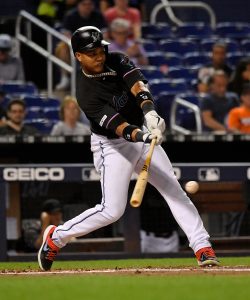
Even though he came into this year as a four-time All-Star and a 1,445-hit man, Castro hasn’t been a spectacular major leaguer. Also a former Cub, the 29-year-old slashed .281/.321/.411 (97 wRC+) from 2010-18 and was coming off four straight seasons with 2.3 fWAR or fewer.
Three months into 2019, the Marlins would surely love another year of Castro’s typically decent production. They’ve gotten anything but that so far. Castro’s stuck in the worst season of his career with minus-1.2 fWAR – good for last among qualified major league hitters – through 345 plate appearances. With a .230/.258/.313 line, Castro’s 51 wRC+ is also the lowest in the game. It basically suggests the 2019 version of Castro has been half the hitter he was in the prior nine seasons.
While Castro continued to look like a potential trade candidate at the outset of the season, that’s probably out the window now. Furthermore, there’s no chance he’ll stay off the free-agent market in the offseason. Castro’s employer will have a chance to pick up a $16MM club option over the winter, but the team’s sure to buy him out for $1MM instead, officially concluding the seven-year, $60MM extension he signed as a potential Cubs cornerstone in August 2012.
A look beyond Castro’s woeful bottom-line production this year shows this isn’t just a case of poor luck. A solid batting average has long driven Castro’s offensive numbers, but his regular BA and expected average (.243) are horrific. Similarly, Castro ranks near the bottom of the sport in expected weighted on-base average (8th percentile), expected slugging percentage (15th percentile), average exit velocity (46th percentile) and hard-hit percentage (46th percentile), per Statcast.
Never one to draw many walks or amass a lot of strikeouts, Castro’s numbers in those categories look fairly normal. He has collected walks at a 4 percent clip, down 1.1 percent from his lifetime mark, and struck out 17.3 percent of the time – not far from a 16.8 career mean. On the other hand, Castro’s .319 batting average on balls in play is down to a meager .262 this year, in part because of the less impactful contact he has made. Power has never really been a hallmark for Castro, though his .083 ISO is easily his lowest in several years and ranks third from last in baseball.
For the most part, the right-handed Castro has performed respectably against same-handed and lefty pitchers alike, which is a key reason why he has been a regular for so long. However, righties are now stymieing Castro, who has put forth a horrendous 35 wRC+ against them this year. Back in 2017, when Castro logged an overall 109 wRC+ to end his Yankees stint, he showed at least some power against righties over the middle and inner half of the plate. That power has now completely evaporated, however.
Even though Castro has never possessed much pop, what he used to have help make him a credible major league hitter. Now, as Castro’s power has disappeared, so has his usefulness as a player. Perhaps it’ll come back at some point, but the way Castro’s trending, he’s heading toward a cold winter in free agency.
Photo courtesy of USA Today Sports Images.
Notable International Signings: 7/2/19
The 2019-20 July 2nd international signing period is officially underway, though it’s not exactly laden with suspense. Teams have long since lined up deals with newly eligible teenage players, so the news today largely represents confirmation of what was anticipated. Still, it’s a day of no small moment, particularly for the young men embarking upon professional careers.
Let’s round up some of the most notable signings of the day. Throughout, we’ll be citing to the reporting of Baseball America (signings tracker; scouting links) and MLB.com’s Jesse Sanchez (Twitter feed; rankings) along with analysis from Fangraphs. You can find each team’s total bonus pool and other information on the process right here. Check the above links for further information and other signings. Here are a few key deals:
- Jasson Dominguez, OF, Yankees: Everyone’s top target is reportedly holding strong on his commitment to go to the Bronx. The deal is said to be for $5.1MM, per Jeff Passan of ESPN.com, with an announcement expected this evening. Dominguez is a switch-hitter who’s said to possess five-tool ability. The Fangraphs team is sufficiently impressed to run him all the way up to the #61 overall MLB prospect ranking right out of the gates (via Kiley McDaniel, on Twitter). The Yanks also have struck a $1.2MM deal with outfielder Jhon Diaz, Sanchez tweets. He was the 18th-rated player on the MLB.com board but ran all the way up to #7 at Fangraphs.
- Robert Puason, SS, Athletics: Another player who’ll command about $5MM, Puason is a toolsy shortstop with big upside. He was said to have a deal in place with the Braves before that team was slapped with international sanctions. It’s worth noting that the Atlanta organization wasn’t actually punished for agreeing to terms early (though that widespread practice is officially forbidden) but rather for structuring a group deal with Puason’s trainer, as Baseball America’s J.J. Cooper explains on Twitter.
- Luis Rodriguez, OF, Dodgers: The value on this one is unknown, but BA’s Ben Badler has photographic evidence of the signing (Twitter link). Rodriguez gets top-three billing from Fangraphs. The Los Angeles club is also in agreement with righty Kristian Cardozo, who’s also considered one of the thirty best players available.
- Bayron Lora, OF, Rangers: Baseball America has made this connection for some time; Sanchez tweets that it’s a $4.2MM deal for the slugging prospect. Shortstops Maximo Acosta and Zion Banister are also members of the Texas signing class. Evan Grant of the Dallas Morning News (via Twitter) has the former at $1.6MM and the latter at $835K. As he notes, the Texas organization will need to acquire some added pool capacity to make the math work.
- Erick Pena, OF, Royals: This is another signing called in advance by the BA crew. Sanchez has the bonus at $3.8MM (Twitter link). FG labels Pena “a well-rounded outfielder with considerable physical projection.”
- Ronnier Quintero, C, Cubs: Occupying the #6 spot on the boards of both Fangraphs and MLB.com, Quintero will follow Willson Contreras from Venezuela to the Chicago organization. The Cubbies also have a deal with fellow top-ten-ish prospect Kevin Made, a shortstop. Sanchez puts the Quintero deal at $3MM and Made’s mark at $1.7MM. Another Venezuelan backstop, Brayan Altuve, will cost the Cubs another million bucks, seemingly setting up the organization for a search for some added pool money.
- Roberto Campos, OF, Tigers: The Detroit organization popped for a hefty $3MM to secure the services of the Cuban outfielder, per Badler (via Twitter). Campos defected in somewhat dramatic fashion several years ago at just 13 years of age. He wasn’t listed among the best prospects, but Chris McCosky of the Detroit News indicates on Twitter that the Tigers like his bat quite a bit.
Several other well-regarded prospects also secured bonuses of $2MM or more, per Sanchez and/or Badler:
A Trade That Is Working Out For The Marlins
The Marlins have been roundly criticized for trades in recent years, deals that have come thanks in part to a desire to cut payroll. Outfielders Christian Yelich, Giancarlo Stanton and Marcell Ozuna, second baseman Dee Gordon and catcher J.T. Realmuto are all prominent players the rebuilding Marlins, stuck in a soon-to-be 16-year playoff drought, have traded away since the end of the 2017 season.
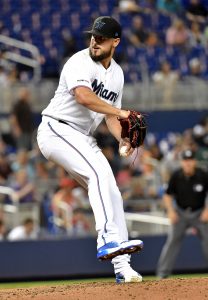
While the Marlins’ decisions since co-owner Derek Jeter took the reins in 2017 haven’t come without protests, at least one of the trades they’ve made under him is paying significant dividends at the MLB level.
In November ’17, a few months after the former Yankees shortstop took the Marlins’ reins, his new team seemingly took advantage of his previous franchise. Miami acquired left-hander Caleb Smith and first baseman/outfielder Garrett Cooper from New York for right-handed pitching prospect Mike King and $250K in international bonus pool money. The Yankees did so in part in an effort to pad their offer to then-free agent Shohei Ohtani, but he ultimately signed with the Angels.
Now, with the World Series-contending Yankees on the hunt for another credible starter, the current version of Smith would fit into their rotation. But Smith, now 27, didn’t get much of a chance with the Bombers. A 14th-round pick of the Yankees in 2013, Smith reached the majors for the first time in 2017 – the season before the trade – and struggled over 18 2/3 innings. Since then, though, Smith has performed like a legitimate major league rotation piece for the Marlins. Dating back to 2018, he has pitched to a 3.83 ERA/4.09 FIP with 10.67 K/9 against 3.33 BB/9, albeit with an awful 28.7 percent groundball rate, in 143 1/3 innings. Among starters who have thrown at least 140 frames since last year, Smith ranks 15th in strikeout rate.
Although Smith has been on the injured list since June 7 with a hip problem, teams still figure to approach the Marlins with interest in him going into the July 31 trade deadline. However, the Marlins don’t seem willing to trade Smith, who won’t be eligible for arbitration until after 2020 or free agency until the conclusion of the 2023 campaign.
The Marlins may have stumbled on a long-term piece in Smith. The same holds true for Cooper, who comes with the same amount of control as Smith. Cooper, a sixth-rounder of the Brewers in 2013, went to the Yankees in July 2017 in a deal for now-Cardinals reliever Tyler Webb. Cooper didn’t look like much more than the potential right-handed side of a first base platoon at the time, and injuries limited him to fewer than 100 plate appearances between the majors and minors last season. This year, though, Cooper’s taking advantage of his chance on a woeful Miami team.
Although the Marlins rank second to last in the majors in runs, their problems haven’t been Cooper’s fault. The 28-year-old has easily been their best hitter, in fact. He’s off to a .317/.383/.488 start (134 wRC+) with seven home runs across 183 plate appearances in his first extensive major league experience. Whether Cooper can keep it up is the question.
The bad: Cooper’s .388 batting average on balls in play is nowhere near sustainable, nor will 35 percent of his fly balls keep leaving the yard. Likewise, it’s concerning that Cooper’s hitting ground balls upward of 55 percent of the time, especially considering he’s hardly a speed demon. His 16.3 percent fly ball rate ranks last among hitters who have totaled 180-plus PA this year. That isn’t necessarily a death knell to his production, granted, as the great Ohtani ranks just two spots better. Cooper’s also having immense difficulty against left-handed pitchers, oddly enough. While he has smacked righties to the tune of a .400 wOBA, southpaws have held him to a .298 mark.
In more encouraging news, Cooper’s strikeout, walk and contact rates are all hovering around average. Better still, Statcast indicates Cooper’s expected slugging percentage (73rd percentile), hard-hit percentage (75th percentile), expected weighted on-base average (83rd percentile) and expected batting average (95th percentile) are all good to exemplary. His .371 xwOBA is essentially right in line with a .376 wOBA that ties him with Max Kepler and Yoan Moncada. All of that suggests Cooper will keep making an impact so long as he continues making contact.
At 32-50, this hasn’t been a victory-laden season for the Marlins, but you take the wins where you can. And it looks as if the team prevailed on its end of this trade with the Yankees, a club so loaded that they can get away with letting go of useful contributors without getting a lot back. The Marlins aren’t as fortunate, but it seems they landed a pair of quality pieces in Smith and Cooper.
Photo courtesy of USA Today Sports Images.
Marlins Open To Trading Starters
The rebuilding Marlins reportedly aren’t inclined to trade any of their controllable starting pitchers, but that isn’t necessarily the case, according to president of baseball operations Michael Hill (via Joe Frisaro of MLB.com).
The Marlins plan to “explore” ways to improve, said Hill, who added: “I think you look at ways to get better. I think you look at where we are organizationally, and we’ve said our pitching is a little bit ahead of our position players.”
Specifically, the Marlins would like to add a middle-of-the-order bat to their lineup, Frisaro reports. Whether they’d be able to get that type of offensive piece for any of their starters is the question.
Although Miami’s a National League-worst 30-47 this season, its starting staff has been a legitimate bright spot. The Marlins’ rotation ranks a surprising sixth in the majors in ERA and a similarly encouraging eighth in FIP, and all of their prominent starters are controllable 20-somethings.
The Marlins haven’t gotten ace-caliber production from anyone, but each of Trevor Richards, Sandy Alcantara, Pablo Lopez, Jose Urena and Caleb Smith have logged respectable or better numbers over at least 12 starts apiece. Meanwhile, Jordan Yamamoto has been brilliant through three starts, Elieser Hernandez has done well during his first three starts this year, and the just-promoted Zac Gallen shut down the Cardinals in his five-inning introduction June 20.
One problem for the Marlins is that there are currently injuries spread throughout their starting group. The strikeout-heavy Smith has been out since June 7 with left hip inflammation, Lopez went down June 19 with shoulder inflammation, and Urena will be out until at least August with a herniated disc in his back. Smith and Lopez are reportedly progressing toward returns, however. Therefore, aside from Urena, any of the Marlins’ starters might end up in play around the July 31 deadline.
If you’re another team, acquiring one of Miami’s starters could mean adding a long-term solution to your staff. Richards, Alcantara and Lopez are all controllable through 2024, while Lopez and Hernandez are under wraps through 2023. Yamamoto and Gallen obviously come with even more control, having just emerged in the majors. So, whether it happens this summer or a bit down the line, it wouldn’t be a surprise to see the Marlins deal from their surplus of starters to improve a toothless offense that ranks among the majors’ worst. Aside from first baseman Garrett Cooper, third baseman Brian Anderson, outfielder Harold Ramirez and veteran stopgap infielder Neil Walker, they’ve struggled to get any production at the plate in 2019.
Minor MLB Transactions: 6/25/19
Keeping track of Tuesday’s minor moves from around baseball…
- The Padres announced that right-handed reliever Kazuhisa Makita has cleared waivers and been outrighted to Double-A Amarillo. This is the second time the Padres have outrighted Makita, which gives him the right to elect free agency, but that would mean leaving what’s left of his $1.9MM salary on the table. The Padres inked the Japanese submariner to a two-year, $3.8MM contract entering 2018, but it hasn’t worked out for either side thus far. The 34-year-old Makita struggled in the majors last season and hasn’t pitched in the bigs at all in 2019. Makita has instead worked at the Double-A level, where he has put up a 3.82 ERA with 8.6 K/9 and 1.7 BB/9 in 37 2/3 innings.
- The Marlins have released righty Ben Meyer, Wells Dusenbery of the Sun Sentinel tweets. To this point, Meyer has spent his whole career with the Marlins since they chose him in the 29th round of the 2015 draft. The 25-year-old’s nightmarish production in the majors in 2018 and with Triple-A New Orleans this season sealed his fate with the organization. In his MLB debut last year, Meyer registered a 10.42 ERA/6.42 FIP with 4.26 K/9 and 6.63 BB/9 over 19 innings. Meyer then notched a 7.43 ERA/6.90 FIP with 9.0 K/9 against 5.57 BB/9 in 63 Triple-A frames this season before Miami said goodbye to him.
- The Rangers’ top affiliate in Nashville has released infielder Nolan Fontana, per the Pacific Coast League transactions page. Texas was the third AL West organization for the 28-year-old Fontana, a 2012 second-round pick of the Astros who also played for the Angels. Fontana racked up his only 35 major league PA with the Angels from 2017-18. He has hit .230/.350/.357 in 1,639 PA at the Triple-A level.
Marlins Activate Neil Walker
The Marlins announced infielder Neil Walker‘s reinstatement from the injured list Tuesday. Walker missed over three weeks with a right quad strain. The club optioned right-hander Jeff Brigham to Triple-A New Orleans to make room for Walker.
The fact that Walker’s healthy as the July 31 deadline draws nearer is an encouraging development for rebuilding Miami, which isn’t chock-full of potential trade pieces. But the versatile, switch-hitting Walker stands out as a Marlin who could find himself on the move over the next month-plus.
Since joining the Marlins on a $2MM contract last winter, Walker has slashed .295/.375/.443 (122 wRC+) in 168 plate appearances. As a defender, the 33-year-old has seen substantial action at first and second base this season, and has also worked at third and in the corner outfield during his career.
Aside from 2018, when Walker signed with the Yankees in mid-March after not finding a deal to his liking in the offseason, he has consistently performed well in the majors. Also a former Pirate and Met, Walker has hit a lifetime .269/.340/.430 (112 wRC+) with 145 home runs in 4,898 trips to the plate. Walker’s affordable salary, solid career production and 2019 numbers figure to make for an appealing combination leading up to the deadline.
Marlins Return Riley Ferrell To Astros
11:02am: MLB.com’s Brian McTaggart tweets that the Astros have assigned Ferrell to Double-A Corpus Christi.
10:37am: Right-hander Riley Ferrell has cleared outright waivers and been returned to the Astros, tweets Chandler Rome of the Houston Chronicle. Ferrell, whom the Marlins selected out of the Houston organization in last December’s Rule 5 Draft, was placed on waivers by Miami late last week. He is not required to be placed on the 40-man roster now that he’s back with his original organization.
Ferrell, 25, pitched reasonably well for the Marlins in Spring Training, yielding a pair of runs on five hits and five walks with 10 strikeouts in 6 2/3 innings. While the walks were obviously unwelcome, Ferrell did look to have a chance to crack the big league roster. Instead, a case of biceps tendinitis landed him on the injured list and has prevented him from pitching in the Majors at all in 2019.
Ferrell did start a rehab assignment in mid May but had that assignment halted after just four appearances. He rebooted his rehab efforts on June 12 and tossed 4 2/3 shutout innings (no hits, one walk, two strikeouts) before the Marlins cut bait. Ferrell averaged nearly 12 punchouts per nine innings in a combined 51 1/3 frames with the Astros’ Double-A and Triple-A affiliates in 2018 but also logged an ugly 5.9 BB/9 mark in the process. Through a total of 10 1/3 rehab innings in 2019, he issued six walks and hit a batter.
Marlins Have “No Intention” Of Trading Caleb Smith
Although the Marlins have the worst record in the National League and the fifth-fewest wins in all of baseball, the organization has “no intention” of trading left-hander Caleb Smith to further its rebuilding effort, tweets Joe Frisaro of MLB.com. More broadly, he notes that Miami isn’t looking to deal from its core of controllable starters.
It still seems quite likely that teams will at least ask about Smith, 27, in the weeks leading up to the July 31 trade deadline. He’s currently on the 10-day IL due to some inflammation in his hip, but there’s no indication to this point that the injury is especially serious. Smith is controllable for four years beyond the 2019 campaign, which would hold enormous value to another club, particularly given how well he’s thrown when healthy.
Through 66 innings this year, Smith has turned in a 3.41 ERA with 11.2 K/9 against 2.7 BB/9. He’s an extreme fly-ball pitcher who has been homer-prone even with a cavernous home park, but his 15.1 percent swinging-strike rate ranks fifth among pitchers with at least 60 innings thrown, trailing the quartet of Blake Snell, Max Scherzer, Justin Verlander and Gerrit Cole. Smith’s 35,4 percent opponents’ chase rate is tied for 12th-best in that same set of 114 pitchers, and the spin rate on his heater falls in the 80th percentile among MLB pitchers.
Of course, all of those reasons are also cause for Miami to hang onto Smith. The Marlins aren’t going anywhere in 2019 and aren’t likely to contend in 2020, either, but they can keep Smith on the roster via arbitration all the way through the 2023 campaign. And for as solid as Smith has been on a per-inning basis, he’s yet to throw more than 77 1/3 innings in a big league season. He reached that level in 2018 before a Grade 3 lat strain ended his season, and his innings in 2019 are expected to be limited as a result. Other clubs may even be more interested in Smith if he proves durable enough to handle a full season of starts (or close to it), and Miami will have ample opportunity to market him down the road if the concept of moving him becomes more palatable.
As for the rest of the Marlins’ rotation, the bulk of their arms are even longer-term pieces. Sandy Alcantara, Pablo Lopez and Trevor Richards are all controllable for five years beyond the current season, while fresh faces like Jordan Yamamoto and Zac Gallen can be controlled through at least 2025. Righty Jose Urena could very well have been attainable, but he’s now on the 60-day injured list due to a herniated disk in his back.
Frankly, the Marlins don’t seem to have many trade assets at all if the plan is indeed to hang onto their intriguing mix of young arms. Veteran Neil Walker has had a productive year and could be flipped for a modest return if he continues to perform once he’s recovered from the quad strain that currently has him on the IL. Fellow free-agent pickups Curtis Granderson and Sergio Romo haven’t been effective (particularly in the case of Granderson), and veteran Starlin Castro is having the worst offensive season of his career. It could be a quiet deadline for the Marlins unless they surprise by changing course with regard to their controllable starters and/or opt to pursue some bats with a good bit of team control remaining.