
The Marlins acquired second baseman Starlin Castro from the Yankees entering 2018 as a way to balance out money in a blockbuster trade. Miami received Castro in its return for then-reigning NL MVP outfielder Giancarlo Stanton, whose onerous contract largely exited the Marlins’ books. When he arrived in South Florida, Castro’s pact included a remaining two years and approximately $22MM in guarantees, far from an unreasonable total considering his track record at that point. Still, the rebuilding Marlins couldn’t find a taker throughout 2018 for Castro, who posted yet another average season in a career full of them.
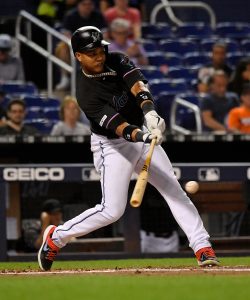
Even though he came into this year as a four-time All-Star and a 1,445-hit man, Castro hasn’t been a spectacular major leaguer. Also a former Cub, the 29-year-old slashed .281/.321/.411 (97 wRC+) from 2010-18 and was coming off four straight seasons with 2.3 fWAR or fewer.
Three months into 2019, the Marlins would surely love another year of Castro’s typically decent production. They’ve gotten anything but that so far. Castro’s stuck in the worst season of his career with minus-1.2 fWAR – good for last among qualified major league hitters – through 345 plate appearances. With a .230/.258/.313 line, Castro’s 51 wRC+ is also the lowest in the game. It basically suggests the 2019 version of Castro has been half the hitter he was in the prior nine seasons.
While Castro continued to look like a potential trade candidate at the outset of the season, that’s probably out the window now. Furthermore, there’s no chance he’ll stay off the free-agent market in the offseason. Castro’s employer will have a chance to pick up a $16MM club option over the winter, but the team’s sure to buy him out for $1MM instead, officially concluding the seven-year, $60MM extension he signed as a potential Cubs cornerstone in August 2012.
A look beyond Castro’s woeful bottom-line production this year shows this isn’t just a case of poor luck. A solid batting average has long driven Castro’s offensive numbers, but his regular BA and expected average (.243) are horrific. Similarly, Castro ranks near the bottom of the sport in expected weighted on-base average (8th percentile), expected slugging percentage (15th percentile), average exit velocity (46th percentile) and hard-hit percentage (46th percentile), per Statcast.
Never one to draw many walks or amass a lot of strikeouts, Castro’s numbers in those categories look fairly normal. He has collected walks at a 4 percent clip, down 1.1 percent from his lifetime mark, and struck out 17.3 percent of the time – not far from a 16.8 career mean. On the other hand, Castro’s .319 batting average on balls in play is down to a meager .262 this year, in part because of the less impactful contact he has made. Power has never really been a hallmark for Castro, though his .083 ISO is easily his lowest in several years and ranks third from last in baseball.
For the most part, the right-handed Castro has performed respectably against same-handed and lefty pitchers alike, which is a key reason why he has been a regular for so long. However, righties are now stymieing Castro, who has put forth a horrendous 35 wRC+ against them this year. Back in 2017, when Castro logged an overall 109 wRC+ to end his Yankees stint, he showed at least some power against righties over the middle and inner half of the plate. That power has now completely evaporated, however.
Even though Castro has never possessed much pop, what he used to have help make him a credible major league hitter. Now, as Castro’s power has disappeared, so has his usefulness as a player. Perhaps it’ll come back at some point, but the way Castro’s trending, he’s heading toward a cold winter in free agency.
Photo courtesy of USA Today Sports Images.
Dang and he did well last year but not enough to get out of Miami
They should DFA him and Grandy ASAP and call up Diaz, Monte and Brinson. Just let the young lineup mold there’s obviously gonna be some struggles but they got a window now with their depth of young, controllable arms
Hopefully he gets in a hot streak so that we can trade him. Highly doubtful
Díaz is def ready. Brinson should be called up soon. Def sometime this year. He’s been solid in AAA. Monte most likely in September.
Unless he goes about 35 for his next 45 and flashes a little power, it’s not happening.
The Mets will be interested in picking him up.
As a Marlins fan, I’d much rather give a young player a chance to start. Let Castro pinch hit against lefties and then move on from him. For a franchise that has basically hit the reset button on their roster, it seems silly to keep starting him.
It’s a shame for both the Marlins and Castro as there are multiple contenders in need of an upgrade at 2B for the stretch drive. Best hope for Castro is for MIA to dfa him, eat the rest of his 2019 salary less prorated minimum once he’s claimed, and leave it to the claiming team to buy out 2020.
Career BABIP: .319
2019 BABIP: .262
Pretty clear what’s happening here…
Remember when the Cubs wanted Syndergaard for Castro? haha.
I remember the Cubs turning down Syndergaard for Castro. They wanted Wheeler.
Remember when the Marlins had their choice between Syndegaard, Aaron Sabchez and Justin Nicolino in the Toronto trade?
Nightmare season? Chris Davis would kill for a .230
.230 is terrible. .230 with power is the only way you are a big league hitter when hitting .230. And Castro has 0 power.
Schwarber usually hits about .230 and Cub fans consider him a star
Guess again dude. We do not consider Kyle “Adam Dunn minus 15 homers” a star
Schwarber walks a lot and hits a ton of homers, justifies the low average and makes him a star
Good to see you are evaluating a player who works a count, and drives the ball well, with BA. Schwarber should be DHing in the AL, but he has value as a hitter.
At least chris Davis was never reliant on average. And if he does connect, he has a chance to hit it out… In reality, neither are big league hitters
Andrew Burns could and probably would do a better job if given a chance.
I’m shocked he wasn’t traded after he was traded for Stanton. Being traded for spare parts then traded again for Giancarlo Stanton. Both were lopsided trades. Cubs came out the biggest winner with a world series championship. He was basically traded for Ben Zobrist. At this point the Cubs really need Zo back. DFA descalso and bring back Zo.
Its complete bs that they “used” his salary for Craig Kimbrel. If they wanted to they could have had Kimbrel and 3 other high level relievers. They have plenty of money to spend.
Everyone knows it was complete nonsense when Tom Ricketts said they were broke or had limited money. A team that has 250 mil dollar payroll is not broke.
12 KB
10 Rizzo
7 Baez
22 Lester and Heyward
21 Yu
Those are their high priced guys. All others are 2 million or under
I love how you turn an article about Starlin Castro’s 2019 season into a inner look into the Cubs Finances
Castro never wanted to be a Marlin in the first place. After playing for good teams in front of packed houses for almost ten years, the empty seats and the losing has taken its toll.
JMHO, but if he ends up on a contender this year, I bet you’ll see a different player. Can’t be any fun for a veteran guy on this team. You’re going to lose most nights and you know you aren’t part of this team’s future plans. Fish will have to eat all or most of what he’s owed to move him, but some team(s) will see him as an upgrade over what they already have starting and/or on the bench. I could see him in Texas or Tampa.
My thoughts exactly. He doesn’t want to be in Miami – never did – and it shows. He’s not doing himself any favors by failing to overcome that problem.
I always imagined Castro would be a good fill in Boston when Pedroia went down