
Travis Shaw Announces Retirement
Former MLB infielder Travis Shaw took to Twitter on Monday to announce his retirement from playing. The left-handed hitter appeared at the game’s highest level in each of the last eight seasons.
“For the last eight years, I’ve been blessed to live out my childhood dreams of playing Major League Baseball,” Shaw wrote. “But today, that dream comes to an end! 12 years ago, being a 9th-round pick, I would never have imagined what this game provided me. The memories will last a lifetime. To everyone that made an impact on my career (the list is endlessly long), I will forever be indebted to you! As this chapter closes, the only two words that come to mind is THANK YOU!”
As Shaw mentioned, he entered the professional ranks as a ninth-round pick in 2011. Selected by the Red Sox out of Kent State, he signed for $110K. Within a couple seasons, he began to appear at the back half of Baseball America’s top 30 prospects in the Boston system. He hit well in the minors and debuted at age 25 in May 2015. He hit the ground running over 65 games as a rookie, putting together a .270/.327/.487 line with 13 home runs.
That earned Shaw an extended look on Boston’s 2016 squad. Pablo Sandoval missed most of that season with shoulder surgery, freeing up the hot corner for Shaw. He didn’t quite maintain his rookie form, posting a .242/.306/.421 line through 530 plate appearances. The following winter, the Sox dealt Shaw to Milwaukee for reliever Tyler Thornburg.
The move panned out for the Brew Crew, who immediately installed Shaw as their primary third baseman. He took well to Milwaukee’s favorable hitting environment, topping 30 home runs in each of his first two seasons. He combined for 63 longballs between 2017-18, putting together a cumulative .258/.347/.498 line with a very strong 11.6% walk percentage. Shaw played in just over half the team’s games in 2019 but saw his production fall to a .157/.281/.270 mark.
From that point forward, Shaw settled in as a depth corner infielder and bench bat. He played the shortened 2020 season with the Blue Jays before returning to Milwaukee for the start of 2021. After struggling in his second stint with the Brewers, he landed back in Boston via release waivers. Shaw found a brief glimpse of peak form in 28 games for the Sox late in the ’21 campaign. He re-signed on a minor league deal during the lockout and made the Opening Day roster. Shaw played in seven games early last season but didn’t reach base in 19 plate appearances. After going unclaimed on waivers, he hit free agency last May and doesn’t plan to seek out other opportunities.
Shaw played in 733 major league games. He tallied just under 2700 plate appearances and hit .237/.319/.437 with 114 homers, 127 doubles, 366 runs batted in and 310 runs scored. Shaw had the aforementioned two 30-homer campaigns and twice eclipsed 30 doubles. His career offensive production checked in right around league average, as measured by wRC+. Both FanGraphs and Baseball Reference valued Shaw’s career around eight wins above replacement, with much of that value concentrated in his strong first two seasons in Milwaukee. MLBTR congratulates Shaw on a fine playing career and wishes him the best in retirement.
Brewers, Brandon Woodruff Avoid Arbitration
The Brewers are in agreement with star hurler Brandon Woodruff on a $10.8MM deal to avoid arbitration, reports Jeff Passan of ESPN (Twitter link). They’ll avoid a hearing in the third of four trips through the process for Woodruff, who first qualified as a Super Two player during the 2020-21 offseason.
A former 11th-round pick, Woodruff has broken out as one of the game’s best starters. He’s a two-time All-Star who hasn’t posted an ERA above 3.05 in any of the past three seasons. Woodruff struck out 30.6% of opponents over 27 starts last season, with a three-week absence due to a high ankle sprain the only black mark on his year.
MLBTR contributor Matt Swartz projected Woodruff for an $11MM salary. His deal comes up in a tick below that but not meaningfully so, and he’s set up well for another raise in 2024. He’ll reach free agency for the first time at the end of the ’24 campaign, when he’d be headed into his age-32 season.
There’s been a fair bit of speculation about the possibility of Milwaukee making Woodruff or ace Corbin Burnes available in trade talks at some point. The Brewers typically run player payrolls a bit lower than average and have shown a general willingness to listen to trade offers on star players in their arbitration seasons. That doesn’t seem to be a consideration this offseason, as Milwaukee has reportedly taken Burnes, Woodruff and Willy Adames off the table in talks this winter.
Brewers Avoid Arbitration With Hoby Milner, Victor Caratini
The Brewers have avoided arbitration with a pair of players before tomorrow’s deadline for sides to exchange salary figures. Reliever Hoby Milner and the club have settled at $1.025MM, reports Robert Murray of FanSided (Twitter link). Catcher Víctor Caratini and the team are in agreement on a $2.8MM salary, reports Mark Feinsand of MLB.com (on Twitter).
Milner inked a minor league contract with Milwaukee over the 2020-21 offseason. The Brewers selected him onto the big league roster that May and he’s held a spot over the past year and a half. The southpaw made 67 appearances last season, working to a 3.76 ERA through 64 2/3 innings. Milner induced grounders at a quality 48.9% clip with a solid 23.5% strikeout percentage and minuscule 5.5% walk rate.
A Texas product, Milner has also pitched with the Phillies, Rays and Angels. He owns a 4.31 ERA over 142 career frames, holding 20 leads while primarily working as a situational left-hander. He topped the three year service threshold last season and reached arbitration for the first time. MLBTR contributor Matt Swartz had projected him for a $1.1MM salary. Turning 32 years old tomorrow, Milner remains under club control through 2025.
Caratini was acquired from the Padres in Spring Training. The switch-hitting catcher played in 96 games as part of a timeshare with Omar Narváez. Caratini got out to a hot start but had a brutal second half, and he finished the season with a .199/.300/.342 line through 314 plate appearances. He hit nine home runs and posted decent strikeout and walk numbers but was plagued by a .228 batting average on balls in play. With Narváez now in Queens, Milwaukee acquired William Contreras to take the primary catching job.
A former 2nd-round draftee of the Cubs, Caratini has over five years of MLB service. He’ll hit free agency for the first time in advance of his age-30 season next winter. His $2.8MM salary for his final arbitration year is an exact match with Swartz’s projection.
Josh Lindblom Announces Retirement
Right-hander Josh Lindblom took to Twitter today to announce his retirement as a player. “For 30 years of my life, I played a game that taught me about more than balls and strikes, hits and runs, and wins and losses,” he wrote. “It taught me about life and made me the person writing this letter.” He then goes on to thank everyone with whom he’s interacted over that time, before concluding “I might be done, but I’m not finished.”
Lindblom, now 35, was first drafted by the Astros, who selected him out of high school with a third-round pick in 2005. Lindblom instead went to the University of Tennessee, later transferring to Purdue University. The Dodgers then selected him in the second round of the 2008 draft.
He was considered one of the club’s better prospects and would make it to the major leagues with the Dodgers in 2011. He did some solid work out of their bullpen that year, making 27 appearances with a 2.73 ERA. He made another 48 appearances for them through July of 2012, posting a 3.02 ERA in that time. He was then flipped to the Phillies at the deadline as part of the trade that sent Shane Victorino to Los Angeles.
His results took a downturn at that point, as his ERA after the trade was 4.63. Another trade sent him to the Rangers for the 2013 season, which he spent working primarily as a starter in Triple-A but struggling in brief MLB appearances. Yet another trade sent him to the A’s for 2014, where he was only able to make a single appearance in the majors, spending the rest of his time in Triple-A.
Lindblom then signed with the Lotte Giants of the Korea Baseball Organization. His first stint overseas was a successful one, as he threw 210 innings over 32 starts there with a 3.56 ERA. He couldn’t quite repeat that performance in 2016, as his ERA ticked up to 5.28 over 30 starts. A brief MLB comeback didn’t lead to much, with Lindblom signing a minor league deal with the Pirates. He was selected to the club’s roster and made four appearances but was eventually outrighted and returned to the Lotte Giants for the final months of the 2017 campaign.
2018 would prove to be a pivotal turning point for Lindblom. He signed with the Doosan Bears of the KBO and posted a 2.88 ERA over 26 starts and 168 2/3 innings. He returned to the club for 2019 and was even better. He made 30 starts in his second year as a Bear and registered a 2.50 ERA over 194 2/3 frames. He was voted the MVP of the league that year and the Bears won the Korean Series title.
He was able to parlay that strong stretch in the KBO into a three-year deal with the Brewers, which came with a $9.125MM guarantee and incentives that could have allowed him to earn $18MM. Unfortunately, he couldn’t quite replicate that production in North America, at least not at the big league level. He posted a 5.16 ERA in the shortened 2020 season and then a 9.72 mark over eight relief appearances the year after. He was outrighted in May of 2021 and has been pitching in Triple-A since then. Though he’s had some decent results at that level, the Brewers never selected him back to the roster.
It’s certainly been a circuitous journey for Lindblom, as his career path took him to six different MLB teams and a couple of KBO squads. He hangs up his spikes having played in 134 major league games and 130 in Korea. We at MLBTR congratulate him on a unique and interesting time as a professional athlete and wish him the best in whatever he gets up to next.
Brewers, Thyago Vieira Agree To Minor League Deal
The Brewers and hard-throwing righty Thyago Vieira are in agreement on a minor league contract with an invitation to Major League Spring Training, reports Adam McCalvy of MLB.com (via Twitter).
Vieira, one of just five Brazilian-born pitchers in MLB history, appeared in parts of three MLB campaigns with the Mariners (2017) and White Sox (2018-19) before signing with the Yomiuri Giants of Japan’s Nippon Professional Baseball for the 2020 season. The flamethrowing righty at one point ranked within the top 20 prospect in both Seattle’s and Chicago’s systems, due in no small part to a power fastball that averaged 97 mph during those three big league seasons and can at times crack triple digits.
As is so often the case for flamethrowing young prospects, however, command has been an issue for Vieira. The right-hander has walked just over 11% of his opponents both in Triple-A and the Majors, and he’s also been susceptible to plunking batters with errant pitches. He’s tossed just 25 2/3 innings at the MLB level but has hit three batters and snapped six wild pitches in that brief time. Overall, Vieira logged a 7.36 ERA in those 25 2/3 innings.
Vieira has fared much better in parts of three seasons in Japan. While his walk issues actually worsened in his debut campaign with the Giants, he’s since pared them back. Vieira notched a 2.93 ERA and saved 19 games in 2021, and while injury limited his time on the field in 2022, he was outstanding when healthy. In 20 innings with the Giants this past season, he posted a pristine 0.90 ERA with a 37.3% strikeout rate and 9.3% walk rate. All told, Vieira leaves Japan with a 3.61 ERA, a 26.2% strikeout rate and a 13.2% walk rate.
Vieira is a clear project for the Brewers’ development staff, but he’s an intriguing one who’s armed with a blistering heater who won’t turn 30 years old until July. The Brewers surely aren’t banking on anything from him right now, but he’ll get the opportunity to compete for a bullpen role this spring. If he doesn’t make the club, he can work on honing his command in Triple-A Nashville while awaiting an MLB opportunity in Milwaukee.
Trevor Kelley Elects Free Agency
The Brewers announced that right-hander Trevor Kelley cleared waivers and was assigned to Triple-A Nashville, per Adam McCalvy of MLB.com. Kelley had been designated for assignment last week when the club acquired Bryse Wilson. Kelley has rejected the assignment and elected free agency, which was his right as a player with a previous career outright.
Kelley, 30, was drafted by the Red Sox in 2015 and worked his way up to the majors in 2019. He got into 10 games for Boston that year but posted an ERA of 8.64. The Sox put him on waivers and Kelley was claimed by the Phillies. He got another four appearances in 2020 but was shelled again with a 10.80 ERA in that short time and was outrighted at season’s end.
The Brewers signed him to a minors deal for 2022 and he was able to crack the club’s roster. He spent the season getting frequently optioned between the majors and minors. He posted a 2.36 ERA in 34 1/3 innings for Nashville with a 30% strikeout rate, 7.1% walk rate and 43.9% ground ball rate. Unfortunately, all those rate stats were a bit worse in his 23 2/3 major league innings, leading to a 6.08 ERA.
Kelley evidently didn’t find a club willing to give him a 40-man roster spot, but those solid results in Nashville could get him a minor league deal. Now that he’s a free agent, he can seek out the best opportunity for himself. If he eventually signs elsewhere and makes it back onto a roster someday, he’ll still have one option season and less than a year of MLB service time.
Will Brewers’ Rotation Depth Lead To Houser Trade?
The Brewers’ lone free-agent move of thee offseason thus far — a one-year, $4.5MM deal with lefty Wade Miley — became official this afternoon. Miley returns for a second stint with the Brewers in hopes of rebounding from an injury-marred 2022 season with the division-rival Cubs. It’s a pretty straightforward deal for a veteran pitcher in search of a rebound. The Brewers offered opportunity and some incentives based on innings to a pitcher who’s had success in Milwaukee once before (2.57 ERA in 16 starts back in 2018). Miley gives the Brewers some depth and the potential for bulk innings at the back of the rotation.
Somewhat curiously, the Brewers already seemed to have plenty of that. Miley’s contract quite likely locks him into the fifth spot in the rotation. The Brewers have maintained that they won’t trade either Corbin Burnes or Brandon Woodruff this winter. Freddy Peralta is signed through 2024 with a pair of club options thereafter. Lefty Eric Lauer was second on the Brewers in terms of both innings pitched and games started in 2022, and while he had a rough finish to the year, there was a lengthy bit of time from summer of 2021 into the 2022 season where Lauer was one of the team’s best pitchers. He’s controlled another two years and seems unlikely to be moved.
That’s five starting pitchers, but the Brewers also signed young Aaron Ashby to a five-year, $20.5MM extension last season in the midst of his rookie campaign last year. That deal, which contains club options for the 2028-29 seasons, was clearly issued with the vision of Ashby pitching out of the rotation. Perhaps for the 2023 season, he’ll serve as a sixth starter and only be called upon to step into the rotation in the event of an injury, but he’s clearly in the long-term plan as a potential starter.
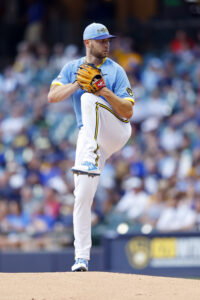
That brings the Brewers up to six rotation options, and that’s before considering right-hander Adrian Houser, who ranked fourth on the team in innings pitched and games started in 2022. Admittedly, 2022 wasn’t a great season for Houser, who limped to an uncharacteristic 4.73 ERA with a career-worst 15.2% strikeout rate and career-low 46.7% ground-ball rate.
Given those struggles from Houser and an uneven season for Ashby, it’s understandable if the Brewers wanted some low-cost stability at the back of the rotation. Miley can provide that, health permitting, but it doesn’t leave Houser with a clear role. He’s out of minor league options, and Ashby seems likelier to be ticketed for the long relief/swingman role over Houser. The Brewers even added an eighth rotation candidate — fellow out-of-options hurler Bryse Wilson — in a small swap with the Pirates. Wilson figures to be in the bullpen to begin the season, if he even makes it to Opening Day on the 40-man roster. For now, his presence gives the Brewers a trio of bullpen arms who operated primarily as starters in 2022.
Houser already throws decently hard (94.4 mph average four-seamer, 93.8 mph sinker in 2022), so it could be argued that he’s somewhat intriguing in a short relief role that might make his velocity tick up even further. But he also already agreed to a $3.6MM salary for the 2023 season, and that seems like a relatively expensive experiment for a Brewers team that declined a net $2.25MM salary for steady veteran reliever Brad Boxberger ($3MM option, $750K buyout).
Dropping Houser into short relief also overlooks the fact that from 2019-21, he was a solid member of the team’s rotation. He began the 2019 season in the ‘pen but moved to the rotation and hardly looked back; overall 55 of Houser’s 75 outings in that time came as a starter. He made only three relief appearances in 2020-21. And, during that three-year period from 2019-21, he pitched to a combined 3.78 ERA with a 20.4% strikeout rate, a 9.3% walk rate and an outstanding 57% ground-ball rate. The strikeout rate was below-average, and the walk rate was a bit elevated, but fielding-independent marks like FIP (4.26) and SIERA (4.28) still felt Houser was plenty serviceable.
There’s no getting around the fact that the 2022 season was an ugly one for Houser, but he’s still an affordable 29-year-old right-hander (30 next month) with a career 3.97 ERA in 428 innings, most of which has come as a starter. He’s eligible for arbitration once more next winter and can become a free agent after the 2024 season. Houser alone isn’t going to change a team’s fortunes in the rotation, but he’s also very arguably as good a bet as the bulk of the remaining unsigned free agents. Certainly, he’ll cost less from a financial perspective, though he’d of course require a modest package of young talent or perhaps a bat in a similar square-peg/round-hole situation.
With Houser falling to at least sixth, if not seventh on the Brewers’ rotation depth chart, he stands out as a natural trade candidate. World Series hopefuls probably aren’t going to look at Houser and think he’s someone they can acquire and plug into a playoff rotation, but there are plenty of teams still on the lookout for solid innings at the back of their starting staff.
Even for a rebuilding team, it’s conceivable they could buy low on Houser now and then recoup most of that value, if not more, at the deadline or next offseason if he’s able to bounce back or partially reinvent himself under the tutelage of a new organization. (That’s not a knock on the Brewers specifically, but it’s common for new teams to alter pitch selection, arm slot, etc.) He could also help take the pressure off a team’s young starters and allow those less experienced arms to be eased into the Majors.
Given the constant need for pitching throughout the league, there’s no shortage of teams that could feasibly make sense as a Houser suitor. The Orioles, for instance, are still reportedly on the hunt for another veteran arm. General manager Mike Elias was in the Astros’ scouting department in 2011 when Houser was a second-round pick. The Red Sox are teeming with injury uncertainty thanks to the presence of Chris Sale and James Paxton. Most of the Tigers’ young pitchers have befallen some type of injury in the past calendar year. The Nationals could use some more support for young arms like Cade Cavalli and MacKenzie Gore. The Rockies’ rotation is a collection of question marks, and Colorado tends to value ground-ball pitchers.
That’s just a handful of speculative landing spots, and it’s a given that other needs will arise during Spring Training, when camps begin to open and pitchers are inevitably sidelined due to injury. If the Brewers don’t find any offers to their liking now, they can simply hold onto Houser and see how demand looks in two months’ time. It’s possible an in-house injury will alter the calculus for the Brewers themselves, too. The nice part is that while Houser may be a bit pricier than they’d prefer, given his lack of a clearly defined role, he’s also not so expensive that the Brewers need to urgently pursue trades to dump his salary.
It’s been a quiet offseason for the Brewers on the free-agent front, but Milwaukee has already swung seven trades under newly installed baseball operations leader Matt Arnold. Gone from the ’22 Brew Crew via trade are Kolten Wong, Esteury Ruiz and Justin Topa. Newcomers include William Contreras, Jesse Winker, Abraham Toro, Javy Guerra, the previously mentioned Bryse Wilson, Owen Miller and Payton Henry. Based on the rotation depth they have with Miley in the fold and the lack of minor league options for Houser, he’s a decent candidate to change hands and push Arnold’s trade count in his first offseason at the helm up to eight.
Brewers Sign Josh VanMeter To Minor League Deal
The Brewers have informed reporters, including Curt Hogg of the Milwaukee Journal Sentinel, that they have signed infielder Josh VanMeter to a minor league with an invitation to major league Spring Training.
VanMeter, 28 in March, has appeared in the past four major league seasons, spending time with the Reds, Diamondbacks and Pirates. He first got the call in 2019 and spent that season being frequently optioned between the majors and minors for the Reds. His work in the majors was a bit below average, as he hit .237/.327/.408 for a wRC+ of 88. But in 49 minor league games, he hit an incredible .348/.429/.669 for a wRC+ of 175.
Unfortunately, VanMeter hasn’t been able to come close to that level of production in the three years since, either in the majors or the minors. He spent most of 2022 in the majors with the Pirates, hitting just .187/.266/.292 for a wRC+ of 59. He was designated for assignment and outrighted in September, reaching free agency at season’s end.
Though he hasn’t hit much in the past few years, VanMeter at least brings defensive versatility. In his time in the big leagues, he’s played the outfield corners, every infield position except shortstop, as well as an inning behind the plate and three innings on the mound. It’s also possible his bat gets a boost from the upcoming rules against extreme defensive shifts, as he hits from the left side and was shifted in 79.7% of his appearances last year.
The Brewers have a bit of fluidity to their infield picture since Jace Peterson reached free agency and signed with the A’s while Kolten Wong was dealt to the Mariners. The club received Abraham Toro back in that Wong deal and also acquired Owen Miller from the Guardians. Luis Urías could take over third base while prospect Brice Turang is an option to join Willy Adames in the middle infield, but Turang has still yet to reach the majors. Mike Brosseau is also in the mix. The addition of VanMeter gives the club an experienced player to add some depth without using a roster spot for now. If he earns his way back onto the 40-man, he’s out of options and will have to stick around or else be designated for assignment. He has between three and four years of MLB service time and could be retained for future seasons via arbitration if he can work his way into Milwaukee’s plans.
Brewers Sign Wade Miley
Jan. 9: The Brewers formally announced their one-year deal with Miley. This weekend’s trade of Justin Topa to the Mariners opened a spot on the 40-man roster.
Jan. 4: The Brewers are in agreement with veteran starter Wade Miley on a one-year deal. It’s reportedly a $4.5MM guarantee for the O’Connell Sports Management client. Miley will make $3.5MM next season and is guaranteed a $1MM buyout on a $10MM mutual option for the 2024 campaign.
The deal also contains various innings-based incentives that could max it out at $6MM. He’d earn an extra $150K by getting to 75 innings pitched, followed by $350K for getting to the 100-inning plateau and two $500K bonuses available at 125 and 150 innings. The deal also contains a $250K assignment bonus if Miley were traded.
Miley, 36, heads to his third NL Central team in as many seasons. He spent two years with the Reds from 2020-21, including a 3.37 ERA through 28 starts during the latter campaign. The Reds nevertheless placed him on waivers at the start of last offseason, as they’d evidently determined not to trigger a $10MM option on his services. Miley was claimed by the Cubs, who promptly exercised the option, and he went on to spend one year on Chicago’s North Side.
It wasn’t the kind of season the Cubs had envisioned. The 12-year MLB veteran began the season on the injured list thanks to inflammation in his throwing elbow. He made his team debut in early May, but that return proved short-lived. He went back on the IL after four starts, this time due to a strain in his shoulder. Miley wound up out of action for over two months, not returning until September. He pitched five times down the stretch, concluding his season with nine appearances.
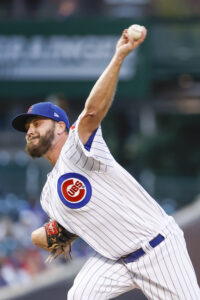
To his credit, the crafty veteran remained effective when able to take the hill. The former All-Star pitched to a 3.16 ERA through 37 innings. He averaged only 85.1 MPH on the cutter that served as his primary pitch and struck out a below-average 17.6% of opponents. Miley has never overpowered batters, relying instead on solid enough control and the ability to avoid barrels.
That was again the case during his limited 2022 work. Miley induced grounders on a very strong 52.6% of batted balls. He held opponents to a subpar 86.7 MPH average exit velocity and allowed fewer than one home run for every nine innings pitched for a third straight season. While he hasn’t topped a 20% strikeout rate in a season since 2014, his heavy reliance on a cutter and changeup has allowed him to consistently keep away from damaging contact.
That track record is clearly of appeal to a Milwaukee club that plays in a fairly hitter-friendly home park. The Brewers already have six quality starting pitchers. Corbin Burnes and Brandon Woodruff headline the group, followed by Freddy Peralta and Aaron Ashby. Eric Lauer and Adrian Houser are quality options at the back end. Miley has started 285 of his 292 MLB appearances, though it’s possible Milwaukee prefers to deploy him in a more flexible swing role considering his lack of innings in 2022.
If the plan is for Miley to secure a season-opening rotation spot, that could free up general manager Matt Arnold and his front office to market Lauer or Houser in trade. The Brewers could look for another bat to incorporate into the right field and first base mix, and it’s possible they bring in a veteran infielder to lessen the workload for Luis Urías or rookie Brice Turang. Dealing one of their incumbent starters would be a way to bolster a lineup that was middle-of-the-pack last season.
It’s Milwaukee’s first significant dip into major league free agency this offseason. Miley’s relatively modest salary brings the Brewers payroll projection to approximately $119MM, as calculated by Roster Resource. Milwaukee opened last year with a player payroll just shy of $132MM, so there should still be room for Arnold and his group to build out the roster as they try to close the gap with the Cardinals at the top of the division.
Ken Rosenthal of the Athletic first reported Miley and the Brewers were in agreement on a one-year, $4.5MM deal that could max out at $6MM. Bob Nightengale of USA Today was first to report Miley would receive a $3.5MM salary in 2023 and that the deal contained a $10MM mutual option with a $1MM buyout; Nightengale was also first with the specifics of the incentive structure and the assignment bonus.
Image courtesy of USA Today Sports.
Mariners Acquire Justin Topa
The Mariners announced a swap of right-handers, as Justin Topa was acquired from the Brewers in exchange for minor leaguer Joseph Hernandez.
Topa has pitched in each of the last three MLB seasons, albeit in the limited fashion of 18 1/3 innings over 17 total games. The righty has an 8.35 ERA for his brief career, thanks to two particularly disastrous outings in 2021 that saw Topa charged with nine earned runs over 1 1/3 frames of work.
A flexor tendon strain sidelined Topa for most of the 2021 season, and flexor tendon surgery resulted in another trip to the 60-day injured list last season. Since the start of the 2021 campaign, Topa has thrown only 45 1/3 total innings in the majors and minors (10 2/3 IP in MLB, 34 2/3 in the minors). Injury absences have unfortunately been the story of a career that began as a 17th-round pick for the Pirates in the 2013 draft, as Topa has previously undergone two Tommy John surgeries.
Between all the health issues and even brief drops out of affiliated baseball (Topa played for indy ball teams for parts of the 2017 and 2018 seasons), Topa is a hard player to evaluate as he enters his age-32 season. However, he immediately drew attention as a possible late-blooming gem when he made his MLB debut in 2020, and posted a 2.35 ERA with 12 strikeouts and no walks over his first 7 2/3 innings. This performance earned Topa a spot on Milwaukee’s postseason roster, and he threw two scoreless innings in his lone appearance.
A hard-thrower who averaged 97.5mph on his fastball in that debut season, Topa’s velocity fell to a 95.7mph average over the last two seasons. While we’re dealing with small sample sizes all around in these three brief bits of Major League exposure for Topa, his injury situation explains the velo drop, and the next step will be seeing if he can regain any velocity now that the flexor tendon issue seems to be behind him.
The Mariners were intrigued enough by Topa to spend a 40-man roster spot on him, and Seattle also parted ways with a 22-year-old coming off a breakout season at single-A. Hernandez posted a 3.39 ERA over 116 2/3 innings in 2022, with an impressive 29.4% strikeout rate but an underwhelming 11.1% walk rate. This does at least represent some improved control from earlier in Hernandez’s career, and the righty’s swing-and-miss numbers indicated how dangerous he could be with improved command.
Hernandez started 22 of 24 games in 2022, and the Brewers will certainly continue to give the right-hander chances as as a starting pitcher. If the control problems persist, Hernandez’s ultimate future (and path to the big leagues) might come as a reliever, and he possesses an excellent slider that could be even more devastating in a limited role.