
Assessing The Yankees’ Options In Left-Field
The Yankees have been one of baseball’s busier teams this winter, bringing back Aaron Judge on a franchise-record nine-year, $360MM deal, while also adding Carlos Rodon and Tommy Kahnle and bringing back first-baseman Anthony Rizzo on a two-year pact. There’s no guarantee more moves are on the way for New York, but it seems if there is one move to make it’ll come in left-field.
Ten players saw time in left for the Yankees in 2022. Of the players who made more than ten appearances there, Joey Gallo, Andrew Benintendi and Miguel Andujar have new teams, Tim Locastro and Marwin Gonzalez are free agents, while Aaron Hicks remains on the roster. While there’s been reports of the Yankees trying to move Hicks this winter, he remains on the team and at this point figures to have some role to play in 2023. Given his presence, it makes sense to take a look at the internal candidates to man left in 2023, before taking a look at what options the Yankees have externally if they do go down that route.
Internal Options
- Aaron Hicks: The 33-year-old had a disappointing campaign in 2022, slashing .216/.330/.313 with eight home runs in 130 games. That was good for a 90 wRC+ (ten percentage points below league average), and was the second straight year Hicks has been below-average offensively. He was a solid contributor from 2017-20, but has seen his power numbers drop off significantly in recent years. Hicks did benefit from a move from center to left, and was worth 8 Defensive Runs Saved in 413 innings there in 2022. He has three years and $30.5MM (including a buyout on a $12.5MM team option in 2026). Should the Yankees opt against bringing a left-fielder in, Hicks seems to be the most likely player to be manning the position on opening day.
- Oswaldo Cabrera: Cabrera acted as something of a spark plug for the Yankees after receiving his first big league call up in August this year. Down the stretch, Cabrera played in 44 games, slashing .247/.312/.429 with six home runs while appearing in every position bar center-field and catcher. Despite having played just 34 outfield innings in the minors, Cabrera spent the bulk of his big league time in the corner spots, impressing to the tune of 9 Defensive Runs Saved in 278 2/3 innings. While Cabrera certainly put a strong case forward to be an everyday outfielder going forward, he may have more value to the Yankees as utility-type given his ability to play just about any position.
- Giancarlo Stanton: The veteran spent the most time on the grass in a season since 2018, logging 312 2/3 innings after being restricted to the DH spot almost exclusively in recent years. The bulk of that came in right-field, where Stanton was worth -4 Defensive Runs Saved. It’s unlikely to be a better picture in left, and while Stanton remains a strong offensive threat, it seems more likely that the Yankees will keep him in the DH spot more often than not and use him in the outfield only occasionally.
- Estevan Florial: The 25-year-old has been stuck in the upper minors for a while now, tallying just 63 big league plate appearances in the last three seasons. During that time he’s hit .185/.302/.278 with a single home run. The former top-100 prospect hit .283/.368/.481 with 15 home runs and 39 stolen bases at Triple-A last year. He’s out of options now, so the Yankees would have to expose him to waivers if they want to take him off the big league roster. There’s a chance the Yankees keep him around as an outfield option on the bench, but they haven’t seen enough in recent years to give him an extended look in the majors and it’s unlikely they’d do that now.
Free Agents
- David Peralta/Trey Mancini/Andrew McCutchen: The free agent market for left-fielders has been largely cleared out, but if the Yankees were to go down that path this trio of hitters would likely be the best remaining options. With perhaps the exception of Mancini, they could likely have these players on one-year deals. Peralta’s left-handedness could make him more appealing in Yankee Stadium, but ultimately all three have limitations that make it unlikely the Yankees would go down this route. At the end of the day, if the Yankees are to upgrade left-field it’d surely be for someone that vastly improves their current options. The trade market certainly has those options, but it doesn’t appear that free agency does anymore.
Trade Market
- Bryan Reynolds: The switch-hitting Pirates star has been linked to the Yankees in recent weeks since requesting a trade out of Pittsburgh. There’s no guarantee the Pirates trade Reynolds, and it appears they’re asking for a significant haul (headlined by a top pitching prospect) in return. The top of the Yankees’ farm system is heavy in position players, which may make a match tricky but Reynolds would fit their needs. He’s under control for three more seasons and will earn $6.75MM in 2023. That’s a highly affordable rate for a player who’s amassed 12.5 fWAR in four seasons. It’d be a big swing for the Yankees to go out and trade for Reynolds, and they’d have to give up a lot of prospect value, but it’d certainly put them in a strong position over the next few seasons.
- Max Kepler: Kepler is under control for another season at $9.5MM (including a buyout on a $10MM 2024 team option). He experienced a down year at the plate last season, hitting just nine home runs and slashing .227/.318/.348. He’s a left-handed pull hitter, so there’s a chance that a combination of Yankee Stadium’s short porch and the restrictions on defensive positioning can boost his offensive numbers, but a lot of his value is in his glove. While he has been playing right-field in Minnesota, he’s been worth 19 Defensive Runs Saved there over the past two seasons. The cost to acquire him would be less than Reynolds, but the production would likely be less too. While Kepler makes some sense, the Yankees may wonder whether it’s worth carrying both Hicks and Kepler on the same roster.
- Arizona’s Outfielders: Even after dealing Daulton Varsho to Toronto, the Diamondbacks are still stocked with outfielders, especially given they acquired one – Lourdes Gurriel Jr. – in that trade. Corbin Carroll, Alek Thomas and Jake McCarthy are all young outfielders that project as the future of Arizona’s outfield. They’ve been mentioned in trades and certainly could appeal to New York, but perhaps they could be motivated to flip Gurriel to New York. He slashed .291/.343/.400 with five home runs for Toronto last season, and is under control for one more season at $5.8MM. The Snakes are building a strong young roster, and while Gurriel is a solid player, his one year of remaining team control probably doesn’t align with Arizona returning to contention.
Ultimately, there’s a few different options for the Yankees to go down. As poor as Hicks was in 2022, he was still worth 1.5 fWAR and if the Yankees can’t trade him and don’t want to go after a clear upgrade like Reynolds, it does make some sense to at least start the season with him in left. That way they can see if he can rebound at the plate, and look to make a move depending on how that goes at the trade deadline mid-season.
Who Will Be The Yankees' Opening Day Left-Fielder?
-
Oswaldo Cabrera 23% (3,762)
-
Bryan Reynolds 22% (3,570)
-
Aaron Hicks 22% (3,529)
-
Max Kepler 7% (1,160)
-
Other 7% (1,131)
-
Lourdes Gurriel Jr. 6% (948)
-
Giancarlo Stanton 5% (745)
-
Andrew McCutchen 4% (597)
-
Estevan Florial 2% (372)
-
David Peralta 2% (334)
Total votes: 16,148
Pirates Notes: Reynolds, Starting Pitching, Cruz
The Pirates have made a handful of moves to bring in major league talent this winter, but one of the biggest storylines remains the potential departure of star outfielder Bryan Reynolds. Reynolds handed in a trade request on December 3, but at this point remains on the Bucs’ roster, with the team reportedly setting a high asking price for the 27-year-old. MLB Network’s Jon Morosi adds a bit more depth to that, reporting Pittsburgh wants a top starting pitcher to headline the return. Morosi cites the Dodgers’ Bobby Miller and the Blue Jays’ Ricky Tiedemann – both of whom are top-40 MLB prospects – as examples of the sort of prospect they want.
While both L.A. and Toronto could make sense as speculative fits for Reynolds, neither has been reported as in discussions with the Pirates. That’s not true of the Yankees though, and Morosi further reports that New York has been in contact with the Pirates over the past few weeks. The Yankees’ major remaining off-season need is a left-fielder so the switch-hitting Reynolds makes plenty of sense, especially given the free agent market has thinned out considerably following Andrew Benintendi and Michael Conforto finding new homes.
As Morosi notes, one roadblock to a deal could be Pittsburgh’s desire for a starting pitcher to headline the deal. The Yankees’ system is headlined by position player prospects such as Anthony Volpe, Oswald Peraza and Jasson Dominguez. Their top starting pitcher prospects, according to Baseball America, are Randy Vasquez, Will Warren and Drew Thorpe, but all three project as back-of-the-rotation types rather than the frontline starter Pittsburgh is seeking. Clayton Beeter shot up New York’s prospect charts after coming over from the Dodgers in the Joey Gallo trade and would be an intriguing name to watch, but unlikely to headline any deal.
A potential trade of Reynolds would help to free up the surplus of outfielders the Pirates have. Alternatively, as Rob Biertempfel of The Athletic writes, general manager Ben Cherington could package up one of his lesser-known outfielders with other prospects in a deal, possibly for a starting pitcher.
“We would still like to add a starting pitcher. That market’s been strong, but we continue to stay engaged with some free agents and trade opportunities. Both of those can be hard to speculate, in terms of how likely it is to line up. We’d also like to add another position player, if we can,” Cherington said.
As things stand, the Pirates are slated to go with some combination of Reynolds, Jack Suwinski, Miguel Andujar and Connor Joe in the outfield at the major league level, with Ji Hwan Bae, Calvin Mitchell, Canaan Smith-Njigba and Travis Swaggerty options as well, so it certainly makes sense that the Pirates could dip into that group to try and bolster another part of the roster.
Biertempfel’s report also provides some update on shortstop Oneil Cruz, who sustained an ankle injury playing winter ball in the Dominican Republic.
“He does have some swelling. He’s not gonna play right now and let that calm down. We’re going to try to get him to the States after the holidays, just to be sure about what’s going on. But all reports so far are that it’s a relatively minor thing. It should pass without being too much of an issue,” Cherington said.
While there’s nothing definitive there, it doesn’t seem like there’s too much concern over Cruz’ status from the Pirates. After belting 17 home runs and slashing .233/.294/.450 across 361 plate appearances, Cruz finished sixth in NL Rookie of the Year voting, and looks set to be Pittsburgh’s opening day shortstop in 2023.
Yankees Sign Tanner Tully, Ryan Weber To Minor League Deals
The Yankees recently signed a number of players to minor league contracts, as reported by Chris Hilburn-Trenkle of Baseball America. Among those that haven’t previously been covered at MLBTR: left-handers Tanner Tully and Nick Ramirez, righty Ryan Weber and infielder Jamie Westbrook.
Tully had spent his entire career in the Cleveland system. A 26th round pick in 2016, he worked his way to the majors for the first time this year. Tully appeared out of Terry Francona’s bullpen three times, allowing four runs in six innings. He spent the bulk of the season at Triple-A Columbus, where he started 24 of 28 outings. Through 122 innings, the Ohio State product put up a 4.72 ERA with a modest 18.5% strikeout percentage but an excellent 4.9% walk rate.
The 28-year-old doesn’t throw hard, averaging just under 91 MPH on his fastball during his MLB time. He’s a quality strike-thrower who has gotten average or better grounder rates in the minors of late. He’ll presumably open the year at Triple-A Scranton/Wilkes-Barre and serve as rotation or long relief depth.
That’s a role with which Weber is also familiar. He spent the 2022 campaign in the Yankees organization, shuttling on and off their roster whenever the club needed to cover some innings. The 32-year-old made five appearances, all in relief. He allowed just one run across 10 2/3 innings with a trio of strikeouts and a walk. That marked his eighth consecutive year logging some big league action, and he has a 5.02 ERA across 177 2/3 career frames.
Like Tully, Weber is a soft-tossing control specialist. He consistently racks up grounders on over half the batted balls he allows, including a robust 53.5% rate in 39 2/3 frames for Scranton this past season. Weber walked just 3% of opponents with the RailRiders, albeit with a 16.5% strikeout rate.
Ramirez, 33, adds some left-handed relief depth to the mix. He appeared in the big leagues in each season between 2019-21, suiting up with the Tigers and Padres. Between the two clubs, he posted a 4.55 ERA with a 20.4% strikeout rate and 9.5% walk percentage across 110 2/3 innings. Ramirez spent the entire 2022 campaign working out of the bullpen with the Mariners highest affiliate in Tacoma. He had a nice season, working to a 2.93 ERA with a 23.7% strikeout percentage and 46% ground-ball rate through 55 1/3 frames. That wasn’t enough to crack an excellent Seattle bullpen, but he’ll try to work his way back to the majors in the Bronx.
Westbrook has yet to play in the big leagues. The 27-year-old has played almost a decade in the minors, spending parts of four seasons at Triple-A. He looked like to be under consideration for an MLB call when the Tigers acquired him from the Brewers in an April trade. That proved not to be, as the former fifth-round draftee spent the year at Triple-A Toledo. Westbrook hit .248/.349/.377 across 499 plate appearances, showing solid plate discipline without much power. He’s primarily a second baseman but has experience in the corner outfield; he’ll add some defensive flexibility to the upper levels of the system.
Yankees In Agreement With Wilmer Difo
12:10pm: Joel Sherman of The New York Post adds that Difo will have the right to opt out of the deal on July 1.
11:40am: The Yankees and infielder Wilmer Difo are in agreement on a contract, reports Robert Murray of Fansided. It’s split deal that will pay him a salary of $1.2MM if he’s in the majors.
Difo, 31 in April, has appeared in each of the past eight MLB seasons, not offering much at the plate but proving to be quite versatile. Through 1306 plate appearances in his career, he has a batting line of .250/.311/.353 for a wRC+ of 74, indicating he’s been 26% below league average in that time.
That’s not terribly exciting offense, but his best attributes are in other parts of his game. Difo is a switch-hitter and has played every position on the diamond except for first base and catcher. His glovework on the infield is also generally graded as average or better, giving him plenty of avenues for helping out a club. He had to settle on a minor league deal with the Diamondbacks for 2022, eventually getting selected to the big league club but only appearing in three games.
The Yankee infield has some uncertainty in it right now. On paper, a potential alignment would feature Anthony Rizzo at first, Gleyber Torres at second, Josh Donaldson at third and youngster Oswald Peraza at shortstop. DJ LeMahieu could be a factor at various positions but he finished the season injured and his health is uncertain right now. There’s also young utility player Oswaldo Cabrera in the mix, though he might be on the outfield depth chart until the club makes upgrades there. Isiah Kiner-Falefa is also on the roster, seemingly having been bumped into a utility role by Peraza. That’s a lot of options but Torres, Kiner-Falefa and Donaldson have all been mentioned in trade rumors. Peraza and Cabrera each had solid debuts in 2022 but still don’t have much experience.
By adding Difo, the club has given themselves a glove-first veteran depth option on hand to be deployed as needed. He has less than five years of MLB service time, meaning he could be retained for 2024 via arbitration if he works his way into the team’s plans.
Yankees Designate Lucas Luetge For Assignment
The Yankees announced they’ve designated reliever Lucas Luetge for assignment. The move creates a 40-man roster spot for Tommy Kahnle, who has officially signed a two-year free agent deal.
It’s a relatively surprising decision, as Luetge is coming off a strong two-year run in the New York bullpen. The southpaw returned to the majors in 2021 for the first time in six years. Signed to a minor league deal over the 2020-21 offseason, he broke camp with the MLB club that season. Luetge held his bullpen spot all year and posted a 2.74 ERA over 72 1/3 innings. He struck out an above-average 25.9% of batters faced with a sterling 5% walk rate, holding left-handed hitters to a dreadful .196/.204/.315 line in the process.
Luetge’s 2022 campaign wasn’t quite at that level, but he managed another productive year. He was called upon 50 times and put up a 2.67 ERA across 57 1/3 frames. The 35-year-old punched out 23.9% of opponents against a 6.8% walk percentage. Lefties managed a more respectable .269/.359/.333 showing off him this time around, largely thanks to an uptick in free passes.
Nevertheless, Luetge generally handled himself well when tabbed by skipper Aaron Boone. Over his time in pinstripes, he put together a 2.71 ERA through 129 2/3 frames. He avoided the injured list in both seasons, struck out a quarter of his opponents and walked less than 6% of batters faced. Luetge held opponents to a .255/.307/.371 slash in 552 plate appearances. He missed bats on over 12% of his offerings in both seasons and was particularly adept at staying off barrels. Only 23.5% of batted balls against him this past season were hit hard, per Statcast; that’s the lowest rate of any qualified pitcher in the game.
While Luetge was consistently productive, he never quite worked his way up the bullpen hierarchy in the Bronx. New York relied upon Wandy Peralta in higher-leverage situations, and Luetge was a healthy scratch in this year’s American League Championship Series. Peralta generates more ground-balls and throws in the mid-90s, while Luetge has succeeded on guile and movement — primarily turning to a cutter that averaged just 87.6 MPH this year.
As New York stockpiles power arms in the bullpen, Luetge was squeezed out of the picture. There’s a good chance he finds another landing spot in the next few days, with the Yankees having a week to trade him or put him on waivers. Luetge is eligible for arbitration through the end of the 2024 season; he’s projected by MLBTR contributor Matt Swartz for a $1.7MM salary next year. That’s a reasonable price for a productive lefty bullpen arm, and teams like the Cardinals, Astros, Cubs and Guardians could check in with New York general manager Brian Cashman about the possibility of a minor trade.
Yankees Designate Junior Fernández For Assignment
The Yankees announced that right-hander Junior Fernández has been designated for assignment. The club has recently made their signings of Aaron Judge and Carlos Rodón official and needed to open a roster spot.
Fernandez, 26 in March, has spent most of his career as a Cardinal, getting sporadic opportunities with them since his 2019 debut. Over the past four seasons, he’s tallied 54 innings in the big leagues with a 5.17 ERA and a solid 49.4% ground ball rate. His strikeout and walk rates have both been subpar, however, coming in at 18.7% and 13.9%, respectively.
The fact that Fernández hasn’t been able to rack up strikeouts is surprising since he has elite velocity on his fastball. He averaged 98.8 mph on his four-seamer this year and 98.7 mph on his sinker. Per Statcast, that puts his velocity in the 98th percentile among qualified pitchers. He’s been better at getting punchouts in the minors but without improved results overall. Over the past two years, he’s thrown 58 2/3 Triple-A innings with a 5.22 ERA, despite striking out 27.1% of batters faced.
The Cardinals evidently ran out of patience with his lack of results, as he was designated for assignment in September. He was claimed by the Pirates and made three appearances for them down the stretch. In November, the Bucs also sent him to DFA limbo, with Fernández landing with the Yankees on a waiver claim.
The righty is still young and could turn things around, but he is now out of options and won’t be easily shuttled between the majors and the minors. But he does have just under two years of MLB service time, giving him plenty of cheap control that could appeal to clubs. The Yanks will have one week to trade him or pass him through waivers.
Yankees Sign Aaron Judge To Nine-Year Deal
December 21: Judge will make even salaries of $40MM throughout the course of the deal, per Jon Heyman of The New York Post.
December 20: The Yankees have made it official today, announcing the deal.
December 7: The reigning American League MVP isn’t going anywhere. Free-agent outfielder Aaron Judge has agreed to terms on a new contract with the Yankees, reports Jon Morosi of MLB.com. The deal, which is still pending a physical, will guarantee Judge $360MM over a nine-year term, reports Ken Rosenthal of The Athletic.
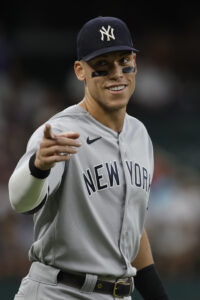
It’s the largest free-agent contract in MLB history, handily topping Bryce Harper‘s previous $330MM record. The $40MM average annual value on the contract establishes a new record among position players and trails only the matching $43.333MM AAVs of Max Scherzer and Justin Verlander — both of whom are on shorter-term deals — for the largest in MLB history. Judge is represented by Page Odle of PSI Sports Management.
Judge’s decision to remain in New York puts an end to a weeks-long saga that saw him primarily fixated on the Yankees and Giants, his two most serious suitors from the moment he rejected a qualifying offer issued by the Yankees. The Giants were reported to have made a similar offer yesterday, and Morosi tweets that Judge turned down higher offers after ultimately deciding he preferred to remain a Yankee. The Padres, notably, made a late offer worth a reported $400MM in an attempt to woo Judge, albeit to no avail. Judge will now likely spend his entire career in Yankee pinstripes, as the new contract will run through his age-39 season.
Judge famously bet on himself heading into the 2022 season, turning down a seven-year, $213.5MM extension offer from the Yankees in Spring Training. General manager Brian Cashman took the uncommon step of announcing the terms of the Yankees’ final offer to the public. While that unorthodox tactic upset Judge — as the outfielder himself has since publicly stated — it also leaves no doubt as to the numbers that were offered and thus gives a clear window into just how much the 2022 MVP gained in betting on himself. Judge’s gamble drew some scrutiny, but in the end, he secured an additional two years and a jaw-dropping $146.5MM — a 68.6% increase over the originally proposed guarantee.
It’s a massive win for Judge — one that was earned on the heels of a season the likes of which baseball fans have not seen since Barry Bonds dominated during the steroid era. Judge led the Majors in home runs, runs scored, RBIs, on-base percentage, slugging percentage and total bases, finishing out the year with a comical .311/.425/.686 batting line and a new American League record of 62 home runs.
It’s nearly impossible to draw up a better platform season for a free agent. Judge not only captivated baseball fans but caught the attention of sports fans everywhere while chasing down Roger Maris’ longstanding record, evidenced by being named Time Magazine’s Athlete of the Year. Judge thrived in a national spotlight with the game’s highest-profile team and also almost singlehandedly prevented a second-half collapse by the Yankees. Judge mashed at a .349/.502/.784 clip following the All-Star break, belting 29 home runs and reaching base in more than half of his 307 plate appearances. The rest of the lineup, meanwhile, looked utterly lifeless in the season’s final months; non-Judge Yankees hitters combined for a disastrous .223/.292/.360 slash after the All-Star break.
Those heroics simultaneously pushed the Yankees to a division crown in the AL East (thus landing them a first-round bye in the newly expanded playoff format) and painted a gruesome picture for Cashman and owner Hal Steinbrenner of just what a Judge-less Yankee team might look like moving forward. While Judge finally went cold with a 1-for-16 slump in a brutal ALCS that saw his team score just nine total runs in a sweep at the hands of the eventual-champion Astros, it’s unlikely the Yankees would’ve even reached that point had he not put the team on his back in such dramatic fashion.
By measure of wRC+, which weights for a hitter’s league environment and home park, Judge was 107% better than an average big league hitter in 2022. It’s the highest single-season mark any qualified hitter has posted since Bonds in 2004, and if you prefer to set Bonds aside for PED reasons, Judge’s 2022 wRC+ is the best of any hitter since Ted Williams in 1957. There’s no overstating just how remarkable his 2022 season proved to be.
Of course, Judge is hardly a one-year wonder. Setting aside some struggles in a brief 2016 call-up that saw him tally just 95 plate appearances, the former No. 32 overall draft pick has been one of baseball’s best hitters for the past six seasons. A 52-homer campaign in 2017 earned Judge not only a unanimous selection as the American League Rookie of the Year but also a second-place finish in AL MVP voting. Injuries impacted each of his next three seasons, however. Judge missed nearly two months in 2018 when he fractured his wrist upon being hit by a pitch, and he missed time in 2019-20 with a severe oblique strain and a pair of calf strains.
Over the past two seasons, however, Judge has appeared in 94% of the Yankees’ games and been among the game’s very best players in the process. In addition to his 2022 MVP win, he earned a fourth-place finish in MVP balloting in 2021 after slashing .287/.373/.544 with 39 home runs. Virtually every batted-ball metric under the sun supports the notion that Judge is a generational talent at the plate. He led the Majors in average exit velocity, hard-hit rate and max exit velocity in each of the past two seasons, according to Statcast, which also ranks Judge as MLB’s leader in “expected” slugging percentage and weighted on-base average in that span.
Judge’s power profile is so prodigious that it’s easy to overlook his defensive skill set, but doing so would undersell his all-around value. Listed at 6’7″ and 282 pounds, Judge might draw the assumption that he’s a plodding slugger who’s a liability with the glove, but that’s in no way reflective of reality. To the contrary, Judge’s 61 Defensive Runs Saved since his Major League debut tie him for eighth among all MLB players, regardless of position. Statcast placed his sprint speed in the 50th percentile among MLB players in 2022, while his arm strength landed in the 93rd percentile. Judge will surely slow down over the life of the contract, but at least for the time being, he’s even a viable option in center field, where he logged a career-high 632 innings this past season and turned in above-average marks in DRS, Ultimate Zone Rating and Outs Above Average.
Since Judge’s first full season came at age 25 and he’s set to turn 31 early in the first season of his new contract, it’s easy to see why the Yankees initially tried to limit the contract to a seven-year term. Instead, Judge’s legendary 2022 campaign pushed them to compete with other teams in free agency and offer a nine-year contract that will carry him through age 39. Long-term contracts paying even through age 38 have been exceedingly rare in the last decade. Arguably the only other player who’s done that without compromising on the average annual value is Mike Trout, who tacked on ten years and $360MM in a March 2019 extension. In contrast, Phillies-for-life Bryce Harper and Trea Turner accepted AAVs of $25.4MM and $27.3MM, respectively.
Judge’s aging curve will be an issue for another day. Looking at financial component of this agreement for 2023, it comes at an even larger cost to the Yankees than the bottom-line, $360MM guarantee. New York was about $5.8MM shy of the luxury-tax barrier prior to agreeing to terms with Judge, as projected by Roster Resource, and his $40MM AAV now catapults them into the second tier of luxury penalization.
As a second-time offender, they’re subject to a 30% tax on the first $20MM by which they exceed the luxury threshold and a 42.5% tax for the next $20MM. They’ll pay a 75% tax on the next $20MM by which they exceed the threshold and a 90% tax on every dollar spent thereafter. Judge bumps the Yankees to a projected $267.2MM worth of luxury obligations, meaning if the Yankees called it an offseason right now, they’d be on the hook for approximately $12.035MM in penalties. That seems unlikely, however, and any further additions will come with substantial taxes, as New York now sits $5.8MM shy of the third tier of penalties (and the aforementioned 75% tax rate). The Yankees have been reported to hold strong interest in free-agent ace Carlos Rodon, though it’s not clear whether Steinbrenner has the appetite for a $40MM AAV on Judge and an AAV approaching or even exceeding $30MM for Rodon.
It’s possible, if not likely, that they’ll look to get out from underneath the remainder of their onerous commitments to Josh Donaldson or Aaron Hicks via the trade market, but the Yankees would need to pay down a substantial portion of either player’s salary to facilitate such a trade (or take on another bad contract in return). There’s also been speculation about the Yankees possibly dealing from their sizable arbitration class, with infielder Gleyber Torres a commonly cited possibility.
Judge’s enormous AAV not only makes the Yankees a lock to repeat as a second-time luxury payor — it also makes them quite likely to be a third-time offender in 2024, when they’re already projected for nearly $170MM in luxury obligations. That figure doesn’t include any of the team’s arbitration-eligible players, and any multi-year additions this winter will increase that number. With Luis Severino, Frankie Montas and Harrison Bader all set for free agency following the 2023 campaign, the Yankees will likely be on the lookout for both rotation and outfield help in the next 12 to 15 months.
Those moving parts coalesce to demonstrate how quickly the Yankees’ luxury figure could balloon. Teams crossing the luxury tax for the third consecutive season are taxed at rates of 50% (first $20MM), 65% (next $20MM), 95% (next $20MM) and 110% (all dollars thereafter).
All of that is secondary to the Yankees, however, who entered the offseason hell-bent on retaining the league MVP and burgeoning franchise icon. They went to record-setting levels in order to make it happen, furthering the future market for star-caliber free agents in the process, but it’s surely a day for celebration in the organization regardless of any down-the-road consequences.
From a broader market perspective, Judge’s deal with the Yankees not only puts a bow on one of the highest-profile free agencies in recent memory — it’s also likely to serve as a facilitator for a flurry of subsequent moves. So much of the 2022-23 offseason hinged on Judge’s decision, that several teams and other top-tier free agents have been reluctant to act.
For instance, with Judge now remaining in New York, the Giants will likely turn their attention to the shortstop market, where they reportedly have Carlos Correa atop their list of targets. The Twins have been angling to re-sign Correa, but it was always in Correa’s best interest to see if the Giants might miss on Judge and jump into the bidding. If Correa departs Minnesota, the Twins reportedly view Xander Bogaerts as their top fallback option. As with Correa, then, it was in Bogaerts’ best interest to know where Judge landed before he made any sort of decision. All the while, the Red Sox have been hoping to keep Bogaerts, just as the Braves have been hoping to keep Dansby Swanson. But the Cubs, Dodgers and Cardinals have each been tied to the shortstop market, and the Padres have been aggressive in trying to add a marquee player of any shape or size and clearly still have money to spend.
The previously mentioned Rodon, too, likely needed to wait on Judge, given the Yankees’ interest. And it’s feasible that the next tier of free-agent pitchers, including Chris Bassitt and Kodai Senga, prefer to wait until Rodon comes off the board so that they can stand as the two top options and perhaps have increased leverage among rotation-hungry teams.
Viewed through that lens, Judge’s contract is far more than a watershed moment in Yankees franchise history, it’s a catalyst that’ll set off a chain reaction of franchise-altering decisions and megadeals throughout the sport — quite possibly within the next few days or weeks. While elated echoes of “All Rise” ring out through the Bronx, things are just getting started for the rest of the league.
Yankees Sign Carlos Rodon To Six-Year Deal
December 21: The Yankees have officially announced the signing.
December 15: The best remaining free agent starter is headed to the Bronx. The Yankees are reportedly in agreement on a six-year, $162MM contract with Carlos Rodón. The Boras Corporation client will receive a $5MM signing bonus and a $22MM salary next season followed by successive $27MM salaries from 2024-28. The deal contains a full no-trade clause and runs through Rodón’s age-35 season.
New York pairs the addition with their record-setting deal for defending AL MVP Aaron Judge as part of a huge offseason. The guarantee ties that of Brandon Nimmo for the sixth-largest deal of the offseason. Rodón will finish with the second-largest guarantee among free agent pitchers, narrowly behind the five-year, $185MM pact Jacob deGrom inked with the Rangers.
It’s the culmination of an incredible two-season run. The left-hander entered the professional ranks eight years ago, selected by the White Sox with the third overall pick in the 2014 draft. Owner of a mid-90s fastball and a wipeout slider, he was regarded as a potential top-of-the-rotation starter who’d quickly reach the big leagues. Rodón indeed found himself on Chicago’s south side by the middle of the 2015 campaign, and he posted a 3.90 ERA in 304 1/3 innings through the end of the following season.
Unfortunately, the Miami native’s career was then sidetracked by injuries. Rodón lost a chunk of the 2017 campaign to biceps bursitis, then underwent arthroscopic shoulder surgery that September. He didn’t debut until June the following year, making 20 starts. Early the next season, Rodón was diagnosed with an elbow issue. He went back under the knife in May ’19, this time undergoing a Tommy John procedure. He missed the remainder of that year, returning at the tail end of the 2020 campaign for four appearances.
The mounting injury troubles led the White Sox to decline to tender him a contract heading into 2021. Chicago circled back towards the end of the offseason, bringing him back on a $3MM free agent deal. That move was met with a fair amount of criticism, but it turned into one of the best decisions of GM Rick Hahn’s tenure.
Rodón was brilliant in 2021, earning his first All-Star nod with a 2.31 ERA over 89 2/3 first-half innings. He looked on his way to a Cy Young award when he dealt with some shoulder fatigue in August. Rodón only missed a couple weeks and continued to pitch well upon his return, although his velocity dropped towards season’s end. The southpaw concluded the year with a 2.37 ERA and a massive 34.6% strikeout percentage across 132 2/3 innings. He placed fifth in Cy Young balloting.

The end-of-year shoulder issue and velocity dip seemed to scare the Chicago front office, however. They made the eyebrow-raising decision not to issue Rodón a qualifying offer, allowing him to hit the open market without draft compensation attached. He remained a free agent until after the lockout, when the Giants added him on a two-year, $44MM guarantee. The deal contained an opt-out clause after year one, conditional on Rodón reaching 110 innings pitched in 2022. It was an opportunity for the star hurler to bet on himself, knowing a nine-figure deal could be in the cards if he maintained his 2021 form over a full, healthy season.
Rodón did exactly that, doubling down with perhaps the best season of his career. He stayed healthy all year, making 31 starts and tallying a personal-high 178 innings. Rodón worked to a sterling 2.88 ERA. He earned a second straight All-Star nod and was among the game’s best at missing bats. Rodón fanned 33.4% of opponents against a solid 7.3% walk rate. Among pitchers with 100+ innings, only Braves rookier Spencer Strider bested that strikeout percentage. Strider, Shohei Ohtani, Max Scherzer and Gerrit Cole were the only pitchers with a larger gap between their strikeout and walk rates.
Almost as importantly, Rodón’s arsenal showed no ill effects after his 2021 dip. His fastball averaged a strong 95.5 MPH, making him one of the game’s harder-throwing lefty pitchers. He generated high-end spin and whiff rates on both his fastball and slider, and opposing hitters swung through a massive 14.1% of his total pitches. Rodón stifled batters from both sides of the plate; he held lefties to a .179/.257/.260 line, while hitters with the platoon advantage put together just a .207/.264/.319 mark.
A second season of elite performance, this one without any health scares, cemented the 30-year-old as one of the sport’s top pitchers. His career took a more winding road than expected when he was drafted, but Rodón has developed into a top-of-the-rotation starter. He made the easy decision to opt out of his deal with San Francisco after topping the necessary innings threshold, and he quickly turned down a qualifying offer.
It now looks like a potentially elite Yankee rotation. New York watched Jameson Taillon depart but upgrades with the Rodón addition. He and Cole are co-aces, backed up by breakout hurler Nestor Cortes, Luis Severino and Frankie Montas. The latter two have had some injury concerns in recent seasons, but they’re overqualified as fourth and fifth starters if healthy. Domingo Germán, Clarke Schmidt and prospect Randy Vasquez are on hand as depth options who could step in if any of the top five get injured.
Rodón was one of three aces available in free agency, jointing deGrom and Justin Verlander. As the youngest of that trio, he always looked likely to secure the longest deal. The six-year term will be the longest for any pitcher this winter, although deGrom’s five-year contract and the stronger than expected market for mid-tier starters led to rumors Rodón’s camp was seeking a seven-year pact that’d push past $200MM. He falls well shy of that lofty hope, but the six-year, $162MM commitment is still quite strong for a pitcher.
It’s the first six-year commitment for a free agent pitcher since Cole and Stephen Strasburg pushed to nine and seven years, respectively, over the 2019-20 offseason. Patrick Corbin ($140MM) and Yu Darvish ($120MM) are the only other open market hurlers to reach six years since the start of the 2016 campaign. At the start of this offseason, MLBTR forecasted Rodón for a five-year, $140MM pact.
The cost for New York goes beyond the salary they’ll owe, as the deal pushes them even further into luxury tax territory. The Yankees were already set to pay the competitive balance tax, and adding Rodón pushes them towards the top tier of penalization. The contract comes with a $27MM average annual value, bringing New York’s CBT figure within a rounding error of the $293MM mark, according to Roster Resource. That’s the cutoff for the fourth CBT tier and places them around $60MM north of the $233MM base threshold.
New York also paid the luxury tax in 2022, so they’ll be subject to heightened penalties as a repeat payor. The Yankees will pay a 30% tax on their first $20MM in overages ($6MM), 42% on their next $20MM ($8.4MM), 75% on the next $20MM ($15MM) and 90% on every dollar spent above $293MM. Signing Rodón pushes them firmly to the top of the third threshold, essentially tacking on around $18MM in taxes. The $27MM salary will bring their raw payroll total around $277MM, which’ll easily be a franchise record.
Going past the third threshold will also push the Yankees first draft choice in 2024 down ten spots. Meanwhile, signing a player who’d turned down a qualifying offer will have a significant impact on their 2023 draft. New York is subject to the highest penalties as a team that paid the CBT this year. They’ll lose their second and fifth-highest selection in next summer’s amateur draft, while their international bonus allotment will drop by $1MM.
The Giants will receive compensation for Rodón’s departure. As a team that neither received revenue sharing payments nor paid the CBT this year, they’ll pick up a bonus selection between Competitive Balance Round B and the start of third round (typically around 75th overall) in next year’s draft. San Francisco had seemingly prepared for Rodón’s departure from the roster by making a pair of their preferred shorter-term rotation additions, bringing aboard Sean Manaea and Ross Stripling on two-year guarantees.
With Ródon off the board, Dansby Swanson is the last remaining free agent who’s likely to find a nine-figure deal. The free agent rotation market has mostly been covered at the top end, with Nathan Eovaldi, Michael Wacha, Johnny Cueto, Corey Kluber and Drew Rucinski standing as some of the top options still available. Needless to say, none of that group has the kind of upside Rodón does. It’s a bold bet from the Yankees, one they hope adds an impact arm to their playoff rotation as they look to advance past the AL Championship Series for the first time since 2009.
Jon Heyman of the New York Post first reported Rodón and the Yankees had agreed to a six-year, $162MM deal that contained a full no-trade clause. Bob Nightengale of USA Today was first to report the specific financial breakdown.
Image courtesy of USA Today Sports.
Yankees Sign Michael Hermosillo, Demarcus Evans To Minor League Deals
The Yankees have added a bit of minor league depth, signing outfielder Michael Hermosillo and right-hander Demarcus Evans to minor league deals, according to each player’s MLB transaction log (here and here).
Hermosillo, 28 next month, has spent the past two seasons with the Cubs. He hit just .115/.250/.148 without a home run across 73 plate appearances and 31 games in 2022. He spent much of the year on the injured list with a left quadriceps strain, and only made an additional ten appearances at the Triple-A level, hitting .324/.400/.559 in 40 plate appearances. While that sort of sample size is far too small to draw accurate conclusions, he did hit .306/.446/.592 over 186 plate appearances a year earlier at that level, so he certainly can hit at the highest level of the minors.
Originally drafted in the 28th round by the Angels in 2013, Hermosillo came up through their system and made his big league debut in 2018. Despite tallying some promising numbers coming through the minors, Hermosillo never hit enough in the big leagues to stick, putting up a .188/.287/.288 line over 118 plate appearances in three years with the Angels. Combined with his Cubs work, that makes for a career .167/.268/.283 line with four home runs over 229 plate appearances.
Defensively, Hermosillo logged most of his time in center field, but also spent some time in left as well. On the whole, he’s been worth 3 Outs Above Average in 312 2/3 career innings in center, 1 OAA in 115 innings in left and 1 OAA in 126 innings in right. So even if the bat doesn’t show up in the big leagues, there’s a solid glove-first depth piece for the Yankees to cover any injuries.
Evans, 26, didn’t pitch in the big leagues last year but made appearances over the prior two seasons for the Rangers. Originally drafted in the 25th round in 2015, Evans came up through the Rangers’ system flashing big strikeout stuff, averaging a 13.5 SO/9 over his minor league career. He got a brief cup of coffee in the big leagues in 2020, pitching four innings to a 2.25 ERA. A longer stint was ahead in 2021, but the results didn’t come, as Evans was tagged for a 5.13 ERA over 26 1/3 innings. Despite striking out batters at an above-average 27.5% clip, the walks were an issue for Evans, as he handed out free passes at a 13.3% rate.
At Triple-A this year, Evans tossed 33 innings of 3.82 ERA ball. The same issues that plagued his big league stint were evident in the upper minors, as Evans offset a strong strike out rate (30.1%) with a poor walk rate (15.1%). His fastball sits in the low-90s, and he mixes in a cutter and a curveball. He’ll give the Yankees a bit of minor league bullpen depth at worst, with a bit of upside there if they can straighten out his walk problems.
Yankees Agree To Minor League Deals With Art Warren, Jake Bauers
The Yankees have agreed to minor league contracts with right-hander Art Warren and first baseman/outfielder Jake Bauers, as first indicated on the transactions log at MiLB.com. Warren’s contract is a two-year minor league deal that includes an invitation to Major League Spring Training in 2024, I’m told.
Warren, 30 in March, spent the past two seasons with the Reds and is expected to miss the 2023 season after undergoing surgery to repair the UCL in his pitching elbow back in September. Given that lengthy recovery period, the Reds non-tendered him earlier in the offseason. He’ll now latch on with a new club in hopes of rehabbing his arm and pitching his way into the Yankees’ bullpen plans in 2024, when he’s back at full strength.
While the 2022 season wasn’t a good one for Warren — 6.50 ERA, career-worst 13.3% walk rate and 1.50 HR/9 — it’s fair to wonder how much his elbow’s health (or lack thereof) contributed to those struggles. Warren’s average fastball sat at 95.3 mph with Cincinnati in 2021 but dipped to 93.6 mph in 2022, and his overall results in a healthy 2021 showing were outstanding. The 6’3″, 230-pound righty parlayed a big strikeout rate in Triple-A into a Major League look with the Reds and delivered a 1.29 ERA with an eye-popping 41.5% strikeout rate in 21 innings of work. Only four pitchers (min. 20 innings) managed to top Warren’s 19.2% swinging-strike rate in 2021: Liam Hendriks, Raisel Iglesias, Josh Hader and Jacob deGrom. Suffice it to say, when healthy, there’s plenty of intrigue surrounding Warren’s raw stuff.
Warren didn’t get a look in the Majors until his age-26 season with the Mariners, in part due to injuries, and he didn’t pitch in 2020 due to the canceled minor league season. The recent elbow issue will further cut into his opportunities, and he’ll be 31 by the time he has a legitimate chance to make the Yankees’ roster in 2024. If he makes the team at that point, he’ll be controllable for five years before he can become a free agent. For now, he won’t earn service time on the minor league deal but will be able to rehab at the Yankees’ facilities and with their training and medical staff.
As for Bauers, it’ll be his second stint with the Yankees, who signed him to a minor league deal last offseason as well and ultimately traded him to the Reds in exchange for cash over the summer. The 27-year-old former top prospect didn’t crack the big league roster with either club, hitting .226/.352/.406 with the Yankees’ Triple-A club and just .135/.276/.271 with the Reds’ top affiliate.
Bauers has appeared in parts of three Major League seasons, spending time with Tampa Bay, Cleveland and Seattle, but he’s managed a tepid .213/.307/.348 batting line in 1126 plate appearances. He’ll give the Yankees a left-handed depth option at first base and left field down in Scranton.