
Orioles Sign Pete Alonso
Pete Alonso is an Oriole. Baltimore announced the five-year deal on Thursday and will formally introduce their new slugger at a press conference on Friday morning. The Boras Corporation client reportedly receives a $155MM guarantee. He’ll collect a $12.5MM signing bonus and an $18.5MM salary in 2026. He’ll then earn $31MM per year over the next four seasons. There are no deferrals or opt-outs in the contract, and Alonso receives a limited no-trade clause. Catcher Maverick Handley has been designated for assignment as a corresponding 40-man roster move.
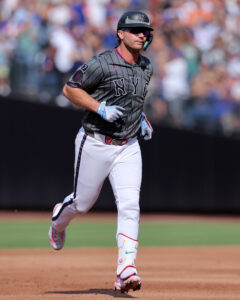
It’s the second major defection from the Mets in as many days. Edwin Diaz spurned Queens for a three-year, $69MM deal with the Dodgers just yesterday. Alonso now heads to the Orioles, with whom he met in person at this week’s Winter Meetings (which are being held in Orlando, not all that far from Alonso’s Tampa-area home).
Although bolstering the rotation has been the obvious goal for Baltimore all offseason, the O’s have also been in pursuit of a major upgrade to the lineup. They offered Kyle Schwarber the same five-year, $150MM terms to which he agreed in his return to the Phillies and have now pushed incrementally further to give Alonso a record-setting average annual value for a first baseman over that same five-year term.
Alonso, who turned 31 over the weekend, famously rejected a reported seven-year, $158MM extension offer from the Mets back in 2023. He drew a fair bit of criticism for that decision, particularly when his market didn’t develop as hoped during last offseason’s initial foray into free agency. Alonso wound up returning to the Mets on a two-year, $54MM deal that was frontloaded with a $30MM salary in 2025 and allowed him to opt back into free agency this winter.
Between that $30MM, the $20.5MM he earned in his final season of arbitration eligibility and the newly promised $155MM from the Orioles, Alonso will end up with $205.5MM over the same seven years that would’ve been covered under the extension offer he turned down.
In Alonso, the Orioles are adding one of the steadiest power hitters on the planet. He’s slugged at least 34 home runs in every 162-game season since his 2019 debut, plus another 16 round-trippers in the shortened 2020 campaign. Dating back to 2019, Schwarber (268) and Aaron Judge (285) are the only players with more home runs than Alonso’s 264.
Steady as his power output has been, Alonso needed a “rebound” campaign of sorts in order to get this type of long-term deal. While his market last offseason was surely weighed down by a qualifying offer — players can only receive one QO in their career, so that wasn’t an issue this time around — Alonso had slugged a career-low 34 home runs with an increase in strikeouts and a downturn in his batted-ball metrics. His .240/.329/.459 output in 2024 was more good than elite.
The 2025 campaign brought improvements across the board. Alonso belted 38 homers and 41 doubles (up from 31 the year prior) while slashing .272/.347/.524 (141 wRC+). He lopped two percentage points off his strikeout rate, cutting it to a roughly average 22.8%, and saw enormous upticks in his average exit velocity (93.5 mph in ’25, 89.8 mph in ’24), barrel rate (18.9% vs. 13.2%) and hard-hit rate (54.4% vs. 46.4%). Alonso struggled through a poor month of July, but as the Mets were fighting for their postseason lives (and ultimately falling short), Alonso put the team’s offense on his back alongside fellow stars Juan Soto and Francisco Lindor. From Aug. 1 onward, the “Polar Bear” raked at a .297/.339/.584 clip (153 wRC+) with 16 home runs and 15 doubles in 239 plate appearances.
Despite that Herculean finish to the season, Alonso received tepid interest from the only club he’s ever known. The Mets were reportedly reluctant to go beyond three years in their talks with Alonso, and the New York Post’s Joel Sherman reported in the aftermath of today’s agreement that they never made a formal offer once it became clear where Alonso’s market was headed. That’s surely a point of frustration for the majority of Mets fans but also shouldn’t come as a major surprise; if the Mets were going to commit to Alonso long-term under president of baseball operations David Stearns and owner Steve Cohen, that likely would have happened last winter. The Mets were only comfortable with a short-term deal then and clearly didn’t change that thinking this time around.
Alonso is the second 30-homer slugger acquired by Baltimore president of baseball operations Mike Elias this winter. The O’s also picked up outfielder Taylor Ward (36 homers in 2025) in a trade sending talented but oft-injured righty Grayson Rodriguez to the Angels. The additions of Alonso and Ward should both add an influx of right-handed power to a team that hit just .231/.297/.364 against left-handed pitching in 2025 and also create myriad trade possibilities for Elias and his staff.
It’s feasible that the Orioles simply add a prominent starting pitcher via free agency as their primary means of addressing the rotation, but their newly acquired thumpers open the space for more creativity. Alonso’s addition could make it easier to trade young corner infielder Coby Mayo, while plugging Ward into a corner outfield spot makes one of Dylan Beavers or Colton Cowser easier to include in a trade for pitching help. Baltimore’s decision to tender a contract to Ryan Mountcastle, a defensively limited right-handed slugger coming off a poor season, now looks like all the more of a head-scratcher, though. The O’s could try to find a taker willing to buy low on him or, alternatively, hope that he can bounce back and be part of the solution between first base and designated hitter.
Payroll-wise, there was always clear runway to add a major contract to the books. The Orioles have spent the better part of the past decade in a rebuild and thus haven’t been handing out multi-year deals very often. The only players guaranteed anything beyond the upcoming 2026 season are Tyler O’Neill, Ryan Helsley and Samuel Basallo. O’Neill and Helsley are only signed through 2027, and Helsley can opt out of his contract following the 2026 season. (O’Neill’s $16.5MM salary in 2027 is all but immovable after his ugly 2025 showing.) Basallo’s eight-year, $67MM extension has just an $8.375MM average annual value. His salary will sit at just $1MM in each of the next three seasons and won’t top $10MM until 2031, at which point Alonso’s contract will have already wrapped up.
Alonso adds $31MM per year to the ledger — assuming an even distribution of his $155MM — but the rest of the books are so clean that it shouldn’t impede the Orioles from future additions of note and/or extensions for prominent young players. RosterResource now projects them for a payroll just under $148MM in 2026, but the 2027 books only have $62.5MM in guaranteed money ($48.5MM if Helsley turns down his player option). By 2028, Alonso and Basallo are the only players guaranteed anything.
Alonso’s contract becomes the second-largest in Orioles history, trailing only the seven-year, $161MM contract given to first baseman Chris Davis under a prior ownership and front office regime. That contract was laden with deferrals, too, which considerably weighed down the net present value.
When considering that wrinkle, the investment in Alonso can be considered the most significant expenditure in franchise history — but it’s also just one of several steps the Orioles will take this winter. Elias is still angling to upgrade his team’s rotation, and the O’s could still use help in the bullpen. This could very well end up being viewed as the signature move of the offseason — if not the entire Elias era to date — but the O’s aren’t likely to coast from here to spring training. There’s more on the horizon.
ESPN’s Jeff Passan first reported the sides were finalizing a five-year, $155MM deal. Andy Kostka of The Baltimore Banner was first on the limited no-trade protection. Jon Heyman of The New York Post had the salary structure.
Preller: Fernando Tatis Jr. Not Available In Trade Talks
The Padres’ payroll reduction (relative to its 2023 peak) and limited of financial flexibility this offseason has led to plenty of hope from other clubs about the possibility of prying star right fielder Fernando Tatis Jr. away from San Diego. However, president of baseball operations A.J. Preller decisively stated at the end of this week’s Winter Meetings that the three-time All-Star won’t be changing hands.
“He’s one of the best players in baseball, is a two-time Platinum (Glove) winner,” Preller told Kevin Acee of the San Diego Union-Tribune in response to Tatis speculation. “The guy has taken over portions of seasons and games and playoff series and everything like that. … Every one of the different versions and iterations of the team and roster we put up there, it’s ‘Tati’ right in the middle. Hopefully, he is one of the top players on our team this year. He’s somebody that we’re not talking about, however you want to say that. If you want to say that’s ‘untouchable,’ you can say that.”
A trade of Tatis has never seemed particularly likely, though some around the industry have wondered whether it’ll eventually be necessary, given the uncertainty surrounding Padres ownership and the ongoing efforts to scale back payroll. San Diego has reduced its spending considerably since the passing of late owner Peter Seidler. Earlier this offseason, Seidler’s brother, John, who has since been named the team’s control person, announced that his family will explore a sale of the franchise.
That announcement came less than one year after a tumultuous and very public-facing quarrel between Sheel Seidler — Peter’s widow — and the other two Seidler brothers, Bob and Matt. Back in February, Sheel filed suit against Bob and Matt Seidler, alleging that they’ve breached fiduciary duty and committed fraud as successors of Peter’s trust. She accused her brothers-in-law of selling assets to themselves “far” below market prices in an effort to consolidate control of the franchise and of violating Peter’s wishes that she serve as interim control person before passing ownership onto the couple’s children at a later date. Matt Seidler contested the suit in a formal response wherein he accused his sister-in-law of attempting to “manufacture claims against the Trustees in pursuit of the control that Peter intentionally chose not to give her.” To date, the suits have not been litigated, nor is there any indication that a settlement has been reached.
For the time being, none of that off-field tension seems to have an impact on Tatis’ status with the club. Certainly, an eventual ownership change could create a different financial outlook in San Diego one way or another, particularly considering the remaining nine years and $286MM on Tatis’ contract.
Hefty as that sum may be, it bears emphasizing that it’s still a “bargain” relative to what Tatis would command on the open market. Had Tatis never penned that extension, he’d be a first-time free agent right now, having accumulated his sixth year of MLB service in 2025.
Tatis would be a 26-year-old (27 in January) coming off a .268/.368/.446 showing (131 wRC+) with 25 home runs, 27 doubles two triples, 32 steals (in 39 tries) and career-best walk and strikeout rates (12.9% and 18.7%, respectively). As Preller referenced, he’s a two-time Platinum Glove winner (and three-time Gold Glove winner). Tatis has hit at least 21 home runs in every 162-game season he’s played (plus 17 in the shortened 60-game season back in 2020).
Given his youth, borderline elite production at the plate and superlative defense, Tatis would have been the clear top free agent in this offseason’s class, likely in line for a contract running into his late 30s or even age-40 season. He may not have matched Juan Soto‘s jaw-dropping $765MM guarantee, but Tatis would very likely have been in line for a contract even larger than the 14-year, $500MM extension signed by fellow second-generation star Vladimir Guerrero Jr. last spring. He’s been worth an average of about 6.5 wins above replacement (6.4 fWAR, 6.6 bWAR) per 162 games played in his career to this point.
Though the Padres won’t be moving Tatis anytime soon, San Diego is exploring other ways to create more financial flexibility. As was reported earlier in the month, the Friars are at least listening on Jake Cronenworth, if not shopping him, and have been willing to hear out clubs who’ve expressed interest in right-hander Nick Pivetta. RosterResource projects the Padres for a payroll of about $201MM right now. Ownership wants to keep the 2026 payroll roughly in line with last year’s mark, around $224MM, which is down from the team’s rough $255MM peak in 2023 but considerably higher than spending levels under prior ownership groups.
Blue Jays Sign Cody Ponce To Three-Year Deal
December 11th: The Jays officially announced the Ponce signing today. According to The Associated Press, he receives a $3MM signing bonus and an $5MM salary for the 2026. He’ll make $11MM annually between 2027-28.
December 2nd: The Blue Jays are reportedly in agreement with free agent starter Cody Ponce on a three-year, $30MM contract. The deal is pending a physical and has yet to be announced by the team. The Jays have two openings on the 40-man roster and do not need to make a corresponding move. Ponce, a client of Excel Sports Management, returns to the majors after an MVP-winning season in the Korea Baseball Organization.
Toronto continues to load up in the rotation on the same day they finalized their seven-year contract with Dylan Cease. They already had a strong top four with Cease, Trey Yesavage, Kevin Gausman and Shane Bieber. Ponce and José Berríos project as the fifth and sixth starters in what looks like one of the strongest rotations in baseball. Eric Lauer, who pitched to a 3.18 ERA over 104 2/3 innings in a swing role this year, is down to seventh on the depth chart.
The three-year deal and $10MM average annual value suggests the Jays view Ponce as a starter. He doesn’t have much rotation experience in the big leagues, starting five of 20 appearances with the Pirates between 2020-21. Ponce struggled in that first look but has reinvented himself since moving to Asia. He pitched parts of three seasons in Japan before a breakout 2025 season with the KBO’s Hanwha Eagles.
Ponce took the ball 29 times and turned in a 1.89 earned run average across 180 2/3 innings. He recorded a league-best 36.2% strikeout percentage against a tidy 6% walk rate. Ponce led the league with 252 strikeouts overall and was the only KBO pitcher with a sub-2.00 ERA in more than 100 innings.
The numbers alone would have been enough for Ponce to get back on the MLB radar. The more important factor for his contract was that his stuff has taken a matching jump. Ponce averaged 93.2 MPH on his fastball during his big league look, but a scout with a non-Toronto team told MLBTR in October that his velocity had climbed into the mid-90s. Eno Sarris of The Athletic wrote earlier this week that his average heater was in the 95 MPH range, and he has been clocked up to 98. Ponce has reportedly picked up a splitter — the carrying pitch for Yesavage and Gausman as well — and mixes in a cutter and curveball.

Ponce throws harder and has better secondary stuff than Erick Fedde did when he returned to North America after his own MVP season in Korea. As a result, the 31-year-old gets an extra year and doubled the $15MM guarantee that Fedde received from the White Sox over the 2023-24 offseason. Fedde, for what it’s worth, pitched well in his first year back before his numbers cratered this past season.
It’s a strong deal for Ponce, who tops MLBTR’s prediction of two years and $22MM. It’s by far the biggest payday of his career. Ponce received a signing bonus a little north of $1MM as a second-round pick by the Brewers in the 2015 draft. He did not come close to the service time to qualify for arbitration in his first stint in MLB and played on a $1MM contract with the Eagles.
The salary breakdown hasn’t been reported, but an even distribution of $10MM annually would push Toronto’s projected payroll to roughly $272MM (courtesy of RosterResource). The $10MM average annual value pushes their luxury tax projection above $280MM. The Jays are in the second tier and are taxed at a 42% rate on spending between $264MM and $284MM. That means they’ll pay $4.2MM in taxes for the first season of the Ponce contract. That’s a relative drop in the bucket given the amount the Jays are spending, but the payroll only seems likely to climb. They’d like to re-sign Bo Bichette and will almost certainly add a high-leverage reliever to join Jeff Hoffman and Louis Varland at the back end.
Spending beyond the $284MM mark would raise their tax penalties and result in their top pick in the 2027 draft being moved back 10 spots. That doesn’t appear to be much of a deterrent for a team that forfeited its second and fifth-highest picks in next summer’s draft and $1MM from its international bonus pool to sign Cease. The Jays are all in after coming tantalizingly close to their first World Series in three decades.
If payroll does become an obstacle to re-signing Bichette or adding to the bullpen, the Jays could look to shop Berríos. He’s making $18MM next season and will need to decide whether to opt out of the remaining two years and $48MM on the deal after 2026. It’s not an egregious contract but looks above market for what’ll be ages 32-34 on a pitcher who has struck out fewer than 20% of batters faced in consecutive seasons. Berríos is a solid source of back-of-the-rotation innings, but the Jays would probably need to pay down some of the money and/or take back a slightly underwater deal in a trade.
The simpler path would be to keep everyone and open the season with a six-man rotation if no one suffers an injury during Spring Training. No team gets through an entire season using only five starters. The pitching staff logged a lot of innings this fall. Gausman and Bieber will be free agents after next season, and while Berríos doesn’t look like he’s trending towards an opt-out, that could change with a strong platform year. Lauer will also return to the open market next winter.
Aside from Yesavage, the Jays don’t have much in the way of upper level pitching prospects. Former top prospect Ricky Tiedemann is on the 40-man roster and will probably make his MLB debut in 2026, but he missed the entire ’25 season and has pitched 140 innings since being drafted in 2021. The durability concerns might push him to the bullpen, and even if the Jays want to give him another chance as a starter, they’re certainly not going to let him throw 150 innings. Jake Bloss is unlikely to be a factor until the second half after undergoing elbow surgery in May. The Ponce signing probably rules the Jays out on bringing back Chris Bassitt or Max Scherzer but doesn’t make a Berríos trade a foregone conclusion.
Ken Rosenthal of The Athletic first reported that Ponce and the Jays were finalizing a three-year deal. ESPN’s Jeff Passan had the $30MM guarantee.
Image courtesy of USA Today Sports.
Braves Sign Mike Yastrzemski
The Braves announced a two-year, $23MM contract with outfielder Mike Yastrzemski. He’ll make $9MM in 2026 and $10MM in 2027 and is guaranteed a $4MM buyout on a 2028 club option valued at $7MM. Yastrzemski is represented by Jack Toffey Sports Management. Atlanta designated outfielder Michael Siani for assignment in a corresponding move.
Atlanta hadn’t waded too far into the free agent market outside of re-signing closer Raisel Iglesias. The club now improves its outfield/DH mix by bringing in Yastrzemski. The lefty-swinging veteran finished last season with the Royals after getting dealt by the Giants at the trade deadline. After spending his first six seasons in San Francisco, Yastrzemski will now be on his third team in the calendar year.
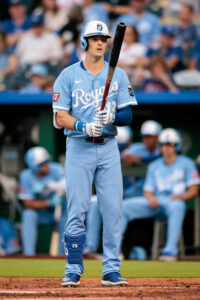
Before the move, the Braves were looking at a pair of speed-first options in holdover Eli White and waiver claim Siani as their bench outfielders behind the trio of Ronald Acuna Jr., Michael Harris II, and Jurickson Profar. Yastrzemski gives them a more viable offensive contributor as the fourth outfielder. Braves president of baseball operations Alex Anthopoulos recently mentioned he preferred to leave the DH spot open and split the duties between multiple players. Yastrzemski figures to factor into that equation against right-handed pitching, grabbing left field reps with Profar moving to DH.
Yastrzemski was having one of his weakest offensive campaigns with the Giants prior to getting traded. He had managed just eight home runs and a career-low .355 SLG across 97 games. The move to Kansas City flipped his season, as he quickly emerged as a crucial top-of-the-order contributor. Yastrzemski slugged nine home runs in 50 games with the Royals, while walking more than he struck out. He capped off his season with a two-homer game against the Athletics.
The 35-year-old Yastrzemski didn’t reach the big leagues until age 28. He immediately made an impact in the power department, swatting 21 home runs in 411 plate appearances as a rookie. Yastrzemski earned near-regular playing time over the next five seasons, providing solid production against righties while typically sitting against lefties. He tended to strike out at an above-average rate, but still finished with a wRC+ of at least 106 in all but one season with the Giants.
Yastrzemski has spent the majority of his time in right field, though he has experience at all three outfield spots. He made six starts in left field, five starts in center field, and 29 starts in right field during his brief stint with the Royals. Yastrzemski graded out as a neutral fielder by Outs Above Average. His range received poor marks, but he offered value with his arm, per Statcast.
Kansas City was reportedly interested in a Yastrzemski reunion. Given his strong two months for the team, it made sense the Royals would look to bring him back. The club is currently short on proven outfielders, with Jac Caglianone, Kyle Isbel, and John Rave penciled in as starters. Considering that the trio is entirely left-handed, targeting a righty bat might be a better fit for Kansas City.
Robert Murray of FanSided first reported the Braves were nearing a deal with Yastrzemski. Jon Heyman of The New York Post first had the two-year, $23MM guarantee and the option.
Yankees, Astros Among Various Clubs Interested In Freddy Peralta Trade
There hasn’t been much movement at the top of the free agent rotation market. Most of the focus on starting pitching has been on the trade front, though we didn’t see any major deals at the Winter Meetings.
Most of the top trade candidates are questionable to move at all. Brewers star Freddy Peralta is among that group. Milwaukee isn’t motivated to trade the All-Star righty on the heels of a 97-win season, but they’re not going to shut down conversations entirely. They’ve heard from no shortage of teams with interest. Ken Rosenthal and Will Sammon of The Athletic report that the Astros, Giants, Mets, Orioles, Red Sox and Yankees are among the clubs that have reached out about Peralta.
The wide range of suitors is to be expected. Houston, San Francisco, Baltimore and the Mets all have starting pitching at or near the top of the priority list. The Astros are focusing on the trade market as they try to stay below the luxury tax line. The Giants and Mets have ample payroll flexibility but have downplayed their desire to make long-term commitments to a starter. The Orioles are casting a wide net to find an impact arm who can slot in the upper half of the rotation. They’ve been tied to Framber Valdez and Ranger Suárez in free agency, as well as trade possibilities like Edward Cabrera and MacKenzie Gore.
The Yankees will begin the season without Gerrit Cole and Carlos Rodón due to injury. Clarke Schmidt may miss the entire season rehabbing Tommy John surgery. They’re set to open the season with Max Fried and Cam Schlittler in the top two spots. Will Warren and Luis Gil project as the third and fourth arms for now, and they don’t have a fifth starter lined up. Warren had a solid rookie season but struggled with the home run ball. Gil was the Rookie of the Year in 2024. This year, he was limited to 57 innings with mediocre strikeout and walk numbers after missing a few months with a lat strain.
Boston isn’t as clearly in need of starting pitching. They entered the offseason pursuing a #2 starter. They’ve acquired Sonny Gray to fill that role and brought in Johan Oviedo as a back-end option. The focus is on adding a big bat or two, but they’ve been tied to virtually every free agent or trade candidate of significance.
Peralta fits on every contender. He’ll make $8MM in the final season of what turned out to be a dramatically team-friendly extension. He’s coming off a career-low 2.70 ERA and finished fifth in NL Cy Young balloting. This was the third straight season in which he reached 200 strikeouts and started 30+ games. The Brewers fully expect to compete for another division title themselves. They’ve pulled the trigger on trades of stars with dwindling club control windows (e.g. Josh Hader, Corbin Burnes) to remain consistently competitive, though that’s not an absolute. They were happy to hold Willy Adames all the way to free agency.
Adames rejected a qualifying offer and netted a compensatory draft pick when he signed with the Giants. Barring injury, Peralta would be a near lock to do the same if Milwaukee holds him all year. That’d net them a compensatory pick after the first round of the 2027 draft — assuming he signs for at least $50MM. Milwaukee would be entitled to the highest level of compensation as a revenue sharing recipient.
Obviously, the Brewers could extract a far greater return for even one year of Peralta’s services on the trade market. They’re balancing that against the hit it’d deal to the 2026 team. Brandon Woodruff is back to join Quinn Priester, Jacob Misiorowski and Chad Patrick in what would still be a high-upside rotation. Every club would be better with Peralta on it, though.
President of baseball operations Matt Arnold addressed the Peralta rumors shortly before the Winter Meetings. “I’m not sure that there’s a scenario that’s been presented that would make any sense for us,” Arnold said last week (link via Adam McCalvy of MLB.com). “We obviously get hits on him all the time. He’s a very popular target, certainly. But he’s also a huge part of our team and we want to be competitive in 2026. A big part of this is bringing back the core that we had last year.”
Support MLBTR With A Trade Rumors Front Office Subscription
About a month ago, MLB Trade Rumors celebrated its 20th anniversary! We hope you enjoyed our Winter Meetings coverage!
The MLBTR writing team consists of Steve Adams, Anthony Franco, Darragh McDonald, Mark Polishuk, Nick Deeds, Leo Morgenstern, Charlie Wright, and AJ Eustace. We all love baseball and we’re dedicated to bringing you the hot stove news with timeliness, accuracy, context, and analysis. The essence of the website has not changed in these 20 years – we’re not jumping on any trends involving clickbait, gambling, or AI.
Part of the reason MLBTR is still going strong is the addition of our Trade Rumors Front Office subscription service five years ago. I have never viewed that as a charity for us; my goal is to provide value well beyond the $34.99 per year cost. Here’s what you get with your subscription:
- Removal of all ads on the website and in our app (just make sure you’re logged in!)
- My weekly mailbag
- Exclusive weekly hot stove articles from expert MLB writers Steve Adams and Anthony Franco
- Exclusive member-only online chats with Steve and Anthony every week
- MLB Contract Tracker: a high-powered tool featuring 19+ years of free agent contracts and extensions
- MLB GM Tracker: GM tenures for all 30 teams dating back to 2000, with links to each GM’s contract history
- MLB Agency Database: agencies for more than three-quarters of those who played in MLB in the last three seasons, compiled from industry sources
- Random perks such as early access to our revamped Trade Rumors app (coming soon!)
In the midst of our all the offseason action, please consider supporting MLBTR with a Trade Rumors Front Office subscription. It comes with a 100% money-back guarantee!
Orioles Among Teams In Discussion With Marlins On Edward Cabrera
The Orioles are among the clubs in conversations with the Marlins about hard-throwing starter Edward Cabrera, report Ken Rosenthal and Will Sammon of The Athletic. There’s been a decent amount of smoke regarding a potential Cabrera trade over the past week, and The Athletic writes that Miami’s talks with other clubs have picked up.
Cabrera is one of the higher-upside arms in the sport. He got out to a slow start but turned in a 2.95 earned run average while striking out 26.5% of opponents in 20 appearances between the beginning of May and the end of August. Cabrera has always had power stuff, but he dialed in his control and walked fewer than 7% of batters faced over that four-month stretch. The 27-year-old righty was one of the more intriguing deadline trade candidates, but Miami never received an offer they found compelling.
Holding Cabrera was defensible given his talent and extended window of affordable team control. It wasn’t without risk, though, particularly from a health perspective. Cabrera has battled shoulder issues in the past, and he’d never topped 100 MLB innings in a season before this year. While the shoulder wasn’t an issue in 2025, he was diagnosed with an elbow sprain at the beginning of September. It briefly raised fears about a possible Tommy John surgery. He instead wound up missing only three weeks and returned to make two starts to finish the season.
The Marlins wouldn’t have brought Cabrera back for two largely meaningless games if they felt he were at a serious risk of re-injury. (Miami was still mathematically alive in the Wild Card race into the season’s final week but never had a real chance of getting to the playoffs.) Cabrera didn’t look any worse for wear. His fastball was back up around 98 MPH on average, and he punched out seven Mets hitters across five scoreless innings in the season’s final game.
Miami has nevertheless remained open to offers that would swap a starter for much needed offensive help. They’ve taken Eury Pérez off the table but are willing to discuss the rest of their rotation. Cabrera has the highest trade value of that group. He’s under club control for three seasons and projected by MLBTR contributor Matt Swartz for a $3.7MM salary.
The Fish could swap Cabrera for hitting while opening the season with a rotation comprising Pérez, Sandy Alcantara, Ryan Weathers, Braxton Garrett and Max Meyer. They have Janson Junk and Ryan Gusto as depth options and top prospects Robby Snelling and Thomas White looming in the high minors. They’d probably look to add a more stable source of innings at the back end, but it’d still be a high-ceiling group.
Baltimore and Miami have already lined up on one huge pitching for offense swap in recent years. The Marlins sent Trevor Rogers to the Orioles for Kyle Stowers and Connor Norby at the 2024 deadline. It initially looked lopsided in Miami’s favor with Stowers’ emergence as an impact bat. Rogers’ late-season dominance this year is potentially rebalancing the scales. The Orioles still need to raise the ceiling of the rotation alongside Rogers and Kyle Bradish, while their controllable infield talent (e.g. Jordan Westburg, Coby Mayo) aligns nicely with Miami’s needs.
Phillies Re-Sign Kyle Schwarber
The Phillies are bringing him back. Slugger Kyle Schwarber has returned to the Phils on a five-year contract, the team announced. It’s reportedly a $150MM guarantee that pays the Excel Sports Management client an even $30MM per season. The Phils had multiple 40-man vacancies and didn’t need to make a corresponding move.
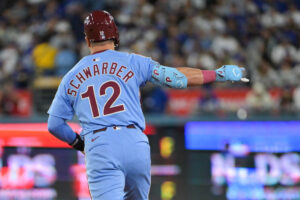
The deal is a testament to Schwarber’s elite talents as it sets new precedents in a few different ways. Schwarber is primarily a designated hitter, having played the outfield just 13 times combined over the past two years. He is also turning 33 years old in March.
Those are both qualities which tend to tamp down a player’s earning power. As shown in MLBTR’s Contract Tracker, the biggest guarantee for any free agent age-33 or older was Josh Donaldson‘s $92MM deal with the Twins, which was signed when he was still a capable third baseman. Pure designated hitters also tend not to get paid. Per the Contract Tracker, Shohei Ohtani is the only free agent DH to get to nine figures. He was obviously a special case as a two-way player and superstar. J.D Martinez signed a five-year, $110MM deal with the Red Sox in 2018. He was still an outfielder at the time but did become more of a DH over the course of that pact.
Schwarber himself has proved to be a special case, as he just keeps getting better at the plate. He has always been a guy who strikes out and walks a lot, with notable power mixed in. From 2017 to 2021, he was generally good for about 30 home runs per year. He got to 38 in 2019, but that was the year with the juiced balls.
Over the past four years, Schwarber has never finished with fewer than 38 long balls. He’s reached 46 in three of those four. In 2025, he set a new personal best with 56. He has also erased his previous platoon issues. In 2024, he slashed .300/.407/.490 for a 152 wRC+ against lefties, compared to a .218/.342/.482 line and 124 wRC+ otherwise. In 2025, those lines were .252/.366/.598 and .232/.364/.541 for respective wRC+ numbers of 162 and 146.
On top of the statistics, Schwarber has received praise for his leadership and clubhouse presence during his time with the Phillies. They clearly wanted to bring him back but plenty of other teams were interested as well. The Mets, Pirates, Reds, Red Sox, Orioles and Giants were all connected to him in recent weeks. The Bucs even reportedly made an offer of four-years and $120MM, a very bold gesture for a club that has never signed a free agent for more than $39MM.
But amid all that interest from other clubs, it always seemed like the safe bet would be Schwarber returning to Philadelphia. He was clearly beloved in the city and in the clubhouse. The Phils have a number of other needs but they have been aggressive spenders in recent years and it seemed like they would likely top whatever deal Schwarber got elsewhere. They have done so and, as mentioned, set new benchmarks for free agent deals for a hitter this age or a designated hitter of any age. MLBTR predicted he could secure a five-year, $135MM deal. He got those five years but did a bit better than predicted in terms of the average annual value.
Per RosterResource, the deal brings the Phils up to a payroll of $270MM and a competitive balance tax figure of $289MM. At the end of 2025, those numbers were $291MM and $314MM. If they plan on getting to a similar spot in 2026, they have about $20MM left to play with.
They still have a few things on the to-do list. In addition to Schwarber, they also want to bring back catcher J.T. Realmuto, who also became a free agent at the end of the 2025 season. Remaking the outfield and adding to the pitching staff are also on the agenda. $20MM wouldn’t be a ton to do all of that, so perhaps they will be willing to raise the payroll again, though they could also try to accomplish a few things on the trade market.
For the other teams, it’s possible that this opens the offseason floodgates. The position player section of free agency has been slow moving so far. Early on, Trent Grisham and Gleyber Torres accepted qualifying offers. The Mariners and Josh Naylor quickly reunited. For the past three weeks, there have been no multi-year deals for free agent hitters.
Now that Schwarber is off the board, the clubs who fell short will be pivoting to other options. Some of those clubs won’t be players for Kyle Tucker or Bo Bichette but perhaps Cody Bellinger, Pete Alonso, Eugenio Suárez, Alex Bregman and others will see their markets heat up in the coming days and weeks.
Jeff Passan of ESPN first reported the five-year, $150MM agreement. Bob Nightengale of USA Today had the even salary breakdown. Photos courtesy of Jayne Kamin-Oncea, Imagn Images
White Sox Win Draft Lottery
The White Sox have won the MLB Draft Lottery and earned the first pick. They had the best odds to land the top spot at 27.73%. Chicago will be followed by the Rays and Twins.
Here’s the first round order:
- White Sox
- Rays
- Twins
- Giants
- Pirates
- Royals
- Orioles
- Athletics
- Braves
- Rockies
- Nationals
- Angels
- Cardinals
- Marlins
- Diamondbacks
- Rangers
- Astros
- Reds
- Guardians
- Red Sox
- Padres
- Tigers
- Cubs
- Mariners
- Brewers
This is the fourth edition of the draft lottery. The system was introduced through the most recent collective bargaining agreement to deemphasize tanking. The top six overall selections are determined by the lottery. There are limitations on picking in the lottery in multiple years. Clubs that aren’t revenue sharing recipients are barred from getting lottery picks in consecutive years, and no team can pick in the lottery three years in a row. Those parameters knocked out the Rockies, Nationals, and Angels this year.
Record still has weight when it comes to the draft order, which propelled the 60-win White Sox to the top of the odds board for the No. 1 selection. The Twins had the second-highest odds to earn the first pick at 22.18%, followed by the Pirates at 16.81%. No other team had better than a 10% chance to win the lottery.
This is the second time the team with the best odds received the top pick. The Pirates, along with two other teams, had the top odds when they won the 2022 lottery and earned the right to select Paul Skenes. The Guardians were a long shot to win in 2023, and the Nationals had the fourth-best odds in 2024.
The Giants and Royals came out as big winners, finding themselves with lottery picks after winning 80+ games last season. San Francisco went .500 and finished just two games out of a Wild Card spot. Kansas City ended up above .500 for the second straight year.
The Cardinals had a significant drop, falling from the eighth-best odds down to the 13th pick. The Marlins also fell five spots, going from the ninth-best odds to the 14th pick.
UCLA shortstop Roch Cholowsky is widely regarded as the top prospect in the 2026 draft. High school shortstop Grady Emerson and Alabama infielder Justin Lebron are candidates to be selected with early picks.
Phillies Extend Rob Thomson
The Phillies are getting the band back together. The club and manager Rob Thomson have signed an extension which runs through 2027. Scott Lauber of the Philadelphia Inquirer was among those to relay the news.
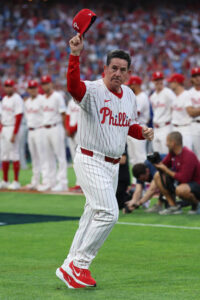
The news is notable but unsurprising. Thomson took over as the Philly skipper in the middle of the 2022 campaign when Joe Girardi was fired. Since then, the club has been very successful and Thomson has received consistent praise for his handling of the star-laden roster.
The Phils finished that 2022 campaign with a modest 87-75 record but that was enough to nab a Wild Card spot. They then went on a deep postseason run, losing the World Series to the Astros in six games. They followed that up with a 90-win campaign in 2023. That led to another Wild Card spot and a trip to the NLCS. The two most recent seasons saw the Phils win 95 and then 96 games. They won the National League East in both of those, though they were felled in the NLDS each time.
The lack of postseason success seemingly hasn’t dampened the vibes from the team. Rather, it’s led to more of a “job’s not done” type of attitude. The Phils are also reportedly reuniting with designated hitter Kyle Schwarber and would like to do the same with catcher J.T. Realmuto.
The one player who has seemingly not gelled with Thomson is Nick Castellanos. The outfielder was benched for a game in June due to what Thomson referred to as “an inappropriate comment,” per ESPN. Later in the year, Castellanos publicly called out Thomson for what he called “questionable” communication. Castellanos remains on the roster but the Phils are reportedly hoping to trade or release him, which is perhaps an indication of how the club feels about the spat.
After the 2024 season, Thomson was going into the final season of his contract. Teams generally prefer their managers and front office personnel to not be in lame-duck status, so he and the Phils worked an extension running through 2026. One year later, finding themselves in the same situation, they have once again tacked an extra year onto the deal.
Though he’s relatively new to managing, Thomson has been in the game a long time and is now 62 years old. He was actually planning to retire in 2022 before getting to sit in the manager’s chair. It seems that he and the Phils are happy to keep things rolling forward but they have continually kept the deals fairly short, perhaps allowing Thomson to re-evaluate his long-term plans after each season.
For now, the Phils will opt for a good amount of continuity. As mentioned, things have generally been going quite well in recent years. Ideally, they can have another season of regular season success in 2026, perhaps with a bit of extra postseason magic.
Photo courtesy of Jayne Kamin, Bill Streicher, Oncea-Imagn Images