
Yankees Select Brendan Beck
The Yankees announced Thursday that they’ve selected the contract of righty Brendan Beck from Triple-A Scranton/Wilkes-Barre. Right-hander Yerry de los Santos was optioned to Triple-A following last night’s game. New York already had a trio of 40-man roster vacancies. Their roster is now at 38.
Beck will be with the club for today’s afternoon tilt against the Rangers and could make his big league debut. Veteran righty Paul Blackburn is slated to start for the Yanks after Ryan Weathers was scratched due to illness. Beck, a starter with the Yankees’ top affiliate, could be a long relief option behind Blackburn, whose longest outing of the season has been three innings. Weathers will slot back into the rotation next week, manager Aaron Boone told reporters last night (link via ESPN’s Jorge Castillo). Weathers himself told the team’s beat that he got sick shortly after his last start and wound up losing nine pounds in under 48 hours (via SNY’s Chelsea Janes), so he’ll understandably be pushed back a few days as he regains strength.
The 27-year-old Beck — the younger brother of Giants righty Tristan Beck — was the Yankees’ second-round pick out of Stanford back in 2021. He’s a soft-tossing righty with plus command whose pro career has been marred by injuries. Beck required Tommy John surgery not long after being drafted and then missed all of the 2024 campaign due to another elbow surgery.
Beck returned from that second elbow procedure in 2025 and delivered a terrific season between Double-A and Triple-A, combining for 131 1/3 innings with a 3.36 ERA, a 23.6% strikeout rate and a 6.9% walk rate. He’s had an uneven start to his 2026 season, serving up a 5.11 ERA in 37 frames, but nearly all the damage against him thus far came in a pair of nightmare outings that saw him yield seven and eight runs. He’s held opponents to two or fewer earned runs in four of seven starts this year and is coming off a strong seven-inning outing against the Blue Jays’ top affiliate, where he held his opponents to a pair of runs on five hits and a walk with four strikeouts.
The Beck brothers, whose mother was born in England and whose grandfather was born in Wales, pitched for Great Britain’s team in this year’s World Baseball Classic. Brendan tossed four shutout innings with four strikeouts. This is his first career selection to the 40-man roster, so 2026 will be the first of three minor league option years for him. The Yankees can control Beck for at least six years beyond the current campaign.
Yankees Notes: Weathers, Lagrange
Ryan Weathers was knocked around in today’s Grapefruit League loss. The new Yankees southpaw allowed seven runs on eight hits in three innings. He’s up to 16 earned runs over 12 1/3 frames across four starts this spring.
The struggles haven’t jeopardized Weathers’ hold on a rotation spot. Manager Aaron Boone confirmed the lefty will open the season in the starting five (relayed by Bryan Hoch of MLB.com). Boone noted that he’s more focused on the pitcher’s raw stuff than results in exhibition play.
Despite being hit around, Weathers has shown a promising arsenal. His fastball is up above 98 mph on average, a tick higher than his 97 mph heater during last year’s regular season with Miami. Weathers has picked up 17 strikeouts while missing bats on more than 14% of his offerings. It’s certainly an ugly ERA, but the velocity and whiffs are encouraging.
Max Fried, Cam Schlittler, Will Warren, Luis Gil and Weathers will comprise the season-opening rotation. Gerrit Cole and Carlos Rodón are each opening on the injured list. Cole threw an inning in his first Spring Training appearance on Wednesday. Rodón hasn’t pitched this spring but could be ready for regular season action by the end of April.
Weathers and Gil each have a minor league option remaining. They’ll have a few starts to try to ensure they stick in the rotation once Rodón and/or Cole are healthy. It’d be crowded if everyone is available, but the Yankees don’t have much experienced depth in the short term. Osvaldo Bido is out of options and could find himself back on waivers next week. Swingmen Ryan Yarbrough and Paul Blackburn and prospect Elmer Rodríguez (who has yet to pitch in the big leagues) are the other healthy rotation options on the 40-man roster.
Among the team’s non-roster invitees, no one turned more heads this spring than righty Carlos Lagrange. The 22-year-old fireballer reeled off 13 2/3 innings of one-run ball while recording 13 strikeouts. He was routinely pumping triple digit fastballs with wipeout secondary stuff. There was some thought that Lagrange might even be pitching his way into the Opening Day conversation, but the Yankees reassigned him to minor league camp this afternoon.
Boone acknowledged that Lagrange looked much nearer to MLB readiness than he’d anticipated coming into the spring. “I don’t know if we were ever going to break [camp] with him, but I would say we’ve at least talked about it,” he told Greg Joyce of The New York Post. “What he’s done the last six weeks definitely made us think maybe he’s closer than we think.”
Lagrange’s arsenal would probably play in the big league bullpen already. It’s potential top-of-the-rotation stuff, so the Yankees will continue developing him as a starter in the minors to work on his command. Lagrange was around the zone this spring, only issuing four walks with one hit batter. That’s obviously a small body of work. His strike-throwing has been the big question in the minors. Lagrange walked more than 12% of opponents in his 120 innings between High-A and Double-A last year. He’ll need to be added to the 40-man roster to keep him out of the Rule 5 draft next offseason, and it seems likely he’ll debut at some point this year.
Poll: How Will The Yankees’ Rotation Fare In 2026?
Much has been made of the Yankees’ apparent offseason strategy of “running it back.” While retaining Trent Grisham and especially Cody Bellinger surely count as successes, some fans were hoping for more tangible improvements. Aaron Judge will be 34 in April, and there are only so many years left in his prime (at least as a perennial MVP candidate). The Blue Jays, Orioles, and Red Sox have all upgraded their rosters, meaning the Yankees will have their work cut out for them in 2026.
One area with a range of potential outcomes is the rotation. The group performed quite well in 2025, placing eighth in the league with a combined 13.5 fWAR. Max Fried and Carlos Rodón were the biggest reasons for that success. Fried excelled in a career-high 195 1/3 innings, showcasing his signature control and groundball tendencies en route to a fourth-place finish in AL Cy Young voting. Rodón matched Fried’s innings total in his best season as a Yankee, posting a 3.09 ERA with an above-average 25.7% strikeout rate and cutting down on home runs. Rookie Will Warren made 33 starts and showed promise, as did Cam Schlittler in a second-half callup.
The ceiling is clearly high, especially if Warren and Schlittler do well in their sophomore campaigns. Still, there are downside risks related to injuries, underperformance, and depth. Starting with injuries, Gerrit Cole will be back at some point after missing last year due to Tommy John surgery. Prior to that, he only pitched half a season in 2024 due to elbow inflammation. He is now 35 years old with his last full-season workload coming in 2023, when he won the AL Cy Young award.
Manager Aaron Boone said last week that Cole has “had a good rehab” with “no hiccups” (link via Manny Randhawa of MLB.com). It’s not a matter of whether he will perform well when he returns. The question is whether he will sustain his ace-level, pre-injury performance now that he is in his mid-30s and coming off of injury. There is also the matter of volume, as even a June return from Cole would leave several months’ worth of innings for other starters to cover.
Rodón is in a similar spot after undergoing surgery in October to remove loose bodies in his elbow. He is more likely to avoid starting 2026 on the 60-day injured list than Cole, with Rodón aiming to return in late April or early May. He is two years younger than Cole, so he’s less of a risk to suddenly decline. The question with Rodón is whether he can repeat his 2025 performance. A look at his Statcast page offers reason for optimism, with his fastball, breaking, and offspeed run values all grading in the 91st percentile or better. That said, he was more of a mid-rotation starter in 2024, when he posted a 3.95 ERA and allowed 1.59 home runs per nine innings. Both he and Cole are under contract through 2028.
As for the younger arms, a lot of the rotation’s success depends on improvement from Warren and Schlittler maintaining his performance over a larger sample. For Warren, that comes down to improving his secondary offerings. While his fastball graded out in the 95th percentile by run value, his breaking and offspeed pitches were points of struggle. His slider was his main breaking pitch, but Statcast considered it 10.6 runs below average. His curveball and changeup were both at least 4.6 runs below average. His 24.1% strikeout rate was impressive, but he’ll need to sharpen his secondary offerings and cut back on hard contact if he wants to become a true mid-rotation starter.
Schlittler was a revelation in 14 starts last year. He had a 2.96 ERA and a 27.3% strikeout rate in 73 innings during the regular season and turned in an all-time rookie performance in Game 3 of the Wild Card Series against the Red Sox. His ceiling is arguably higher than Warren’s, although there are similar questions regarding his secondary offerings and control. Statcast took a negative view of his curveball and slider, which he only used a combined 17.3% of the time. Meanwhile, his 10.2% walk rate could use some improvement. None of that diminishes the value of his plus fastball, of course. Still, he’ll need to make adjustments in order to sustain last year’s performance.
Outside of those arms, the club has Luis Gil and newly-acquired Ryan Weathers on hand. Gil won the AL Rookie of the Year award in 2024 but only threw 57 innings over 11 starts last year due to a right lat strain. His 3.32 ERA was good on the surface, but his peripheral numbers – 4.94 xERA and 4.63 FIP – painted him about a run and a half higher. His struggles with control are well-known at this point, and he also suffered a 10.0% drop in strikeout rate in 2025.
Weathers has 86th-percentile fastball velocity, but he has only thrown 281 big-league innings since debuting in 2021. Last year, he was limited to eight starts and 38 1/3 innings due to left flexor and lat strains. The Yankees shelled out four prospects to acquire him, so they’ll give him a chance to harness his fastball while betting on better health. Otherwise, the team has Ryan Yarbrough and Paul Blackburn as depth options. Yarbrough did well enough last year, but neither option inspires much confidence if they need to cover significant innings. Meanwhile, Clarke Schmidt underwent UCL surgery in July, so he won’t be an option until the second half, if at all.
How do you think the Yankees’ rotation will fare in 2026? Be sure to let us know in the poll.
How Will The Yankees' Rotation Fare In 2026?
Photo courtesy of Rafael Suanes, Imagn Images
Details On The Mets’ Offseason Pursuits
The Mets’ offseason has seen a bevy of major names both coming and going off the roster, and the New York Post’s Joel Sherman provides a nice breakdown of both the team’s moves and some of the behind-the-scenes plans (or backup plans) that went into these transactions. Sherman’s piece also details some free agent and trade candidates who hadn’t been previously cited as Mets targets, including Ranger Suarez, Ryan Weathers, Johan Oviedo, and Pirates hurlers Bubba Chandler and Braxton Ashcraft.
New York’s trade for Freddy Peralta earlier this week helped the Mets finally secure the frontline rotation help they’d been seeking all winter, which helped because many of the other pitchers the team was exploring had already changed teams. The Yankees acquired Weathers from the Marlins two weeks ago, the Red Sox landed Oviedo from the Pirates in early December, and Suarez signed with the Red Sox last week as well on a five-year, $130MM contract.
That type of long-term deal for a pitcher was thought to be outside of the Mets’ comfort zone, as multiple reports indicated that the team preferred shorter-term arrangements when trying to find rotation help. The same was largely true of the Mets’ position-player pursuits, as the team offered Kyle Tucker four years and $220MM, and then landed Bo Bichette on a three-year, $126MM deal with two player opt-out clauses. If Bichette hadn’t signed and Suarez had remained available, Sherman wrote that the Mets “would have pivoted to try to upgrade the rotation with a willingness to do the five years at $130 million Boston did.”
It’s an example of how the offseason can be a series of sliding doors, with a team’s priorities quickly changing when other teams start making moves and various star players leave the board. Bichette himself wasn’t even known to be a Mets target until the eleventh hour, as missing out on Tucker led the Mets to quickly turn to Bichette and snatch him away from an almost-finalized agreement with the Phillies. And, as it turned out, the Mets ended up landing their desired ace in inexpensive fashion in terms of money (Peralta is owed $8MM in 2026 before entering free agency next winter), but at the hefty trade cost of noted prospects Brandon Sproat and Jett Williams.
Prying Bichette away from the Phillies may have provided some measure of revenge for the Mets after their unsuccessful pursuit of Kyle Schwarber. New York was known to have interest in Schwarber’s services, and Sherman noted that the Mets “were much deeper in on him than previously publicly known.” It was widely expected that Schwarber would re-sign with the Phils and he indeed rejoined the club for five years and $150MM. As interested as the Mets were, Sherman wrote that they “perceived they would have to beat [five years/$150MM] by a good deal to get him to leave Philadelphia,” so the Amazins backed off.
The Mets had plenty of talks with the Marlins about Edward Cabrera before Cabrera was dealt to the Cubs, so it isn’t surprising that Weathers’ name was also brought up in those discussions. Sherman reported that 8-10 teams had interest in Weathers, and it ended up being the Yankees (another Cabrera suitor) who landed the southpaw for a four-prospect package.
It was no secret that the Pirates were looking to upgrade their lineup this offseason, and with a surplus of arms on the roster, the assumption was that Pittsburgh would look to move starting pitching for some bats. The five-player deal that sent Oviedo to Boston brought back Jhostynxon Garcia as a young outfielder who can help the Bucs as early as 2026, and Mike Burrows was traded to the Astros as part of the three-team swap with the Rays that brought Brandon Lowe to Pittsburgh.
With Oviedo and Burrows gone, the Pirates have probably closed the door on further pitching trades, as GM Ben Cherington has said the team would now be open to adding a bit of rotation depth, if anything. Chandler (one of baseball’s top pitching prospects) and Ashcraft (a former second-round pick) each made their MLB debuts in 2025 and look to be part of the Pirates rotation both this season and for years to come, if everything pans out.
Sherman said the Mets “extensively” discussed Chandler, Ashcraft, and Oviedo in negotiations with the Pirates, and it would be fascinating to know the specifics of those talks. Gauging by the Oviedo deal, the Bucs were presumably looking for controllable position-player talent, so any of Brett Baty, Mark Vientos, Ronny Mauricio, or even top prospect Carson Benge might have been on the Pirates’ wish list. If Pittsburgh had looked for more of a veteran bat in the Lowe mold, Jeff McNeil (who was dealt to the A’s just before Christmas) might have been a fit, but it is hard to imagine the Pirates would’ve given up a significant MLB-ready pitcher for McNeil.
Marlins Trade Ryan Weathers To Yankees
The Marlins moved another starter, trading Ryan Weathers to the Yankees for four prospects: outfielders Dillon Lewis and Brendan Jones and infielders Dylan Jasso and Juan Matheus. New York already had two openings on the 40-man roster, so no corresponding moves were necessary. Both teams have announced the deal.
It’s the second significant rotation move in as many weeks for Miami. The Fish swapped Edward Cabrera to the Cubs for a package led by rookie outfielder Owen Caissie on Wednesday. It’s surprising to see them pull the trigger on another deal to subtract a controllable starter. Cabrera and Weathers have each had trouble staying healthy, and Miami evidently preferred to stockpile position players over the pair of talented but risky starters.
Weathers, a 26-year-old lefty, is the son of longtime big leaguer David Weathers (who coincidentally was traded from the Florida Marlins to the Yankees at the 1996 deadline). This is the second time that Ryan Weathers finds himself on the move. The Padres selected him with the #7 overall pick in the 2018 draft. He made it to the majors within three years, no small feat for a pitcher who signed out of high school, but struggled in scattered looks with San Diego. The Friars dealt him to Miami at the ’23 deadline for first baseman Garrett Cooper.
The Weathers acquisition came a few months before Miami installed Peter Bendix atop baseball operations. Weathers has shown mid-rotation potential over the past couple seasons but hasn’t been able to put together a full showing. A strained index finger on his throwing hand cost him three months in 2024. He missed the first six weeks last year after suffering a forearm strain during Spring Training. Weathers returned and pitched well over five starts before going down again — this time with a lat strain that knocked him out into September.
Weathers has been limited to 24 starts and 125 innings over the past two years. He turned in a 3.74 earned run average with a solid 22% strikeout rate and lower than average 6.8% walk percentage. Weathers has pushed his average fastball into the 96-97 MPH range and can miss bats with his changeup and sweeper. At full health, he has looked like a potential third or fourth starter. He hasn’t been healthy for more than a couple months at a time since 2023.
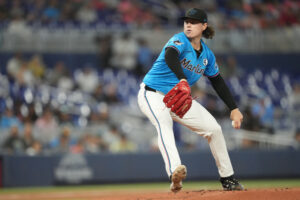
Miami and Weathers settled on a $1.35MM salary last week. This offseason was his first of arbitration eligibility. He’ll go through the process at least twice more and won’t hit free agency until the 2028-29 offseason at the earliest. The Yankees are currently in the third tier of luxury tax penalization and taxed at a 95% rate on spending up to $304MM. Weathers’ modest salary means New York only takes on roughly $1.3MM in taxes to add him.
There’s also some roster flexibility, as the southpaw has one minor league option remaining. Weathers should break camp in Aaron Boone’s rotation assuming he gets through Spring Training healthy. Gerrit Cole and Carlos Rodón will open the season on the injured list, while Clarke Schmidt could miss the entire year after last July’s Tommy John procedure. Weathers slots alongside Will Warren and Luis Gil as their projected third through fifth starters behind Max Fried and Cam Schlittler. Any of Weathers, Warren or Gil could be optioned to Triple-A if everyone’s healthy once Rodón and/or Cole return.
The trade should increase Miami’s urgency to add an affordable starter via free agency. Eury Pérez and Sandy Alcantara are the only two locks for Clayton McCullough’s season-opening rotation. Braxton Garrett (internal brace) and Max Meyer (hip surgery) missed most or all of the 2025 season. They’re expected to be ready for Opening Day but should be on innings limits. Journeyman Janson Junk was a decent fifth starter, while Ryan Gusto and Adam Mazur have limited MLB experience.
There’s more upside coming through the pipeline. Highly-regarded prospects Thomas White and Robby Snelling have reached Triple-A. Snelling dominated over 11 starts there and has a strong chance to win a rotation spot out of Spring Training. Former second-rounder Dax Fulton is on the 40-man roster and has also reached Triple-A, though he’s coming off a less impressive season in the high minors.
It remains a high-ceiling group, especially once White and Snelling take the mound at loanDepot Park. They’re short a veteran at the back end whom they can rely upon for some innings. It’s likely they’ll dip into free agency for a starter on a one-year deal, as they did last winter with the Cal Quantrill signing. They should aim a little higher this time around since it’s not out of the question they compete for a playoff spot in 2026. Maybe a multi-year deal candidate like Zack Littell or Nick Martinez winds up dropping into their price range as Spring Training approaches. Jose Quintana, Martín Pérez and former Miami draftee Chris Paddack are all locks for one-year deals and would be more comparable to the Quantrill pickup.
Lewis is the biggest get of the four prospects. Jon Heyman of The New York Post reported last week that Miami evaluators were particularly bullish on the 22-year-old outfielder. His name came up in conversations between the teams when New York was pursuing Cabrera. While they didn’t find an agreeable package in those conversations, the Marlins found another way to add Lewis to the system.
A right-handed hitter, Lewis was a 13th-round pick in 2024 out of Queens University of Charlotte. While he didn’t enter pro ball with a ton of fanfare, he impressed pro scouts during his first full season. Baseball America recently ranked him eighth among Yankees prospects, while he slotted 16th in the system at MLB Pipeline.
Evaluators praise his center field defense and big exit velocities that hint at the raw power upside in his 6’3″ frame. He’s coming off a .237/.321/.445 slash with 22 home runs and 26 stolen bases in a pitcher-friendly setting in the low minors. Lewis struck out at a higher than average 23.5% rate, which is concerning for a college draftee who has yet to advance beyond High-A. There’s a decent amount of risk with questions about his hit tool and distance from the majors, but he’s another toolsy outfield pickup for a club that added Caissie last week.
Jones was another late-round college pick in 2024. A left-handed hitting center fielder out of Kansas State, he combined for a .245/.359/.395 line between High-A and Double-A. Jones walked in almost 15% of his plate appearances and stole 51 bases in 60 attempts. He’s listed at 5’10” and doesn’t have Lewis’ physical upside, but scouts praise his approach and speed. Baseball America ranked him 13th in the Yankees system, while he landed 15th on Pipeline’s ranking. There’s a decent chance he ends up as a fourth outfielder.
Jasso, 23, is a right-handed hitting corner infielder who spent last season in Double-A. He had a solid year, batting .257/.326/.400 with 13 homers. Jasso was a 2023 undrafted free agent whose minor league performance landed him in the back third of New York’s top 30 prospects. He should begin the season at Triple-A Jacksonville and could find himself in the MLB mix by the end of the year. He’ll be eligible for the Rule 5 draft next winter.
Miami rounds out the return with Matheus, a 21-year-old shortstop/third baseman out of Venezuela. The switch-hitter put together a .275/.365/.376 line with a 12.3% walk rate and 18.5% strikeout percentage in A-ball last year. Matheus is on the smaller side at 5’10” and hasn’t hit for more than five home runs in a season. He’s a lottery ticket potential utility player who’ll also be eligible for the Rule 5 draft after the ’26 season.
Jack Curry of The Yes Network first reported the Yankees were acquiring Weathers for four prospects. Craig Mish of SportsGrid had the full return. Image courtesy of Jim Rassol, Imagn Images.
Marlins Notes: Cabrera, Alcantara, Weathers, Outfield, Bullpen
While much of the focus regarding the Marlins this offseason has been on their intent to spend more aggressively (relatively speaking) and bolster the lineup, the Fish still have a pair of prominent trade candidates in the rotation. Right-handers Edward Cabrera and Sandy Alcantara are on wishlists for pitching-hungry clubs around the league, though neither is a lock to be moved.
Kevin Barral and Isaac Azout of Fish On First reported last week that the organization “expects” Alcantara to be with the club come Opening Day. MLB.com’s Christina De Nicola offers a similar sentiment today, suggesting that Cabrera is the likelier of the two to be moved this offseason — if either is traded at all. Miami isn’t actively shopping either pitcher at the moment, she writes, though it’s all but a given that there’ll be an uptick in inquiries at next week’s Winter Meetings. De Nicola also lists lefty Ryan Weathers as a potential trade candidate while rightly noting that the Fish would be selling low on a talented southpaw after consecutive injury-plagued seasons.
Acquired in the 2023 trade sending Garrett Cooper to the Padres, Weathers has been a steal for Miami when healthy. That’s been a major caveat, unfortunately. A lat strain, flexor strain and finger strain have combined to limit the former No. 7 overall draft pick to just 24 starts dating back to Opening Day 2024. Weathers has totaled 125 innings in that time and notched a 3.74 ERA with a 22% strikeout rate and 6.8% walk rate. That league-average strikeout rate is backed by a roughly average 11.7% swinging-strike rate. Weathers has sat 96.2 mph on his heater since ’24 and kept a strong 45.6% of batted balls against him on the ground. As with Cabrera, he’s a clear injury risk but has had some recent success and comes with another three seasons of club control.
Cabrera stands as the prize of the Marlins’ potential trade candidates in the rotation, but because of his age (27), affordable salary ($3.7MM projection, via MLBTR contributor Matt Swartz), former top prospect status and 2025 results (3.53 ERA, 25.8 K%, 8.3 BB%, 46.6 GB% in 137 2/3 innings), he also surely comes with the highest asking price.
Jeff Passan and Kiley McDaniel of ESPN wrote just this morning that Miami has asked for “premium prospects” in for any club that has poked around on Cabrera, and the right-hander’s lengthy injury history has left interested parties wary of making such a commitment. The 2025 season was Cabrera’s first reaching 100 innings in the majors, and he’s spent time on the injured list with an elbow sprain, blisters, shoulder impingement (three times) and tendinitis in his elbow — all since 2021.
Certainly, the Marlins could use their deep supply of starting pitching to bring in some bats to help the lineup, but free agency remains a viable path as well. They’ve primarily focused on first base to this point, but Barry Jackson of the Miami Herald reports that president of baseball ops Peter Bendix and his staff have begun to broaden their search. Miami is also looking into potential outfield and third base acquisitions, believing that the versatility of players like Connor Norby and Griffin Conine could allow them to target bats at other positions.
It’s already known that the Marlins have been considering Norby at first base. Jackson adds that the Fish are planning to get Conine some work at first next spring and also believe that outfielder Heriberto Hernandez could be an option there.
The bullpen has been another point of focus for Bendix & Co., with reports tying Miami to prominent names like Devin Williams (who has since signed with the Mets), Raisel Iglesias (who re-signed in Atlanta) and Pete Fairbanks (who Bendix knows well from his days as Rays general manager). Jackson adds veteran relievers Kyle Finnegan, Tyler Rogers and twin brother Taylor Rogers as three more bullpen arms who intrigue the Marlins.
Finnegan, 34, has closed games for the division-rival Nationals for years but elevated his production to new heights following a summer trade to the Tigers. Detroit pushed Finnegan to use his splitter more and tweaked his release point, and the right-hander was flat-out dominant in the Motor City, emerging as one of manager A.J. Hinch’s go-to relievers. He tossed 18 innings of 1.50 ERA ball following the trade and saw his strikeout rate jump from 19.6% in D.C. to an eye-popping 34.8% in Detroit.
The Rogers brothers have lengthy track records themselves. Taylor, a lefty, was a high-end setup man and All-Star closer with the Twins during his peak years from 2017-22. He’s settled into more of a middle relief role since signing with the Giants — where he teamed with his brother — and subsequently being traded to the Reds and Cubs.
While Taylor was the prominent name early in the brothers’ careers, it’s Tyler who is now the higher-profile reliever. He’s pitched 378 1/3 innings of 2.71 ERA ball dating back to 2021, including a pristine 1.98 earned run average in 77 1/3 frames between the Giants and Mets in 2025. Tyler doesn’t miss many bats, as one would expect from a soft-tossing right-handed submariner whose sinker averages 83.5 mph, but he has impeccable command (2.2% walk rate since 2024) and is all but impossible to square up due to the deception in his delivery. Tyler has the slowest “fastball” and lowest whiff percentage in the majors but also sits in the 95th percentile (or better) of big league pitchers in terms of opponents’ exit velocity, barrel rate and hard-hit rate.
At the moment, Miami has a projected 2026 payroll of just $59MM, per RosterResource. They’re sitting just under $70MM in luxury tax obligations. The general thinking has been that, like the A’s last offseason, the Marlins will want to push that CBT number closer to $105MM in order to avoid any type of MLBPA grievance that might jeopardize their revenue-sharing status. That could be achieved by bringing in free agents, trading for veterans on guaranteed salaries, or extending players already on the roster. The Marlins have reportedly spoken to both Kyle Stowers and Eury Perez about long-term deals; talks with either player could pick back up later in the offseason.
Marlins Designate Seth Martinez For Assignment
The Marlins announced that left-hander Ryan Weathers has been reinstated from the 60-day injured list, a move which was previously reported. In a corresponding move, right-hander Seth Martinez has been designated for assignment.
Martinez, 31, had some decent run with the Astros earlier in his career. Over 2022 and 2023, he gave Houston 81 2/3 innings, allowing 3.75 earned runs per nine. His 23.7% strikeout rate and 9.4% walk rate were both close to league average. But last year, his strikeout rate dropped to 16.2%. He was sent to the minors a few times, exhausting his final option season.
He was therefore out of options heading into 2025, which gave him a tenuous hold on a roster spot. But given his past success, he still had enough appeal to bounce around the league. In the offseason, he went to the Diamondbacks, Marlins, Mariners and Marlins again via a series of waiver claims. The Fish put him on waivers again around Opening Day, when he finally cleared.
He has therefore spent most of this year pitching in Triple-A. He logged 43 2/3 innings for Jacksonville with a 3.71 ERA, 28.9% strikeout rate and 9.6% walk rate. He was called back up to the big leagues about two weeks ago. Between then and now, he tossed 6 2/3 innings for the Marlins, allowing four earned runs via four hits and three walks while striking out four. It appears that wasn’t enough to get him beyond the fringes of the roster, so he’s been bumped off today.
With the trade deadline having passed, Martinez will have to be on waivers yet again in the coming days. He won’t have much short-term appeal to clubs, since he wouldn’t be postseason eligible for any claiming team. But he can be controlled for four seasons beyond this one since he has less than three years of service time. Given the notable interest he garnered in the offseason and his recent uptick in strikeouts in the minors, perhaps there’s a team intrigued enough to make a claim. If such a team exists, they could get a close-up look at Martinez in the final few weeks of the season as they decide about putting him in their 2026 plans.
Photo courtesy of Brad Mills, Imagn Images
Marlins To Activate Ryan Weathers On Thursday
Ryan Weathers is listed as the Marlins’ probable starter for Thursday’s game against the Nationals. He’ll be activated from the 60-day injured list and take the ball for the first time in three months. Miami will need to open a spot on the 40-man roster.
Weathers has struggled through a second straight injury-riddled year. An index finger strain on his throwing hand cost him most of the second half of 2024. This year saw him miss the first six weeks after he suffered a Spring Training forearm strain. Weathers returned and took five starts over three weeks before he sustained the lat injury.
The health problems have interrupted a potential breakout. The former seventh overall pick turned in a 3.63 ERA with solid strikeout and walk numbers across 16 starts a year ago. He has worked 24 2/3 frames of 3.28 ERA ball while punching out 22.5% of opponents this year. Weathers has pushed his average fastball velocity above 97 MPH. His changeup and breaking ball have each gotten strong results. Weathers has also shown far better command over his two seasons in Miami than he did early in his career with the Padres. He has the ability to be a mid-rotation starter if his arm holds up.
Weathers has crossed the three-year service threshold and will reach arbitration for the first time in the offseason. His limited body of work will keep his salary affordable, and he’s under team control for three years. He’s part of a talented but volatile collection of starting pitchers in Miami.
The Fish have Sandy Alcantara signed for $17MM next season. Weathers, Edward Cabrera, Braxton Garrett and Max Meyer are all eligible for arbitration. They’ve all shown flashes of promise but haven’t proven they can stay healthy. Eury Pérez is still in his pre-arbitration years. Janson Junk and Ryan Gusto could compete for spots at the back end. That’s before accounting for a minor league pipeline that features Thomas White, Robby Snelling and Noble Meyer. Alcantara will probably be on the trade block during the winter. Much of the Marlins’ short-term future will hinge on the health and development of their collection of younger arms.
Cabrera may be the biggest x-factor. He has had a career season, working to a 3.57 earned run average over a personal-high 24 starts. He has performed at a top-of-the-rotation level going back to the beginning of May: 110 innings of 2.95 ERA ball with a 26.5% strikeout rate. The run was halted when an elbow sprain sent him to the injured list last week. Cabrera also has a history of shoulder problems and hadn’t reached 100 MLB innings in a season until this year.
The Marlins shut the righty down for a week after the diagnosis. Manager Clayton McCullough said this afternoon that Cabrera will now ramp up a throwing program that gives him a chance to return this season (link via Christina De Nicola of MLB.com). McCullough unsurprisingly suggested the team would quickly shut things down if Cabrera’s elbow doesn’t respond well but indicated the pitcher and team both want to see how he feels as he throws with more intensity. Even if Miami isn’t playing for anything in the standings, Cabrera would surely feel a lot better about his offseason if he’s able to get back on the mound for an appearance or two before the year closes.
Marlins Place Ryan Weathers On 60-Day IL With Lat Strain
The Marlins announced that left-hander Ryan Weathers has been placed on the 60-day injured list due to a lat strain. Righty Eury Pérez has been reinstated from the 60-day IL, as was reported last week. Isaac Azout of Fish on First reported on Weathers prior to the official announcement.
It’s an unfortunate development for Weathers, who has had a stop-and-start career with his flashes of promise usually proving to be brief. A seventh overall pick of the Padres, he was once a top 100 prospect but struggled in his first tastes of the majors. He had a 5.73 earned run average through his first 143 big league innings when the Marlins traded for him in 2023.
In Miami, he showed some hints of a breakthrough last year. He logged 86 2/3 innings over 16 starts with a 3.63 ERA. His 21.8% strikeout rate was around average, while his 6.5% walk rate and 46.6% ground ball rate were both strong marks. Unfortunately, injuries capped the overall workload. A strain in his left index finger sent him to the IL in June and it took him over three months to return, with his final three starts occurring in September.
This year, injuries have interfered again. In mid-March, he suffered a forearm strain that sent him to the IL to start the year. He was reinstated from the IL and put up some decent numbers, with a 3.28 ERA, 22.5% strikeout rate, 7.8% walk rate and 40.6% ground ball rate in five starts this year. Unfortunately, he’s now on the shelf again. The specifics of the injury are still lacking but the fact that he’s been quickly placed on the 60-day IL after just starting on Saturday doesn’t bode well.
The move will seemingly remove any chance of Weathers being a summer trade candidate, as he will be on the shelf past the deadline. Players on the IL can be traded but it wouldn’t make much sense for the Marlins to flip him when his value is low. He can be retained via arbitration for three seasons after this one. The silver lining of the injury absences, for the Marlins, is that he won’t be able to increase his salary very much.
The Fish will have other opportunities to trade him in the future, ideally after he has shown a strong run of health to build value. Or perhaps Weathers can be a part of a competitive club in Miami, depending on how long this ongoing rebuild takes to bear fruit.
For now, the Marlins will proceed without Weathers in the rotation. Pérez jumps into a group that includes Sandy Alcantara, Cal Quantrill and Edward Cabrera, with guys like Valente Bellozo also in the mix. Max Meyer is on the IL himself but his hip impingement seems minor and he could be back shortly.
With the club sporting a 24-39 record that has them ahead of only the Rockies in the National League, it’s expected that they will be broadly open to trades. In recent years, players like Luis Arráez, Jazz Chisholm Jr. and Jesús Luzardo have been sent out of town even with years of club control remaining. As mentioned, Weathers is far less likely to be moved now, though he will ideally be able to jump back into the rotation late in the year and build some more innings going into 2026.
Photo courtesy of Nathan Ray Seebeck, Imagn Images
Poll: Should The Marlins Trade Ryan Weathers?
When it comes to trade candidates on the Marlins, the majority of the focus has been squarely on right-hander Sandy Alcantara. A recent Cy Young award winner who missed last season while rehabbing Tommy John surgery, Alcantara is earning a healthy salary on a team that is seemingly always looking for opportunities to lower its already-meager payroll and has enough team control remaining for rival clubs to convince themselves to part ways with prospects they’d never consider dealing for a rental arm.
That all makes Alcantara a sensible and attractive trade candidate on paper, but a major issue with those plans has emerged this year: he simply isn’t pitching very well. The righty’s 7.89 ERA through 12 starts is the worst mark among starters with at least 50 innings this year, and even more advanced metrics like his 5.04 FIP and 4.85 SIERA are the 11th- and tenth-worst figures in the sport respectively. It’s going to be hard to convince opposing teams to pay a premium for Alcantara as he’s currently pitching, and that’s a problem for a Miami club that’s in the midst of a deep rebuild.
While Alcantara might not be pitching like the front-line starter the team was hoping to be able to market to needy clubs this summer, another intriguing arm has inserted himself into the discussion with a strong start to the season: left-hander Ryan Weathers. The 25-year-old started the 2025 campaign on the injured list due to a forearm strain he suffered during Spring Training, but in four starts since returning he’s looked nothing short of excellent with a 2.49 ERA, 25.3% strikeout rate, and a 43.1% ground ball rate. Those peripherals don’t quite live up to that ERA, but even his 3.60 SIERA to this point in the year puts him on par with arms like Merrill Kelly and David Peterson who have established themselves as solid mid-rotation, playoff-caliber starters.
On top of his solid performance, Weathers would also be extremely attractive as a trade candidate because he’s making less than $780K this season and comes with plenty of team control. The southpaw won’t be a free agent until the end of the 2028 season, so even clubs facing tight budget restrictions in the short term or who aren’t interested in adding long-term salary commitments could have interest in his services if he’s made available. Weathers’ combination of strong results and a team-friendly contract situation could make him an extremely valuable trade asset for the Fish this summer.
With that being said, there are certainly strong reasons to think the Marlins may not want to part ways with the southpaw. Weathers is still just 25 years old and has yet to complete a full, healthy big league campaign with the club. Four starts is a small sample size that could make him difficult to market, and while good health should allow him to get more like ten to twelve starts under his belt before trade season kicks into high gear, it’s possible he’ll take a step back and wind up pitching closer to the 3.63 ERA and 4.11 FIP he posted in 16 starts last season going forward. Even if he does keep this level of success up, there’s certainly an argument to be made that Weathers could be dealt at a later date when he’s more established and teams might feel more comfortable surrendering a large trade package for him.
What’s more, Weathers’ three seasons of team control after this one could make the Marlins a bit more reluctant to trade the lefty. Miami surely hopes to be competing for the postseason again before 2029, especially with players like Kyle Stowers, Connor Norby, Agustin Ramirez, and Xavier Edwards showing themselves to be solid pieces this year. A potential front three of Eury Perez, Max Meyer, and Weathers under long-term team control would go a long way to making the Marlins legitimate contenders sooner rather than later, and many of those aforementioned pieces only have one more year of team control than Weathers does. Moving someone like Edward Cabrera, who has the same amount of team control remaining as Weathers but is two years older, could also be a preferable option given that Weathers is set to hit free agency ahead of his age-29 season.
Of course, many of the reasons that Weathers would be difficult to part ways with now could be argued as reasons he should be traded at some point. His injury history may make him less valuable in trade, but the Marlins are seeing right now with Alcantara what struggling after a major arm injury can do to a player’s value. The lefty’s youth would mean he’s in the prime of his career when the Marlins will hopefully be trying to contend again, but it also would make him a prime extension candidate for a club with deeper pockets than Miami. The collection of talent the club has at its disposal is impressive, but it still leans much more towards pitching than offense, so swapping a player like Weathers for a bat with similar control could go a long way to improving the team.
How do MLBTR readers think the Marlins should handle Weathers this summer? Should he be kept off the market entirely, shopped aggressively, or moved only if a team makes an overwhelming offer? Have your say in the poll below:
Should The Marlins Deal Ryan Weathers?
-
The Marlins should only trade Weathers if they get an exceptional offer. 58% (1,114)
-
The Marlins should trade Weathers for whatever they can get this summer. 29% (569)
-
The Marlins shouldn't trade Weathers this summer, no matter what. 13% (247)
Total votes: 1,930