
Braves Re-Sign Ha-Seong Kim
The Braves are bringing back Ha-Seong Kim on a one-year, $20MM contract, per a club announcement. The team designated right-hander Osvaldo Bido for assignment to open the necessary 40-man roster spot. Kim, a Boras Corporation client, had declined a $16MM player option and earns a $4MM raise to return as Atlanta’s starting shortstop.
Kim spent the final month of the 2025 season with the Braves. They claimed him off waivers from the Rays, who were happy to get out from under the player option. Atlanta was long since buried in the playoff picture. The move was solely about building a relationship with Kim in the hope that he’d return next year. They preferred it’d be on the player option but felt that a few weeks within the clubhouse might give them an edge in re-signing him even if he opted out.
The righty-hitting Kim made a solid impression on his new club. He reeled off a 10-game hitting streak in the middle of September and recorded at least one knock in 15 of his first 19 contests. Kim finished in a 1-19 skid over his final five games, dropping him to a middling .253/.316/.368 line in 98 plate appearances. That was still quite a bit better than the .214/.290/.321 mark he’d put up in a similar amount of playing time over an injury-riddled few months in Tampa Bay.
Overall, Kim is coming off a .234/.304/.345 slash in 48 games. The Braves certainly feel that’s not representative of his true talent. Kim had been an above-average everyday player with the Padres between 2022-24. He was a slightly better than average hitter who played plus defense throughout the infield. Kim’s time in San Diego ended when he tore the labrum in his right shoulder diving into first base on a pickoff attempt in August ’24. He required surgery that led the Padres to opt against issuing him a qualifying offer.

The Rays surprisingly won the bidding for Kim last offseason, signing him to a two-year, $29MM deal with an opt-out. It was always a baffling move for a low-payroll club. The Rays signed Kim to a $13MM salary for the first season despite knowing he was unlikely to be a factor until a few months into the year. He didn’t make his season debut until shortly before the All-Star Break. Calf and back issues resulted in subsequent minimal injured list stays. While the Rays managed to offload the final few weeks of Kim’s salaries thanks to the waiver claim, they still paid a little more than $11MM for 24 games of replacement level production.
Kim should enter the 2026 season at full health. While his results were down this year, he posted career-high marks in average exit velocity and hard contact rate. That seems to bode well for his shoulder strength, at least in the batter’s box. There may be a little more cause for concern on defense. Kim’s arm strength was down around four miles per hour this past season, according to Statcast. His arm was closer to average than the plus weapon it had been in prior years, though it hasn’t dropped to a point where the team would have any concerns about his viability on the left side of the infield. Even the post-injury version of Kim threw harder on average than Mookie Betts, Corey Seager or Taylor Walls — all of whom were Gold Glove finalists at shortstop in 2025.
The Braves aren’t the only team that viewed Kim as a solid rebound candidate. ESPN’s Jeff Passan reported that the 30-year-old rebuffed interest from clubs willing to go multiple years in order to get back to the market next winter. The Tigers were the only other team publicly linked to Kim this offseason, though clubs like the Giants and Pirates are known to be pursuing infield help. MLBTR had predicted Kim would receive a two-year, $30MM contract with an opt-out after the first season. He opts for the straight one-year deal at a higher salary to bet on himself.
Kim slots back in as Atlanta’s everyday shortstop. That’ll push trade pickup Mauricio Dubón into a utility role. The Braves were unable to make Kim a qualifying offer this offseason because they’d acquired him during the season. Assuming they don’t trade him midseason, they would have the ability to make the QO next winter. That’d entitle them to draft compensation if he plays well enough to reject and sign elsewhere.
Atlanta has been one of the most aggressive teams in the first couple months of free agency. Kim joins Robert Suarez, Raisel Iglesias and Mike Yastrzemski as significant free agent pickups. They took on Dubón’s final arbitration season, which costs $6.1MM. They have more than $245MM in guaranteed commitments for next season. They’re already well beyond this year’s approximate $208MM Opening Day mark.
The Kim signing also pushes them beyond the $244MM base luxury tax threshold, as calculated by RosterResource. They’re at roughly $255MM in CBT obligations. Atlanta had paid the luxury tax in 2023 and ’24 but stayed below the line this year. That reset their payor status going into 2026. They’re taxed at a 20% rate on their first $20MM above the line. For the moment, they have a minimal tax payment (roughly $2.2MM). That figures to climb throughout the offseason and into next year. The Braves still need to solidify a rotation that had been wrecked by injuries, and they’re certainly hoping to find themselves in position to add around the trade deadline.
With Kim staying at Truist Park, the shortstop market is essentially down to top free agent Bo Bichette. Depth types Isiah Kiner-Falefa and Willi Castro are the next-best options in free agency. There aren’t any obvious trade candidates at the position, which played into Atlanta’s decision to acquire a utilityman in Dubón to give them cover in case Kim priced himself out of their comfort zone.
Jon Heyman of The New York Post first reported that the Braves were re-signing Kim to a $20MM contract, which The Athletic’s Ken Rosenthal specified was for one year. Image courtesy of Jordan Godfree, Imagn Images.
Rangers Sign Danny Jansen
December 15: Texas officially announced the signing, also revealing the presence of a mutual option for the 2028 season. The Rangers have confirmed the Jansen and Alexander deals and are up to 37 players on the roster, pending the finalization of Díaz’s contract.
December 12: The Rangers are reportedly in agreement with free agent catcher Danny Jansen on a two-year, $14.5MM deal. The contract includes another $1MM in bonuses for the ISE Baseball client. Texas entered the night with 35 players on their roster and will not need to make any corresponding moves to accommodate this evening’s flurry of free agent activity.
It’s the second straight offseason in which the Rangers added a free agent catcher on a two-year contract. They signed Kyle Higashioka to a $13.5MM deal last winter. Jansen gets a nearly identical contract to split the playing time in 2026. Texas needed a catcher after non-tendering Jonah Heim on the heels of a second straight down year.
Jansen and Higashioka won’t match up in a strict platoon. They both hit from the right side. Neither player has huge platoon splits over the course of their careers. That’ll allow Skip Schumaker to divide the playing time based on comfort with each day’s starting pitcher. Higashioka and Jansen are similar players overall, though the latter is the more patient hitter. That provides a slightly higher floor from an on-base perspective even if neither player is likely to hit for a high average.
The 30-year-old Jansen (31 in April) was an underrated all-around catcher early in his career with the Blue Jays. He generally performed well in limited playing time but struggled to stay healthy for a full season. Jansen has avoided injuries over the past two years except for a small wrist fracture that cost him the first couple weeks of the 2024 campaign. His production on both sides of the ball dropped that year, though, leaving him to take an $8.5MM pillow contract with the Rays.
Jansen’s numbers rebounded to an extent in Tampa Bay. He hit .204/.314/.389 with 11 home runs across 259 plate appearances. It was at least a jump from a power perspective, as he connected on two more homers in that half-season than he had over 94 games in 2024. His defensive performance was mixed. Jansen is among the league’s best at blocking balls in the dirt, but his pitch framing numbers have declined over the past couple years. He doesn’t have great pure arm strength yet managed to throw out a solid 24% of baserunners after struggling in that regard in 2024.
Tampa Bay dealt him to the Brewers at the deadline. While it was surely a nice return home for the Appleton, Wisconsin native, that wasn’t an ideal landing spot a couple months before free agency. William Contreras plays as much as any catcher. Jansen only got 16 starts and tallied 78 plate appearances with the Brew Crew. He made the most of the sporadic playing time, adding another three homers and doubles apiece. He hit .254/.346/.433 in that limited look. While Jansen isn’t a high-end #1 option, he’s overqualified for a backup role behind one of the five best catchers in the game.
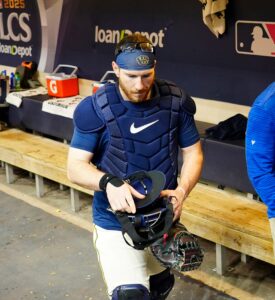
It was always going to be a brief stint in Milwaukee. They made the easy call to decline a $12MM option and look for a much cheaper backup catcher. Jansen finds a better landing spot in Arlington. He benefitted from a weak free agent class. The Rangers weren’t willing to spend what it’d take to add J.T. Realmuto. That left Jansen and Victor Caratini as the only real possibilities if they were going to sign a catcher. Everyone else in the class is a backup or organizational depth type.
RosterResource estimated the Rangers’ payroll around $167MM heading into the evening. Evenly distributing Jansen’s salaries would push that close to $174MM. Texas also agreed to one-year deals with Alexis Díaz and Tyler Alexander. Contract terms for the two pitchers are unreported, though it’s unlikely they cost more than a couple million dollars between the two of them.
The Rangers opened the 2025 season with a player payroll around $218MM. They’ve been clear that number is coming down, though it’s not known to what extent ownership is willing to go. It appears the front office will do its heavy lifting either in the lower rungs of free agency or via trade. They could use a mid-rotation starter and still need to add multiple relievers. Upgrading at least one of first or third base would also be ideal, though that’s a lot to accomplish on what appears to be a tight budget.
Robert Murray of FanSided first reported the agreement on a two-year, $14.5MM deal. Image courtesy of Imagn Images.
Subscribers On The Benefits Of Trade Rumors Front Office

As you may know, I started a paid subscription service five years ago called Trade Rumors Front Office. For $34.99 per year, subscribers enjoy ad-free browsing of MLBTR, access exclusive articles and chats from our writers every week, and dive into GM-caliber tools such as our MLB Contract Tracker. Recently I asked our subscribers if they would like to provide quotes about this service for marketing purposes. This was entirely voluntary; these are all real subscribers and none of them were paid for their quotes. I’ve chosen a few of my favorites below. Learn more about Trade Rumors Front Office here!
————————————————————————————————————————————
I was a free user of MLBTR for years. It was my go to app for all the latest news. When the pitch came around to consider subscribing, I figured I had gotten enough value over the years that I owed it to the team to support them. Wow! I had no idea what I was missing! Getting rid of the ads was worth it alone, but all the chats are awesome. The writers really take their time to thoughtfully answer all sorts of fake trade proposals and armchair GM scenarios. What I figured would be a one-time thing, is likely going to be an ongoing subscription. 100% worth the money! – Matt
I really appreciate the Front office exclusive chats and the emailed articles with each writer’s perspectives on a variety of topics. I also subscribe simply because I think the work MLBTR does is valuable and very much worth supporting. – Greg
MLB Trade Rumors’ Front Office subscription is worth every penny—and a whole lot more. It’s the only website I’m sure to read every day, and being a subscriber enhances the experience with features like ad-free browsing, Front Office chats and special articles. I don’t see how a diehard baseball fan can get along without the excellent work from the MLBTR team! – Tom
Trade Rumors Front Office has been a subscription worth every penny. From weekly chats to great detailed articles, every baseball fan would benefit greatly, and more importantly have a lot of fun, from enjoying their content. – Joseph
I think the member chats are always well done. I especially enjoy the member’s mailbag that Tim does every week. He really takes the time to give well thought out thorough answers. I’ve learned a lot from them. – Marc
None of the other sites I subscribe to are anywhere close to MLBTR. I’m seriously thinking of cancelling all of them. – Alf
MLBTR is my first read in the morning for news. My go to for breaking news. The front office subscription has been well worth the price and they’re always producing high quality content. They keep me up to date on basketball and football too. Highly recommend to any diehards of the Big 3 sports leagues! – Greg
MLBTR Front Office Subscription offers the greatest value differential from its free offering (essential for a baseball fan) than any equivalent that I am aware of. – Reynold
Has to be one of the best decisions I made signing up for this. Just a lack of advertisement that flashes on the side of the screens makes things so much easier to read. I also read the chats but after they’re completed. Just too busy during the day to be involved and I love all the extra stuff that I get. anyone not on the subscription based, you’re wasting your time it’s so inexpensive , Join today you’ll see the benefits right away. – Andy
I check MLBTR several times a day, and my Trade Rumors Front Office subscription would be a bargain at the twice at the price. MLBTR simply has the sharpest minds in baseball analysis, with a treasure trove of information at their disposal (and at ours). It is required reading for the serious baseball fan. – John
MLB Trade Rumors has been my baseball go-to for over a decade, and I subscribed this year both to support their work and to access additional quality content. Their writers have the passion of fans and the knowledge of industry pros. It’s a pleasure to read good, AI-free, well-researched writing, without corporate spin, and I plan to renew for many years to come. – Lloyd
The absolute ‘go-to’ source. Buries competitors. And, questions are answered! If you have made the decision to invest in this type of information, there is no better, cost effective way to do so. – Paul
To read about all the benefits of Trade Rumors Front Office – which comes with a 100% money-back guarantee – click here!
Blue Jays Sign Tyler Rogers To Three-Year Deal
The Blue Jays announced the signing of free agent reliever Tyler Rogers to a three-year contract. It’s reportedly a $37MM guarantee for the Frontline Athlete Management client. Rogers receives a $5MM signing bonus and a $7MM salary for the 2026 season. He’ll make $12MM annually between 2027-28 and is guaranteed a $1MM buyout on a $9MM club option for 2029. The option vests at a $12MM salary if Rogers makes 60 appearances in ’28 or combines for 110 games between 2027-28 (assuming he passes a postseason physical). Lefty Justin Bruihl has been designated for assignment as the corresponding move.
Rogers, who’ll celebrate his 35th birthday next week, secures a sizable payday to pitch at the back of the Toronto bullpen. One of the sport’s most distinctive pitchers, Rogers is a soft-tossing submariner who bided his time awaiting an MLB opportunity. He was a 10th-round pick by the Giants in 2013 who signed for $7,500 after his senior season at Austin Peay State University. Rogers spent the next six years in the minor leagues, performing well all the way up through Triple-A but without the raw stuff to get the attention of the big league club.
It wasn’t until the end of Rogers’ third full season in Triple-A that he received an MLB look. He was nearing his 29th birthday and close to calling it quits to pursue a career as a firefighter (as Alex Pavlovic of NBC Sports Bay Area covered in 2020). The Giants finally gave him an opportunity at the end of the ’19 season. Rogers tossed 17 2/3 innings of three-run ball to hold his roster spot. He broke camp the following year and has never gone back down to the minors — not even on a rehab stint.
Rogers has played six-plus seasons in the big leagues without going on the injured list. While there’s obviously some luck involved in avoiding any fluke injuries, it’s clear that his underhand delivery puts less stress on his arm. Rogers has made 403 appearances since the start of the 2020 season. That’s 30 more than any other pitcher. Most of those outings have come in high-leverage situations, as his arm angle continues to flummox hitters.
After posting a 4.50 earned run average as a rookie, Rogers has turned in a 3.04 mark or better in four of the past five seasons. He ranks near the bottom of the league in whiffs and has never posted a league average strikeout rate. That’s to be expected for a pitcher who throws an 82-83 MPH sinker and a sweeping breaking ball that clocks in around 74 MPH. It’s a profile designed for weak, ground-ball contact. Rogers gets that year after year, and he almost never puts batters on via base on balls.
While some pitchers with extremely low arm slots can struggle with opposite-handed batters, that hasn’t been an issue for Rogers. He has held lefties to a .235/.289/.336 line in 776 career plate appearances. Right-handed hitters haven’t fared much better, turning in .246/.282/.350 mark in nearly 1000 trips to the plate.

Rogers has spent the bulk of his career in San Francisco, including a two-year stretch where he overlapped with twin brother Taylor Rogers. The Giants fell out of contention shortly before the trade deadline and flipped the impending free agent to the Mets for middle reliever José Buttó and prospects Blade Tidwell and Drew Gilbert. Rogers continued churning out results in his new home, pitching 27 1/3 innings of 2.30 ERA ball. He finished the season with a career-best 1.98 earned run average behind a 62.1% grounder rate while leading MLB with 81 appearances.
The Mets unsurprisingly wanted Rogers back, but they balked at what turned out to be a surprisingly lucrative contract. He more than doubled MLBTR’s prediction of a two-year, $18MM deal. New York has also seen Edwin Díaz, Gregory Soto and Ryan Helsley sign elsewhere. They’ve added Devin Williams to close but will need to find multiple setup arms from the right side.
That’s the role Rogers should continue to fill with the Jays. Toronto was open to supplanting Jeff Hoffman in the ninth inning, but they didn’t come away with any of Díaz, Raisel Iglesias or Robert Suarez. Rogers had a brief run as San Francisco’s closer in 2021 but has otherwise been a setup man. He was fourth in MLB with 32 holds this past season and handily leads the majors in that category over the last six years. Rogers joins Louis Varland as the top leverage arms in front of Hoffman.
The Jays could still look to add a better left-hander than Brendon Little, but Rogers becomes the fifth member of their projected bullpen who cannot be optioned to the minor leagues. Hoffman, Yimi García and Eric Lauer all have the five-plus years of service time to refuse any minor league assignment. Tommy Nance is out of options. Varland can be optioned but certainly isn’t in jeopardy of being sent down. If the Jays have all six starters healthy going into the season, that’d leave only one spot for Little or another left-handed acquisition. That’s to say nothing of Rule 5 picks Angel Bastardo and Spencer Miles — both of whom have an uphill battle to stick on the roster.
Those are secondary considerations for an all-in Toronto team. The $12.333MM average annual value pushes their estimated luxury tax number to $294MM, as calculated by RosterResource. That’s already easily a franchise high before considering the possibility that they add Kyle Tucker or bring back Bo Bichette.
That’ll be their second straight season paying the competitive balance tax. They’re hit with a 42% tax on spending between $264MM and $284MM and taxed at a 75% rate from $284MM to $304MM. Any spending above the final threshold comes with a 90% penalty. The Rogers deal will come with an approximate $8-9MM tax bill. It also firmly pushes them beyond the $284MM mark at which their top pick in the 2027 draft is moved back by 10 spots (though that was basically inevitable after the Dylan Cease and Cody Ponce signings).
It’s a significant investment in a 35-year-old reliever. The Braves also went to three years, at $15MM annually, to sign Suarez on Thursday. That was the first three-year contract for a reliever that age since 2020. There hadn’t been a three-year term at more than $10MM per season for a 35-year-old bullpen arm since Mariano Rivera almost two decades ago. A closer who sits around 99 MPH, Suarez breaking that precedent wasn’t as surprising. The Jays are betting on Rogers’ unconventional style to age equally well.
Ken Rosenthal of The Athletic was first on the three-year, $37MM deal and the vesting option specifics. Jon Heyman of The New York Post reported the salary breakdown and the $9MM club option.
Image courtesy of Kyle Ross, Imagn Images.
Dodgers Sign Edwin Diaz
December 15th: The deal also contains a condition club option for 2029, reports Jon Heyman of The New York Post. That option has a $6.5MM base, with Diaz able to earn an extra $750K for 45 games finished and 50 games finished, plus another $1MM for 55 games finished. The specific conditions for the option aren’t known but Alden González of ESPN reports that it would be available to the Dodgers if Diaz spends a certain amount of time on the injured list.
December 12th: The Dodgers officially announced the signing today.
December 9th: For the second straight offseason, the Dodgers are signing the top relief arm on the market. They’ve reportedly agreed to a three-year, $69MM contract with now-former Mets closer Edwin Diaz. It’s a record-setting annual value for a reliever, breaking the $20.4MM record that Diaz himself already held. Diaz’s contract with the Dodgers contains $4.5MM in deferred salary annually. The net-present value, for luxury tax purposes, is roughly $21.1MM.
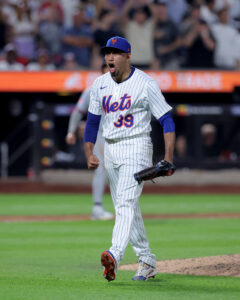
Diaz, a Wasserman client, returned to the open market this winter when he opted out of the final two seasons of the precedent-setting five-year, $102MM contract he signed with the Mets the last time he was a free agent. The right-hander had been guaranteed $38MM over the final two seasons of that contract, so by opting out and testing the market, he secured himself an additional one year and $31MM in guarantees. The Mets, according to Joel Sherman of the New York Post, offered Diaz a three-year, $66MM deal with “slight” deferrals.
The 31-year-old Diaz (32 in March) has spent the past seven years in Queens and, after a rocky first campaign, has turned in a collective 2.36 ERA (2.12 SIERA, 2.15 FIP) with a mammoth 40.8% strikeout rate and 8.9% walk rate. He’s piled up 144 saves in 332 appearances as a Met.
For the Dodgers, Diaz represents the most on-the-nose means of addressing a problem that nearly doomed them in the postseason: a lack of reliable bullpen help. Injuries to Evan Phillips, Tanner Scott, Brusdar Graterol and others left the Dodgers with a thin enough stock of trustworthy relievers that L.A. turned to Blake Snell, Tyler Glasnow and Yoshinobu Yamamoto (one day after he threw nearly 100 pitches) in pivotal high-leverage settings during their World Series run. That they even progressed to the World Series was largely attributable to historic performances from starters Yamamoto, Snell, Glasnow and Shohei Ohtani in the postseason’s earlier rounds.
The Dodgers have now signed the top reliever on the market in consecutive offseasons. They inked Tanner Scott to a four-year, $72MM pact last winter, though that deal contained $21MM worth of deferred money, thus knocking down the present value. Scott’s first year in L.A. didn’t go at all as hoped; he limped to a 4.74 ERA with improved command but lesser velocity and strikeout rates. After yielding 11 home runs in the 2022-24 seasons combined, Scott served up 11 round-trippers in his first season as a Dodger.
Certainly, they’ll hope for better results with Diaz, whose track record is lengthier and steadier than that of Scott. While he’s naturally had some year-to-year variance in his earned run averages — as is the case for any reliever — Diaz has been at 3.52 or better in each of the past five seasons, including three sub-2.00 campaigns. He’s punched out at least 34.6% of his opponents each season along the way, and since a shaky walk rate in 2021, he’s sat between 7.7% and 9.3% in that regard for four straight seasons.
That’s not to say there aren’t any red flags at all with regard to Diaz. His average fastball velocity has dipped in two consecutive seasons. While this past season’s average of 97.2 mph was still well above average, it’s also two miles per hour shy of Diaz’s 2022 peak. He also gave up considerably more hard contact. Diaz’s 88.5 mph average exit velocity and 39.7% hard-hit rate were both the second-highest marks of his career, trailing only his disastrous 2019 season (his first as a Met). Neither is a glaring issue, particularly considering Diaz maintained elite strikeout and swinging-strike rates (38% and 18%, respectively), but he’ll want to avoid allowing those negative trends to continue, however slight they may currently be.
Diaz will slot into the ninth inning, pushing Scott to a setup role alongside Alex Vesia, Blake Treinen, Anthony Banda, Brock Stewart and Graterol. Will Klein, Ben Casparius and Jack Dreyer all had solid or better seasons in 2025, but if everyone is healthy — far from a given — there’s only room for one of that trio in the final bullpen spot. Of course, injuries will inevitably create opportunities for many of the Dodgers’ overqualified depth arms, and each of Klein, Casparius, Dreyer and Edgardo Henriquez have minor league options remaining.
The Dodgers have paid the luxury tax in (more than) three consecutive seasons and are more than $60MM over the $244MM first-tier luxury threshold, meaning they’ll pay a 110% tax on the AAV on Diaz’s contract. However the annual salaries break down, he’ll cost them an additional $25.3MM in taxes alone. Assuming an evenly distributed $23MM per season, RosterResource, now projects next year’s Dodgers payroll at just over $359MM (although that does not account for substantial deferrals to Ohtani, Scott, Freddie Freeman, etc.).
The Mets would have been subject to those same penalties had they matched or topped this offer. Diaz reportedly entered the market seeking a five-year contract. When that didn’t materialize, he clearly pivoted to a record-setting, shorter-term arrangement. The extent of the deferrals in New York’s offer aren’t yet clear, but there’s no indication (yet, anyway) that the Dodgers’ offer includes any deferred money.
While New York couldn’t have known when signing Devin Williams to a three-year, $51MM pact that Diaz would also sign for three years and a total of $18MM more, the results from those two high-end relievers will now be carefully watched by Mets fans for the next three seasons. If Williams returns to form, it’ll look like a savvy pivot to get a comparable reliever at a lesser rate. If not, there will be plenty of second-guessing and criticism from the fan base.
Of course, owner Steve Cohen also clearly has the resources to have simply won the bidding on both relievers, but that’s ultimately not the route the front office chose. They’ll now look to other avenues as they seek to continue adding to the bullpen. The Mets were open to re-signing Diaz even after adding Williams, and while this deal clearly went past their comfort zone, there are other high-end arms still available — Robert Suarez, most notably. Choosing to let Diaz walk also frees up further resources for a potential re-signing of Pete Alonso or perhaps a run at another target of note.
The Mets bid farewell to Diaz, who rejected a $22.025MM qualifying offer, with only minimal compensation for his departure. Due to their status as luxury tax payors, they’ll receive a compensatory draft pick after the fourth round of next summer’s draft. The Dodgers, meanwhile, will surrender their second- and fifth-highest selections in next year’s draft. The league-allotted cap on their personal spending pool for international amateur free agents will also be reduced by $1MM.
Such considerations tend to be ancillary for the market’s top-spending clubs. Perennial luxury payors consider them the cost of doing business in the deepest waters of the free agent pool. The Dodgers have punted draft picks to sign Shohei Ohtani and Freddie Freeman (among others) in recent seasons. For them, the allure of adding a closer with nearly unrivaled dominance takes precedence as they try to assemble a roster capable of winning three consecutive World Series for the first time since the 1998-2000 Yankees.
The Athletic’s Will Sammon first reported the agreement. Sammon and colleague Ken Rosenthal were also the first to report the three-year term. ESPN’s Jeff Passan broke the total guarantee. Joel Sherman and Jon Heyman of the New York Post reported the Dodgers’ emerging interest in Diaz shortly before the agreement became public. Sherman reported on the deferrals.
Brewers Trade Isaac Collins To Royals For Angel Zerpa
December 14: Both teams have officially announced the trade.
December 13: The Brewers are sending outfielder Isaac Collins and right-hander Nick Mears to the Royals, reports Robert Murray of FanSided. Left-hander Angel Zerpa is heading to Milwaukee in the swap, reports Jeff Passan of ESPN.
Kansas City entered the offseason with a plan to add outfielders. The club made good on those intentions this week. After signing Lane Thomas on Friday, the Royals now add the switch-hitting Collins to the outfield mix. The cost is a controllable lefty reliever, though they get a bullpen piece back in return. Milwaukee clears some of its outfield glut while adding a hard-throwing reliever who is just now hitting arbitration.
The 28-year-old Collins went from relative obscurity to an integral part of Milwaukee’s offense last season. He made the team out of Spring Training and emerged as the club’s primary left fielder. Collins delivered a 122 wRC+ across 130 games. He finished fourth in NL Rookie of the Year voting, just behind teammate Caleb Durbin.
The Brewers were reportedly looking to move some of their outfield depth, with Collins and Blake Perkins mentioned as potential candidates. Jackson Chourio and Sal Frelick are entrenched as everyday options, with Christian Yelich factoring in when he isn’t DHing. Collins, Perkins, Garrett Mitchell, and Brandon Lockridge were in the mix behind that trio. Milwaukee also added Akil Baddoo on a split deal.
Zerpa popped up in trade discussions last offseason, but ultimately remained in Kansas City. He reached 60 appearances for the second straight season, posting a 4.18 ERA over 64 2/3 innings. Zerpa pushed his solid ground ball rate to league-leading levels in 2025. He’d always been more of a grounder-getter than a strikeout guy, but his 63.7% ground ball rate ranked in the 99th percentile last season.
The 26-year-old Zerpa’s 3.97 career ERA doesn’t jump off the page, though his underlying numbers paint a better picture. The lefty posted a career-best 3.38 SIERA in 2025, bringing his career mark down to 3.67. He had a solid 3.50 xFIP this past year. Zerpa has recorded a BABIP above .320 in back-to-back seasons. His ground ball approach can lead to some batted ball variance, but that number could regress in future seasons.
Mears came to Milwaukee in a trade from Colorado in July 2024. He struggled mightily in his first partial season with the team, but provided solid results as a middle relief option in 2025. Mears faltered down the stretch, allowing five earned runs in five September appearances. He also missed time with back tightness that month. Mears tossed 1 1/3 scoreless innings in the NLDS but was left off the NLCS roster.
Kansas City has been linked to several outfielders in the trade market, including Teoscar Hernandez, Jake Meyers, and Brendan Donovan. They were connected to Jarren Duran earlier today. Harrison Bader and Austin Hays have been mentioned as free agent possibilities for the Royals. They entered the offseason with an unproven group of Jac Caglianone, Kyle Isbel, and John Rave in the outfield, with Tyler Tolbert and Dairon Blanco as bench options.
Thomas and Collins aren’t Duran-level additions, but they’re improvements on the in-house choices. The former Brewer should help in particular against right-handed pitching. Collins slashed .280/.390/.415 over 295 plate appearances from the left side. He showed some power as a righty, but hit just .232 with a pedestrian .324 OBP. Thomas will likely grab playing time against lefty starters.
Zerpa is an intriguing fit in what projects to be a lefty-heavy bullpen. Milwaukee already has Jared Koenig and Aaron Ashby locked into leverage roles, with Rob Zastryzny in a middle relief gig and DL Hall as the long guy. Trevor Megill and Abner Uribe should soak up the majority of the save opportunities, with Koenig as the situational closer if multiple lefties are coming up. Zerpa might need one or two of those relievers to get dealt to factor into a late-inning job.
Photo courtesy of Benny Sieu, Imagn Images
Red Sox Showing Interest In Willson Contreras
After missing out on both Pete Alonso and Kyle Schwarber, the Red Sox continue to pursue upgrades for their lineup. One target they’re recently looked into, according to MassLive.com’s Chris Cotillo, is Cardinals first baseman Willson Contreras.
Of course, the Red Sox and Cardinals already completed one trade sending a notable veteran to Boston; right-hander Sonny Gray was traded to the Sox in exchange for righty Richard Fitts and minor league lefty Brandon Clarke earlier in the offseason. (The Cardinals included $20MM in cash to help facilitate the swap.) Like Gray, Contreras is a veteran on a pricey contract with a full no-trade clause who St. Louis would like to move in order to clear payroll and create opportunities for younger players.
However, while Gray was very clear about his willingness to waive his no-trade clause this winter, Contreras has been more on the fence. The catcher-turned-first-baseman said at season’s end that he would consider certain scenarios but preferred to remain in St. Louis. Contreras has reportedly warmed a bit to the idea of approving a trade as the offseason has progressed, but he’s still going to be particular about his potential destination. It’s not yet clear to which teams Contreras would be willing to approve a trade, but he’d presumably prefer a contender. Boston clearly checks that box.
The fit in Boston is a natural one. First base was a question mark throughout the 2025 season. Young slugger Triston Casas struggled through a cold spell for the first three weeks and then suffered a season-ending knee injury just as he was beginning to show signs of emerging from that slump. Boston turned to Romy Gonzalez, Abraham Toro and eventual free agent pickup Nathaniel Lowe for much of the season. Gonzalez thrived against left-handed pitching but was below-average against righties, as is typical for him. Toro struggled and was eventually outrighted off the roster. Lowe performed decently down the stretch but was non-tendered due to a hefty arbitration price and a poor four months to begin the season.
Acquiring Contreras, who’s batted .256/.356/.461 (130 wRC+) across the past four seasons, would add an everyday option to the lineup and allow Gonzalez to be deployed in more of a utility role. Though he’s new to first base, Contreras made a smooth transition to the position in 2025. The longtime catcher had a poor defensive reputation behind the dish but turned in solid marks for his glovework at his new defensive home. Statcast’s Outs Above Average metric pegged him as a positive defender (+6), and Defensive Runs Saved had him as a nearly average defender (-1). Those numbers could feasibly improve a bit as he takes even more reps at the position.
Contreras is earning $36.5MM over the next two seasons and has a $5MM buyout on a $17.5MM club option for the 2028 season. That remaining $41.5MM in guaranteed money is roughly in line with market value — at least in terms of average annual value — for a first baseman who’ll turn 34 next May. Christian Walker landed a three-year, $60MM contract covering his age-34 through age-36 seasons just last winter, for instance.
For the Red Sox, the $20.75MM in remaining AAV would put them over the luxury tax threshold, though given their pursuit of so many notable free agents and trade targets, that doesn’t seem like it’ll be a big impediment this time around. If the Sox don’t want to go too far beyond the tax line, the Cardinals’ inclusion of $20MM in the Gray trade shows a clear willingness to pay down salary in exchange for a better return. Those prior talks surely gave both parties an idea of which remaining players in Boston’s system would be of interest. And while it may not be a deciding factor in Contreras’ decision, the familiarity of having former teammates like Gray and Aroldis Chapman already on the roster could be somewhat of a perk.
Diamondbacks Sign Michael Soroka
December 12th: The Diamondbacks made it official today, announcing they signed Soroka to a one-year deal with a mutual option. Fellow righty Bryce Jarvis has been designated for assignment as the corresponding move.
December 8th: The Diamondbacks and free agent right-hander Michael Soroka are in agreement on a one-year deal that will reportedly pay the ISE Baseball client a guaranteed $7.5MM. Soroka can tack on an additional $2MM worth of incentives. The deal is pending a physical. Once complete, he’ll be penciled into the team’s rotation.

Soroka, still just 28 years old, is already signing the second free-agent contract of his career. He inked a one-year, $9MM deal with the Nats last offseason after an uneven year with the White Sox, wherein he struggled immensely as a starting pitcher before posting huge numbers as a reliever down the stretch. Washington plugged Soroka back into a starting role in 2025, eventually flipping him to the Cubs at the trade deadline. Soroka posted a middling 4.52 ERA in 89 2/3 innings (17 starts, six relief appearances) but continued to intrigue with sharp rate stats: 25.1% strikeout rate, 7.7% walk rate, 44.1% ground-ball rate.
Arizona is in need of help both in the rotation and in the bullpen, so even though Soroka is bound for the starting staff, he could be a fallback in the bullpen if the initial plan doesn’t work out. For now, he’ll join the trio of Ryne Nelson, Eduardo Rodriguez and Brandon Pfaadt as one of manager Torey Lovullo’s starters.
It still wasn’t that long ago that Soroka looked like one of the game’s most promising young arms. The 2015 first-round pick ranked as one of baseball’s top prospects prior to his debut with Atlanta, and the first two seasons of his career more than justified that billing. In 200 1/3 innings from his late-2018 callup through the end of the 2019 season, Soroka pitched to a sparkling 2.79 earned run average. His 20% strikeout rate was below-average, but he compensated for that with an excellent 5.9% walk rate, a 50.2% grounder rate and plenty of weak contact.
Injuries decimated the next several years of Soroka’s career and eventually pushed him out of the Braves’ plans. He’s twice torn his Achilles tendon and also missed time due to multiple shoulder injuries and a biceps strain. Soroka hasn’t reached even 100 innings in a major league season since that outstanding 2018-19 run; in fact, he’s pitched only 215 1/3 big league innings total since that time — just 15 more than he pitched in that initial MLB run.
Soroka will be one of multiple additions in general manager Mike Hazen’s rotation. The D-backs entered the offseason in dire need of pitching depth. Of the aforementioned trio of starters, only Nelson (3.39 ERA, 154 innings) posted quality bottom-line results last year. Both Rodriguez and Pfaadt posted ERAs north of 5.00, though each (Pfaadt in particular) was viewed more favorably by fielding-independent metrics.
Diamondbacks owner Ken Kendrick has already indicated that payroll will decline after last year’s mark topped $200MM for the first time in franchise history. However, he’s also made clear that the team is fully intent on striving to contend despite that reduction. It’s not clear exactly where the ultimate budget lies, but Hazen and his staff should have plenty of spending room even with the budget scaling down. The addition of Soroka pushes next year’s projected payroll to just over $151MM, per RosterResource.
Arizona has also been looking into a reunion with righty Merrill Kelly, whom they traded to the Rangers in July ahead of his free agent departure this offseason. There’s mutual interest there, though Kelly’s annual salary will likely more than double what Soroka just commanded. Pete Fairbanks is a known target on the bullpen side of things, though he’s surely just one of many. The D-backs are also at least hearing out other clubs who inquire on star second baseman Ketel Marte, though a trade is seen as unlikely, and they’re listening to offers on lefty-swinging outfielders Alek Thomas and Jake McCarthy.
Suffice it to say, it’ll be a busy few days for the D-backs in Orlando at this week’s Winter Meetings, though it’s unlikely the check off every item on their to-do list before MLB’s premier offseason event concludes.
Jesse Rogers and Jeff Passan of ESPN first reported the one-year agreement between the two parties. Nick Piecoro of the Arizona Republic first reported the salary terms, incentives and Soroka’s role.
Guardians Manager Stephen Vogt Signed Multi-Year Extension
When the Guardians originally hired Stephen Vogt as their new manager following the 2023 season, it was announced that he’d signed a three-year contract covering the 2024-26 seasons. Vogt, however, isn’t coming up on the final year of his contract as it might have seemed. ESPN’s Jeff Passan reports that the Guardians quietly signed Vogt to a multi-year extension following the 2024 campaign. The new contract was never announced, nor was it reported at the time.

Vogt, 41, has been named American League Manager of the Year in each of his two seasons as Cleveland’s skipper. Under his watch, the Guardians have twice enjoyed late-season rallies to force their way into the postseason. The ’24 Guardians won 88 games and topped the Tigers in the ALDS before falling to the Yankees in the ALCS. In 2025, Cleveland won 92 games but lost to the Tigers in a 2-1 Wild Card series defeat. Overall, Vogt is 180-143 as a big league manager.
It’s not entirely clear how long Vogt’s new contract runs, but he’s likely signed through at least the 2028 season now. He’ll continue overseeing a club that’s anchored by perennial MVP candidate José Ramirez and is on the cusp of welcoming a new wave of top prospects who could comprise the Guardians’ long-term core.
Outfield prospect Chase DeLauter made his big league debut in 2025. He’ll be joined by 2024 No. 1 overall pick Travis Bazzana at some point in 2026, and fellow top prospects like infielder Angel Genao and catcher Cooper Ingle could make their debuts this coming season as well. Bazzana and Ingle both reached Triple-A in 2025; Genao held his own as a 21-year-old in Double-A. Pitching prospect Khal Stephen, acquired from the Blue Jays in the deadline deal sending Shane Bieber to Toronto, dominated up through the Double-A level in ’25 and could be an option to join Vogt’s rotation in 2026.
Though the Guardians are unlikely to ever field a payroll that’s consistently in the top half of the league, the presence of Ramirez, some quality arms (e.g. Gavin Williams, Tanner Bibee), looming young prospects and a perennially successful player development department should continue to put Vogt and the Guardians organization in position for success within the American League Central.
Braves Sign Robert Suarez
The Braves further solidified the back of their bullpen Thursday, announcing the signing of former Padres closer Robert Suarez on a three-year, $45MM contract. Suarez, a client of Primo Sports Group, became a free agent at season’s end when he opted out of the final two years and $16MM on his five-year contract with San Diego. He’ll be paid $13MM in 2026 and $16MM in both 2027 and 2028, per the team. There are reportedly no deferrals in the contract. Atlanta designated lefty Ryan Rolison for assignment to open a spot on the 40-man roster (more on that move here).

The 34-year-old Suarez (35 in March) went directly from Mexico to Japan’s Nippon Professional Baseball late last decade and, after establishing himself as one of the top relievers in NPB, has broken out as a top-tier reliever in the majors. Originally signed on a two-year deal with the Padres, he opted out after one year and inked a five-year, $46MM extension that afforded him another opt-out provision after the third year, which he took last month.
Now Atlanta-bound, Suarez has consistently posted quality numbers in high-leverage spots for the Friars. Dating back to his 2022 MLB debut, he’s posted a 2.91 ERA with a 26.5% strikeout rate and 7.6% walk rate in 210 innings. Suarez sits just under 99 mph with his four-seamer and complements the pitch with a changeup that got great results in ’22-’23 but has been hit hard the past two seasons. It hasn’t led to poor results, however, because Suarez’s fastball and sinker both grade out as dominant offerings.
Suarez joins right-hander Raisel Iglesias, who re-upped on a one-year, $16MM contract earlier in the offseason, to form a potent one-two punch at the back of new manager Walt Weiss’ bullpen. Notably, Ken Rosenthal of The Athletic reports that Iglesias will continue to serve as the closer in Atlanta. Suarez will operate as his primary setup man (and, of course, can handle save opportunities in the event that Iglesias is unavailable or suffers an injury). Setup work is nothing new for Suarez, who in 2022 helped set up for Taylor Rogers and in 2023 was a key setup arm for Josh Hader.
On the surface, a three-year, $45MM contract for a high-end reliever feels fairly well in line with contractual norms around the game. However, Suarez’s camp did quite well to get him the third guaranteed year. As shown in MLBTR’s Contract Tracker, this is the first deal of three or more years for a 35-year-old (or older) reliever since Will Harris signed for $24MM with the Nationals prior to the 2020 season. Before that, you’d have to go all the way back to Ryan Madson‘s three-year pact with the A’s back in 2015 to find another example of a bullpen arm being paid for this long of a term at Suarez’s age.
Adding Suarez brings Atlanta’s 2026 payroll up to about $241MM. RosterResource estimates that the team is carrying more than $236MM worth of luxury-tax considerations, which places them within $8MM of the 2026 season’s $244MM first-tier luxury threshold. President of baseball operations Alex Anthopoulos has already checked several items off his winter to-do list, though Atlanta still figures to be open to additions at shortstop, on the bench and/or on the pitching staff. That said, re-signing Iglesias, acquiring utilityman Mauricio Dubon and bringing in both Suarez and outfielder Mike Yastrzemski (on a two-year, $23MM deal) has removed some of the urgency to make further additions.
ESPN’s Jeff Passan first reported the agreement and the terms of the contract. The Athletic’s Will Sammon first reported the year-to-year breakdown.