
Brandon Belt Expected To Miss Around Four Weeks Due to Thumb Fracture
SEPTEMBER 28: Belt has been placed on the 10-day injured list, with Thairo Estrada recalled to take his active roster spot. Belt’s fracture is expected to take around four weeks to fully heal, reports Andrew Baggarly of the Athletic (Twitter link). It’s possible the club attempts to expedite his return to the field even before the bone is fully healed, with the plan for Belt to be reevaluated on an approximately weekly basis.
That wouldn’t officially end Belt’s season, but it does seem likely the Giants will need to make a deep postseason run (perhaps as far as the World Series) to give him an opportunity to return. Ruf, who is eligible to be activated from his own IL stint this week, seems likely to handle first base for the Giants throughout most of the playoffs.
SEPTEMBER 27: The Giants have announced that an x-ray revealed a fracture in the left thumb of first baseman Brandon Belt, as relayed by several reporters, including Alex Pavlovic of NBC Sports Bay Area. Belt was hit on the thumb by a pitch in yesterday’s game and was pulled a short time later. The expected recovery timeline is still unknown right now, as Belt still plans on more meetings with doctors, per Maria I. Guardado of MLB.com. However, for comparison’s sake, both J.T. Realmuto and Joey Votto suffered a fractured thumb earlier this year and missed about a month before returning to action.
This is awful timing for Belt and the Giants, both because the postseason begins in a week and because Belt had been on such a tear of late. Since returning from a knee injury August 5th, Belt’s slash line is an absurd .297/.394/.690, hitting 18 home runs in that stretch. That production is 83% better than league average, according to wRC+. After three straight years of lagging production from 2017 to 2019, Belt has essentially been on fire the past two years. Since the start of the 2020 season, in 148 games, his line is .285/.393/.595. His wRC+ of 163 in that time is the third-best in the majors among those with at least 550 plate appearances, trailing only Juan Soto and Bryce Harper.
As for the team, they are already guaranteed a playoff spot, though which kind is still to be determined. They are currently two games ahead of the Dodgers for the lead in the NL West, with each team having six games remaining. In the absence of Belt, they will likely turn to Wilmer Flores and LaMonte Wade Jr., who have each seen some time at first base this year. Darin Ruf could be an option down the road, but he himself was just placed on the IL on Thursday with an oblique injury. Those three all have good numbers this year, but the loss of Belt’s potent bat is certainly a blow to the offense, as it would be to any team’s.
It’s also unfortunate timing for Belt, career-wise, as he’s heading into free agency in just over a month. This injury could deny him the ability to add to his postseason ledger, which already includes a pair of World Series titles with the Giants in 2012 and 2014. Although, based on the incredible numbers he’s put up over the past two seasons, he should still garner plenty of interest on the open market, even if he’s unable to make another appearance this year.
Mets Shut Down Jacob deGrom
Mets manager Luis Rojas told The Athletic’s Tim Britton (Twitter links) and other reporters that ace Jacob deGrom has been shut down for the remainder of the 2021 season. “There’s no sense to” letting deGrom pitch in what would essentially be a meaningless game, Rojas said, adding that deGrom would likely have been deployed if the Mets had still been in the running for a playoff spot. The skipper also said that there was no physical reason deGrom was unable, as the right-hander came out of a Monday side session looking “fine to pitch.”
The news officially ends deGrom’s season at 92 innings, with an 1.08 ERA and a set of extraordinary peripherals backing up the right-hander’s work. What was looking like a third Cy Young Award-winning campaign was hampered by several minor injuries, however, before deGrom was placed on the 10-day IL (and then the 60-day IL) with forearm tightness.
His rehab work contained at least one setback, and further concerns arose when Mets president Sandy Alderson said that deGrom had recovered from the “lowest-grade partial tear” in his right UCL. DeGrom went on record denying this statement, saying “my ligament is perfectly fine.” Rojas and acting GM Zack Scott had also previously said deGrom’s elbow issues weren’t related to any structural problems, which only added to the confusion over deGrom’s status. Today, Rojas stated that deGrom was expected to be ready for Spring Training.
Of all the problems that befell the Mets in 2021, losing perhaps the sport’s best pitcher for such an elongated period of time might have been the biggest setback. While the team continued to insist that deGrom would indeed be back at some point, New York’s nosedive in the standings made it something of a moot point. The Mets are 17-34 over their last 51 games, and are mired in a stretch of 10 losses in their past 11 games.
It isn’t any surprise that the Mets are now prioritizing deGrom’s 2022 readiness over a token relief outing or two, and next season is shaping up as particularly important one for both the team and the ace righty. DeGrom can opt out of his contract following the 2022 campaign, leaving his $30.5MM salary for 2023 (and the Mets’ $32.5MM club option for 2024) on the table in search of a more lucrative free agent deal. As great as deGrom’s track record has been, he’ll need to display good health in what will be his age-34 season in order to land such a contract if he does choose to opt out.
Mets Reinstate Noah Syndergaard From 60-Day Injured List
Noah Syndergaard is finally back in the majors, as the Mets have reinstated the right-hander from the 60-day injured list. Syndergaard will start the second game of New York’s doubleheader with the Marlins today, and officially act as the 29th man for the twin bill. Catcher Chance Sisco was designated for assignment to make room on the 40-man roster.
It was almost exactly two years ago that Syndergaard last pitched in a big league game, tossing seven innings in a 7-6 Mets win over the Braves on September 29, 2019. The former All-Star then underwent Tommy John surgery in March 2020 and was initially projected to return around midseason, but a bout of elbow inflammation delayed Syndergaard’s return even further.
Now, the man they call “Thor” will only make a cameo appearance or two in the Mets’ final few games, though Syndergaard will surely feel comforted by getting some proper game action under his belt before another long offseason. Syndergaard isn’t expected to work as a true starting pitcher, as he will serve as an opener today and could see work out of the bullpen for any other appearances.
Syndergaard’s extended absence was far from the only thing that went wrong for the 2021 Mets, and given how some pitchers don’t look quite themselves in their first outings back from TJ surgery, it isn’t any guarantee that a healthy Syndergaard would’ve provided a midseason boost even if he had met his projected recovery time.
Between a 2017 season that was limited to 30 1/3 innings due to injuries, and now the 2020-21 campaigns, Syndergaard has already endured three lost seasons in his brief MLB career. When he has been able to pitch, Syndergaard has looked like a top-of-the-rotation arm, posting a 3.31 ERA, 26.4% strikeout rate, and 20.7 K-BB% over 716 innings from 2015-19.
It makes for one of the winter’s more intriguing free agent cases, as Syndergaard will hit the open market at the end of the year. An argument can certainly be made that the Mets should issue a qualifying offer to Syndergaard, as a one-year contract in the $20MM range is a worthy investment for a frontline pitcher and Thor might be apt to take such a deal as a pillow contract to set himself up for a longer-term deal in the 2022-23 offseason. Retaining Syndergaard would also provide some rotation depth in the event that Marcus Stroman leaves in free agency.
On the other hand, the Mets might have some natural reservation about committing $20MM to a pitcher who has missed essentially two full years. With Robinson Cano‘s contract returning to the books, the Mets will have less payroll space to either re-sign such noteworthy free agents as Stroman, Syndergaard, Javier Baez or Michael Conforto, or to acquire suitable replacements for the roster. Then again, owner Steve Cohen might not consider the luxury tax threshold to be an impediment for the Mets’ to-be-determined next president of baseball operations, and Cohen might be more motivated to spend big after his club’s disappointing season.
From Syndergaard’s perspective, he’ll at least get a bit of a showcase to prove that he is healthy, even if a handful of innings won’t necessarily assuage the concerns of any interested teams looking to sign him this winter. His free agent market could be hampered by the specter of draft pick compensation if he did reject the QO, but Syndergaard’s ceiling is high enough that an enterprising team could still be willing to take the plunge on more than one guaranteed year.
New York claimed Sisco off waivers from the Orioles in June, and the catcher appeared in only five games with the Mets at the big league level. Sisco had some respectable numbers in part-time duty with the O’s over the last two seasons, but his defensive struggles and a big lack of production at the start of 2021 led the Orioles to part ways with the former top prospect. For the season as a whole, Sisco is hitting only .149/.241/.189 over 83 combined plate appearances with New York and Baltimore.
Cardinals Activate Dakota Hudson, Jack Flaherty From IL
5:03 pm: Flaherty has indeed been activated to start this evening’s game against the Cubs. Lefty Brandon Waddell was optioned to Triple-A Memphis to open active roster space.
10:24 am: The Cardinals announced Friday that right-hander Dakota Hudson has been activated from the 60-day injured list and added to the active roster as the 29th man for today’s doubleheader. The Cards already had an open 40-man spot after releasing Daniel Ponce de Leon this week. Opening Day starter Jack Flaherty is still expected to be activated from the 10-day injured list in a separate move today, tweets MLB.com’s Jon Morosi. He’s the scheduled starter for Game 2 of the twin bill.
It’s an unusually quick turnaround for Hudson, who underwent Tommy John surgery less than one year ago but has already completed a minor league rehab assignment that saw him start five games across three different levels. Hudson built up to five innings in each of his two most recent starts, tossing 57 and 68 pitches, respectively, as he continued building up arm strength. He held opponents to a 0.96 ERA through 18 2/3 frames of rehab work, albeit with a less-than-stellar 10-to-8 K/BB ratio.
Of course, some rust is to b expected given the nature of his injury and the subsequent layoff. That Hudson is able to contribute this season at all is fairly remarkable in and of itself, and his return could serve as a notable boon for a surging Cardinals club.
The 27-year-old righty has been quite effective when healthy, pitching to a 3.17 ERA through his first 241 Major League innings. Because of sub-par 20.5 percent and 9.9 percent strikeout and walk rates, fielding-independent metrics aren’t quite so bullish (4.74 FIP, 4.55 xFIP). There’s no doubting that Hudson, an extreme ground-ball pitcher (57.3 percent), has benefited from a perennially excellent Cardinals infield defense. That said, the St. Louis infield as as good as ever now that Nolan Arenado has been installed at the hot corner, and his heavy sinker ought to serve the Cards well whether Hudson is used as a starter, an opener or in some type of relief role.
A return from Hudson was never viewed as a given, but manager Mike Shildt began to plant the seeds that it was at least possible several months back. Hudson will now have the opportunity to help a scorching-hot Cardinals club that has won a dozen consecutive games — all but icing a Wild Card berth in the National League along the way. Hudson’s usage and effectiveness down the stretch could be instructive as to how he’d be deployed in a potential playoff series, should the Cards advance beyond the Wild Card round of play.
Matthew Boyd To Undergo Flexor Tendon Surgery
Tigers southpaw Matthew Boyd will undergo surgery to repair the flexor tendon in his left forearm, manager A.J. Hinch told reporters (including Jason Beck of MLB.com). The team didn’t provide any specific timetable for his recovery, but they’re “hopeful” he’ll be able to pitch at some point in 2022.
It’s a disappointing but not wholly unexpected development. Boyd missed two and a half months earlier this season because of triceps discomfort, returning in late August. He made just two starts before landing back on the shelf due to recurring elbow soreness, and the team sent him to visit a specialist a couple weeks ago.
The small silver lining is that the repair which Boyd will undergo is a less extensive procedure than a full Tommy John surgery. That offers some hope he’ll make it back onto a mound next year, but he’s almost certainly going to miss a good portion of the upcoming season.
It’s possible the surgery brings a premature end to Boyd’s six-plus year tenure in Detroit. The 30-year-old is scheduled to go through the arbitration process for a third and final time this offseason. Were the Tigers to tender him a contract, he’d be due a raise on this season’s $6.5MM salary before reaching free agency at the end of the 2022 campaign. Now that he’s seemingly in line to miss much of next year, Boyd’s likely to be let go a year early.
Tigers GM Al Avila told reporters (including Evan Woodbery of MLive) the club isn’t ruling out the possibility of Boyd pitching there moving forward. That’d most likely come in the form of a lower cost, incentive-laden free agent deal after a non-tender. But a non-tender would give Boyd the opportunity to explore inquiries from other teams.
If this does wind up marking the end of Boyd’s time with the Tigers, it’d conclude a generally up-and-down tenure. Acquired from the Blue Jays at the 2015 trade deadline as part of the David Price deal, Boyd almost immediately stepped into the Tigers’ rotation. He’s remained a member of the starting staff ever since, settling in as a reliable back-end innings eater for the first few years.
That changed in 2019, when Boyd leaned more heavily on his four-seam fastball at the expense of his sinker and saw a huge uptick in whiffs. Through the end of July that year, he owned a 3.94 ERA with an elite 32.5% strikeout rate across 132 1/3 innings. That dramatically improved performance — coupled with the Tigers’ continued rebuild — made Boyd one of the hottest names on the summer trade market.
Ultimately, Detroit made the decision to hold onto Boyd past the deadline. That proved to be a misstep in retrospect. He struggled down the stretch that season before a very poor showing in last year’s shortened campaign.
Detroit continued to stick by Boyd, though, and he rewarded their faith with a bounceback showing in 2021. The huge strikeout stuff Boyd showed in that 2019 season has fallen all the way back to his early-career levels, but Boyd tamped down on his prior home run troubles early this season en route to a career-low 3.89 ERA in fifteen starts.
Indians Activate Shane Bieber From Injured List
Sept. 24: Bieber has been reinstated from the 60-day injured list, the Indians announced Friday. Righty Nick Sandlin is being transferred from the 10-day IL to the 60-day IL to create a 40-man roster spot. Cleveland also reinstated Amed Rosario from the bereavement list and optioned infielder Ernie Clement and lefty Francisco Perez to Triple-A Columbus.
Sept. 22: Shane Bieber will return to the Indians to start Friday night’s game against the White Sox, interim manager DeMarlo Hale told reporters (including Mandy Bell of MLB.com). It’ll be his first appearance since June 13. He’s on the 60-day injured list, so a corresponding 40-man move will need to be made, although that can be accomplished by simply transferring Wilson Ramos from the 10-day IL to the 60-day IL in the wake of his season-ending knee injury.
The 26-year-old Bieber was placed on the 10-day injured list back on June 14 due to a right shoulder subscapularis muscle strain. The reigning American League Cy Young winner hadn’t been quite as dominant as he was during 2020’s 60-game sprint, but he’d still impressed with 90 2/3 frames of 3.28 ERA ball prior to landing on the injured list. Bieber’s 33.9 percent strikeout rate, while still among the best in the league, was down from last year’s remarkable 41.1 percent showing. His 8.6 percent walk rate marked a slight increase over last year’s 7.1 percent clip.
Bieber’s injury was a major factor in Cleveland’s downfall in the American League Central standings this season, although had he been the lone member of the rotation to fall to an injury, perhaps the club could’ve withstood the loss. Instead, he was joined by both Aaron Civale and Zach Plesac for lengthy stays on the injured list, forcing the Indians to lean heavily on a group of rookie starters who spent much of the season looking overmatched.
At this point, any postseason hopes for Cleveland have been dashed, but there’s still some value in getting Bieber a few innings to close out the year on a high note. Pitching in a game setting without experiencing any lingering or recurring symptoms will allow both Bieber and the team to head into the offseason with greater confidence that the right-hander’s injury won’t carry over into the 2022 season. As a first-time arbitration-eligible player, Bieber surely appreciates the opportunity to pick up a few more innings to help offset the missed time.
Looking to 2022, Bieber will return to front a rotation that again looks to be stocked with quality young arms. The aforementioned Civale gives the club a strong No. 2 option behind Bieber, and while young Triston McKenzie was clobbered for seven runs in his most recent appearance, he’s shown some extended flashes of brilliance this year and looks well on his way to settling into the rotation as well. Plesac’s 2020 numbers look increasingly like an outlier, but even if that’s the case, he presents a solid fourth option. Cal Quantrill, meanwhile, has a 3.05 ERA (albeit with a 4.18 FIP) in 115 innings out of the rotation. Right-hander Eli Morgan hasn’t fared particularly well in his debut campaign but does have sound numbers in Triple-A. He’ll be a fine depth option moving forward, and the Indians have also at least gotten some big league exposure for depth options like Sam Hentges, J.C. Mejia and Logan Allen this year as well.
Diamondbacks Extend Torey Lovullo
Diamondbacks manager Torey Lovullo will remain with the team after signing a contract extension, GM Mike Hazen told reporters. Lovullo’s previous contract was set to expire following the 2021 season, but his new deal is guaranteed through the 2022 season with a club option for 2023.
Hazen recently told reporters that he hoped to have a decision made about Lovullo’s future before the season was over, and the skipper has now received a bit more security heading into what might be a tumultuous offseason in Arizona. The D’Backs are tied with the Orioles for the worst record in baseball (48-104), as Arizona has followed up a rough 2020 season with an outright disaster of a 2021 campaign.
So many things have gone wrong for the D’Backs over the last two years that Lovullo is hardly to blame for all of the team’s problems, though the extension also can’t be viewed as a huge vote of confidence. With only one more guaranteed year added, Lovullo’s lame-duck status could very well continue deep into the 2022 campaign, as Hazen and the front office have given themselves some flexibility in determining the manager’s role amidst many other large questions about the future direction of the franchise.
The Diamondbacks’ struggles over the last two seasons have sunk Lovullo’s record as manager to 333-365, though it wasn’t long ago that Lovullo was drawing widespread praise for his work in Arizona’s dugout. Lovullo built a strong reputation as a minor league manager in the Indians organization and then as a coach with the Blue Jays and Red Sox (also serving as Boston’s interim manager for the last month and a half of the 2015 season) before being hired by the D’Backs following the 2016 season.
Lovullo’s first season with Arizona saw him win NL Manager Of The Year honors while leading the Snakes to a 93-69 record and a victory over the Rockies in the NL Wild Card game. While that remains Lovullo’s lone postseason trip as manager, the Diamondbacks also had winning records in both 2018 and 2019.
Between a widespread array of injuries and under-performance from so many players up and down the roster, Lovullo hasn’t had much to work with, particularly in the bullpen. Hazen made a point of observing the Diamondbacks’ 9-29 record in one-run games, noting that while the team is still coming up short, the fact that they’re staying competitive is some testament to how the D’Backs are still responding to Lovullo even while playing out the string.
Athletics Reinstate Chris Bassitt From Injured List
TODAY: Bassitt has been officially reinstated from the injured list, the A’s announced. Left-hander Sam Moll was moved to the paternity list to create roster space for Bassitt. In another move, Oakland released the recently-DFA’ed Aramis Garcia.
TUESDAY, 7:34 pm: Bassitt will indeed start Thursday’s game against the Mariners, manager Bob Melvin told reporters (including Matt Kawahara of the San Francisco Chronicle).
9:43 am: As the Athletics try to keep their playoff hopes alive, they could receive a boost that looked unlikely just a few weeks ago. Ken Rosenthal of The Athletic tweeted recently that the A’s are targeting Thursday for right-hander Chris Bassitt‘s return to the club. Shayna Rubin of the San Jose Mercury News reported last night that Bassitt tossed a 30-pitch bullpen session yesterday — his fourth throwing session since being cleared to throw off a mound.
A return to the field for Bassitt would make for a feel-good moment regardless of any potential impact on the postseason race. The baseball world took a collective gasp when Bassitt was struck in the face by a 100 mph line-drive back on Aug. 17. The right-hander remained down on the field for several minutes as he was tended to by the medical staff. He was eventually carted off the field with a towel covering his face. Bassitt sustained multiple facial fractures that had to be stabilized via surgery, but he avoided a concussion and any damage to his vision or his eye.
It was a frightening scene that quite obviously called into question whether Bassitt would be able to return to the field at all in 2021. Immediate questions were more focused on his overall well-being, but just over a month later, he now remarkably appears to be on the cusp of pitching in a big league game again.
Manager Bob Melvin said last night (via Rubin) that the team isn’t sure what type of role Bassitt would have upon returning. Based on the length of his recent bullpen session and simulated games, it doesn’t seem likely that Bassitt would jump right back into the workhorse rotation role he’d held down prior to the injury. That said, he’s clearly stretched out enough to go multiple innings, so he could make some abbreviated starts down the stretch, serve as a scheduled long man behind an opener, or even just operate as a multi-inning bullpen option as the situation dictates.
Prior to his injury, the 32-year-old Bassitt was in the midst of a career year for the A’s. He’d made 24 starts, averaging just shy of 6 1/3 innings per outing and completing six frames in 17 of those 24 trips to the hill. Along the way, he’d notched an impressive 3.06 ERA with a strong 25.3 percent strikeout rate and an excellent 5.8 percent walk rate through a total of 150 innings. He’s still fourth on the A’s in terms of total innings pitched, trailing Frankie Montas, Sean Manaea and Cole Irvin.
It’s been a tough stretch for the A’s since the injury to Bassitt. The team is 14-16 in the 30 games without him, and Oakland starters have combined for a 4.47 ERA in his absence — ranking just 17th in the Majors during that stretch. That 4.47 mark is due almost entirely to the excellent work of Montas over his past six outings (1.89 ERA, 38 innings pitched). The A’s have leaned on Manaea, Irvin, Paul Blackburn and James Kaprielian to start the team’s remaining games, but each of them has an ERA of 4.94 or worse since Bassitt’s injury.
The A’s aren’t technically eliminated from winning the division just yet, although at seven games back, their chances of doing so are all but nonexistent. Oakland’s best path to the postseason will be to secure the second Wild Card spot in the American League. That spot currently belongs to the Blue Jays, who lead the Yankees by a half game, the A’s by two games and the Mariners by three games.
Orioles To Retain Manager Brandon Hyde
The Orioles will retain manager Brandon Hyde for at least the 2022 season, reports Dan Connolly of The Athletic. The 2021 season marked the final guaranteed contract on his original three-year deal to manager the O’s, but Connolly reports that the Orioles and Hyde quietly agreed to an extension last offseason that runs through at least the 2022 season.
There’d been at least some speculation about Hyde’s job status, given his original contract was set to expire. MASNsports.com’s Roch Kubatko wrote recently, however, that the “expectation” was for Hyde to return in 2022, and it appears that will indeed be the case.
Hyde’s first three seasons at the helm haven’t been punctuated by many victories. The Orioles are just 127-246 since he was hired. Of course, there’s little sense in judging a manager on wins and losses when it’s clear that the front office isn’t making much of an effort to put a winning product on the field. The Orioles set out on the early stages a rebuild in the final few months of former general manager Dan Duquette’s tenure, trading Manny Machado, Zack Britton and others in the summer of 2018. Duquette was dismissed not long after, and ownership tabbed Astros assistant general manager Mike Elias as his replacement.
Elias hired Hyde as a successor to former manager Buck Showalter, but he’s gone on to continue that rebuilding effort that was set in motion by Duquette & Co. The most notable moves under Elias’ watch have been trades of some of the few remaining veterans on the roster — Dylan Bundy, Mychal Givens and Alex Cobb among them. The only free agents the Orioles have signed to Major League deals under the current regime are Freddy Galvis, Jose Iglesias, Nate Karns and Maikel Franco (in addition to some minor league deals for veterans like Matt Harvey, Wade LeBlanc, Tommy Milone and Felix Hernandez). Both Galvis and Iglesias were traded before their contracts expired. (Karns and Franco surely would have been as well, had those signings panned out as hoped.)
Given that Elias inherited a depleted farm and proceeded to strip down an already threadbare MLB roster, it’s not a surprise that Hyde doesn’t have much to show as far as wins and losses go. By all accounts, however, he’s been a steadying presence amid persistent roster turnover, and it’s certainly hard to ignore the manner in which some young players have begun to blossom under his watch and the watch of his coaching staff.
Cedric Mullins is in the midst of a breakout season and now looks like a possible cornerstone piece. Austin Hays had a productive August and has enjoyed a massive month of September thus far. Ryan Mountcastle recently swatted his 30th homer and could get some down-the-ballot Rookie of the Year votes, even if he’s not a favorite to actually win the award. John Means has broken out as a rock-solid starter to lead an otherwise inexperienced and struggling pitching staff. None of those successes can be pinned upon the manager/coaching staff alone — player development is an organization-wide effort — but it’s Hyde and his lieutenants who are working most directly with that blossoming young talent on a day-to-day basis.
Looking ahead, it seems unlikely that the 2022 season will be a turning point in terms of a return to contention. The Orioles aren’t expected to spend heavily in free agency this winter, and while they have several intriguing young players — and more on the very near horizon — the AL East is a stacked division. In all likelihood, the Orioles won’t be aiming to contend, in earnest, until 2023 at the earliest.
Still, it’s a vote of confidence in Hyde that he’s being entrusted with another key developmental season in 2022, when top-ranked MLB prospect Adley Rutschman is expected to debut along with other ballyhooed youngsters, including top-ranked pitchers DL Hall and Grayson Rodriguez. Time will tell whether the O’s decide he’s the right person to helm the ship as the rebuild draws to an actual close, but the new contract is ostensibly a step in that direction.
Reds Extend Manager David Bell Through 2023
The Reds and manager David Bell have agreed on a contract extension that runs through the end of the 2023 season, Bell himself told reporters (including Mark Sheldon of MLB.com). Bell anticipates his entire coaching staff will return next season as well.
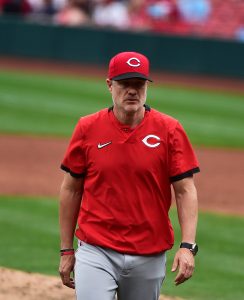
Bell has led the Cincinnati dugout for the past three seasons, with the team posting a cumulative 184-190 record (.492 winning percentage). Before landing his first managerial gig, he’d worked in a few different capacities, serving on Mike Matheny’s coaching staff with the Cardinals for five years before spending a season as the Giants’ vice president of player development.
The Reds hired Bell in October 2018, signing him to a three-year guarantee. That deal contained a club option for the 2022 season. Rather than exercise the option and potentially enter next season with Bell in a lame duck capacity, Cincinnati struck early to guarantee Bell’s position for another two years. It’s not clear whether his new deal also contains options beyond 2023.
At the time of Bell’s initial hiring, the Reds were still amidst a multi-year rebuild. They’d posted below-average records in each of the five prior seasons, finishing last in the NL Central every year from 2015-18. The club dismissed skipper Bryan Price early in 2018, with Jim Riggleman taking the reigns on an interim capacity for the remainder of the year.
The team made some progress in Bell’s first year at the helm. After winning between 64 and 68 games in each of the prior four seasons, the Reds went 75-87 in 2019, surpassing the Pirates to get out of the basement of the division. They flipped the switch completely into win-now mode late in the year, acquiring Trevor Bauer at the trade deadline with an eye towards 2020 and pushing payroll to a franchise-record height that winter. The front office signed Mike Moustakas and Nick Castellanos to matching $64MM guarantees and also added Shogo Akiyama and Wade Miley on multi-year deals.
The organization clearly envisioned 2020 as the opening of a new competitive window. Obviously, the pandemic-necessitated shortened season threw a wrench in those plans, but the Reds did at least finish 31-29 last year to earn a spot in the expanded playoff. That snapped a six-year postseason drought, but Cincinnati was quickly dispatched by the Braves in the Wild Card round. The club then had a relatively inactive offseason, entering this year with a significant question mark at shortstop and some concerns about the relief corps.
Those issues impacted the club’s early-season play, particularly as Eugenio Suárez struggled badly in an attempt to move from third base to shortstop. Cincinnati hovered right around .500 through the season’s first half before catching fire coming out of the All-Star Break. Not too long ago, they looked as likely as anyone to claim the NL’s second Wild Card spot, but the club has stumbled to a 7-12 record in September. Coupled with the Cardinals’ recent surge, Cincinnati now sits four games back of St. Louis for the final playoff spot. According to FanGraphs, their postseason odds are down to 5.9%.
Missing the playoffs would certainly be a disappointing outcome for a Cincinnati club that expected to contend this season. GM Nick Krall and the front office nevertheless believe in Bell’s ability to lead the club back to the playoffs over the coming years. Despite their up-and-down play this season, the Reds have seen homegrown, controllable players like Jesse Winker, Jonathan India and Tyler Stephenson emerge as above-average regulars during Bell’s tenure. That trio will work with the resurgent Joey Votto and a talented pitching staff led by Luis Castillo, Sonny Gray and Tyler Mahle to form what the club hopes to be a competitive core in 2022 and beyond.