
Shohei Ohtani Open To Discussing Long-Term Deal With Angels
Shohei Ohtani created plenty of speculation when he recently revealed that there’d been no extension talks with the Angels front office and added that above all else, his priority moving forward is “to win.” With the Angels now officially posting a losing record in six straight seasons, fans and pundits alike have wondered about Ohtani’s future in Anaheim. The likely American League MVP emphasized following the conclusion of the Halos’ 2021 season, however, that he’d carry an open mind into any discussions regarding a long-term extension (link via Jack Harris of the Los Angeles Times).
“I think I would, of course, talk to them with feelings of openness,” Ohtani said via his interpreter. “Regardless of whether that leads to anything, I individually want to have a solid offseason to make sure we can win next year.”
The matter of Ohtani’s contract for the 2022 season is already settled. Back in February, he signed a two-year, $8.5MM contract that covered his first two arbitration seasons (2021 and 2022) — a decision for the Angels surely have to be thankful in retrospect. Ohtani’s outstanding season on both sides of the ball would have surely led to a much larger salary in arbitration than the $5.5MM he’ll receive next year under that two-year pact.
It was a historic season for Ohtani, who tallied 639 plate appearances as a hitter and also logged 130 1/3 innings on the mound. His 46 home runs at the plate were third in all of baseball, trailing only Vladimir Guerrero Jr. and Salvador Perez. Ohtani hit .257/.372/.592 with 46 long balls, 26 doubles, eight triples and 26 steals. He scored 103 runs, plated another 100 and posted the fourth-best walk rate among qualified hitters.
On the mound, his 29.3 percent strikeout rate on the mound was tied for 12th among the 96 pitchers who tossed at least 120 innings, and his 3.18 ERA ranked 22nd. Ohtani’s 8.3 percent walk rate was a half-percent higher than the average starting pitcher but his huge strikeout rate and above-average ground-ball rate (45 percent) helped to make him one of the more effective starting pitchers in the game on a per-inning basis.
If Ohtani proves at all capable of approximating that production in 2022, he’d set himself up for perhaps the most fascinating and complex arbitration case in Major League history. An extension, of course, would preclude that headache for the Angels — but his brilliant 2021 season has also made any potential negotiations as complicated as an arbitration hearing would be.
Ohtani has rather clearly cemented himself as one of the game’s greatest pure talents. He’s two years from free agency, so the first couple seasons of a theoretical extension wouldn’t pay him full market value (although a new deal could theoretically begin next season and replace his $5.5MM salary in favor of a larger sum). Beyond that, the question is just how highly the would-be free agent seasons might be priced. Ohtani’s teammate, Mike Trout, and Yankees right-hander Gerrit Cole received the largest average annual salaries in MLB history, $36MM per season, when signing their respective deals. (While Trout’s contract was technically restructured as a 12-year, $426.5MM deal, that includes the two years and $66.5MM he was already guaranteed at the time of his extension, which paid him $360MM in new money over 10 years — hence the $36MM AAV figure.)
Free-agent seasons that are bought out this far in advance are typically (but not always) discounted to some extent, but the inherent difficulty in assigning a value to Ohtani’s free-agent campaigns is multi-faceted. Not only is he two years from the market, he’s also only had one full, healthy season on the mound. It’s clear that he’s of top-of-the-rotation caliber from a pure talent perspective, but he pitched just 53 1/3 innings combined in his first three MLB seasons (thanks largely to Tommy John surgery).
That lack of durability is an obvious red flag and strike against him. At the same time, if the Angels wait another year to determine whether Ohtani can replicate or exceed that workload on the mound, he’ll only further drive up his price tag — both by proving his durability and moving closer to free agency. There’s also no precedent for a player with this skill set, so his representatives at CAA could argue that any valuations based on comparisons to other players and/or contracts are generally irrelevant.
Stepping back a bit, the Angels’ entire payroll needs to be considered when looking at the prospect of retaining Ohtani on what would presumably be a massive commitment. The Angels will have Justin Upton‘s contract come off the books following the 2022 season — which is no small sum given next year’s $28MM salary.
However, the Halos are already paying Trout a $35.45MM salary every year from 2022-30, and they’ll also pay Anthony Rendon $36MM in 2022 before paying him $38MM annually from 2023-26 under his backloaded $245MM contract. Trout and Rendon, like Ohtani, have proven to be MVP-caliber talents at their best. Trout has three MVPs and arguably ought to have more, and Rendon has a pair of top-five finishes, including a third-place finish as recently as 2019. We can’t know precisely what value would be placed on Ohtani’s free-agent seasons — the first of which would be his age-29 campaign — but that an extension would likely mean paying out more than $100MM annually to just three players, at least from 2024-26.
The Angels are a large-market club, but they also haven’t traditionally spent at the same level as other big-market teams like the Dodgers, Giants, Yankees, Red Sox, etc. This year’s $182MM Opening Day payroll was the largest in franchise history, and owner Arte Moreno hasn’t given his front office the green-light on exceeding the luxury tax threshold since way back in 2004 — his first full season as owner after purchasing the club in May 2003.
There’s no way of knowing just yet what will happen to the luxury tax system in the future, as it’ll be a hotly contested topic during ongoing collective bargaining talks between the league and the players association. Whatever alterations do come about will be key factors for Moreno and second-year general manager Perry Minasian to consider in negotiations with Ohtani’s camp, as paying Trout, Rendon and Ohtani on long-term arrangements would make filling out a roster behind that trio all the more difficult.
All of that comes before even considering other needs in the rotation and the absence of proven, cost-controlled starters on a team that has perennial rotation issues. The Angels have a handful of interesting young arms (e.g. Patrick Sandoval, Reid Detmers, Griffin Canning, Jaime Barria), but they’ll likely need to bring in some veteran arms as well. There’s also the matter of a lack of a long-term solution at shortstop and the looming, star-studded crop of free-agent shortstops to consider. It all makes for a fascinating long-term outlook in Anaheim, as should be expected with a talent as unique as Ohtani and a big-market club as starved for a postseason berth as the Angels, who haven’t appeared in a playoff game since 2014.
The original version of this post cited an Associated Press translation of Ohtani’s quote, which indicated he is “very open” to discussing an extension. Our post has since been updated to reflect what we are told is a more accurate but slightly different translation of his response, from the Los Angeles Times, that he would talk to the Angels “with feelings of openness.”
Yankees Select Brody Koerner, Transfer Luke Voit To 60-Day IL
The Yankees have selected the contract of right-hander Brody Koerner and optioned him to Triple-A, per a team announcement. To make room on the 40-man roster, first baseman Luke Voit was transferred from the 10-day IL to the 60-day IL.
For Voit, this officially ends his season and eliminates any chance of him returning to the club at some point during the postseason. Overall, it was a disappointing campaign for the slugger, as he was hampered by injuries, with multiple trips to the IL, primarily due to his knee. He managed to get into 68 games at the MLB level and hit .239/.328/.437. That production was still 11% better than league average as measured by wRC+. However, that’s a big drop-off from the wRC+ of 153 that he put up during the shortened 2020 campaign and the 126 he had over 118 games in 2019.
It was perhaps because of Voit’s continued struggles to stay healthy that the Yankees acquired a replacement first baseman at the deadline in the form of Anthony Rizzo. However, Rizzo is a free agent at the end of this season, meaning that the Yankees could let Voit take over as the regular first baseman again in 2022. Though that will probably depend on how his health progresses over the coming months and through the winter. Voit reached arbitration for the first time last winter as a Super Two player. He and the Yankees agreed to a $4.7MM salary for 2021. He would be in line for a modest raise for 2022.
Koerner was previously selected to the roster in early August and lasted about three weeks before being outrighted back to Triple-A. In that time, he only got into two games, logging three innings with two hits, two walks, one earned run and one strikeout. In Triple-A this year, he’s logged 75 innings with an ERA of 3.48 and 60 strikeouts. He could potentially be an emergency option for the Yankees during the postseason. Players in the organization but not on the 40-man roster before September 1 can still participate in the playoffs via a petition to the Commissioner’s Office, a fairly common maneuver throughout the league.
Yankees Place DJ LeMahieu On Injured List
The Yankees are placing infielder DJ LeMahieu on the injured list with a sports hernia, according to manager Aaron Boone, as relayed by several reporters, including Marly Rivera of ESPN. LeMahieu last played September 30th, missing the past few games with the injury, meaning the soonest he could return to the club would be if they qualified for the ALCS. Right-handed pitcher Luis Gil is taking his spot on the active roster.
This is very unfortunate timing for the Yankees, as they are currently trying to wriggle out of a four-team logjam for the two American League Wild Card spots. They and the Red Sox are going into the final scheduled day of the season just one game ahead of the Blue Jays and Mariners in the standings. With the potential for various one-game tiebreakers and then the Wild Card game itself, each team will be taking an all-hands-on-deck approach in order to survive. Boone says, as relayed by Rivera in a separate tweet, that LeMahieu worked out today before the very late decision was made. Bryan Hoch of MLB.com quotes Boone as saying LeMahieu is “too compromised” to play right now.
It’s been a disappointing season for the 33-year-old, perhaps because of the injury. In his first Yankees contract, over 2019 and 2020, LeMahieu hit an excellent .336/.386/.536, which amounts to a wRC+ of 146, all while having the versatility of playing multiple positions around the infield. On the heels of that excellent performance, the Yankees re-signed LeMahieu to a six-year, $90MM contract in the most recent offseason. Unfortunately, the first year of the deal has seen LeMahieu’s production drop off to a line of .268/.349/.362, a wRC+ of 100. Nevertheless, that league-average production being put on the shelf is still a loss for the club. Rougned Odor is slotting into third base for the Yanks today, and he has a 2021 slash line of .201/.286/.379, wRC+ of just 82.
As for Gil, he adds another arm to the Yankees’ stable at a time when they might need a lot of them over the next few days. In six starts at the big league level this year, he’s logged 29 1/3 innings with an ERA of 3.07. He’s likely to be used as a long-relief option, though, as Jameson Taillon is starting today’s game, with Gerrit Cole the planned starter for whatever game the Yankees play next, be that some kind of tie-breaker or the Wild Card game.
Padres Planning To Fire Manager Jayce Tingler
After a disappointing season with high expectations, the Padres are planning to part ways with manager Jayce Tingler after two seasons at the helm, per MLB Network’s Jon Heyman (via Twitter). The decision has not been confirmed by the club, who calls the news of Tingler’s fire “premature,” tweets AJ Cassavell of MLB.com. Still, expectations are that Tingler will be let go.
The Padres shocking collapse this year has been well-documented, and it appears that Tingler will be left holding the bag. Despite the frustrating season, Tingler will finish his tenure in San Diego with a winning record, sitting currently at 115-105, a .523 winning percentage.
The Padres were the “it” team of 2020, Tingler’s first season as manager. A relative unknown at the time of his hire, Tingler nonetheless led the Padres to the playoffs for the first time since 2006 and finished second in manager of the year voting. Though they were swept by the eventual champion Dodgers, it was a competitive and spirited three-game series, setting the stage for a tight divisional race in 2021.
The future looked bright for Tingler, who was hand-picked to manage the club by A.J. Preller, who himself was promoted to president of baseball operations and extended through 2026 in February. Preller’s promotion came amid a busy winter, after which the Friars were all but assumed to push the Dodgers for the NL West crown. The Padres extended Fernando Tatis Jr., locking in their star shortstop as the future of the franchise, and they overhauled their rotation with trades for Blake Snell, Yu Darvish, and Joe Musgrove, among other moves.
The 2021 season began on script with the Padres having a share of the best record in MLB as late as 54 games into the year, as MLB.com’s Sarah Langs recently tweeted out. They were 34-20 at that point in the season on May 30th. The injuries began to pile up, and from that point on, the rollicking-good-fun Padres have been nothing short of a disaster. They’ve gone 44-62 since, guaranteeing a losing campaign yesterday with their 82nd loss. The loss came at the hands of the Giants, who took the Padres’ Cinderella season right out from under them and wore it for themselves.
The Padres on-field failures are wide-ranging, though injuries no doubt played a role. The inflexibility of a roster weighed down with hefty contracts for under-performing veterans also played a part. It certainly seems a touch hypocritical for Preller to send Tingler packing, and yet it would hardly be a surprising development. There have been quite a few front office people let go, in fact, as repercussions of the difficult season have been felt throughout the organization. Recent weeks, as well, have been marred by rising tensions and in-dugout altercations that drew national attention, perhaps even providing cause for a Tingler dismissal.
Development failures have also been central to the Padres narrative. With that in mind, the futures of MacKenzie Gore, Adrian Morejon, and Ryan Weathers will be of particular interest for anyone in a leadership role moving forward. It wasn’t long ago that these young arms were the crown jewels of a deep farm system, but trades have depleted the system’s depth while their young hurlers have yet to establish themselves as difference-makers at the Major League level.
The spotlight will shine ever brighter on Preller in the days and weeks to come. Given his recent extension, it seems he’ll continue as the primary driver within the organization, though his next managerial hire will likely be his last unless the team can get itself back on track.
Dodgers Place Clayton Kershaw On 10-Day IL With Forearm Discomfort
6:04PM: More will be known once Kershaw undergoes more tests, but Dodgers manager Dave Roberts told MLB.com’s Juan Toribio and other reporters that the team is going ahead as if Kershaw’s 2021 season is over.
4:03PM: The Dodgers have placed Kershaw on the 10-day injured list with left forearm discomfort. Righty Mitch White was called up to take Kershaw’s spot on the active roster.
TODAY, 7:14AM: Things are not looking good for Kershaw, who looks like he might be “out for a while,” per ESPN’s Jeff Passan (via Twitter). Tests still must be completed, but Kershaw himself spoke of the injury, detailing it as similar to what he’s been dealing with all year, that quote provided in full here by ESPN’s Alden Gonzalez.
OCTOBER 1: Dodgers star Clayton Kershaw left this evening’s start against the Brewers in the second inning due to what the team called forearm discomfort (via Fabian Ardaya of the Athletic). Kershaw was tagged for three runs on five hits in that brief time, although his fastball velocity was in its customary 90 MPH range.
More will be known after further evaluation, but it’s an obviously concerning development. Any forearm injury is worrisome for pitchers, and Kershaw missed more than two months earlier in the season because of inflammation in the area. He returned from that IL stint on September 13 and was making his fourth start since coming back.
There’s no indication at this point that Kershaw’s in line for another extended absence. But it’s hard to imagine a more inopportune for such a development. The Dodgers entered play two games back of the Giants in the NL West, with a possibility of being eliminated from division contention tonight. Max Scherzer is lined up to start a potential Wild Card game, but Kershaw would no doubt be a key component of a potential NLDS pitching staff if he’s healthy. The three-time Cy Young award winner is slated to hit free agency this offseason.
Rockies Hire Bill Schmidt As General Manager
The Rockies have removed the “interim” tag from Bill Schmidt, as Schmidt will officially take over the team’s front office as the new general manager. Schmidt has been serving as the interim GM since May 3, a week after former general manager Jeff Bridich resigned.
The club also announced promotions of two other in-house executives. Danny Montgomery goes from special assistant to the GM to being a newly-minted vice president and assistant GM of scouting, while assistant GM Zack Rosenthal had the vice president title added to his current duties.
“After five months as our interim general manager, it became increasingly clear that Bill was the right person to lead this franchise forward,” Rockies president/COO Greg Feasel said in the press release. “We already knew Bill as a trusted and respected baseball professional within the game. He came into a challenging situation and quickly impacted the play on and off the field. Bill’s promotion also gives the organization an opportunity to promote two experienced individuals, Danny and Zack, to leadership roles that will be key in getting us to the next level.”
At the time of Bridich’s departure, the Rockies announced that a wider search for a new GM/president of baseball operations would take place after the season, though the club has now decided to stick with a familiar face. Schmidt has been working in Colorado since October 1999 in various scouting capacities, and has been running the team’s drafts since 2000. Schmidt was promoted to VP of scouting in 2007, a title he held until becoming interim GM. Before joining the Rox, Schmidt also worked as a scout and minor league coach with the Reds and Yankees, a minor league coach with the Brewers, and as a national crosschecker for the Indians.
Schmidt’s hiring is something of an old-school move, as teams have generally trended towards younger and more analytically-inclined front office executives in recent years, rather than older, more established baseball lifers. Schmidt is known to be widely respected around the sport, and his hiring will surely be applauded by peers pleased to see him finally getting a shot to run a big league organization.
It is fair to wonder if Rockies fans are as enthusiastic, however. Bridich was also a longtime front office employee before he was hired as GM in 2014, and the hiring of Schmidt (and even the promotions of Montgomery and Rosenthal) reflect more continuity within an organization that many fans and pundits believe is in need of a shakeup. Owner Dick Monfort is known to be very loyal to his employees — perhaps to a fault, as the team’s insularity has been seen as a chief reason for the Rockies have had only five winning seasons since the Monfort brothers become majority owners in 2005.
Thanks to a brutal 19-34 start, the Rockies will finish under the .500 mark yet again this season, despite a respectable 55-51 mark since May 30. That performance over the last four months quite possibly inspired the team’s decision to mostly stand pat at the trade deadline, moving only Mychal Givens despite the number of impending free agents (most notably Trevor Story and Jon Gray) on the roster. The Rockies have designs on re-signing Gray, while Story is as good as gone but the team didn’t find any acceptable trade offers, so the decision was made to keep Story and at least recoup a draft pick via the qualifying offer.
Schmidt now faces a tall order in getting the Rockies on track, considering the potential free agent losses, a farm system seen as being lacking in impact talent, and the ever-difficult NL West. It will be interesting to see how Schmidt’s approach differs from Bridich, who relied mostly on free agency to make his moves and didn’t swing many major trades (apart from moving longtime stars Nolan Arenado and Troy Tulowitzki) in his tenure as GM.
Pirates Promote Oneil Cruz
TODAY: Cruz’s promotion has been officially announced by the Pirates. Right-hander Tanner Anderson has been placed on the 10-day IL due to a right foot contusion.
OCTOBER 1: The Pirates are planning to promote shortstop prospect Oneil Cruz to make his major league debut, reports Héctor Gómez of Z101 (Twitter link). The 22-year-old checked in as the game’s #50 overall farmhand on Baseball America’s midseason update. Cruz is already on the 40-man roster.
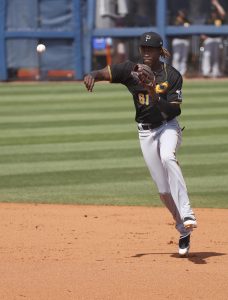
Cruz signed with the Dodgers out of the Dominican Republic over the 2015-16 international signing period. Los Angeles included Cruz, who was then in Low-A, as part of a package headed to Pittsburgh for Tony Watson at the 2017 trade deadline. The left-handed hitter has spent the past four years climbing the minor league ranks, moving fairly slowly but posting big numbers at every level.
In 2018, Cruz hit .286/.343/.488 while spending the entire season at Low-A. He split the 2019 campaign between High-A and Double-A and was added to the 40-man roster that offseason to keep him from selection in the Rule 5 draft. Last year’s canceled minor league season obviously cost Cruz the chance to play in games, although he was part of the Bucs’ alternate training site group.
As Cruz has aged, he’s continued to fill out one of the bigger frames in affiliated ball. The 22-year-old is now listed at 6’7″, 210 pounds, and he’ll soon become the tallest shortstop in major league history. That atypical profile has led to some concern among prospect evaluators he’d eventually have to move off the position, but he’s worked there exclusively in the minors this year and has continued to hold his own. In their midseason report, BA pegged Cruz as a capable defender, and evaluators credit him with one of the better arms in the minor leagues. There’s still some sentiment he could wind up moving into the outfield eventually, but it seems he’ll at least get an opportunity to first try and stick on the left side of the infield.
While there may be some questions about his long-term defensive home, there’s no debate concerning Cruz’s power potential. His exceptional size and athleticism leads to some of the game’s biggest power projection, with Eric Longenhagen of FanGraphs grading his raw power as a future 80 on the 20-80 scouting scale. BA, meanwhile, pegs his power potential at a 70 on the same scale.
Cruz’s size has led to some trepidation about his ability to consistently make contact. Longer-levered players can sometimes have trouble synchronizing their swing mechanics, and Cruz indeed had some alarming strikeout numbers early in his minor league career. As he’s climbed the ladder, he’s ironed out those issues significantly. Cruz has taken 302 plate appearances between Double-A and Triple-A this season, hitting .310/.375/.594 with seventeen home runs and a 22.8% strikeout rate that’s right in line with this year’s major league average.
With Cruz performing at a high level on both sides of the ball, the Pirates will give him a two-game cameo to close out the season. He can still be optioned to the minors in one more season, and he’s only played in six career Triple-A games. It’s certainly possible he starts next season back in the upper minors, whether for developmental or service time reasons. (Barring a change to the current service time structure in the upcoming collective bargaining agreement, the Pirates would only have to keep Cruz in the minors for a couple weeks to delay his path to free agency by an additional season). But whatever long-term plans the organization has, they’ll reward his consistently strong performance with his first big league call to close out this season, giving fans a glimpse at one of the most exciting young players in the organization in the process.
AJ Pollock Will Narrowly Miss Triggering Ability To Opt Out Of Contract
Dodgers outfielder AJ Pollock is in the midst of one of his best seasons, having posted an excellent .301/.360/.532 batting line with 19 home runs, 27 doubles, a triple and nine stolen bases. That production would position the 33-year-old as one of the best outfielders on the free-agent market this winter, but MLBTR has confirmed that Pollock will fall just a few plate appearances shy of the threshold necessary to trigger an opt-out clause in his deal.
Pollock’s contract, signed in Jan. 2019, was a four-year, $55MM deal that covered the 2019-22 seasons with a player option for a fifth year in 2023. However, the contract also allowed Pollock to opt out of the 2022 season and receive a $5MM buyout if he hit one of two plate appearance milestones: 1450 plate appearances combined from 2019-21 or 1000 combined from 2020-2021.
Last year’s pandemic-shortened season threw a wrench into vesting clauses such as this one, but the league and the players association agreed to prorate plate appearances and innings pitched for the purpose of calculations such as this one. Pollock’s 210 plate appearances last season are thus multiplied by 2.7, meaning they account for 567 plate appearances toward that threshold. (MLBTR’s Anthony Franco explored this possibility when Pollock returned from the IL last week.)
Pollock needed 433 plate appearances in 2021 to unlock that right to opt out, but he’s currently at 408 plate appearances with just four games to play. It’s nearly unfathomable that he’d manage to accumulate 25 trips to the plate in a span of four games. As such, it seems that a pair of hamstring strains for Pollock this season — one in his left leg in May and another in his right leg earlier this month — will cost him the opportunity to return to the open market in advance of his age-34 season.
Pollock will now be under contract for the 2022 season on a $10MM salary, after which he’ll have a $10MM player option or a $5MM buyout. To that extent, he’ll still control his own fate next offseason, but he’ll be doing so when he’s a year older and potentially coming off a weaker performance at the plate. Pollock’s contract does allow him to boost the value of that $10MM option as well; it’d increase by $1MM for reaching each of 400, 450, 500, 550 and 600 plate appearances next season.
Nolan Arenado Won’t Exercise Opt-Out Clause This Offseason
Nolan Arenado had previously suggested on a few occasions that he was unlikely to opt out of his current contract with the Cardinals. This afternoon, he officially put any notion about exercising the opt-out to bed.
“I’m not opting out,” Arenado told Derrick Goold of the St. Louis Post-Dispatch. “We can put that out there. I will not be opting out. I will be coming back. That was always the plan. I’m absolutely coming back. I feel like this year has been special in a lot of senses.”
Arenado will return to St. Louis on a $35MM salary ($6MM of which will be deferred) next season. He’ll have another opportunity to opt out and test the open market over the 2022-23 offseason. His initial extension with the Rockies contained only the post-2021 opt-out provision which Arenado is electing to forgo. However, the Cardinals added the second opt-out as part of a restructuring to convince Arenado to waive his no-trade clause and facilitate St. Louis’ deal with Colorado last winter.
As part of that trade-off, the Cards also added an additional year and $15MM in guaranteed money to Arenado’s contract. Were he to forgo next year’s opt-out as well, he’d be guaranteed another $144MM between 2023-27. All told, his deal contains another six years and $179MM beyond this season.
The Cardinals’ acquisition of Arenado was one of the most important moves of last offseason. St. Louis surrendered a five-player package — Austin Gomber, Elehuris Montero, Tony Locey, Mateo Gil and Jake Sommers — to bring in the eight-time Gold Glover. He’s continued to perform well, albeit not quite at his peak level, over his first season in Cardinal red. Through 642 plate appearances, Arenado is hitting .256/.313/.499 with 34 home runs. That’s solidly above-average offensive production, and Arenado has again rated as one of the game’s preeminent defenders at the hot corner.
Arenado’s work is a key reason the Cards are playoff-bound for the third straight season. St. Louis entered the month a bit behind the pack in the postseason picture, but they’re currently amidst an incredible 17-game win streak that has officially clinched them a berth in next week’s NL Wild Card game.
As part of last offseason’s trade, Colorado agreed to cover $51MM of Arenado’s contract (assuming he doesn’t trigger either opt-out) — including his entire $35MM salary for 2021. $15MM of that was paid this year, with the rest of those payments deferred over the next few seasons. Arenado has suggested in the past he’s not anxious to exercise next season’s opt-out, either, but he’ll have another year to gauge the organization’s progress and determine whether he wants to explore his options. Free agents next offseason will have the added bonus of a little more certainty about the market structure, since this winter’s free agency is clouded by the impending expiration of the current collective bargaining agreement on December 1.
Royals Extend Michael A. Taylor
The Royals announced an agreement to keep center fielder Michael A. Taylor from hitting the open market this winter. Taylor receives a two-year, $9MM guarantee, paid out via successive $4.5MM salaries in 2022 and 2023. He’d receive an additional $50K for hitting the 325, 375, 425, 475 and 525 plate appearance mark in each season, with up to $500K in total incentives available. Taylor is represented by ALIGND Sports Agency.
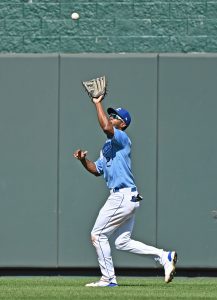
It’s a bit surprising at first glance to see Kansas City jump the market to extend Taylor, who is amidst a below-average year at the plate in his first season in Royal blue. Across 508 plate appearances, the 30-year-old owns a .244/.298/.359 line with twelve home runs. Even after accounting for Kansas City’s extremely pitcher-friendly home ballpark, Taylor’s offensive numbers check in around 21 percentage points below league average according to wRC+.
That’s right in line with his typical production. The right-handed hitter spent the first seven seasons of his big league career with the Nationals, generally struggling to produce much offensively. Taylor has flashed intriguing power potential at times, but he’s been held back by a propensity to swing and miss. He’s not a complete free swinger — Taylor’s rate of chasing pitches outside the strike zone hovers right around league average — but he comes up empty quite a bit even when swinging at pitches inside the strike zone.
Taylor has posted above-average offensive numbers just once in parts of eight big league seasons. Over 432 plate appearances with the Nats in 2017, he hit .271/.320/.486 and popped 19 homers. That season was propped up by an unsustainably high .363 batting average on balls in play, though, and Taylor hasn’t found that kind of success in the years since. Going back to the start of the 2018 campaign, he owns a .234/.291/.364 line with an alarming 28.9% strikeout rate.
That the Royals are anxious to keep Taylor off the open market in spite of his offensive struggles is a testament to his prowess with the glove. Taylor rated very highly defensively throughout his time in Washington, and he’s continued to excel on that side of the ball with Kansas City.
Aside from a pair of semi-rest days at designated hitter, Taylor has lined up exclusively in center field this season. Over 1,141 innings at the position, he’s rated as a staggering 21 runs above average, by measure of Defensive Runs Saved. That’s six runs clear of second-place finisher Harrison Bader. Statcast’s range-based Outs Above Average metric paints a similar picture. By that measure, Taylor is tied with Bader and Manuel Margot with an outfield-best +14 plays. Those advanced metrics align with Taylor’s general reputation for defensive excellence.
The Royals have long valued defense more than most clubs, partially because of the extreme spaciousness of Kauffman Stadium. Excellent glovework was a backbone of their back-to-back pennant winners (and one-time champions) last decade, and the front office continues to place a real emphasis on turning batted balls into outs. With Taylor among the sport’s best handful of players at tracking down fly balls, they’ve struck early to keep him in the fold for the next couple seasons.
While Kansas City surely values Taylor quite a bit, it’s also worth keeping in mind that there wouldn’t have been too many viable alternatives available even if they wished to turn elsewhere. Starling Marte handily tops the upcoming free agent center field class, but he always seemed likely to land a multi-year deal that would’ve been above the Royals’ typical range of spending. Beyond Marte, the class features a group of players who have almost unanimously scuffled offensively this season — Kevin Pillar, Jake Marisnick and Danny Santana among them. There’d have been a strong case for Taylor as the second-best overall center fielder available in free agency.
It’s similarly unclear which center fielders would be attainable in trade. There’ll surely be plenty of calls on players like Cedric Mullins, Bryan Reynolds and Ketel Marte, but their teams’ willingness to make those respective players available ranges from questionable to highly unlikely.
Rather than test the vagaries of the free agency and trade markets, the Royals will lock Taylor into center field for the next couple seasons. Last winter, Kansas City added veterans Mike Minor and Carlos Santana on multi-year free agent deals in an effort to contend. That didn’t pan out, but president of baseball operations Dayton Moore and his front office will surely make another run at being competitive this winter. Santana will be back at first base, while franchise cornerstone Salvador Pérez returns on the heels of one of the better offensive seasons by a catcher in recent memory. Nicky Lopez has played well enough to earn an everyday job somewhere, even if top prospect Bobby Witt Jr. comes up early in the season and stakes a claim to Lopez’s current shortstop position. And the versatile Whit Merrifield will be back to hold down a role at some spot on the diamond while hitting at the top of the lineup.
Taylor’s deal brings the Royals’ guaranteed commitments just north of $50MM, in the estimation of Roster Resource’s Jason Martinez. That’s before accounting for a fairly modest arbitration class, which will feature raises for players like Brad Keller, Adalberto Mondesi, Scott Barlow and Lopez. Even if that group winds up banking something in the collective $10-15MM range, that still leaves a bit of breathing room for further additions before hitting this season’s $86MM+ mark. It’s certainly possible ownership would be willing to spend beyond this season’s level, since the franchise has run payrolls north of $120MM in the past.
Jeff Passan of ESPN first reported the Royals’ agreement with Taylor on a two-year, $9MM deal. Alec Lewis of the Athletic reported the deal contained an additional $500K in available incentives. Anne Rogers of MLB.com reported the salaries were to be paid out equally in each season, while Robert Murray of FanSided was first with the specific incentive structure.
Image courtesy of USA Today Sports.