
Doug Fister Retires
Veteran right-hander Doug Fister has elected to call it a career after spending parts of 10 seasons in the Majors, agent Page Odle tells Jon Morosi of MLB.com. Fister, 35, received multiple Major League contract offers this winter, according to Odle, but is instead making a “100 percent family-driven” decision to spend time with his wife and two children.
A seventh-round pick of the Mariners back in 2006, Fister ascended to the Majors as a largely unheralded prospect with the Mariners in 2009. After establishing himself as a quality starter over his first 378 frames with the Mariners, Fister was flipped to the Tigers in a 2011 trade deadline deal, where he’d go on to thrive over another three seasons. Fister, in fact, was somewhat quietly one of the game’s better starters from 2011-14, pitching to a 3.11 ERA (129 ERA+) with 6.5 K/9, 1.7 BB/9 and 0.7 HR/9.
A 2015 forearm strain led to diminished velocity and diminished results for Fister, though he managed to make 32 starts for the 2016 Astros and served as a stabilizing force in their rotation. Hip and knee injuries slowed Fister in his most recent run with the Rangers, with the latter of the two issues ultimately ending his season after 66 innings.
All in all, Fister will walk away from his baseball career with a lifetime 83-92 record, a 3.72 ERA, 6.1 K/9 and 2.1 BB/9 in 1422 1/3 big league innings. The towering 6’8″ righty also amassed an impressive postseason resume, tallying 56 2/3 innings of 3.02 ERA ball with a 41-to-17 K/BB ratio in five separate postseasons runs (three with the Tigers, one with the Nats and one with the Red Sox). He made one World Series start, with the Tigers in ’12, where he tossed six innings of one-run ball against the Giants.
Fister earned more than $36MM in player salaries over the life of a career that both Baseball-Reference and Fangraphs value at 20 wins above replacement. Best wishes to the former Tigers, Mariners, Nationals, Astros, Red Sox and Rangers righty in his life beyond baseball.
Bauer, Cole, Wood Win Arbitration Cases
The players may be suffering through a winter of discontent in the free agent market, but they have now scored some notable wins in arbitration. Trevor Bauer of the Indians, Gerrit Cole of the Astros, and Alex Wood of the Reds have all been awarded the contract values they sought by their respective arbitration panels, per ESPN.com’s Jeff Passan (Twitter link).
Bauer will take home $13MM, a full $2MM more than the Indians had sought to pay him. Cole’s $13.5MM salary was about the same amount higher than the Astros’ $11.425MM filing figure. And Wood secures a $9.65MM payday that tops the $8.7MM the Reds defended.
[RELATED: MLBTR Arbitration Tracker]
Those cases break what had been a tie in arb hearings. The players already had a solid edge in the more significant cases, with Blake Treinen ($6.4MM vs. $5.6MM), Carlos Correa ($5MM vs. $4.25MM), and Tommy Pham ($4.1MM vs. $3.5MM) all coming out ahead while Kyle Barraclough ($2MM vs. $1.725MM), Michael Taylor ($3.5MM vs. $3.25MM), and Ryan Tepera ($1.8MM vs. $1.525MM) lost smaller-value contests.
In coming away with wins, all three of the starters also managed to top their projected earning power from MLBTR and Matt Swartz. Bauer ($11.6MM), Cole ($13.0MM), and Wood ($9.0MM) had projected in range of what they ultimately earned, but took shots on securing bigger paydays by making their cases to panels.
Bauer’s situation is particularly noteworthy, since he won a previous arb hearing and remains eligible for one more trip through the process after the 2019 season. This time last year, Bauer emerged with a $6.525MM salary rather than the $5.3MM the team proposed. That made him $1.225MM richer this time around as well, since his raise was dropped on top of a greater starting point. The same will hold true next year.
That serves to illustrate how important these cases can be to an individual player. But there’s also a broader market significance. Each data point that trends north can be cited by another player in the future, either in seeking a bigger arb number or in negotiating out the terms of an extension.
Phillies Extend Aaron Nola
The Phillies have officially reached a long-term deal with star righty Aaron Nola. The contract, which forestalls an arbitration hearing and expands the team’s control rights over its best pitcher, is said to be a four-year, $45MM deal that includes a club option.
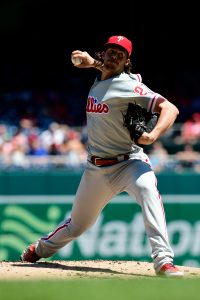
Nola, a client of Paragon Sports, will receive a $2MM signing bonus and $4MM salary for the coming season. He’ll then earn successive salaries of $8MM, $11.75MM, and $15MM. The 2023 option is valued at $16MM and includes a $4.25MM buyout. Nola’s 2022 salary and 2023 option value will reportedly each increase by $1MM for each Cy Young win he secures, by $500K for a second-place finish and by $250K for finishing third through fifth in Cy Young voting.
Ultimately, then, the Phillies can control five future seasons of Nola, including 2019, at a total outlay of just $56.75MM (or perhaps a bit more, depending on Cy Young finishes). Nola gives up two would-be free agent campaigns in the deal. He had been nearing a hearing to determine his first-year arbitration salary, with his side filing at $6.7MM and the club countering at $4.5MM.
Now 25, Nola originally came to the Phillies organization as the seventh overall pick of the 2014 draft. He has rewarded the club handsomely for that selection, having already thrown 569 innings of 3.35 ERA ball at the game’s highest level while maintaining 9.4 K/9 and 2.5 BB/9 along with a 50.9% groundball rate.
Those shiny peripherals have been there from the outset for Nola, who has been a darling of ERA estimators ever since he took a big league mound. For his career to date, Nola is credited with a 3.24 FIP, 3.29 xFIP, and 3.48 SIERA.
In a sense, then, Nola’s eye-popping 2018 season was more a continuation than a turning point. But his 212 1/3-inning effort was still clearly a coming-out party, as Nola showed he could sustain excellence over a big workload while pitching meaningful innings. His resulting 2.37 ERA would have made him a Cy Young winner in some campaigns, though he settled for a still-impressive third-place finish after Jacob deGrom and Max Scherzer both turned in monster seasons.
[RELATED: MLBTR Extension Tracker]
The obvious comp for this extension is the deal reached two years ago between the Cardinals and Carlos Martinez. That agreement included more money, but a lengthier term, for another high-quality, 25-year-old hurler who was nearing a first arbitration hearing. Martinez took home a $51MM guarantee over five years, while giving the Cards successive $17MM and $18MM options with a cumulative $1MM buyout, meaning his deal would top out at seven seasons and $85MM.
Nola’s camp probably prefers his deal to Martinez’s, which set a high-water mark for arb1 pitcher extensions but did give away two additional seasons of control. Still, it’s a bit of a surprise to see that Nola did not break new ground in earnings, particularly since he secured a significant initial draft bonus in addition to already having one season of arb salary (nearly) in hand. Even if he ended up losing the hearing and suffering a major injury this spring, he’d profile as an easy 2020 tender candidate. The recent experience of Garrett Richards — who has thrown just 138 2/3 innings over the past three seasons and is rehabbing from Tommy John surgery, yet earned over $20MM in his final three arb years and then signed for $15.5MM in free agency — shows that teams will pay big money to hang onto the upside of top arms. Nola’s downside was limited, even in the event of a catastrophic injury. In terms of upside scenarios, the tepid free agent market is perhaps a factor, but team squeamishness toward long-term deals did not prevent Patrick Corbin from landing six years and $140MM — due in no small part to the fact that he hit the open market at 29 years of age.
If the option is indeed picked up, Nola will stand to reach free agency in advance of his age-31 campaign. He’d certainly still have ample earning capacity at that point, though leaving two prospective free agent campaigns in the hands of the Phils unquestionably removes some of the highest-upside contract scenarios. Of course, chasing the biggest imaginable guarantee certainly isn’t the top priority for every player, and it’s not hard to see how this contract serves Nola’s own interests as well — particularly since he did deal with a worrying forearm strain not long ago.
Whatever one thinks of the deal from the player’s perspective, it seems to be an easy risk for the big-budget Phillies to take. The Martinez experience does show some of the downside risks at play, as his injuries would have tamped down his arb earnings and do cloud his future, though he’s still a talented and youthful pitcher with ample promise. Locking up Nola comes with its own risks, but loads of upside as well.
It’s notable in this case that the sides had such a wide spread in their arb filing numbers. That had set up an important hearing decision, with Nola seeking to step in not far below Dallas Keuchel‘s record $7.25MM salary and the Phils defending something closer to the longstanding ceiling for first-time eligible pitchers (the 2006 Dontrelle Willis salary of $4.35MM). MLBTR projected a $6.6MM salary for Nola, though the team obviously felt comfortable with its aggressively low stance and the panel would have been forced to pick one of the two filing numbers. That left plenty of risk for Nola; the $2.2MM gap, after all, would also have been reflected in his prospective arb2 and arb3 salaries.
On the team’s side, though, the deal forecloses the greater earning situation. Had Nola landed the $6.7MM he asked for, and then turned in two more seasons in range of his career norms, he easily could have cleared $30MM in arbitration earnings and might well have done quite a bit more than that. deGrom’s other-worldly campaign scored him a record-setting $9.6MM year-over-year raise; expecting anything on that order would be foolish, of course, but that number shows the magnitude of potential earnings.
Of greater importance than controlling Nola’s arbitration earnings is the acquisition of control rights over two more seasons, his age-29 and age-30 campaigns. Had Nola hit the open market after his arb time ran out, he might well have commanded a huge and lengthy deal — with any acquiring team interested especially in capturing his remaining prime years. Doing a contract now allows the Phillies to hang onto those seasons for a relatively low price and without any need to promise Nola money well into his thirties.
Ken Rosenthal and Matt Gelb of The Athletic first reported the deal (Twitter link). Jeff Passan of ESPN.com tweeted the contract breakdown. The Athletic’s Jayson Stark reported the contract’s escalator clauses.
Photo courtesy of USA Today Sports Images.
Athletics To Sign Robbie Grossman
The Athletics have agreed to a one-year contract with outfielder Robbie Grossman, per Ken Rosenthal of The Athletic (Twitter link). It’s a major-league deal that lands in the $2MM range and also comes with some incentives, per Susan Slusser of the San Francisco Chronicle.
Grossman, a 29-year-old switch-hitter, was non-tendered by the Twins last fall after projecting to earn $4.0MM. He has turned in above-average offensive numbers for the Twins, though hasn’t replicated his breakout 2016 effort in the ensuing two campaigns.
The calling card here is on-base ability. Through over two thousand plate appearances, Grossman carries a .355 OBP. He has boosted that mark up to .371 over the past three years. While he delivers little in the way of power (.122 ISO), Grossman has walked at a 12.8% lifetime clip.
Grossman doesn’t shine as an outfield defender, earning mostly slightly below-average grades from advanced metrics. He doesn’t add value on the bases; in fact, he was panned for his efforts on foot in 2018 (-4.8 BsR).
Clearly, then, the interest here for the A’s is in picking up Grossman’s ability to get aboard. He’ll presumably function mostly as a reserve outfielder, with Khris Davis taking up the DH slot. Grossman has been particularly effective against left-handed pitching in his career.
Athletics Re-Sign Brett Anderson
WEDNESDAY: The deal is now official.
TUESDAY: Anderson and the A’s do indeed have an agreement, pending a physical that is slated to take place today, Slusser writes in a full column. ESPN’s Buster Olney tweets that if the medicals check out, Anderson will be guaranteed $1.5MM and can make another $1MM via incentives.
MONDAY: The Athletics are nearing a contract with lefty Brett Anderson, per Susan Slusser of the San Francisco Chronicle (Twitter links). Anderson himself tweeted this evening (without divulging the team) that he’s preparing for a physical tomorrow, so that may be all that remains before the agreement is finalized.
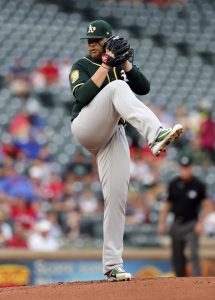
It’ll be a MLB deal for Anderson, a client of The Legacy Agency. Financial terms remain unknown at this time.
There have been quite a few ups and downs over the years for the southpaw, who is now 31 years of age. Once a highly promising young hurler in Oakland, Anderson has often been effective on the mound but has dealt with countless injuries, particularly to his back. All told, he has made about half of the starts he might have over his decade in the majors.
Last year came with a typical blend of positives and setbacks. Anderson dominated at Triple-A to earn his way back to the A’s staff, missed some time with a shoulder injury, and ultimately turned in 80 1/3 innings of 4.48 ERA ball over 17 starts in the big leagues.
As usual, Anderson turned in underwhelming strikeout numbers, with just 5.3 per nine in 2018. He made up for that by drawing grounders on 55.6% of the balls opposing hitters put in play, his highest rate since his last full season of 2015, and by allowing a personal-low 1.5 walks per nine. Statcast actually felt Anderson was a bit unfortunate, as it valued him with a .338 wOBA-against but a .318 xwOBA-against. ERA estimators valued Anderson as a solid back-of-the-rotation performer (4.17 FIP, 3.91 xFIP, 4.13 SIERA).
There’s a lot to like about that profile on a low-cost, low-risk deal. Clearly, there isn’t much appetite around the game for promising multiple seasons to Anderson, given his health history. But for an Oakland org that is still looking to fill out a decent rotation on the cheap, it’s easy to see the appeal.
Photo courtesy of USA Today Sports Images.
Jacob deGrom Puts Opening Day Deadline On Contract Talks
Long-anticipated contract talks between the Mets and star right-hander Jacob deGrom have yet to get underway, though indications are that the sides will explore a new deal in camp. According to Mike Puma of the New York Post, the sides will need to work quickly if they are to reach agreement, as deGrom has informed the team he will not negotiate during the season.
This news means that the Mets and deGrom have only about six weeks to hammer out the details of what promises to be a monster new contract, if one is to be reached at all. While it’s common for extensions to be announced during camp, it seems in this case that deGrom and his agents at CAA had anticipated much more background dialogue in the months between the Winter Meetings (when they met with Mets officials) and Spring Training.
To be sure, there’s no mandate that the sides reach agreement. They already have agreed to a $17MM arbitration salary for 2019, which includes a record-setting raise befitting deGrom’s historically notable 2018 season. And with deGrom under team control for one more season, there’d still be time to negotiate in the future.
Getting something done now, however, may be the Mets’ best chance to secure deGrom’s future services at a relatively palatable rate. Otherwise, the 30-year-old could decide to take on the risk of health or performance decline with hopes of eventually striking it rich in free agency. His relatively advanced age is a factor, to be sure, but to this point deGrom has been a workhorse and he projects to enter the open market in advance of his age-33 season. If his ensuing two campaigns are anything like the one he just wrapped up, he’ll have no trouble commanding big numbers on the open market. That said, deGrom is plainly interested in capitalizing on his 2018 excellence, and is also surely aware of the risks that come with pitching through two full MLB seasons.
There are some other considerations here. Puma notes, as Andy Martino of SNY.tv has suggested previously, that deGrom’s current agent — Mets GM Brodie Van Wagenen’s former partner Jeff Berry — has suggested that players have on-field recourse to utilize against their employers to gain leverage in an increasingly unfriendly market setting. Specifically, he proposed that pitchers self-impose workload limits if they aren’t protected by long-term agreements. That path — sure to be highly controversial if implemented — seems to be on the table here. Public perception would be an important consideration in how that would play out, and also colors the present talks. The Mets had given fans (as well as deGrom) reason to believe that they’d make a big push to lock up the reigning NL Cy Young winner. Now, the onus seems to be on the organization to come forward with a significant offer.
Kyler Murray Announces He Is “Firmly And Fully Committing” To NFL Career
Outfielder/quarterback Kyler Murray, this year’s Heisman Trophy winner but also the No. 9 overall pick by the Athletics in the 2018 MLB draft, announced today that he will pursue a career in football rather than baseball (Twitter link). Murray’s statement reads as follows:
“Moving forward, I am firmly and fully committing my life to becoming an NFL quarterback. Football has been my love and passion my entire life. I was raised to play QB, and I very much look forward to dedicating 100% of myself to being the best QB possible and winning NFL championships. I have started an extensive training program to further prepare myself for upcoming NFL workouts and interviews. I eagerly await the opportunity to continue to prove to NFL decision makers that I am the franchise QB in this draft.”
The decision is a tough but not exactly unexpected one for the A’s. While the team had maintained some optimism that Murray might choose baseball, it was reported by ESPN’s Adam Schefter at the time Murray declared for the NFL draft that his mind was largely made up.
Oakland paid Murray a $4.66MM signing bonus in last summer’s draft, and while they’ll reportedly recoup the vast majority of that sum, they won’t be given a compensatory pick in the 2019 draft to make up for Murray’s decision to choose an NFL career over MLB. More specifically, ESPN’s Jeff Passan tweets that Murray will return $1.29MM of the $1.5MM of his signing bonus that has been paid out to him so far. He’ll also forfeit the remaining $3.16MM that would have been paid to him on March 1.
Although baseball’s guaranteed contract structure is alluring for the select few players who reach arbitration and free agency, choosing the NFL offers Murray a more certain financial future. If he’s selected anywhere in the first round of the 2019 NFL Draft, he can expect to earn more than twice what he’d have earned with the Athletics’ signing bonus; last year’s No. 32 overall pick, Lamar Jackson, signed for nearly $9.5MM and will earn the entirety of that sum. Beyond that, Murray won’t have to spend the next few years playing in largely empty minor league parks, nor will he spend the first two to three seasons of his career earning roughly the league minimum, as he’d have done as a pre-arbitration MLB player.
In exchange for a more immediate payday and a quicker path to competing at his sport’s highest level, of course, Murray will play a much more physically demanding game that comes with a heightened risk of both short- and long-term injury. One can imagine that all of those factors were weighed heavily by Murray when making the decision to ultimately spurn the A’s in pursuit of football.
Technically, the Athletics will be able to retain the rights to Murray, in the event that he ever has a change of heart or is forced to alter his career path. Oakland will put him on the restricted list for the time being, though that move is purely a formality for now, given the emphatic nature of Murray’s announcement.
Francisco Lindor Out Seven To Nine Weeks Due To Calf Strain
Spring Training isn’t even underway, but the Indians have already announced a bit of tough news for fans, revealing Friday that star shortstop Francisco Lindor suffered a right calf strain in prepping for camp. Per the team’s announcement, Lindor will be ready to return to “Major League game activity” in seven to nine weeks. Seven weeks would put Lindor on track to be ready for the beginning of the regular season, though if his rehab takes closer to the longer end of that timetable, he’d miss the first couple of weeks of the year.
If Lindor is to miss time early on, the Indians can turn to one of Max Moroff or Yu Chang as a short-term stopgap. While the short-term nature of Lindor’s injury doesn’t necessarily force Cleveland into making a major addition. However, looking at the current assortment of bench options, the argument could already be made that the team is in need of some additional infield depth. At the very least, adding a player such as Adeiny Hechavarria, Alcides Escobar or Jose Iglesias in a reserve role now seems a bit more prudent than it already did, especially given the possibility for lingering effects that are inherent to any injury.
Even missing out on Lindor for a couple of weeks could prove quite detrimental for the Indians, given that the level of payroll approved by ownership forced the front office into a series of moves that have actively weakened the roster. Meanwhile, both the Twins and White Sox have made some improvements, with the latter still actively pursuing some big-name upgrades.
Lindor, one of the game’s most dynamic players, turned in a brilliant .277/.352/.519 slash with 38 homers and 25 steals en route to a sixth-place finish in American League MVP voting. Paired with his defense at shortstop, Lindor was worth nearly eight wins above replacement. The 25-year-old paced the Majors in plate appearances and runs scored, though it’s now decidedly less likely that he’ll be able to replicate either feat.
Royals Sign Brad Boxberger To One-Year Contract
Thursday: Rustin Dodd of The Athletic tweets that Boxberger has passed his physical and officially signed with the Royals.
Wednesday: The Royals are “closing in” on a one-year contract with free-agent righty Brad Boxberger, according to MLB.com’s Jeffrey Flanagan (via Twitter). A client of the Boras Corporation, he’ll receive a $2.2MM guarantee along with $1MM in potential incentives, per Jon Heyman of MLB Network (Twitter links).
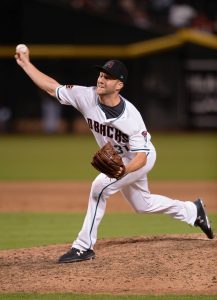
The 30-year-old Boxberger was non-tendered by the Diamondbacks in advance of his final season of arbitration eligibility. He was projected to earn at a $4.9MM rate, owing in no small part to the fact that he racked up 32 saves last year.
At times, Boxberger has been quite an effective late-inning reliever. In his 284 1/3 total MLB innings, he carries a 3.42 ERA with 11.6 K/9 and 4.6 BB/9.
As those numbers hint, opposing hitters have generally had a tough time making contact with Boxberger’s four-seam/change combo. On occasion, though, he has trouble inducing them to chase out of the zone and ends up doling out too many free passes. That’s what occurred in 2018, when he walked 32 in 53 1/3 innings and ended up with a 4.39 ERA on the year.
To be fair, Boxberger also racked up 12.0 K/9 in 2018, so he’s still capable of rather elite strikeout numbers. But his fastball velocity dropped below 92 mph for the first time in his career. With more time to react, opposing hitters only offered at 27.6% of the pitches that Boxberger left outside of the zone.
It’s not hard to imagine Boxberger competing for the closer’s job in Kansas City this spring. Wily Peralta took over that role last year, locking up saves in all of his 14 chances, but he doesn’t exactly have a longstanding history of success as a reliever and handed out 23 walks in his 34 1/3 innings on the season.
Photo courtesy of USA Today Sports Images.
Rangers Sign Hunter Pence To Minor League Deal
3:04pm: MLB Network’s Jon Heyman tweets that Pence’s deal has a $2MM base salary and another $1.25MM worth of incentives available to him
2:44pm: The Rangers announced Thursday that they’ve signed outfielder Hunter Pence to a minor league contract and invited him to Major League Spring Training. It’s a homecoming of sorts for Pence, a native of Fort Worth who attended high school in Arlington. The team also confirmed its previously reported signing of corner infielder/pitcher Matt Davidson.
Pence, 36 in April, was long one of the game’s more productive right fielders but has seen his production at the plate wane over the past two seasons. Dating back to the 2017 season, he’s mustered just a .249/.297/.368 slash with 17 homers, 24 doubles and six triples in 792 plate appearances with the Giants. He’ll look to rediscover some semblance of his peak form — .282/.341/.463 from 2011-16 — in his new deal with Texas. The veteran has been open about the work he’s been doing to make alterations to his swing in an effort to bounce back at the plate.
The Rangers currently have Joey Gallo, Delino DeShields Jr. and Nomar Mazara lined up around the outfield, with Shin-Soo Choo slotted in at designated hitter and prospect Willie Calhoun looming as an option in left field and at DH. Pence, though, could plausibly compete for a bench job given the uncertainty beyond the Rangers’ starting lineup. At the moment, one of Jeff Mathis or Isiah Kiner-Falefa (whichever isn’t catching that day) is the only real lock for a bench spot with the Rangers. Calhoun, infielder Patrick Wisdom and center fielder Carlos Tocci all figure to compete for a reserve gig as well, though all have minor league options remaining.