
Phillies Acquire J.T. Realmuto
2:15pm: The Phillies have announced the trade, acquiring Realmuto in exchange for Alfaro, Sanchez, Stewart and international funds. It seems, then, that the bonus money was the fourth component of the deal, rather than an additional minor league talent.
1:30pm: One of the winter’s biggest storylines has finally drawn to a close, as the Phillies and Marlins have agreed to a deal that will send star catcher J.T. Realmuto to Philadelphia, according to Jim Bowden of The Athletic (Twitter links). A four-player package will go to Miami in return, headlined by young backstop Jorge Alfaro and top pitching prospect Sixto Sanchez. Southpaw Will Stewart is one of the other pieces in the deal. The Marlins also acquire an international signing slot worth $250K, per ESPN.com’s Jeff Passan and the New York Post’s Joel Sherman (Twitter links).
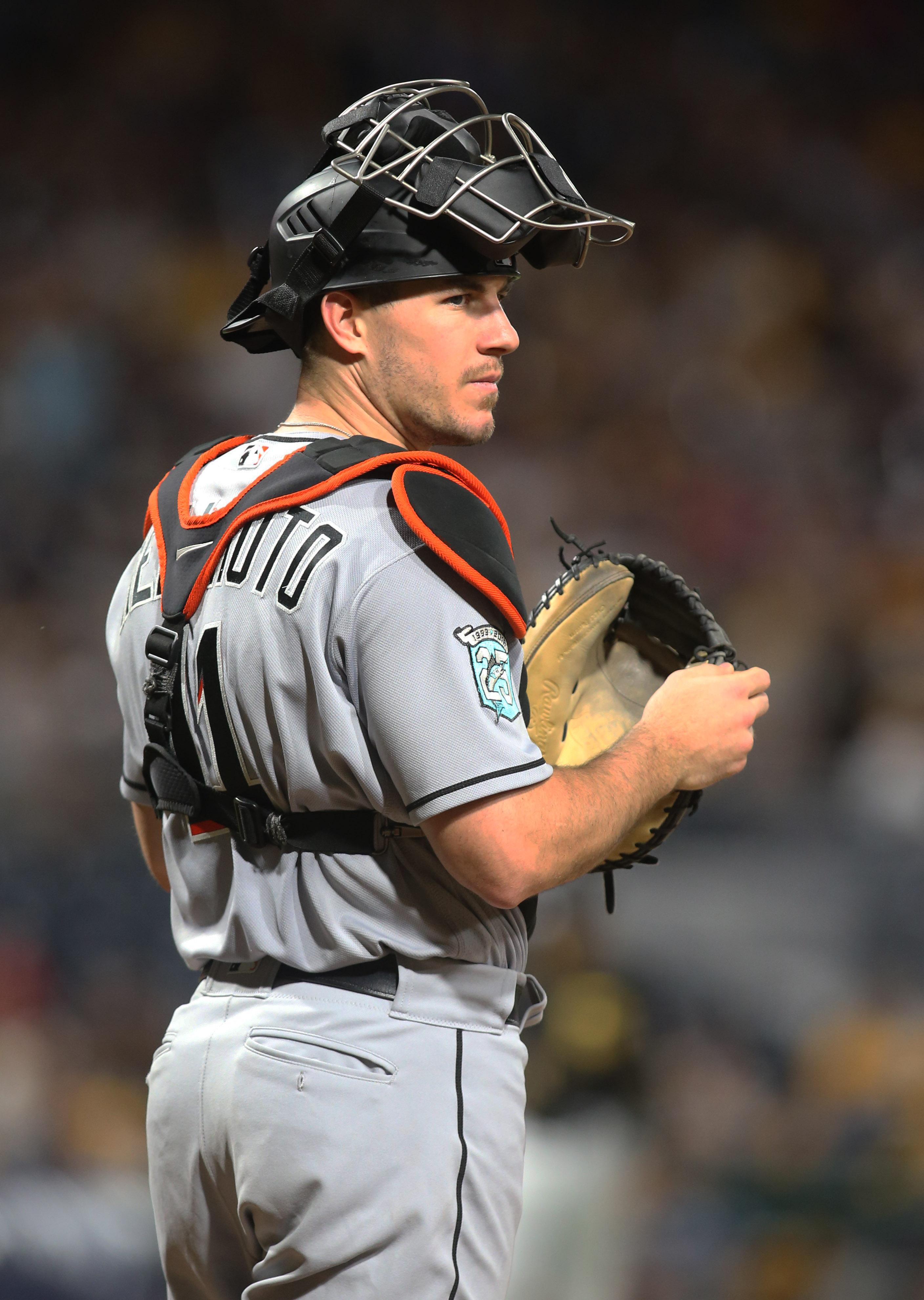
The course of negotiations surrounding Realmuto took many twists and turns. At various times, it seemed he’d end up at a variety of different teams, with the Dodgers, Padres, Reds, Braves and Astros all rumored to be involved to varying extents. Ultimately, the Phillies emerged late as the winning suitor, with their willingness to include Sanchez, one of the game’s top-ranked pitching prospects, seemingly pushing things over the finish line.
With the move, the Phils will add two seasons of Realmuto, a player who has established himself as the game’s best backstop. He’s earning just $5.9MM in 2019 with one more season of arbitration eligibility still remaining. It’s certainly possible that the Phils will pursue extension talks with the 27-year-old, though there is no indication that the possibility of a long-term contract is an element of today’s transaction.
Some may wonder whether this represents an alternative to the Phils’ longstanding pursuit of top free agents Bryce Harper and Manny Machado. Odds are, it only enhances the odds of such a major outlay. Parting with the years of cheap control over Alfaro and the upside of the two pitchers clearly positions the Phillies as a win-now club. And Realmuto is an affordable piece who won’t remotely clog the still-wide-open current and future Philadelphia balance sheets. His addition only further underscores the Phillies’ desire to win, which one would figure to be an appealing trait for either Machado or Harper. Of course, both are still expected to go to the highest bidder, but Philadelphia’s aggressive commitment to winning this offseason could be a tipping point in its favor should either top free agent be weighing similar offers from the Phillies and another suitor.
Future maneuverings aside, Realmuto himself provides a significant boost to the Phillies’ 2019 playoff chances. The 27-year-old missed the first few weeks of the 2018 campaign due to a minor back injury but came storming back with a terrific .277/.340/.484 batting line, 21 home runs, 30 doubles and three triples in 531 plate appearances. Realmuto’s OPS+ (which is adjusted for home park and league) checked in at 139 — effectively indicating that he was 39 percent better than a league-average hitter. That’s all the more impressive when considering that catchers, on the whole, were about 10 to 15 percent less effective than a league-average bat. Put simply — there are few, if any catchers in baseball who could upgrade a lineup more than Realmuto.
Defensively speaking, Realmuto is solid across the board. He’s thrown out would-be base thieves at a 35 percent clip across the past three seasons and has turned in average or better pitch-blocking marks, per Baseball Prospectus, throughout his career. While Realmuto’s framing efforts graded out poorly early in his big league tenure, he drew above-average marks in 2017 and average marks last season, so the Phillies can likely expect at least average output in that regard. Realmuto isn’t the framer that Alfaro was in 2018, but he’s a better blocker, and it’s not unreasonable to think that he could be a three- or four-win upgrade over Alfaro on his own.
As one would expect for a player of Realmuto’s caliber, the cost of acquisition was hardly cheap. Alfaro will step directly into the Marlins’ lineup as the team’s primary new backstop. While his bat is a work in progress, his framing in 2018 was excellent, and scouting reports on him as a prospect often pegged him with an 80-grade arm (top of the 20-80 scale).
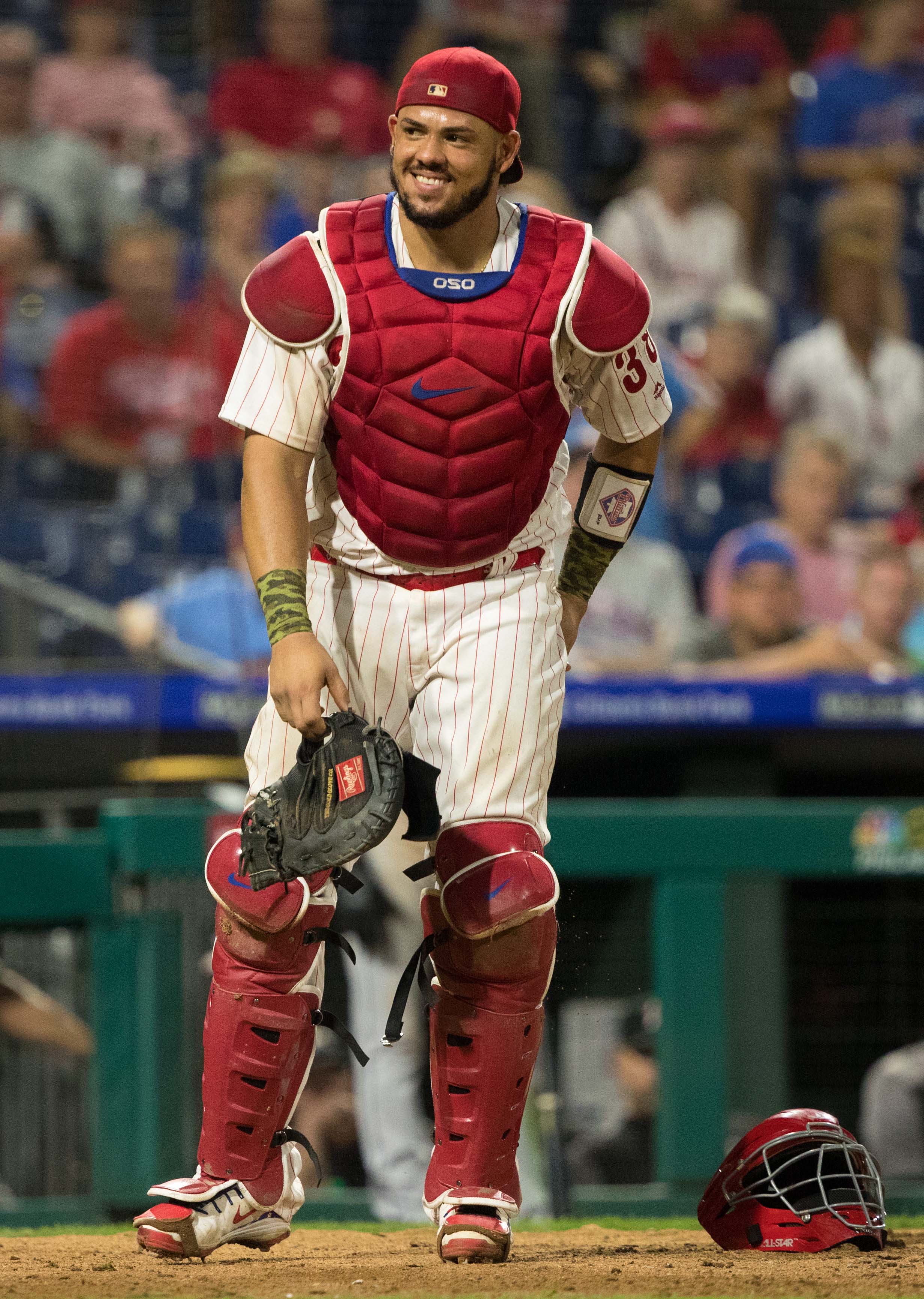
Alfaro hit .262/.324/.407 with 10 homers in 377 PAs last season, but there’s reason to doubt his ability to replicate that output. Specifically, Alfaro whiffed in 36.6 percent of his plate appearances and benefited from an eye-popping (and clearly unsustainable) .406 average on balls in play. The 25-year-old will need to improve on his contact skills if he’s to carve out a career as a regular, but the tools he possesses are undeniably enticing — particularly for a rebuilding club like Miami.
Sanchez, meanwhile, has rated among the game’s top pitching prospects for the past couple of seasons thanks to a triple-digit fastball and the potential for three average or better secondary offerings. The biggest question with him is health, as the righty was limited to 46 2/3 innings last season thanks to arm troubles (though none that required surgery). Sanchez reached the Class-A Advanced Florida State League as a 19-year-old last year — making him about four years younger than the average player in that league. Despite facing more advanced and experienced hitters, Sanchez pitched to a pristine 2.51 ERA with a terrific 45-to-11 K/BB ratio and a 52.3 percent ground-ball rate in those 46 2/3 frames when healthy. He’s likely at least a year away from MLB readiness, but he’ll immediately become not just the most highly regarded pitcher in the Marlins organization but their clear-cut top prospect.
The addition of Stewart, 21, isn’t a throwaway note for the Marlins, either. A 20th-round pick back in 2015, the lefty has elevated his status with a strong showing to this point in his pro career and was ranked 18th among Phillies farmhands by Eric Longenhagen and Kiley McDaniel of Fangraphs just last month. Stewart was two years younger than his average opponent in Class-A last season but nonetheless worked to a 2.06 ERA with 7.1 K/9, 1.7 BB/9 and a sensational 62.9 percent ground-ball rate in 113 2/3 innings as a starter. His sinker is complemented by a trio of potentially average offerings, and his significantly improved walk rate in ’18 is reason for further encouragement. The ceiling on Stewart is certainly lower than on Sanchez, but as ground-ball oriented pitcher with solid control, he could function as a nice back-of-the-rotation piece in the Marlins’ spacious home park if all pans out well.
In all, the Marlins have certainly positioned themselves to come away from the trade with a fair bit of value. While there’s certainly risk to the assets which they acquired — as is the case when trading any star player for unproven talent — Alfaro was long one of the game’s top catching prospects before debuting, and the most optimistic scouting reports on Sanchez peg him as a potential top-of-the-rotation starter. It’s feasible that by mid-to-late 2020, both could be on the Marlins’ big league roster, and the addition of a solid arm such as Stewart, even if he’s more “high floor” than “high ceiling,” deepens the farm and presents another potential rotation piece.
The Phillies traded a pair of high-upside players, Alfaro and Sanchez, who could prove to be dynamic pieces for a division rival down the line but did so at a time when the NL East could legitimately be seized by any of the division’s top four teams. Realmuto will join new additions Jean Segura and Andrew McCutchen alongside holdover Rhys Hoskins in the top portion of the Phillies’ lineup, and with the potential addition of Harper or Machado looming, his presence should be a key element in a dramatically improved lineup. The Phillies are aggressively looking to atone for last season’s late collapse, and the moves they’ve made, to date, seem quite likely to help the organization achieve that goal.
Frank Robinson Passes Away
Word emerged today that legendary former ballplayer and manager Frank Robinson has passed away at 83 years of age. MLBTR extends its condolences to the Hall of Famer’s family, friends, and many acquaintances around the game.
On the field, Robinson was one of the game’s most-feared sluggers for a nearly unfathomable stretch, with his first All-Star nod coming in his Rookie of the Year season of 1956 and his final one occurring in 1974, his final full campaign. In between, Robinson made a dozen additional All-Star appearances and won Most Valuable Player awards in both the National League (with the Reds in 1961) and American League (in 1966, his first season with the Orioles).
A paragon of consistency, Robinson’s worst seasons were the stuff of dreams for most MLB players. He ultimately appeared in 21 campaigns, compiling an eye-popping .294/.389/.537 lifetime batting line in 11,742 trips to the plate. Robinson not only racked up 586 career home runs — still tenth-most in history — but struck out only 789 times while drawing 698 walks.
Robinson’s legendary run as a player only tells part of his story. He finished out his time on the field as a player-manager of the Indians, making him the first African American manager in the history of baseball. Even while breaking barriers, Robinson’s supreme talent and determination showed through. In his first season leading the dugout, which was also his age-39 campaign as a player, he posted a 153 OPS+ and drew 29 walks against 15 strikeouts in 149 trips to the plate.
Robinson went on to run the dugouts of the Giants (becoming the first black manager in the National League), Orioles, and Expos/Nationals. Though he did not have a standout run of success in that job, with a 1065-1176 lifetime record as a skipper, Robinson later went on to take a prominent role in MLB operations and remained a highly respected member of the baseball community throughout. All told, his ongoing service cemented his legacy as one of baseball’s all-time lifers.
Robinson was elected to the Hall of Fame in 1982. He has had his number 20 retired by the Reds, Orioles, and Indians. And he received the Presidential Medal of Freedom in 2005.
Photo courtesy of USA Today Sports Images.
Phillies, Marlins Working Out Details Of Prospective J.T. Realmuto Swap
Reports emerged this morning that momentum was growing between the Phillies and Marlins on a deal to send star catcher J.T. Realmuto to Philadelphia. Now, it seems, the sides have made yet further strides, to the point that they appear to be on the cusp of a completed transaction.
Joel Sherman of the New York Post cites multiple sources (Twitter link) for the proposition that the negotiations are “down to physical reviews” and the supplemental prospect pieces in the swap. He reports that top Phillies pitching prospect Sixto Sanchez would join young backstop Jorge Alfaro as the two key pieces of the package.
That report builds upon prior indications of a nearing agreement. Bob Nightengale of USA Today tweets that two of the other organizations that had been pursuing Realmuto now believe he’s destined to land with the Phils. Craig Mish of MLB Network Radio on Sirius XM tweeted that he expects a deal to occur today, while MLB.com’s Jon Morosi reported the growing momentum with the Philadelphia organization specifically.
In terms of the final details of the package, it seems that’s still open to discussion. (One wonders whether other Marlins players or third teams could also be involved.) Sherman reports (Twitter links) that players under consideration including top-ten organizational prospects Mickey Moniak, Adam Haseley, and Adonis Medina, with Jon Heyman of MLB Network reporting (Twitter links) that Alec Bohm, Luis Garcia, and Spencer Howard all also being talked about.
That bunch of names covers most of the top portion of the Phillies farm, so there’ still a good bit of variability in the outcome here. Sherman says the outlook for the deal still looks good — indeed, Sanchez’s medicals are already under review in Miami — but there’s haggling left to go. The Marlins want four total players and are unsurprisingly trying to pry loose some of the Phils’ best remaining farm assets.
MLB, Union Discussing Significant Rule Changes
9:45pm: The Athletic’s Jayson Stark sheds some more light on potential changes to be discussed (subscription required). Chief among them is that the league and MLBPA are discussing the formation of a joint committee to study the potential impact of lowering and/or moving back the pitcher’s mound in an effort to curb the growing advantage pitchers face as velocity ticks upward league-wide. The study would be conducted throughout 2019, with a report on the findings delivered by the end of the year.
As Stark explores at length, further topics to be discussed include changes to the definition of the strike zone — which have been discussed in the past, as recently as 2016 — as well as alterations to the manner in which draft order is determined and the potential to award compensatory picks for revenue sharing teams that make or narrowly miss the postseason.
7:53am: Major League Baseball commissioner Rob Manfred and MLBPA executive director Tony Clark have recently been discussing a series of potential rule changes centering around pace of play, roster size and roster construction, writes Ken Rosenthal of The Athletic (subscription link). ESPN.com’s Jeff Passan and Joel Sherman of the New York Post (Twitter thread) add further details, characterizing the dialogue as something of a thaw in relations.
The two most notable changes that’ll jump out to readers are surely the Union’s proposal for a universal designated hitter — possibly beginning as soon as the 2019 season — and the league’s proposal that all pitchers must face a minimum of three hitters per appearance (barring an injury). Other especially notable concepts under discussion include expanding standard rosters to 26 players and shrinking September rosters to 28 players. Both were proposed by the league with an eye toward the 2020 season.
Obviously, the mere fact that the two sides are discussing various scenarios is far from an indication that a significant number of the ideas being bandied about will come to fruition. However, the game has generally had at least a handful of new rules implemented in each recent season, with restrictions on the number of mound visits per game and automatic intentional walks among the most recent alterations that have come into play.
The addition of a designated hitter in the National League for the 2019 season would not only lead to a great deal of pushback from many fans — though that’s true of all rule changes — but could lead to some unrest among both teams and agents. Perhaps all parties were quietly made aware of this possibility back in November, but if not, there’d undoubtedly be an advantage for teams that held off on activity early in the winter. Conversely, a player such as Nelson Cruz would be understandably irked to only now be learning that his market might’ve included 15 other teams.
It’s not a surprise that the MLBPA would want to push for a designated hitter in the NL with this level of immediacy, though. There would be clear ramifications on the player market, which could help a few more players find jobs late in the winter. Names like Evan Gattis, Lucas Duda, Adam Jones, Carlos Gonzalez and others could all find increased interest, and the added lineup depth in the NL would likely have some degree of impact on the markets for the game’s top two free agents: Bryce Harper and Manny Machado. Perhaps this wouldn’t lead to entirely new suitors emerging, but the prospect of having the increased flexibility of a DH could make it easier for Harper to fit onto a team with a crowded outfield mix or for Machado to fit onto a roster with a perceived infield logjam. And the long-term outlook for any premium hitter would change with the ability to utilize a DH slot.
All of that said, though, it still seems likelier that a rule change that impacts the very manner in which a team constructs its roster is something that would need to be known to all months in advance. The Union may be proposing implementation of the rule in 2019, but it seems more plausible that it’d come into effect in 2020 at the earliest.
Those factors have led to doubt in some quarters that the DH will indeed come to the NL this year, as Andy Martino of SNY.tv reports (Twitter links). Even if the commissioner’s office decides it would like to move ahead, Martino cautions, the owners may well be slower to come around. And even if they are open to a quick turnaround, the expectation is that there’ll be an expectation of concessions on the part of the union. Whether the players will be amenable to giving value back for the DH — a rule change that would hold out at least some promise for enlarging the overall pie by bringing more offense to the National league — remains to be seen.
Turning to the three-batter minimum, that would all but wipe out the so-called “LOOGY” role — the left-handed relief specialists who are oft called upon to face just one or two lefties before being swapped out. That minimum could also come into play for teams that have been most aggressive in utilizing the “opener” role; the days of Dan Jennings and his southpaw peers facing just one batter to start a game before departing (a tactic the Brewers did indeed use this season) would be instantly wiped out. Per Passan, this proposed change came from the league side; the players “did not strongly oppose the idea” but suggested waiting to deploy it until the 2020 season.
Left-handed relievers and their representatives surely wouldn’t be thrilled with the development, though it seems likely to reduce the number of pitching changes and conversely place a greater deal of emphasis on rostering and developing relievers who can throw one or more innings without glaring platoon splits. Players who fit that mold, naturally, would see the demand for their services rise even further. Perhaps the union imagines that there could be some other market advantages to a general de-specialization of relief roles, as there’d be slightly greater incentive to keep starters in for longer and a slight enhancement of the market value of the best overall relief arms.
Rosenthal notes that eliminating specialist roles could lead to fewer strikeouts by virtue of the fact that there’d be an increase of plate appearances in which batters held the platoon advantage, though it seems that such a reduction would be relatively minimal. While specialist relievers admittedly have higher strikeout rates against same-handed opponents, the general league-wide discrepancy in strikeout rate in platoon situations isn’t as staggering as some might think; right-handed hitters (excluding pitchers hitting in NL parks) struck out at a 22.3 percent clip against fellow righties and a 21.1 percent clip against lefties. Meanwhile, left-handed hitters fanned at a 23.5 percent rate against southpaw pitchers and a 20.9 percent rate against righties. There would be some impact, to be sure, but it’s unlikely that this change alone would curb stand in the way of yet another record-setting strikeout mark in 2019.
Ultimately, the batters-faced minimum and the theoretical slight downturn in strikeouts further gets into what has become the focal point of Manfred’s tenure as commissioner: improving the game’s pace of play. That, as Manfred has noted on multiple occasions, includes both length of game and the level of action within a game (more specifically, the number of balls put into play). Reducing the number of pitching changes and even incrementally increasing the number of balls in play could lead to small gains in both of those goals, though neither seems likely to bring about major change, and the advent of the “opener” strategy may even mitigate whatever pitching changes are eliminated by implementing a minimum number of batters faced.
To that end, there figure to be further tweaks to the game, be they in 2019, 2020 or beyond. Rosenthal reminds that Manfred does have the power to unilaterally implement the 20-second pitch clock that was proposed last offseason, even if no agreement is reached with the players’ union. Beyond that, there’s also been discussion of even further reducing the maximum number of mound visits a team can make, and the league apparently has interest in using Spring Training to experiment with runners being placed on the bases in extra innings.
Most of the foregoing has little to do with what is surely the union’s greater concern — the increasingly glacial pace of the MLB offseason and the rampant increase of teams tanking in order to increase their access to amateur talent in the league’s hard-slotted draft and international markets. Perhaps some concessions could be made to help appease both sides, though it still seems that an extraordinarily contentious set of negotiations is on the horizon when the current collective bargaining agreement expires in 2021.
It does seem there are some relatively minor initiatives being pursued by the players on that front, with Passan adding a few items of note. In particular, the MLBPA has proposed the implementation of a single trade deadline to take place before the All-Star break, rather than the current system of a non-waiver deadline at the end of July and what is effectively an end-of-August deadline to acquire players that have cleared waivers. Eliminating later-season trade opportunities, the union seemingly believes, would force teams to be more proactive in their offseason investments. Likewise, Passan says, the union has proposed various concepts (still mostly vague in their details) involving gains or losses of draft picks and international amateur spending availability to incentivize greater spending by all clubs.
Finally, in another area that impacts overall player earning capacity in a complicated manner, the players have floated some ideas regarding service-time manipulation of top prospects. According to Passan, the concept seems to be that players could boost their service time through “performance, playoff appearances or awards.” Finding a workable arrangement will surely be quite complicated, but that is at least a creative approach to what seems from the outside to be rather a vexing problem to solve given the inherently subjective considerations involved in promoting a player.
Taken as a whole, there is obviously quite a lot to digest and for the parties still to discuss. We’ll see whether any significant changes are implemented in advance of the present season — and whether they can be settled in time to influence the final outcomes of this winter’s market.
Giants Reportedly Enter Mix For Bryce Harper
The Giants have reportedly entered the mix for star free agent Bryce Harper. Randy Miller of NJ.com tweeted the connection, with Jon Heyman of MLB Network adding on Twitter that the club has recently met with Harper.
It is not yet clear how serious the interest is on behalf of the San Francisco organization, which is already dealing with quite a few large contract entanglements and recently turned over its baseball operations to Farhan Zaidi. Still, it’s intriguing to hear the connection. Zaidi was joined by owner Larry Baer and skipper Bruce Bochy in the sit-down, Alex Pavlovic of NBC Sports notes in a tweet.
Harper was already known to have met recently with the NL West rival Padres. Heyman suggests that multiple new organizations have entered the picture of late, which certainly could suggest that agent Scott Boras has sought to expand the pool of possibilities. Just what that suggests about Harper’s market and asking price isn’t clear.
It had long seemed that the Giants would be a leading potential landing spot for Harper, due to the team’s obvious need for youthful stars — particularly in the outfield — and history of maintaining high payrolls. But with the organization engineering a baseball ops shake-up after a pair of disappointing seasons, the match became much less certain.
Zaidi made his name finding value for the A’s and then scaling that process up as GM of the Dodgers. Plunking down huge dollars over long terms has not been a signature tenet of his approach as an executive. And the Giants are already loaded with underperforming contracts, some worse than others, that have left the organization with relatively little wiggle room beneath the competitive balance tax threshold.
That’s not to say that the San Francisco organization doesn’t make any sense as a Harper suitor. Even if immediate contention isn’t completely reasonable, the club has plenty of high-quality veteran players. With some creativity, the luxury tax barrier could also be dealt with. Zaidi noted at the outset of his tenure that he expects the organization’s decisions on premium talent to be “driven more by baseball need and opportunity than kind of working backwards from a payroll.” He cast doubt then on pursuit of a star free agent, but did not rule out the concept entirely.
Nationals To Re-Sign Jeremy Hellickson
The Nationals have reportedly agreed to re-sign righty Jeremy Hellickson to a one-year, MLB contract. Hellickson, a client of the Boras Corporation, will earn a $1.3MM base rate and could achieve up to $4MM in incentive pay.
The extra cash is tied to the number of starts Hellickson makes. He can take home $200K bonuses upon reaching his 3rd, 5th, 7th, 9th, 11th, 12th, 14th, 16th, 18th, 21st, and 23rd start and another $300K apiece for numbers 25 through 30.
Hellickson commands a big league roster spot after a productive 2018 season in D.C. Otherwise, the deal is rather similar to the one he took last year, a minor-league arrangement with a $2MM MLB salary and $4MM incentive package that ultimately paid dividends for both player and team.
Hellickson ultimately threw 91 1/3 innings over 19 starts, producing a 3.45 ERA for the Nats. The club rarely allowed him to face an opposing order for a third time. And understandably so: Hellickson was tagged for a .419/.500/.721 slash by the fifty opposing hitters that stepped into the box against him after two prior looks.
Even with that judicious deployment accounted for, ERA estimators weren’t totally sold on the outcome. Odds are, the Nats also would anticipate Hellickson regressing toward the levels of productivity that the metrics support. Still, for a fifth rotation/long-man candidate, those numbers — FIP (4.22), xFIP (4.27) and SIERA (4.33) — were rather promising.
It’ll be interesting to see how the Nationals approach their roster this spring. The club invested heavily to add Patrick Corbin at the top of the staff and committed to veteran Anibal Sanchez as a number-four starter. With Hellickson back in the fold, younger hurlers Joe Ross and Erick Fedde may be on the outside looking in. Those pitchers could end up winning a rotation job in camp, checking down to a bullpen job, or starting the season on optional assignment.
Craig Mish of MLB Network Radio on Sirius XM reported (Twitter links) that the sides were in discussions and later detailed the incentives. MLB.com’s Jamal Collier reported (Twitter link) the sides were “progressing.” Jon Heyman of MLB Network (Twitter link) first reported a deal was in place and provided financial details, while Mark Zuckerman of MASNsports.com tweeted that it was a MLB contract.
Photo courtesy of USA Today Sports Images.
Marlins Sign Curtis Granderson
The Marlins have announced a minor-league deal with outfielder Curtis Granderson. It includes an invitation to participate in MLB Spring Training. He’ll earn $1.75MM in the majors with $250K in possible incentives, per Jon Heyman of MLB Network (via Twitter).
Granderson turns 38 in March but can still get the job done at the plate. He ended the 2018 campaign with 403 plate appearances of .242/.351/.431 hitting, good for a 116 wRC+. That’s right at his career mark for overall productivity (117 wRC+), though the most recent iteration of Granderson relied a bit more on on-base percentage than the power that has traditionally driven his value.
There are certainly some major caveats here from an on-field perspective. Granderson was not trusted to face lefties last year, reflecting his longstanding struggles against same-handed pitching. And metrics have increasingly soured on his glovework in the outfield.
Still, it seems like a nice addition for the Marlins, who likely gave Granderson assurances that he’d have an inside track to a roster spot and semi-regular playing time. The team is likely headed for another rough season in the standings, but needs to maintain some fan interest and provide veteran leadership. Granderson, a widely respected clubhouse presence, is more a contemporary of Marlins CEO Derek Jeter (his former Yankees teammate) than of the many young players on the Miami roster. He’ll join recent signee Neil Walker in providing some affordable gravitas before potentially transforming into a mid-season trade chip.
Padres Meet With Bryce Harper
Feb. 2, 2:53pm: Per Jon Heyman of MLB Network, the San Diego brass sees Harper as a “business/marketing opportunity” and “may now lean” toward securing his services over those of Manny Machado, despite their obvious need at 3B and swarm of young, controllable corner outfielders.
Jan. 31, 11:24pm: Acee has an update on tonight’s meeting, in which Padres general partner Peter Seidler joined GM A.J. Preller and skipper Andy Green to make the pitch. Per the report, the San Diego contingent was “extremely prepared and seemed sincere about wooing” Harper.
11:40am: The Padres’ entry into the Harper bidding is more “extended due diligence,” and is not as serious as their interest in Machado, writes Kevin Acee of the San Diego Union-Tribune. The surprising lack of suitors for Harper has helped to fuel San Diego’s interest, he adds.
Meanwhile, Rosenthal tweets that the meeting will take place tonight. MLB.com’s Jon Morosi calls the Padres one of four suitors for Harper, alongside the Phillies, White Sox and Nationals, noting that one other club remains “on [the] periphery” (Twitter link).
10:44am: The Padres will meet with free-agent outfielder Bryce Harper in Las Vegas today or tomorrow, reports Ken Rosenthal of The Athletic (Twitter links). Padres ownership is “expected” to be represented at the meeting, and Rosenthal further notes that Harper and agent Scott Boras have met with other teams “in recent days,” though there’s still no signs that a deal close.
The news of a meeting with Harper comes on the heels of last week’s report that the Padres are pursuing Manny Machado and planning a similar sitdown with him, although MLB.com’s Jon Morosi tweeted last night that the Padres/Machado meeting has still not taken place. Nevertheless, the Padres’ surprise emergence as a potential suitor for the market’s top two free agents is of note, and the very fact that in-person meetings are being scheduled shows a level of interest that many teams throughout the league have not expressed.
Outfield isn’t exactly an area of need for the Friars, who already have Wil Myers, Manuel Margot, Hunter Renfroe, Franchy Cordero, Franmil Reyes and Travis Jankowski on the roster. Harper, though, would nonetheless represent an upgrade in right field and would further allow the Padres to explore the trades of younger, controllable outfielders. It’s also possible that Harper’s market hasn’t progressed to the level that San Diego initially expected, and ownership has agreed to a meeting to determine whether there’s a plausible fit. The Padres did sign another high-profile Boras client, Eric Hosmer, to an eight-year deal worth $144MM last winter, and the organization surely feels it is now closer to contending than it was at that point, even if doing so in 2019 is a long shot (with or without Harper).
The Hosmer contract was already a significant expenditure for the typically conservative Padres, and signing either Harper or Machado would represent next-level spending the likes of which has never been seen by the organization and its fans. However, as I noted last week when looking at how Machado could fit into the payroll, it might not be as difficult as many would think for the Padres to accommodate an annual salary of $30MM+ (Harper spurned a 10-year, $300MM offer from the Nationals that has reportedly since been increased).
Myers and Hosmer are the only long-term contracts on the books for the Padres, and Hosmer’s contract was heavily front-loaded. While he’s earning $21MM annually for the next four seasons, Hosmer’s salary will drop to $13MM per year from 2023-25. Myers is owed $5.5MM in 2019 and $22.5MM in each of the three subsequent seasons, although the Padres have been trying to offload that contract for awhile anyhow.
Even speculatively penciling in a hefty $34MM annual rate of pay for Harper and assuming that the organization is unable to trade Myers, there’d only be three seasons in which the Padres were on the hook for all of those salaries. Combined, those three would equal $77.5MM — a huge sum for three players by San Diego’s standards, but come 2023 they’d be paying Harper and Hosmer under $50MM combined with Myers off the books. And, given the Padres’ deluge of oncoming talent from one of the game’s top-ranked farm systems, it’s likely that Harper and Hosmer could be largely surrounded by pre-arbitration players. Fernando Tatis Jr., Luis Urias and Francisco Mejia could all potentially join Harper and Hosmer as regulars in that theoretical lineup by the end of the 2019 season.
None of that is to say that a deal between the two sides is likely, but the financial component may be far easier to navigate than many would expect upon first glance. The meeting is just one step in what would surely be an arduous negotiation process, but it seems clear that current Padres ownership is at least open to the possibility of high-level spending before its hopeful core emerges at the big league level.
Astros Sign Wade Miley
Feb. 1: The Astros have formally announced the signing. Houston’s 40-man roster is now at 39 players.
Jan. 31: The Astros have agreed to a one-year deal with lefty Wade Miley, according to Ken Rosenthal of The Athletic (via Twitter). The O’Connell Sports Management client receives a $4.5MM guarantee and can tack on $500K in incentives, Bob Nightengale of USA Today adds (Twitter links).
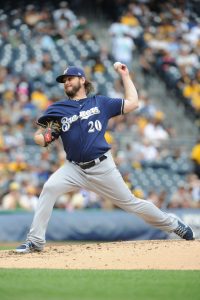
Miley becomes the latest mid-range starter to settle for a one-year pact after entering the offseason with a case for a multi-season arrangement. He’ll presumably step into the Houston rotation, though his incentives package includes provisions allowing him to earn either for starts or relief appearances, per Ken Davidoff of the New York Post (Twitter link).
This trip through free agency may not have been quite as financially rewarding as Miley might have hoped, but he landed with a clear contender and certainly fared better than he did the last time around. Miley settled for a minors pact last year with the Brewers after a rough two-season run, but turned things around after overcoming some health issues early in the season.
All told, Miley worked to a 2.57 ERA in 80 2/3 frames over 16 starts last year in Milwaukee. He averaged only 5.6 K/9 with 3.0 BB/9, but generated a robust 52.8% groundball rate and allowed only three home runs on the year.
In some regards, Miley was not a substantially different pitcher last year than he had been over the prior seven seasons. His swinging-strike rate sat just a half percentage point above his lifetime 8.6% mark; his average fastball velocity sat right at his career mean of ~92 mph. But that only tells part of the story, as Miley drastically revamped his arsenal in a manner that obviously paid dividends.
In particular, Miley ramped up usage of his cutter, which became his most-used and most-effective pitch, while burying his sinker and slider in favor of enhanced usage of a curve and change. He surrendered much more pull-side contact than before, but with a career-high 2.24 GB/FB rate, the shift-savvy Brewers were able to gobble up quite a few of those well-struck balls. Miley also induced weak contact on 19.5% of the balls put in play against him and ended the season with a career-low .269 BABIP-against.
That last figure — batting average on balls in play — is an interesting one to consider. Any change in Miley’s fortunes in that area, or in the number of balls that leave the yard, could reverse his turnaround. First, though, opposing hitters will have to find a way to solve Miley’s two favorite new offerings; they managed sub-.200 batting averages and sub-.300 slugging percentages against both his cutter and curve last year. Statcast was duly impressed, as it credited Miley with a .300 xwOBA that largely supports the weak .283 wOBA mark he held batters to.
Photo courtesy of USA Today Sports Images.
Diamondbacks Sign Greg Holland
TODAY: The team has announced the signing.
YESTERDAY: The Diamondbacks have agreed to a one-year deal with free agent reliever Greg Holland, according to Robert Murray and Ken Rosenthal of The Athletic (via Twitter). The Boras Corporation client secures a $3.25MM guarantee and $3.5MM in possible incentives, per Jon Heyman of MLB Network (Twitter links). Holland still must pass a physical before the contract will be finalized.
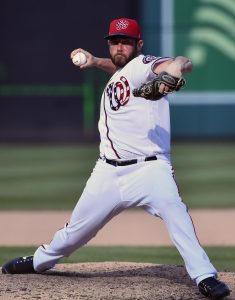
Now 33 years of age, Holland is not the same pitcher that once featured as one of the game’s most dominant relievers. Indeed, he last pitched as a true relief ace back in 2014. He blew out his elbow in the ensuing campaign and has never fully regained his velocity.
That’s not to say that Holland hasn’t shown his share of ability in the ensuing seasons. He turned in a successful 2017 campaign for the Rockies, so much so that he received and rejected a qualifying offer from the organization in the following winter. And though things went terribly last year with the Cardinals after a late-spring signing, Holland did rebound later in the season with the Nationals.
It truly was a dramatic turnaround, though it’s hard to pinpoint the root cause for the change. In his 25 frames in St. Louis, Holland surrendered as many earned runs and free passes as he recorded strikeouts (22 apiece). Upon arriving in D.C., Holland contributed 21 1/3 innings over which he posted a 25:10 K/BB ratio and permitted only a pair of earned runs on just nine hits.
Over the course of the season, Holland proved capable of limiting the long ball, as he has long done. And he still generated a strong 13.1% swinging-strike rate. Clearly, the D-Backs won’t anticipate the full-fledged re-emergence of the once-great closer, but they’ve evidently seen enough to believe that Holland can still be a quality, late-inning arm.
The exact plan for Holland’s usage isn’t yet evident, but it would hardly be surprising to see him receive at least a full-blown shot at earning the closer’s gig this spring. Archie Bradley currently profiles as the top ninth-inning option in Arizona, but he has been successful in a more flexible role. Details of Holland’s incentives package aren’t yet known, but could offer a hint as to the expectations of all involved.
Needless to say, the Cardinals did not see a return on the $14MM they invested in Holland last year. It’s tough to imagine the Diamondbacks ending up with a similar sense of regret, given the much lower amount promised. If they end up paying Holland the full $6.75MM contemplated in the contract, it’ll only be because he warranted the opportunities. Beyond that, even if the Snakes prove unable to mount a surprise challenge for the postseason, they ought to have an opportunity to spin off Holland (and his remaining financial obligations) to another team over the summer.
Photo courtesy of USA Today Sports Images.