
Braves Release Alex Verdugo
TODAY: The Braves released Verdugo after he cleared waivers, the Athletic’s David O’Brien writes.
JULY 2: The Braves have designated outfielder Alex Verdugo for assignment, reports Ken Rosenthal of The Athletic. Verdugo’s spot on the roster will go to fellow outfielder Jurickson Profar, who will be reinstated from the restricted list after serving an 80-game PED ban.
Verdugo, 29, signed a one-year, $1.5MM contract with Atlanta late in the offseason. He first filled a reserve role behind Jarred Kelenic but wound up thrust into a more prominent role when Kelenic’s prolonged struggles to hit big league pitching saw him optioned to Triple-A Gwinnett. Verdugo raced out to a hot start with the Braves, hitting .322/.385/.441 in his first 65 plate appearances, but his production has cratered since that time. Dating back to May 6, Verdugo has registered an anemic .203/.257/.225 batting line (37 wRC+) in 148 turns at the plate.
This year’s run with the Braves largely mirrors Verdugo’s 2024 with the Yankees. His early hot streak in New York lasted longer than his hot streak in Atlanta, but his struggles as a Yankee were also more protracted. Verdugo has now tallied 834 plate appearances across the past two seasons and generated a dismal .234/.292/.339 batting line. That’s a far cry from his 2019-23 form, when he batted .283/.338/.432 and served as a solid regular in the outfield corners for the Dodgers and Red Sox.
Even Verdugo’s once-excellent defensive grades have deteriorated in recent years. Defensive Runs Saved still gave him a slightly positive mark (+1) in 426 innings this season, but that’s nowhere near his 2019-24 levels, when he garnered a gaudy +31 mark in 6150 innings. Statcast’s Outs Above Average pegged Verdugo as a scratch defender in 2024 but has him at minus-5 in 2025. Verdugo’s sprint speed used to rank well above average but is now in the 21st percentile of big leaguers, which has obviously cut into his range in left field.
The Braves can trade or place Verdugo on outright waivers at any point in the next five days, although given his guaranteed salary and lack of production, the likeliest outcome will be a release. If and when he clears release waivers, any other club could sign Verdugo and owe him only the prorated league minimum for any time spent on the major league roster. That sum would be subtracted from what Atlanta owes him, but the Braves will remain on the hook for the vast majority of his 2025 salary.
Top 40 Trade Candidates For The 2025 Deadline
We’ve hit July and are less than a month from the trade deadline, so it’s an appropriate time for MLBTR’s first pass at which players could be on the move. While we’ve probably already seen the year’s biggest trade with the Rafael Devers stunner, the number of teams on the postseason bubble will make the next few weeks particularly interesting. Trade volume tends not to ramp up until the second half of the month — both to allow fringe contenders more time to evaluate their playoff chances and because clubs primarily remain focused on the July 13-14 amateur draft.
As is the case for all our trade candidate lists, we’re trying to strike a balance between the player’s appeal and the likelihood that they’ll move. This isn’t purely a ranking of trade value or talent. There are players in the back half of the list who’d vault to the top if it were clear that they’d be moved. It’s an inherently subjective exercise.
This is a league-wide summary, but we’re also drilling down more specifically into each team with our new Deadline Outlook series for Front Office subscribers. We’ve already covered most of the clear buyers and sellers in that series and will continue checking off the bubble teams over the next couple weeks.
With that out of the way, onto the list! We’ll update and quite likely expand the rankings at least once or twice as the deadline draws near.
Stats are through play on July 2.
1. Sandy Alcantara, RHP, Marlins ($17MM in 2025; $17MM in 2026, $21MM club option/$2MM buyout for 2027)
As a former Cy Young winner signed affordably on a rebuilding team that traded a dozen players last July, Alcantara has stood as the most prominent and obvious trade candidate for much of the season. A few factors have gummed the situation up more than expected. First and foremost, Alcantara not only hasn’t looked like his former self for much of the season — he simply hasn’t been a very good pitcher. The velocity is still strong, but Alcantara carried an 8.47 ERA into the month of June. His strikeout, walk and ground-ball rates all went in the wrong direction, relative to past levels.
Alcantara looked to be righting the ship when he rattled off four starts/23 innings with a 2.74 ERA and improved rate stats. He followed that encouraging stretch with a seven-run shellacking at the hands of the D-backs. Now, on top of his inconsistency, Miami recently won eight straight games. The Fish are still seven under .500, but they’ve graduated from “surefire seller” to merely “likely seller.” Alcantara is simultaneously the most talented and enigmatic pitcher on this list.
2. Mitch Keller, RHP, Pirates ($15MM in 2025; $16.5MM in 2026, $18MM in 2027, $20MM in 2028)
A steady, mid-rotation workhorse who’s signed to a reasonable contract, Keller’s name has come up in connection to the Cubs and will surely garner interest from virtually every pitching-hungry team on the market. He’s working with a diminished strikeout rate this season but has missed more bats over the past two months (20.3 K%) than he did early in the year (16.8 K% through May 2).
The Pirates don’t need to move Keller, but they’re deep in young pitching and thin on young, impact position players. Flipping Keller for an interesting bat(s) and then reallocating his salary to a mid-range free agent has some merits. If the Pirates do move him, they’ll probably be seeking MLB-ready help, as the current front office regime is in year six of an increasingly interminable rebuilding process.
3. David Bednar, RHP, Pirates ($5.9MM in 2025, arbitration-eligible through 2026)
Bednar struggled in 2024, then pitched so poorly to begin the 2025 season that the Pirates optioned him to Triple-A Indianapolis. A few weeks later, he was back on the big league roster and back to peak form. Since his mid-April recall, Bednar has pitched 28 2/3 innings with a 1.88 ERA, a mammoth 36.6% strikeout rate and a 6.3% walk rate. He’s going to get a raise to the $8-10MM range in his final arbitration year, and the Pirates would probably prefer not to pay that, even for a hometown fan favorite. Ownership has reportedly intervened in past Bednar trade talks, but that doesn’t seem likely to be the case this time around — not in the wake of his roller-coaster calendar year and with just one additional (and expensive) season of club control remaining.
4. Ryan O’Hearn, 1B/DH, Orioles ($8MM in 2025, free agent at season’s end)
O’Hearn has gotten better every year since being traded to Baltimore in 2023 and now stands as one of the best bats not just on this list but in the entire American League. He’s hitting .295/.383/.471 (44% better than average, per wRC+) with 11 homers, 10 doubles, an 11% walk rate and just a 16.3% strikeout rate. O’Hearn is far better against righties than lefties. A contender with a righty-hitting platoon option could benefit greatly from plugging O’Hearn into the heart of its order.
5. Andrew Heaney, LHP, Pirates ($5.25MM in 2025, free agent at season’s end)
In 2022, it was Tyler Anderson. In 2023, it was Rich Hill. In 2024, Martin Perez. This year’s veteran Pirates lefty du jour is the 34-year-old Heaney, who’s been an effective innings eater at the back of their rotation. Heaney’s velocity, strikeout rate and swinging-strike rate are all down relative to recent years, but he’s a veteran lefty who can solidify the fourth or fifth spot in a contender’s rotation before moving to the bullpen in the postseason. The Bucs have scaled back his slider usage and have Heaney throwing a sinker more frequently, so perhaps another club thinks that there’s more upside to miss bats if he reverts to his former usage rates. Heaney posted a 12% swinging-strike rate and fanned 23% of his opponents just last year in Texas.
6. Ryan McMahon, 3B, Rockies ($12MM in 2025; $16MM annually in 2026-27)
The Rockies tend to resist selling their best players, particularly when they have multiple years of club control remaining. McMahon is no exception. They passed on truly making him available last year despite interest, then watched as McMahon torched his trade value over the remainder of the season and in the early portion of 2025.
McMahon got hot in early May, however, and while he’s slumped a bit over the past couple weeks, he looks a lot like the classic version of himself. Dating back to May 1, he’s slashing .258/.349/.478 with 10 homers, nine doubles and a triple. His strikeout rate in that span is almost 30%, but contact has long been an issue for the 30-year-old, so that’s nothing new. This looks like vintage McMahon — 20-homer pop with plus defense at the hot corner and plenty of strikeouts. We can never accurately predict what the Rockies will do, but if their current 37-win pace can’t convince them a change in approach is needed, perhaps nothing will. McMahon should be available this time around, and Jon Heyman of The New York Post reported yesterday that the Rox are more willing to listen than they have been previously.
7. Jeffrey Springs, LHP, Athletics ($10.5MM annually in 2025-26; $15MM club option/$750K buyout for 2027)
The A’s traded for Springs over the winter, hoping they were buying low on a lefty who looked to have a quiet breakout with the 2022-23 Rays before blowing out his elbow. Instead, he’s pitched like a fourth starter. Springs’ velocity is down a mile per hour, and his strikeout and walk rates have both trended the wrong way since returning from surgery. He’s sitting on a 4.30 ERA but has looked better of late. Even if he’s only a fourth starter, his contract isn’t bad, and there could be upside for better performance as he further distances himself from surgery.
8. Cedric Mullins, OF, Orioles ($8.725MM in 2025, free agent at season’s end)
Mullins had a huge April but is hitting just .171/.215/.336 in 164 plate appearances since that time. His season-long batting line is down to right about league average. Mullins’ defensive ratings have dipped in recent years, but he’s one of the few center field options who could feasibly be on the trade market this summer. He entered the season as a pretty clear qualifying offer candidate, but if his current struggles continue, the O’s might not chance that — which only makes the notion of a trade more compelling.
9. Dennis Santana, RHP, Pirates ($1.4MM in 2025, arb-eligible through 2026)
When the Pirates claimed Santana last June, few took notice. Jokes were made. Santana was a journeyman right-hander who’d ping-ponged around the league. The Pirates were looking to emerge from a lengthy rebuild and plucked a cheap power arm with an inconsistent track record off waivers.
Pittsburgh’s claim of Santana is a reminder that we never really know how even the most mundane transaction will pan out in this game. Since landing with the Pirates, Santana has pitched 80 2/3 innings with a 2.02 ERA, 25.5% strikeout rate, 5.6% walk rate and 41.3% ground-ball rate. He’s averaging 95.2 mph on his heater and proving near impossible to square up (86.1 mph average exit velocity, 4.3% barrel rate, 29.8% hard-hit rate). His lack of track record kept his arbitration price tag low. Santana now looks like a quality high-leverage arm whose salary amounts to relative peanuts. He has another season of club control remaining and probably won’t top $4MM. Nearly any bullpen-needy team would be happy to have him, and since he’s effectively found money with minimal control remaining, the Pirates should be more than willing to move him.
10. Jake Bird, RHP, Rockies (pre-arbitration in 2025, arb-eligible through 2028)
Bird has worked to change the shape and speed of his slider in recent years, and he’s now throwing it more than either his sinker or curveball. The result is 48 innings with a terrific 2.63 ERA (2.96 SIERA). Bird has whiffed 29.1% of his opponents against a 9.5% walk rate. He’s “only” averaging 94.3 mph on his sinker, so he’s not necessarily a power arm by today’s standards, but he’s been extremely effective. Bird won’t reach arbitration until this offseason and is under club control through 2028. This is precisely the type of player the Rockies have resisted trading at peak value in the past. Will they change direction this time around? They should, given both the state of the organization and the fact that relief pitchers are notoriously volatile.
11. Seth Lugo, RHP, Royals ($15MM in 2025; $15MM player option for 2026)
Lugo would have a case for the #1 spot on the list if he were a lock to be traded. He’s coming off a Cy Young runner-up finish and carries a 2.21 ERA through 15 starts this year. While he doesn’t have huge swing-and-miss stuff, he has proven capable of excelling as a starter and would fit well as the #2 or #3 pitcher in a postseason rotation. The Royals are hopeful of avoiding a sale, but they’ve dropped six games below .500 after a terrible June and are running out of time to get back on track.
The contract structure is the complicating factor. Lugo’s $15MM salary is a bargain for a pitcher of his caliber. He has a matching player option for 2026 that he’d almost certainly decline so long as he finishes this year healthy. That’s pure downside for an acquiring team, though. If Lugo gets injured in the final two months, they’re stuck paying that. He’d otherwise be able to walk next winter. Teams tend to be reluctant to acquire players whose deals have opt-out clauses, but there’ll be such a demand for starting pitching that someone should be willing to roll the dice and hope he stays healthy. They’ll want to price that downside into whatever they offer the Royals, which could make it tricky to find an agreeable prospect package.
12. Marcell Ozuna, DH, Braves ($16MM in 2025, free agent at season’s end)
It doesn’t seem as though the Braves will be all that keen on trading players controlled beyond the season, but Ozuna is a free agent who can’t be tendered a qualifying offer because he already received one earlier in his career. The 34-year-old slugger’s power output is down this year, but he’s still ripped 11 homers en route to a .242/.370/.389 batting line (116 wRC+). This year’s 16.7% walk rate is a career best, and Ozuna’s batted-ball metrics on Statcast remain excellent.
13. Michael Soroka, RHP, Nationals ($9MM in 2025, free agent at season’s end)
Soroka signed a one-year, $9MM free agent contract to work out of Washington’s rotation. He missed a month early in the season with a biceps strain but has been healthy since the second week of May. A 4.70 ERA through 59 2/3 innings isn’t eye-opening, but he’s striking out more than 26% of opponents. Soroka posted big strikeout numbers in a relief role for the White Sox late last season, so he could be a target for teams seeking rotation or bullpen help.
14. Germán Márquez, RHP, Rockies ($10MM in 2025, free agent at season’s end)
After an ugly start to his season, Márquez is back on track. He’s held opponents to a 2.70 ERA over his past eight starts — a sample of 43 1/3 innings — although that includes six unearned runs at the hands of the Dodgers on June 24. He’s fanned 20.9% of his opponents and issued walks at a sharp 5.8% clip in that time. Márquez isn’t missing as many bats, generating as many grounders or throwing quite as hard as he did at his peak, but he’s an affordable 30-year-old righty with a nice track record who could potentially benefit from finally getting out of Coors Field. At his best, in 2018, Márquez posted a 3.77 ERA (3.10 SIERA) and fanned more than 28% of his opponents. He’s probably not going to get back to that level, but there’s some track record and a bit of upside here.
15. Aaron Civale, RHP, White Sox ($8MM in 2025, free agent at season’s end; Brewers covering portion of the salary)
Civale was bounced from the Brewers’ rotation earlier this summer when they called up top prospect Jacob Misiorowski. Given that he’s a career-long starter and impending free agent, he requested a trade, and the Brewers/White Sox accommodated him. The South Siders are surely hoping to be able to flip Civale for more than they gave up (non-tender candidate Andrew Vaughn). He’s been a passable if unspectacular rotation option since returning from an early IL stint, logging a 3.86 ERA, 17.5% strikeout rate and 9.7% walk rate in seven starts (35 innings). A team just looking for a competent starter to keep them in the game every fifth day could flip a nominal prospect to the White Sox to get something done.
16. Adrian Houser, RHP, White Sox ($1.35MM in 2025, free agent at season’s end)
Speaking of White Sox starters and nominal returns, Houser has done well to rebuild some value after a brutal season with the Mets. The longtime Brewers hurler signed a big league deal in late May after being granted his release by the Rangers. He’s responded with seven starts and 42 2/3 innings of 1.90 ERA ball. Houser’s 18.1% strikeout rate, 8.2% walk rate and 46.8% grounder rate don’t support that success, which is propped up by a sky-high 87% strand rate that he won’t sustain. That said, he’s averaging a career-best 95 mph on his four-seamer and getting good results on a curveball he’s throwing at a career-high clip, so there are some tangible changes to support an ERA in the low 4.00s.
17. Jesus Sanchez, OF, Marlins ($4.5MM in 2025, arb-eligible through 2027)
At $4.5MM, Sanchez is the highest-paid position player on Miami’s roster (not counting the dead money owed to Avisail Garcia). He’s a former top prospect who has settled in as a league-average right fielder. Sanchez has double-digit home run power and serviceable but hardly elite on-base skills. It’s tough to sell him having a much higher ceiling as he nears his 28th birthday, but he’s a straightforward target for teams that need to raise the floor in the corner outfield. He’s still reasonably affordable and controllable for two years after this one, though his expected arbitration salary may climb to a point beyond what teams are willing to pay by 2027.
18. Kyle Finnegan, RHP, Nationals ($6MM in 2025, free agent at season’s end)
The Nats didn’t trade Finnegan last summer, perhaps in part because of some struggles leading up to the trade deadline. He was non-tendered after an awful second half but re-signed on a one-year deal and has been solid in 2025. Finnegan’s velocity and strikeout rate are down, but he’s still sporting a 2.61 ERA and 18 saves on the season. The dip in strikeouts and a poor 8.7% swinging-strike rate are going to impact his trade value, but the Nats should be able to flip him for a decent return.
19. Nathaniel Lowe, 1B, Nationals ($10.3MM in 2025, arb-eligible through 2026)
A steadily productive first baseman for the Rangers from 2021-24 when he batted a combined .274/.359/.432 (124 wRC+), Lowe has taken a significant step back following an offseason trade to the Nationals. He’s shown signs of life recently, swatting four homers and tallying six multi-hit games since June 17. If Lowe can maintain this hot streak for another four weeks, he’ll be able to largely attribute his sub-par production to an anomalous six-week stretch from early May to mid-June. There’s a nice track record here, and Lowe should be popular in a market that’s light on impact bats.
20. Zack Littell, RHP, Rays ($5.72MM in 2025, free agent at season’s end)
The Rays are in the thick of the AL East race and are not going to be true “sellers.” They never close the door on creative trade scenarios, though, and they may feel they can part with Littell without dealing a huge hit to their playoff odds. He’s an elite strike-thrower who carries a 3.61 ERA over 17 starts. Most teams probably view him as a low-end #3 or solid fourth starter. The Rays have a strong rotation and still have a shot to welcome Shane McClanahan back in the final month or two. Littell probably walks in free agency next offseason. Cashing him in for a controllable asset on a pitching-starved market while adding elsewhere on the roster would fit the Rays’ usual operating procedure.
21. Luis Severino, RHP, Athletics ($15MM in 2025; $20MM in 2026, $22MM player option for 2027)
The A’s brought Severino to West Sacramento on a three-year deal, and it seems like all parties involved might prefer a mulligan. Severino has recently been outspoken about the unfavorable home conditions at Sutter Health Park, where he’s pitched to a 6.79 ERA compared to a 3.04 mark on the road. Trading Severino won’t be an easy feat. The A’s overpaid to get him in the first place, and Severino is now sitting on a 5.09 ERA with a 15.4% strikeout rate that ranks 68th among 70 qualified major league starting pitchers. On top of that, he has an opt-out following the 2026 season.
22. Luis Robert Jr., OF, White Sox ($15MM in 2025; $20MM club options/$2MM buyout for 2026-27)
The Sox have been hopeful that the oft-injured Robert will return to his brilliant 2023 form and build up some trade value, but he keeps trending in the opposite direction. He’s still just 27 years old, but dating back to Opening Day 2024, Robert is lugging a .209/.275/.354 batting line around with him. He landed on the injured list with a hamstring strain over the weekend. He’s still a plus baserunner with strong defensive tools, but what once looked like a pair of bargain $20MM options on his contract now look unlikely to be exercised. The Sox are willing to pay down some of this year’s $15MM salary to facilitate a trade, and that might be their only true means of extracting any sort of return.
23. Andrew Benintendi, OF, White Sox ($16.5MM annually in 2025-26; $14.5MM in 2027)
He’s slumping a bit recently, but Benintendi has quietly returned to his ways as a productive hitter since last June. Over his past 557 plate appearances, Benintendi is batting .247/.315/.468 with 27 home runs. He’s been a power-over-hit corner outfielder with deteriorating defensive value for more than a calendar year now. No one is taking the full freight of Benintendi’s remaining contract, but he’s a more productive hitter than Robert and the Sox are willing to eat money to trade them both. Would another team bite if the Sox ate the rest of this year’s salary and paid Benintendi down to $5-7MM per season in 2026-27?
24. Josh Naylor, 1B, D-backs ($10.9MM in 2025, free agent at season’s end)
Naylor, who clubbed 31 homers for the 2024 Guardians, is striking out at a career-low 13% clip. He’s ripped 10 homers and already tied a career-high with 10 stolen bases. Naylor walks less than O’Hearn but has shown slightly more pop and makes even more contact. They’re comparable players, however, and Naylor’s .304/.359/.474 batting line (130 wRC+) would be a jolt to any team seeking help at first base or designated hitter. The D-backs aren’t selling just yet, but they’ve lost Corbin Burnes, Justin Martinez and A.J. Puk for the season, while Corbin Carroll (broken wrist) and Gabriel Moreno (broken finger) are also on the shelf. Their performance over the next two weeks is crucial.
25. Eugenio Suárez, 3B, D-backs ($15MM in 2025, free agent at season’s end)
Suárez has continually made the Mariners rue parting ways with him following the 2023 season. Faced with a reduced payroll, Seattle shipped him to Arizona and has seen him shake off a poor start to the 2024 campaign to post a combined .255/.320/.502 slash with the Snakes. He’s already belted 26 home runs this season. Suárez would be one of the prizes of the rental market if the Diamondbacks sell and could both solidify third base and fill a vital heart-of-the-order need for contenders seeking third base help.
26. Zac Gallen, RHP, D-backs ($13.5MM in 2025, free agent at season’s end)
The 2025 season wasn’t supposed to go like this for Gallen, an impending free agent who finished top-five in Cy Young balloting in both 2022 and ’23 before posting a 3.65 ERA in an injury-shortened 2024 campaign. His run of excellent results has been snapped, decisively, by a 5.45 ERA on the season. The quality start he tossed last time out was just his sixth in 18 tries. Gallen hasn’t lost much velocity, but his command has eroded both in terms of walk rate and precision within the zone, leading to a glut of home runs. The track record is so good (3.29 ERA in 815 innings from 2019-24) that Gallen could quickly rebuild some trade value with a few more good outings. Of course, the D-backs will hope those good outings come around and propel them back into contention.
27. Edward Cabrera, RHP, Marlins ($1.95MM in 2025, arb-eligible through 2028)
Cabrera is a former top pitching prospect whose MLB career has been inconsistent. He has shown big stuff and bat-missing ability but had been plagued by well below-average command for his first few seasons. He’s showing signs of putting it together at age 27, turning in a 3.41 ERA through 71 1/3 innings. Even that is weighed down by a pair of April clunkers. Cabrera has allowed two or fewer earned runs in nine of his past 10 starts and carries a 2.05 mark with a manageable 9% walk rate since the beginning of May. The Marlins cheaply control him for three seasons beyond this one, so they’re not facing the same financial pressure to cash him in as they are with Alcantara. This may come down to whether the front office genuinely believes he’s amidst a breakout or feels he’s pitching at an unsustainable level and would rather look to sell high.
28. Mike Tauchman, OF, White Sox ($1.95MM in 2025, arb-eligible through 2026)
A low-cost pickup of Tauchman after he was non-tendered by the Cubs has proven wise for the South Siders. He has had two IL stints due to a strain in his right hamstring but has produced a .262/.350/.443 slash in 140 plate appearances when healthy. Tauchman has a .358 OBP in nearly 900 plate appearances dating back to 2023, and he’s been productive against lefties and righties alike.
29. Seranthony Dominguez, RHP, Orioles ($8MM in 2025, free agent at season’s end)
The hard-throwing Dominguez is sporting a career-high 32.4% strikeout rate but also a career-worst 14.4% walk rate. He’s also sporting a 3.15 ERA — his third sub-4.00 ERA in the past four seasons. Dominguez has a career 3.53 ERA with 39 saves and 69 holds.
30. Gregory Soto, LHP, Orioles ($5.35MM in 2025, free agent at season’s end)
Another of Baltimore’s impending free agents, Soto is a former All-Star closer who is both tantalizing and frustrating. He has rare velocity from the left side, averaging around 97 MPH on both his sinker and four-seam fastball. The command comes and goes, but he has punched out nearly 28% of opposing hitters and has pitched well since a rough April. He carries a 3.72 ERA with a near-31% strikeout rate in 19 1/3 innings since the start of May.
31. Charlie Morton, SP, Orioles ($15MM in 2025, free agent at season’s end)
The 41-year-old Morton had a horrendous start to his Baltimore tenure, giving up 29 runs across 26 2/3 innings through the end of April. That ensures he’s going to have a poor overall stat line and obscures that he has pitched quite well for the last six weeks. Morton found his footing amidst a brief stint in the bullpen in May. He drew back into the rotation on May 26 and has posted a 2.90 ERA with a 27% strikeout rate over his last six starts. He’s still sitting in the 94-95 MPH range on his fastball and has a near-11% swinging strike rate. The season-long 5.63 ERA is still ugly, but a strong July would lend more credence to the idea that he’s back to his mid-rotation form after a fluke month.
32. Andrew Kittredge, RHP, Orioles ($9MM in 2025; $9MM club option/$1MM buyout for 2026)
Kittredge missed two months due to a knee injury but has fired 18 solid innings since his debut. His 4.50 ERA is pedestrian, but he’s fanned 23.8% of his opponents against a 7.5% walk rate. As is often the case for relievers with small samples of work, a significant portion of the damage against Kittredge came in one appearance wherein he served up four runs to the Rays. Kittredge has a 2.66 ERA in exactly 200 innings since 2020, and he’s controllable into 2026 via a reasonably priced club option.
33. Ramon Laureano, OF, Orioles ($4MM in 2025; $6.5MM club option for 2026)
Laureano has been the inverse of Mullins in 2025; after an awful first month, he’s been absolutely on fire, slashing .313/.393/.550 over his past 150 plate appearances. It’s his most productive stretch since returning from an 80-game PED ban in 2021. Laureano has far better career numbers versus lefties, but he’s been crushing right-handed pitching as well in 2025.
34. Adolis Garcia, OF, Rangers ($9.25MM in 2025, arb-eligible through 2026)
Garcia’s production has declined sharply since his 2023 postseason heroics. He hit .224/.284/.400 a year ago and is down to a .232/.276/.393 slash with 10 homers this season. He’d need a big second half to convince the Rangers to tender him an eight-figure contract for his final season of arbitration. If they expect to move on during the offseason regardless, Texas could shop Garcia as a change-of-scenery candidate. That’d be true even if they don’t commit to selling, as a trade would open more spending room beneath the luxury tax threshold as they try to inject some life into a mediocre offense.
35. Anthony Bender, RHP, Marlins ($1.42MM in 2025, arb-eligible through 2027)
Bender’s strikeout rate has cratered from 25.9% in 2024 to just over 18% this season. His fastball, which averaged 98 mph back in 2022, is down to “just” 95.9 mph in 2025. Those red flags notwithstanding, Bender touts a 2.19 ERA in 37 frames for the Fish. He has a career 3.12 mark in 170 1/3 innings, and he’s controlled an additional two years beyond the current season.
36. Pete Fairbanks, RHP, Rays ($3.82MM in 2025; $8MM club option/$1MM buyout for 2026)
Fairbanks is having another solid season as Tampa Bay’s top high-leverage arm. He owns a 2.45 ERA with 15 saves in 17 opportunities across 34 appearances. He’s getting grounders at a 50% clip but has seen his once excellent strikeout rate fall to a career-low 21.2%. That’s not much of a concern while he’s playing on a bargain salary that checks in below $4MM. Fairbanks’ deal contains a more expensive club option for next year. He has already boosted its value to $8MM and is trending towards pushing it into eight figures based on his appearance and games finished totals. That’d be a heavy price for the Rays to pay a reliever. An offseason trade may be more likely with the team fighting for a playoff spot, but Tampa Bay probably wouldn’t close the door on a deadline deal for the right price.
37. Jarren Duran, OF, Red Sox ($3.85MM in 2025, arb-eligible through 2028)
Duran is a season removed from a top-10 MVP finish when he hit .285/.342/.492 while appearing in 160 games. His numbers are down this year, as he carries a league-average .253/.312/.409 slash in nearly 400 plate appearances. Duran almost never misses a game and has 20-homer upside. He’s an excellent baserunner who has shown the ability to play a plus left field — though the defensive metrics differ on his performance this season. The optics of trading him within six weeks of dealing Devers would be terrible. Still, the Red Sox recently added top prospect Roman Anthony to a heavily left-handed outfield. They could get a haul for Duran at three and a half seasons of control.
38. Wilyer Abreu, OF, Red Sox (pre-arb in 2025, arb-eligible through 2029)
The same logic about Boston’s outfield applies to Abreu. He hasn’t shown quite the ceiling that Duran did in 2024 but he’s having the better ’25 season of the two. Abreu is already at a career-high 17 homers with a .261/.329/.506 line in 76 games. Most of that has come in a platoon capacity, as he hasn’t had much of a chance to improve upon his lifetime .198/.274/.302 slash against left-handed pitching. Abreu is still a year from arbitration and controllable for four seasons beyond this one. The Sox would demand a significant return even if he’s more of a strong-side platoon bat than a true All-Star caliber everyday player.
39. Bryan Reynolds, OF, Pirates ($12MM in 2025; $14MM in 2026, $15MM per year from 2027-30 with $2MM buyout on 2031 club option)
Reynolds is only two seasons into a franchise-record seven-year, $100MM contract extension. He’s having a down year, hitting .237/.301/.393 with 10 homers in what would easily be the worst 162-game season of his career. Reynolds’ batted ball metrics are still impressive, though, and there’d certainly be teams willing to bet on the track record. If another team is willing to absorb most or all of the contract, would the Pirates be willing to sell low to clear the money? They’re reportedly only making Paul Skenes and franchise legend Andrew McCutchen truly untouchable, but this would be another blow to a lineup that already can’t score.
40. Oneil Cruz, OF, Pirates (pre-arb in 2025, arb-eligible through 2028)
Pittsburgh’s toolsy center fielder was also notably excluded from the reported list of Pirates’ untouchables. That doesn’t make a trade likely, but there’ll certainly be teams that try to pull him from Pittsburgh. Cruz’s defensive miscues and big strikeout totals are frustrating, but he brings as much raw power as anyone this side of Aaron Judge. He’s on pace to surpass 40 stolen bases and could approach or exceed 30 homers in a relative down season. He’s playing for barely more than the league minimum and controllable for three seasons after this one.
Honorable Mentions
Angels: Tyler Anderson, LHP; Kenley Jansen, RHP; Yoan Moncada, IF; Luis Rengifo, IF
Athletics: Luis Urias, 2B
Braves: Raisel Iglesias, RHP; Sean Murphy, C
Cardinals: Erick Fedde, RHP; Ryan Helsley, RHP; Steven Matz, LHP; Miles Mikolas, RHP
Diamondbacks: Jalen Beeks, LHP; Merrill Kelly, RHP; Shelby Miller, RHP
Guardians: Austin Hedges, C; Jakob Junis, RHP; Carlos Santana, 1B; Paul Sewald, RHP; Lane Thomas, OF
Marlins: Calvin Faucher, RHP; Nick Fortes, C; Ronny Henriquez, RHP; Cal Quantrill, RHP
Nationals: Amed Rosario, IF
Orioles: Gary Sanchez, C
Pirates: Bailey Falter, LHP Caleb Ferguson, LHP; Ke’Bryan Hayes, 3B; Isiah Kiner-Falefa, SS
Rangers: Shawn Armstrong, RHP; Patrick Corbin, LHP; Jonah Heim, C; Kyle Higashioka, C; Luke Jackson, RHP; Chris Martin, RHP; Hoby Milner, LHP
Rays: Christopher Morel, LF; Taylor Walls, SS
Reds: Austin Hays, OF; Gavin Lux, INF/OF; Nick Martinez, RHP; Emilio Pagan, RHP; Taylor Rogers, LHP; Brady Singer, RHP; Brent Suter, LHP
Red Sox: Walker Buehler, RHP; Aroldis Chapman, LHP; Lucas Giolito, RHP
Rockies: Thairo Estrada, 2B; Ryan Feltner, RHP
Royals: Carlos Estevez, RHP; Jonathan India, INF/OF; Michael Lorenzen, RHP; John Schreiber, RHP
Twins: Harrison Bader, OF; Willi Castro, INF/OF; Danny Coulombe, LHP; Ty France, 1B; Chris Paddack, RHP
Currently on the injured list: Miguel Andujar, 3B/OF (Athletics); Zach Eflin, RHP (Orioles); Ryan Mountcastle, 1B (Orioles); Tyler Mahle, RHP (Rangers); Jon Gray (Rangers); Chas McCormick, OF (Astros)
Rays Reinstate Ha-Seong Kim
The Rays have reinstated infielder Ha-Seong Kim from the 60-day injured list, reports Marc Topkin of the Tampa Bay Times. Infielder Curtis Mead has been optioned as the corresponding move. The 40-man roster already had a vacancy.
Kim, 29, spent the 2021 to 2024 seasons with the Padres. He didn’t hit much in his first North American season but was a bit above average at the plate in the next three. He slashed a combined .250/.336/.385 from 2022 through 2024, which translated to a wRC+ of 106.
That production made him a very valuable player, when combined with his speed and defense. He also stole 72 bases in 88 tries in that 2022-24 stretch. He played the three positions to the left of first base, with his glovework highly rated at all three spots. Put together, FanGraphs credited him with 10.5 wins above replacement for that span.
He seemed to be trending towards a nice market in the most recent offseason, with some suggesting a nine-figure deal as a possibility, before a shoulder injury intervened. He sustained the injury diving into first base on a pickoff attempt in August of last year. He ultimately underwent surgery in October, which put his 2025 timeline into question. Agent Scott Boras suggested late-April return would be possible. Padres president of baseball operations A.J. Preller floated a more nebulous “May, June, July” timeline.
That uncertainty naturally impacted his market and it seemed likely he would sign either a one-year deal or a two-year deal with an opt-out. Surprisingly, it was the Rays who ultimately took him off the board. In February, they signed him to a two-year, $29MM deal with a $13MM salary this year and $16MM next year, though with Kim having the opportunity to opt out after the first season.
That $29MM guarantee is the largest the Rays have ever given to a free agent position player but they are probably not planning to pay the whole thing. The ideal outcome here is likely that Kim returns and plays well enough to opt out, in search of a long-term deal. At that point, they can make him a qualifying offer and collect draft pick compensation as he departs. That’s contingent on him playing well over the next few months, of course.
In the meantime, he can help the Rays fortify a relatively weak position as they gear up for a playoff push. They Rays are 48-39, putting them in possession of a Wild Card spot and just half a game back of the Blue Jays and Yankees in the super tight American League East division.
They have done that despite getting little production from the shortstop position. As a team, they have a .201/.284/.280 line from that spot, translating to a 63 wRC+. Both José Caballero and Taylor Walls have produced good defense and stolen some bases but without providing much punch from the plate. If Kim can return to his old form, he should provide an upgrade there while bumping those two into bench infield roles.
Photo courtesy of Chadd Cady, Imagn Images
Yankees Have Shown Interest In Ryan McMahon
As the Yankees search for infield upgrades to address their need for either a second baseman or third baseman — Jazz Chisholm Jr. can play either spot — they’ve reached out to the Rockies regarding the potential availability of Ryan McMahon, reports Jon Heyman of the New York Post. While the Rockies have been unwilling to entertain offers for McMahon in the past, Heyman suggests that they’re willing to listen this time around as they barrel toward a potentially historic loss total in 2025. He adds that New York has yet to contact the D-backs about Eugenio Suarez, though that has more to do with Arizona being within arm’s reach of a Wild Card spot (three games back) than a lack of interest.
McMahon would bring a major upgrade to a Yankees infield that has felt one player short all season. Chisholm has split his time almost evenly between second base (251 innings) and third base (214 innings), performing well with the bat at both spots. He’s hitting .240/.339/.490 on the season and has swatted 14 homers to go along with 10 steals. His 28.2% strikeout rate is up nearly four percentage points over his 2024 levels, but Chisholm’s 11.5% walk rate is far and away a career-high mark.
Chisholm told The Athletic’s Chris Kirschner earlier this week that he knows he’s a better defender at second base and that he’d prefer to be playing there if all else were equal, but he’s happy to do “whatever it takes to help the team win.” A trade for McMahon (or another third baseman) could kill two birds with one stone: solidify the hot corner and get Chisholm back to the position at which he’s most comfortable and best-suited to play.
Earlier this year, it looked as though the Rockies may have missed the boat on trading McMahon. He drew considerable interest in the weeks and months leading into last summer’s trade deadline, but McMahon is reportedly a favorite of Rox owner Dick Monfort, who wasn’t keen on shipping out an All-Star infielder who’s signed affordably through 2027. McMahon wound up falling into a deep slump over the season’s final two months and started the 2025 campaign with the least-productive month of his big league tenure. He entered the month of May hitting just .147/.273/.235 with a sky-high 35.5% strikeout rate.
McMahon homered on May 1, however, and it’s been business as usual for him since. He’s largely back into All-Star form, hitting at a .253/.343/.468 clip with 10 homers, nine doubles and a triple in his past 216 turns at the plate. It should be noted that he’s currently in a bit of a cold spell, with just two hits and 11 strikeouts in his past 23 plate appearances, but nothing so drastic or prolonged as his swoon from August through April (.179/.272/.275, 320 plate appearances). He’s still hitting only .216/.318/.387 on the season because of that disastrous first month, but the trend lines in May and most of June were quite favorable.
On top of his resurgent bat, McMahon has maintained his status as a premium defensive player. Both Defensive Runs Saved (3) and Statcast’s Outs Above Average (3) grade him as a positive in 2025. He’s not on quite the same pace as he was in 4434 innings from 2021-24 (50 DRS, 38 OAA), but McMahon is an unequivocal plus defender at the hot corner who also has ample experience and strong defensive grades at second base.
McMahon’s contract is surely appealing to the Yankees as well. He’s not necessarily a raucous bargain, but the former No. 42 overall draft pick is being paid $12MM this season and is owed $16MM in both 2026 and 2027. The Yankees would pay a 110% tax on his contract’s annual value, given their status as a third-time offender in the top tier of luxury penalization, but McMahon’s six-year, $70MM extension is still well shy of the market rate for a plus defensive third baseman with 25-homer pop.
Heyman also suggests that Pirates third baseman Ke’Bryan Hayes is at least “on the Yankees’ radar” as a change of scenery candidate, though he’d be a pure project. Hayes is an elite defender whose offensive output has cratered after recurring back troubles have popped up in recent years. He’s playing out an eight-year, $70MM contract signed with Pittsburgh prior to those back troubles surfacing. The Pirates owe him a $7MM salary this season and are on the hook for an additional $36MM over the contract’s final four guaranteed seasons (2026-29).
Hayes is hitting well over the past three weeks (.324/.342/.405 in 76 plate appearances), but it’d be a pretty big leap of faith to expect that to continue, considering the 28-year-old’s composite .239/.289/.297 slash in 714 plate appearances dating back to Opening Day 2024. Still, given the strength of his glove, his above-average speed and solid contact skills, Hayes at least makes sense for infield-needy clubs to track as a long-shot trade candidate.
Royals Interested In Bryan Reynolds
The Royals have been looking for outfield upgrades for years and Ken Rosenthal of The Athletic reports that they have interest in Bryan Reynolds of the Pirates, though Rosenthal adds that talks haven’t yet gained momentum and Kansas City is also interested in other hitters.
Reynolds, 30, has been one of the faces of the Pirates for years. As the club has struggled to win, he has been one of their few consistently strong performers. Just over two years ago, they signed him to a seven-year, $100MM extension, the largest guarantee the franchise has ever given out.
Despite his status with the club, it appears he is at least somewhat available. The Pirates are 38-50 and nine games out of a playoff spot, putting them clearly in seller position. Recent reporting indicated that they will have very few off-limits players in trade talks this month, with Paul Skenes and Andrew McCutchen reportedly the only players who will be truly off the table.
Willingness to discuss a trade doesn’t mean it will actually happen but picking up the phone suggests a non-zero chance. Reynolds is now into his 30s and his performance has dipped a bit this year. He has a line of .237/.301/.393 on the season, which translates to a wRC+ of 90. He came into this year with a career line of .276/.352/.470 line and a 121 wRC+. He’s never been an especially strong defender, so he needs to hit to provide value.
It’s possible the baseball gods are responsible for the dip. Reynolds came into this year with a career .328 batting average on balls in play but he has just a .295 BABIP this season. That’s despite the fact that his batted-ball metrics have actually improved. His 49.1% hard hit rate, 91.8 mile-per-hour exit velocity and 11.5% barrel rate are all career highs.
It makes for a tricky calculus for the Pirates. As mentioned, Reynolds is an esteemed member of the franchise and has been signed to the largest contract in franchise history. Trading that deal barely two years after it was signed would surely be a bad public relations move at a time when the fan base is already unhappy. From a pure baseball perspective, it would also be tricky. Moving Reynolds now could be a bit of a sell-low move since his surface-level stats are down but the numbers under the hood look fine.
On the other hand, the Pirates always have a tight budget and the Reynolds deal still has five years and $76MM remaining after this year, including the buyout on a 2031 club option. There will be about $4MM left of this year’s $12MM salary at the end of July, meaning there would be about $80MM in total left to be paid out at the deadline. With a lack of sellers this year, perhaps the Bucs are dreaming about moving on from a big chunk of change owed to an aging player while they have the chance, perhaps getting something useful back in return.
But of course, that would require some club to have faith in Reynolds bouncing back from this year’s swoon. It’s possible clubs have some skepticism around that. If Reynolds were declared a free agent today, he probably wouldn’t get an $80MM deal, which arguably makes the deal underwater. The Pirates could eat some money in the deal to improve the return but that could exacerbate the P.R. issue. Not only would they be trading away the largest deal in franchise history after a short amount of time, but they would be paying Reynolds to play elsewhere.
For the Royals, as mentioned, their outfield has been an ongoing problem. Kyle Isbel and Drew Waters lead the team in plate appearances from the outfield spots this year but each has a wRC+ of 66. A two-year deal for Hunter Renfroe was a dud and he has been released. Jac Caglianone is getting his first taste of major league playing time but hasn’t got into a groove yet. The MJ Melendez experiment went on for years before he got sent to the minors.
That’s been a big part of the club’s top-heavy offense. Last year, they were able to succeed thanks to an outstanding season from Bobby Witt Jr., along with some decent contributions from Salvador Perez and Vinnie Pasquantino, but the lineup was otherwise lackluster. This year, Witt is still quite good but not quite at last year’s pace. Perez has fallen off more significantly. A big surge from Maikel Garcia has compensated for those dips somewhat, but it’s still a lineup with a number of holes.
The club has a collective .243/.298/.364 line and 81 wRC+, production that is worse than every big league club apart from the White Sox and Rockies. They have still managed to hang in contention thanks to their pitching but are 5.5 games out of a playoff spot at the moment. Providing a jolt to the lineup would surely improve their chances of making gains in the race.
Though the Royals spend a bit more money than the Pirates, they’re not exactly top dogs in that department. Witt’s extension is the only deal in their franchise history larger than the $100MM that the Pirates gave to Reynolds. Taking on $80MM as part of a midseason deal would be no small matter.
Perhaps they view that as an opportunity that is normally not available to them. As Rosenthal points out, they were connected to Anthony Santander this winter, but he ultimately signed with the Blue Jays. That was technically a five-year, $92.5MM deal but it’s actually worth about $70MM when factoring in deferrals. The Royals also had reported interest in Jurickson Profar, who signed with Atlanta on a three-year, $42MM deal. Perhaps it’s a coincidence, but those two and Reynolds are all switch-hitters.
After struggling to find free agents willing to take their money, perhaps they view this as a chance to get around that problem. Reynolds doesn’t have a full no-trade clause but does have the ability to block trades to six teams. It’s unknown if the Royals are one of the six on his list. But as mentioned, the $80MM has to be a factor. That’s more than what Profar and Santander got, when considering the deferrals. If the Royals didn’t have the money to finish those kinds of deals in the winter, do they have it now?
Turning back to Pittsburgh, it’s not as though they are so overflowing with bats that they can flippantly discard them. The main reason they are in seller position this year is because of their tepid offense, as their pitching is actually quite good. That largely seems to be the case going forward as well, since they have an enviable collection of young arms but a lack of impact bats. They don’t have a qualified hitter with a wRC+ above 112 this year. 38-year-old McCutchen is the only one with a wRC+ higher than 102. Reynolds is scuffling a bit this year but he’s still one of the better bats in the lineup and trading him would deal a huge blow to their future offense.
It’s a very interesting fit in many ways. The Royals have clearly tried to get a player like Reynolds for years, so it’s understandable they would have interest. But would they be able to make it work financially? The Pirates naturally have to consider ways to make the most of this lost season. But the front office in Pittsburgh would have to also consider the P.R. hit and the downgrade to next year’s offense. They surely want to contend in 2026 and their pitching makes that possible, but the lineup is already bad and would get worse without Reynolds in it.
Photo courtesy of Sam Navarro, Imagn Images
Rangers Option Josh Jung
The Rangers announced today that they have reinstated infielder Jake Burger from the 10-day injured list. Fellow infielder Josh Jung has been optioned to Triple-A Round Rock as the corresponding move, the first time in his career he’s been optioned to the minors.
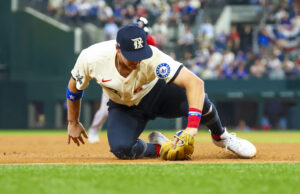
The move highlights what a tough time Jung has been having of late. Since the calendar flipped to June, he has produced an awful .158/.208/.221 slash line in 101 plate appearances. His 19 wRC+ in that time is the third-worst mark in the majors, ahead of just Brenton Doyle and Michael Harris II.
“He keeps working, but I don’t know what else to tell you,” manager Bruce Bochy said this week, per Evan Grant of The Dallas Morning News. “If it’s, you know, another break, and you have to do it, it’s a performance-based game, as we always say. We’ve got to find a way to score runs. … We do have some options if we have to give a guy a break.”
The lack of performance was naturally not lost on Jung himself. “I haven’t been very good,” he said on Monday, per Grant. “It’s been the worst [month] ever. I’m just trying to stay in my routine and make adjustments. It’s a daily grind, daily battle, but I’m doing everything I can. It’s frustrating. It’s hard. But this game isn’t easy. It’s just me versus me right now.”
Grant also relays that the club wants Jung to work on fastballs up-and-in, a pitch that he hasn’t been able to lay off of, with one of the worst rates in the majors for swinging at such pitches outside the strike zone.
It’s a stark contrast to Jung’s previous work. The eighth overall pick in the 2019 draft, Jung got a cup of coffee in the majors in 2022. He got a fuller opportunity in 2023 and ran with it, hitting .266/.315/.467 in 122 games. He then hit .308/.329/.538 in 17 postseason games, helping the Rangers win their first title in franchise history. Last year, a right wrist fracture limited him to 46 games but he still put up a stout .264/.298/.421 line when on the field. Here in 2025, he was doing fine before the month of June, as he was sporting a .277/.321/.440 line at the end of May.
It seems possible that the book is out on him, which has led to his aforementioned struggles with those up-and-in fastballs. That’s been one part of a larger team-wide lack of offense this year, as the Rangers have a collective .228/.296/.366 batting line. Their 87 wRC+ is only better than four teams: the Royals, Pirates, White Sox and Rockies. Ezequiel Durán played third last night and is in there again tonight. He’s been even worse than Jung, with a .145/.229/.226 line this year, but the Rangers are probably hoping that Jung can quickly find his form and retake the job.
How that plays out could impact the club’s deadline plans. They are currently 42-44 and 2.5 games back of a playoff spot in the American League. If they can hang in the race and Jung is still struggling, perhaps the club would look to external third base options, or they could perhaps move Josh Smith over to the hot corner and leave Burger in charge of first base. That would open the designated hitter spot for the return of Joc Pederson or someone else on the roster. There are a few moving pieces there and the situation could change in a few different ways in the coming weeks.
For Jung personally, the length of this rehab assignment could impact him professionally. He came into this year with two years and 27 days of service time. By my count, he has added 97 days so far this year, getting him to 2.124. That’s 48 days shy of the three-year mark. If he’s recalled by the middle of August, he could still get over the three-year line before the offseason. If not, then his path to free agency would be pushed by a year. As of now, he may have enough service time to qualify for arbitration as a Super Two player, depending on where this year’s cutoff ultimately falls. Any service time he could add later in the year would increase his chances of qualifying for arb, while hitting the three-year line would guarantee it.
Photos courtesy of Jerome Miron and Kevin Jairaj, Imagn Images
Kevin Pillar Announces Retirement
Kevin Pillar is hanging up his Superman cape. On an appearance on Foul Territory, he announced that he is retiring from playing. He was with the Rangers earlier this year but was released about a month ago.
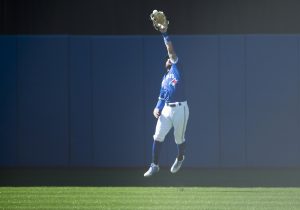 Pillar, now 36, was able to engineer an incredible zero-to-hero career. The Blue Jays drafted him in the 32nd round of the 2011 draft. But despite that humble beginning, he would not only make it to the big leagues but he would stick around for more than a decade.
His best asset was his defense, as he quickly earned a reputation for making highlight-reel catches, often diving horizontally in a way that earned him his Superman nickname. He got some limited big league time in 2013 and 2014 before fully cementing himself as a big leaguer in 2015.
That year, he got into 159 games for the Jays, producing a batting line of .278/.314/.399. His 94 wRC+ indicated he was 6% below league average at the plate, but that was more than adequate to pair with his other attributes. He stole 25 bases and received strong grades for his glovework, leading FanGraphs to credit him with 3.7 wins above replacement. That played a big role in getting the Jays to the postseason for the first time since 1993. Though the club was eventually felled by the Royals in the ALCS, the Jays got José Bautista‘s legendary bat flip game along the way.
That would ultimately prove to be an apex for Pillar. He never again stole more than 15 bases nor topped a 90 wRC+ in a full season. But he still proved to be a useful player in generally the same shape, with his speed and defense making up for some subpar offense. From 2016 to 2018, he got into 442 games for the Jays, slashing .258/.296/.401 for an 86 wRC+ and producing 4.5 fWAR.
By the time the 2019 season had rolled around, Pillar was 30 years old and the Jays were rebuilding. Early that year, he was flipped to the Giants, which started the journeyman period of his career. Over the next few years, he would bounce to the Red Sox, Rockies, Mets, Dodgers, Braves, White Sox, Angels and Rangers. Though he had moved into his 30s, his performance was roughly the same as before, though with his glovework naturally slipping a bit. Over those 2019-25 seasons, he played 544 games and hit .246/.284/.415 for an 85 wRC+ and produced 2.4 fWAR.
Most recently, he had a stint with the Rangers but hit just .209/.209/.256 in 20 games before getting designated for assignment and released. He had flirted with retirement before but now seems to have decided that it’s time to hang up the spikes.
Any 32nd-round pick making it to the big leagues is exceedingly rare. In fact, the draft was shortened to 20 rounds a few years ago, so it likely won’t happen again. Pillar not only made it, but he got into 1,234 games over 13 seasons. He racked up 1,053 hits, including 114 home runs. He was credited with 10.8 WAR from FanGraphs and 16.1 from Baseball Reference. He earned about $25MM in his career, according to Baseball Reference. We at MLB Trade Rumors congratulate Pillar on an impressive career and wish him the best with whatever comes next.
Braves Place Spencer Schwellenbach On IL With Elbow Fracture
The Braves announced today that right-hander Spencer Schwellenbach has been placed on the 15-day injured list due to a right elbow fracture. Left-hander Austin Cox has been recalled to take his roster spot. The club also reinstated righty Daysbel Hernández from the IL and optioned right-hander Kevin Herget. They also officially announced that outfielder Jurickson Profar has been reinstated from the restricted list with outfielder Alex Verdugo designated for assignment, a swap that was previously reported.
Mark Bowman of MLB.com relays that Schwellenbach felt sore after his last game against the Phillies and a small fracture was discovered. He’ll be shut down for four weeks and could be back with the big league club in September.

It’s obviously bad news all around. For Schwellenbach personally, he was on the way to having an excellent first full season in the big leagues. He debuted with 21 starts last year and posted a 3.35 earned run average in 123 2/3 innings. That secured him a rotation spot for 2025 and he has been even better this year, with a 3.09 ERA in 17 starts. Put together, he has a 3.23 ERA, 25.2% strikeout rate, 4.4% walk rate and 44.1% ground ball rate in 234 1/3 innings.
All that is now on pause, as he’ll be on the shelf for a while. The four-week shutdown period will take him into August. If he’s healthy at that point, he could ramp back up and make a few more starts in September, though a setback could prevent him from returning again this year.
For the team, it’s yet another kick when they’re already down. Atlanta has struggled to get into a good groove this year and has produced disappointing results so far. They have a record of 38-46, which puts them seven games back of a playoff spot and with six teams to leapfrog. That’s partially due to underperformance from some guys on the roster but they also lost Profar to a PED suspension and have seen their rotation get weakened by injuries.
The first domino to fall was Reynaldo López, as he made just one start before requiring arthroscopic shoulder surgery. He’s been on the IL since then and still isn’t near a return. About a month ago, AJ Smith-Shawver required Tommy John surgery, putting him out of commission until well into next year. A couple of weeks back, Chris Sale suffered a rib cage fracture. His timeline is unclear but he has been transferred to the 60-day IL, meaning he can’t return until mid-August at the earliest. Now Schwellenbach is the latest blow.
Prior to the Sale injury, president of baseball operations Alex Anthopoulos tried to strike an optimistic tone and said the club would not be selling, though he did leave the door open a crack by saying they could reevaluate late in July. That reevaluation seems more likely with today’s news. The club still needs to climb in the standings to give the club justification to buy, but that will be hard to do with no López, Sale, Smith-Shawver or Schwellenbach.
For now, the club will proceed with a rotation consisting of Spencer Strider, Grant Holmes, Bryce Elder and Didier Fuentes. To take Schwellenbach’s spot, they could recall someone like Hurston Waldrep, Nathan Wiles or Davis Daniel. Non-roster guys like José Suarez, Ian Anderson and Zach Thompson are all on the minor league injured list.
Going forward, the club presumably has less confidence in its ability to contend with the recent injuries to Sale and Schwellenbach, so the prospect of doing some deadline selling with an eye towards returning to contention in 2026 has surely increased. The deadline is on July 31st this year, so there are still about four weeks to see some more results roll in and have conversations with other clubs.
Photos courtesy of Brett Davis and Orlando Ramirez, Imagn Images
Giants Exercise 2026 Option On Manager Bob Melvin
The Giants have exercised their 2026 club option on manager Bob Melvin, per a team announcement. He’d previously been in the final guaranteed season of his contract.
“Having the chance to work alongside Bob every day, we’re really fortunate to have such an experienced leader and one of the most well-respected managers in baseball,” Giants president of baseball operations Buster Posey said in a statement within today’s press release announcing the move. “His leadership, preparation, and connection with our players have been invaluable, and we believe he’s the right person to continue to guide this team forward.”

Melvin, 63, is in his second season as the Giants’ skipper after a two-year stay in San Diego and a length 11-year run as the Athletics’ manager. He’d previously managed the D-backs and Mariners as well. Melvin’s first season in San Francisco resulted in a disappointing 80-82 showing that saw ownership move on from now-former president of baseball operations Farhan Zaidi and replace him with Posey.
Posey wasn’t the one to originally hire Melvin — at least not directly, although Posey was a minority owner prior to overtaking baseball ops — but his work with three-time Manager of the Year (once with the D-backs, twice with the A’s) was enough to convince him that Melvin is the right person for the job.
Thus far in 2025, the Giants sit five games over .500, at 45-40. That leaves them a game and a half back in the Wild Card standings but a hefty eight games out of first place in the stacked National League West. San Francisco has struggled through a dry spell recently, as the offense has gone cold and resulted in the Giants dropping 11 of their past 15 games. Melvin’s club started the season 19-12 through the end of April but has gone 26-28 since, posting matching 13-14 records in both May and June.
Recent struggles notwithstanding, Melvin will get the chance to see things through in 2025 and return to manage the club in 2026, when Posey’s vision for the team has taken more hold. The Giants, under Posey, have signed Willy Adames and swung a stunning June blockbuster for Rafael Devers. Matt Chapman’s six-year extension came when Zaidi was still president, but Posey reportedly played a significant role in pushing that deal across the line after talks had slowed. With Mike Yastrzemski and Wilmer Flores up for free agency at season’s end, the 2026 season could see further changes to the core of position players at Oracle Park.
“I’m grateful for the opportunity to continue leading this group,” Melvin said within today’s press release. “I believe in what we’re building here, and I appreciate the confidence that the Giants ownership group, Greg [Johnson], Buster, Larry [Baer], Zack [Minasian] and the rest of the Giants’ organization have shown in me and our staff. We have a lot of unfinished business this year, and I’m looking forward to the work ahead.”
Melvin currently holds a 1642-1547 record (.515) in 22 seasons as a major league manager across the five aforementioned teams. He’s eight wins behind Mike Scioscia for 20th-most in MLB history and just 84 behind Buck Showalter for 19th.
Yordan Alvarez Shut Down Due To Setback With Hand Injury
Astros outfielder/designated hitter Yordan Alvarez seems to have hit another speed bump. General manager Dana Brown informed reporters, including Chandler Rome of The Athletic, that Alvarez has been shut down due to some renewed hand soreness. He will see a specialist at some point in the next 48 hours, at which point the club hopes to have more information.
At this point, details are still fairly sparse regarding Alvarez, though it’s an ominous development. Hand issues have been an ongoing problem for him. He had soreness in both hands in 2022 and spent some time on the injured list. Hand soreness also seemingly hampered him during spring training in 2023.
This year, he got out to a bad start, hitting .210/.306/.340 for a 76 wRC+ through 29 games. He landed on the 15-day injured list in early May due to right hand inflammation. At the end of May, Brown relayed that the club found a “very small fracture” in the ring finger of Alvarez’s right hand. He has been ramping up activities in recent days but this renewed soreness obviously creates concern that he’s not fully healed.
Time will tell how serious this setback is but it’s less than ideal for the Astros. Alvarez has been a key part of their lineup and one of the best hitters in baseball during his career. He came into this season with a .298/.390/.583 batting line and 166 wRC+. Only Aaron Judge had a higher wRC+ for the 2019-2024 span, among hitters with at least 60 plate appearances.
The Astros would obviously love to have that bat back in the lineup. That’s especially true because he is left-handed and the club is notably deficient in that department. The Astros don’t really have a pure lefty in their everyday lineup. Switch-hitters Victor Caratini and Cooper Hummel are getting regular playing time. The three pure lefties on the active roster at present are all bench players: Taylor Trammell, César Salazar and Luis Guillorme.
Putting aside handedness, this also compounds a more general injury problem for the Astros. They have over a dozen players on the IL, including seven position players. They recently lost their starting shortstop when Jeremy Peña hit the IL last week with a rib fracture.
Despite the all of those injuries, the Astros are 50-34. They are six games up in the American League West and will clearly be buying at the deadline. Brown already openly admitted that the club is looking for lefty bats. That need would only grow if this setback for Alvarez turns out to be significant. The club seems to be planning to avoid the competitive balance tax this year, which will be a challenge in making additions. RosterResource estimates the club’s CBT number is at $236MM, just $5MM from the base threshold.
Photo courtesy of Troy Taormina, Imagn Images