
Possible Snag In Deal Between Orioles, Yovani Gallardo
TUESDAY: The Orioles are expected to try and restructure their agreement with Gallardo, FOX Sports’ Ken Rosenthal reports (Twitter link), and it’s unlikely that the matter will be resolved quickly. It’s a rather risky move on the Orioles’ part, as Eduardo A. Encina of the Baltimore Sun observes that Gallardo’s camp may well not be willing to renegotiate terms. The team would have to be confident it has the internal pitching depth to fill the rotation spot Gallardo would’ve filled, as other available free agent starters will likely come with more injury red flags than Gallardo and may have an even harder time passing the Orioles’ strict physical standards.
7:26pm: The Orioles’ issue with Gallardo is concern over his shoulder, according to Eduardo A. Encina of the Baltimore Sun (links to Twitter). However, as Encina notes, Gallardo doesn’t have a history of shoulder problems, and it’s rare that a 30-year-old pitcher’s shoulder will be 100 percent clean. He further tweets that the Orioles are likely being “super cautious” due to the draft pick forfeiture that is associated with Gallardo, and if Gallardo did not come with that price, the shoulder may not be perceived as a significant issue. Kubatko tweets that the Orioles hope to get the results of additional testing on Gallardo back tomorrow.
2:29pm: It isn’t known whether the Orioles could try to restructure their agreement with Gallardo or back out of it altogether, FOX Sports’ Ken Rosenthal reports (Twitter links). Beyond the $35MM commitment, the Orioles are also concerned at having to surrender the 14th overall pick for a player they may feel isn’t up to par physically.
11:23am: The status of the three-year, $35MM agreement between the Orioles and right-hander Yovani Gallardo is “unclear” following some questions that have arisen in Gallardo’s phyiscal, Yahoo Sports’ Jeff Passan reports (via Twitter). MASNsports.com’s Roch Kubatko tweeted word from a source that there was “more work to do” on the physical before anything was made official between the two sides, and the team wanted another look at Gallardo’s MRI.
As Passan noted, the Orioles are “notorious medical sticklers,” so it could that this is simply another case of the team being very careful before committing to a major contract. While it’s unusual for a player physical to extend over two days, it’s perhaps not unexpected given Baltimore’s history.
This offseason’s signing splurge notwithstanding, the O’s have generally been hesitant about any sort of major free agent signing under Peter Angelos’ ownership. On several occasions, the Orioles have backed out of agreements with players such as Will Clark, Aaron Sele, Grant Balfour and Jair Jurrjens due to complications that arose from those players’ physicals. As Ken Rosenthal related in a 2013 column about the Balfour controversy, the now-standard practice of teams insisting on physicals before signing players stemmed from the Orioles voiding a 1998 contract with Xavier Hernandez when a post-signing examination revealed Hernandez had a torn rotator cuff.
It isn’t known what specific issue Baltimore has with Gallardo’s physical, as he has been more or less injury-free since a pair of knee injuries in 2008. In fact, Gallardo has been one of the game’s more durable starters in recent years, averaging 191 innings per season since 2009.
Try Our Free Weekly Newsletter
Do you enjoy the analysis found here at MLB Trade Rumors? Why not give our free newsletter a try this week? We’ll deliver an exclusive article to your inbox – no strings attached! I’ll be weighing in on deals, rumors, and all the hot stove-related topics MLBTR has been known for since I launched the site a decade ago. These articles will be exclusive to MLBTR Newsletter subscribers and will not appear on the website. I may also provide occasional updates on what’s next for MLBTR. It’s completely free. The next newsletter will arrive in subscriber inboxes this afternoon.
I’ll be honored if you give us your email address and join the thousands of MLBTR readers already enjoying the Newsletter. We will never sell your email address or market anything to the mailing list, and you can unsubscribe easily. Those of you viewing this post in our app can use this link.
Orioles To Sign Dexter Fowler
7:15pm: Jon Heyman tweets that Fowler’s contract is worth $33MM over three years.
6:27pm: In a full column, Kubatko adds that there is also not an opt-out clause in the deal, which is still pending the ever-important physical.
6:13pm: The Baltimore Sun’s Peter Schmuck tweets that Fowler’s contract doesn’t contain any options. He also notes that the deal with Gallardo may yet survive the issues with his physical.
5:37pm: The Orioles and outfielder Dexter Fowler have agreed to terms on a three-year deal, MASNsports.com’s Roch Kubatko reports (via Twitter). The contract will be worth about $35MM in total, reports ESPN’s Buster Olney (on Twitter). Fowler is a client of Excel Sports Management.
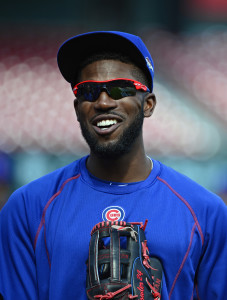
Fowler becomes the second potentially significant free agent addition for the Orioles over the past week, as the team also agreed to a three-year pact with right-hander Yovani Gallardo over the weekend. However, there’s said to be a holdup in that deal relating to Gallardo’s medicals. It at least bears mentioning that Fowler’s agreement would seem to fall closely in line with the three-year, $35MM deal to which Gallardo agreed. However, a deal in this range for Fowler was rumored to be a possibility before the Orioles even reportedly agreed to terms with Gallardo, and there is not yet any indication that Fowler’s deal is some kind of reallocation of the funds that were to be allotted to Gallardo. Should both deals remain in place, the pair of late agreements will hearken back to the Orioles’ February additions of Nelson Cruz and Ubaldo Jimenez in 2014.
Fowler, 30 in March, should be penciled in as the everyday right fielder in Baltimore, as Adam Jones is locked into center field and offseason signee Hyun Soo Kim is said to be the team’s left fielder. (Baltimore reportedly doesn’t feel Kim has the arm strength for right field.) Fowler will bring to the top of the Orioles’ lineup a strong history of getting on base as well as moderate power and speed. The switch hitter is coming off a season in which he batted .250/.346/.411 with a career-best 17 home runs to go along with 20 stolen bases for the Cubs. He tacked on another pair of homers and another steal over the life of 39 postseason plate appearances with the Cubs, during which time he posted an .816 OPS. All told, Fowler is a career .267/.363/.418 hitter in 3830 Major League plate appearances. While he was at one time believed to be a product of Coors Field — his home park throughout the first four full seasons of his big league career — Fowler has quieted some of that talk by maintaining solid levels of production in Houston and Chicago after being traded in each of the past two offseasons.
From a defensive standpoint, metrics such as Ultimate Zone Rating and Defensive Runs Saved have never been bullish on Fowler’s work in center field, though he could certainly profile more favorably with the shift to an outfield corner. Even if he doesn’t prove to be a standout defender in right field, he should provide superior glovework to internal candidates such as Mark Trumbo, Nolan Reimold and Ryan Flaherty.
If a deal is completed, the Orioles would forfeit their top unprotected draft pick by adding Fowler to the fold. Should the deal for Gallardo also be completed, Baltimore would be sacrificing the 14th and 28th overall picks in the upcoming Rule 4 Draft (their current second pick, No. 29 overall, would improve to No. 28 upon forfeiture of the No. 14 pick). The Cubs, in turn, would pick up a draft pick at the end of the first round. The loss of those two picks for the Orioles certainly further damages Baltimore’s minor league system, which was recently rated among the worst in the league by outlets such as Baseball America and ESPN. Then again, the Orioles are in a clear win-now mode after re-signing Chris Davis and Darren O’Day this offseason (to say nothing of the Kim signing and Matt Wieters‘ acceptance of the qualifying offer); the organization’s current focus, as evidenced by the agreements with Gallardo and Fowler, is on the present-day roster and making a run at the AL East.
Furthermore, as I recently outlined in the MLBTR Mailbag and discussed with Jeff Todd on the MLBTR Podcast, the Orioles could always shift course and aim for an aggressive rebuild midway through the 2017 season or in the 2017-18 offseason if the next two years don’t go as planned. With Manny Machado, Zach Britton, Jones, Fowler and Gallardo all lined up to hit free agency following the 2018 campaign, they’d have a huge number of short-term assets to be flipped for long-term gain. And, if the Orioles enjoy a strong run buoyed by this pair of late signings, the hit to the farm system will become little more than a footnote.
Should both deals ultimately come to fruition at the reported $35MM price tag, the Orioles will finish up the offseason as baseball’s most prolific spenders. The price tags on Fowler, Gallardo, Davis ($161MM), O’Day ($31MM), Wieters ($15.8MM) and Kim ($7MM) would bring the team’s free-agent expenditures to a staggering $284.8MM, to say nothing of the $9.15MM worth of salary added in acquiring Trumbo from the Mariners and avoiding arbitration with him on a one-year deal.
Photo courtesy of USA Today Sports Images.
Jose Reyes Placed On Administrative Leave Pending Completion Of Criminal Proceedings
Commissioner Rob Manfred’s office announced today that Rockies shortstop Jose Reyes, who has an April 4 trial set in connection with his offseason domestic violence allegations, has been placed on paid leave until his hearing has been resolved, at which point Commissioner Manfred will make a decision on potential disciplinary measures against Reyes (i.e. a suspension). The official release announcing the move reads as follows:
“Commissioner Robert D. Manfred, Jr. announced today that Colorado Rockies’ shortstop Jose Reyes has been placed on paid leave pending completion of his criminal proceedings in Hawaii, pursuant to Major League Baseball’s Joint Domestic Violence, Sexual Assault and Child Abuse Policy. Section III.C.2 of the Policy permits the Commissioner to impose a paid suspension pending resolution of the legal proceedings or an investigation. Upon resolution of Reyes’ criminal proceedings and the completion of the Commissioner’s Office’s investigation into the incident, Commissioner Manfred will make a decision whether to impose discipline on Reyes. The Commissioner’s Office will have no further comment on this matter until a final disposition is announced.”
The administrative leave means that Reyes will miss the entirety of Spring Training with the Rockies and will not be with the club for the team’s opener on April 4 — the same day as his hearing. In mid-January, Reyes plead not guilty to charges alleging the assault of his wife at a Hawaii hotel on Oct. 31. If he’s found guilty in his hearing, it stands to reason that he’ll face a fairly weighty suspension under the domestic violence policy. The policy states that Manfred can issue discipline so long as there is “just cause,” which, as Patrick Saunders of the Denver Post recently noted, means that the criminal hearing will not necessarily be the sole deciding factor.
The Major League Baseball Players Association has also weighed in on the matter and issued a statement. Via the MLBPA’s press release:
“We are closely monitoring the proceedings in Hawaii, as well as the Commissioner’s actions under the Domestic Violence, Sexual Assault and Child Abuse Policy. If further discipline is issued, or if Mr. Reyes’ paid suspension is not resolved in a timely fashion, the Players Association will work with Mr. Reyes to ensure that all of his rights under the Policy are protected. Pursuant to the confidentiality provisions of the Policy, the Players Association will have no further comment at this time.”
Reyes is one of three players facing potential discipline under the domestic violence policy, as both Yankees closer Aroldis Chapman and Dodgers right fielder Yasiel Puig are under investigation as well. However, neither Chapman nor Puig had charges filed against him, and as such, there’s no hearing set for either player (and, subsequently, no need for administrative leave). A decision from the Commissioner’s Office on those two cases is still pending.
Ken Rosenthal of FOX Sports first reported that Reyes would be placed on paid leave until his legal proceedings had been resolved (links to Twitter).
Agent: Cliff Lee Not Expected To Pitch In 2016
Cliff Lee was reportedly considering a comeback earlier this winter, but as his agent Darek Braunecker now tells FOX Sports’ Ken Rosenthal (Twitter link), “We don’t anticipate him playing at this point.”
Lee last pitched on July 31, 2014 and has since been sidelined due to elbow problems and then a partially torn flexor tendon in his throwing shoulder. After receiving a clean bill of health in December, however, Lee was looking to return to the mound and drew interest from at least 15 teams. There were some caveats to Lee’s comeback attempt, however, as Braunecker said in January that his client would require “a perfect fit” to return. Lee was looking for a one-year Major League deal with a contender reportedly in the range of $6MM-$8MM in base salary, plus incentives. The left-hander also didn’t reach the point of throwing for teams or holding a showcase, so clubs had several questions about the health of Lee’s shoulder, or when in the season he’d be able to pitch.
At age 37 and already 18 months removed from his last game, it’s hard to see Lee mounting another comeback attempt next offseason. If this is indeed the end of Lee’s 13-year Major League career, he’ll go down as one of the best left-handed starters of his era. Lee’s impressive resume includes the 2008 AL Cy Young Award, four All-Star appearances, stints on two pennant winners (the 2009 Phillies and the 2010 Rangers) and a 2.93 ERA over his last 1415 innings. He also banked over $143.3MM over his career, most of it earned from the five-year, $120MM contract he signed with Philadelphia in the 2010-11 offseason.
Three-Team Jay Bruce Deal With Reds, Angels, Blue Jays “Dead”
TUESDAY: The medical concerns were in regard to a Blue Jays minor leaguer involved in the deal who was presumably going to the Reds, FOX Sports’ Ken Rosenthal reports (Twitter link). With this trade at least temporarily off, Yahoo Sports’ Jeff Passan wonders if other teams could approach the Reds with offers for Bruce since they seem open to dealing him for a fairly low price.
11:15pm: Talks are “dead” for the time being, Olney tweets.
11:06pm: The reason for the holdup is that one of the teams found an issue with one of the players’ medicals, Yahoo! Sports’ Jeff Passan tweets, clarifying that the player in question was not Bruce. ESPN’s Jerry Crasnick, meanwhile, tweets that someone close to the talks believes the problem is Saunders’ knee, an injury to which caused him to miss most of last season.
10:47pm: Some of the parties discussing the deal now doubt it will come to fruition, ESPN’s Buster Olney tweets. The reasons for the hitch are currently unclear.
8:44pm: The three teams are reviewing medical records of the players involved, tweets Rosenthal.
8:20pm: The deal is nearing completion, Jeff Fletcher of the Orange County Register tweets.
6:36pm: The current deal has Bruce going to Toronto, Saunders heading to Anaheim and prospects going to the Reds, Heyman tweets. That suggests the Angels, who have a very weak farm system, will be providing the prospects.
6:13pm: Bruce does not currently have the Jays on his no-trade list, Ken Rosenthal of FOX Sports tweets.
6:03pm: Heyman tweets that the proposed deal between the Jays and Reds actually also involves the Angels, with Saunders heading from Toronto to Anaheim in the deal. The Jays and Reds also discussed a three-team deal with the Athletics, but that trade is no longer on the table, Yahoo! Sports’ Jeff Passan tweets.
5:44pm: Reds outfielder Jay Bruce remains on the trade market, and they could be in the process of trading him to the Blue Jays, Jon Heyman tweets. If the Jays were to acquire Bruce, he would likely play mostly left field, with Jose Bautista in right. Toronto’s top left field options currently include Michael Saunders, who missed most of last season due to injury, and 23-year-old Dalton Pompey.
For the Reds, Bruce would be the latest in a long string of veteran departures that has also included Johnny Cueto, Mike Leake, Marlon Byrd, Todd Frazier and Aroldis Chapman. Bruce would be unlikely to command a large return, since he’s hit just .222/.288/.406 in the last two seasons. He might, however, be in line for somewhat of a resurgence in 2016 if his batting average on balls in play (which was just .251 last season) improves a bit. When he does make contact, he has largely retained his ability to hit for power, hitting 26 home runs last season.
Still, Bruce will make $12.5MM in 2016, plus a $1MM buyout or a $13MM option in 2017, and while those figures aren’t exorbitant, he’s far from a bargain at that price. The Orioles have also recently been connected to Bruce, although at last check, their interest wasn’t particularly strong.
Predicting Tommy John Surgeries
From Derick Velazquez in January to Lance Lynn in November, there were 112 ulnar collateral ligament (UCL) injuries requiring reconstructive surgery — commonly called Tommy John Surgery (TJS) — in the 2015 season. Once a career-killer, UCL injuries have become a much more survivable injury over the last 30 years. And while more and more players are successfully returning from TJS, the procedure itself is a catastrophic event and requires a minimum of a year to recover.
That makes predicting UCL injuries a valuable and worthy endeavor. From the GM to the fantasy owner, being able to steer away from players with early warnings signs of UCL injuries can save a team’s season. The red flags for UCL injuries are not big, though, and many UCL injuries appear from nowhere. But using a large data set, culled from a variety of valuable resources, we can find the tiny red flags, the little baby red flags.
For the past seven months, I have been working with Tim Dierkes and his staff to develop a model to predict Tommy John surgery. The creation of this model required, quite literally, hundreds of thousands of lines of data and hundreds of man hours to combine and connect and test data from a variety of disparate sources. The project also took, as a sacrifice, one of my computer’s CPUs, which burned out shortly after completing some herculean computations. Fare thee well, i7.
[For further details on the process, results, and limitations of this study, please refer to Bradley’s MLBTR Podcast appearance and MLBTR Live Chat.]
The Results
The following is an attempt to quantify the risks that foreshadow potential UCL injuries. It is a combination of FanGraphs player data, Jeff Zimmerman’s DL data, PITCHf/x data, a bunch of hard work, and the keystone data: Jon Roegele’s TJS data, as stored on Zimmerman’s Heat Maps. We also checked our numbers against Baseballic.com, which houses arguably the most comprehensive injury data online.
And while most efforts at quantifying TJS risk have focused on recent appearances or recent pitches, our research takes a step further back and examines injury risks on an annual basis. It seeks to consider the problem from the GM’s view, and not the game manager’s.
The following names are sorted by greatest risk to least. For more details about the columns and the model that has created this data, continue reading after the embedded data.
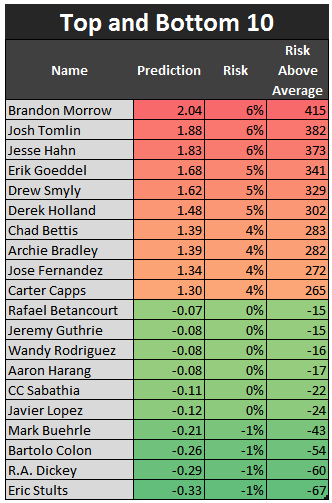
Click Here for Interactive Tableau and Full Results
The results include three terms that help define where the players fit:
- Prediction: My method of regressing the variables against pending TJS events resulted in a scale of 0 to 7, where 7 is the season before a player undergoes TJS. So our top player above, Brandon Morrow, ranks a 2.04 out of 7.00, meaning he is nowhere near a player about to absolutely have a shredded UCL. But it is certainly above average.
- Risk: This is the player’s prediction, divided by the highest possible result, 7. Then, I then multiply the result by the degree of confidence I have in the model, which is the R^2 of .22. R^2 is the statistical tool for checking how much the model explains the variation in the data. It is unconventional to multiply the regression result against the R^2, but I wanted to firmly assert that this model can only explain — at most — 22% of the variation we find in the TJS population. I have additionally listed the results as whole numbers in an effort to limit the perception of precision that a decimal place conveys.
- Risk+: This is merely a representation of how far above average or below average the player’s risk is. Here, 0% indicates a league-average risk; 100% is 2x the league average; 200% is 3x, and so on.
The Raw Numbers section includes the specific variables involved (explained in further detail in the “The Inputs” section). The Indexed Section includes the same data, but indexed (unless it is binary). That means the average is 100, twice the average is 200, and so on. This is the same as wRC+ or OPS+ or even Risk+, minus the % sign and with league average at 100 instead of 0%.
The Inputs
Over the preceding months, I have tested, prodded, and massaged many numbers. These were the factors that ultimately proved to have the strongest, most consistent relationships with impending TJS:
- LHP = 1: MLB pitching staffs have been 28% left-handed since 2010. TJS victims are 25% left-handed. Throwing the ball with your right hand — unlike Tommy John, the original — is the first tiny red flag.
- St. Dev. of Release Point: Previous studies (such as here and here) have attempted to connect release point variations with injuries. In the various models I created, release point had a consistent, while small, predictive power. I did not control for whether or not the pitcher appeared to have a deliberate difference in release points (as in, guys who pitch from multiple arm slots), but the infrequency of that trait does not seem to impact the variable.
- Days Lost to Arm/Shoulder Injury in 2015: After many different permutations of what constitutes “an injury” or an “arm,” I landed on this unusual definition of an arm/shoulder: It’s everything from the wrist back, including the elbow, shoulder, and — why not — the collarbone. So it’s basically the principle upper-body actors of the throwing motion. No fingers, no legs. So if a player injured this arm/shoulder/collarbone area, the sum of their missed days has a decently-sized red flag planted on it. This is among the most important predictive factors for TJS — which makes intuitive sense. Previous injuries could be a forewarning of a bigger injury, or it could be a contributing factor in creating an UCL injury as pitchers compensate for a tweak or a partially-recovered injury.
- Previous TJS?: This is a count of how many times the pitcher has gone under the knife. While only a small percentage of pitchers have Tommy John Surgery in their career, it strongly predicts a second surgery. Since 2010, there have been 10,000+ pitchers in the majors and minors combined. In that time, about 560 pitchers in the minors and majors have had TJS, and 57 were repeats. So the ratio of MLB and MiLB players to TJS victims is about 5%, but the repeat rate is over 10%. In other words, TJS begets more TJS.
- Hard Pitches: This variable is the sum of four-seam fastballs (FA), two-seam fastballs (FT), and sinking fastballs (SI) as categorized by the default (MLBAM) PITCHf/x algorithm. Various attempts to include different pitch types and pitch counts all proved inferior to just a raw count of the hardest three pitches that the PITCHf/x database records.
- ERA-: This is a park-, league-, and era-adjusted ERA, as reported by FanGraphs. This is the most puzzling part of the model, and the part I am least comfortable about, but a good ERA- (below 100) correlated weakly but negatively with good health. Possible bad data aside, the only theory I can muster to explain this is the idea that pitchers in the middle of good years are more likely to pitch on short rest or make emergency relief appearances in extra-inning games or key late-season games. The elite closer is more likely to pitch the three-consecutive-days marathon than the struggling middle reliever.
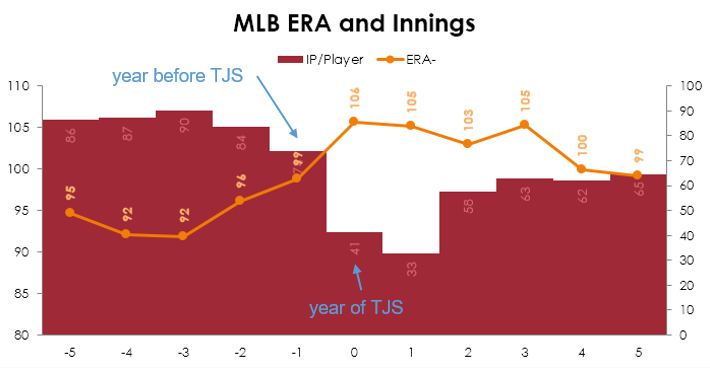
- Age: Here is another iffy variable. Why do older guys without a previous TJS have fewer Tommy John Surgeries? Well, for one, there are fewer older pitchers than younger pitchers, but even after we control for that, we see fewer 38-year-olds going under the knife. The reason is probably that fewer late-career guys see a major UCL tear as worth trying to overcome, and instead call it a career. Few can forget the end of Ramon Ortiz‘s 2013 season, when the then-Blue Jays starter suffered what appeared to be an UCL injury and left the field in tears. Many assumed the 40-year-old righty would end his career then, but Ortiz was fortunate enough to avoid a UCL tear and managed to pitch in Mexico as recently as 2015. Had the 2014 injury been an UCL tear, Ortiz may have just ended his career then. There is also some survivor bias in here. Guys with truly durable UCLs are more likely to make it to their age-35 seasons (and beyond).
Here is a breakdown of the variable and coefficients involved:
| Coefficients | Standard Error | P-value | |
|---|---|---|---|
| Intercept | 1.6319 | 0.27 | 0.00 |
| Average of LHP? | -0.1847 | 0.07 | 0.01 |
| Avg Arm Slot STDDEV | 1.6667 | 0.54 | 0.00 |
| Arm/Shoulder? | 0.0110 | 0.00 | 0.00 |
| Previous TJS? | 0.2981 | 0.07 | 0.00 |
| Hard Pitches | 0.0001 | 0.00 | 0.15 |
| ERA- | -0.0020 | 0.00 | 0.04 |
| Age | -0.0524 | 0.01 | 0.00 |
It is important to remember that the coefficients here do not visibly represent the strength of each variable because they each use a different scales. For instance, the largest Previous TJS is 2, but the largest Hard Pitches number is 2,488. (That said, Previous TJS is a much more predictive variable.)
P-values, in short, are the probabilities that the given variable is actually meaningless. Traditionalist might bristle at some of the P-values involved there. I personally find the customary cut-off P-values of .10, .05, or .01 artificial and unnecessarily limiting. Others are welcome to disagree.
Why is Player X So High/Low?
So your favorite pitcher is Brandon Morrow, and you’re distressed to see him top the charts here. Let’s look at why:
- In 2015, Morrow missed 155 days after having debris removed from his shoulder. That’s 22x the league average among pitchers that completed at least 30 innings. No other pitcher on this list missed more days. (The average time missed was a little under 7 days.)
- And despite missing most of the year, he still managed to throw a large amount of fastballs because, as Brooks Baseball puts it, he “relied primarily on his Fourseam Fastball (95mph) and Slider (88mph)…” Morrow threw his fastball almost 60% of the time in 2015.
- Lastly, he is just barely on the wrong side of the average age of this group. While the age variable is still an odd one, it is important to keep in mind that TJS culls the herd in the early years. If Morrow were 36 and coming off an injured season of this magnitude, he would still probably be the most likely TJS candidate, but he’d get a few bonus points for proving his UCL could have lasted this long in the first place.
I am pleased to see the likes of R.A. Dickey, Mark Buehrle, and Bartolo Colon at the bottom of the list. They are older pitchers with incredibly steady release points and no recent injury history (Dickey, of course, doesn’t have a UCL in the first place, though obviously the statistical algorithm in question doesn’t take such factors into consideration. We left his name in the results regardless of that fact, for those wondering why, as a means of illustrating the type of pitcher likely to rank low on the list). Of course, these guys, at their age, are perhaps even more likely to be ineffective and retire mid-season than they are to suffer a catastrophic injury, but that is neither here nor there.
Free agent Tim Lincecum also makes the list, and in a very positive way with a risk that is 51% below the league average. While any GM or fantasy owner looking into a Lincecum 2016 season will no doubt be aware of his injury history, it is a great sign for the two-time Cy Young winner hoping to move forward in his likely-post-Giants career. The strongest contributing factors to Lincecum’s risk, however, are his inconsistent release point and the fact he makes a living off mixing up four generally slower pitches. While he has not shown great effectiveness in the past four seasons, avoiding TJS could buy him enough time to find a rhythm with his greatly decreased velocity.
Young Marlins ace Jose Fernandez only missed 35 days due to a biceps issue — if we don’t count the 97 days he missed recovering from TJS in 2015 — but that previous elbow operation combined with his young age suggests he is at greater risk of a second TJS heading into 2016. Again, we need a caveat here to remind us that age, while a predictor of TJS, may not be a good predictor of UCL tears.
Mark Buehrle, Bartolo Colon, and Eric Stults all have negative risk rates. Does that mean they are growing additional ulnar collateral ligaments? Yes. Almost certainly.
Rejected Variables
There are a few variables not included that might seem intuitive or necessary to include, but ultimately did not make the cut:
- Velocities: Early versions of this model included pitch velocities, but it became apparent after later revisions that pitch velocities — at least given the present variables — was serving as a poor proxy for the number of hard pitches thrown. It follows that guys with fast fastballs throw those fastballs frequently. Take, for instance, freshly Rockie’d reliever Jake McGee, who has a scintillating fastball and rumors of maybe another pitch. Throwing hard may not actually lead to elbow injuries, but throwing a LOT of hard pitches might.
- Other Pitch Frequencies: Throwing breaking stuff did not seem to have a meaningful relationship with TJS events — at least above and beyond the relationship with hard pitch totals. That does not mean sliders might not result in shoulder injuries or knuckleballers don’t have more fingernail issues, but in the given sample, with the given scope of our investigation, breaking and off-speed pitches did not create meaningful relationships.
- Altitude of Home Park: Despite the considerable effort it took to match up each player’s home park with their park’s altitude, this attribute appears to have no effect on TJS. One might suspect that environmental issues impact the prevalence of certain injuries, but we can cross off altitude for now.
- Non-Arm Injuries: I figured leg injuries — given how important legs are in delivering a pitch — or general injuries might have a connection to TJS if in no other way than causing inconsistency in the pitcher’s delivery or release. But once we add in the arm/shoulder injury days into the calculation — along with previous TJ operations — the value of other injuries goes away.
- Injuries in Previous Seasons: Despite connecting players up with five years of injury history, the unstable relationships (i.e. high P-values) also came with negative coefficient — suggesting an injury in 2013 makes you stronger against a possible UCL injury in 2015. That makes no sense.
Room for Improvement
Without comprehensive dumps from the PITCHf/x data at Brooks Baseball or the Baseballic.com injury database, and without good information on late-career UCL injuries that result in retirement instead of TJS, and without medical records from these players themselves, we will always be playing catch-up with our prediction models. If I am a team considering one of the players listed above, I would defer to medical and pitching experts opinions following a thorough medical examination.
But from our perspective, from the data available in the public sphere, these are the best, strongest tiny red flags I could find. And I hope and expect they will push this field forward. If you’d like to discuss my Tommy John research further, check back at MLBTR at 7:30pm central time, as I’ll be doing a live chat.
A special thanks to Jon Proulx who helped do some very boring data work with me!
Bautista “Not Willing To Negotiate” After Naming Asking Price
Blue Jays right fielder Jose Bautista met with multiple reporters at the Jays’ Spring Training facility in Dunedin, Fla. today, and a potential extension was among the topics discussed. However, as MLB.com’s Gregor Chisholm and Sportsnet’s Shi Davidi write, Joey Bats isn’t interested in giving the Blue Jays any form of hometown discount. Bautista, who is eligible for free agency next offseason, said that he met with the Blue Jays two weeks ago and named his asking price. Toronto president of baseball operations Mark Shapiro and GM Ross Atkins sought to negotiate, but that isn’t in Bautista’s plans.
“I’m not willing to negotiate,” Bautista candidly explained. “I don’t think there should be any negotiation. I think I’ve proven myself.”
It’s hard to argue with the notion that Bautista has done anything short of that since signing his five-year, $65MM contract with the Blue Jays prior to the 2011 season. Since that time, Bautista has posted a .270/.393/.540 batting line with 173 home runs. Even when factoring in his hitter-friendly home park, Bautista’s bat has been 55 percent better than the league-average hitter, according to OPS+, and 54 percent better than average, per wRC+. Both Baseball-Reference and Fangraphs agree that he’s been worth between 26 and 27 wins above replacement in that time frame.
That production, relative to his cost, makes it relatively easy to see why Bautista would say, “In my eyes, I’ve given this organization a five-year hometown discount already.” Of course, Bautista knew the risk he was taking in signing that deal; the possibility always existed that he’d continue the torrid pace from his 2010 breakout and turn the contract into a massive bargain, just as the Blue Jays knew there was a possibility that he’d decline and leave them holding one of Major League Baseball’s least desirable contracts.
Bautista tells reporters that he met with Shapiro and Atkins for about 15 minutes. “I didn’t want to waste any time,” Bautista explained. “If this is going to happen, I think it should be natural, organic, quick and easy, it shouldn’t be a pull and tug about a few dollars here or there. I didn’t want to waste any time, I didn’t want to waste their time or their effort, so they can start planning ahead, and if it’s not going to happen they have plenty of time to do so.”
It’s unclear what Bautista specified in terms of years or dollars, although a five-year deal certainly seems like a possibility. Chisholm, in fact, tweets that Bautista was asked whether he thinks he can play for another five years, and the slugger was “emphatic” in responding in the affirmative. Earlier this offseason, MLBTR’s Mark Polishuk examined Bautista’s extension candidacy, noting that Bautista seems very likely to be able to secure at least a four-year deal at a premium rate — well north of $20MM — as a free agent next winter, assuming a typical Bautista season. I’d agree that a healthy four-year deal is a safe expectation, with a five-year deal certainly on the table should he approach last year’s production.
White Sox Sign Jimmy Rollins To Minors Deal
12:53pm: Rollins would earn a $2MM salary upon making the Major League roster, Dan Hayes of CSN Chicago tweets. MLB.com’s Scott Merkin adds that there are no additional incentives in the deal (Twitter link). Hayes also tweets that Saladino still has a good chance to be the club’s everyday shortstop, though Rollins is an option there, and the veteran shortstop can fill a utility role if Saladino does indeed get the everyday nod.
11:09am: The White Sox announced on Monday that they’ve added shortstop and former Phillies cornerstone Jimmy Rollins on a minor league contract with an invitation to Major League Spring Training. Rollins is a client of MVP Sports.
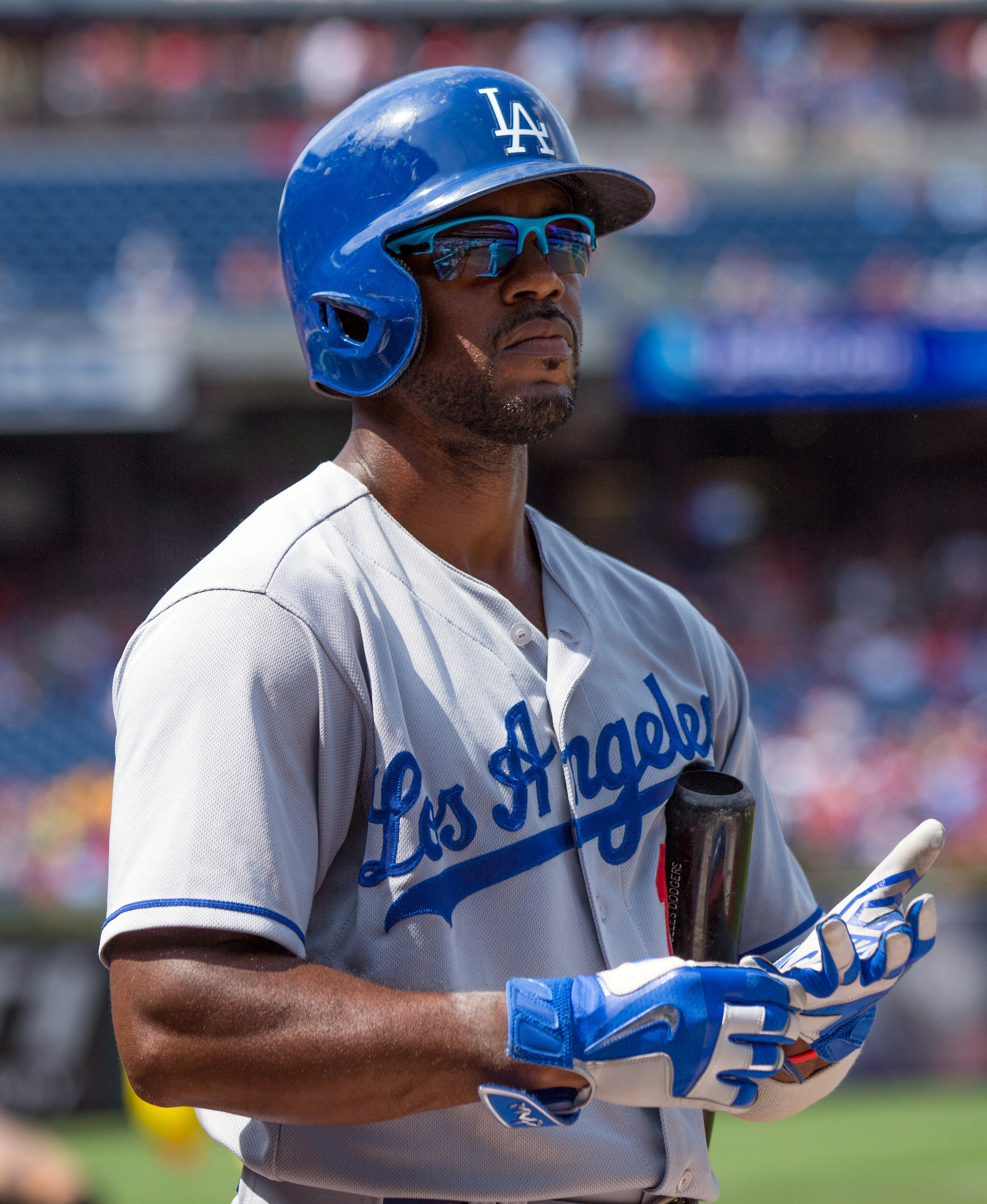
Rollins, 37, would seem to have an excellent chance at breaking camp as the team’s everyday shortstop, on paper. Defensively gifted sophomore Tyler Saladino is presently projected to serve as Chicago’s everyday shortstop, but the 26-year-old has little big league experience and didn’t hit in a 254-plate-appearance debut with the Pale Hose last season. Were Rollins to make the club and serve as the team’s shortstop, Saladino could shift into a valuable utility role; he showed strong defensive chops at second base and third base in addition to shortstop last season.
Last season was a struggle for Rollins, who spent the year with the Dodgers after being picked up in an offseason trade with the Phillies, making the 2015 campaign the only season of Rollins’ illustrious career that hasn’t been spent with the Phillies. Rollins tallied 563 plate appearances with the Dodgers but batted just .224/.285/.358 in that time. While those rate stats are unsightly, Rollins did still swat 13 home runs and swipe 12 bases, showing that there’s still some combination of power and speed left in his tank.
Looking for further positives, Rollins’ 15.3 percent strikeout rate was still more than passable, and his 7.8 percent walk rate was in line with his career averages. Beyond that, Sox fans will perhaps take solace in noting that Rollins’ numbers from July through season’s end (.244/.310/.395) vastly outpaced his production from Opening Day through June 30 (.208/.262/.326). While those endpoints are admittedly arbitrary, the fact that Rollins produced at a roughly league-average clip over the final three months of the regular season gives some hope for a return to his previously more successful ways at the plate (although certainly not to his NL MVP levels).
The main source of Rollins’ struggles would appear to be a .246 average on balls in play — one of the worst marks of his career. While Rollins has never had the BABIP marks that one might expect for a player with his considerable speed, last season’s drop is indeed curious, as his line-drive rate and hard contact rates remained in line with his marks from a 2014 season that saw Rollins bat .243/.323/.394 with 17 home runs. If Rollins can return to those levels, he’d serve as a more-than-adequate stopgap to perceived shortstop of the future and top prospect Tim Anderson, who could make his debut in 2016.
While Rollins was unproductive last season, it still seems surprising that he ultimately commanded a minor league deal, as he was productive as recently as 2014. Then again, it’s possible that Rollins took a minors deal with a fairly substantial guaranteed base salary over some big league deals with lower salaries or a questionable role. The Sox do present a very clear path to everyday at-bats at the shortstop position, and it’s possible that the seasoned and well-respected veteran felt this route offered him the best opportunity to play everyday and reestablish his stock. The Sox do, after all, offer a hitter-friendly environment and a club with raised expectations after adding Todd Frazier and Brett Lawrie to what was a highly unproductive infield unit last season. Indeed, FOX’s Ken Rosenthal now reports, shortly after the signing, that Rollins did have a pair of big league offers, though each was for a super-utility role (Twitter link). Rollins’ preference was to try to earn his way into an everyday role with the Sox.
Dan Hayes of CSN Chicago first reported the agreement (via Twitter).
Photo courtesy of USA Today Sports Images.
Dodgers Sign Yaisel Sierra
FEBRUARY 21: The Dodgers announced the completion of the deal. Sierra will earn a $6MM signing bonus and then salaries of $1MM, $2.5MM, $3.5MM, $4MM, $5.5MM, and $7.5MM, per another Heyman tweet. He will have the ability to opt into salary arbitration if he becomes eligible.
FEBRUARY 20: Sierra and the Dodgers are expected to complete their deal soon, Jon Heyman tweets. It will be in the $30MM-$31MM range.
JANUARY 12: The Dodgers have reportedly agreed on a six-year deal with Cuban righty Yaisel Sierra. Jon Heyman tweeted that a deal was in place after Jeff Passan of Yahoo Sports reported this morning that agreement was close (Twitter link).
Per Passan, Sierra is expected to receive a guarantee of around $30MM. The Dodgers “pulled ahead” with an offer of between $30MM and $35MM over six years, MLB.com’s Jesse Sanchez reports (Twitter links). The other teams that have at least made a “strong push” for Sierra are the Marlins and Cubs, he adds. (Miami’s pursuit was recently reported.)
Needless to say, Los Angeles has been remarkably active on the international market, and the addition of Sierra only continues that trend. The club already added Japanese hurler Kenta Maeda in the new year, signed and traded Hector Olivera last spring, landed a number of high-priced July 2 prospects (led by Cuban hurler Yadier Alvarez) over the summer, and then continued to pay 100% overages on large bonuses to Cuban prospects Yusniel Diaz and Omar Estevez.
Sierra, like Maeda and Olivera, is more or less MLB ready, though he’s probably more likely to see big league action out of a pen in the near term. The Dodgers’ rotation is already arguably somewhat overloaded, though, so Sierra could factor as a 2016 relief piece while looking to tap into his starting upside down the line.
The 24-year-old seems to come with a fairly intriguing ceiling. While he didn’t post good results in his most recent action in Cuba’s Serie Nacional, he is said to have a mid-90s fastball with a good slider. The ready comp is Reds’ righty Raisel Iglesias, with Ben Badler of Baseball America explaining (subscription required) that Sierra has more physical tools but less polished command than did Iglesias when he signed.
Sierra boosted his stock with a showcase in late October that drew a throng of scouts. And recent scouting reports have suggested that the righty has shown improvement in cleaning up both his delivery and command. As Badler noted today on Twitter, Sierra looks like a potential mid-rotation starter at his best.
It’s easy to see the rationale here from the Dodgers’ perspective. Even as the team increasingly eschews large commitments to veterans, it is putting its admirable financial position to work by doling out huge bonuses on the international market. While Sierra won’t require the team to pay a 100% tax, as he wasn’t subject to international signing limitations, the investment still represents a significant up-front cost that probably won’t yield a commensurate return on the field in the immediate future (if it ever does).
Of course, that’s precisely the gamble that all teams take when they dedicate resources to amateur talent. But Los Angeles is uniquely well-situated right now to utilize cash to accumulate young, controllable assets. With the strict limitations applicable to the draft, and the organization’s coming two-year ban on international signings of over $300K, it wouldn’t be at all surprising if we see yet more outlays over the next several months.