
Fernando Tatis Retires
Fernando Tatis has announced his retirement from baseball, El Deportista reports (link in Spanish). Tatis hadn’t played in the Majors since 2010, but he has played in his native Dominican Republic since then and played in Mexico this year. Tatis last turned up in these pages in early 2013, when he worked out for the Orioles (who ultimately did not sign him).
Tatis’ best season came in 1999, when he hit .298/.404/.553 while hitting 34 home runs (including two grand slams in one inning) as the Cardinals’ starting third baseman. He also played for the Rangers, Expos, Orioles and Mets in a career spanning parts of 11 seasons. He finishes his career with a line of .265/.344/.442 and with career earnings of over $17MM, according to Baseball-Reference.com.
Free Agent Profile: Aramis Ramirez
Aramis Ramirez had an up-and-down season for the Brewers, who must sort out his mutual option and weigh a potential qualifying offer. The 36-year-old can still be a force at the plate, and may be the best offensive third baseman available this winter.
Strengths/Pros
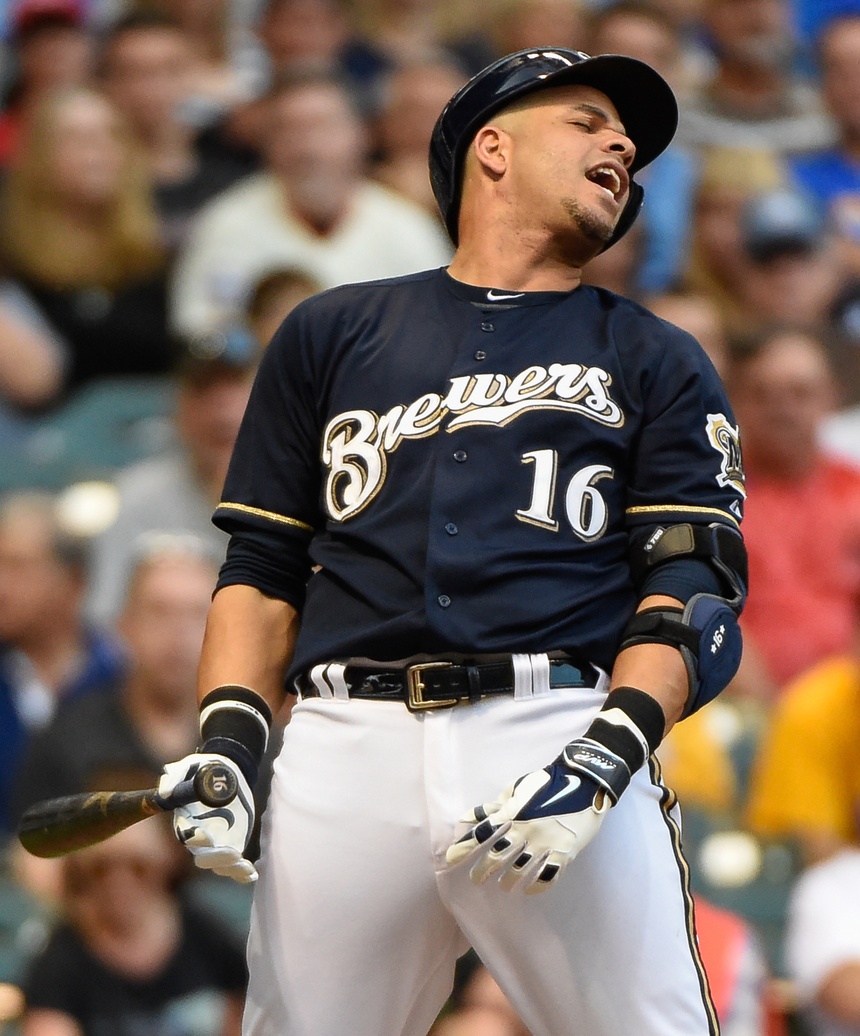 Ramirez has already had an illustrious 17-year-career. Among third basemen, he ranks ninth all-time in home runs, tenth all-time in doubles, and tenth in RBI. Though he’ll likely fall short of the Hall of Fame, Ramirez had a long run of being one of the top 5-10 third basemen in baseball since becoming a regular in 2001.
These days, his power may not be what it once was, but he still ranked 11th among all third basemen in isolated power, ahead of fellow free agent Pablo Sandoval. He’s always made excellent contact, resulting in a .285 career batting average that he matched in 2014. Overall, Ramirez still has a case as a top ten hitter at the hot corner, and he was basically Sandoval’s equal with the bat this year. Ramirez also made his third All-Star team, hitting .288/.336/.459 in the first half.
As MLBTR’s Steve Adams noted in August, Ramirez’s free agent competition at third base isn’t anything special (although it’s certainly no worse than the rest of the free agent hitting class, which is weak overall). If one continues to categorize Hanley Ramirez as a shortstop, Ramirez’s .757 OPS led free agent third basemen, with Sandoval checking in at .739 and Chase Headley at .700. Ramirez will not require nearly the commitment Sandoval will.
Weaknesses/Cons
Metrics suggest Ramirez’s defense was passable this year, though he has had some pretty rough seasons within the last five.
Ramirez will turn 37 next June, so he comes with typical durability question marks. He played 298 games from 2011-12 and a reasonable 133 this year despite a DL stint for a hamstring injury. That’s not bad, but Ramirez seems better suited for an American League team with some DH flexibility, especially if he seeks a multiyear deal.
Ramirez has had a consistent career, but his offense in 2014 was streaky. He posted an OPS over .960 in June and August, yet was under .600 in July and September. He wound up hitting only four home runs in 251 second half plate appearances. Ramirez’s walk rate was down to 4% this year, his worst since his partial 2000 campaign. Baserunning has consistently been a detriment throughout Ramirez’s career.
Personal
Ramirez is married with three children, and he resides with his family in the Dominican Republic in the offseason. The third baseman “lives and breathes for his kids,” a person close to him told MLBTR. When the kids are in school, Ramirez enjoys spending time on his farm in the Dominican.
Ramirez does not exhibit much overt emotion on the field, a trait that drew some criticism in Chicago, perhaps unfairly.
Market
Having spent his entire career in the NL Central, Ramirez has never served as a designated hitter more than five times in a season. He hasn’t played a position other than third base in his entire pro career, so the idea of working him in at first base could be a stretch. Certainly the Brewers would like to bring Ramirez back, as we’ll discuss below. Otherwise, the Diamondbacks, Nationals, Red Sox, Royals, Angels, Yankees, Padres, Giants, and Blue Jays could seek help at the hot corner this offseason. As a veteran who likely has plenty of money in the bank from past contracts, comfort could be a primary factor in Ramirez’s choice.
Expected Contract
Ramirez’s contract situation is complicated. He and the Brewers hold a $14MM mutual option for 2015. On the rare occasions in baseball that both sides of a mutual option have been exercised, it’s never been close to that kind of salary. While a September 17th report from Jon Heyman of CBS Sports said the Brewers intend to pick up their side of the option, Brewers GM Doug Melvin told MLB.com’s Adam McCalvy the topic hasn’t even been broached with the team’s owner or Ramirez’s agent, Paul Kinzer. Realistically, Melvin probably has some idea of what he wants to do, but option decisions aren’t due until after the World Series.
The Brewers do seem likely to pick up their side of the option — they’re faced with a $4MM buyout if they decline it, so the option is effectively only a $10MM decision. If the Brewers pick the option up, Ramirez then has the opportunity to decline and go to free agency, in which case he would not receive a buyout. $14MM is a reasonable salary if Ramirez only wants to play one more year, but he may prefer a longer term. Ramirez suggested in July he’d go for 2,500 career games, a goal of which he is 443 short. That suggests three or four more seasons, but in September, Ramirez was non-committal about what he’d do after 2015.
A two-year deal would be a nice compromise; perhaps Ramirez and the Brewers can work out something that pays around $25MM for that span. I imagine if Ramirez is thinking bigger than that, he’ll have to find it on the open market. One problem: the Brewers can reduce his leverage by making or telling him their intention to make a qualifying offer. I expect them to make that offer if they get to that point. Draft pick forfeiture would affect Ramirez’s market, but not as much as you might think. The players most burned by qualifying offers last winter were asking for big contracts from the outset of free agency. Ramirez might ask for just two years from the start, and I think he could find a team to give it to him even with the draft pick cost attached.
In the somewhat unlikely event that Ramirez hits the open market without a qualifying offer attached, it would help his chances of securing a three-year deal. Still, he’d probably have to sacrifice on average annual value to get a third year, perhaps accepting something like three years and $33MM.
Ultimately, I think Ramirez will sign a two-year, $26MM deal to stay with the Brewers. If he reaches the open market without a draft pick attached, I’ll go with two years and $30MM. If he receives a qualifying offer from the Brewers, I think he’ll turn it down. Even in that scenario, I think he can find the same two-year, $26MM deal on the open market.
Photo courtesy of USA Today Sports Images.
Pirates Designate Jose Tabata For Assignment
The Pirates have designated right-handed-hitting outfielder Jose Tabata for assignment, according to the MLB.com transactions page. Tabata’s struggles led to him being outrighted earlier in the year, though he made his way back to the big league roster and ultimately played in the Wild Card game.
Tabata, 26, has not lived up to the expectations that led the team to sign him to a six-year, $15MM extension in August of 2011. Over the 2012-14 seasons, he has logged only 901 plate appearances, slashing .266/.325/.375. Tabata also saw his promising early numbers on the basepaths (35 steals; 14 times caught in 2010-11) wither away (12 bags stolen, 15 times caught since).
Though Tabata’s .771 OPS in part-time duty last year raised some hope that Pittsburgh would recoup some production from its investment, he again faltered this year. Over just 186 plate appearances, he posted a meager .282/.314/.333 line.
In the end, the Pirates remain on the hook for $8.75MM over the next two years. That includes a $250K buyout for the successive club options that come with his contract. ($6.5MM for 2017, escalating by $1MM thereafter.) Though the early-career extension did not work out, neither does it constitute too serious an impediment, even to a small-payroll club like the Bucs.
Tabata’s contract has already passed through waivers once, but it is not clear that he has much of a future in Pittsburgh at this point. As things stand, the Pirates seem likely to allow Travis Snider a chance this spring to hold off youngster Gregory Polanco for the regular role, perhaps deploying a righty bat to complement those left-handed swingers. Snider, who slashed .264/.338/.438 and hit 13 home runs through 359 plate appearances, has two more seasons of arbitration eligibility remaining.
Kevin Towers Leaving Diamondbacks Organization
After being replaced as the general manager of the Diamondbacks, Kevin Towers has declined an opportunity to stay on in another capacity, the club announced today. The club has also decided not to renew the contract of assistant GM Billy Ryan.
Towers had been waiting to consider the new role after talking it over with new GM Dave Stewart. He took over the club’s baseball operations in 2010. After initially finding success, the D’backs have sputtered in each of the last two years. The seat increasingly heated up as a series of high-profile trades (and, to a lesser extent, free agent signings) backfired on the veteran executive.
Towers first hit his stride in a front office capacity with the Padres, starting out as their scouting director and ultimately taking over as the GM. A long tenure ended after the 2009 season, leading Towers to work as a special assignment scout with the Yankees for one year before heading to Arizona.
It remains to be seen what the future holds for Towers. Many have speculated that he could move back to San Diego in some kind of advisory capacity to newly-hired GM A.J. Preller, though there are no indications to date that anything is in the works.
Offseason Outlook: Colorado Rockies
Another hot start raised expectations in 2014, but regression and injuries once again combined to doom the Rockies. Colorado seems intent on fielding a competitor, but it remains to be seen whether it will have the payroll flexibility needed get there.
Guaranteed Contracts
- Troy Tulowitzki, SS: $118MM through 2020 (including 2021 option buyout)
- Carlos Gonzalez, OF: $53MM through 2017
- Jorge De La Rosa, SP: $25MM through 2016
- Justin Morneau, 1B: $7.5MM through 2015 (including 2016 option buyout)
- Boone Logan, RP: $11.75MM through 2016
Arbitration Eligible Players
- Drew Stubbs, OF (5.047): $5.7MM projected salary
- Jhoulys Chacin, SP/RP (5.012): $4.9MM projected salary
- Rex Brothers, RP (3.117): $1.3MM projected salary
- Michael McKenry, C (3.097): $1.5MM projected salary
- Adam Ottavino, RP (3.087): $1MM projected salary
- Juan Nicasio, SP/RP (3.083): $2.4MM projected salary
- Jordan Lyles, SP (3.060): $2.5MM projected salary
- Tyler Chatwood, SP (3.039): $1MM projected salary
- Wilin Rosario, C (3.023): $3.6MM projected salary
- Non-tender candidates: Chacin
Contract Options
- Brett Anderson, SP: $12MM club option ($1.5MM buyout)
- LaTroy Hawkins, RP: $2.25MM club option ($250K buyout)
Free Agents
With the Rockies, it seems, the real issues reside not in the details of roster construction, but in the philosophical and strategic direction of the organization. Critiques of the decisionmaking structure – and, in particular, owner Dick Monfort and the two key front office executives Dan O’Dowd and Bill Geivett — have migrated from fans and former players to internal sources. Yet it still seems rather unlikely that the team will undergo any kind of front office shakeup, or that the organization’s general approach will change.
Barring a major shift in front office personnel or in operating style, it is not clear what the Rockies can do to change the outlook for next year in a significant way. As things stand, the team appears stuck in a difficult middle ground – albeit one that has not gotten in the way of reliably above-average attendance figures. What are the options going forward?
On the one hand, the club has shown an utter lack of inclination to trade away any of its veterans for future resources. Despite being well out of contention this year, and having a few potential candidates (some playing on expiring contracts), Colorado did not pull the trigger on any summer deals.
Indeed, to the contrary, Monfort was said to have pulled the plug on a deal that would have sent veteran starter Jorge De La Rosa to the Orioles in exchange for a quality prospect arm in Eduardo Rodriguez. Instead of dealing the 33-year-old De La Rosa, the Rockies later inked him to a two-year, $25MM extension. To be sure, it may have been difficult for the team to convince a better arm to pitch at Coors Field for that kind of scratch, and De La Rosa has an excellent track record at altitude. But adding the promising Rodriguez and instead pursuing one of the many mid-level free agent starters (including, perhaps, De La Rosa himself) would have made for a nice alternative.
Even with De La Rosa back, contention in 2015 – while not unimaginable — would be a surprise. Colorado has few glaring holes in the lineup, but the pitching staff is coming off of a season characterized by injury and ineffectiveness.
Then, there is the payroll to consider. Player salaries are expected to land in the mid-$90MM range again, about half of which is already slated to go to De La Rosa and stars Troy Tulowitzki and Carlos Gonzalez. The total guaranteed commitment lands at about $61MM, but that is before accounting for arbitration raises that could cost nearly $25MM and decisions on options the club holds over Brett Anderson and LaTroy Hawkins.
In short, the Rockies have little room for addition without first making some subtractions. But where to trim salary?
It has often been wondered whether and when the Rockies would consider dealing either of their two stars in an effort to reload. But season-ending surgeries for Tulo and CarGo make that difficult to imagine, and Monfort has sent signals that he has no such intention. Senior VP of Major League operations Bill Geivett recently shot down that idea as well: “If we’re going to win, they’re going to need to be part of it, too.”
Beyond those two cornerstones, there are any number of hypothetical possibilities to free up a little cash. Let’s take a closer look, in the context of the overall roster:
The Rockies lineup is largely in place, unless the team decides to explore some changes. Gonzalez will presumably occupy one corner outfield spot, while some combination of younger players – Corey Dickerson, Drew Stubbs, Charlie Blackmon, and Brandon Barnes, many of whom are coming off of breakout years – can be expected to combine to make up a solid unit. Colorado reportedly has some interest in bringing back Michael Cuddyer, but that appears to be quite a luxury.
Among the outfielders, only Stubbs presents the realistic possibility of a cost-saving trade given his $5.7MM projected hit. But he is the best center field option of that group, and may not bring much in return with just one year of not-inexpensive control remaining (not to mention the fact that his big numbers last year were driven by a .440 BABIP at Coors). But his combination of power, speed, and defense could make him a reasonably marketable asset.
In the infield, the diamond appears set at three spots: short (Tulowitzki), third (Nolan Arenado), and first (Justin Morneau). Trading the veteran Morneau could deliver some savings and bolster other needs, with first base being entrusted to Wilin Rosario or prospect Kyle Parker. But that would take away one of the team’s best bats from last year, and the club seemed disinterested in shopping him at last year’s trade deadline.
The Rockies are not without options at the other infield positions, but they offer the greatest possibility for movement. At the keystone, DJ LeMahieu is a reliable defender who just has not contributed much with the stick (career 76 OPS+). Josh Rutledge offers more promise at the plate, but defensive metrics have little regard for his glove. With free agent pickings looking slim, the Rockies might be best served by dealing away one of these still-young players while pursuing a left-handed-hitting utility option – the late-blooming Rafael Ynoa is an in-house possibility — to platoon with whoever remains.
Most interesting, perhaps, is the situation at catcher. Rosario has failed to impress the team behind the dish, and took a step back offensively in 2014. He appears to be a trade candidate, though Colorado would certainly not be selling at an opportune time. And while Michael McKenry was a nice surprise last year, he seems more likely headed for a backup or platoon role. If the Rockies are to make a run at a top free agent, Russell Martin looks like an excellent fit on paper, but he figures to draw strong interest elsewhere and may be out of Colorado’s comfort zone financially.
Ultimately, the possibilities noted above could be driven by whether a pitching acquisition requires cash or a trade chip. As things stand, improving upon the team’s uninspiring group of arms is surely the priority.
In the rotation, De La Rosa will likely be joined by two players who had relative breakout years in Jordan Lyles and Tyler Matzek. That trio contains enough questions of its own, but things get even less clear thereafter. Tyler Chatwood is shelved with his second Tommy John procedure, Jhoulys Chacin looks like a lottery ticket (shoulder problems) or non-tender candidate, and Juan Nicasio is said to be slated for the bullpen. Younger arms like Jon Gray, Eddie Butler, and (to a lesser extent) Christian Bergman and Tyler Anderson offer some hope in the relatively near future. But it would be optimistic to expect too much of that group in 2015. Otherwise, the team is left with questionable depth options like Yohan Flande.
So, what can the Rockies do to bolster that group? The option over Anderson is too risky to be considered seriously: $12.5MM for a full season of a healthy Anderson is an attractive enough proposition, but the lefty has not thrown even 50 frames in a MLB campaign since 2011.
Convincing Anderson to return for a lesser amount makes theoretical sense, but runs into a major practical concern: why would he choose to take a pillow contract to throw half his innings at Coors Field? This same problem, of course, could limit Colorado’s ability to take advantage of the rest of a deep market for mid-tier starters – including some, like Justin Masterson and Brandon McCarthy, who induce ground balls at a solid clip. Even if Colorado can clear enough salary next year to afford an arm of that nature, it would likely need to make a multi-year commitment that could hamstring the organization when it is more likely to be in a position to contend.
The trade route is an alternative to free agency. One could imagine the Rockies matching up with a team like the Mets on some kind of swap of an outfielder for an arm. Rosario probably has enough upside to be an important part of a deal for a useful pitcher. To be sure, adding a reliable hurler with an attractive contract situation would presumably require the sacrifice of some significant portion of the organization’s best prospect talent. But Geivett has said that the team wants to add “impact” even if that means getting an aging hurler.
Relief pitching was every bit as problematic for Colorado last year. Two lefties remain in place — the disappointing Boone Logan and the struggling Rex Brothers – leaving the team with the option either to fiddle with that area or simply hope for improvement. Hawkins is expected to occupy the ninth inning to start the year, which at least provides a ready answer to the question of who will close. Former closer Rafael Betancourt is said to be a possible re-acquisition. And the team has options for right-handed setup men and middle relievers, including Nicasio, Adam Ottavino (who pitched well in 2014), Rule 5 pickup Tommy Kahnle, and surprising 29-year-old rookie Brooks Brown. Improving the production from the pen, then, could be as straightforward or as complicated as the team prefers. With every dollar being watched, it might make the most sense to let the market shake out and pluck a few veterans who miss out on the deals they hoped for.
The difficulty for the Rockies is, in the end, not hard to assess: the team is in position to add a piece or two, but it is more than a piece or two away from being a reliable contender. Stretching future resources to add a player like Martin, or overpaying in AAV and/or years to convince a starter to pitch in Denver, increases the risk of a prolonged malaise. From a competitive perspective, it probably makes sense to craft a strategy of exchanging veterans for future talent. But, then, that was already clear this summer.
Octavio Dotel Retires
The man who has played for more Major League teams than anyone in history won’t be adding another to his resumé, as right-hander Octavio Dotel has decided to officially retire, reports Chris Cotillo of SB Nation’s MLB Daily Dish.
Last we heard on Dotel, the veteran reliever was looking to make a comeback in 2014, though that never wound up coming to be. Cotillo notes that Dotel tried to rehab from his most recent injury (elbow inflammation that cost him nearly all of the 2013 season) in the Dominican Republic in hopes of latching on with a new team, but the rehab was unsuccessful.
Dotel, 40, will finish his career having played for a record 13 teams in the Majors. In parts of 15 big league seasons between the Astros, Athletics, Tigers, White Sox, Royals, Mets, Rockies, Pirates, Braves, Cardinals, Dodgers, Yankees and Blue Jays, Dotel compiled a 3.78 ERA with 10.8 K/9, 3.9 BB/9 and a 32.5 percent ground-ball rate. In his best seasons, Dotel averaged 94+ mph on his fastball, but he lost some of that velocity late in his career and finishes with an average of 93 mph on his heater.
Dotel never earned an All-Star nod, but he did secure a World Series ring after pitching 24 2/3 innings of 3.28 ERA ball during the regular season for the 2011 Cardinals, plus another 10 1/3 postseason frames in which he yielded three earned runs (2.61 ERA). Dotel recorded saves for nine of the 13 teams for which he played, totaling 109 in a career that earned him more than $41MM, per Baseball-Reference.com. MLBTR wishes Dotel the best of luck in his post-playing career.
Braves Retain Fredi Gonzalez, Hire Bo Porter As Third Base Coach
Interim Braves GM John Hart announced today that the team will retain Fredi Gonzalez for the 2015 season and hire recently dismissed Astros manager Bo Porter as a third base/outfield and baserunning coach (Twitter links). According to a team press release, assistant hitting coach Scott Fletcher will not be returning to the organization in 2015, and Porter will replace former third base coach Doug Dascenzo. Hitting coach Greg Walker already announced his resignation earlier this week. The remainder of the coaching staff will return, according to the Braves.
The news may not sit well with Braves fans, as many called for Gonzalez to suffer the same fate as recently fired GM Frank Wren following the team’s collapse and offensive struggles. Gonzalez, however, will be retained for a fifth season as the Atlanta skipper. To this point, the Braves are 358-290 under Gonzalez, who has also managed the Marlins and owns a lifetime 634-569 record as a Major League manager.
David O’Brien of the Atlanta Journal-Constitution reported shortly before the announcement that Porter was expected to join the Braves’ staff (Twitter links). As O’Brien noted, Porter has strong ties to Gonzalez after spending three years with him as a coach for the Marlins and playing for him when Gonzalez managed Triple-A Richmond in 2002.
Rockies Do Not Expect Major Changes For 2015
Barring a last-minute change of heart from owner Dick Monfort, the Rockies are not prepared to undertake significant changes to their front office, reports MLB.com’s Thomas Harding. Likewise, that decision-making group seems set to try to build a contender while relying primarily on the same major pieces that remain under team control.
Senior VP of Major League operations Bill Geivett spoke with Harding on the club’s roster. “We like the team that we have,” he said. “When the majority of them are out there, we feel good about our chances. At the same time, we look at next year and we know our pitching staff, we need to improve, and we need to be able to score runs on the road.”
While not surprising under the circumstances, Geivett indicated that the team has no intentions of dealing its two biggest stars (and two biggest contracts) shortstop Troy Tulowitzki and outfielder Carlos Gonzalez. “If we’re going to win, they’re going to need to be part of it, too,” he explained.
Geivett said that the club’s focus was on improving a pitching staff that was among the least effective in baseball last year. “We need impactful starting pitching,” said Geivett. “We’re not going to check his ID. We don’t care how old he is. We don’t care how much time he has. In order to compete against the teams we play with, we know starting pitching is essential.”
Those comments certainly seem to indicate that Colorado will not be concerned with the future in looking for arms for 2015. At the same time, the club is reportedly not preparing to increase its payroll, and current commitments seem to leave fairly little to spend. Adding another starter would obviously help, given the massive uncertainty that permeates much of the team’s rotation (to say nothing of the bullpen), but it it is far from clear that such an acquisition — in and of itself — would make the team a likely contender.
Geivett himself has a lot riding on the coming season. Monfort made clear recently that he holds Geivett responsible for the product that takes the field at Coors. On the other hand, as Patrick Saunders of the Denver Post recently reported, internal team sources are frustrated with the owner’s own intrusion on baseball decision-making.
Mariners’ President: Payroll Will Increase In 2015
Earlier this week, Mariners GM Jack Zduriencik said that he felt he would have more financial resources to work with, and today Mariners president Kevin Mather confirmed as much in an appearance on 710 ESPN’s Brock and Salk show (Brady Henderson of 710 ESPN has transcribed some of the highlights). Mather explains that the Mariners spent $16MM more than they had budgeted for in 2014 (a total payroll of $107MM), but ownership has no intention of scaling that back after seeing the team’s performance this season:
“They’re fans and they seemed extremely pleased with the competitive nature of the games and September, meaningful baseball, and not one of them has said, ‘What are we going to do to get that $16 million back?’ They were all saying, ‘What are you going to do to get us six more wins next year?'”
Fresh off the signing of Robinson Cano to a 10-year, $240MM contract, the Mariners posted an 87-75 record — their best since 2007 — and cleared two million fans at Safeco Field for the first time since 2010, which Mather says will help him to acquire more resources for Zduriencik.
If you have time to listen to the audio of the full interview (it’s roughly 21 minutes long), Mather’s interview is well worth hearing in its entirety. The first-year president was insightful and candid throughout as he discussed the extension of Zduriencik, the relationship between Zduriencik and manager Lloyd McClendon, his own role with the team and the club’s approach at the trade deadline as they weighed a run at David Price.
Mather feels that Zduriencik’s contract extension was turned into a bigger deal than he’d expected. He echoed a story told by Zduriencik shortly after the extension, stating that he simply broached the topic casually at the end of a business lunch, asking the GM, “Does your wife like it in Seattle?” Zduriencik responded that she loves it, and Mather recalls, “I said, ‘Well, your contract’s up at the end of the year. Why don’t we talk about getting that extended?'” Mather does admit that Zduriencik’s rebuilding effort took longer than it should have, but he called the decision to extend him after the club’s success an “automatic.” Asked about Zduriencik’s best ability, Mather did not hesitate to say “personnel evaluation,” referring to evaluating young players.
Beyond that, he recalled his first test as a president — asking ownership for increased funding to sign Fernando Rodney late in the offseason. Unhappy with the asking prices of remaining starting pitchers and bats, Zduriencik suggested the idea of shortening the game. “The first thing I really tried to sell to ownership was, let’s take the ninth inning off the board,” said Mather, adding that he received little resistance on that front.
The team’s biggest desire moving forward, Mather says, is to avoid going through a “dip” like the Mariners went through from 2004-14:
“We need to be 85 to 95 wins every year, which means we need to draft well, we have to get our draft picks signed, we have to be strategic with our free agent signings, but we need to be competitive year-in, year-out. And you don’t do that by signing broken-down, middle-of-the-road free agents and hoping.”
Regarding the club’s summer interest in Price, Mather emphasized that with the team looking at a Wild Card spot, it was too difficult to mortgage the future. “Will you give up — and I shouldn’t use names — but will you give up [James] Paxton, or [Taijuan] Walker, or [D.J.] Peterson for David Price?” he asked, rhetorically. “…I want to be competitive in 2015, 2016, 2017 — these are young players that we control.”
Lastly, he discusses the impact that the team’s strong performance will have on attracting free agents. While he says it’s a selling point, the biggest red flag for the Mariners in attracting free agents, in Mather’s opinion, is the team’s travel schedule. Mather says he’s been assured by new commissioner Rob Manfred that MLB will look at the travel schedule in order to avoid scenarios like the one that came up this year where the team went from California to Houston to Toronto and back to Seattle without an off-day. He’s reminded Manfred about it multiple times, though he acknowledges that it may take a year or two in order to truly alleviate that pain for West Coast teams.
Offseason Outlook: Chicago White Sox
After a fourth place finish in the AL Central, the White Sox will supplement their bullpen, and perhaps add reinforcements at left field, designated hitter, catcher, and in the rotation.
Guaranteed Contracts
- Jose Abreu, 1B: $51MM through 2019
- John Danks, SP: $28.5MM through 2016
- Chris Sale, SP: $28.15MM through 2017
- Jose Quintana, SP: $25.65MM through 2018
- Alexei Ramirez, SS: $11MM through 2015
- Jeff Keppinger, IF: $4.5MM through 2015 (released in May 2014)
- Scott Downs, RP: $250K buyout (released in July 2014)
Arbitration Eligible Players (service time in parentheses; projections via Matt Swartz)
- Ronald Belisario, RP (4.151): $3.9MM projected salary
- Tyler Flowers, C (3.148): $2.1MM
- Dayan Viciedo, RF/LF (3.123): $4.4MM
- Hector Noesi, SP (3.006): $1.9MM
- Nate Jones, RP (3.000): $600K
- Javy Guerra*, RP (2.133, Super Two): $1.3MM
- Non-tender candidates: Belisario, Viciedo
Contract Options
- Felipe Paulino, SP: $4MM club option with a $250K buyout
Free Agents
- Matt Lindstrom, Paul Konerko (retiring)
It was another summer of trading away veterans for the White Sox, as GM Rick Hahn dealt Gordon Beckham, Alejandro De Aza, and Adam Dunn in a span of 11 days at the end of August. The exact return on Beckham won’t be determined until the offseason, but Hahn did acquire a solid pitching prospect for Dunn in Nolan Sanburn.
It was an ugly campaign, but the 2014 season did provide Chicago clarity at several key positions. Most importantly, 2013 signing Jose Abreu looks like a huge bargain after posting MVP-caliber numbers in his rookie MLB season. Also, center fielder Adam Eaton established himself with a quality year worth 2.8 wins above replacement.
While the player acquired alongside Eaton from Arizona, Matt Davidson, remained in Triple-A and took a step backward, the Sox still found a solid stopgap at the hot corner in 27-year-old Conor Gillaspie. Gillaspie fits on the strong side of a platoon, and could match up with Marcus Semien again.
Avisail Garcia is the incumbent in right field after missing much of 2014 due to a shoulder injury. Just 23, Garcia could take a leap forward in 2015. Tyler Flowers had a passable season as the starting catcher, but struck out a ton and could easily see his average back around the Mendoza line in 2015. The Sox could pony up for Russell Martin, but Hahn should be proactive in attempting to find a quality backstop via trade. The Yankees are probably the team with the most depth at the position, in terms of long-term catchers.
25-year-old Dayan Viciedo declined to a .231/.281/.405 line, and does not look like a long-term piece for Chicago. He could be non-tendered or traded. Should Hahn turn to the free agent market to fill left field, options include Melky Cabrera, Nelson Cruz, and Mike Morse. Nori Aoki, Michael Cuddyer, Torii Hunter, and Nick Markakis haven’t generally played the position, but could be considered. The Rays’ Matt Joyce could be a trade option, and the Dodgers’ outfield surplus remains unresolved. The most intriguing choice would be young Cuban corner outfielder Yasmany Tomas, with whom Abreu is familiar. The problem is that Abreu’s success reset the Cuban market such that Tomas’ price tag could be in the $100MM range. The White Sox have not been connected to Tomas in any notable way thus far.
The White Sox have finally gotten Adam Dunn off the books, and in August Bruce Levine of CBSChicago.com wrote that stealing Victor Martinez away from the Tigers tops Chicago’s offseason wish list. The Sox fell just short of signing Martinez four years ago, leading to their deal with Dunn. Martinez, who had a monster offensive 2014 season few saw coming, turns 36 in December and now spends the majority of his time as a designated hitter. Martinez would represent a fairly risky win-now signing for the Sox, but the switch-hitter would make a fantastic tandem with Abreu in 2015 as he did with Miguel Cabrera in Detroit. The Carlos Beltran deal should be Martinez’s floor, and the Sox would have to forfeit their second-round draft pick.
Trades for Alexei Ramirez could be entertained, though he still has value to the White Sox. He’s under contract for 2015 and has a club option for ’16, and could make a nice bridge to hopeful shortstop of the future Tim Anderson. Anderson, the team’s first-round pick in 2013, missed nearly two months with a broken wrist but still received a surprise promotion to Double-A. With Beckham gone, second base next figures to be a competition, with Micah Johnson, Marcus Semien, and Carlos Sanchez in the mix.
In the rotation, Chris Sale’s dominance continued and Jose Quintana had a quietly excellent campaign. John Danks ate innings at the back end, if nothing else. Hector Noesi, claimed off waivers from the Rangers in April, posted a 4.43 ERA in 27 starts for the Sox. The team is missing at least one more above average starting pitcher, and they could have it soon in 2014 first-round pick Carlos Rodon. Rodon finished the season at Triple-A and has a chance to break camp in 2015 in the big league rotation.
The Paulino experiment was a bust, though the Sox spent very little on him. To reduce the risk of dipping heavily into the team’s No. 6-8 starters, the Sox should at least add a project arm or two for depth.
The White Sox bullpen struggled in 2014, putting up a 4.28 ERA that was second-to-last in the American League. Jake Petricka and Zach Putnam filled the ninth inning void after the offseason trade of Addison Reed, injuries to Matt Lindstrom and Nate Jones, and ineffectiveness from Ronald Belisario (a likely non-tender candidate). Petricka, Putnam, and Daniel Webb were able to keep the ball on the ground, but failed to miss bats. Jones underwent Tommy John surgery in July, so he’s a non-factor for 2015 even if the Sox tender him a contract. The bullpen is a clear area of upgrade for Hahn, who told MLB.com’s Scott Merkin in September, “The overall goal of the bullpen is going to be to acquire multiple options, potentially from the right and left side … many of which could be end-game options for us.” Even if Chicago decides to pass on top free agent reliever David Robertson, the market offers a wide array of quality options.
Hahn used the word “aggressive” multiple times regarding the upcoming offseason, as reported by MLB.com’s Scott Merkin. An aggressive approach makes sense, with Abreu, Sale, and Quintana currently so affordable. The Sox have about $46MM in contract commitments for 2015, plus maybe another $6MM if they retain Flowers, Noesi, Jones, and Guerra. Hahn could have around $40MM to play with in 2015 salaries without raising payroll, enough to add multiple significant free agents.
Though 2014 didn’t go as planned, the Sox received star-caliber performances from Abreu, Sale, and Quintana and quality seasons from Eaton and Gillaspie. There seems to be much offseason work to do to vault this team into contention, with the wish list including a retooled bullpen, an effective bat or two, and added rotation depth.
Note: there is some question as to Javy Guerra’s official service time. MLB’s calculation of 2.133 would make him a likely Super Two player, but his contract being selected (at least publicly) on May 20th suggests 2.128, which would fall short.