
NL East Notes: Harper, Sale, Crick
After his recovery from Tommy John surgery necessitated a move to first base last season, Bryce Harper took well enough to his new position that the Phillies announced in November that Harper would be their regular first baseman in 2024 and beyond. The two-time NL MVP spoke to reporters (including The Athletic’s Matt Gelb) about the situation today, saying “I wanted them to know that I was on board with anything they wanted to do,” and that Harper left the decision about his position up to the club. “I said if you want me in right field, I’ll play right. If you want me at first, I’ll play first base. I think collectively, they said, first base is where we want you. I said, ‘OK, I’ll do everything I can to be there,’ ” Harper said. He is now spending his Spring Training further working on what seems to be his permanent new position, noting that “I don’t think I’ll move back out to right. I don’t. But never say never.”
Harper also confirmed that he is interested in extending his contract, as agent Scott Boras stated in December. The idea caught many by surprise given that Harper still has eight seasons and $196MM remaining on his original 13-year, $330MM contract, and he’ll be turning 39 years old in October 2031. While Harper said “I haven’t really thought too much about” his contract situation, he said that “playing into my 40’s, I mean, that’s the biggest thing for me. So I want to get that done.” It remains to be seen if Harper, Boras, and the Phillies could possibly reach some kind of deal to add two (or more?) years onto Harper’s contract, yet president of baseball operations Dave Dombrowski has downplayed the idea of a renegotiation.
More from around the NL East…
- Chris Sale has battled through several injury-plagued seasons, but the winter of 2023-24 “was the first time going into an offseason without dealing with something since 2018 or something like that,” the new Braves starter told The Athletic’s David O’Brien and other reporters. “It’s been a long time. I had a lot of fun this offseason, being able to play baseball and do things that I haven’t been able to do.” In both acquiring Sale from the Red Sox and then signing him to a two-year extension, the Braves are putting a lot of faith that the southpaw is ready to rebound as he enters his age-35 season. Atlanta even looked into acquiring Sale during the 2023 season, according to manager Brian Snitker.
- Mets reliever Kyle Crick is recovering from a Grade 4 calf strain and might not start throwing bullpens until closer to the end of spring camp, MLB.com’s Anthony DiComo writes. New York signed Crick to a minor league deal in December and he has no issue with pitching in the minors for the start of the season, given how his injury will seemingly prevent him making the Opening Day roster. Crick posted a 3.56 ERA over 187 1/3 relief innings with the Giants, Pirates, and White Sox from 2017-22, though he didn’t pitch in 2023 until surfacing in Dominican Winter League action a few months ago.
- There’s enough happening within the division that this is our second batch of NL East Notes today. Earlier on, Nick Deeds compiled another set of items about the Marlins, Phillies, Nationals, and Braves.
Giants Notes: Soler, Lineups, Transactions, Slater, Zaidi
The Giants’ three-year, $42MM contract with Jorge Soler was finalized and announced earlier today, so Soler, manager Bob Melvin and president of baseball operations Farhan Zaidi were now officially able to discuss the deal with the media. Melvin told reporters (including the San Francisco Chronicle’s Susan Slusser and NBC Sports Bay Area’s Alex Pavlovic) that Thairo Estrada and Wilmer Flores played a key role in helping recruit Soler, as the three players are friends. This helped lure Soler to San Francisco and the West Coast in general, as Soler’s preference was to stay on the East Coast, ideally close to his home in Miami.
Soler will now head west for the first time in his career, after playing with the Cubs, Royals, Braves, and Marlins during his 10 previous Major League seasons. Though Soler’s production has tended to vary wildly over his career, he comes to the Giants on the high of hitting .250/.341/.512 with 36 homers for the Marlins in 2023, bringing some needed pop to San Francisco’s lineup.
This power naturally lends itself to the cleanup spot, and Melvin said that Soler will primarily hit fourth in the batting order and act as the regular designated hitter. New arrival Jung Hoo Lee will hit leadoff and be the everyday center fielder, flanked on the grass by Michael Conforto in left field and Mike Yastrzemski in right. Since both corner outfielders are left-handed hitters, Soler might get some time out of the DH spot when a southpaw is on the mound, though Melvin sees the DH role as a natural way to keep Soler healthy and free of the nagging injuries that have bothered him in recent years.
In general, it seems like the Giants are going with at least slightly more of a regular lineup under Melvin, as opposed to the matchup-centric style of revolving lineups favored by former manager Gabe Kapler. There are still some obvious platoon or timeshare possibilities built into the roster, including Austin Slater‘s role as a right-handed hitting complement to the lefty-heavy starting outfield. However, Melvin said Slater is a little behind the other outfielders in spring work, as Slater spent the offseason recovering from right elbow surgery in October. It doesn’t seem like Slater is in danger of missing Opening Day, though Melvin said Luis Matos will get some extra work as a center fielder.
Since it’s only mid-February, the chance still exists that the Giants might yet add another regular to the mix via free agency or trade. Though some gamesmanship must be acknowledge whenever an executive says they’re happy with their team, Zaidi inferred that further moves to the big league roster were unlikely, if not impossible.
“It’s a little bit more disruptive to add at this point. Anybody who’s a free agent, we’ve theoretically had three and a half months to figure out a deal and if it hasn’t happened yet, at some point organizationally, you just need to turn the page and focus on the players you have,” Zaidi said. “You never rule anything out, whether it’s now or May or June or whatever, but you know, at this point, the calendar makes any further additions unlikely.”
The Giants’ offseasons under Zaidi have largely been defined by the superstar players they didn’t sign (i.e. Bryce Harper, Aaron Judge, Carlos Correa, Shohei Ohtani, Yoshinobu Yamamoto) than the players they did acquire, leading to some consternation amongst the Bay Area fanbase. Still, Slusser notes that the Giants’ signings of Soler, Lee, Jordan Hicks, and Tom Murphy ranked the team second behind only the Dodgers in free agent spending, and San Francisco also completed a major trade in acquiring Robbie Ray from the Mariners.
Zaidi defended the Giants’ pursuits this winter, saying “we’re going to continue to take the big swing in free agency when it makes sense and some of the guys that we’ve pursued and have landed are top five-10 players in baseball. I’ve said this about a couple of them: I’m always surprised there aren’t more teams in on them rather than that maybe they wind up somewhere else. You expect things like this to be competitive and we always feel like we have to be able to pivot when things don’t work out. We think we’ve added some exciting players and I think we feel that energy in camp.”
Phillies Sign Austin Brice To Minor League Deal
The Phillies signed right-hander Austin Brice to a minor league deal this morning, per The Athletic’s Matt Gelb. The deal comes with an invite to big league Spring Training.
Brice, 32 in June, last made an appearance at the big league level for the Pirates back in 2022. The righty made his major league debut in 2016 as a member of the Marlins, though he would ultimately pitch just 14 innings with the club before being sent to Cincinnati as part of the deal that sent Luis Castillo to Cincinnati. Over two seasons with the Reds, Brice struggled to a 5.40 ERA with a matching FIP across 70 innings of work before the club designated him for assignment following the 2018 season. After a series of waiver claims, Brice found himself back in Miami ahead of the 2019 season and enjoyed the best season of his career as he pitched to a solid 3.43 ERA in 44 2/3 innings of work for the Marlins.
Unfortunately, that success at the big league level was short-lived, as Brice has posted a 5.85 ERA in 40 innings of work since the start of the 2020 season and spent the entire 2023 campaign in the minor leagues pitching for the Twins and Diamondbacks, for whom he posted a combined 6.92 ERA in 40 1/3 innings. Despite those brutal numbers last year, Brice’s overall body of work at the Triple-A level still features decent numbers. In 170 1/3 innings of work at the level across six seasons, Brice has posted a 4.54 ERA with a solid 25% strikeout rate against a 10.3% walk rate alongside a strong 47.4% groundball rate.
Those serviceable peripheral numbers are brought down, however, by Brice’s troubles with the longball. Brice has allowed a whopping 17.6% of his fly balls to leave the yard for home runs throughout his major league career, and allowed an even higher percentage at the Triple-A level last year. Given his solid peripherals and penchant for grounders, it’s easy to see how Brice could be a serviceable big league reliever if he can get his home run issues under control.
The right-hander will have a chance to prove himself capable in that regard with the Phillies this spring, where he’ll join fellow NRIs such as Ryan Burr and Nick Snyder in competing for a role in the club’s crowded bullpen. Should Brice fail to make the big league roster out of camp, he’ll likely serve as relief depth at the Triple-A level alongside depth options already on the 40-man roster such as right-handers Michael Rucker and Kaleb Ort.
Orioles Acquire Matt Krook From Yankees
The Orioles acquired left-hander Matt Krook from the Yankees today in exchange for cash considerations, according to an announcement from both clubs. Baltimore designated infielder Diego Castillo for assignment in order to make room for Krook on the club’s 40-man roster.
Krook, 29, had been designated for assignment by the Yankees earlier this week in order to make room for infielder Jordan Groshans on the club’s 40-man roster. Krook made his big league debut last year and struggled badly in four innings of work, walking six batters and allowing 11 runs during his brief cameo in the majors. Brutal as that start to Krook’s big league career was, the southpaw was dominant at the Triple-A level for the Yankees last year, pitching to a 1.32 ERA in 27 appearances while striking out a whopping 39% of batters faced.
The 2023 campaign was Krook’s first as a reliever. He had worked primarily out of the rotation in previous seasons and garnered solid results in previous years, including a 3.76 ERA in 215 1/3 innings of work at the Triple-A level from 2021-22. Unfortunately, he also walked a hefty 13% of batters faced over that same time frame, likely prompting his move to the bullpen last season. While Krook has evidently struggled with control throughout his career, there’s no question that the southpaw sports power stuff capable of succeeding in the majors if he can command it successfully.
Krook figures to join the bullpen mix in Baltimore, where Danny Coulombe, Cionel Perez, and Keegan Akin are the club’s southpaws projected to make the Opening Day bullpen as things stand. That leaves Krook likely to join the likes of right-hander Bryan Baker and lefty Nick Vespi as optionable relief depth, though they also figure to receive competition from non-roster invitees this spring such as Andrew Suarez and Nathan Webb.
As for Castillo, the infielder’s time on Baltimore’s 40-man roster comes to an end just two days after he was initially claimed off waivers from the Phillies. The 26-year-old has spent the past two months riding the transactional carousel, having been part of the Diamondbacks, Mets, Yankees, Phillies, and Orioles organizations at various points during that time. Castillo has notched 97 games at the big league level throughout his career and in that time has slashed just .205/.250/.380 across 284 trips to the plate. Despite that weak offensive performance to this point in his career, Castillo has performed well in the minors, with a strong .296/.410/.407 line across three seasons at the Triple-A level.
That sort of on-base and contact ability would make him an attractive bench piece for any club if he can translate it into big league production, particularly given his defensive versatility. Castillo has primarily played second base and shortstop throughout his career, though he’s also seen time at first, third, and both outfield corners. Now that he’s been designated for assignment once again, the Orioles will have seven days to either work out a trade or attempt to pass him through waivers. Castillo has not yet been outrighted in his career and, if passed through waivers successfully, can be retained in the minors as non-roster depth entering the 2024 season.
Giants Sign Jorge Soler
Feb 18: The Giants officially announced Soler’s deal this afternoon. The slugger will received a $9MM signing bonus in addition to $7MM in salary for the 2024 season and $13MM salaries for each of the 2025 and 2026 seasons. To make room for Soler on the club’s 40-man roster, right-hander Austin Warren was placed on the 60-day injured list.
Feb 13, 6:58AM: Soler’s contract with San Francisco guarantees the slugger $42MM, according to Mike Rodriguez (X Link). The deal is a nearly exact match with MLBTR’s prediction of a three-year, $45MM pact for Soler back in November as part of our annual Top 50 MLB free agents list.
1:02AM: The Giants have agreed to a three-year deal with free agent designated hitter/outfielder Jorge Soler, reports Susan Slusser of the San Francisco Chronicle. The agreement is pending a physical. Soler is a client of the MVP Sports Group.
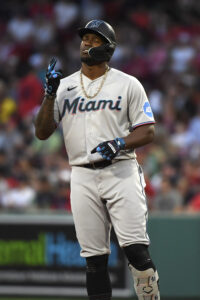
Talks between Soler and the Giants have been going on for at least the past week. As of this morning, the Giants were still reported to be in the mix but had balked at Soler’s request for a third guaranteed season. That, it seems, has changed over the course of the day.
Soler, 32, opted out of the final season of his three-year, $36MM deal with the Marlins back in November after belting 36 home runs while hitting .250/.341/.512 on the season (126 wRC+). Soler posted the second-best walk and strikeout rates of his career at 11.4% and 24.3%, respectively, and Statcast pegged him in the 81st percentile or better in average exit velocity, hard-hit rate and barrel rate.
It’s the type of power profile that the Giants have lacked in recent years. The 2023 Giants ranked 19th in the Majors in home runs (174), 24th in runs scored (674), 28th in average (.235), 24th in on-base percentage (.312) and 27th in slugging percentage (.383). The Giants notoriously haven’t had a player deliver a 30-homer season since Barry Bonds in 2004, and they’ve only had one 20-homer hitter in their lineup in each of the past two seasons (Joc Pederson with 23 in 2022 and Wilmer Flores with 23 last year).
Soler brings a wholly different brand of power. Last year’s 36 big flies were only the second-most he’s hit in a season. Soler paced the American League with 48 homers for the Royals back in 2019, and while injuries have limited him to just two 30-homer seasons in his career, he’s averaged 32 homers per 162 games played in his career. Dating back to that 2019 breakout, Soler ranks 17th among 302 qualified hitters with a .248 isolated power mark (slugging minus batting average). Overall, he’s batted .240/.331/.488 during that time.
The path Soler takes to get to his production isn’t the most straightforward. He’s a streaky hitter in-season and a volatile one from a year-to-year standpoint, with his 2019 and 2023 output teetering on excellent while his 2022 numbers were decidedly below average. Even in the 2021 season that saw Soler catch fire following a trade to Atlanta and go on to be named World Series MVP, he was hitting just .198/.288/.377 in 360 plate appearances at the time Kansas City traded him. He slashed .269/.358/.524 following the change of scenery. A three-year deal with Soler figures to come with its share of peaks and valleys, but he’s the type of bat who can near-singlehandedly carry a lineup for brief stretches, given his top-of-the-scale power.
Though he has plenty of experience in the outfield corners, Soler isn’t likely to see much time there in San Francisco. His defensive grades have continue to decline over the years, and the Marlins only played him sparingly in right field — including just 241 innings last year. Soler has only twice reached 500 defensive innings played in a season. He’ll serve as the Giants’ primary designated hitter, though it’s possible he’ll make occasional appearances in left or right field.
That’s particularly true given that Soler does offer a nice right-handed complement to left-handed corner outfielders like Michael Conforto and Mike Yastrzemski. Production against left-handed pitchers, in particular, was a problem for the 2023 Giants (.245/.306/.376). Soler’s mammoth .277/.393/.688 output against lefties last year represents an enormous boost to San Francisco in such situations.
Adding Soler to the lineup likely cuts into the playing time for J.D. Davis and/or Wilmer Flores against right-handed opponents, but that’s a trio of potent right-handed bats to be able to trot out against opposing southpaws. New backup catcher Tom Murphy (career 126 wRC+ against lefties) should help in that regard as well, as will a full season of switch-hitting catcher Patrick Bailey, who feasted off lefties but struggled against righties. Broadly speaking, the San Francisco lineup looks far more equipped to handle left-handed pitching than last year’s club.
At $14MM per year for Soler, the slugger’s decision to opt out his final year and $13MM in Miami was overwhelmingly the right call. Miami opted not to issue a qualifying offer to Soler, so they won’t receive any draft compensation for his departure, nor will San Francisco be required to forfeit a draft pick or any international money.
Prior to the deal with Soler, San Francisco’s rough $155MM payroll was more than $33MM from their 2023 levels and more than $46MM south of the team’s franchise-record payroll level. That leaves plenty of room for the Giants front office to remain aggressive in free agency, even if ownership isn’t willing to set a new highwater mark on player payroll. That’s true even if the dollars are evenly distributed over the life of the three-year term, but if the deal is at all backloaded there’ll be perhaps a bit more to work with for the upcoming season.
To that end, it’s worth noting that the Giants have been linked to high-profile names like Blake Snell, Matt Chapman and Jordan Montgomery in recent weeks. A deal with Soler shouldn’t preclude them from continuing those pursuits, although with Soler now penciled in as the primary DH, a Chapman signing could perhaps be a precursor to a trade of J.D. Davis. Time will tell whether that’s worth pondering much or goes down as one of many unanswered offseason hypotheticals. Regardless, it seems quite likely that Soler’s signing won’t be the Giants’ last significant addition this winter.
Angels Claim Livan Soto Off Waivers From Orioles
The Angels have claimed infield Livan Soto off waivers from the Orioles, per an announcement from both teams. Anaheim placed left-hander Jose Quijada on the 60-day injured list to make room for Soto on the club’s 40-man roster. The Orioles had designated Soto for assignment earlier this week to make room for infielder Diego Castillo (who was coincidentally DFA’d himself earlier today) on the 40-man roster.
Soto’s sojourn to Baltimore was a brief one, as he returns to the Angels just over two weeks after the club designated him for assignment to make room for right-hander Jose Cisnero on the club’s 40-man roster. The 23-year-old infielder is considered a quality defender at not only shortstop but also second and third base, having spent time considerable time at each position during his professional career. He also boasts solid contact skills, as indicated by a strikeout rate of just 19.3% across six seasons in the minor leagues, though he sports minimal power with just 24 career home runs between the majors and minors.
Soto’s big league experience has been minimal to this point in his career. Though he appeared in majors with the Angels in each of the past two seasons, slashing a strong .375/.414/.531 along the way, that production has come in just 71 trips to the plate spread across 22 games in the majors. That incredible slash line has been bolstered by an unsustainable .469 BABIP throughout his big league career, making his career slash line of just .245/.339/.332 in the minor leagues likely closer to Soto’s true talent level.
Even if Soto can’t maintain his small-sample production in the majors, he still offers plenty of value to the Angels as a left-handed bat with quality defense all around the infield. It’s possible to imagine Soto competing for a bench role on the big league club this spring with the likes of Michael Stefanic and Kyren Paris. If Soto doesn’t secure a role on the Opening Day roster, the Angels will have the ability to option him to the minors and stash him as depth to protect against future injuries.
Red Sox, Triston Casas Have Discussed Possible Extension
2023 was a difficult season for the Red Sox as the club suffered a second consecutive fifth-place finish in the AL East with an identical 78-84 record to their disappointing 2022 campaign. With that being said, rookie first baseman Triston Casas served as a bright spot in the otherwise tough season as he rode a blistering second half to a third place finish in AL Rookie of the Year voting. Prior to the 2023 season, Casas expressed interest in an extension that would keep him in Boston beyond his years of club control, which run through the 2028 season. At the time, he indicated that there had been no such discussions with Red Sox brass, though he struck a different tone in a scrum with reporters (including MLB.com’s Ian Browne) today.
“Of course we have,” Casas told reporters when asked if the sides have talked extension yet. Casas went on to add that while he hopes to stay a member of the Red Sox “forever,” “nothing enticing” had been offered offered to him at this point. Casas decline to get into specifics when asked what sort of contract he would consider, though he noted his goal is a deal that would leave himself and his family “set for the rest of [his] life.”
As a player with just over one year of service time, any extension for Casas would figure to cover his five remaining seasons of team control while also extending Boston’s window of control beyond that. One obvious comp for Casas would be first baseman and former Red Sox prospect Anthony Rizzo, who signed a six-year $40.5MM extension with the Cubs early in the 2013 season that covered the 2014-2019 campaigns. That deal included options and escalators that allowed it to max out at $73MM over eight years. With that being said, there’s several reason to expect Casas to earn significantly more on an extension than Rizzo did. That contract was signed over a decade ago, and while Rizzo was about a year younger at the time of the deal than Casas is now, he had done far less to establish himself as a big league caliber bat.
Entering the 2013 season, Rizzo had hit just .245/.324/.402 in 136 games for his career with an exactly league average wRC+ of 100. Meanwhile, Casas has slashed an impressive .263/.367/.490 (129 wRC+) in 132 games last year and sports a nearly identical 128 wRC+ for his career. While Rizzo’s pedigree as a former top-50 prospect in the sport lent credence to his ability to improve as he entered his mid-twenties, Casas having proved himself as an above-average offensive player in the majors should allow him to earn significantly more even before considering the nearly eleven years of inflation separating the two deals.
So, what sort of deal could make sense for Casas and the Red Sox? Looking at more recent comparisons, Pirates third baseman Ke’Bryan Hayes was another former first-round pick entering his second full seasons in the majors when he signed an eight-year, $70MM extension with Pittsburgh two years ago. While Hayes’s ability to offer elite defense at the hot corner gives him a considerably higher floor than Casas (who is generally considered to be a fringy defender at first base), Casas offers significantly more offensive ability than Hayes, who owned a roughly league-average slash line of just .280/.340/.432 (106 wRC+) in the big leagues at the time of his extension. Casas is also a year younger than Hayes was at the time of his extension, meaning he’d hit free agency ahead of his age 29 season if not extended beyond his current club control.
Given Casas’s relative youth and significant offensive talent, an extension in a similar ballpark to Hayes’s extension with the Pirates could make sense in spite of his lack of defensive value. While the Red Sox have indicated that they expect payroll to be lower in 2024 than it was last year, an extension for Casas would figure to hardly put a dent in the club’s books for the 2024 season, as pre-arbitration extensions tend to escalate salaries over the course of the deal. A deal locking up Casas could also allow Boston to have a potential franchise cornerstone in place long-term as the club’s other young players and prospects, such as Marcelo Mayer, Ceddanne Rafaela, and Roman Anthony, begin to reach and establish themselves at the big league level over the next few years.
NL East Notes: Garrett, Wheeler, Robles, Matzek
The Marlins kicked off Spring Training with a potential injury scare in the rotation, as Jordan McPherson of the Miami Herald relays that, per manager Skip Schumaker, southpaw Braxton Garrett is dealing with “general soreness” in his left shoulder. While shoulder injuries are among the more concerning ailments for pitchers, Schumaker made clear that Garrett hasn’t been shut down at this point with the club instead planning to “push back” the start to Garrett’s spring “until he feels better.” McPherson adds that Garrett continued to play catch late last week.
Garrett, 26, has quietly broken out as a quality mid-rotation arm for the Marlins over the past two seasons. In 48 appearances (47 starts) since the start of the 2022 season, Garrett has posted an impressive 3.63 ERA with a nearly-matching 3.64 FIP across 247 2/3 innings of work. During that time, the lefty has struck out a respectable 23.8% of batters faced while walking just 5.1%. The youngster’s strong peripheral numbers are rounded out by his ability to generate grounders, which he has done at an above-average 48.7% clip over the past two years. With Sandy Alcantara set to miss the entire 2024 campaign while rehabbing Tommy John surgery, Garrett figures to slot in toward the front of the Miami rotation this season alongside the likes of Jesus Luzardo and Eury Perez.
With Garrett’s health uncertain entering camp, it’s fair to wonder what impact his status may have on the club’s trade talks regarding members of their rotation. The Marlins have long been known to be listening on their controllable starting pitching in hopes of addressing other areas of their roster, with Luzardo receiving attention from the likes of the Orioles and Dodgers while the Pirates have also reportedly shown interesting in the club’s available rotation arms. While it’s unclear what impact, if any, Garrett’s current shoulder issue would have on his availability in trade, it’s possible the Marlins may be more hesitant to shop any of their starting options until they have more certainty on Garrett’s status. After all, a hypothetical trade of Luzardo would leave the Marlins with only Perez, Edward Cabrera, and Trevor Rogers as surefire starting options entering the 2024 season if Garrett were to require time on the injured list.
More from the NL East…
- The Phillies have long been hoping to extend veteran ace Zack Wheeler, and comments from Wheeler himself last week indicated that the sides have opened extension talks with Spring Training now underway. While Wheeler indicated that he’s open to negotiating even once the season begins, president of baseball operations Dave Dombrowski indicated to reporters (including Scott Lauber of the Philadelphia Inquirer) that while extending Wheeler is a “priority” for the club, his preference is for the sides to come together on a deal before the regular season begins. Wheeler has established himself as one of the league’s premiere starters since first suiting up for the Phillies during the shortened 2020 campaign. During his time in Philadelphia, the right-hander has pitched to an excellent 3.06 ERA with a 2.90 FIP in 101 starts during the regular season and has augmented that resume with an incredible 2.42 ERA in 63 1/3 postseason innings.
- Victor Robles has patrolled center field for the Nationals on a regular basis ever since his rookie season back in 2019, though it’s possible that could change entering the 2024 season. As relayed by MASN’s Mark Zuckerman, manager Dave Martinez told reporters recently that there will be a “battle” between Robles and 24-year-old rookie Jacob Young for the starting center field job, though Martinez added that Robles has “a little bit of an upper hand” coming into camp. Robles has largely been a plus-glove center fielder with below average offense throughout his career, though in 2023 he appeared to flash more offensive upside as he slashed a solid .299/.385/.364. Unfortunately, that slash line came across just 126 trips to the plate as Robles spent most of the year on the injured list due to back injuries. Young, meanwhile, held his own in a 33-game cup of coffee in the majors last year with a decent .252/.322/.336 slash line in 122 trips to the plate.
- Braves left-hander Tyler Matzek missed the entire 2023 season due to Tommy John surgery, but he told reporters (including Justin Toscano of the Atlanta Journal-Constitution) that he’s feeling good entering Spring Training and hopes to be ready for Opening Day, though he didn’t rule out a possible IL stint to open the season if he needs time to finish preparing to retake the mound. The 33-year-old’s return to the mound figures to provide a significant boost to Atlanta’s relief corps, as Matzek pitched to strong results over three seasons with the Braves prior to the injury. In 132 combined appearances, the southpaw posted a 2.92 ERA with a 3.34 FIP in 135 2/3 innings of work as he struck out 27.4% of batters faced.
Yankees Remain Interested In Blake Snell
The Yankees made an offer to star southpaw Blake Snell last month, but pivoted to a deal with veteran right-hander Marcus Stroman shortly after due to a significant gap between the sides in negotiations. While it’s been unclear to this point whether negotiations between the sides have continued since the Yankees landed Stroman, USA Today’s Bob Nightengale reported this morning that the Yankees continue to have “serious interest” in Snell, though they’re currently waiting for his asking price to drop.
Snell, 31, entered the offseason as the #2 starting pitcher on the market behind now-Dodgers ace Yoshinobu Yamamoto. It’s easy to see why, as the reigning NL Cy Young award winner enjoyed an incredible 2023 season where he posted a majors-leading 2.25 ERA over 180 frames while striking out a whopping 31.5% of batters faced. Those incredible numbers came in spite of Snell leading the majors in walks as he issued free passes to 13.3% of batters faced. Snell’s dominance on the mound is belied somewhat by the inconsistency he’s struggled with in recent years, however. In the four years between his two Cy Young campaigns, he posted the numbers of a mid-to-back of the rotation arm, with a 3.85 ERA and a 3.44 FIP in a combined 413 2/3 innings of work.
That combination of dominance and inconsistency surely has played a role in the gaps Snell is facing between his camp and interested teams. One solution Nightengale floats as a possibility for Snell and the Yankees is a shorter deal, which MLBTR’s Darragh McDonald discussed the merits of early this week. Nightengale suggests that such a deal could come with a yearly salary “in excess of” $35MM. That would seemingly leave Snell likely to beat the short-term, opt-out laden deals signed by right-hander Trevor Bauer and fellow Boras client Carlos Correa in recent years. Bauer’s three-year, $102MM guarantee is a particularly interesting comp for Snell given that both hurlers flashed Cy Young caliber performances when at their best but also struggled with consistency, often posting results closer to the league average in down seasons.
Even as New York remains interested in Snell, the club has the makings of a solid rotation even if they enter Opening Day with their current options. Gerrit Cole is among the league’s best starters, and both Carlos Rodon and Nestor Cortes have enjoyed front-of-the-rotation caliber seasons in the past despite difficult 2023 campaigns. Stroman, meanwhile, is a reliable veteran arm who sports a 3.32 ERA dating back to the 2019 season. The fifth spot in the rotation should the Yankees not add another arm figures to go to right-hander Clarke Schmidt, who posted decent back-of-the-rotation numbers in his first season as a full-time starter last year. While the club would certainly benefit from adding Snell and allowing Schmidt to step into a depth role that the likes of Michael King, Randy Vasquez, and Jhony Brito vacated after being dealt to San Diego in the Juan Soto trade, the addition of Stroman created a credible five-man rotation in the Bronx, at least on paper.
Likewise, the Yankees are far from the only potential suitor for Snell’s services, particularly if the price comes down over the course of the coming weeks. The Angels are a frequently-discussed potential suitor for both him and fellow Boras southpaw Jordan Montgomery, while the likes of the Giants, Phillies, and Blue Jays have all been rumored to have potential interest in Snell should the price of his services falls into a range they’re comfortable with. It’s also possible that, in the event that Snell begins to entertain shorter-term offers at a higher AAV, new clubs that had not been tied to the southpaw previously emerge as potential suitors, as was the case with Correa and the Twins during the 2021-22 offseason.
Phillies Sign Ricardo Pinto To Minor League Deal
The Phillies have signed right-hander Ricardo Pinto to a minor league deal, according to Oscar Budejan (X link). The deal includes an invite to big league Spring Training.
Pinto, 30, began his professional career in the Phillies organization back in 2012 and eventually made his big league debut for the club during the 2017 season. Pinto’s first stint in the majors did not go well as he struggled to a 7.89 ERA in 29 2/3 innings of work, striking out just 17% of batters while walking 11.6%. Pinto was then dealt to the White Sox just before the start of the 2018 season, though he did not make a major league appearance for the club.
Pinto eventually caught on with the Rays and returned to the big leagues late in the 2019 season after posting a decent 4.13 ERA in 104 2/3 innings of work for the club at the Triple-A level, though he was shelled for four runs on four hits and two walks in 2 1/3 innings for Tampa before the Rays designated him for assignment. After a brief stint in the Giants organization, Pinto headed overseas for the 2020 season to pitch in the Korea Baseball Organization. In the KBO, Pinto was used as a starter for the first time since 2016, when he was still at the Double-A level. While he struggled badly to a 6.17 ERA in his 30 starts overseas, he nonetheless found a spot in the Tigers organization.
The right-hander initially worked as a starter for the Tigers, pitching to a 4.29 ERA over 123 2/3 innings of work split between the Double- and Triple-A levels, but converted back to relief work in his second season with the Tigers. The 2022 campaign saw Pinto pitch fairly well out of the bullpen in Triple-A, with a 3.58 ERA and a 27.7% strikeout rate in 32 1/3 frames across 20 appearances. That’s his most recent stateside work, though Pinto has since pitched in Taiwan’s Chinese Professional Baseball League, the Mexican League, and the Venezuelan Winter League.
In returning to affiliated ball, Pinto joins a Phillies organization that appears mostly set in the bullpen entering Spring Training. Nonetheless, Pinto will have the opportunity to establish himself in camp alongside fellow non-roster invitees like Ryan Burr and Nick Snyder as well as depth options currently on the club’s 40-man roster such as Michael Rucker and Kaleb Ort. Any of those arms could find themselves on the Opening Day roster in the event of an injury, or perhaps if they manage to outperform an arm such as right-hander Connor Brogdon during camp.