
Mariners Sign Mitch Garver
The Mariners announced the signing of Mitch Garver to a two-year contract on Thursday afternoon. The deal, which also includes a mutual option for 2026, reportedly guarantees the ISE Baseball client $24MM. Seattle’s 40-man roster count sits at 37.
While Cal Raleigh is still Seattle’s top backstop, Garver gives the Mariners a prominent bat who can act as both a backup catcher and a regular presence at designated hitter. This was the role Garver filled with aplomb for the Rangers last season, as he hit .270/.370/.500 with 19 homers over 344 plate appearances while mostly acting as a DH to allow All-Star Jonah Heim regular time behind the plate. Garver was then the exclusive first-choice DH for the Rangers’ postseason run, as he hit .226/.317/.434 with three homers over 60 PA to help Texas capture its first World Series title.
It wasn’t an entirely perfect platform season for Garver, however, as he missed close to two full months early in the season due to a left knee sprain. This continued a pattern of injuries that has plagued Garver throughout his career, as he has played in only 232 of a possible 546 games since the start of the 2020 season. These health issues (ranging from forearm surgery, an intercostal strain, and knee, groin, and back problems) have contributed to Garver’s increasingly limited usage at catcher, as the move to a DH role should help him stay on the field with a bit more regularity.
 This led to something of a tricky entry into free agency for Garver, as while he was technically the top catcher on the market, it would’ve been risky for a team to rely on him for anything more than a timeshare at the position. As MLBTR’s Nick Deeds suggested back in October, Garver’s ideal landing spot might be “a team with another reliable catching option, so Garver could have a clear path to DH playing time and face less pressure to regularly suit up behind the plate.”
The Mariners fit the bill perfectly, with Raleigh establishing himself as the No. 1 catcher and a big power source over the last two seasons. The switch-hitting Raleigh has much better numbers against right-handers than against left-handers, which dovetails nicely with the right-handed hitting Garver’s ability to mash left-handed pitching.
Tom Murphy signed with the Giants last week, though the M’s seemingly prepared for that departure by acquiring catcher Seby Zavala as part of the Eugenio Suarez trade with the Diamondbacks. If Garver is going to primarily be a DH, the Mariners might still have room for Zavala on the roster to act as more of a traditional backup catcher. This could avoid some roster maneuverings since Zavala is out of minor league options, so the Mariners would have to designate him for assignment and expose him to the waiver wire if they wanted to send him to the minor leagues.
Seattle was known to be looking for a power bat for its DH spot, and a right-handed hitter in particular to help balance out the lineup. Such names as Jorge Soler, J.D. Martinez, and Rhys Hoskins were reportedly on the Mariners’ radar, but Garver will now join the roster on a two-year pact. It’s a little less than the three-year, $39MM that MLBTR projected for Garver, though it’s still a nice payday for a player teams might’ve seen as more of a pure DH than as a regular backstop.
Adding a big bat at any price also helps change the narrative of what has been a distressing offseason for Mariners fans. The Mariners are set to assume total ownership of the ROOT Sports Northwest regional sports network on January 1, and the related additional costs have reportedly limited the team’s ability to spend on player payroll. President of baseball operations Jerry Dipoto said in early December that the Mariners’ payroll would rise from its estimated $140MM figure from 2023, yet most of the club’s moves prior to the Garver signing were designed to cut costs. Suarez’s trade removed one big salary from the books, and Seattle then got rid of a lot more money in the five-player trade with the Braves that saw Jarred Kelenic dealt essentially as a manner of unloading the contracts of Marco Gonzales and Evan White.
As per Roster Resource, the Mariners’ projected 2024 payroll now sits at around $128.5MM with Garver’s salary added. With the $140MM number from 2023 in mind, this still gives the M’s some flexibility to pursue further needs, like an outfielder or infield help. Dipoto has downplayed the idea of trading from the team’s young pitching depth, yet that might be a more cost-effective way of obtaining position-player help than by signing another free agent.
Signing Garver already represents a departure for Dipoto in one sense, as he doesn’t often make notable splashes in free agency. Remarkably, Garver is only the first position-player free agent (and only the fourth free agent whatsoever) Dipoto has signed to a multi-year contract during his eight years running Seattle’s front office. This might imply that Garver could be it for the Mariners this winter as far as relatively notable free agent signings go, or perhaps Dipoto will change tactics and look at other free agents in order to further bolster the lineup.
Jeff Passan of ESPN first reported the Mariners and Garver had agreed to a two-year, $24MM contract.
Photo courtesy of USA Today Sports Images
Latest On Clubs’ Interest In Yariel Rodriguez
December 28: ESPN’s Enrique Rojas reports (on X) that Boston, Pittsburgh and Toronto have all shown interest in Rodriguez as a starter. Cincinnati, San Diego and the Yankees prefer the right-hander in a relief role. Rojas indicates that Rodriguez prefers to start, although there’s no indication he has officially ruled out any teams targeting him in a bullpen capacity.
December 27: The Reds and Red Sox are among the teams still showing interest in free agent right-hander Yariel Rodriguez, tweets Francys Romero. Last week, Romero reported that the Pirates, Astros, Blue Jays and Yankees were also in the running.
Cincinnati hasn’t been frequently tied to Rodriguez throughout the offseason. The Reds were among roughly half the league that sent scouts to evaluate the righty’s throwing session in the Dominican Republic on October 10, a few days after he’d been granted his release from the NPB’s Chunichi Dragons. There hasn’t been much to connect the sides since that point, although it’s not especially surprising that Cincinnati is involved on one of free agency’s younger pitchers.
The Reds have made two major league additions to the pitching staff. Swingman Nick Martinez signed for two years and $26MM, while reliever Emilio Pagán inked a two-year, $16MM deal. President of baseball operations Nick Krall indicated that Martinez will compete for a rotation spot but stopped short of calling him a lock for the season-opening five.
Rodriguez falls into a similar category, as there’s some question about whether he’ll stick in an MLB rotation. The 26-year-old worked out of the bullpen with the Dragons in his final NPB season in 2022. He turned in a stellar 1.15 ERA while striking out 27.5% of opponents over 54 2/3 innings. His 8.3% walk percentage was right in line with the MLB average.
Despite the strong results in relief, it’s likely whichever MLB team signs Rodriguez will give him an opportunity to compete for a rotation spot. He had started in Cuba’s top league before his stint in Japan, and he worked out of the rotation for the Cuban national team during last spring’s World Baseball Classic. Clubs that feel Rodriguez has mid-rotation upside could entertain a noteworthy contract. One evaluator with whom MLBTR spoke before the beginning of the offseason suggested Rodriguez could land a guarantee between $30MM and $50MM.
The Reds have a projected rotation of Andrew Abbott, Hunter Greene, Nick Lodolo and Graham Ashcraft. Left-hander Brandon Williamson and Martinez stand as the top competitors for the #5 job. Aside from Martinez, it’s a generally young group. They’ve all shown promise at the MLB level, but each of Greene, Lodolo and Ashcraft battled injuries last season. None of Abbott, Williamson nor Martinez have ever pitched a full season out of an MLB rotation. That’s also true of Rodriguez, of course, but the Reds could view his youth and ability to work multiple innings as a strong fit as they move firmly into win-now mode after their 2022 retool.
Boston has been linked to Rodriguez more frequently throughout the winter. The 6’1″ hurler held a workout in front of Sox’s and Padres’ evaluators last month. Boston is casting a wide net on the rotation front. While they’ve been tied to top-of-the-market hurlers like Jordan Montgomery and Blake Snell, the Boston Globe’s Alex Speier recently wrote they appeared more focused on the middle tiers of the free agent class.
Free Agent Faceoff: Jordan Hicks/Robert Stephenson
Aside from an early flurry by the Braves, there hasn’t been much movement on the relief market. As shown on MLBTR’s contract tracker, seven relievers have signed a deal that guarantees more than $10MM since the end of the regular season. Atlanta inked three of those contracts, two of which (for Pierce Johnson and Joe Jiménez) came just before the opening of free agency.
There’s no question who tops the class; that’s Josh Hader. The #2 reliever is a matter of debate. One could’ve made arguments for Jiménez, Reynaldo López or even NPB closer Yuki Matsui (who signed a five-year, $28MM pact with San Diego). On our Top 50 free agents, we slotted Jordan Hicks and Robert Stephenson as the top bullpen arms behind Hader. We predicted four-year pacts for both players, pegging Hicks for a $40MM deal and Stephenson at $36MM.
Neither pitcher has a multi-year track record of consistency. Yet they’re each hitting the market at an opportune time, coming off strong platform showings that demonstrate significant upside.
Hicks throws as hard as anyone in the game. His sinker averaged a little above 100 MPH, reaching 103-104. The velocity hasn’t translated into quite as many whiffs as it might seem, as the downhill action on the pitch works better as a ground-ball offering.
The righty has kept the ball on the ground on three-fifths of batted balls over the course of his career. His 24.5% career strikeout rate is more solid than exceptional, although he fanned a personal-high 28.4% of opponents last season. In addition to his eye-popping velocity and huge ground-ball numbers, Hicks has age on his side. He turned 27 in September, making him the youngest free agent reliever of note.
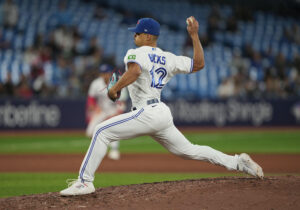
The primary concerns with Hicks are his control and injury history. He has never thrown strikes at a league average rate, walking over 10% of opponents in every season (including an 11.2% clip last year). While Hicks turned in a fully healthy platform year with the Cardinals and Blue Jays in 2023, he missed significant time between 2019-22. Much of that was a result of Tommy John surgery in June 2019. He lost a good portion of the ’21 campaign to continued elbow inflammation, while a flexor strain in his forearm cost him a chunk of the ’22 season.
Stephenson, who turns 31 in February, hasn’t had the same level of alarming arm issues. His career performance track record is spottier, though, as he has allowed 4.64 earned runs per nine over 364 1/3 frames. Some of that is a reflection of pitching in hitter-friendly parks in Cincinnati and Colorado, but Stephenson also posted unspectacular results in 28 1/3 innings with the Pirates.
As recently as last summer, he seemed a fairly nondescript pitcher. He’d been a highly-regarded prospect and showed intriguing stuff without much success at the MLB level. Things turned following an early June trade to the Rays.
In 38 1/3 frames with Tampa Bay, Stephenson posted a 2.35 ERA while striking out 42.9% of opponents. He missed bats on an astounding 28.7% of his offerings. That was not only the highest rate in MLB over that stretch, it was nearly eight percentage points above second-place Félix Bautista. Over the season’s final four months, he was handily the most dominant reliever in the majors on a pitch-for-pitch basis.
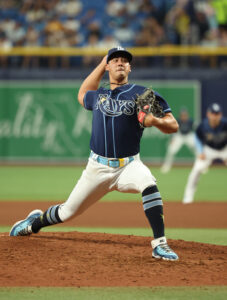
Stephenson doesn’t have the triple-digit velocity of Hicks. Averaging 97 MPH on the heater is more than sufficient, though. He introduced an upper-80s cutter in Tampa Bay, against which hitters made contact on only 40% of their swings. Stephenson has the decided edge in swing-and-miss potential. The question is how much of his dominant four months in Tampa Bay is replicable. He’s unlikely to continue missing bats at that exceptional clip — no pitcher should be expected to maintain that kind of pace — but he’s markedly better than the hurler who owned a career 4.91 ERA and 24.3% strikeout rate before the trade.
There has been some overlap in the Hicks and Stephenson markets. That’s sensible considering they’re probably the top remaining options for teams that don’t want to meet Hader’s asking price. The Rangers, Yankees, Astros, Angels and Orioles are among the clubs linked to both pitchers this winter (although Baltimore subsequently signed Craig Kimbrel). The Red Sox and Cardinals have been tied to Hicks, while the Cubs and Dodgers were linked to Stephenson early in the offseason.
Which one should teams prioritize? Lean in favor of Hicks’ youth and velocity or Stephenson’s bat-missing potential?
Who Should Land The Bigger Contract?
-
Jordan Hicks 74% (2,743)
-
Robert Stephenson 26% (988)
Total votes: 3,731
Images courtesy of USA Today Sports.
Reds Re-Sign Buck Farmer, Designate Bubba Thompson
The Reds announced they’ve signed reliever Buck Farmer to a one-year deal. Outfielder Bubba Thompson was designated for assignment to clear a spot on the 40-man roster. Farmer, an Excel Sports Management client, is guaranteed $2.25MM, reports Mark Sheldon of MLB.com (on X). Ari Alexander of KPRC2 adds that the deal includes incentives that could take the total to $2.6MM.
It’s the third straight season in which Farmer will work in Cincinnati’s middle relief group. The 32-year-old (33 in February) was a durable middle innings option for skipper David Bell last season. He made 71 appearances, which tied for 12th in MLB, and logged 75 frames. His results were around league average.
Farmer allowed 4.20 earned runs per nine. He struck out 22.7% of batters faced while walking 9.4% of his opponents. His 13.3% swinging strike rate was the highest of his 10-year big league run, although it didn’t translate into many strikeouts. Last season’s strikeout percentage was down from the 27.1% mark he posted in 2022. Farmer’s home run rate also ticked up.
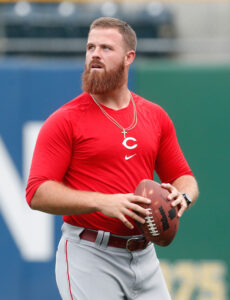
That said, he has generally been a solid bullpen option since joining the Reds on a minor league contract in 2022. He owns a 4.06 ERA in 122 innings with Cincinnati. Bell has generally deployed Farmer in medium-leverage situations with decent results, even if his production tailed off in the second half of 2023.
Farmer earns a slight raise relative to his $1.75MM salary from his final arbitration season. He steps into a relief group that’ll also include Lucas Sims, Sam Moll, Tejay Antone, Alex Young and free agent acquisition Emilio Pagán to bridge the gap to closer Alexis Díaz. Righty Ian Gibaut is out of options, which gives him a good chance to secure an Opening Day job. The Reds could look for another high-leverage arm as they enter the 2024 season with legitimate postseason aspirations.
Tacking on $2.25MM brings their payroll commitments to roughly $88MM, as calculated by Roster Resource. That’s a few million dollars north of last year’s approximate $83MM mark. It’s still well below the $115-120MM range of the preceding two seasons, so Cincinnati should have the ability to bring in another acquisition or two as they look to round out the roster. Rotation depth seems the primary concern and the team could look for a right-handed platoon bat in the outfield.
Cincinnati claimed Thompson off waivers from the Royals earlier this offseason. The 25-year-old outfielder had spent his entire Kansas City tenure in Triple-A. His MLB experience consists of 92 games for the Rangers over the past two seasons. He’s a .242/.286/.305 hitter over that stretch, striking out nearly 30% of the time.
Thompson hasn’t produced much at the plate in the minors either. He hit .259/.339/.395 over 302 Triple-A plate appearances a season ago, well below-average production given the hitter-friendly nature of the top minor league level. Strikeouts have been an issue throughout his career. Thompson has top-of-the-scale speed and the ability to play all three outfield spots, however, so he could be of interest on the waiver wire. Teams typically have seven days to trade players or run them through waivers following a DFA, but that clock is paused this week for the holidays.
Image courtesy of USA Today Sports.
Tigers Hire Dylan Axelrod As Pitching Coordinator
The Tigers have hired Dylan Axelrod to the organization, per a report from Tigers Torkmoil on X. Axelrod will have the title of pitching performance and integration coordinator.
Axelrod, now 38, pitched in the majors for the White Sox and Reds from 2011 to 2015. For the last four years, he was working for the Angels as pitching coordinator. Last month, Sam Blum of The Athletic reported that Troy Percival had been invited to visit the club’s minor league instructional camp and expressed displeasure with how much the pitchers were using iPads. Blum adds that Percival’s opinions “played at least a factor” in Axelrod and Buddy Carlyle getting fired. Last month, Eno Sarris of The Athletic reported that Carlyle had landed a new gig with the Rays. Within the piece from Blum, pitchers like Reid Detmers and Chase Silseth spoke positively about working with Axelrod.
With the Tigers, Axelrod will be working with a pitching staff that has some uncertainty on it. Former first-rounders Casey Mize and Matt Manning are still looking to reach their potential after some injuries and middling results. Younger pitchers like Reese Olson, Sawyer Gipson-Long and Wilmer Flores will be looking to take steps forward. Jack Flaherty will be looking for a bounceback season after signing a one-year deal.
The Opener: Imanaga, White Sox, Blue Jays
Here are three things we’re keeping an eye on throughout baseball today…
1. Two weeks left for Imanaga:
Left-hander Shota Imanaga‘s posting window is open until January 11, meaning there’s now just two weeks left for him to arrange a deal with an MLB club. If no deal is reached by then, he will return to the Yokohama BayStars of Nippon Professional Baseball, but all indications point to his market being robust. He has a 3.18 earned run average in his eight NPB seasons and is coming off a 2023 season that saw him finish with a 2.80 ERA and 29.2% strikeout rate. MLBTR predicted he could secure a five-year, $85MM deal but there have been reports of his market pushing to the $100MM range. The signing team would owe the BayStars a posting fee on top of the money they guarantee to Imanaga.
2. White Sox need roster spot for Maldy:
The White Sox agreed to a deal with catcher Martín Maldonado earlier this week. They currently have a full 40-man roster and will need to make some kind of move in order to open a spot before making the Maldy signing official. Perhaps the club will look to make some kind of trade in the coming days or simply designate someone for assignment.
3. What’s next for the Jays?
The Blue Jays have been connected to a lot of big names this winter, including Shohei Ohtani, Juan Soto and Yoshinobu Yamamoto. Once those players landed elsewhere, the Jays pivoted to smaller moves, recently agreeing to terms with Kevin Kiermaier and Isiah Kiner-Falefa. There’s still time for a bigger splash, with players like Cody Bellinger and Matt Chapman available in free agency. The Kiner-Falefa deal could also be a precursor to a trade, as he now joins a crowded group of depth or part-time players on the roster. With Bo Bichette and Vladimir Guerrero Jr. lined up at shortstop and first base respectively, candidates for the third base and second base positions include Kiner-Falefa, Cavan Biggio, Santiago Espinal, Davis Schneider, Ernie Clement, Otto López, Orelvis Martinez, Addison Barger and Leo Jimenez.
Reds, Brett Kennedy Agree To Minor League Deal
Right-hander Brett Kennedy has returned to the Reds on a minor league contract, according to the transaction tracker at MLB.com. He had elected free agency within a few days of the end of the regular season.
Kennedy, 29, made five big league appearances for Cincinnati last season. He started two of those games, tossing 18 innings of 13-run ball. It was the Fordham product’s first MLB work in five years. His only previous major league experience consisted of six starts for the 2018 Padres.
A former 11th round draftee, Kennedy first signed with the Reds out of independent ball last May. He spent the bulk of the season at Triple-A Louisville. Working out of the rotation, he pitched to a 4.81 ERA through 78 2/3 innings. Kennedy’s 20.8% strikeout rate and 9% walk percentage were each slightly worse than average.
It’d be a surprise if Kennedy is in the mix for an Opening Day roster spot. He showed enough that the organization decided to keep him around as rotation or long relief depth, however. He’ll likely begin the year in Louisville. If the Reds select Kennedy onto the 40-man roster at any point, he can still be optioned to Triple-A for another two seasons.
Twins Sign Josh Staumont
8:51pm: Jon Becker of Roster Resource reports (on X) that Staumont is guaranteed $950K. The deal also contains undisclosed incentives, per Darren Wolfson of SKOR North (X link).
12:04pm: The Twins announced that right-hander Josh Staumont has been signed to a one-year deal, and the Athletic’s Dan Hayes (X link) reports that Staumont will earn slightly less than $1MM. Staumont was projected to earn a $1.7MM arbitration salary this winter, but the Royals designated him for assignment in November and he elected free agency rather than an accept an outright assignment. Staumont is represented by Excel Sports Management.
The righty dominated Twins hitters to the tune of an 0.90 ERA over 20 career innings against Minnesota, so the Twins have seen plenty of Staumont over his five seasons in Kansas City. The results were pretty good overall for Staumont in his first three seasons, as he posted a 2.93 ERA and 26.7% strikeout over 110 2/3 relief innings from 2019-21. However, a 4.07 SIERA, .268 BABIP, and an 11.4% walk rate in that same stretch hinted that some regression was coming, and Staumont’s luck turned over the last two seasons.
Staumont has a 6.09 ERA over 57 2/3 innings since Opening Day 2023, with an ungainly 15.9% walk rate contributing to his issues. Injuries played a role in both tough seasons, yet Staumont’s chief concern is now getting healthy after a thoracic outlet syndrome surgery last July. The exact nature of Staumont’s TOS procedure isn’t known, and given how the treatment is still relatively new, there isn’t yet a lengthy track record of pitchers who returned from TOS surgeries to pitch effectively at the big league level.
Minnesota obviously felt good enough about Staumont’s recovery to give him a big league contract, and it could be a long-term play since Staumont is arbitration-controlled through the 2025 season. If Staumont is able to recover and get back to his early-career form, he could be a very nice low-cost add for the Twins bullpen (and from an AL Central rival, no less). The deal is also a nice late birthday present for Staumont, who just turned 30 last week.
The Twins haven’t done much beyond a few minor league signings this offseason, as the club may still be figuring how to balance both payroll cuts and a sturdy defense of its AL Central title. A low-cost and low-risk signing like Staumont may not be a huge factor in Minnesota’s spending plans since adding inexpensive and potentially high-upside relief pitching is standard business for any team, yet naturally these are the types of deals that can pay particularly big dividends for lower-payroll teams.
This Date In Transaction History: Blake Snell Trade
Today marks three years since the blockbuster that sent a former (and future) Cy Young winner across leagues. The Rays dealt Blake Snell to the Padres in the late evening of December 27, 2020, bringing back a four-player prospect package. Luis Patiño headlined the return, which also included Blake Hunt, former top prospect Francisco Mejía and 2020 third-round draftee Cole Wilcox.
The deal came as something of a surprise, as the Rays weren’t under huge financial pressure to move Snell. Despite the controversy surrounding Kevin Cash’s decision to lift Snell in Game 6 of that year’s Fall Classic, Tampa Bay could’ve held the southpaw into the following season. Snell was under contract for respective salaries of $10.5MM, $12.5MM and $16MM covering the 2021-23 campaigns.
Nevertheless, the Tampa Bay front office felt the prospect return was too strong to pass up. Patiño was viewed as one of the sport’s most talented pitching prospects despite struggling in a brief MLB debut that season. Hunt was a borderline Top 100 minor leaguer at the time. Mejía’s stock had fallen from its peak as he struggled against big league pitching, but he was only entering his age-25 season and had less than three years of MLB service. Wilcox was viewed by many evaluators as a first-round talent that year, only dropping to the third because of a lofty bonus demand.
The deal didn’t pan out at all as the Rays had envisioned. While Snell has had a volatile career, he recaptured the ace-caliber upside he’d shown in Tampa Bay. After turning in a 4.20 ERA over 27 starts during his first year with the Friars, he rebounded to post a 3.38 mark in 2022. The cumulative 3.79 ERA he managed across 256 2/3 innings was solid, although it didn’t hint at the Cy Young level he’d reach in 2023.
Snell didn’t start the ’23 campaign well. He owned a 5.48 ERA with a strikeout rate just under 24% through the first month. After a slight uptick in strikeouts and a 3.82 mark in May, Snell kicked off a four-month stretch as the most dominant pitcher on the planet. From June 1 on, he struck out 35% of batters faced and allowed 1.23 earned runs per nine. His 1.54 ERA after the All-Star Break is the 12th-lowest second half rate since 2000 (minimum 75 innings).

The dominating finish led Snell to cruise to a second career Cy Young. He was a near-unanimous choice as the NL’s top pitcher after posting an MLB-best 2.25 ERA through 180 innings. Snell hit free agency and seems unlikely to return to a San Diego organization that has cut spending. Assuming he signs elsewhere in the coming weeks, he concludes his time as a Padre with a 3.15 ERA while striking out 31.5% of opponents in 436 2/3 frames.
As a team, San Diego didn’t have the kind of success they envisioned. They reached the postseason just once in the last three years. A second-half collapse cost them a playoff berth in 2021. They rebounded with a trip to the NLCS in ’22 but finished 82-80 last season. A strong final couple weeks ostensibly brought them within a couple games of a playoff spot, but the 2023 club was more or less finished by the end of August.
One can debate whether the Friars should’ve more aggressively marketed Snell, Juan Soto and Josh Hader at the deadline. A fringe contender at the time, they elected to add around the margins rather than move their top impending free agents or Soto (whose arbitration price tag they knew was rising). As a team that exceeded the luxury tax threshold, they’ll only receive picks after the fourth round as compensation for losing Snell and Hader, each of whom rejected a qualifying offer.
San Diego’s subsequent decisions don’t negate how well they fared in the Snell trade, however. That turned out to be one of the more lopsided deals of the past few seasons. No one in the return found much success in Tampa Bay. Three of the four are out of the organization entirely.
Patiño saw MLB action in each season from 2021-23. He logged 101 1/3 innings as a Ray, turning in a 5.24 ERA. Patiño’s control hasn’t developed as expected and he has struggled with home runs throughout his MLB tenure. The Rays moved on at the deadline, sending him to the White Sox for cash. He ended up back in San Diego last week; the Friars claimed him when Chicago put him on waivers. He’s out of options, so he’ll either need to open the season on the MLB roster or be made available to other teams yet again.
Neither of the other prospects involved have reached the majors. Hunt has slowly climbed the minor league ladder, hitting at a roughly league average level at each stop. The Rays didn’t want to carry him on the 40-man roster, yet Hunt was eligible for minor league free agency after this season. Tampa Bay dealt him to the Mariners (who did add him to the 40-man) for 2022 eighth-round pick Tatem Levins last month. Wilcox remains in the organization but underwent Tommy John surgery late in the ’21 season. He returned to post a 5.23 ERA in 25 starts at Double-A this year. He went unselected in the Rule 5 draft a few weeks ago.
Mejía, arguably the fourth piece of the return at the time, had the most success for Tampa Bay. The switch-hitting catcher had a .260/.322/.414 batting line in 84 games in 2021. His offense cratered over the last two years, though, as he hit .237/.262/.387 in 459 plate appearances over that stretch. The Rays designated him for assignment in August. He reached free agency at year’s end and signed a minor league deal with the Angels last week.
Image courtesy of USA Today Sports.
Dodgers Designate Bryan Hudson For Assignment
The Dodgers announced that left-hander Bryan Hudson has been designated for assignment. The move opens up roster space for Yoshinobu Yamamoto, whose 12-year, $325MM deal with Los Angeles was made official this afternoon.
Hudson made his Major League debut this season, appearing in six games for L.A. and posting a 7.27 ERA over 8 2/3 innings of relief work. It was a big milestone in Hudson’s eight-year pro career, which began when he was a third-round pick for the Cubs in the 2015 draft. The 6’8″ Hudson pitched in Chicago’s organization until last winter, when he joined the Dodgers on a minor league contract.
The 26-year-old is a grounder specialist, regularly posting groundball rates north of 50% during his time in the minors. However, Hudson’s groundball rates have dropped to around 46.5% at the Triple-A level over the last two seasons, as he has added a lot more strikeout ability to his arsenal. After posting mostly uninspiring strikeout totals for much of his career, Hudson jumped to a 28.4% strikeout rate with Chicago’s Triple-A club in 2022, and then an even more impressive 35.7K% in 55 2/3 frame with Triple-A Oklahoma City last season.
While his 10.92% career walk rate indicates some wildness in Hudson’s game, his ability to rather drastically increase his ability to miss bats is a positive development, particularly since he is still able to generate grounders at an above-average rate. This skillset isn’t unlikely to go unnoticed on the waiver wire, so there’s a decent chance a bullpen-needy makes a claim on Hudson while he is in DFA limbo.